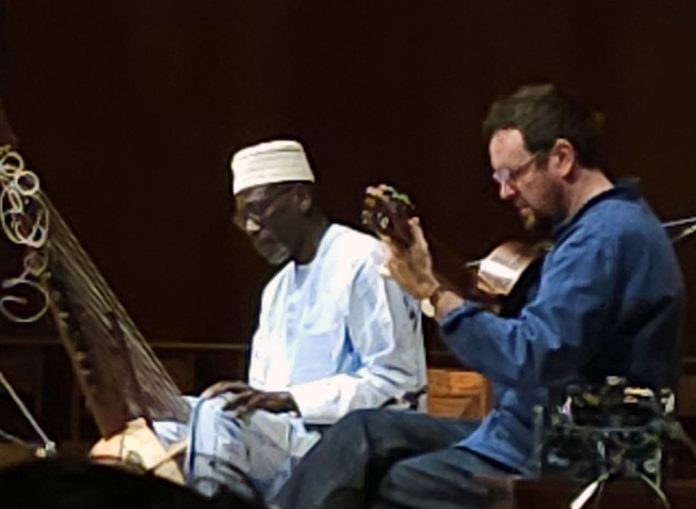
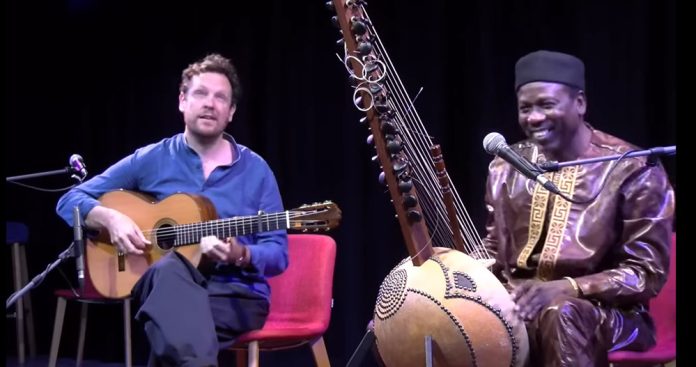
Derek Gripper and Ballaké Sissoko performed to a capcity crowd of over 800 St. Olaf Catholic Church in Minneapolis on Jan. 31, 2026. Photo: Susan Budig/Mshale
Derek Gripper and Ballaké Sissoko performed to a capcity crowd of over 800 St. Olaf Catholic Church in Minneapolis on Jan. 31, 2026. Photo: Susan Budig/Mshale
“We’ve been to New York, LA, and Chicago. People ask me, ‘How’s America?’ And I say, I don’t know. We haven’t been to Minneapolis, yet,” said Derek Gripper classical guitarist from South Africa as he opened their show on January 31st from the sanctuary of St. Olaf Catholic Church in Minneapolis, Minnesota.
His acknowledgment of the unprecedented actions of ICE and Border Patrol in Minnesota set the tone that both he and his musical partner, Ballaké Sissoko, Malian griot, were tuned into the current events of our city and country.
The church nave was filled almost to capacity with over 800 in attendance. Derek Gripper had told Mshale earlier in an interview that the pair only ever played together during sound-checks at a venue and then while on stage for a performance. Each time they perform, the sound is new and unique. As each musician took their seat, we prepared for an anticipated unorthodox sound.
As I looked at them playing together, Ballaké dressed in white wearing a tunic, lounge pants, and fez, glittering sparkles shimmered in the light from his trousers. Derek wore a more Western look in denim jeans and blue shirt.
They sat about four or five feet apart, not on top of one another, but close enough that the sound from their instruments—kora and guitar—could weave together as it slid off the strings. The physical space was acoustically energetic, bouncing with their music, which was absorbed by the ears and bodies of the audience.
A perfect visual came to mind. I envisioned the pair producing a murmuration with their notes. How the body of sound projected in one direction and then an invisible hand pointed a section of notes on a new bearing and mysteriously all of the notes suddenly now followed this altered course.
It was not like the gradual flux and rhythm of an ocean’s tide. The duo’s sound changed with a decisive, but not jarring movement, one section shifted and then the rest followed suit. It was as if Derek and Ballaké could read one another’s minds.
Since music is their only common language, neither fluent in one another’s spoken language, perhaps there was some mind-reading going on. It also occurred to me how cool it would be to have a screen behind them, tapped into their brains so we could have an artist’s roadmap of where their songs were headed.
There was almost no chatter between numbers. Song titles weren’t prefaced before the pair started to play their next number. The pattern tended to be that Ballaké plucked some notes on his kora and Derek answered with his guitar either echoing or contrasting what had already been presented. Then the pair fell into synchronicity for the next several minutes until they concluded their song.
My ear is not skilled enough to differentiate between when the kora is leading the song or the guitar has taken the lead. Although yes, I can certainly hear and identify when a kora or a guitar is played, when Gripper and Sissoko are playing, their notes swirl in such a fashion that I can no longer separate which plucked string belongs to which instrument.
Derek was more physically engaged in the music. His head bobbed and swayed, he rocked back and forth, his left knee jigging up and down in rapid, rhythmic staccato. Ballaké sat with more reserve, showing his engagement through his shoulders and neck, eskista-like, intermittently vocalizing a throaty “Yeah!”
Wrapping up a song was also mysterious. It was as if we were being led blindfolded into a dream. There wasn’t a chorus or repetition, no words or bookends. There might be a bit of call and response, a set-up and resolution, but without predictability. It was as if the audience decided the song was finished. The musicians slowed their playing, softening and easing back without fully stopping. If the spectators started to clap, the song concluded and the applause increased.
At one point, Derek exited and Ballaké soloed on his kora. I loved what he played. It ended much too soon. Then Derek returned and played some Bach on his guitar. I liked Derek’s solo as well. Individually, their music fits into a container with which I am familiar. When they play together, it’s outside of my understanding and harder for me to fully appreciate, but at the same time, left me in awe.
When they played in tandem, it was trance-inducing. But one needed to stay present to hear what they were playing. It was easy to lose focus and relax into their sound, floating away on the music.
As the show came to an end, Derek conversed with us more, conveying how the current political climate in the US compared, for him, with the dismantling of apartheid when he was a boy and teen in Cape Town. He said, what’s interesting is that all those politicians who supported apartheid suddenly disappeared once apartheid was demolished. He intimated that the same would happen here.
With that, their 90-minute show ended and we forced ourselves back into reality.
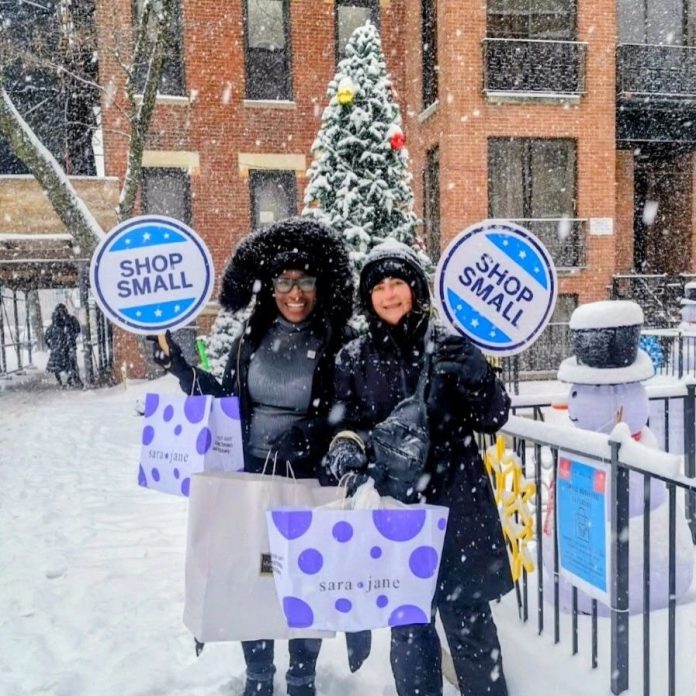
A photo on the SBA Facebook page promotes Small Business Saturday in Old Town Chicago. Effective March 1, 2026, business owners that are green card holders will no longer be eligible for SBA loans. Photo: Courtesy SBA
A photo on the SBA Facebook page promotes Small Business Saturday in Old Town Chicago. Effective March 1, 2026, business owners that are green card holders will no longer be eligible for SBA loans. Photo: Courtesy SBA
By Mae Anderson
NEW YORK (AP) — The Small Business Administration said in a policy note that green card holders won’t be allowed to apply for SBA loans, effective March 1.
The move is the latest by the SBA as it works to tighten loan restrictions and restructure the agency.
Last year, it tightened a requirement that businesses applying for loans must be 100% owned by U.S. citizens, U.S. nationals, or lawful permanent residents, up from a 51% standard.
In December, it issued a policy note that said up to 5% of a business could be non-citizen owned. But the current policy rescinds that, as well as making lawful permanent residents ineligible, too.
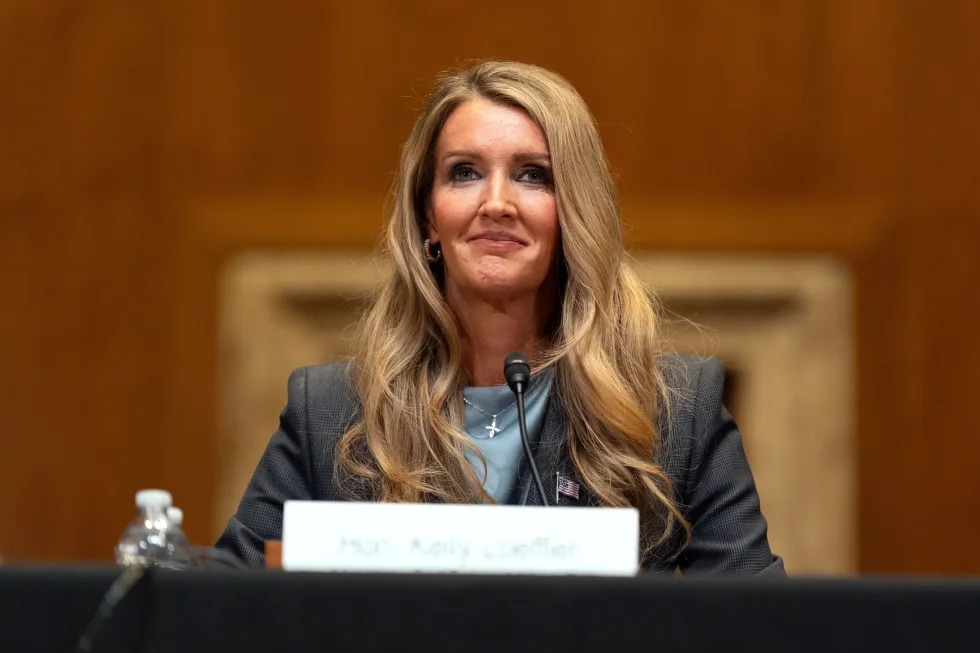
Small Business Administration administrator Kelly Loeffler listens during a hearing of the Senate Committee on Capitol Hill, May 21, 2025, in Washington. Photo: Mark Schiefelbein/AP
“The Trump SBA is committed to driving economic growth and job creation for American citizens – which is why, effective March 1, the agency will no longer guarantee loans for small businesses owned by foreign nationals,” said SBA spokesperson Maggie Clemmons in an emailed statement. “Across every program, the SBA is ensuring that every taxpayer dollar entrusted to this agency goes to support U.S. job creators and innovators.”
The SBA doesn’t give out direct loans, except when they’re related to disasters, but it works with lenders to distribute loans to small businesses. The loans typically have better rates than traditional loans.
Small business advocacy group the Small Business Majority said the move is “a decision that will limit the growth of small businesses and jobs throughout the United States.”
“The latest decision by SBA fails to recognize that immigrants are twice as likely to start a business as native-born U.S. citizens,” said Small Business Majority CEO John Arensmeyer. “Given that reality, SBA’s severe restrictions will have a negative impact on small business creation throughout this country for years to come.”
68th GRAMMYs Recap: Kendrick Lamar wins most awards, Bad Bunny wins Album of the Year
Bad Bunny won album of the year at the 68th annual Grammy Awards on Sunday night for DeBÍ TiRAR MáS FOToS. During the evening, Bad Bunny, aka Benito Antonio Martínez Ocasio, was among the artists that took stands against the U.S. Immigration Customs and Enforcement (ICE) presence in many American cities.
“Before I say thanks to God, I’m gonna say: ICE out,” Bad Bunny said to great applause while accepting the award for best música urbana album. “We’re not savage, we’re not animals, we’re not aliens. We are humans and we are Americans.”
More Political Statements
Political messaging took center stage at the Grammys, as multiple high-profile artists used the platform to express unity and protest. Billie Eilish, her brother Finneas, and music legend Carole King were seen wearing white pins stamped with the bold message “ICE OUT” during their appearances onstage. The statement extended beyond the usual activists, as Justin and Hailey Bieber—who generally steer clear of overt political expression in U.S. affairs—also chose to wear the pins.
The message was further amplified when Eilish addressed the audience during her Song of the Year acceptance speech, opening with the pointed remark, “no one is illegal on stolen land,” underscoring the broader sentiment behind the symbolic display.
King Kendrick Reigns
Kendrick Lamar made history at the 2026 Grammy Awards, surpassing Jay-Z’s record to become the rapper with the most career Grammy wins. Lamar secured a total of five awards on Sunday night.
His wins included Record of the Year for “Luther” (featuring SZA) and Best Rap Album for GNX. The pre-telecast saw him claim three initial awards: Best Rap Song for “TV Off,” Best Melodic Rap Performance for “Luther” (with SZA), and Best Rap Performance for “Chains & Whips” (where he was a featured performer).
Lamar’s historic fourth win, for Best Rap Album, officially broke Jay-Z’s long-standing record. He solidified his new position with his fifth win of the night for Record of the Year. Among those who picked up two awards each during the pre-telecast: Kehlani, the Cure, Turnstile, Leon Thomas, Mavis Staples, I’m With Her, Gustavo Dudamel, Amy Allen and Ludwig Göransson (for his work on the “Sinners” soundtrack and score).
Lauryn Hill led powerful tributes
Lauryn Hill closed out the night by spearheading two powerful tribute segments dedicated to D’Angelo and Roberta Flack. The homage to D’Angelo unfolded as an expansive musical celebration, featuring performances of his iconic tracks such as “Nothing Even Matters,” “Brown Sugar,” “Lady,” “Devil’s Pie,” “Another Life,” “Untitled (How Does It Feel),” and “Africa.” The segment brought together an impressive lineup of artists, including Lucky Daye, Raphael Saadiq, Anthony Hamilton, Leon Thomas, Bilal, and Jon Batiste. D’Angelo, a four-time Grammy Award recipient whose influence reshaped modern R&B and neo-soul, passed away from pancreatic cancer in October at just 51 years old.
The tribute to Roberta Flack was presented as a sweeping medley honoring her timeless legacy. It included emotionally rich renditions of “The First Time Ever I Saw Your Face,” performed alongside Jon Batiste, and “Compared to What,” featuring Leon Bridges and Alexia Jayy. Additional highlights included “The Closer I Get to You” with Lalah Hathaway and October London, as well as “Where Is the Love,” joined by John Legend and Chaka Khan. The tribute culminated in a show-stopping Fugees reunion, as Hill reunited with Wyclef Jean for a stirring performance of “Killing Me Softly with His Song,” the track that helped define their career through its iconic sample. Flack, a revered singer-pianist and five-time Grammy winner, passed away on February 24, 2025, at the age of 88, leaving behind a legacy that was formally recognized with a Lifetime Achievement Award in 2020.
Topping the list of nominees for the 68th GRAMMY Awards® were Kendrick Lamar (9), Cirkut (7), Jack Antonoff (7), Lady Gaga (7), Bad Bunny (6), Leon Thomas (6), Sabrina Carpenter (6), Serban Ghenea (6), Andrew Watt (5), Clipse (5), Doechii (5), Sounwave (5), SZA (5), Turnstile (5), and Tyler, The Creator (5).
A full list of this year’s Grammy winners follows. The winners are in bold.
Record of The Year
“DtMF” – Bad Bunny
“Manchild” – Sabrina Carpenter
“Anxiety” – Doechii
“WILDFLOWER” – Billie Eilish
“Abracadabra” – Lady Gaga “luther” – Kendrick Lamar With SZA (WINNER) “The Subway” – Chappell Roan
“APT.” – ROSÉ, Bruno Mars
Album of The Year
DeBÍ TiRAR MáS FOToS — Bad Bunny (WINNER) SWAG — Justin Bieber Man’s Best Friend — Sabrina Carpenter Let God Sort Em Out — Clipse, Pusha T & Malice MAYHEM — Lady Gaga GNX — Kendrick Lamar MUTT — Leon Thomas CHROMAKOPIA — Tyler, The Creator
Song of the Year
“Abracadabra” – Lady Gaga, Henry Walter & Andrew Watt, songwriters (Lady Gaga)
“Anxiety” – Jaylah Hickmon, songwriter (Doechii)
“APT.” – Amy Allen, Christopher Brody Brown, Rogét Chahayed, Omer Fedi, Philip Lawrence, Bruno Mars,
Chae Young Park, Theron Thomas & Henry Walter, songwriters (ROSÉ, Bruno Mars)
“DtMF” – Marco Daniel Borrero, Scott Dittrich, Benjamin Falik, Benito Antonio Martínez Ocasio, Hugo René Sención Sanabria, Tyler Thomas Spry & Roberto José Rosado Torres, songwriters (Bad Bunny)
“Golden [From “KPop Demon Hunters”]” – EJAE & Mark Sonnenblick, songwriters (HUNTR/X: EJAE, Audrey Nuna, REI AMI)
“luther” – Jack Antonoff, Roshwita Larisha Bacha, Matthew Bernard, Scott Bridgeway, Sam Dew, Ink, Kendrick Lamar, Solána Rowe, Mark Anthony Spears & Kamasi Washington, songwriters (Kendrick Lamar With SZA)
“Manchild” – Amy Allen, Jack Antonoff & Sabrina Carpenter, songwriters (Sabrina Carpenter) “WILDFLOWER” – Billie Eilish O’Connell & Finneas O’Connell, songwriters (Billie Eilish)(WINNER)
Best New Artist
Olivia Dean (WINNER) KATSEYE
The Marias
Addison Rae
sombr
Leon Thomas
Alex Warren
Lola Young
Producer of the Year, Non-Classical
Dan Auerbach Cirkut (WINNER) Dijon
Blake Mills
Sounwave
Songwriter of The Year, Non-Classical
Amy Allen (WINNER) Edgar Barrera
Jessie Jo Dillon
Tobias Jesso Jr
Laura Veltz
Best Pop Solo Performance
“DAISIES” — Justin Bieber
“Manchild” — Sabrina Carpenter
“Disease” — Lady Gaga
“The Subway” — Chappell Roan “Messy” — Lola Young (WINNER)
Best Pop Duo/Group Performance
“Defying Gravity” — Cynthia Erivo & Ariana Grande (WINNER) “Golden” (from KPop Demon Hunters) — HUNTR/X: EJAE, Audrey Nuna, REI AMI
“Gabriela” — KATSEYE
“APT” — ROSÉ, Bruno Mars
“30 For 30” — SZA Featuring Kendrick Lamar
Best Pop Vocal Album
SWAG — Justin Bieber Man’s Best Friend — Sabrina Carpenter Something Beautiful — Miley Cyrus MAYHEM — Lady Gaga (WINNERS) I’ve Tried Everything But Therapy — Part 2 — Teddy Swims
Best Dance/Electronic Recording
“No Cap” — Disclosure & Anderson .Paak
“Victory Lap” — Fred again.., Skepta, & PlaqueBoyMax
“SPACE INVADER” — KAYTRANADA
“VOLTAGE” — Skrillex “End Of Summer” — Tame Impala (WINNER)
Best Dance Pop Recording
“Bluest Flame” — Selena Gomez & benny blanco “Abracadabra” — Lady Gaga (WINNER) “Midnight Sun” — Zara Larsson
“Just Keep Watching” (from F1 The Movie) — Tate McRae
“Illegal” — PinkPantheress
Best Dance/Electronic Album
EUSEXUA — FKA twigs (WINNER) Ten Days — Fred again.. Fancy That — PinkPantheress Inhale / Exhale — RÜFÜS DU SOL F— U SKRILLEX YOU THINK UR ANDY WARHOL BUT UR NOT!! <3 — Skrillex
Best Remixed Recording
“Abracadabra – Gesaffelstein Remix” — Gesaffelstein, remixer (Lady Gaga, Gesaffelstein) (WINNER) “Don’t Forget About Us” — KAYTRANADA, remixer (Mariah Carey & KAYTRANADA)
“A Dreams A Dream – Ron Trent Remix” — Ron Trent, remixer (Soul II Soul)
“Galvanize” — Chris Lake, remixer (The Chemical Brothers & Chris Lake)
“Golden – David Guetta REM/X” — David Guetta, remixer (HUNTR/X: EJAE, Audrey Nuna, REI AMI)
Best Rock Performance
“U Should Not Be Doing That” — Amyl and The Sniffers
“The Emptiness Machine” — Linkin Park
“NEVER ENOUGH” — Turnstile
“Mirtazapine” — Hayley Williams “Changes (Live From Villa Park) Back To The Beginning” — YUNGBLUD Featuring Nuno Bettencourt, Frank Bello, Adam Wakeman, II (WINNER)
“As Alive As You Need Me To Be” — Trent Reznor & Atticus Ross, songwriters (Nine Inch Nails) (WINNERS) “Caramel” — Vessel & II, songwriters (Sleep Token)
“Glum” — Daniel James & Hayley Williams, songwriters (Hayley Williams)
“NEVER ENOUGH” — Daniel Fang, Franz Lyons, Pat McCrory, Meg Mills & Brendan Yates, songwriters (Turnstile)
“Zombie” — Dominic Harrison & Matt Schwartz, songwriters (YUNGBLUD)
Best Rock Album
private music — Deftones I quit — HAIM From Zero — Linkin Park NEVER ENOUGH — Turnstile (WINNER) Idols — YUNGBLUD
Best Alternative Music Performance
“Everything Is Peaceful Love” — Bon Iver “Alone” — The Cure (WINNER) “SEEIN’ STARS” — Turnstile
“mangetout” — Wet Leg
“Parachute” — Hayley Williams
Best Alternative Music Album
SABLE, fABLE — Bon Iver Songs Of A Lost World — The Cure (WINNER) DON’T TAP THE GLASS — Tyler, The Creator moisturizer — Wet Leg Ego Death At A Bachelorette Party — Hayley Williams
Best R&B Performance
“YUKON” — Justin Bieber
“It Depends” — Chris Brown Featuring Bryson Tiller “Folded” — Kehlani (WINNER) “MUTT — Live From NPR’s Tiny Desk” — Leon Thomas
“Heart Of A Woman” — Summer Walker
Best Traditional R&B Performance
“Here We Are” — Durand Bernarr
“UPTOWN” — Lalah Hathaway
“LOVE YOU TOO” — Ledisi
“Crybaby” — SZA “VIBES DON’T LIE” — Leon Thomas (WINNER)
Best R&B Song
“Folded” — Darius Dixson, Andre Harris, Donovan Knight, Don Mills, Kehlani Parrish, Khris Riddick-Tynes & Dawit Kamal Wilson, songwriters (Kehlani) (WINNER)
“Heart Of A Woman” — David Bishop & Summer Walker, songwriters (Summer Walker)
“It Depends” — Nico Baran, Chris Brown, Ant Clemons, Ephrem Lopez Jr., Ryan Press, Bryson Tiller, Elliott Trent & Dewain Whitmore Jr., songwriters (Chris Brown Featuring Bryson Tiller)
“Overqualified” — James John Abrahart Jr, Durand Bernarr, John Derisme, Egberto “Budda” Foster, Amaire Johnson, Frank Moka, Cary Singer & Chase Worrell songwriters (Durand Bernarr)
“YES IT IS” — Jariuce Banks, Lazaro Andres Camejo, Mike Hector, Peter Lee Johnson, Rodney Jones Jr., Ali Prawl & Leon Thomas, songwriters (Leon Thomas)
Best Progressive R&B Album
BLOOM — Durand Bernarr (WINNER) Adjust Brightness — Bilal LOVE ON DIGITAL — Destin Conrad Access All Areas — FLO Come As You Are — Terrace Martin & Kenyon Dixon
Best R&B Album
BELOVED — GIVĒON Why Not More — Coco Jones The Crown — Ledisi Escape Room — Teyana Taylor MUTT — Leon Thomas (WINNER)
Best Rap Performance
“Outside” — Cardi B “Chains & Whips” — Clipse, Pusha T & Malice Featuring Kendrick Lamar & Pharrell Williams (WINNER) “Anxiety” — Doechii
“tv off” — Kendrick Lamar Featuring Lefty Gunplay
“Darling, I” — Tyler, The Creator Featuring Teezo Touchdown
Best Melodic Rap Performance
“Proud Of Me” — Fridayy Featuring Meek Mill
“Wholeheartedly” — JID Featuring Ty Dolla $ign & 6Lack “luther” — Kendrick Lamar With SZA (WINNER) “WeMaj” — Terrace Martin & Kenyon Dixon Featuring Rapsody
“SOMEBODY LOVES ME” — PARTYNEXTDOOR & Drake
Best Rap Song
“Anxiety” — Jaylah Hickmon, songwriter (Doechii)
“The Birds Don’t Sing” — Gene Elliott Thornton Jr., Terrence Thornton, Pharrell Williams & Stevie Wonder, songwriters (Clipse, Pusha T & Malice Featuring John Legend & Voices Of Fire)
“Sticky” — Aaron Bolton, Dwayne Carter, Jr., Dudley Alexander Duverne, Tyler Okonma, Janae Wherry, Gloria Woods & Rex Zamor, songwriters (Tyler, The Creator Featuring GloRilla, Sexyy Red & Lil Wayne)
“TGIF” — Lucas Alegria, Dillon Brophy, Yakki Davis, Jess Jackson, Ronnie Jackson, Mario Mims, Jorge M. Taveras & Gloria Woods, songwriters (GloRilla)
“tv off” — Jack Antonoff, Larry Jayy, Kendrick Lamar, Dijon McFarlane, Sean Momberger, Mark Anthony Spears & Kamasi Washington, songwriters (Kendrick Lamar Featuring Lefty Gunplay) (WINNER)
Best Rap Album
Let God Sort Em Out — Clipse, Pusha T & Malice GLORIOUS — GloRilla God Does Like Ugly — JID GNX — Kendrick Lamar (WINNER) CHROMAKOPIA — Tyler, The Creator
Best Spoken Word Poetry Album
A Hurricane in Heels: healed people don’t act like that — partially recorded live @City Winery & other places — Queen Sheba Black Shaman — Marc Marcel Pages — Omari Hardwick & Anthony Hamilton Saul Williams Meets Carlos Niño & Friends At Treepeople — Saul Williams, Carlos Niño & Friends Words For Days Vol. 1 — Mad Skillz (WINNER)
Best Jazz Performance
“Noble Rise” — Lakecia Benjamin Featuring Immanuel Wilkins & Mark Whitfield “Windows – Live” — Chick Corea, Christian McBride & Brian Blade (WINNER) “Peace Of Mind / Dreams Come True” — Samara Joy
“Four” — Michael Mayo
“All Stars Lead To You – Live” — Nicole Zuraitis, Dan Pugach, Tom Scott, Idan Morim, Keyon Harrold, Rachel Eckroth & Sam Weber
Best Jazz Vocal Album
Elemental — Dee Dee Bridgewater and Bill Charlap
We Insist 2025 — Terri Lyne Carrington and Christie Dashiell Featuring Weedie Braimah, Milena Casado, Morgan Guerin, Simon Moullier and Matthew Stevens
Portrait — Samara Joy (WINNER)
Fly — Michael Mayo
Live at Vic’s Las Vegas — Nicole Zuraitis, Dan Pugach, Tom Scott, Idan Morim, Keyon Harrold, Rachel Eckroth and Sam Weber
Best Jazz Instrumental Album
Trilogy 3 — Live — Chick Corea, Christian McBride & Brian Blade Southern Nights — Sullivan Fortner Featuring Peter Washington & Marcus Gilmore (WINNER) Belonging — Branford Marsalis Quartet Spirit Fall — John Patitucci Featuring Chris Potter & Brian Blade Fasten Up — Yellowjackets
Best Large Jazz Ensemble Album
Orchestrator Emulator — The 8-Bit Big Band Without Further Ado, Vol 1 — Christian McBride Big Band (WINNER) Lumen — Danilo Pérez and Bohuslän Big Band Basie Rocks — Deborah Silver and The Count Basie Orchestra Lights on a Satellite — Sun Ra Arkestra Some Days Are Better: The Lost Scores — Kenny Wheeler Legacy Featuring The Royal Academy of Music Jazz Orchestra and Frost Jazz Orchestra
Best Latin Jazz Album
La Fleur de Cayenne — Paquito D’Rivera and Madrid-New York Connection Band
The Original Influencers: Dizzy, Chano & Chico Arturo O’Farrill & The Afro Latin Jazz Orchestra — Featuring Pedrito Martinez, Daymé Arocena, Jon Faddis, Donald Harrison & Melvis Santa
Mundoagua – Celebrating Carla Bley — Arturo O’Farrill & The Afro Latin Jazz Orchestra
A Tribute to Benny Moré and Nat King Cole — Gonzalo Rubalcaba, Yainer Horta & Joey Calveiro (WINNER)
Vanguardia Subterránea: Live at The Village Vanguard — Miguel Zenón Quartet
Best Alternative Jazz Album
honey from a winter stone — Ambrose Akinmusire Keys To The City Volume One — Robert Glasper Ride into the Sun — Brad Mehldau LIVE-ACTION — Nate Smith (WINNER) Blues Blood — Immanuel Wilkins
Best Traditional Pop Vocal Album
Wintersongs — Laila Biali The Gift Of Love — Jennifer Hudson Who Believes In Angels — Elton John & Brandi Carlile Harlequin — Lady Gaga A Matter Of Time — Laufey (WINNER) The Secret Of Life: Partners, Volume 2 — Barbra Streisand
Best Contemporary Instrumental Album
Brightside — ARKAI (WINNER) Ones & Twos — Gerald Clayton BEATrio — Béla Fleck, Edmar Castañeda, Antonio Sánchez Just Us — Bob James & Dave Koz Shayan — Charu Suri
Best Musical Theater Album
Buena Vista Social Club (WINNER) Marco Paguia, Dean Sharenow & David Yazbek, producers (Original Broadway Cast)
Death Becomes Her Taurean Everett, Megan Hilty, Josh Lamon, Christopher Sieber, Jennifer Simard & Michelle Williams, principal vocalists; Mary-Mitchell Campbell, Noel Carey, Sean Patrick Flahaven, Julia Mattison & Scott M. Riesett, producers; Noel Carey & Julia Mattison, composers/lyricists (Original Broadway Cast)
Gypsy Danny Burstein, Kevin Csolak, Audra McDonald, Jordan Tyson & Joy Woods, principal vocalists; David Caddick, Andy Einhorn, David Lai & George C. Wolfe, producers (Jule Styne, composer; Stephen Sondheim, lyricist) (2024 Broadway Cast)
Just In Time Emily Bergl, Jonathan Groff, Erika Henningsen, Gracie Lawrence & Michele Pawk, principal vocalists; Tom Kirdahy, Derik Lee, Andrew Resnick, Bill Sherman & Alex Timbers, producers (Bobby Darin, composer & lyricist) (Original Broadway Cast)
Maybe Happy Ending Marcus Choi, Darren Criss, Dez Duron & Helen J Shen, principal vocalists; Deborah Abramson, Will Aronson, Ian Kagey & Hue Park, producers; Hue Park, lyricist; Will Aronson, composer & lyricist (Original Broadway Cast)
Best Country Solo Performance
“Nose On The Grindstone” — Tyler Childers
“Good News” — Shaboozey “Bad As I Used To Be” (from F1 The Movie) — Chris Stapleton (WINNER) “I Never Lie” — Zach Top
“Somewhere Over Laredo” — Lainey Wilson
Best Country Duo/Group Performance
“A Song To Sing” — Miranda Lambert And Chris Stapleton
“Trailblazer” — Reba McEntire, Miranda Lambert, Lainey Wilson
“Love Me Like You Used To Do” — Margo Price & Tyler Childers “Amen” — Shaboozey & Jelly Roll (WINNER) “Honky Tonk Hall Of Fame” — George Strait, Chris Stapleton
“Good News” — Sean Cook, Collins Obinna Chibueze, Michael Ross Pollack, Sam Elliot Roman, Nevin Sastry & Jacob Torrey, songwriters (Shaboozey)
“I Never Lie” — Carson Chamberlain, Tim Nichols & Zach Top, songwriters (Zach Top)
“Somewhere Over Laredo” — Andy Albert, Trannie Anderson, Dallas Wilson & Lainey Wilson, songwriters (Lainey Wilson)
“A Song To Sing” — Jenee Fleenor, Jesse Frasure, Miranda Lambert & Chris Stapleton, songwriters (Miranda Lambert And Chris Stapleton)
Best Traditional Country Album
Dollar A Day — Charley Crockett American Romance — Lukas Nelson Oh What A Beautiful World — Willie Nelson Hard Headed Woman — Margo Price Ain’t In It For My Health — Zach Top (WINNER)
Best Contemporary Country Album
Patterns — Kelsea Ballerini Snipe Hunter — Tyler Childers Evangeline Vs. The Machine — Eric Church Beautifully Broken — Jelly Roll (WINNER) Postcards From Texas — Miranda Lambert
Best American Roots Performance
“LONELY AVENUE” — Jon Batiste Featuring Randy Newman
“Ancient Light” — I’m With Her
“Crimson And Clay” — Jason Isbell
“Richmond On The James” — Alison Krauss & Union Station “Beautiful Strangers” — Mavis Staples (WINNER)
Best Americana Performance
“Boom” — Sierra Hull
“Poison In My Well” — Maggie Rose & Grace Potter “Godspeed” — Mavis Staples (WINNER) “That’s Gonna Leave A Mark” — Molly Tuttle
“Horses” — Jesse Welles
Best American Roots Song
“Ancient Light” — Sarah Jarosz, Aoife O’Donovan & Sara Watkins, songwriters (I’m With Her) (WINNER) “BIG MONEY” — Jon Batiste, Mike Elizondo & Steve McEwan, songwriters (Jon Batiste)
“Foxes In The Snow” — Jason Isbell, songwriter (Jason Isbell)
“Middle” — Jesse Welles, songwriter (Jesse Welles)
“Spitfire” — Sierra Hull, songwriter (Sierra Hull)
Best Americana Album
BIG MONEY — Jon Batiste (WINNER) Bloom — Larkin Poe Last Leaf On The Tree — Willie Nelson So Long Little Miss Sunshine — Molly Tuttle Middle — Jesse Welles
Best Bluegrass Album
Carter & Cleveland — Michael Cleveland & Jason Carter A Tip Toe High Wire — Sierra Hull Arcadia — Alison Krauss & Union Station Outrun — The Steeldrivers Highway Prayers — Billy Strings (WINNER)
Best Traditional Blues Album
Ain’t Done With The Blues — Buddy Guy (WINNER) Room On The Porch — Taj Mahal & Keb’ Mo’ One Hour Mama: The Blues Of Victoria Spivey — Maria Muldaur Look Out Highway — Charlie Musselwhite Young Fashioned Ways — Kenny Wayne Shepherd & Bobby Rush
Best Contemporary Blues Album
Breakthrough — Joe Bonamassa Paper Doll — Samantha Fish A Tribute To LJK — Eric Gales Preacher Kids — Robert Randolph (WINNER) Family — Southern Avenue
Best Folk Album
What Did The Blackbird Say To The Crow — Rhiannon Giddens & Justin Robinson Crown Of Roses — Patty Griffin Wild And Clear And Blue — I’m With Her (WINNER) Foxes In The Snow — Jason Isbell Under The Powerlines April 24 – September 24 — Jesse Welles
Best Regional Roots Music Album
Live At Vaughan’s — Corey Henry & The Treme Funktet For Fat Man — Preservation Brass Church Of New Orleans — Kyle Roussel Second Line Sunday — Trombone Shorty And New Breed Brass Band A Tribute To The King Of Zydeco — (Various Artists) (WINNER)
Best Gospel Performance/Song
“Do It Again” — Kirk Franklin; Kirk Franklin, songwriter
“Church” — Tasha Cobbs Leonard, John Legend; Anthony S. Brown, Brunes Charles, Annatoria Chitapa, Kenneth Leonard, Jr., Tasha Cobbs Leonard & Jonas Myrin, songwriters
“Still — Live” — Jonathan McReynolds & Jamal Roberts; Britney Delagraentiss, Jonathan McReynolds, David Lamar Outing II, Orlando Joel Palmer & Terrell Demetrius Wilson, songwriters
“Amen” — Pastor Mike Jr.; Adia Andrews, Michael McClure Jr., David Lamar Outing II & Terrell Anthony Pettus, songwriters
“Come Jesus Come” — CeCe Winans Featuring Shirley Caesar (WINNER)
Best Contemporary Christian Music Performance/Song
“I Know A Name” — Elevation Worship, Chris Brown, Brandon Lake; Hank Bentley, Steven Furtick, Brandon Lake & Jacob Sooter, songwriters
“Hard Fought Hallelujah” — Brandon Lake With Jelly Roll; Chris Brown, Jason Bradley Deford, Steven Furtick, Benjamin William Hastings & Brandon Lake, songwriters (WINNER)
“Headphones” — Lecrae, Killer Mike, T.I.; Tyshane Thompson, Bongo ByTheWay, Michael Render, Lecrae Moore & Clifford Harris, songwriters
Sunny Days — Yolanda Adams Tasha — Tasha Cobbs Leonard Live Breathe Fight — Tamela Mann Only On The Road Live — Tye Tribbett Heart Of Mine — Darrel Walls, PJ Morton (WINNER)
Best Contemporary Christian Music Album
CHILD OF GOD II — Forrest Frank Coritos Vol. 1 — Israel & New Breed (WINNER) King Of Hearts — Brandon Lake Reconstruction — Lecrae Let The Church Sing — Tauren Wells
Best Roots Gospel Album
I Will Not Be Moved — Live — The Brooklyn Tabernacle Choir (WINNER) Then Came The Morning — Gaither Vocal Band Praise & Worship: More Than A Hollow Hallelujah — The Isaacs Good Answers — Karen Peck & New River Back To My Roots — Candi Staton
Best Latin Pop Album
Cosa Nuestra — Rauw Alejandro BOGOTÁ DELUXE — Andrés Cepeda Tropicoqueta — KAROL G Cancionera — Natalia Lafourcade (WINNER) Y ahora qué — Alejandro Sanz
Best Música Urbana Album
DeBÍ TiRAR MáS FOToS — Bad Bunny (WINNER) Mixteip — J Balvin FERXXO VOL X: Sagrado — Feid NAIKI — Nicki Nicole EUB DELUXE — Trueno SINFÓNICO — En Vivo — Yandel
MALA MÍA — Fuerza Regida, Grupo Frontera Y Lo Que Viene — Grupo Frontera Sin Rodeos — Paola Jara Palabra De To’s – Seca — Carín León (WINNER) Bobby Pulido & Friends Una Tuya Y Una Mía – Por La Puerta Grande – En Vivo — Bobby Pulido
Best Tropical Latin Album
Fotografías — Rubén Blades, Roberto Delgado & Orquesta Raíces — Gloria Estefan (WINNER) Clásicos 1.0 — Grupo Niche Bingo — Alain Pérez Debut y Segunda Tanda, Vol. 2 — Gilberto Santa Rosa
Best Global Music Performance
“EoO” — Bad Bunny (WINNER) “Cantando en el Camino” — Ciro Hurtado
“JERUSALEMA” — Angélique Kidjo
“Inmigrante Y Que” — Yeisy Rojas
“Shrini’s Dream” – Live — Shakti
“Daybreak” — Anoushka Shankar Featuring Alam Khan & Sarathy Korwar
Sounds Of Kumbha — Siddhant Bhatia No Sign of Weakness — Burna Boy Eclairer le monde – Light the World — Youssou N’Dour Mind Explosion – 50th Anniversary Tour Live — Shakti Chapter III: We Return To Light — Anoushka Shankar Featuring Alam Khan & Sarathy Korwar Caetano e Bethânia Ao Vivo — Caetano Veloso And Maria Bethânia (WINNER)
Best Reggae Album
Treasure Self Love — Lila Iké Heart & Soul — Vybz Kartel BLXXD & FYAH — Keznamdi (WINNER) From Within — Mortimer No Place Like Home — Jesse Royal
Best New Age, Ambient, or Chant Album
Kuruvinda — Kirsten Agresta-Copely According To The Moon — Cheryl B. Engelhardt, GEM, Dallas String Quartet Into The Forest — Jahnavi Harrison NOMADICA — Carla Patullo Featuring The Scorchio Quartet & Tonality (WINNER) The Colors In My Mind — Chris Redding
Best Children’s Music Album
Ageless: 100 Years Young — Joanie Leeds & Joya Buddy’s Magic Tree House — Mega Ran Harmony — FYÜTCH & Aura V (WINNER) Herstory — Flor Bromley The Music Of Tori And The Muses —Tori Amos
Best Comedy Album
Drop Dead Years — Bill Burr PostMortem — Sarah Silverman Single Lady — Ali Wong What Had Happened Was… — Jamie Foxx Your Friend, Nate Bargatze — Nate Bargatze (WINNER)
Best Audio Book, Narration and Storytelling Recording
Elvis, Rocky & Me: The Carol Connors Story — Kathy Garver Into The Uncut Grass — Trevor Noah Lovely One: A Memoir — Ketanji Brown Jackson Meditations: The Reflections Of His Holiness The Dalai Lama — Dalai Lama (WINNER) You Know It’s True: The Real Story Of Milli Vanilli — Fab Morvan
Best Compilation Soundtrack For Visual Media
A Complete Unknown Timothée Chalamet
Nick Baxter, Steven Gizicki & James Mangold, compilation producers; Steven Gizicki, music supervisor
F1 The Album (Various Artists)
Brandon Davis, Joe Khoury, Kevin Weaver, compilation producers; David Taylor & Jake Voulgarides, music supervisors
KPop Demon Hunters (Various Artists)
Spring Aspers & Dana Sano, compilation producers; Ian Eisendrath, music supervisor
Sinners (WINNER) (Various Artists) Ryan Coogler, Ludwig Göransson & Serena Göransson, compilation producers; Niki Sherrod, music supervisor
Wicked Cynthia Erivo, Ariana Grande (& Wicked Movie Cast)
Stephen Oremus, Stephen Schwartz & Greg Wells, compilation producers; Maggie Rodford, music supervisor
Best Score Soundtrack For Visual Media (Includes Film And Television)
How To Train Your Dragon John Powell, composer
Severance: Season 2 Theodore Shapiro, composer
Sinners (WINNER) Ludwig Göransson, composer
Wicked John Powell & Stephen Schwartz, composers
The Wild Robot Kris Bowers, composer
Best Score Soundtrack for Video Games and Other Interactive Media
Avatar: Frontiers of Pandora – Secrets of the Spires — Pinar Toprak, composer Helldivers 2 — Wilbert Roget, II, composer Indiana Jones And The Great Circle — Gordy Haab, composer Star Wars Outlaws: Wild Card & A Pirate’s Fortune — Cody Matthew Johnson & Wilbert Roget, II, composers Sword of the Sea — Austin Wintory, composer (WINNER)
Best Song Written For Visual Media
“As Alive As You Need Me To Be” — From TRON: Ares Trent Reznor & Atticus Ross, songwriters (Nine Inch Nails)
“Golden” — From KPop Demon Hunters (WINNER) EJAE, Park Hong Jun, Joong Gyu Kwak, Yu Han Lee, Hee Dong Nam, Jeong Hoon Seo & Mark Sonnenblick, songwriters (HUNTR/X: EJAE, Audrey Nuna, REI AMI)
“I Lied to You” — From Sinners Ludwig Göransson & Raphael Saadiq, songwriters (Miles Caton)
“Never Too Late” — From Elton John: Never Too Late Brandi Carlile, Elton John, Bernie Taupin & Andrew Watt, songwriters (Elton John, Brandi Carlile)
“Pale, Pale Moon” — From Sinners Ludwig Göransson & Brittany Howard, songwriters (Jayme Lawson)
“Sinners” — From Sinners Leonard Denisenko, Rodarius Green, Travis Harrington, Tarkan Kozluklu, Kyris Mingo & Darius Poviliunas, songwriters (Rod Wave)
Best Music Video
“Manchild” — Sabrina Carpenter
Vania Heymann & Gal Muggia, video directors; Aiden Magarian, Nathan Scherrer & Natan Schottenfels, video producers
“So Be It” — Clipse
Hannan Hussain, video director; Theresa Kusumadjaja, video producer
“Anxiety” — Doechii (WINNER) James Mackel, video director; Pablo Feldman, Jolene Mendes & Sophia Sabella, video producers
“Love” — OK Go
Aaron Duffy, Miguel Espada & Damian Kulash Jr., video directors; Petra Ahmann & Andrew Geller, video producer
“Young Lion” — Sade
Sophie Muller, video director; Aaron Taylor Dean & Sade, video producers
Best Music Film
Devo — Devo
Chris Smith, video director; Danny Gabai, Anita Greenspan, Chris Holmes & Chris Smith, video producers
Live At The Royal Albert Hall — Raye
Paul Dugdale, video director; Stefan Demetriou & Amy James, video producers
Relentless — Diane Warren
Bess Kargman, video director; Peggy Drexler, Michele Farinola, Bess Kargman & Kat Nguyen, video producers
Music By John Williams — John Williams (WINNER) Laurent Bouzereau, video director; Sara Bernstein, Laurent Bouzereau, Justin Falvey, Darryl Frank, Brian Grazer, Ron Howard, Meredith Kaulfers, Kathleen Kennedy, Frank Marshall, Steven Spielberg & Justin Wilkes, video producers
Piece By Piece — Pharrell Williams
Morgan Neville, video director; Morgan Neville, Caitrin Rogers, Mimi Valdes & Pharrell Williams, video producers
Best Recording Package
And The Adjacent Possible Hà Trịnh Quốc Bảo, Damian Kulash, Jr., Claudio Ripol, Wombi Rose & Yuri Suzuki, art directors (OK Go)
Balloonerism Bráulio Amado & Alim Smith, art directors (Mac Miller)
Danse Macabre: De Luxe Rory McCartney, art director (Duran Duran)
Loud Is As Farbod Kokabi & Emily Sneddon, art directors (Tsunami)
Sequoia Tim Breen & Ken Shipley, art directors (Various Artists)
The Spins — Picture Disc Vinyl Darby Kaighin-Shields & Miller McCormick, art directors (Mac Miller)
Tracks II: The Lost Albums (WINNER) Meghan Foley & Michelle Holme, art directors (Bruce Springsteen)
Best Album Cover
CHROMAKOPIA (WINNER) Tyler Okonma, art director (Tyler, The Creator)
The Crux Jake Hirshland, Joe Keery, Neil Krug, Taylor Vandergrift & William Wesley II, art directors (Djo)
Debí Tirar Más Fotos Benito Antonio Martinez Ocasio, art director (Bad Bunny)
Glory Cody Critcheloe, Mike Hadreas & Andrew J.S., art directors (Perfume Genius)
moisturizer Iris Luz, Lava La Rue & Rhian Teasdale, art directors (Wet Leg)
Best Album Notes
Adios, Farewell, Goodbye, Good Luck, So Long: On Stage 1964-1974 Scott B. Bomar, album notes writer (Buck Owens And His Buckaroos)
After The Last Sky Adam Shatz, album notes writer (Anouar Brahem, Anja Lechner, Django Bates, Dave Holland)
Árabe Amanda Ekery, album notes writer (Amanda Ekery)
The First Family: Live At Winchester Cathedral 1967 Alec Palao, album notes writer (Sly & The Family Stone)
A Ghost Is Born — 20th Anniversary Deluxe Edition Bob Mehr, album notes writer (Wilco)
Miles ’55: The Prestige Recordings (WINNER) Ashley Kahn, album notes writer (Miles Davis)
Best Historical Album
Joni Mitchell Archives – Volume 4: The Asylum Years — 1976-1980 (WINNER) Patrick Milligan & Joni Mitchell, compilation producers; Bernie Grundman, mastering engineer (Joni Mitchell)
The Making Of Five Leaves Left Joe Black, Cally Callomon & Johnny Chandler, compilation producers; Simon Heyworth & John Wood, mastering engineers; Richard Whittaker & John Wood, restoration engineers (Nick Drake)
Roots Rocking Zimbabwe – The Modern Sound Of Harare’ Townships 1975-1980 — Analog Africa No.41 Samy Ben Redjeb, compilation producer; Michael Graves, mastering engineer; Michael Graves & Jordan McLeod, restoration engineers (Various Artists)
Super Disco Pirata – De Tepito Para El Mundo 1965-1980 — Analog Africa No. 39 Samy Ben Redjeb, compilation producer; Michael Graves, mastering engineer; Jordan McLeod, restoration engineer (Various Artists)
You Can’t Hip A Square: The Doc Pomus Songwriting Demos Will Bratton, Sharyn Felder & Cheryl Pawelski, compilation producers; Michael Graves, mastering engineer; Michael Graves & Jordan McLeod, restoration engineers (Doc Pomus)
Best Engineered Album, Non-Classical
All Things Light Jesse Brock, Jon Castelli, Matt Chamberlain, Tyler Johnson, Nick Lobel, Simon Maartensson, Lawrence “Boo” Mitchell, Rob Moose, Anders Mouridsen, Ryan Nasci, Ernesto Olvera-LaPier, Ethan Schneiderman, Rahm Silverglade & Owen Stoutt, engineers; Dale Becker, mastering engineer (Cam)
Arcadia Neal Cappellino & Gary Paczosa, engineers; Brad Blackwood, mastering engineer (Alison Krauss & Union Station)
For Melancholy Brunettes & sad women Joseph Lorge, Blake Mills & Sebastian Reunert, engineers; Patricia Sullivan, mastering engineer (Japanese Breakfast)
That Wasn’t A Dream (WINNER) Joseph Lorge & Blake Mills, engineers; Patricia Sullivan, mastering engineer (Pino Palladino, Blake Mills)
Best Engineered Album, Classical
Cerrone: Don’t Look Down (WINNER) Mike Tierney, engineer; Alan Silverman, mastering engineer (Sandbox Percussion)
Shostakovich: Lady Macbeth Of The Mtsensk District Shawn Murphy & Nick Squire, engineers; Tim Martyn, mastering engineer (Andris Nelsons, Kristine Opolais, Günther Groissböck, Peter Hoare, Brenden Gunnell & Boston Symphony Orchestra)
Standard Stoppages Sean Connors, Robert Dillon, Peter Martin, Bill Maylone, Judith Sherman & David Skidmore, engineers; Joe Lambert, mastering engineer (Third Coast Percussion)
Blanton Alspaugh
All Is Miracle – The Choral Music Of Kyle Pederson (Timothy J. Campbell & Transept) (A)
Heggie: Intelligence (Kwame Ryan, Janai Brugger, Jamie Barton, J’Nai Bridges & Houston Grand Opera) (A)
Marsalis: Blues Symphony (Jader Bignamini & Detroit Symphony Orchestra) (A)
Massenet: Werther (Robert Spano, Matthew Polenzani, sabel Leonard & Houston Grand Opera) (A)
The Mirage Calls (Charles Bruffy & Kansas City Chorale) (A)
Sheehan: Ukrainian War Requiem (Michael Zaugg, Axios Men’s Ensemble & Pro Coro Canada) (A)
Sun, Moon, Stars, Rain (Christopher Gabbitas & Phoenix Chorale) (A)
Sergei Kvitko
Biedenbender: Enigma; River Of Time (Kevin L. Sedatole & Michigan State University Wind Symphony) (A)
Chiaroscuro (Vedrana Subotic) (A)
Dancing In A Still Life (Tasha Warren) (A)
Excursions (Vuorovesi Trio) (A)
Four Hands. Two Hearts. One Hope. Ukrainian And American Music For Piano Duo (Mykhailo Diordiiev & Anastasiia Larchikova) (A)
Here And Now – Trumpet Music By Virginia Composers (Jason Crafton, Richard Masters, Annie Stevens & Paul Langosch) (A)
Lansky: Touch And Go (Gwendolyn Dease) (A)
Orbiting Garden (William Hobbs) (A)
Would That Loving Were Enough (Haven Trio) (A)
Morten Lindberg
Fred Over Jorden (Peace To The World) (Elisabeth Holte, Kjetil Bjerkestrand & Uranienborg Vokalensemble) (A)
Stjernebru (Anne Karin Sundal-Ask & Det Norske Jentekor) (A)
Yule (Trio Mediæval) (A)
Dmitriy Lipay
Heggie: Before It All Goes Dark (Joseph Mechavich, Megan Marino, Ryan McKinny & Music Of Remembrance Ensemble) (A)
Odyssey (Jorge Glem, Gustavo Dudamel & Simón Bolívar Symphony Orchestra Of Venezuela) (A)
Ortiz: Yanga (Gustavo Dudamel, Alisa Weilerstein & Los Angeles Philharmonic) (A)
Elaine Martone (WINNER) Berlioz: Symphonie Fantastique (Franz Welser-Möst & The Cleveland Orchestra) (A) Chopin & Rachmaninoff: Cello Sonatas (Brian Thornton & Spencer Myer) (A) Dear Mrs. Kennedy (Ryan Townsend Strand) (A) Eastman: Symphony No. 2; Tchaikovsky: Symphony No. 2 (Franz Welser-Möst & The Cleveland Orchestra) (A) LeFrak: Romántico (Sharon Isbin, Lopez-Yañez & Orchestra Of St. Luke’s) (A) Mozart: Piano Concerto No. 27 & Symphony No. 29 (Garrick Ohlsson, Franz Welser-Möst & The Cleveland Orchestrea) (A) The Poet & The Prodigy (Debra Nagy & Mark Edwards) (A) Shapes In Collective Space (Tallā Rouge) (A) Songs Of Orpheus (Kelley O’Connor) (A)
Best Immersive Audio Album
All American F—boy Andrew Law, immersive mix engineer (Duckwrth)
An Immersive Tribute To Astor Piazzolla — Live Andrés Mayo & Martín Muscatello, immersive mix engineers; Andrés Mayo & Martín Muscatello, immersive producers (Various Artists)
Huang Ruo: An American Soldier
Carolyn Kuan, conductor; Hannah Cho, Alex DeSocio, Nina Yoshida Nelsen & Brian Vu; Adam Abeshouse, Silas Brown & Doron Schachter, producers (American Composers Orchestra; David Henry Hwang)
Kouyoumdjian: Adoration
Alan Pierson, conductor; Miriam Khalil, Marc Kudisch, David Adam Moore, Omar Najmi, Naomi Louisa O’Connell & Karim Sulayman; Mary Kouyoumdjian, producer (Silvana Quartet; The Choir Of Trinity Wall Street)
O’Halloran: Trade & Mary Motorhead
Elaine Kelly, conductor; Oisín Ó Dálaigh, John Molloy & Naomi Louisa O’Connell; Alex Dowling & Emma O’Halloran, producers (Irish National Opera Orchestra; Mark O’Halloran)
Tesori: Grounded
Yannick Nézet-Séguin, conductor; Ben Bliss, Emily D’Angelo, Greer Grimsley & Kyle Miller; David Frost, producer (The Metropolitan Opera Orchestra; The Metropolitan Opera Chorus; George Brant)
Best Choral Performance
Advena – Liturgies For A Broken World
Craig Hella Johnson, conductor (Simon Barrad, Emily Yocum Black & Michael Hawes; Conspirare)
Childs: In The Arms Of The Beloved
Grant Gershon, conductor (Billy Childs, Dan Chmielinski, Christian Euman, Larry Koonse, Lyris Quartet, Anne Akiko Meyers, Carol Robbins & Luciana Souza; Los Angeles Master Chorale)
Lang: Poor Hymnal
Donald Nally, conductor (Steven Bradshaw, Michael Hawes, Lauren Kelly, Rebecca Siler & Elisa Sutherland; The Crossing)
Ortiz: Yanga (WINNER) Gustavo Dudamel, conductor; Grant Gershon, chorus master (Los Angeles Philharmonic; Los Angeles Master Chorale)
Requiem Of Light
Steven Fox, conductor; Emily Drennan & Patti Drennan, chorus masters (Brian Giebler & Sangeeta Kaur; The Clarion Choir)
Best Chamber Music/Small Ensemble Performance
“Dennehy: Land Of Winter” Alan Pierson & Alarm Will Sound (WINNER)
“La Mer – French Piano Trios”
Neave Trio
“Lullabies For The Brokenhearted”
Lili Haydn & Paul Cantelon
“Slavic Sessions”
Mak Grgić & Mateusz Kowalski
“Standard Stoppages”
Third Coast Percussion
Best Classical Instrumental Solo
Coleridge-Taylor: 3 Selections From 24 Negro Melodies
Curtis Stewart; Michael Repper, conductor (National Philharmonic)
Hope Orchestrated
Mary Dawood Catlin; Jesús David Medina & Raniero Palm, conductors (Venezuela Strings Recording Ensemble)
Inheritances
Adam Tendler
Price: Piano Concerto In One Movement In D Minor
Han Chen; John Jeter, conductor (Malmö Opera Orchestra)
Shostakovich: The Cello Concertos (WINNER) Yo-Yo Ma; Andris Nelsons, conductor (Boston Symphony Orchestra)
Shostakovich: The Piano Concertos; Solo Works
Yuja Wang; Andris Nelsons, conductor (Boston Symphony Orchestra)
Best Classical Solo Vocal Album
Alike – My Mother’s Dream Allison Charney, soloist; Benjamin Loeb, conductor (National Symphonia Orchestra)
Black Pierrot Sidney Outlaw, soloist; Warren Jones, pianist
In This Short Life Devony Smith, soloist; Danny Zelibor, pianist; Michael Nicolas, artist
Kurtág: Kafka Fragments Susan Narucki, soloist; Curtis Macomber, artist
Schubert Beatles Theo Hoffman, soloist; Steven Blier, pianist (Rupert Boyd, Julia Bullock, Alex Levine, Andrew Owens, Rubén Rengel & Sam Weber)
Telemann: Ino – Opera Arias For Soprano (WINNER) Amanda Forsythe, soloist; Robert Mealy, Paul O’Dette & Stephen Stubbs, conductors (Boston Early Music Festival Orchestra)
Best Classical Compendium
Cerrone: Don’t Look Down Sandbox Percussion; Jonathan Allen, Victor Caccese, Christopher Cerrone, Ian Rosenbaum, Terry Sweeney & Mike Tierney, producers
The Dunbar/Moore Sessions, Vol. II Will Liverman; Jonathan Estabrooks, producer
Emmy journalist Georgia Fort of Minnesota was arrested the morning of Jan. 30, 2026 following her coverage of an ICE protest at a St. Paul Church. Photo: Courtesy Georgia Fort
Emmy journalist Georgia Fort of Minnesota was arrested the morning of Jan. 30, 2026 following her coverage of an ICE protest at a St. Paul Church. Photo: Courtesy Georgia Fort
Minnesota journalist Georgia Fort was this morning (Jan. 30) taken into custody by federal agents following orders from U.S. Attorney General Pam Bondi.
Her arrest is in connection with her presence during a protest at Cities Church in St. Paul on Jan. 18 where she had gone to cover it. That church’s pastor is an official at the St. Paul U.S. Immigration and Customs Enforcement field office.
Civil rights attorney Nekima Levy Armstrong was arrested last week following the church protest, as was local activist Trahern Jeen Crews and Minnesota Senate candidate Jamael Lundy, husband to St. Paul City Council member Anika Bowie.
At my direction, early this morning federal agents arrested Don Lemon, Trahern Jeen Crews, Georgia Fort, and Jamael Lydell Lundy, in connection with the coordinated attack on Cities Church in St. Paul, Minnesota.
Fort’s arrest follows that of former CNN anchor Don Lemon who was arrested last night. Like Fort, Lemon was also at Cities Church covering the protest.
Fort livestreamed the moment she was about to be taken into custody.
At a Friday afternoon press conference inside Minneapolis City Hall and outside the Federal Court house across the street, supporters and members of the press demanded Fort’s immediate release.
Democrat Lyna Nyamwaya, a Kenyan American resident of New Hope, has ended her campaign for the Minnesota House of Representatives. Mshale Staff Photo by Richard Ooga
Democrat Lyna Nyamwaya, a Kenyan American resident of New Hope, has ended her campaign for the Minnesota House of Representatives. Mshale Staff Photo by Richard Ooga
Registered nurse and adjunct professor Lyna Nyamwaya has ended her campaign for the Minnesota House of Representatives District 43A.
Nyamwaya, of New Hope, said she will instead work with other leaders “for a stronger, healthier, and more inclusive Minnesota.”
“After deep reflection, I’ve made the decision to suspend my campaign for MN State Representative in District 43A,” Nyamwaya said in a surprise announcement on Facebook. “I understand some may be disappointed, and I don’t take that lightly. This decision was made after thoughtful reflection, consultation, prayers, and integrity.”
Nyamwaya launched her bid for the open House seat in October 2025, emphasizing her lived experience and a pledge to fight for working families facing an uncertain future.
The required financial reporting with the Minnesota Campaign Finance & Public Disclosure Board for state candidates shows her candidacy was attracting the requisite financial support from individual donors. In the three months since launching her campaign, she had raised a respectable $5,000 for the reporting period that ended on Dec. 31, 2025. The 2-year spending limit by law for campaigns is $80,000.
Reached for further comment by Mshale, Nyamwaya said pressing family obligations were also a factor “which will make me miss the precinct caucuses.”
She did not rule out a future run for office.
Nyamwaya’s exit leaves School Board Integrity Project founder Kyrstin Schuette and attorney Travis Thompson, as the two Democrats competing in the DFL primary. For the period ending Dec. 31, 2025, Thompson reported raising just over $1,000 according campaign finance reports he filed, while no information was available for Schuette.
District 43A includes all of New Hope and most of Crystal.
This story was updated to reflect Lyna Nyamwaya’s residence as New Hope and not Crystal.
U.S. Rep. Ilhan Omar, Democrat of Minnesota, was attacked by man who sprayed an unknown liquid at her as she addressed a town hall in Minneapolis. Mshale Staff Photo by Jasmine Webber
Congresswoman Ilhan Omar was sprayed with an unknown liquid as she addressed a Tuesday town hall meeting in north Minneapolis attended by other lawmakers, including Minnesota Senate President Bobby Joe Champion who sat to her right.
A livestream of the town hall monitored by Mshale showed a man who had been sitting in the front row standing up and rushing the stage just as Rep. Omar called on DHS Secretary Kristi Noem to “resign or face impeachment.”
The security detail that has been a constant presence around her since she was first elected to Congress due to vitriolic attacks from President Trump, quickly tackled and subdued the man before leading him away.
As her security tried to stop her from continuing and take her away, she resisted and asked them for 10 minutes to finish her remarks. Minneapolis City Council member LaTrisha Vetaw can be heard on the video exhorting her to follow her security’s advice as “its about your own safety, he sprayed something on you.”
“These f‑‑king a‑holes are not going to get away with it,” a defiant Omar said as the security detail relented and let her continue.
The man was later identified as Anthony Kazmierczak of south Minneapolis.
Rep. Omar later posted on social media that she was okay and will not be intimidated.
“I’m ok. I’m a survivor so this small agitator isn’t going to intimidate me from doing my work. I don’t let bullies win. Grateful to my incredible constituents who rallied behind me. Minnesota strong,” Omar wrote.
I’m ok. I’m a survivor so this small agitator isn’t going to intimidate me from doing my work.
I don’t let bullies win.
Grateful to my incredible constituents who rallied behind me. Minnesota strong.
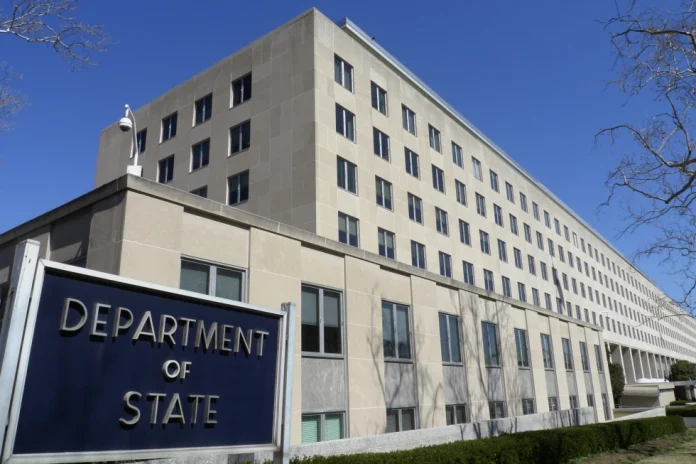
In this March 9, 2009 file photo, The Harry S. Truman Building, headquarters for the State Department, is seen in Washington. Photo: J. Scott Applewhite/AP
In this March 9, 2009 file photo, The Harry S. Truman Building, headquarters for the State Department, is seen in Washington. Photo: J. Scott Applewhite/AP
WASHINGTON (AP) — The Trump administration has identified a host of athletic competitions it classifies as “major sporting events” — aside from soccer’s 2026 World Cup and the 2028 Olympic Games — that athletes and coaches will be allowed to travel to the U.S. to take part in despite a broad visa ban on nearly 40 countries.
In a cable sent to all U.S. embassies and consulates Wednesday, the State Department said athletes, coaches and support staff for the World Cup, the Olympics and events endorsed or run by a long list of collegiate and professional sporting leagues and associations would not be subject to the full and partial travel bans that apply to citizens of 39 countries and the Palestinian Authority.
However, the cable made clear that foreign spectators, media and corporate sponsors planning to attend the same events would still be banned unless they qualify for another exemption.
“Only a small subset of travelers for the World Cup, Olympics and Paralympics, and other major sporting events will qualify for the exception,” it said.
President Donald Trump’s administration has issued a series of immigration and travel bans as well as other visa restrictions as part of ongoing efforts to tighten U.S. entry standards for foreigners. At the same time, the administration has been looking to ensure that athletes, coaches and fans are able to attend major sporting events in the U.S.
Trump’s Dec. 16 proclamation banning the issuance of visas to the 39 countries and the Palestinian Authority had carved out an exception for athletes and staff competing in the World Cup, the Olympics and other major sporting events. It delegated a decision on which other sporting events would be covered to Secretary of State Marco Rubio.
Wednesday’s cable lists the events that are covered, including “all competitions and qualifying events” for the Olympic Games, Paralympic Games, Pan-American Games, and Para Pan-American Games; events hosted, sanctioned or recognized by a U.S. National Governing Body; all competitions and qualifying events for the Special Olympics; and official events and competitions hosted or endorsed by FIFA, soccer’s governing body, or its confederations.
The exemption also will cover official events and competitions hosted by the International Military Sports Council, the International University Sports Federation and the National Collegiate Athletic Association as well as those hosted or endorsed by U.S. professional sports leagues such as the National Football League, the National Basketball Association and Women’s National Basketball Association, Major League Baseball and Little League, National Hockey League, Professional Women’s Hockey League, NASCAR, Formula 1, the Professional Golf Association, Ladies Professional Golf Association, LIV Golf, Major League Rugby, Major League Soccer, World Wrestling Entertainment, Ultimate Fighting Championship and All Elite Wrestling.
The cable said other events and leagues could be added to the list.
Of the 39 countries, a full travel ban applies to Afghanistan, Burkina Faso, Chad, the Republic of the Congo, Equatorial Guinea, Eritrea, Haiti, Iran, Laos, Libya, Mali, Myanmar, Niger, Sierra Leone, Somalia, Sudan, South Sudan, Syria, Yemen, and people with Palestinian Authority-issued passports.
A partial ban is in place for citizens of Angola, Antigua and Barbuda, Benin, Burundi, Cuba, Dominica, Gabon, Gambia, Ivory Coast, Malawi, Mauritania, Senegal, Tanzania, Tonga, Togo, Venezuela, Zambia and Zimbabwe.
For many Kenyans living abroad, sending money home is more than a financial transaction - it is an expression of responsibility, care, and connection.
For many Kenyans living abroad, sending money home is more than a financial transaction - it is an expression of responsibility, care, and connection.
For many Kenyans living abroad, sending money home is more than a financial transaction – it is an expression of responsibility, care, and connection.
Each transfer carries purpose: supporting parents, paying school fees, meeting medical needs, or sustaining investment projects back home.
While millions of families rely on these remittance flows, few are aware of the journey their money takes – from an overseas digital wallet to an Equity Bank account in Kenya.
Though the process appears seamless, behind the scenes multiple systems and safeguards work together to ensure every transfer is secure, fast, and accurate.
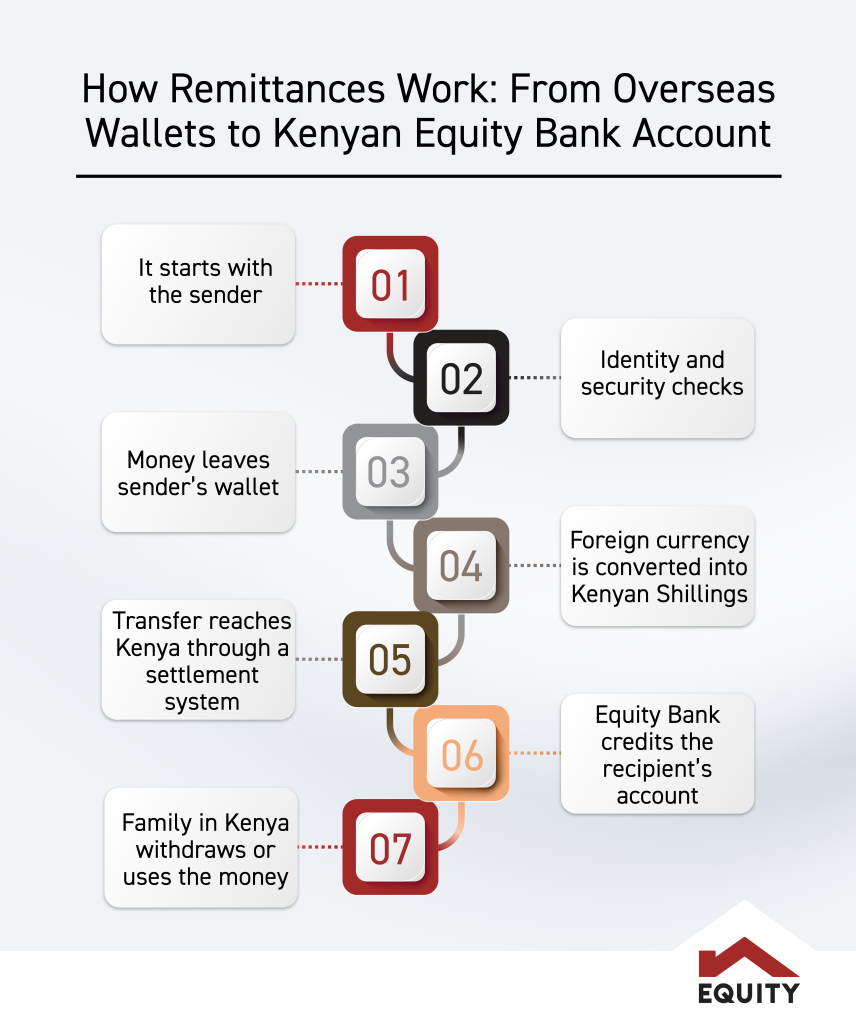
It starts with the sender
Every remittance begins with a Kenyan abroad opening a mobile app or logging into an online banking platform. They enter the amount they want to send, choose Kenya as the destination, and select the recipient’s Equity Bank account.
Behind this simple interface is a series of automated systems confirming details and preparing to route the transaction. What used to require in-person visits to transfer agents can now be done in minutes on a smartphone.
Identity and security checks
Before the transaction can proceed, the remittance provider verifies the sender’s identity. This is a standard requirement globally and is designed to safeguard both the sender and the recipient by preventing fraud. The system may request a passport, national ID, or a quick confirmation of email and phone number.
These checks happen once or occasionally for large transactions, and they ensure that financial systems remain safe and compliant with international regulations.
Money leaves sender’s wallet
After verification, the sender authorizes the transfer. The money is then deducted from their card, bank account or digital wallet. Although it feels like the funds are “travelling,” what actually moves are secure digital instructions. These instructions signal to the financial networks involved that money should be made available to the recipient in Kenya.
This stage is entirely digital and happens within seconds, thanks to modern payment systems linking international partners.
Foreign currency is converted into Kenyan Shillings
Because the money originates in a different currency, dollars, euros, pounds or others, it must be converted into Kenyan shillings.
Most remittance platforms automatically apply the exchange rate, showing the sender how much the recipient will receive before they confirm the transfer.
The conversion happens behind the scenes and ensures that by the time the transaction reaches Kenya, the value is ready to be deposited in shillings.
Transfer reaches Kenya through a settlement system
A settlement system is the behind-the-scenes infrastructure that allows money sent from one country to be confirmed, recorded, and released to a bank in another country.
Once the conversion is done, the transfer enters the settlement stage. The remittance provider sends a secure message through systems like SWIFT or other digital networks to inform its Kenyan banking partner that funds are incoming.
At this point, Equity Bank is notified that a specific customer should receive a specific amount. These settlement instructions are the backbone of the global remittance system and ensure that every transfer is accurately recorded and matched.
Equity Bank credits the recipient’s account
When Equity Bank receives the settlement message, it processes the details and credits the recipient’s account. In many cases, this happens almost immediately. The recipient often receives an SMS or a push notification from Equity Mobile, confirming that the money has arrived.
The moment that alert comes through is when the long cross-border journey finally becomes real for the person on the receiving end.
Family in Kenya withdraws or uses the money
Once the funds reflect in the account, the recipient can access the money in the way that suits them best.
They may withdraw cash from an ATM or branch, transfer it to M-Pesa or Airtel Money, pay bills through mobile banking, or use it directly for school fees, medical payments or shopping.
Whether you are in United States, United Kingdom, Europe, or Australia, Equity Bank has the infrastructure to make this journey seamless.
Equity Bank’s impeccable digital and settlement systems ensure that cross-border transfers are handled swiftly, securely, and consistently; making sure the money sent with love arrives when it is needed most.
Ready to Send Money Home with Confidence?
Explore remittance options and learn how Equity can support your needs:
Derek Gripper and Ballaké Sissoko perform at the 2022 SOAS Festival of Ideas in London. The two will appear together at St. Olaf Catholic Church on Saturday, Jan. 31, 2026 as part of the St. Olaf Music Series. Photo: YouTube Screengrab
Derek Gripper and Ballaké Sissoko perform at the 2022 SOAS Festival of Ideas in London. The two will appear together at St. Olaf Catholic Church on Saturday, Jan. 31, 2026 as part of the St. Olaf Music Series. Photo: YouTube Screengrab
With over 2000 languages spoken in Africa, most Africans speak more than one language. That’s true for Derek Gripper who hails from Cape Town, South Africa and for Ballaké Sissoko, Malian-French now living in Paris. One speaks English, the other French. While they sit side by side in sound-check and performance, neither speaks the language of the other.
Technically.
Mshale spoke with Derek Gripper last month when he explained that their common language is understood through music. It’s the plucking of the strings of their instruments—a guitar and a kora—and the glances exchanged and the smiles or raised eyebrows aimed at each another, even the sway of their shoulders that imparts information to one another.
Gripper said, “we’ve never had a discussion about the music that we play. We’ve never planned what we’re going to play, and we’ve also never played outside of either the studio or the concert hall.”
He reflected further, “So I think the closest we’ve come to a rehearsal is the sound check, you know, where we will play for 10 or 15 minutes together. So it’s kind of all improvised, uh, together, in the sense that we have a shared repertoire of the standards of kora, but we’re also improvising, having a conversation between what I remember, and what he knows, and things like that.”
Sissoko plays kora and Gripper plays guitar, but the music Gripper plays he has translated from kora music to guitar. In fact, that is how this unique collaboration began.
“It officially started in 2011 when I transcribed one of his two of his pieces for my album, One Night on Earth, which was this transcription of kora music for guitar and the two composers whose music I chose were Tourmani Diabate and Ballaké Sissoko,” Gripper said.
He followed that album with more translation of the Malian kora by Sissoko on consecutive albums, Libraries on Fire and New Ancient Strings.
This one-sided collaboration moved into dynamic in-person play during the pandemic oddly enough.
Gripper said, “The real collaboration started in 2022. We had a gig at the School of Oriental and African Studies, SOAS, in London, which was a pretty momentous occasion that was commemorating the fifty years since his father, [Djelimady Sissoko, also a brilliant kora player], had been in London.”
Interrupting himself, Gripper said, “Ballaké also played at Number 10 Downing Street on that occasion, which I imagine is probably the one and only time there’s been a kora performance in Number 10 Downing Street.”
The pair has performed and recorded together since then. “The next night, we went into the studio and we recorded the album that we’ve since released together,” Gripper said.
A classical guitarist who’s dedicated himself to playing kora music, Derek Gripper has played with many kora players over the years. “I’ve never had the experience,” Gripper said, “that I have [had] with Ballaké.”
“I’ve done collaborations and had really wonderful. times, but, you know, it’s not often that you find someone that you really just feel so comfortable with to play it with.” He added, “There’s a kind of kindness, and a looking after each other, and a mutual excitement, even though it’s not verbally expressed. but you can feel that, you know, that we… we enjoy… we really enjoy playing together.”
This copacetic relationship, Gripper said, “that’s, that’s really the payoff. I like the fact that we can’t talk to each other. I actually… obviously, it’d be great if we could, and I know that people who tour with him who can have a totally different experience, but I like the uniqueness of this experience, that we kind of know each other through a different medium.”
Gripper and Sissoko will perform on January 31st at St. Olaf Catholic Church 215 S 8th St., Minneapolis, MN 55402 as part of the St. Olaf Music Series 2025-26.
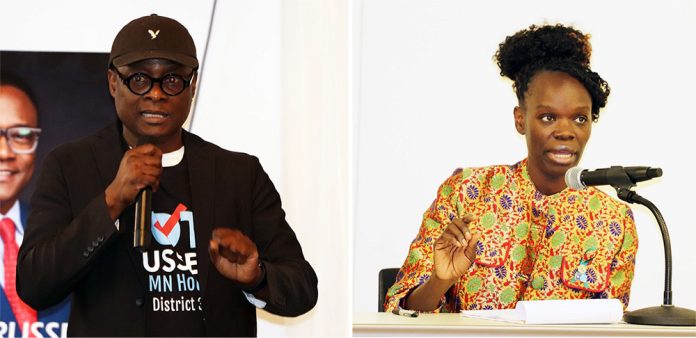
Liberian American Wynfred Russell has launched a primary challenge against Kenyan American Minnesota state Rep. Huldah Hiltsley who is serving her first term. Russell lost to Hiltsley in the last primary election. Mshale Staff Photos by Tom Gitaa
Liberian American Wynfred Russell has launched a primary challenge against Kenyan American Minnesota state Rep. Huldah Hiltsley who is serving her first term. Russell lost to Hiltsley in the last primary election. Mshale Staff Photos by Tom Gitaa
Former Brooklyn Park City Council member Wynfred Russell is seeking a primary rematch against Minnesota state Rep. Huldah Hiltsley in the deep blue District 38A.
Russell lost to Hiltsley by 50 votes in a hotly contested Democratic primary in 2024, following the retirement of Mike Nelson who had served for 22 years. After securing the party nomination, Hiltsley went on to win 65% of the vote against Republican Brad Olson in November becoming the first Kenyan-born state legislator in the country.
Russell announced his rematch campaign via social media Monday evening via a flyer advertising a campaign launch for Jan. 24 with the words “REAL LEADERSHIP REAL RESULTS” and with state Sen. Susan Pha as the “special guest speaker.” Senate District 38’s delegation of three legislators comprises two Hmong women, Pha in the Senate and Samantha Vang in the House (38B), and Kenyan American Hiltsley as the other House member (38A).
Mshale’s attempts to reach both Pha and Russell for comment before publication were unsuccessful. In the 2024 race between the two African immigrants, Pha supported Russell.
State Sen. Susan Pha, Rep. Samantha Vang and Rep. Huldah Hitsley at a joint Senate District 38 townhall meeting at North Hennepin Community College on Aug. 26, 2025. Mshale Staff Photo by Tom Gitaa
In a WhatsApp statement to Mshale when reached for comment on the latest challenge from Russell, Hiltsley said she will let her legislative record in the one year she has been in the legislature speak for itself.
“In just one year at the legislature I was able to author and pass three bills with a direct impact on my district and the state,” Hiltsley said. “I was the author of HF3019 which appropriated $80,000 for the Osseo sesquicentennial and that bill passed as part of the legacy bonding bill.”
Hiltsley said she was the chief author of the homelessness prevention assistance program which appropriated $8 million to address and prevent family homelessness “so that we are stabilizing families and ensuring that a temporary crisis does not become a permanent loss of housing.”
“I was also the co-author of a bill to enhance renter protection statewide which passed and is now law,” Hiltsley said, referring to the new requirement for cities to provide a link to the Attorney General’s Landlord-Tenant Guide with any renewal of rental license, registration, or certificate of occupancy.
Data from the Center for Effective Lawmaking which tracks legislators’ effectiveness and performance, shows it is rare for bills sponsored by first-term legislators to become law.
The state’s major pollical parties first major political activity for 2026 will be the precinct causes which will be held on February 3. At the caucuses is where delegates for upcoming conventions are selected. You can get caucus information for your area by visiting the Minnesota Secretary of State.
Diaspora remittances are often discussed in financial terms. But for the people who send them - and the families who depend on them - they represent something far deeper.
Diaspora remittances are often discussed in financial terms. But for the people who send them - and the families who depend on them - they represent something far deeper.
For many Kenyans living abroad, the journey often begins with hope: a new job, a new country, a chance to build a different life.
Yet even as routines change and new environments take shape, home remains close.
Phone calls, messages, and WhatsApp family group updates keep you connected.
Diaspora remittances are often discussed in financial terms. But for the people who send them – and the families who depend on them – they represent something far deeper. They are stories of responsibility, care, loyalty, and the desire to remain present, even across thousands of Kilometres.
The sacrifice behind every transfer
At face value, a remittance is simply money sent from abroad to Kenya. But within every transfer lies shared obligation and personal sacrifice.
It may be a nurse in the United States or the United Kingdom sending money for a parent’s medication. A graduate in Australia setting aside funds before the next school term. A tech professional in Europe supporting a sibling’s business during a slow month.
What looks like a routine transaction is often the result of long shifts, strict budgeting, and careful personal trade-offs.
Many Kenyans in the diaspora balance rent, bills, childcare, and savings goals – while still sending money home. There is pride in being able to help, but there is also pressure. Expectations can grow, even as life abroad presents its own challenges.
Still, month after month, the support continues – because the connection to home remains strong.
The impact
On the receiving side, that money becomes real action: school fees cleared, rent paid, food purchased, a medical emergency handled.
Families see it not just as financial support but as reassurance. Proof that even from far away, you are still there.
Many families can point to a defining moment when remittance support made the difference – a child sitting exams, a hospital bill cleared, a farming season saved, or a business surviving a difficult period.
In many households, remittances form the backbone of daily life and long-term stability.
Safe, reliable transfer channels
Because remittances carry both emotional weight and urgency, how you send them matters just as much as why you send them.
Diaspora senders want confidence that the money they send to their loved ones – whether to bank accounts, mobile wallets, or cash pick-up points across Kenya – will reach the right place without unnecessary delays, deductions, or risk.
Using trusted, regulated channels like Equity Diaspora Banking provides that peace of mind. Equity understands the human reality behind remittances and ensures that sending money home is:
Secure – protected and compliant
Reliable – predictable delivery
Transparent – clear records and tracking
Convenient – multiple payout options across Kenya
Affordable – value-driven costs
The Bank protects you from the risks that come with informal channels, including lost funds, uncertainty, and delays. It gives you proper records, accountability, and traceability, which are
This reduces the risk of funds getting lost, delayed, or misdirected, especially when the money is meant for something as sensitive as school fees, medical care, or rent.
For Kenyans abroad, your remittances matter – not just to the people receiving them, but to the larger story of who you are and what you stand for.
At Equity Diaspora Banking, we understand this deeply. Our goal is to make sending money home seamless, trustworthy, and empowering – so every transfer reflects your intent and arrives with confidence.
Ready to Send Money Home with Confidence?
Explore remittance options and learn how Equity can support your needs: