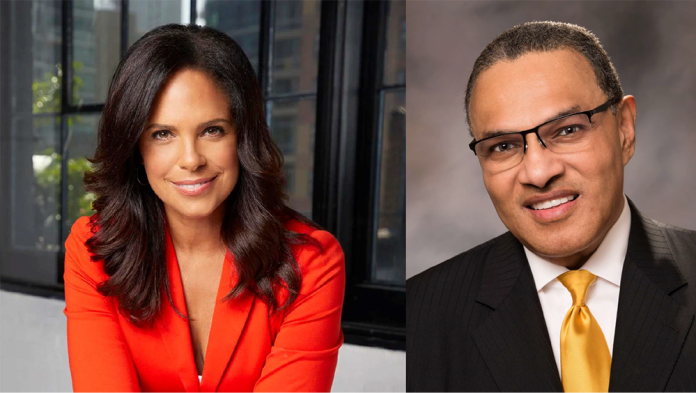
Soledad O’Brien and Dr. Freeman A. Hrabowski, III will keynote the Annual MLK Holiday Breakfast at the Minneapolis Convention Center on Monday, Jan. 19, 2026. Photo: Courtesy
Soledad O’Brien and Dr. Freeman A. Hrabowski, III will keynote the Annual MLK Holiday Breakfast at the Minneapolis Convention Center on Monday, Jan. 19, 2026. Photo: Courtesy
The 36th annual Dr. Martin Luther King, Jr. Holiday Breakfast will go on as planned on Jan. 19 in Minneapolis, in the midst of protests in the city against the Trump administration’s ongoing assault on civil rights.
The event, which will be held at the Minneapolis Convention Center, is one of the nation’s largest annual breakfast celebrations honoring Dr. King’s legacy and is presented by General Mills in support of the Twin Cities chapter of UNCF, which raises funds to help young men and women attain higher education.
The theme of the event, “Make a Career of Humanity,” echoes Dr. King’s call for lifelong service and commitment to justice and equality. The theme was inspired by civil rights icon’s message, “Commit yourself to the noble struggle for equal rights. You will make a greater person of yourself, a greater nation of your country, and a finer world to live in.”
This year’s breakfast comes in the middle of the Trump administration’s heavy-handed immigration enforcement campaign in Minneapolis, which critics of President Donald Trump say threatens to reverse the gains made by Dr. King’s sacrifice. Early this month, the Department of Homeland Security sent about 2,000 Immigration and Customs Enforcement (ICE) agents to Minneapolis to crackdown on immigrants, mostly members of the Somali community, who the president says should be deported because they are “garbage.” Protests against the operations have intensified since Jan. 7, when ICE agent Jonathan Ross shot a woman three times at close range, killing her. The woman, identified as 37-year-old mother of three, Renee Nicole Good, was a U.S. citizen.
This year’s event will feature two keynote speakers: Soledad O’Brien, and Dr. Freeman A. Hrabowski, III. O’Brien is an award-winning documentarian, author and founder of Soledad O’Brien Productions, a media production company dedicated to telling empowering and authentic stories
Hrabowski is a consultant, lecturer and speaker on the topics of leadership, STEM education, workforce development and civic engagement. He is currently serving as President Emeritus of the University of Maryland, Baltimore County (UMBC), championing minority achievement in graduate studies.
Local music and culture will also be part of the morning, with performances by Billy Steele of Sounds of Blackness, honoring Black artist traditions.
Doors will open at 6:45 a.m., with breakfast and pre-event programming beginning at 7:30 a.m. The event will be broadcast live on WCCO AM at 8:30 a.m., and keynote presentations will also air on Minnesota Public Radio during the midday segment.
The Cedar Cultural Center hosted the inaugural Festive Beats of Afrika on Dec. 20, 2025 to celebrate the African diaspora through music, dance, and storytelling. Mshale Staff Photo by Jasmine Webber
The Cedar Cultural Center hosted the inaugural Festive Beats of Afrika on Dec. 20, 2025 to celebrate the African diaspora through music, dance, and storytelling. Mshale Staff Photo by Jasmine Webber
The Cedar Cultural Center hosted an event, Festive Beats of Afrika, to celebrate the African diaspora through music, dance, and storytelling last December 20th. The stage held a full band with guitar, keyboard, and percussion, occasionally joined by other instrumentalists backing up the two individual singers.
The dance troupe, Afrocontigbo, definitely offered a unifying element with energetic dance moves that invited the audience to participate. One dancer incorporated some Indlamu-inspired high kicking as well as iconic hip-shaking soukous dancing.
The house band however didn’t provide the rhythmic driving beat needed to sustain the dancing. I couldn’t tell if it was the band at fault or the sound system, but they were often muddled and seemingly without leadership.
In fact, the whole event started with a disembodied voice previewing the show. It wasn’t until the fourth number played that I could identify the emcee. While he was humorous and enjoyable and very pro-Nigerian, his home country, he didn’t stand out with flash and hype. I did appreciate how he dropped bits of history or other trivia into his monologue about Nigeria.
I definitely wanted to fist-pump his statement, Africa is the cradle of civilization, which is too often overlooked.
Congolese musician, Diatoti, strutted out with the moves and the voice to excite the crowd, which filled about 2/3rds of the dance space. She is undeniably strong and sensual, taking command of the music and floor as if she alone owns it. She is so much fun to watch and experience, a true ambassador of the DRC. Performing a half-dozen numbers, the soukous-influenced music and dance appealed to everyone.
Darling Carolyne Naomi gracing the stage with her Nigerian-inspired sound, was swallowed up with the noise and intensity. I wanted to love her performance and so did others. I could tell by the way their hips swayed and feet shuffled, but no one put themselves out on the dance floor as there was no hook, no bounce from the music to propel them.
This was simply not Naomi’s ideal situation. To enjoy Naomi’s music, it needs to be delivered in a solo concert seated in chairs with space to dance. In that environment, she will shine as her nightingale voice soars. But at the Festive Beats of Afrika, it was too much. It’s not a reflection on the resilience and strength of Naomi, but on her style and art trying to fit into a raucous dance. You wouldn’t play tennis with a football would you?
I hope The Cedar continues this endeavor, but with a different mix of musicians and more time spent on sound-check. The impetus is wonderful and the Twin Cities has a wealth of artists who can fill the setlist.
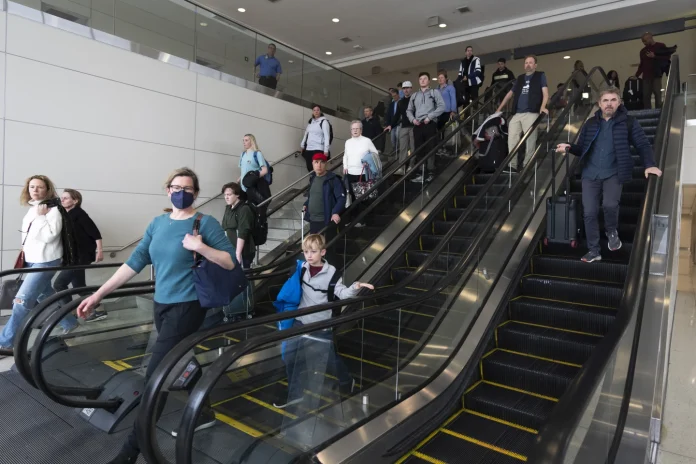
International travelers go down the escalator to get processed at the port of entry at Washington Dulles International Airport in Chantilly, Va. Monday, April 1, 2024. Photo: Manuel Balce Ceneta/AP
International travelers go down the escalator to get processed at the port of entry at Washington Dulles International Airport in Chantilly, Va. Monday, April 1, 2024. Photo: Manuel Balce Ceneta/AP
The African nations of Botswana, the Central African Republic, Guinea, Guinea-Bissau and Namibia have been added to the list of countries whose citizens have to post a bond of up to $15,000 to apply for a non-immigrant visa to enter the United States.
The new additions became effective on January 1 with Bhutan and Turkmenistan the only non-African counties added to the updated list, which brings the total number of countries affected by the bond policy to thirteen.
Those posting the bonds are also required to enter and exit the United States through three designated ports of entry:
Boston Logan International Airport (BOS)
John F. Kennedy International Airport (JFK)
Washington Dulles International Airport (IAD)
Failure to enter and exit the U.S. through the three airports will lead to one losing their bond.
When it started the visa bond policy last year, the Trump administration said it was part of an effort to combat visa overstays, and that it was pilot program.
The administration plans to add 25 more countries to the pilot with different implementation dates through January 21.
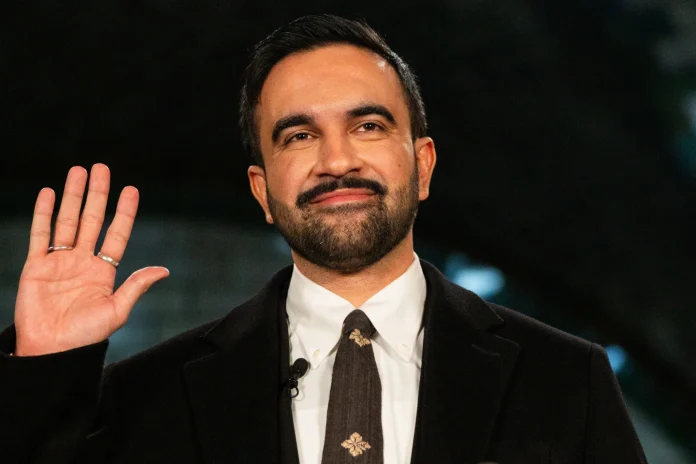
Zohran Mamdani is sworn in as mayor of New York City at Old City Hall Station, New York, Thursday, Jan. 1, 2026. | Photo: Amir Hamja/ via AP Pool
Zohran Mamdani is sworn in as mayor of New York City at Old City Hall Station, New York, Thursday, Jan. 1, 2026. | Photo: Amir Hamja/ via AP Pool
NEW YORK (AP) — Incoming Mayor Zohran Mamdani took his midnight oath of office on a centuries-old Quran, marking the first time a mayor of New York City uses Islam’s holy text to be sworn in and underscoring a series of historic firsts for the city.
The 34-year-old Democrat became mayor in a long-closed subway station beneath City Hall, the first Muslim, first South Asian and first African-born person to hold that position.
These milestones — as well as the historical Quran — reflect the longstanding and vibrant Muslim residents of the nation’s most populous city, according to a scholar who helped Mamdani’s wife, Rama Duwaji, select one of the books.
Most of Mamdani’s predecessors were sworn in on a Bible, although the oath to uphold the federal, state and city constitutions does not require the use of any religious text.
Zohran Mamdani hugs his wife Rama Duwaji after he is sworn in as mayor of New York City at Old City Hall Station, New York, Thursday, Jan. 1, 2026. | Photo: Amir Hamja/via AP Pool
And while he has focused heavily on the issue of affordability during his campaign, Mamdani was outspoken about his Muslim faith. He frequently appeared at mosques across the five boroughs as he built a base of support that included many first-time South Asian and Muslim voters.
A look at the three Qurans that Mamdani used
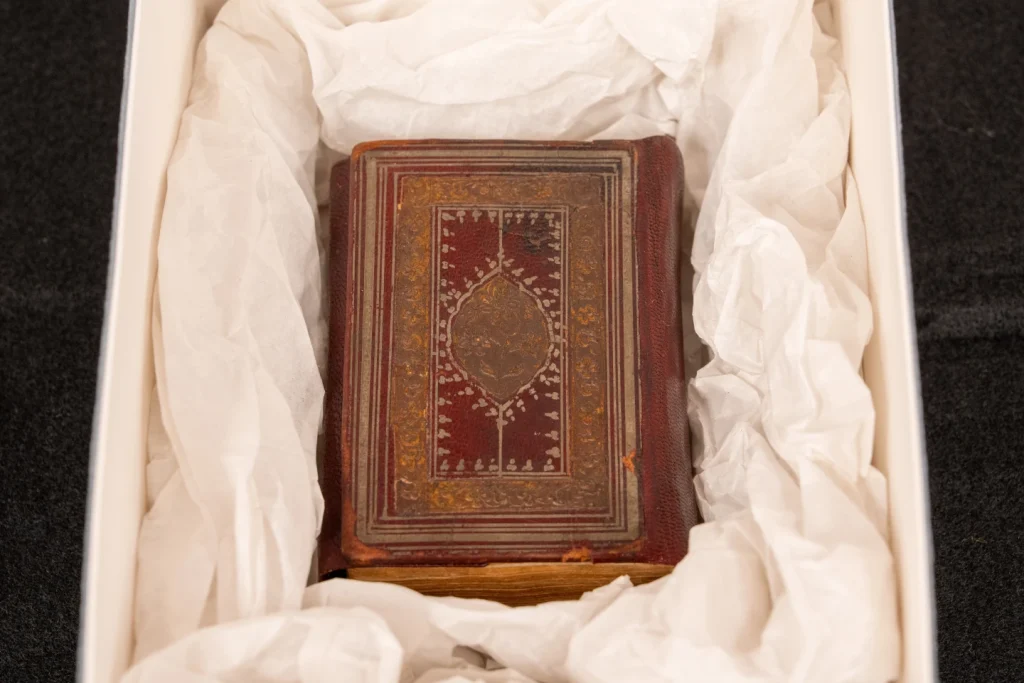
Two Qurans were to be used during the subway ceremony: his grandfather’s Quran and a pocket-sized version that dates back to the late 18th or early 19th century. It is part of the collection at the New York Public Library’s Schomburg Center for Research in Black Culture.
That copy of the Quran symbolizes the diversity and reach of the city’s Muslims, said Hiba Abid, the library’s curator for Middle Eastern and Islamic Studies.
“It’s a small Quran, but it brings together elements of faith and identity in New York City history,” Abid said.
For a subsequent swearing-in ceremony at City Hall on the first day of the year, Mamdani will use both his grandfather’s and grandmother’s Qurans. The campaign hasn’t offered more details on those heirlooms.
One Quran’s long journey to Mamdani’s hand
The manuscript was acquired by Arturo Schomburg, a Black Puerto Rican historian whose collection documented the global contributions of people of African descent. While it is unclear how Schomburg came into possession of the Quran, scholars believe it reflected his interest in the historical relationship between Islam and Black cultures in the United States and across Africa.
Unlike ornate religious manuscripts associated with royalty or elites, the copy of the Quran that Mamdani will use is modest in design. It has a deep red binding with a simple floral medallion and is written in black and red ink. The script is plain and readable, suggesting it was created for everyday use rather than ceremonial display.
Those features indicate the manuscript was intended for ordinary readers, Abid said, a quality she described as central to its meaning.
“The importance of this Quran lies not in luxury, but in accessibility,” she said.
This photo provided by The New York Public Library shows the Schomburg Quran on Dec. 16, 2025 in New York. | Photo: Jonathan Blanc/The New York Public Library via AP
Because the manuscript is undated and unsigned, scholars relied on its binding and script to estimate when it was produced, placing it sometime in the late 18th or early 19th century during the Ottoman period in a region that includes what is now Syria, Lebanon, Israel, the Palestinian territories and Jordan.
Abid said the manuscript’s journey to New York mirrors Mamdani’s own layered background. Mamdani is a South Asian New Yorker who was born in Uganda, while Duwaji is American-Syrian.
Identity and controversy
The meteoric rise of a Muslim democratic socialist also brought a surge of Islamophobic rhetoric, amplified by national attention on the race.
In an emotional speech days before the election, Mamdani said the hostility had only strengthened his resolve to be visible about his faith.
“I will not change who I am, how I eat, or the faith that I’m proud to call my own,” he said. “I will no longer look for myself in the shadows. I will find myself in the light.”
The decision to use a Quran has drawn fresh criticism from some conservatives. U.S. Sen. Tommy Tuberville of Alabama wrote on social media, “The enemy is inside the gates,” in response to a news article about Mamdani’s inauguration. The Council on American-Islamic Relations, a civil-rights group, has designated Tuberville as an anti-Muslim extremist based on past statements.
Such backlash is not new. In 2006, Keith Ellison, the first Muslim elected to Congress, faced condemnation from conservatives after he chose to use a Quran for his ceremonial oath.
Following the inauguration, the Quran will go on public display at the New York Public Library. Abid said she hopes attention surrounding the ceremony — whether supportive or critical — will prompt more people to explore the library’s collections documenting Islamic life in New York, ranging from early 20th century Armenian and Arabic music recorded in the city to firsthand accounts of Islamophobia after the Sept. 11 attacks.
“This manuscript was meant to be used by ordinary readers when it was produced,” Abid said. “Today it lives in a public library where anyone can encounter it.”
___
Associated Press writers Jake Offenhartz in New York and Kim Chandler in Montgomery, Alabama, contributed.
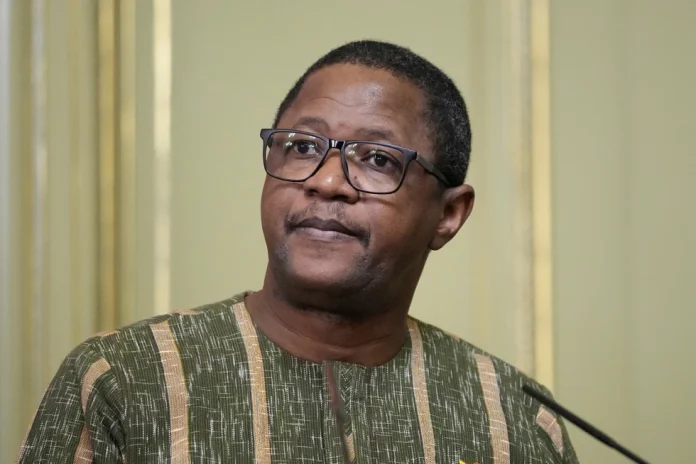
Burkina Faso Foreign Minister Karamoko Jean Marie Traore attends a joint news conference following a meeting of Russian foreign Minister Sergey Lavrov with foreign Ministers of the Confederation of Sahel States in Moscow, Russia, April 3, 2025. Photo: Pavel Bednyakov/AP Pool
Burkina Faso Foreign Minister Karamoko Jean Marie Traore attends a joint news conference following a meeting of Russian foreign Minister Sergey Lavrov with foreign Ministers of the Confederation of Sahel States in Moscow, Russia, April 3, 2025. Photo: Pavel Bednyakov/AP Pool
BAMAKO, Mali (AP) — Mali and Burkina Faso said late Tuesday they would ban U.S. citizens from entering their countries in retaliation for U.S. President Donald Trump’s decision to ban Malian and Burkinabe citizens from entering the United States.
The announcements, made in separate statements by the foreign ministers of the two West African countries, marked the latest twist in the frosty relationship between West African military governments and the U.S.
On Dec. 16, Trump expanded earlier travel restrictions to 20 more countries, including Mali, Burkina Faso and Niger, which are run by juntas and have formed a breakaway association from the regional bloc, the Economic Community of West African States.
“In accordance with the principle of reciprocity, the Ministry of Foreign Affairs and International Cooperation informs the national and international community that, with immediate effect, the Government of the Republic of Mali will apply the same conditions and requirements to US nationals as those imposed on Malian citizens,” the Malian Ministry of Foreign Affairs said in a statement.
Another statement signed by Burkina Faso’s Minister of Foreign Affairs Karamoko Jean-Marie Traoré cited similar reasons for the ban on American nationals entering Burkina Faso.
The White House noted persistent attacks by armed groups as one of the reasons for the travel ban. Mali and Burkina Faso have struggled to contain armed groups that have spread rapidly in both countries. The juntas vowed to fight the armed groups after deposing civilian governments over the insecurity that has roiled much of the region.
The Equity Mobile App and Equity Online platforms offer intuitive, secure, and innovative features that make managing money effortless for Kenyans at home and those in the Diaspora.
The Equity Mobile App and Equity Online platforms offer intuitive, secure, and innovative features that make managing money effortless for Kenyans at home and those in the Diaspora.
Sponsored Content from Equity Bank
Nairobi, Kenya – Equity Bank continues to strengthen its position as the go-to bank for convenient, secure, and affordable payment solutions for customers both locally and across the global Diaspora.
As part of this commitment, the Bank has various innovative solutions encouraging customers to embrace cashless payments using Equity Cards, the Equity Mobile App, and Equity Online. The solutions reinforce Equity’s promise of simple, reliable, and cost-effective digital banking – anytime, anywhere.
Banking Without Borders
Designed with today’s globally connected customer in mind, the Equity Mobile App and Equity Online platforms offer intuitive, secure, and innovative features that make managing money effortless for Kenyans at home and those in the Diaspora and their families back home.
Key Features of Equity Mobile App and Equity Online:
Personal finance management for better control
Bill payments including water, electricity (Kenya Power), DSTV, ZUKU, school fees, government services, and other utilities)
Card services management, including stopping a card and paying credit card bills
Access to loans directly through the platform
Forex calculator for easy conversion of major foreign currencies to Kenya Shillings
Mobile payments for goods and services
Secure local and international money transfers
24/7 access to banking services
User-friendly interface suitable for all customer segments
With the Equity Mobile App, customers enjoy smooth, reliable payments while maintaining full visibility and control over their finances – no pressure, no hassle.
Enhanced International Payments & Transfers
To further support the Diaspora community, the Equity Mobile App and Equity Online integrate Western Union and PayPal withdrawal services, enabling customers to:
Send and receive international remittances conveniently
Withdraw PayPal funds directly into their Equity accounts
Support loved ones back home quickly and securely – straight from their mobile devices
Equity Online, the web-based version of the Mobile App, offers the same robust functionality, making it ideal for customers who prefer banking via a laptop or desktop while abroad.
Equity Bank’s Commitment to Digital Innovation
Equity Bank continues to invest heavily in digital innovation as part of its mission to empower communities across Kenya and the wider African region. The Equity Mobile App and Equity Online are central to the Bank’s strategy to promote:
Cashless and contactless payments
Financial inclusion
Affordable, accessible banking solutions for all
These platforms are redefining Kenya’s digital banking landscape by combining convenience, security, and flexibility, while meeting the evolving needs of customers at home and in the Diaspora.
With Equity Mobile App and Equity Online solutions, Equity Bank reaffirms its promise: banking that works for you – wherever you are in the world.
For support for you or your loved one, you can engage Equity as follows:
Rep. Bennie Thompson at a hearing of the House Committee on Homeland Security on Dec. 11, 2025. Photo: Rep. Thompson Facebook Screengrab
On September 22, President Donald Trump signed an executive order designating “antifa” as a domestic terrorist organization. Trump has repeatedly referred to “antifa” on social media. On October 8, at the White House, Trump hosted an “antifa” roundtable. Sitting between his Attorney General Pam Bondi and his Secretary of Homeland Security Kristi Noem, the event branded “Antifa” as a domestic “terrorist organization.”
But on December 11, at a hearing of the House Committee on Homeland Security, Secretary Noem and Michael Glasheen, an official with the National Security Branch of the FBI, were blank-faced on several issues brought up by Democrats on the committee. The Trump Administration — and now a top FBI official have proclaimed that antifa is the FBI’s “primary concern.”
But Glasheen could not answer any detailed questions or provide any evidence or data regarding the location of “antifa” or membership numbers. Nor could he respond to who the leader of “antifa” is. After Glasheen stated that “antifa is our primary concern right now,” during the December 11 hearing, he was hammered by Rep. Bennie Thompson (D-MS), the most senior Democrat on the committee, who asked the FBI for facts. The FBI official could provide none. Thompson asked Glasheen to reference FBI data on what Trump, and now the FBI, is calling the number one domestic terrorist threat in the U.S.
“Right now, what I see from my position is that that’s the most immediate terrorist threat we’re facing on the domestic side,” Glasheen told Homeland Security committee members on December 11.
“So, where is Antifa headquartered? Where in the United States does antifa exist if it’s a terrorist organization and you’ve identified it as number one?” Rep. Thompson pressed Glasheen. “How many members do they have in the United States as of right now?” Thompson also asked.
“It’s very fluid … the investigations are active,” Glasheen responded as he nervously moved his hands, seated next to Secretary Noem.
“Sir, you wouldn’t come to this committee to say something that you can’t prove. I know you wouldn’t do that. But you did,” Rep. Thompson said. Thompson is the senior member of the House Committee. The exchange quickly went viral on social media.
In past committee testimony under previous administrations, the FBI has identified white supremacists as the number one domestic terrorist threat in the U.S. On December 5, 2023, FBI Director Christopher Wray testified that, “the greatest terrorism threat to our homeland is posed by lone actors or small cells of individuals who typically radicalize to violence online, and who primarily use easily accessible weapons to attack soft targets. We see the lone offender threat with both Domestic Violent Extremists (“DVEs”) and HVEs, two distinct threats, both of which are located primarily in the United States and typically radicalize and mobilize to violence on their own.”
The Trump Administration has been attempting to erase reality on the issue of white supremacy and domestic terror. Rep. Thompson and other Democrats have been raising alarms all year on Trump’s increasing levels of militarization inside the U.S. and their brazen disregard for civil liberties and due process.
In a statement before the House voted on the National Defense Authorization Act, Rep. Thompson pointed out that the bill, “could lead to major civil liberties violations. Most troubling is that the proposal would waive wiretapping prohibitions for DHS carrying out counterdrone operations across any of its missions—including immigration enforcement. Now is not the time to write Trump’s DHS a blank check. The Trump Administration has shown it cannot be trusted.”
During the committee meeting on December 11, Noem was faced with questions on ICE arrests that have involved American citizens and veterans who have served in combat being apprehended. Secretary Noem denied that American citizens were being apprehended by ICE. Rep. Seth Magaziner (D-RI) hammered Noem when he asked if any American citizens or veterans were being abducted by ICE and then produced two examples that were in fact true by showcasing the individuals who were arrested, and in one case deported, live during the hearing.
Secretary Noem left the hearing early, referencing another event she had to attend. It was later reported that the event she referenced was cancelled. Because many members of Congress have been saying for months that the Trump Administration is largely unresponsive to their policy questions, committee hearings with Trump cabinet officials have become the only place where questioning can take place.
That has often resulted in embarrassing and telling exchanges that have featured few detailed policy answers from the Administration.
Black men face average unemployment spells of 12.1 weeks according to the November 2025 jobs report shows. Photo: iStock
Black men face average unemployment spells of 12.1 weeks according to the November 2025 jobs report shows. Photo: iStock
he U.S. labor market showed further signs of strain in November, with new federal data revealing rising unemployment, steep losses in government jobs, and worsening conditions for Black workers, particularly Black men, according to an analysis of the latest Bureau of Labor Statistics report and a review by the National Women’s Law Center.
Employers added 64,000 jobs nationwide in November, a modest gain following months of data disruptions caused by the federal government shutdown. The unemployment rate rose to 4.6 percent, up from 4.4 percent in September, the last month for which a full labor force survey was completed. The increase places unemployment at its highest level in four years.
Behind the headline figures, federal employment continued to fall sharply. Since January, when Donald Trump returned to office, federal payrolls have declined by 271,000 positions. The November report reveals continued reductions tied to deferred resignation programs and layoffs that accelerated earlier in the fall, according to the Bureau of Labor Statistics.
The rise in unemployment has been uneven, with Black workers experiencing some of the most severe impacts. Black men ages 20 and older saw their unemployment rate jump from 6.6 percent in September to 7.5 percent in November. Black women ages 20 and older recorded an unemployment rate of 7.1 percent in November, slightly lower than September’s 7.5 percent but still higher than any other racial or ethnic group.
Long-term unemployment has also become more pronounced for Black workers. Black women who are unemployed are typically out of work for 14.5 weeks, while Black men face average unemployment spells of 12.1 weeks. By comparison, white women experience unemployment lasting about 8.6 weeks, and white men about 9.6 weeks, according to the National Women’s Law Center’s review of federal labor data.
The November report shows that overall job growth remains concentrated in a narrow set of sectors. Healthcare added more than 46,000 jobs, while construction employment rose by 28,000. Manufacturing lost 5,000 jobs, and transportation and warehousing shed nearly 18,000 positions. Leisure and hospitality also declined, reflecting broader weakness outside a handful of growth industries.
Federal officials cautioned that November’s data carry higher-than-usual margins of error due to survey delays related to the shutdown. Even so, economists reviewing the report noted that revisions to late-summer and early-fall payrolls showed fewer jobs than initially reported, reinforcing signs of a cooling labor market.
The Bureau of Labor Statistics reported that the number of people unemployed for more than six months rose to 1.9 million in November, up from 1.7 million a year earlier. Wage growth slowed to 3.5 percent over the past year, the weakest pace since before the pandemic, adding pressure on households facing elevated prices and limited job mobility.
The National Women’s Law Center said it will continue monitoring labor market data by race, gender, and industry to assess how job losses and prolonged unemployment affect women and families as federal employment contracts and hiring remain subdued.
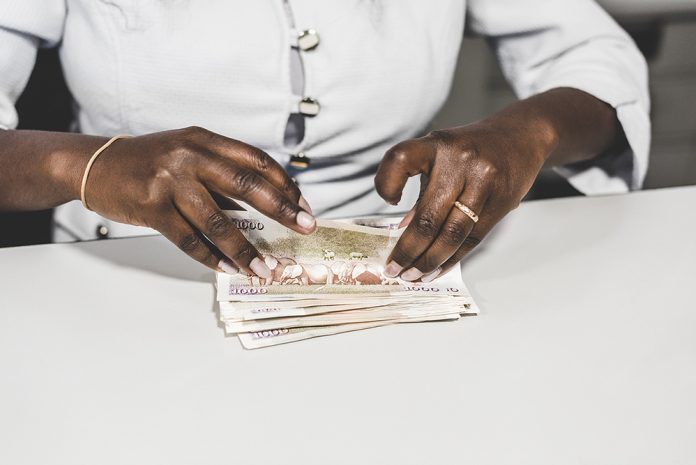
Remittances to Kenya from its citizens abroad were a record $5 billion in 2024 and is on track to hit $7 billion as 2025 draws to a close. Photo: Nirian/iStock
Remittances to Kenya from its citizens abroad were a record $5 billion in 2024 and is on track to hit $7 billion as 2025 draws to a close. Photo: Nirian/iStock
When Prime Cabinet Secretary Musalia Mudavadi announced in November that Kenyan citizens abroad were on course to set a record in the amount of money they sent home in 2025, many saw it as a cause for celebration.
“This figure has actually hit a trillion [shillings],” he announced jubilantly.
That is approximately $7.7 billion, a tremendous increase from the $5.04 billion sent in 2024. The figure is even more impressive when considering Kenya’s nominal GDP in 2025 is estimated at $136 billion. Although this is often great news for the government, Kenyans abroad usually receive the news with mixed reactions.
Ken Lemaiyan, one of the founders of Kenyans Changing Kenya, a California-based civic organization, said the money he and most of his compatriots sent home was for sustaining families, and for small-scale projects like building residential homes.
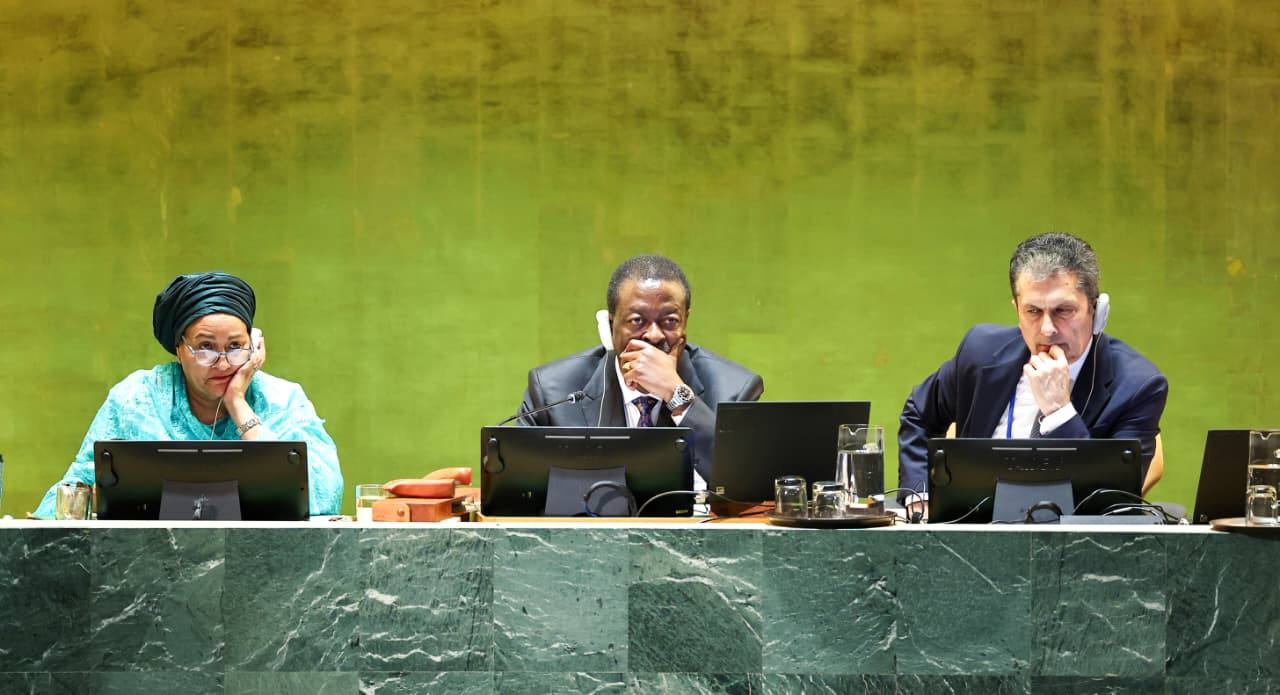
Kenya’s cabinet secretary for foreign and diaspora affairs, Musalia Mudavadi, chairs the 80th United Nations General Assembly on September 24, 2025. He said in November that remittances from his country’s diaspora is projected to hit $7 billion in 2025. Photo: Courtesy United Nations
“It’s spending, not investing,” Lemayian said. “It’s a lifeline for families – school fees, medicines – but is it building Kenya’s economy?”
Lemaiyan said Kenya needed systems to turn diaspora cash into sustainable projects that can create employment and trigger national growth.
“Otherwise, we’re just surviving, not thriving,” he said.
North America accounts for the largest portion of diaspora remittances to Kenya, according to the Central Bank of Kenya (CBK). For example, almost 60% of the $438 million sent home in October came from North America, especially the United States where close to 165,000 Kenyans live, according to the 2024 U.S. Census Bureau’s American Community Survey (ACS).
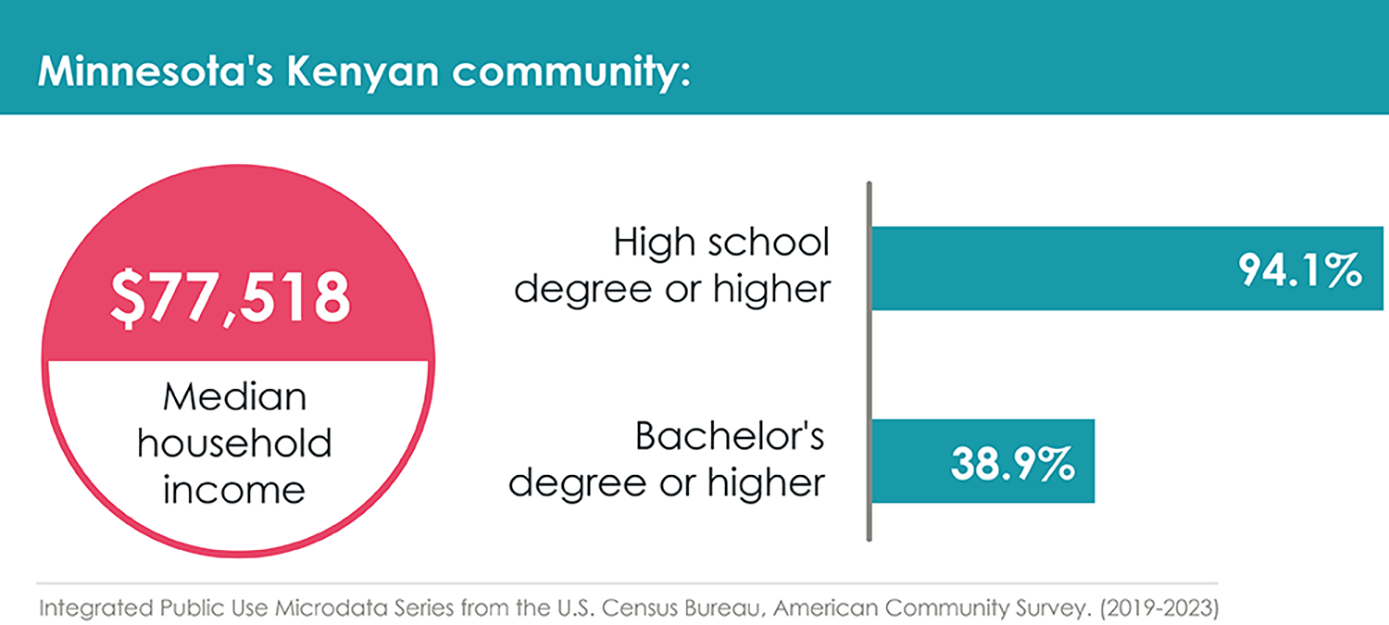
Kenyans in the United States tend to be highly educated. A Minnesota Compass analysis of Integrated Public Use Microdata Series ACS data (2019-2023), for example, found that 94.1% of the Kenyan community in Minnesota, approximately 20,000 people, had a high school diploma or higher, and 38.9% had at least an undergraduate degree.
Graphic: Minnesota Compass for Mshale
Numerous studies have shown that that communities with high rates of education have lower unemployment rates and higher earnings, compared to those that don’t. In 2022, for example, a National Center for Education Statistics survey of people aged 25-34 found that median earnings of those with bachelor’s degrees were 59% higher than of those whose highest level of education was high school. The high education attainment is evident in Minnesota’s Kenyan community, with a median household income of $77,518, according to the Minnesota Compass report. That figure is statistically tied with the national median household income of $77,719. This is an indication that the Kenyan community is doing relatively well and could explain the upward trend in remittances.
Samuel Ireri, the group head of international banking and payments at Equity Group, agreed that Kenyan citizens abroad could be much better financially if more of the money they sent home went into stable investments. For more than 23 years he lived in the United States and worked for several banks in the Minneapolis area, including Wells Fargo, and JP Morgan Chase. But he left because he strongly believed he could use what he had learned from the prestigious American banks to bridge the gap in diaspora investments.
“[I was] trying to find a purpose in life,” he said. “How do I serve my country? How can I fill in the gaps with the knowledge, the experience that I had in banking, and in financial services?”
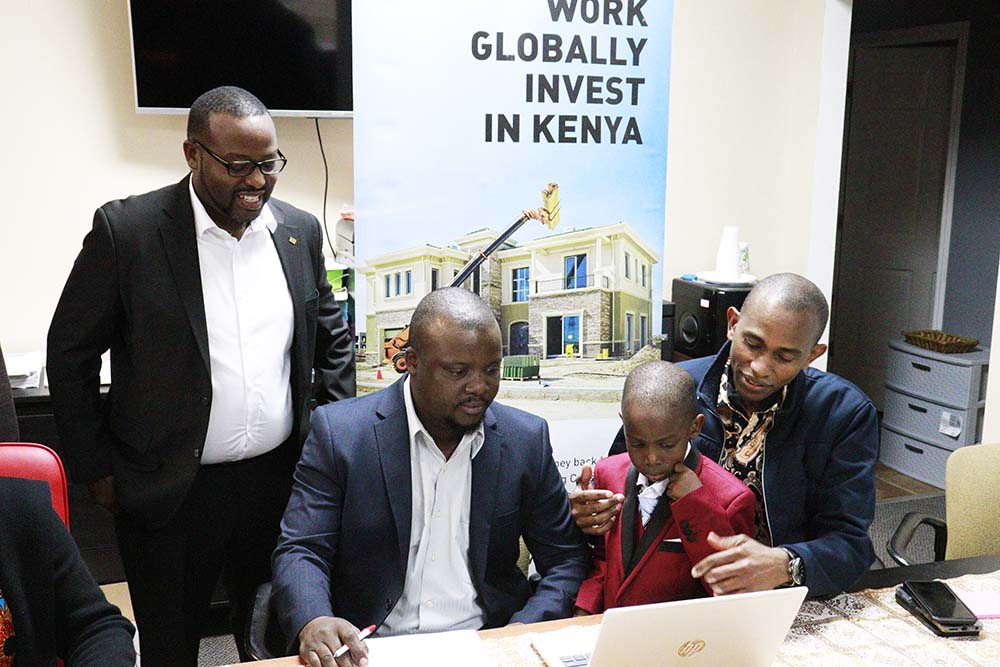
Samuel Ireri, the group head of international banking and payments at Equity Group, standing, watches as the bank’s business development manager Jeff Gitahi, right, helps a member of the diaspora in Minnesota reactivate their account during the bank’s Fall 2025 North America roadshow. Mshale Staff Photo by Tom Gitaa
So, when in January an opportunity to join one of the largest private banking and finance companies in Kenya, Ireri didn’t think twice. One of his priorities at Equity was to simplify the process of opening and maintaining accounts online to give Kenyans abroad confidence in the country’s financial system. He took steps to remove obstacles he had encountered as a customer living abroad.
“The load of paperwork,” Ireri said, “the bureaucracy of getting your account up and running, and trying to follow up when there’s an issue, and people not getting back to you.”
Ireri said Equity reduced the paperwork and focused on improving its app so customers could access their accounts remotely. Equity was also working with the CBK to see how it could digitize the process.
Dr. Wilson Endege is the CEO and director of Daktari Biotechnology Ltd (DKTB), an ambitious venture that has been rallying Kenyans abroad to do more than just sending money to relatives. When he graduated from the Free University of Brussels in 1992, he was only the third person from Kenya to earn a doctorate in molecular biology. When he couldn’t find work in Kenya, he left for the United States, where he worked as a scientist at Harvard Medical School, and numerous pharmaceutical companies before leaving to found DKTB. He said for Kenyans and Africans abroad needed to rely less on governments and more on their own ingenuity.
“I’m not saying that the government is not relevant,” Endege said. “I just don’t think they engage [with the diaspora] correctly.”
Dr. Wilson Endege. Photo: Courtesy Daktari Biotechnology
Endege said African governments had failed to build adequate infrastructure to incentivize their citizens abroad to make sustainable investments that create jobs. He said Africans should emulate Asian countries, which became economic powerhouses because they harnessed the knowledge and power of their diasporas.
“They created opportunities and invited people to bring back technology so that they could start producing some of these products in their own countries,” Endege said. “As a result, some of the big tech companies you see today have come out of those countries.”
To the contrary, he said, African leaders were often skeptical or outright dismissive when their citizens abroad come home with new ideas. Ten years ago, when he founded DKTB, he wanted to develop Diaspora University Town, a city centered around a state-of-the-art research university and a hub for creation of medicines and vaccines for Africa. Endege said DKTB wrote to nearly a dozen county governments seeking partners and land for the project.
“We wanted to direct some of the diaspora resources into a project that would have impact and create opportunities,” Endege said.
When none of them showed interest, DKTB decided to go without the government. They managed to acquire 1,500 acres from a community in Taita-Taveta, a county in southern coastal region. He assembled a team and began pitching the investment idea to the diaspora and is now hoping Kenyan investors will jump on the opportunity.
“Someone has to do it,” he said when asked why, at nearly 70 years old, he should bother. “I think more about the opportunity that has been lost for people, for the country, and someone has to come back and tell them that we need to do this a little bit differently.”
On December 4, during a White House cabinet meeting, President Trump launched into a hateful, racist rant against Congressional Black Caucus member Rep. Ilhan Omar. Mshale Staff Photo by Tom Gitaa
On December 4, during a White House cabinet meeting, President Trump launched into a hateful, racist rant against Congressional Black Caucus member Rep. Ilhan Omar. Mshale Staff Photo by Tom Gitaa
On December 4, during a White House cabinet meeting, President Trump launched into a hateful, racist rant against Congressional Black Caucus member Rep. Ilhan Omar (D-MN).
“Those Somalians should be out of here. They’ve destroyed our country. And all they do is complain, complain, complain. You have her – she’s always talking about ‘the constitution provides me with uhhhh,’” Trump ranted, speaking of Congresswoman Omar.
Trump has targeted Rep. Omar and other members of Congress’s “Squad” before and during his first term in office. Those attacks by Trump included Reps. Ayanna Pressley, Alexandria Ocasio-Cortez. Many political observers wonder if Trump’s latest rant was a strategy to deflect from bad economic news. Either way, Trump’s latest racist tirade isn’t new.
Rep. Omar’s family fled Somalia during a war and then earned asylum in the U.S. in 1995. She became a U.S. citizen at age 17 and has represented Minnesota’s 5th congressional district since 2019.
In 2019, Trump said that the congressional group nicknamed “the squad” should “go back and help fix the totally broken and crime-infested places from which they came.” During his 2024 campaign for the White House, Trump made anti-immigration rants a predictable part of his campaign rallies.
The Congressional Black Caucus responded to the latest attacks by Trump and other Republicans in an era of brazen anti-Blackness.
“From the recently leaked texts of Republican officials using the n-word and praising Hitler to President Trump’s comments in the Cabinet Room, it’s beyond clear that the Republican Party’s racism truly knows no bounds,” wrote the Congressional Black Caucus in a press release in defense of Rep. Omar on December 4.
The attacks heighten the tension of national political discourse. The level of political vitriol would appear to have real-world applications. Great Britain’s paper The Independent exclusively reported on Dec. 8, a serious threat to Rep. Omar. The Congresswoman has had to add personal security to her team in recent years.
“A 30-year-old Florida man is facing up to a half-decade in federal prison after confessing to posting violent threats on social media that promised to decapitate Democratic Rep. Ilhan Omar, murder her ‘monkey children,’ then eat the kids ‘for protein,’ according to plea agreement papers reviewed by The Independent,” the Dec. 8 post by the newspaper relayed. The news arrived days after Trump’s attacks, though the matter appeared to be related to comments the Congresswoman may have made after the murder of Charlie Kirk.
The latest attack on Rep. Omar is only one of a series of pressures on the Congressional Black Caucus. Several members are now facing challenges to their power as several members are facing sudden redistricting changes in states with Republican Governors. These include Missouri, Texas, and Indiana.
In August, Texas Republicans began the back-and-forth onslaught that became the current partisan redistricting fight. California answered the call by passing a ballot initiative that will likely lead to the elimination of several GOP congressional seats. In Virginia, there is open talk by Democrats of altering the congressional delegation in a way that could produce ten Democrats in the Virginia delegation out of eleven.
Several members of the CBC, including Rep. Emanuel Cleaver (D-MO), Al Green (D-TX), Andre Carson (D-IN), Jasmine Crockett (D-TX), and Marc Veasey (D-TX) are dealing with the special challenge of chasing district lines for partisan reasons.
Rep. Crockett was drawn out of her own district during the GOP-driven map redraw in Texas. On the evening of December 8, Crockett announced she would be running against Republican Senator John Cornyn for U.S. Senate in 2026.
The race was forced in part by the onslaught of redistricting fights that are likely to get more complicated in the early part of next year.
Korma Aguh-Stuckmayer (with calabash shaker) is the brainchild behind Festive Beats of Afrika that will be held at the Cedar Cultural Center in Minneapolis on Saturday, Dec. 20, 2025. Mshale Staff Photo by Jasmine Webber
Korma Aguh-Stuckmayer (with calabash shaker) is the brainchild behind Festive Beats of Afrika that will be held at the Cedar Cultural Center in Minneapolis on Saturday, Dec. 20, 2025. Mshale Staff Photo by Jasmine Webber
The Twin Cities performing art scene will receive a dose of African cultural brilliance through music, dance, and storytelling on Dec. 20, when three trailblazing performers take the stage at The Cedar Cultural Center.
The three, Carolyne Naomi, DiaToti, and Korma Aguh-Stuckmayer of Afrocontigbo, will be participating in Festive Beats of Afrika an event that organizers hope will become an annual celebration showcasing the diversity, storytelling and joy of African music and dance.
The showcase was the idea of Korma Aguh-Stuckmayer, the founder of Afrocontigbo, a West African dance and wellness company known for its dedication to promote African heritage, intergenerational wellness, and community empowerment through dance and storytelling.
After collaborating with fellow artists Naomi, and DiaToti, Aguh-Stuckmayer said she felt the timing was right for such a festival.
“I thought, ‘Let’s get something going before the end of the year,’” she said. “We’re talented African women artists and we have enough talent to entertain you.”
Naomi, a singer-songwriter, guitarist and performer based in the Twin Cities since 2017, performs a blend of Afrobeats music, with influences from soul, R&B, reggae, and gospel. Naomi said she hoped the audience feels the holiday warmth she remembers from Lagos, Nigeria.
“Growing up in Nigeria, Christmas wasn’t snow and winter,” Naomi said. “It was dance, music, food, and celebration. We’d take Christmas songs and put a fusion of African rhythm and beats to give them an Afro-festive vibe. That’s the experience I want people to have. Like going back home again to the motherland.”
For Congolese singer-songwriter, and dancer DiaToti, Festive Beats of Afrika is about inclusion.
“We are trying to include everybody in this show,” DiaToti said. “There will be people from Uganda, Ivory Coast, Kenya, South Africa, Gambia. Come, even though your country is not represented.”
Diatoti and Carolyne Naomi will take the stage with Korma Aguh-Stuckmayer of Afrocontigbo at the Cedar Cultural Center in Minneapolis on Saturday, Dec. 20, 2025 for Festive Beats of Afrika. Photo: Stanley Ooga for Mshale
DiaToti transitioned from modeling to performing in 2019, she has gained recognition for blending Afro-fusion, Congolese rumba, R&B, and other contemporary music styles. Her goal was to make every audience member feel connected, regardless of cultural background, she said.
“Music is a universal language,” she said. “Music is its own culture and language. It heals, and unites. Even if you don’t understand the words you feel it. Music is basically a healer, it’s a medicine.”
The artists share a mutual belief in the importance of showcasing African arts in Minnesota, especially during the long winter months.
“When we engage with our culture, community, food, we experience joy we can’t measure,” Aguh-Stuckmayer said. “Winter when it’s cold outside, a lot of times people fall into depression and are looking for ways to stay connected. This gives people a chance to come out and connect.”
The artists said they hoped the event will strengthen the African diaspora by creating a space for people to connect with one another.
“I’ve met people who are from certain parts of Africa who are like, ‘I don’t even know if I have a community here’,” Naomi said. “Events like this help people find belonging. It makes Minnesota’s diversity visible, not just by color but in the arts and music representation.”
The trio gave credit to a wide network of other artists, including choreographers, drummers, cultural organizers, and DJs, who they said were shaping the show’s sound and movement from behind the scenes. Featured partners include Tamu Grill, Papa Joe from Kenya, DJ Boziah, and choreographer Peacenwar. The artists’ hope is to fill the venue with people ready to dance, and celebrate.
“Bring your dancing shoes, because you gotta get ready to boogie,” Aguh-Stuckmayer said with a laugh.
DiaToti said the community does not have to wait until some big name entertainer comes to town to buy tickets to shows.
“Support us the local artists,” DiaToti said “We are very good at what we do.”
The evening event will be a two-hour live concert, featuring drumming, storytelling, and traditional and contemporary dances, with performances spanning from all regions of Africa.
“We open the doors for other people to come in and discover who we are and what we do,” DiaToti said.
Tickets are availale online for $20 or may be purchased at the door for $25.