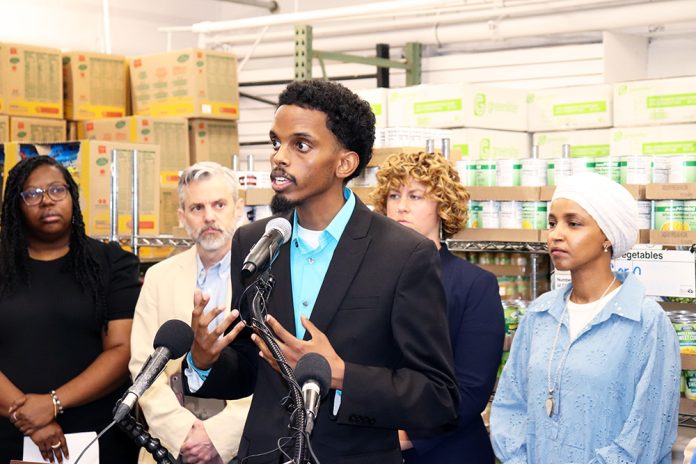
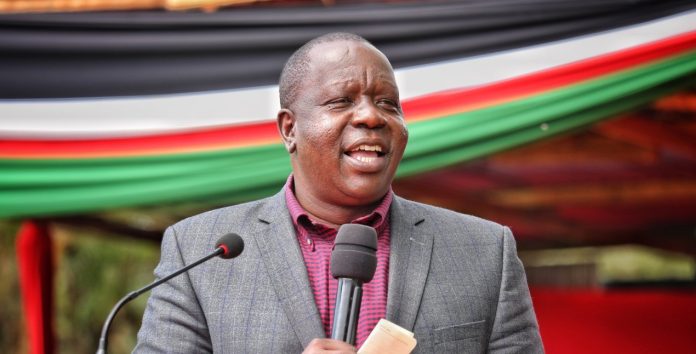
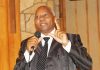
Minnesota Senator Omar Fateh speaks during a press conference on July 10, 2025 at the Sabathani food shelf in his district opposing President Trump’s “Big Beautiful Bill.” The state Democratic Party on Aug. 21, 2025 revoked the party’s endorsement of his mayoral candidacy following a successful challenge from Mayor Jacob Frey. Mshale Staff Photo by Tom Gitaa
Minnesota Senator Omar Fateh speaks during a press conference on July 10, 2025 at the Sabathani food shelf in his district opposing President Trump’s “Big Beautiful Bill.” The state Democratic Party on Aug. 21, 2025 revoked the party’s endorsement of his mayoral candidacy following a successful challenge from Mayor Jacob Frey. Mshale Staff Photo by Tom Gitaa
The Minnesota DFL’s Constitution, Bylaws & Rules Committee (CBRC), on Thursday revoked the historic endorsement of state Sen. Omar Fateh as the party’s nominee for Minneapolis Mayor following a challenge from current mayor Jacob Frey.
Fateh on July 19 received the required 60 percent of delegates at the Minneapolis DFL convention to secure the endorsement, the first time in 16 years that a candidate was able to garner enough votes to receive the coveted endorsement.
The Frey campaign within days launched a formal challenge to the state party, citing an “extraordinarily high number of missing or uncounted votes produced by the highly flawed and untested electronic voting system.”
Yesterday, Minnesota DFL chair Richard Carlbom, released the findings of the CBRC, saying “After a thoughtful and transparent review of the challenges, the Constitution, Bylaws & Rules Committee found substantial failures in the Minneapolis Convention’s voting process on July 19, including an acknowledgement that a mayoral candidate was errantly eliminated from contention.”
The mayor of a suburban St. Paul city however disagreed with the state party’s decision, saying on X that “It was clear, crystal-clear Fateh had the vast majority of support in the room, his supporters filled 2 entire sections. Frey’s didn’t even fill one.”
Mayor Zach Lindstrom of Mounds View said he was the sergeant-at-arms at the convention that handed Fateh the endorsement, and is therefore “unbiased in this race.”
“So, believe me when I tell you Fateh is getting screwed,” Lindstrom said. “I’m very disappointed that this happened to him. I saw with my own eyes someone who clearly had the room and for him to get rugged is just another reason the party approval is at an all-time low and hemorrhaging support.”
I was at this convention as Sargent at Arms, in fact this was the first convention I have ever attended. People that know me know that I call it straight and I don’t mix words. I’m also unbiased in this race. So believe me when I tell you Fateh is getting screwed. It was clear,… https://t.co/dIytPAR81M
Numerous other leaders across the state echoed Lindstrom’s sentiments, including U.S. Rep. Ilhan Omar who represents Minneapolis in Congress.
Mayor Frey on his part hailed the decision by the state DFL, saying in a statement that “”I am proud to be a member of a party that believes in correcting our mistakes, and I am glad that this inaccurate and obviously flawed process was set aside.”
Frey is serving his second term as Mayor and by going for a third term is trying to join former Mayors RT Rybak and Don Fraser as the longest serving. Rybak served for three terms while Fraser was mayor the longest at 14 years. In Fraser’s first term, mayoral terms were two years before it was changed to four years – he went on to win three 4-year terms.
Fateh was elected to the Minnesota Senate in 2020, becoming the first Somali American and first Muslim to serve in the upper house of the state legislature. He represents District 42 which includes the Phillips and Powderhorn neighborhoods of Minneapolis – including the intersection where George Floyd was killed by Minneapolis police. Frey was mayor at the time.
Sen. Fateh responded to the CBRC’s ruling via a video message on X and Facebook.
“”Twenty-eight party insiders voted to take away our endorsement behind closed doors. This group was comprised of non-Minneapolis residents, Mayor Frey supporters and even donors. This is exactly what Minneapolis voters are sick of. The insider games, the backroom decisions and feeling like our voice doesn’t matter in our own city. Frey’s team used every tactic they could, including delay and confusion on convention day, because they didn’t have the votes.”
If elected, Fateh will be the city’s first Muslim mayor and the second Black person to serve in the role after Sharon Sayles Belton.
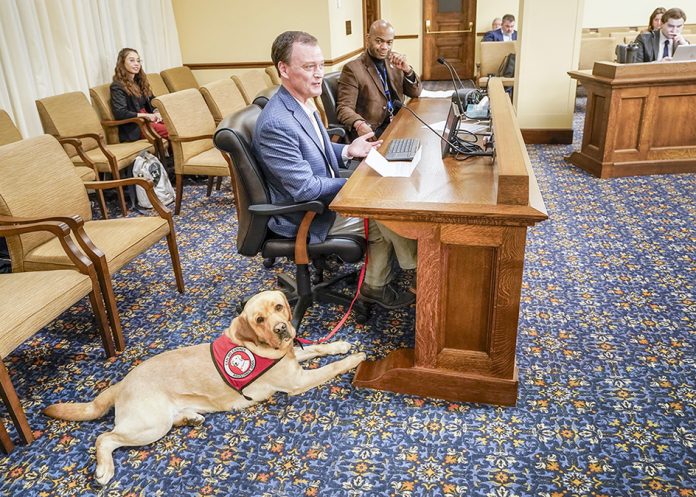
Jeff Johnson, executive director of Can Do Canines, testifies with Tucker, a 3-year-old service dog in training, during the House Housing Finance and Policy Committee Feb. 26. Johnson testified in support of a bill sponsored by Rep. Cedrick Frazier, seated right, that would modify service dog accommodations in housing such as rentals. Photo: Andrew Von Bank/Minnesota Legislature/Session Daily
Jeff Johnson, executive director of Can Do Canines, testifies with Tucker, a 3-year-old service dog in training, during the House Housing Finance and Policy Committee Feb. 26. Johnson testified in support of a bill sponsored by Rep. Cedrick Frazier, seated right, that would modify service dog accommodations in housing such as rentals. Photo: Andrew Von Bank/Minnesota Legislature/Session Daily
A Minnesota state legislator is the first to officially enter the open 2026 race to be Hennepin County’s top prosecutor.
Rep. Cedrick Frazier, 46, announced his campaign for Hennepin County Attorney on Monday in a YouTube video.
He would become the first Black county attorney in Minnesota if elected.
The race for county attorney in Minnesota’s largest county is open for the second consecutive election cycle after the current holder, Mary Moriarty, elected in 2022, announced she will not seek reelection after one term.
Frazier in his video announcement offered himself as a candidate who is qualified to fix a legal system that has failed society.
“When I look at our legal system right now, it’s clear that it continues to uphold failed policies that perpetuate cycles of violence, rather than promoting true healing for victims and meaningful accountability for perpetrators,” he said. “From the capitol to the courtrooms, we need leadership with proximity to the issues impacting our communities.”
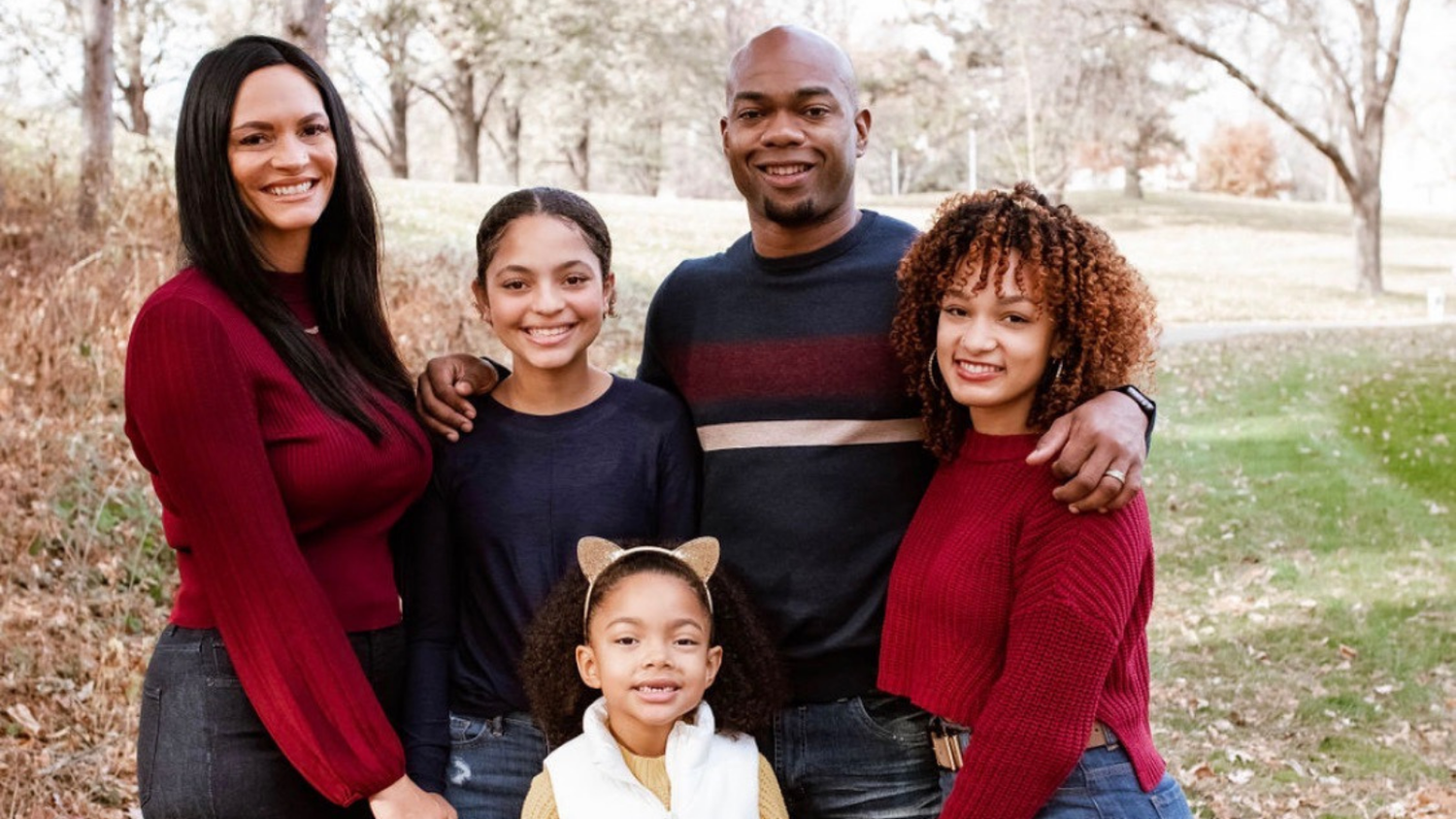
Minnesota state Rep. Cedric Frazier, his wife Stella and their three children, are seen on a photo posted on his campaign website. Frazier announced on Monday, Aug. 18, 2025 that he will run for Hennepin County Attorney in the 2026 election in which the incumbent is not seeking reelection. If he elected, he will be the first Black person to serve as a county attorney in Minnesota. Photo: Courtesy Cedric Frazier campaign.
Frazier represents District 43A in the Minnesota House, which includes the entire city of New Hope – where he lives with his wife Stella and their three children – and most of Crystal. He was first elected to the seat in 2020 and is serving his third term where he has previously been vice chair of the public safety and judiciary committees.
He is co-chair of the Minnesota House People of Color and Indigenous (POCI) Caucus alongside Rep. Liish Kozlowski of Duluth.
His day job is that of a staff attorney with the state’s powerful teachers’ union, Education Minnesota. State legislator roles are parttime where they are paid a salary of $51,750 and most of them have full time jobs elsewhere, as employees or business people.
Frazier is a native of Chicago who first came to Minnesota three decades ago to attend college on a football scholarship. He holds a bachelor’s in psychology from the University of Minnesota, Morris and a master’s degree in urban studies and local government management from Minnesota State University, Mankato. His law degree is from William Mitchell College of Law.
Prior to his legislative career, he was a public defender in Hennepin County and also served a term on the New Hope City Council, becoming the first Black person in that city to do so. A role he says that prepared him for this time. as it helped him build “trust between the police department and the community.”
He wrote on X following his video announcement that growing up in the South Side of Chicago, where gang violence and drug trafficking were prevalent, the community watched as the justice system “failed the very people it claimed to serve.”
This background, which includes him losing loved ones to gun violence, is what he says equips hm to deal with the challenges of Hennepin County.
“I’ve worked to keep guns out of dangerous hands,” he said. “I’m running for Hennepin County Attorney because I believe that public safety starts with public trust, and leadership starts with listening.”
The county attorney manages a staff of over 500 and is responsible for setting priorities on which cases are to be prosecuted, in addition to providing legal advice and representation to the county government. The office has annual budget of $69 million.
The county attorney’s annual salary is currently $224,820 after the Board of Commissioners increased it last year from $195,065. It will rise to $231,564 in 2026. In comparison, the highest paid county employees are the county administrator, who pulls in $367,415.51 and the medical examiner who is paid $358,075.29.
Frazier’s campaign has posted an endorsement from Attorney General Keith Ellison on its website.
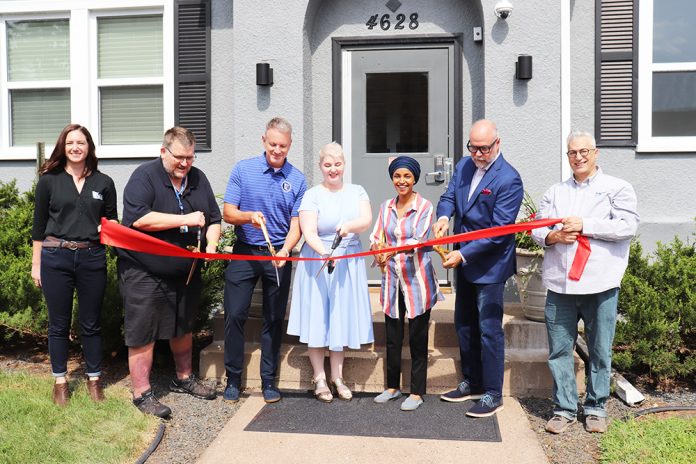
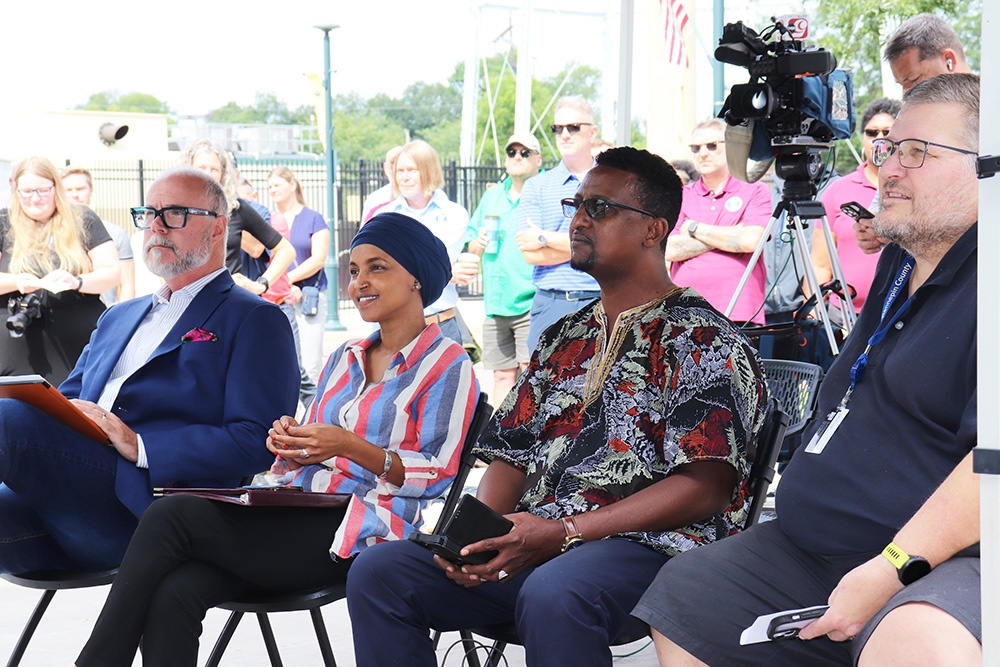
U.S. Rep. Ilhan Omar joined state and local leaders at the ribbon-cutting ceremony for new affordable housing for homeless U.S. Military veterans in Robbinsdale, Minnesota on Thursday, August 14, 2025. Mshale Staff Photo by Tom Gitaa
U.S. Rep. Ilhan Omar joined state and local leaders at the ribbon-cutting ceremony for new affordable housing for homeless U.S. Military veterans in Robbinsdale, Minnesota on Thursday, August 14, 2025. Mshale Staff Photo by Tom Gitaa
U.S. Rep. Ilhan Omar and local officials on Thursday celebrated the successful completion of a $2 million project to convert a century old hotel into affordable housing units for veterans.
The Robin Hotel building at 4628 41st Ave N. in Robbinsdale, is now officially open and will soon house U.S. military veterans in 14 one-bedroom units. The conversion of the building started in earnest in 2023 after the city council approved the conversion of the hotel into housing for veterans in the Minneapolis first-ring suburb.
The project was developed by Minnesota Assistance Council for Veterans (MCAV); a nonprofit whose mission is to end veteran homelessness in the state.
MCAV’s chief housing officer, Ms. Sara Riegle, in her remarks described how the birth of the project came about towards the tail end of the pandemic.
Robbinsdale Mayor Brad Sutton, Rep. Ilhan Omar, Mr. Ali Isse – the congresswoman’s deputy district director – and Hennepin County Commissioner Jeffrey Lunde listen as MCAV’s chief housing officer, Ms. Sara Riegle speaks at the ribbon-cutting ceremony for new affordable housing for homeless U.S. Military veterans in Robbinsdale, Minnesota on Thursday, August 14, 2025. Mshale Staff Photo by Tom Gitaa
“Jon Lovald, our COO, invited me to participate in a phone call with Julia from Hennepin County, and Julia let us know, ‘hey, we have this building, this historic building that was built in 1901. It’s coming available in downtown Robbinsdale, we want to maintain this as affordable housing, but we don’t want to manage it. Would you (MACV) be interested in managing this historic building?’” said Riegle. “And we said, well, gosh, sure, we’re just starting to build up our portfolio of landlords. We’re interested in participating in that.”
Hennepin County then contributed $1.25 million, using funds from its almost $246 million share of the American Rescue Plan Act – commonly known as COVID funds – that President Biden signed into law in 2021.
Rep. Omar, whose district includes Robbinsdale, was able to secure an additional $750,000 in federal funding for the project.
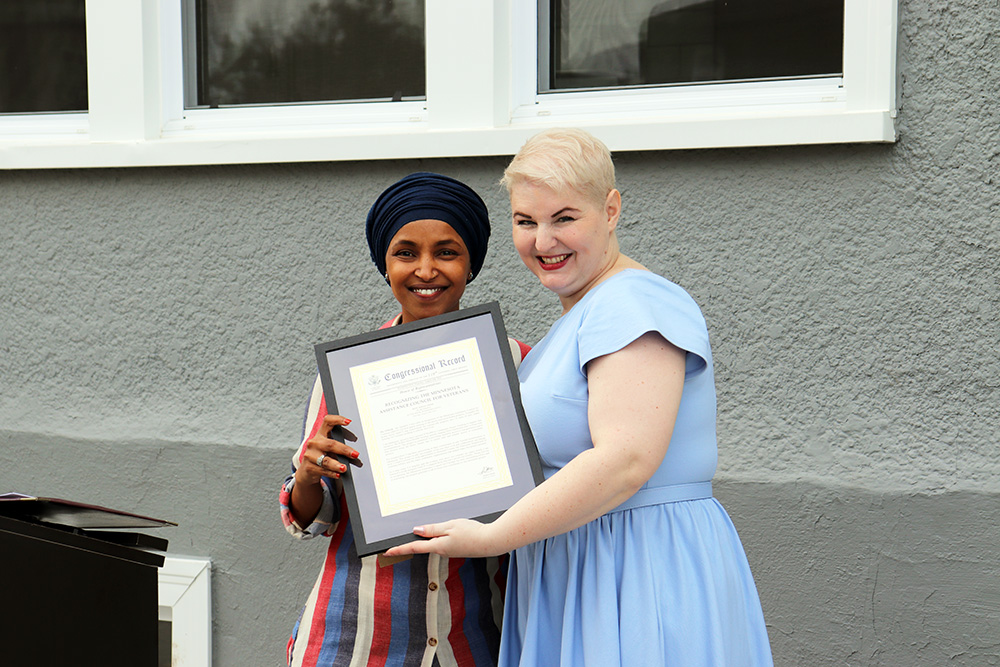
At the ribbon-cutting ceremony Thursday morning, Omar said the project’s completion has been entered into the Congressional Record which read in part “The Robin offers flexible housing options ranging from transitional stays to long-term accommodation. This project is committed to providing equitable access to transportation, and is located along metro transit lines to ensure easy and reliable access to community services.”
Omar commended MVAC for their “unwavering commitment” to end veteran homelessness in Minnesota, adding that the Robin project is one example of their work in changing lives.
According to the Minnesota Department of Veterans Affairs, there were 652 veterans in the state’s Homeless Veteran Registry in 2024, with 94 of them experiencing “recurring homelessness.” Of the 652, 59% were white, with Blacks a distant second at 27%.
As of February 2024, more than 40,000 foreign nationals were serving in active and reserve components of the Armed Forces, according to the Department of Defense. Additionally, 115,000 foreign nationals residing in the United States are veterans who have previously served on active duty.
158,000 immigrants have gained U.S. citizenship through serving in one of the branches of the U.S. military in the last 20 years, according to an estimate from The Immigrant Learning Center, a Massachusetts-based nonprofit that provides educational opportunities and resources to immigrants.
There are more than 530,000 immigrant veterans in the Unites States currently, 83% of whom are naturalized citizens, according to The Immigrant learning Center.
U.S. Rep. Ilhan Omar presents a framed Congressional Record to Minnesota Assistance Council for Veterans’ chief housing officer, Ms. Sara Riegle at the ribbon-cutting ceremony for new affordable housing for homeless U.S. Military veterans in Robbinsdale, Minnesota on Thursday, August 14, 2025. Mshale Staff Photo by Tom Gitaa
President Obama in 2014 awarded posthumous Medals of Honor to two foreign-born veterans, World War II veteran Pedro Cano and Vietnam War veteran Jesus Duran, who never received them while alive due to their ethnicities and prevailing attitudes towards soldiers of color in that era.
Robbinsdale Mayor Brad Sutton called the new housing “a shining example of what can happen when government and nonprofits work hard, and hand-in-hand, for the greater good.”
“Let us remember, every veteran who finds a home here is a reminder of our shared responsibility. Our gratitude for their service must be matched by our commitment to their well-being,” said Sutton.
Hennepin County Commissioner, Jeffrey Lunde, who represents Robbinsdale at the county board, congratulated MACV for their work in ending veteran homelessness.
“I think when we ask our people to go serve our country, and they come back with some baggage, it is our responsibility to treat them as well as when they were treating us by risking their lives on our behalf,” said Lunde. “So, again, I give credit to MACV for their work, and we look forward to continued partnership.”
After officials cut the ribbon for the official opening of the building, Rep. Omar told Mshale as she walked to her waiting car that veteran housing will continue to be a top priority for her.
Xp Lee on Tuesday, Aug. 12, 2025 won the Democratic primary to fill Minnesota House of Representatives District 34B, formerly held by the late former Speaker Melissa Hortman who was assassinated on June 14, 2025. Photo: Courtesy of Xp Lee Campaign
Xp Lee on Tuesday, Aug. 12, 2025 won the Democratic primary to fill Minnesota House of Representatives District 34B, formerly held by the late former Speaker Melissa Hortman who was assassinated on June 14, 2025. Photo: Courtesy of Xp Lee Campaign
Former Brooklyn Park City Council member Xp Lee on Tuesday won the DFL nomination to run for Minnesota’s House District 34B, left vacant after the assassination of former speaker of the House Melissa Hortman in June.
Lee received 1,186 votes or 59 percent of the 2,005 votes cast in the DFL special primary. Brooklyn Park City Council member Christian Eriksen was second with 489 votes, ahead of Hennepin County prosecutor Erickson Saye who received 330.
In the uncontested Republican primary, Ruth Bittner received 209 votes.
Special elections are characterized by low turnouts, and this one happening at the tail end of summer as voters are wrapping up their summer was especially low – less than five percent of the 26,540 registered voters took part.
Lee will now compete against Bittner in the special election set for September 16.
“To the voters of District 34B — thank you for your confidence and your vote. This campaign has always been about you — your families, your jobs, your schools, your future. Tonight’s win is not the end; it’s the beginning of the work ahead.,” Mr. Lee wrote on Facebook, just over an hour after results were announced. Regarding the person he is hoping to succeed, he said, “Melissa has been a tireless champion for our communities, fighting for working families, investing in our schools, and protecting our environment. She has set a high bar for what it means to serve, and I am grateful for her years of leadership.”
He added, “Melissa, thank you for paving the way and inspiring so many of us to step forward.”
The district is heavily Democratic and Lee is the favorite to win against Bittner in September. The late Hortman in November won a twelfth term by a convincing 63% of the vote against her Republican challenger.
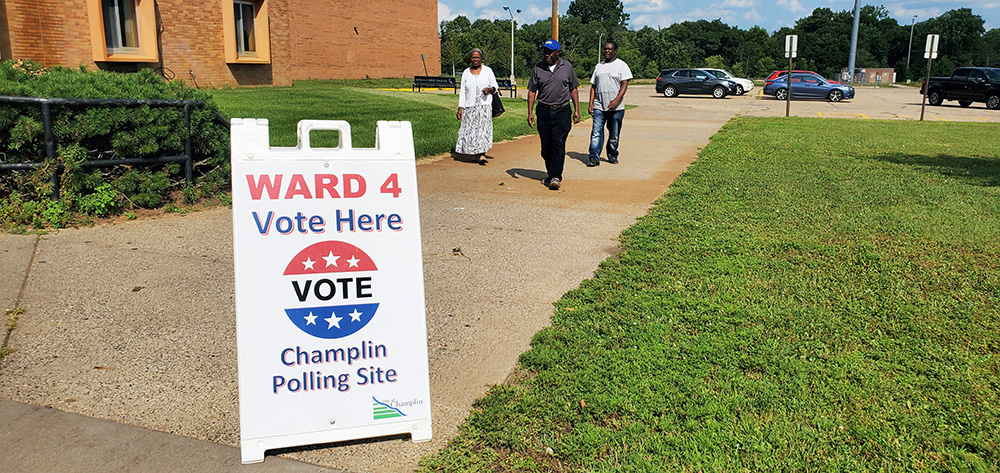
The Makora family from Champlin, mother Mary, father Charles and their son Rashid, arrive at Jefferson Middle School in Champlin on Tuesday, Aug. 12, 2025 to vote in the special primary election to fill the late Melissa Hortman’s seat. Mshale Staff Photo by Tom Gitaa
Lee’s election to the Brooklyn Park City Council also came via a special election, after he was elected on February 2022 to fill a vacant seat that was previously occupied by Lisa Jacobson who had become mayor. He served the remainder of Jacobson’s term which ended in 2024. He did not seek reelection.
In campaign literature, he described himself as a refugee, a union member, a father, and a public servant. He works at the Minnesota Department of Health as a health equity strategist.
Balance of Power
When Hortman was killed on June 14, the Legislature had already adjourned. The House of Representatives was split evenly at 67 members each for Democrats and Republicans. It does not reconvene until February 17, 2026.
Lee’s expected victory on September 16 will maintain the balance of power in the House.
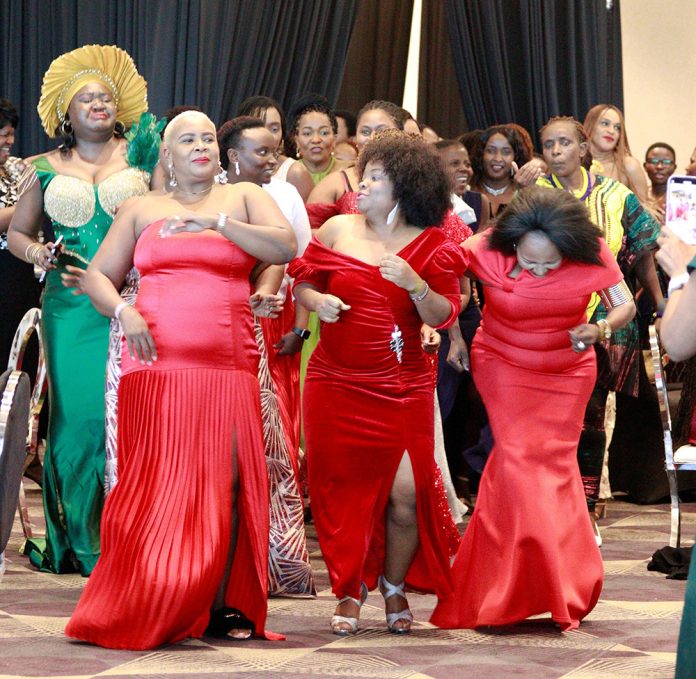
Members of the Minnesota chapter of Kenyan Women in the United States (KWITU) dance to “Ekio Nkiekio” by Mcubamba Robbah as they welcome guests during the final day of the national organization’s annual reunion and 10-year celebration at the InterContinental Riverfront Hotel in St. Paul, Minnesota on Saturday, Aug. 9, 2025. Mshale Staff Photo by Cynthia Simba
Members of the Minnesota chapter of Kenyan Women in the United States (KWITU) dance to “Ekio Nkiekio” by Mcubamba Robbah as they welcome guests during the final day of the national organization’s annual reunion and 10-year celebration at the InterContinental Riverfront Hotel in St. Paul, Minnesota on Saturday, Aug. 9, 2025. Mshale Staff Photo by Cynthia Simba
It was all pomp and circumstance Saturday, as hundreds of Kenyan women from across the United States and Canada descended on Minnesota’s Twin Cities for a gala to conclude a three-day reunion that began Thursday.
The gala was the peak of a convention that began in St. Paul on Thursday to celebrate 10 years since the founding of Kenyan Women in the United States (KWITU), an organization established to empower immigrant women from the East African country as they struggle to settle so far away from home.
Before entering the ballroom at the InterContinental Riverfront Hotel in St. Paul, women dressed elegantly in East African attire lined on a red carpet and took turns as a professional photographer took pictures of them. Others danced to the Swahili music playing in the background. The women then danced and ululated with excitement into the ballroom and settled at banquet tables decorated with bouquets of white roses. After a word of prayer and singing of both the Kenyan and American national anthems, the women were treated to dinner.
“Ten years! Ten years!” KWITU Founder and President Lilly Richards, yelled excitedly as women danced around before the events of the evening commenced. “I know how far we’ve come. We are still standing, and we aren’t going anywhere.”
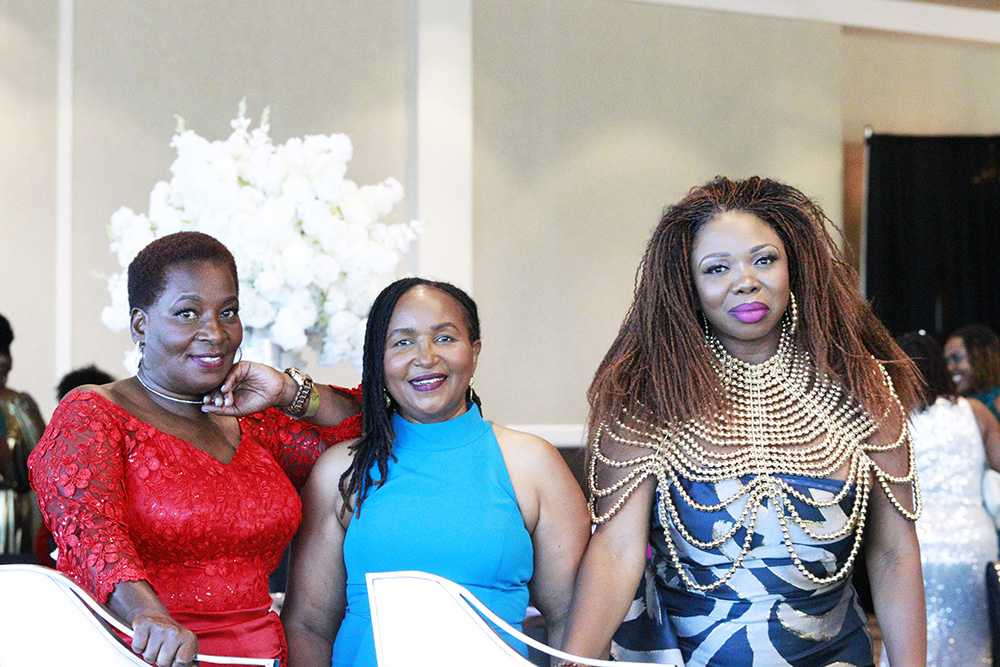
KWITU Founder and President Lilly Richards, right, with the organization’s treasurer Susan Saiyiorri and board member Aileen Anne Mucangi on the final day of the organization’s annual 3-day reunion and 10-year celebration at the InterContinental Riverfront Hotel in St. Paul, Minnesota on Saturday, Aug. 9, 2025. Mshale Staff photo by Cynthia Simba
When Annemarie Machehu first moved to the United States in 2008, there wasn’t an organization that brought Kenyan women together at the scale of KWITU. Machehu learned about the organization through a Facebook group page while living in Missouri. She joined the group during its first year, in 2015.
“You want that connection,” said Machehu, who now lives in Phoenix, Ariz., where she has a financial planning business. “What motivated me most was the women empowerment. Everyone from different backgrounds, you come together and make something great.”
Suzanne Wanja, a Kansas City based nurse practitioner who has also been a member since KWITU’s founding, said that the friendships she has formed with other women have been an integral part of her life.
Suzanne Wanja of Kansas City, Missouri enters the ballroom at the InterContinental Riverfront Hotel on the final day of the Kenyan Women in the United States (KWITU) annual reunion and 10-year celebration gala in St. Paul, Minnesota on Saturday, Aug. 9, 2025. Her chapter is bidding to host the next KWITU convention in Missouri. Mshale Staff Photo by Jasmine Webber
“One of the things about KWITU is I’ve been seeing the same faces every year,” Wanja said. “You create a bond and relationships.”
The friendships Wanja has found through KWITU go beyond just meeting once a year for conventions. Earlier in the summer, she was one of 30 women who took a group trip to Bali, Indonesia. And when it came time to launch her organic cosmetic business, she said she first consulted Richards, KWITU’s founder and president.
Her company, Tivon makes organic skincare products and is also part of her medical esthetics business where she performs various beauty procedures. The practice even offers medically assisted weight loss medications called glucagon-like peptide-1 (GLP-1), commonly known as Ozempic. The pharmacological agents work to promote weight loss by increasing glucose uptake and delaying gastric emptying which makes individuals feel full for longer periods of time.
“I get inspired a lot,” Wanja said.
Wanja is now leading a bid to host the next KWITU reunion in Kansas City, Mo. The organization has been holding reunions around the country since its founding. Members who would like to host a reunion make a bid and the honor is given to city with the most votes.
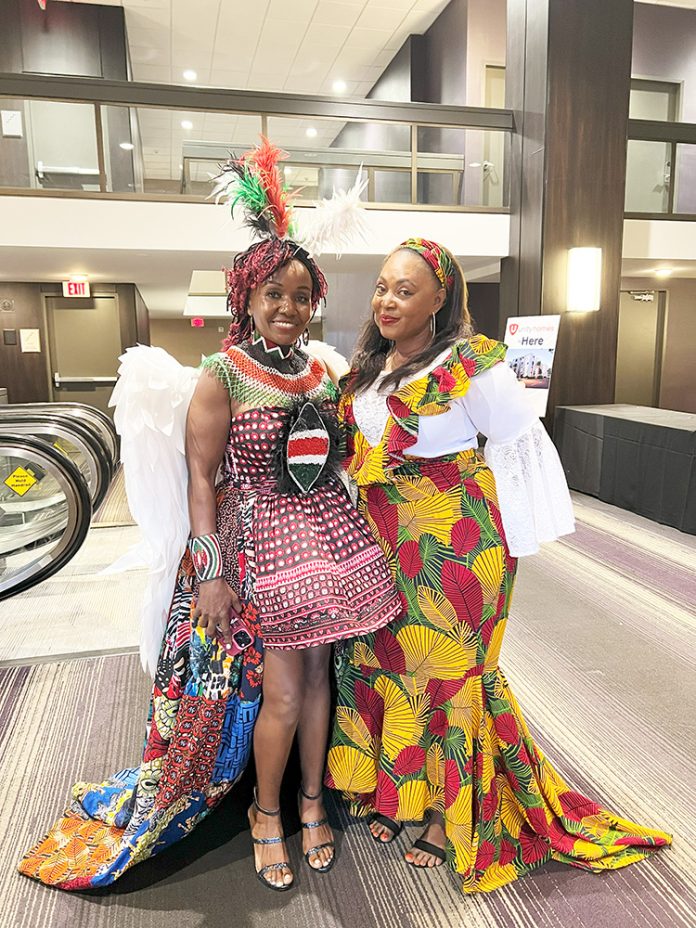
On the first full day of the Kenyan Women in the United States (KWITU) annual reunion and 10-year celebration in St. Paul, Minnesota on Friday, the women came decked in their finest African attire like these two KWITU members from New York. Mshale Staff Photo by Cynthia Simba
On the first full day of the Kenyan Women in the United States (KWITU) annual reunion and 10-year celebration in St. Paul, Minnesota on Friday, the women came decked in their finest African attire like these two KWITU members from New York. Mshale Staff Photo by Cynthia Simba
The largest organization of Kenyan women in North America began a three-day convention in Minnesota Friday to celebrate its 10th anniversary.
The convention of Kenyan Women in the United States, which is popularly known by the acronym, KWITU, brought hundreds of women from across the United States to St. Paul in what organizers called a reunion of its members.
Most attendees proudly showcased Kenyan culture by wearing kitenge, vibrant dresses with matching headgear tailored from multicolored cloth unique to East and Central Africa. Many donned earrings made with colorful traditional beads. Others wore the beaded bracelets bearing the Kenya flag and other traditional symbols.
“This is my first KWITU event, and I’m excited to be here all the way from Maryland,” Mary Kamau.
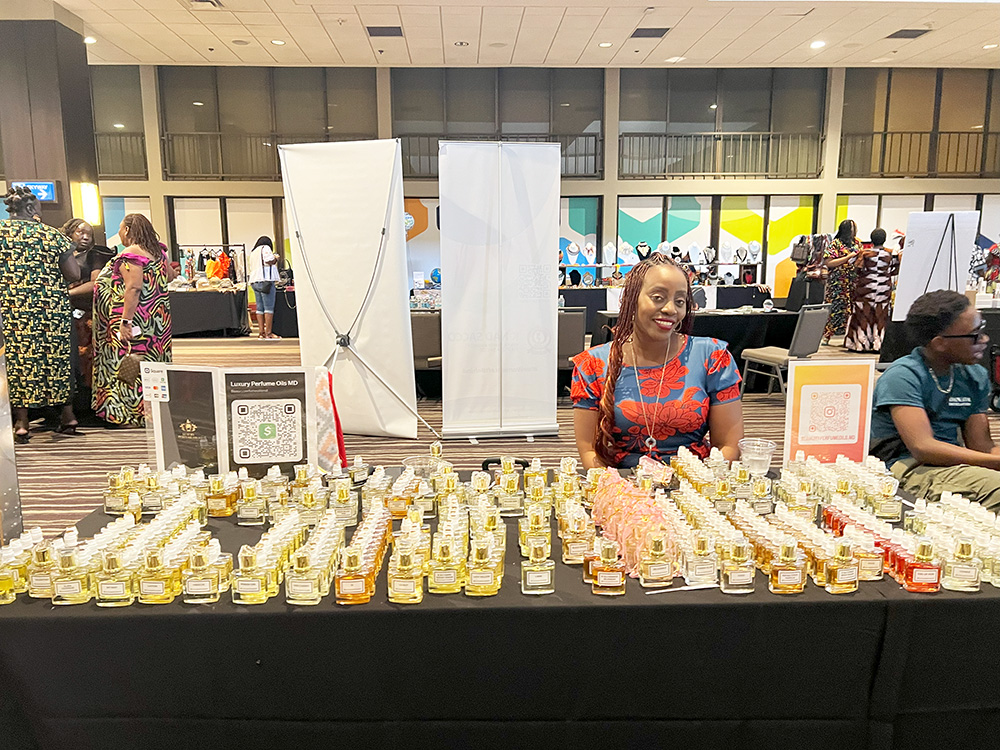
Kamau is the founder of Luxury Perfume Oils, a business she launched last year to make fragrances that mimic luxury brands but retail at a fraction of the cost. She said that she loved being a member of KWITU for social reasons, but also for the opportunities that exist for learning and growth.
“I love the fact that it has a sense of community, unity, and support for small businesses and learning about different things in life,” she said. “KWITU is a full course.”
One of the main reasons KWITU was founded is to address challenges women and young girls of Kenyan descent face. There were different panel conversations on various topics, from domestic violence and women’s health to financial literacy and entrepreneurship.
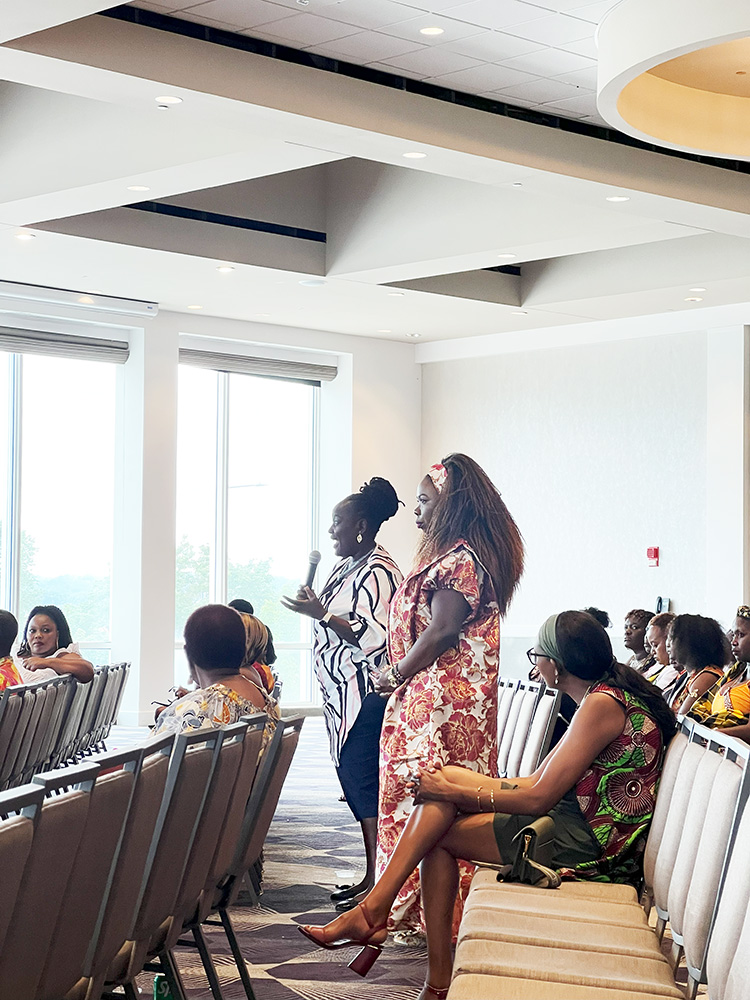
The topic of women’s health and safety, which is rarely discussed in African communities, garnered a lot of audience participation. Panel member Veronica Rotich, who lives in Minnesota, said she realized her inadequacy in health education after a near HIV scare with her partner.
“My mom never talked to me about sex,” Rotich said.
Mary Kamau, owner of Luxury Perfume Oils, at the Kenyan Women in the United States (KWITU) annual reunion and 10-year celebration in St. Paul, Minnesota. Her company is one of the many vendors at this year’s event that kicked off today concludes Saturday, Aug. 9, 2025 with a gala and keynote address. Mshale Staff Photo by Cynthia Simba
Rotich has now made it her mission to educate youth about healthy relationships and proper sex education. She is the founder of Minnesota African Youth Initiative, an organization that focuses on health education as well mental health resources for African youth.
“Parents are not comfortable, so they have people like me do it,” she said. “We need to think about helping our children,” she said. “Let’s talk to our children about healthy relationships.”
Panel members also discussed the importance of teaching children proper terms for their body part as well as appropriate behavior to help keep them safe.
Vendors with various businesses mostly owned by KWITU members had booths displaying their products and services. The ventures ranged from diaspora funeral insurance agencies, investment start-ups, real estate and land companies, to skin care and artisan products which included a Kenyan-based fashion design house completing an American tour, as well as a locally operated spice company and even a travel agency owned by a nurse.
On the first full day of the Kenyan Women in the United States (KWITU) annual reunion and 10-year celebration in St. Paul, Minnesota on Friday, after opening remarks from the founder and president Lilly Richards (right), there were panel discussions on health, financial literacy, entrepreneurship and domestic violence. The reunion weekend concludes Saturday, Aug. 9, 2025 with a gala and keynote address. Mshale Staff Photo by Cynthia Simba
Priscah Norton, who for many years worked as a chef in Kenya before she came to the United States, said the daunting task of finding spices that match the taste of her home country inspired her to start her own spice company. Based in Madison, Wis., sells East African spices that she grinds and packages herself.
“I hope people get an authentic taste of spices,” Norton said.
KWITU was founded by Lilly Richards in 2015. After experiencing difficulties navigating life in the United States on her own as an immigrant, she said she wanted to create an organization that offered guidance and resources for new arrivals to help them in their transition to the United States from Kenya.
“When I came here, I was young and I was alone,” Richards told Mshale in a past interview.
Afrocontigbo, a Little Africa festival mainstay, perform at this year’s edition on Sunday, Aug. 3, 2025 in St. Paul, Minn. Mshale Staff Photo by Cynthia Simba
Afrocontigbo, a Little Africa festival mainstay, perform at this year’s edition on Sunday, Aug. 3, 2025 in St. Paul, Minn. Mshale Staff Photo by Cynthia Simba
The Little Africa festival returned to St. Paul for the 11th year, as members from African communities came to showcase their cultures and support their businesses.
“It means a lot to me because it brings together different cultures, awareness, businesses,” said Ugandan-born John Kisekka. “There is plenty of food. I encourage all Africans to come meet, socialize, make new friends, and engage in business.”
Kisekka, a deejay who professionally goes by the name of DJ Johnie, said that he hoped the festival achieves the goal of celebrating and raising awareness for African cultures in the Twin Cities. He moved to the United States from Uganda more than two decades ago and began working as a deejay not only as a means of earning money but also to promote African music.
The American Afar diaspora pose for a photo as they get ready to perform a dance celebrating the culture of the Afar people at the Little Africa festival on Sunday, Aug. 3, 2025 in St. Paul, Minn. The Afar ethnic group can be found in Ethiopia, Djibouti, and Eritrea. Mshale Staff Photo by Cynthia Simba
The festival, which was organized by African Economic Development Solutions (AEDS) to promote African culture and business in the Twin Cities, took place on Aug. 3, in Saint Paul at Hamline Park near Little Africa Plaza. Multiple streets in the area were closed to vehicles giving festival goers plenty of space to explore the dozens of vendors, small businesses, and community organizations representing various nationalities from both the African continent and the diaspora.
The event opened with a parade, followed by a performance by Kalpulli Yaocenoxtli, a Native American dance group dedicated to preserving indigenous culture through dance. Starting the performances with the group was special homage to the rich Native American culture that preceded the United States.
The event hosted lots of vendors and food trucks where hundreds of festival goers sampled foods from various African cultures as well as fusion meals and drinks from around the world. Attendees could purchase jollof rice, Jamaican jerk chicken, lemonade, Asian bubble tea, as well as matcha lattés from a newly established pop-up café owned by a first generation Ethiopian American.
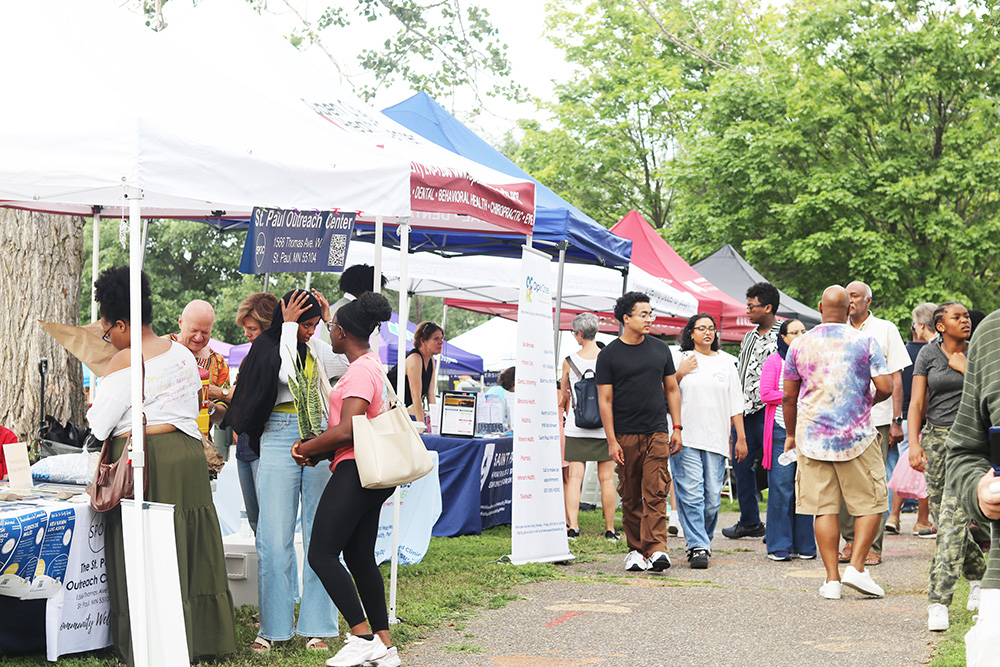
Festival goers check out the many vendors at the annual Little Africa festival held in St. Paul, Minn. on Sunday, Aug. 3, 2025. Mshale Staff Photo by Cynthia Simba
The women from Mama’s Market and Deli, also performed an Ethiopian coffee ceremony which involved roasting, brewing, and serving coffee in three rounds. Mama’s Market and Deli is one of the newest small businesses to open inside Little Africa Plaza with the help of AEDS. The market is owned and operated by nine immigrant women and offers deli sandwiches, smoothies, and Ethiopian specialty coffee, among other items.
African immigrant business ownership has increased drastically in recent years, doubling between 2017 and 2022. The growth has been fueled in part by organizations such as AEDS and the African Development Center, which have been committed to sharing resources and securing business loans for new ventures. With increased access to funding and business education, African-born entrepreneurs and their descendants have established enterprises to meet the needs of their communities.
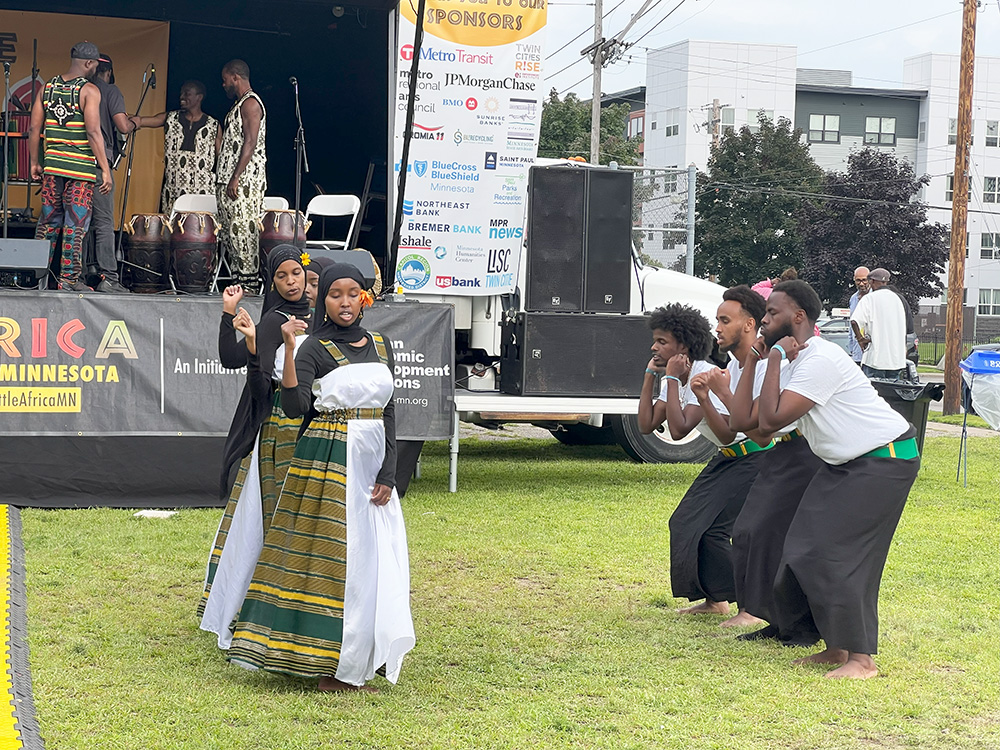
Members of the Somali Museum Dance Troupe at the Little Africa festival on Sunday, Aug. 3, 2025 in St. Paul, Minn. Mshale Staff photo by Cynthia Simba
The population of Minnesotans who identify as African has increased in the past several decades. The increase in mainly attributed to the arrival or Somalis and Ethiopians, most of who came as refugees. There are also significant populations of Kenyans, Liberians, and Nigerians.
But the festival didn’t attract only people with direct ties to Africa. Milwaukee transplants and St. Paul residents, Carrie Cattlett and Luke Jacobs came to the event because they live in the area and wanted to support one of their favorite local businesses.
Innocent Reggae Band performs at the 11th Little Africa festival as children join in the dancing on Sunday, Aug. 3, 2025 in St. Paul, Minn. Mshale Staff Photo by Cynthia Simba
“This is literally in our neighborhood,” Cattlett said.
“Mama’s market is right next to our house, and we love them,” Jacobs said. “So, we wanted to come here and support them and also see everything else that the African festival has.”
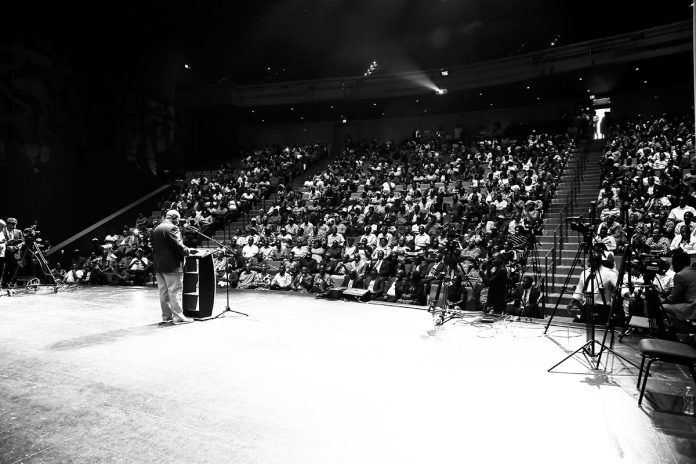
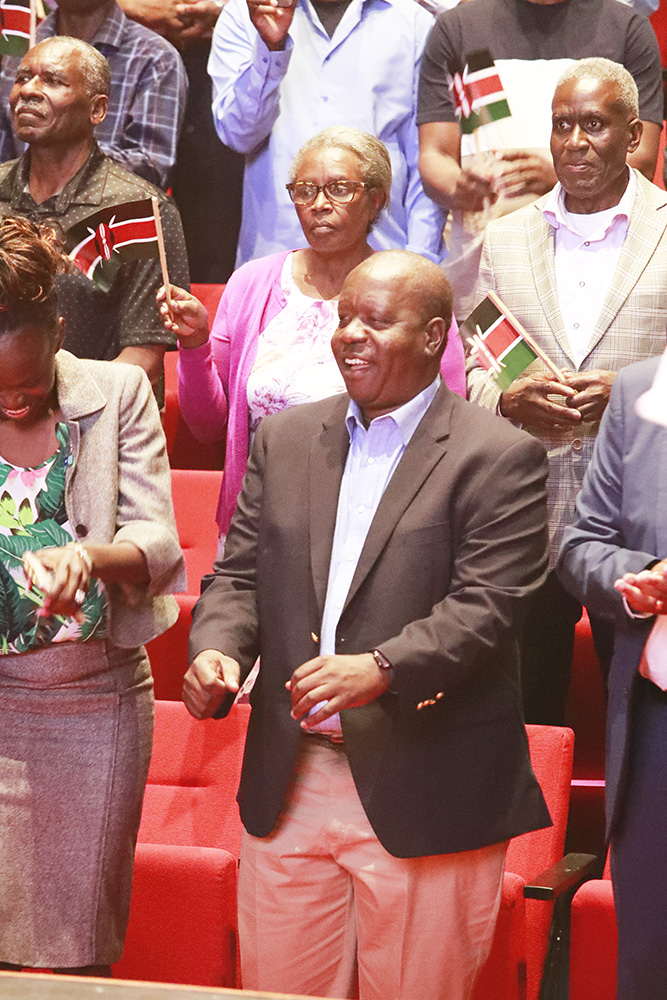
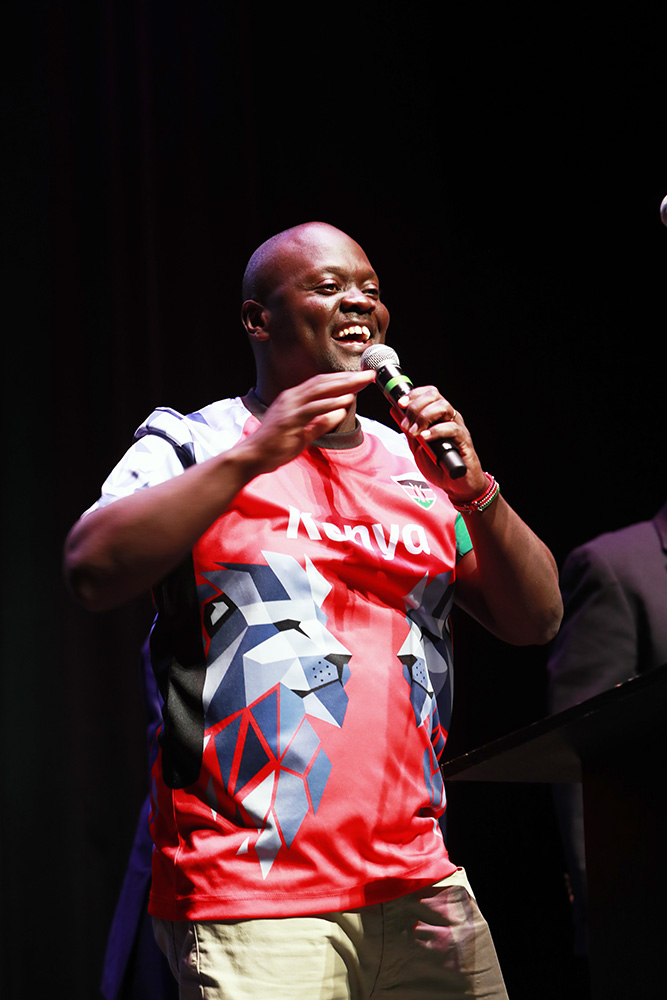
Kenyan presidential candidate Dr. Fred Matiang’i addresses Kenyans in Minnesota at the 1,000-capacity theater inside Ames Center in Burnsville, Minnesota on Sunday, Aug. 3, 2025. Mshale Staff Photo by Richard Ooga
Kenyan presidential candidate Dr. Fred Matiang’i addresses Kenyans in Minnesota at the 1,000-capacity theater inside Ames Center in Burnsville, Minnesota on Sunday, Aug. 3, 2025. Mshale Staff Photo by Richard Ooga
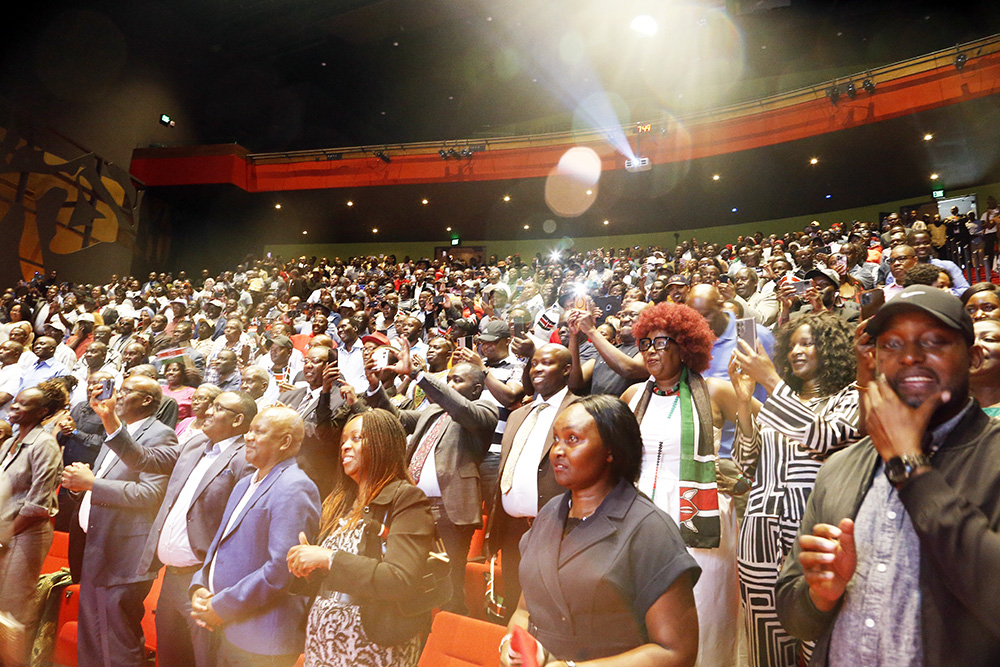
The Ames Center’s 1,000 seat main theater in Burnsville which on a regular basis hosts theatrical plays and concerts – such as the “Takin’ It To The Limit” EAGLES tribute” next month – was filled to capacity on Sunday, but it wasn’t a play or concert that Kenyan Americans drove hours to see.
A Kenyan presidential candidate, Dr. Fred Okeng’o Matiang’i, was in Minnesota for a two-day visit and Sunday evening was the climax of it all with a free event to address the large Kenya community in the state. The night before, over 200 turned out for a $250 per person dinner at the Brooklyn Park Marriot and a few dozen showed up Sunday for a ‘By Invitation Only’ $1,000 per person breakfast at the sprawling home of a Kenyan American in Maple Grove.
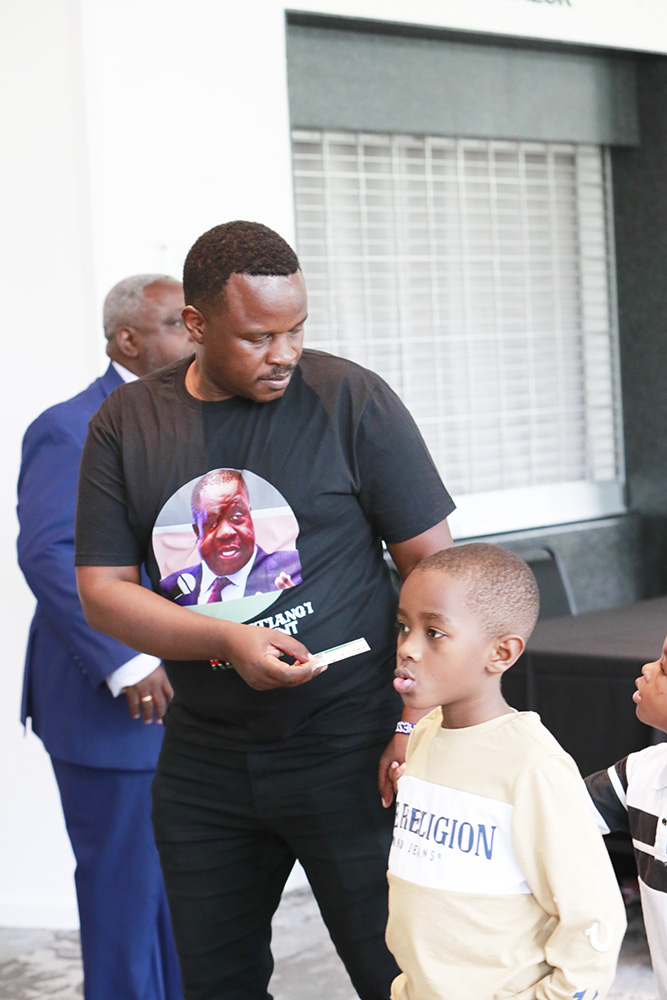
They came wearing his face on their chests, waved Kenyan flags, chanted his name and danced to patriotic songs at the urging of Mr. James Gichana of Egesa FM, who revved up the crowd as they awaited the arrival of their special guest. Gichana, a popular radio host in the vernacular radio station, has been a constant presence in the latest iteration of the Matiang’i diaspora roadshow.
Kenyan presidential elections are not until 2027, but the citizens of east Africa’s economic powerhouse got buyer’s remorse less than two years after electing President William Ruto in a disputed election. Ruto won by just 233,000 votes out of over 14.3 million that were cast, foreshadowing his unpopularity that came in quick fashion. A popular youth revolt against high taxation and corruption dubbed the “Gen Z Protests,” almost toppled his fragile government last year with an angry citizenry storming parliament forcing members, except for one, to flee through an underground tunnel.
Ruto being “the most hated man” in the country has put the country in the mood for change as the cost of living has increased by most metrics since he took office, and he has also become more autocratic. This has led to an earlier than usual campaign and the emergence of candidates hoping to limit him to one term. It is not a horse race yet, but three candidates are considered frontrunners – Dr. Matiang’i; immediate former deputy president Mr. Rigathi Gachagua and the country’s former vice president Mr. Kalonzo Musyoka.
Remittances to Kenya by its diaspora hit a record 4 billion dollars in 2023, with most of it coming from the United States. Presidential campaigns in Kenya, especially those not enjoying incumbency, have a diaspora outreach unit as part of their campaign toolkit. They are a source of both campaign funds – like the two fundraising events held by Matiang’i in Minnesota – but even more importantly, they command significant influence with kin and friends back in Kenya.
Over 3 million Kenyans live in the diaspora, according to the International Organization for Migration, a UN agency. The United States accounts for the largest single bloc of them at close to 157,000 (5%) – which many believe to be an undercount – and Minnesota is one of the largest states with Kenyans at close to 20,000.
A man wearing a Fred Matiang’i t-shirt arrives with his children at the Ames Center in Burnsville, Minn. where the Kenyan presidential candidate addressed Kenyans in the state on Sunday, Aug. 3, 2025. Mshale Staff Photo by Richard Ooga
Out of the three candidates, Matiang’i is the first to bring his campaign to Minnesota. Him and Gachagua have been in the U.S. for the last few weeks, visiting various states with large numbers of Kenyans. Dr. Kefa Otiso, one of the speakers at Sunday’s event said Minnesota is one such state. Otiso is a professor at Bowling Green State University where he does research on urban and economic geography with, an expertise in remote sensing and geoinformatics (GIS) applications.
Otiso urged a future Matiang’i government to give Kenyans in the U.S. what they need, which is “more consulates and more voting centers as the majority of Kenyans live here in the middle, the Midwest, at least in these eight cities.” He named cities that are deserving of a consulate in the order of their population strength (of Kenyans) with the Minneapolis/St. Paul metro at the top followed by Dallas, Seattle, Atlanta, Chicago, Boston, Kansas City and Columbus, OH. Kenya has an embassy in Washington DC and a consulate in Los Angeles and New York.
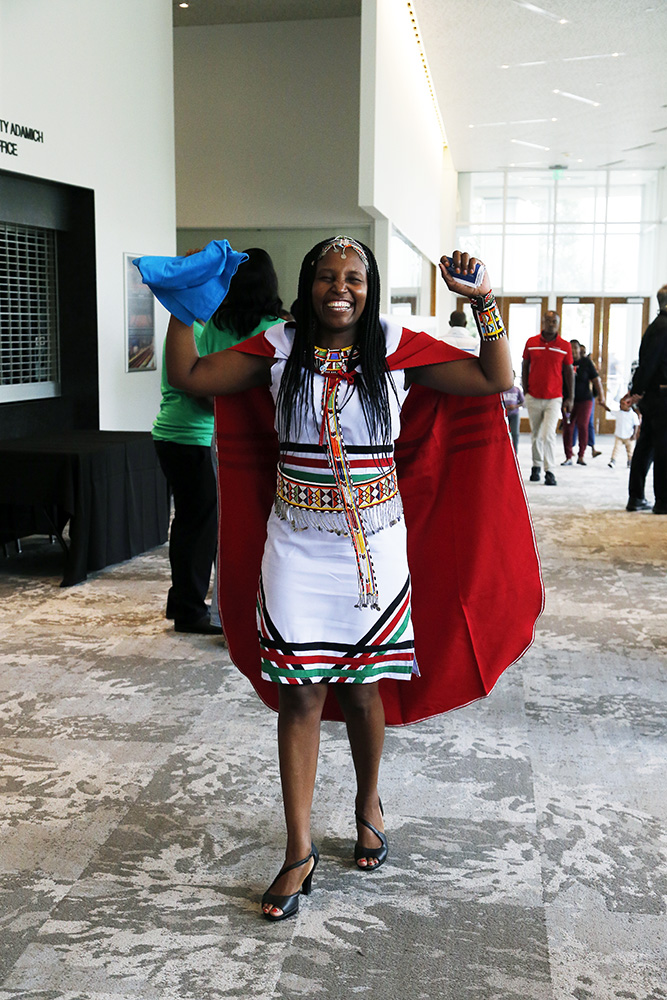
A woman wearing the colors of the Kenyan flag expresses joy after entering the venue where Kenyan presidential candidate Dr. Fred Matiang’i was about to address Kenyans in Minnesota in Burnsville on Sunday, Aug. 3, 2025. Mshale Staff Photo by Richard Ooga
Chanting “you are the 6th”, referring to Matiang’i as the sixth president, the crowd welcomed him with cheers and applause as he took to the podium to give his much-anticipated address.
Matiang’i, a former interior minister, presented himself as a man of action and a great supporter of the diaspora and their aspirations, praising them as Kenya’s greatest ambassadors.
“We cannot only have your money without your voice, we must now have your voice,” he said.
He said he also supports the establishment of up to 20 polling centers for Kenyans in the U.S. to vote in the upcoming 2027 elections where he is expected to be on the ballot, revealing that he is already working with diaspora leaders that are lobbying to make it a reality.
“Let me ask you a question, sometimes we also have to be serious. I think that’s what frustrates me about what is happening in our country. How do you expect someone to fly from Houston to go and vote in Washington?” he said. “Honestly, does it make sense? Let’s be serious.”
Kenyan presidential candidate Dr. Fred Matiang’i shakes a leg alongside Kenyan-born Rep. Huldah Momanyi Hiltsley of the Minnesota House of Representatives as dancers entertain the crowd, moments before he took the stage to addresses Kenyans at Ames Center in Burnsville, Minnesota on Sunday, Aug. 3, 2025. Mshale Staff Photo by Richard Ooga
Kenyans in the U.S. can only vote at the embassy in Washington, or the New York and Los Angeles consulates. The diaspora has pushed the electoral body in charge of elections to scrap the requirement that only consular locations can serve as polling places, and instead bring voting locations to areas with large numbers of Kenyans. In the 2022 presidential election for instance, a paltry 744 were registered as voters at the Washington embassy and two consulates combined.
Matiang’i criticized recent talk from key members of the Ruto regime about ending universal free primary education that was enacted by the country’s third president, Mwai Kibaki, a move that won the country global acclaim. He termed such talk as regressive.
“One million kids went to school. One million. In fact, you have seen the clip doing rounds where President Clinton says that if there is one person he wished to meet that time, it was President Kibaki,” he told the crowd. “What we have in our country is government by excuses.”
Hon. Antoney Kibagendi, a member of the Kenyan Parliament and one of the MPs that voted against the controversial Finance Bill 2024 that caused GenZ to take to the streets and ultimately breach parliament buildings when it passed, warms up the crowd as he introduces Dr. Matiang’i to address Kenyans at the Ames Center in Burnsville, Minnesota on Sunday, Aug. 3, 2025. Mshale Staff Photo by Richard Ooga
Matiang’i offered he will be a great steward of the Kenyan economy saying that the economic mismanagement and heavy taxation is making many lose their minds.
Prior to Dr. Matiang’i speaking, four GenZ youth were given a chance to address the audience, with one of them pointing out the mental health challenges Kenyan youth are facing.
Matiang’i, who at one time served as the minister for education, opined some of the mental health issues can be addressed by fixing broader societal and governance issues
“Half of the reasons why we have mental health problems in our country is because of the ecosystem and environment in which we live. If you graduated six years ago, you have no job, your brother has no job, your sister has no job, your mom has no job, your father is earning a miserable salary, paying a house you will never go into. How would you remain sane? How would you remain sane?” he said. “That’s why we have these challenges. The young people are going through these issues because of the challenges we have in the country.”
The crowd cheers, and some use their phones to record the moment Kenyan presidential candidate Dr. Fred Matiang’i took to the stage to address them at Ames Center in Burnsville, Minnesota on Sunday, Aug. 3, 2025. Mshale Staff Photo by Richard Ooga
Mr. Charles Chesumbai, a realtor from Shakopee, said he came with an open mind but at the end of the meeting told Mshale he is very excited for a potential Matiang’i presidency, because the former minister doesn’t come across as a “typical politician.”
“He is a very honest person, he is more of a civil servant that is into service delivery which is what we want in the country,” he said. “He is not like these politicians that come here and all they talk about is politics and not how we can fix things.”
Others however did not need any convincing from Dr. Matiang’i, as they already view him as the country’s next president. They were just there to meet and cheer him on.
“I came to see the sixth, I am so impressed by him as I see there is light at the end of the tunnel, and feel he will be the one to help us fight corruption and the problems our country is facing right now” said Ms. Naomi Maangi, a psychiatric nurse practitioner who lives in Ramsey.
Two ladies that were in conversation with her before our interview listened in and nodded in agreement.
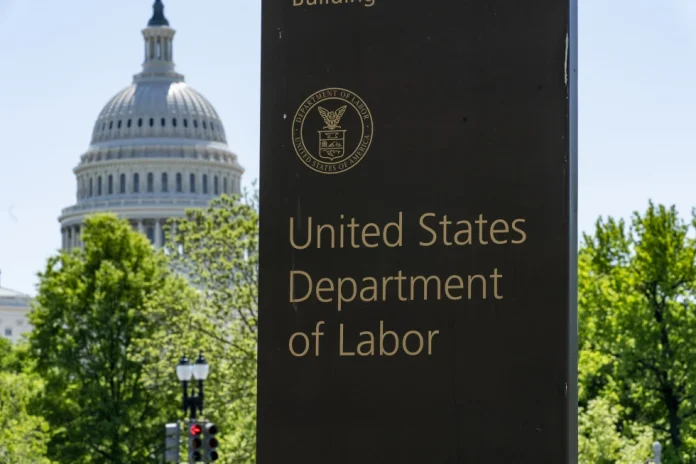
The entrance to the Labor Department is seen near the Capitol in Washington, May 7, 2020. Photo: J. Scott Applewhite/AP File
The entrance to the Labor Department is seen near the Capitol in Washington, May 7, 2020. Photo: J. Scott Applewhite/AP File
A new 16-page issue brief by the Joint Center for Political and Economic Studies warns that federal industrial policy investments aimed at advancing economic opportunity for Black communities are under threat, as the Trump administration eliminates key diversity, equity, and inclusion (DEI) provisions and slows the disbursement of funding.
“These investments offer a window to increase Black workers’ access to ‘good jobs’—jobs that offer family-sustaining wages, benefits, wraparound supports, and career advancement opportunities,” Dr. Smith Finnie wrote.
The IIJA, signed into law in 2021, authorized $1.2 trillion to modernize roads, bridges, and broadband infrastructure. The CHIPS and Science Act of 2022 invested $280 billion to strengthen the semiconductor industry and build a skilled workforce. The IRA, also passed in 2022, used tax credits and grants to support clean energy projects, particularly in low-income areas and communities harmed by pollution.
The report notes that these laws included intentional equity components—such as labor protections, apprenticeship incentives, environmental justice programs, and wraparound workforce services—but many of those components are now being rolled back or underfunded.
“In 2025, the Trump administration eliminated many of the diversity, equity, and inclusion initiatives in industrial policy legislation,” the report states. “Currently, significant funding is being slowly dispersed, paused, or clawed back, impacting the economic mobility of Black workers.”
According to the Joint Center, the programs have already reached over 99 percent of high-poverty counties. Cities with large Black populations, including Baltimore, Augusta, New Orleans, and Raleigh, were among those set to receive millions to improve infrastructure and launch workforce development hubs through community colleges.
In Detroit, IIJA funding is being used for the I-375 Community Reconnection Project to reconnect two historically Black neighborhoods severed by highway construction. Under the CHIPS Act, the Department of Commerce awarded $184 million to six Recompete Pilot Program finalists, including $20 million to Reinvest Birmingham, which is scaling up workforce development and transportation access to reduce the city’s high Black unemployment rate.
The IRA directed approximately $55 billion to reduce local pollution and support environmental justice efforts. Seventy percent of clean energy investments under the law have been in counties with lower employment rates, 78 percent in areas with below-median household incomes, and 86 percent in regions with below-average college graduation rates.
In Prince George’s County, Maryland, a majority-Black jurisdiction, ten communities will receive $20 million through the Environmental and Climate Justice Program to support climate resilience, reduce energy costs, and grow a clean energy workforce.
Despite these investments, the Joint Center found that many Black-led and Black-allied organizations remain under-informed and under-resourced. A foundational network of eight such organizations participated in the project, with 60 percent engaged in federal policy. Yet most expressed unfamiliarity with the industrial policy agenda and cited barriers, including limited staff, insufficient technical support, and a lack of targeted outreach.
Participants had applied for broadband grants and climate-related funding but struggled to navigate the complex process or receive adequate guidance. To address these gaps, the Joint Center hosted virtual sessions with policy experts from academia and the Biden administration, providing opportunities to learn about funding pathways, federal priorities, and equity initiatives.
The report provides a set of messaging principles for Black-led and Black-allied organizations, including the importance of highlighting Black workers’ economic contributions, addressing historic exclusion from skilled trades, and advocating for place-based investments and better data tracking. “Industrial policy must ensure our communities have clear access to good jobs, high wages, and meaningful training opportunities,” the report states.
It also calls on funders to support Black-led research, researchers to track equity outcomes, employers to implement fair hiring and advancement practices, and training providers to build accessible career pathways in technology and manufacturing.
“Funding and workforce development opportunities must be accessible for Black workers and Black-led and allied organizations,” the brief states. “Defunding industrial programs now would reduce opportunities for Black workers to thrive and take part in the industrial sector before these initiatives take root.”
Kenyan presidential candidate Dr. Fred Matiang’i will bring his diaspora campaign roadshow to Minnesota when he meets with Kenyans living in the state on Aug. 2 and Aug. 3, 2025. Photo: X/Otwoma The Brand
Kenyan presidential candidate Dr. Fred Matiang’i will bring his diaspora campaign roadshow to Minnesota when he meets with Kenyans living in the state on Aug. 2 and Aug. 3, 2025. Photo: X/Otwoma The Brand
A University of Nairobi professor has described President William Ruto of Kenya as “the most hated man” in the country, just a year after a popular uprising by youth protesting high taxation, dubbed the “Gen Z Protests” almost toppled his government.
The president’s image will take another hit this weekend when one of the candidates seeking to make him a one term president in the next election, Dr. Fred Okeng’o Matiang’i, makes a visit to Minnesota to meet with the large Kenyan community. Matiang’i served as interior minister in the preceding administration of President Uhuru Kenyatta – of which Ruto was the deputy president.
On Sunday, Aug. 3, he will address a free town hall style event dubbed “The Kenya We Deserve” at the 1,000 capacity Ames Center in Burnsville.
Announcements on Kenyan community forums and WhatsApp groups have been reminding people to register for the free event to ensure admission.
The free town hall event will be preceded the night before with a $250 per person “Dinner with Matiang’i” at the Brooklyn Park Marriott on Saturday, Aug. 2.
“This is more of a listening tour for Dr. Matiang’i as he wants to hear what Kenyans here in Minnesota have to tell him regarding the issues the country is facing,” Dr. John Makori, chair of the local host committee, told Mshale.
Remittances to Kenya by its diaspora hit a record 4 billion dollars in 2023, with a majority of the money coming from the United States. Presidential campaigns in Kenya, especially those not enjoying incumbency, have a diaspora outreach unit as part of their campaign toolkit. They are a source of both campaign funds and the influence they wield back in Kenya – in their villages and towns.
In 2020 as the pandemic got started, over 3 million Kenyans lived in the diaspora, according to the International Organization for Migration, a UN agency. The United States accounts for the largest single bloc of them at close to 157,000 (5%) – which many believe to be an undercount – and Minnesota is one of the largest states with Kenyans at close to 20,000.
Besides Matiang’i, two other candidates have also emerged seeking to challenge President Ruto. One of them is his former deputy, Mr. Rigathi Gachagua, whom the president engineered a successful impeachment against in parliament. The other is the country’s former vice president Kalonzo Musyoka. The vice president title was changed to deputy president in a new constitution promulgated in 2010.
Of the three, its Gachagua and Matiang’i that to date, have demonstrated robust diaspora campaign outreach efforts. Both are currently traversing the United States visiting with the diaspora in states with large numbers of Kenyans.
Constitutionally, Gachagua is barred from holding public office following his impeachment, but he has petitioned the courts for it to be overturned. In the meantime he launched a new political party in May (Democratic for Citizens Party – DCP) and has become a major critic of the Ruto regime, to the delight of many Kenyans.
Earlier this month Gachagua launched a party branch office in Seattle. Under the U.S. Foreign Agents Registration Act (FARA), it’s a requirement for any foreign political party to register its presence – in practice this is done by requiring those acting as “agents of foreign principals” to register with the Department of Justice and disclose their relationships and activities. As of the time of this writing, a search for DCP, or those acting on its behalf did not appear to have registered yet with the Justice Department.
Matiang’i has yet to declare his party, but Makori said once that happens, he expects a chapter to be set up in Minnesota.
“What would probably happen first is for those of us here in the U.S. a national secretariat for the party will be set up and then we will have state chapters like here in Minnesota, when possible,” said Makori.
An earlier version of this story did not have the apostrophe in Okeng’o. We regret the error.
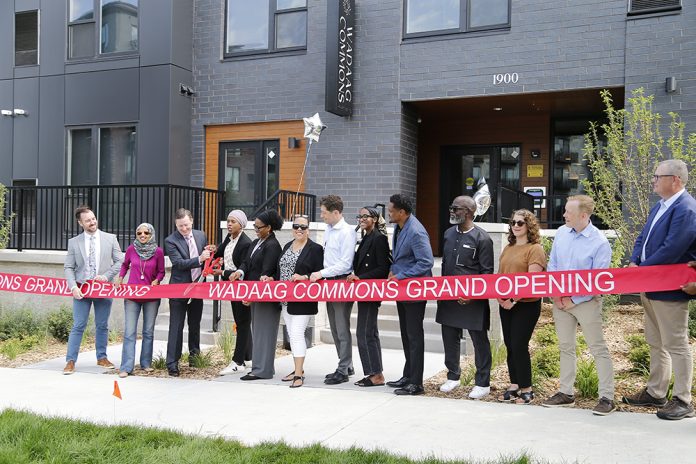
Rep. Ilhan Omar and Mayor Jacob Frey alongside Hennepin County Commissioner Angela Conley were some of the leaders at the ribbon-cutting ceremony for the new 39-unit affordable housing complex Wadaag Commons in the Seward neighborhood of Minneapolis on Tuesday, July 29, 2025. Mshale Staff Photo by Richard Ooga
Rep. Ilhan Omar and Mayor Jacob Frey alongside Hennepin County Commissioner Angela Conley were some of the leaders at the ribbon-cutting ceremony for the new 39-unit affordable housing complex Wadaag Commons in the Seward neighborhood of Minneapolis on Tuesday, July 29, 2025. Mshale Staff Photo by Richard Ooga
The wait is over for families that have been waiting for the completion of Minneapolis’ newest affordable complex in the Seward neighborhood.
The grand opening of Wadaag Commons was celebrated by U.S. Rep. Ilhan Omar, Minnesota Housing Commissioner Jennifer Ho, Hennepin County Commissioner Angela Conley, Mayor Jacob Frey, Councilman Jamal Osman and project partners on Tuesday, July 29, with a ribbon-cutting ceremony.
Wadaag – the Somali word for sharing – was developed by Noor Companies, an affordable housing developer that also rebuilt the Target on Lake Street that was destroyed during the George Floyd uprising – as well Estes Funeral Chapel in North Minneapolis, the only Black-owned funeral home in the Twin Cities.
“It’s built with premium materials, 60% of this building is brick and it should last more than 100 years,” said Nawal Noor, CEO of Noor Companies. “Solar panels will be going on the roof. Because I truly believe that everyone deserves a sustainable home and a beautiful place that they can go to.”
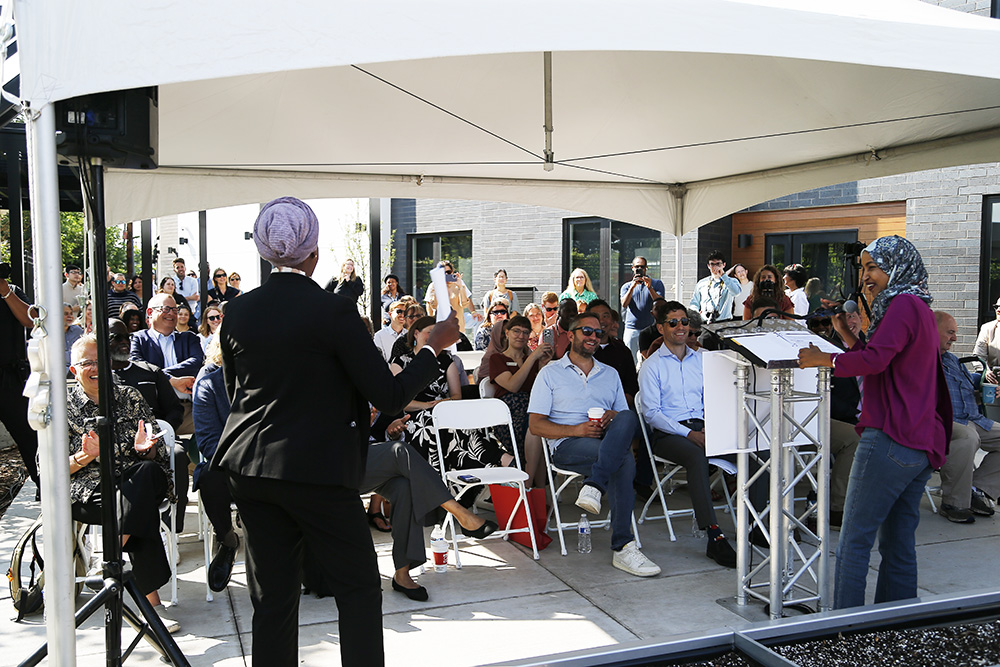
U.S. Rep. Ilhan Omar draws a reaction from the crowd as she calls Nawal Noor, developer of Wadaag Commons, to the podium to accept the Congressional Record honoring the affordable housing development during the ribbon-cutting on Tuesday, July 29, 2025 in Minneapolis. Mshale Staff Photo by Richard Ooga
The development consists of 39 units that are three- and four-bedrooms and will cater to the large East African families that Mayor Frey said was critical because “families deserve to have the space so that not everyone is directly on top of one another.” The city of Minneapolis contributed $14 million to the project and the mayor said “It’s worth every dollar.”
The transit-oriented complex also has a playground and features modern amenities like electrical vehicle charging stations, bike racks, a sundeck and garages. A special feature of the playground is that it has lighter color tones and some sensory features to cater to children on the autism spectrum.
Commissioner Conley said the county will continue to prioritize housing projects like Wadaag that “uplifts the humanity of the families and the individuals that will become our future neighbors.” Her point was echoed by Councilmember Osman who represents the area where the complex is located. Osman also chairs the City Council’s business housing and zoning committee and said that when projects come before his committee “first thing I ask is like, ‘do we have a large unit here?’ I know it’s not economically smart for some of the developers to build large units, but there are families with seven kids, eight kids, there are families with special needs that need that extra room.”
Attendees at the ribbon-cutting ceremony for the new 39-unit affordable housing complex Wadaag Commons in the Seward neighborhood of Minneapolis on Tuesday, July 29, 2025 are given a tour of the new units. Mshale Staff Photo by Richard Ooga
A total of $28 million in public investments went into the project from federal, state, county and city funding. Noor Companies was the lead in the project that included a partnership with Minneapolis-based nonprofit developer Redesign and U.S. Bank as a limited partner, or the “money partner” as one bank representative quipped at the event.
Eligible families for the units are those that earn 30% of the area median income, and with only 39 units, there is still a large unmet need according to Noor because “we have 2,000 people on the wait list.”
Noor narrated some of the challenges she faced, including some financing rejections before finally getting a yes from important players like Minnesota Housing, the state agency responsible for financing affordable housing.
“I would say building a Target store in three months is way easier than doing affordable housing. The development world is not easy, especially when you face prejudice, pushback, because you’re different, you’re a woman of color. I’ve heard no more times than I can count,” Noor said. “But I carried the responsibility because I knew it was possible and our community needed it.”
Commissioner Ho praised Noor for not giving up despite multiple rejections from her agency before financing came through.
“Thanks for being persistent. Thanks for being patient with me. Thanks for understanding that it’s not a judgment of a good project or a bad project,” Ho said. “It’s just I don’t have enough money to fund all the good that we need in this state.”
Noor said she believes she is the first Somali developer to receive financing for a project of this scale from Minnesota Housing.
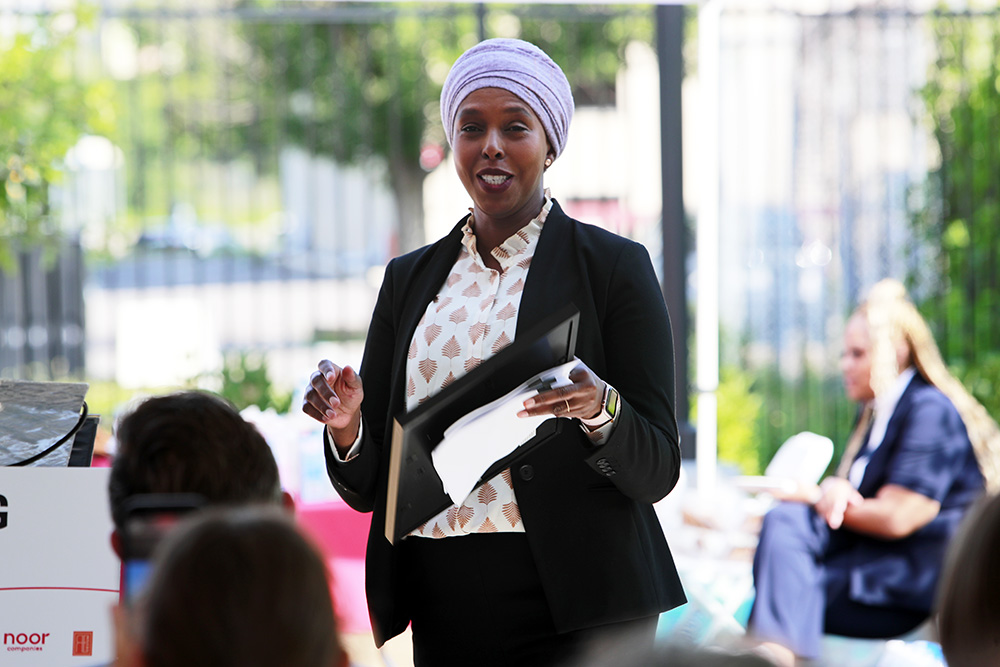
Nawal Noor, CEO of Noor Companies, after receiving the Congressional Record from U.S. Rep. Ilhan Omar on Tuesday, July 29, 2025 during the ribbon-cutting ceremony of the 39-unit affordable housing Wadaag Commons that her company was the lead on in partnership with Redesign. Mshale Staff Photo by Richard Ooga
The Twin Cities region still faces challenges in meeting its affordable housing goals, according to the Federal Reserve Bank of Minneapolis. In 2023 for instance, as Wadaag was preparing to break ground for construction, the region barely surpassed the Metropolitan Council’s goal of creating 2,090 new affordable housing units per year by just 100 units. The Metropolitan Council is the regional governmental agency created by the Legislature to coordinate planning and development in the seven counties within the Twin Cities metro area.
U.S. Rep. Ilhan Omar, who grew up with Noor in the Cedar Riverside area, and helped secure $1.8 million in federal funding, said the new complex is a good use of taxpayer funds because it meets the needs of providing new and affordable large family housing, and also serves those facing homelessness. Nine of the units will be dedicated to homeless families.
“The inclusion of sensory-based playground to ensure children with autism can have a place to play, and a provision of garden lots for residents to grow their own food are thoughtful details,” she said. “Truly makes this a home.”
At the conclusion of her remarks, Omar surprised Noor with a congressional record titled “Honoring Wadaag Commons.”