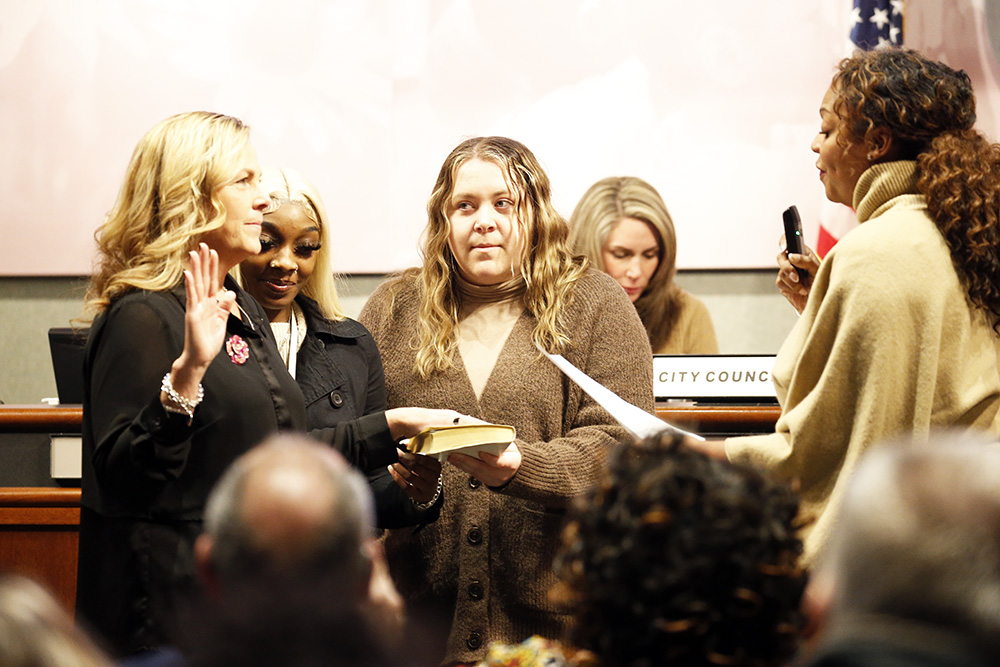
Amanda Cheng Xiong, 22, takes the oath of office on Monday, Jan. 6, 2025 to represent the East District on the Brooklyn Park City Council. She is the Councill’s youngest member. Administering the oath is City Clerk Devin Montero. Mshale Staff Photo by Richard Ooga
Amanda Cheng Xiong, 22, takes the oath of office on Monday, Jan. 6, 2025 to represent the East District on the Brooklyn Park City Council. She is the Councill’s youngest member. Administering the oath is City Clerk Devin Montero. Mshale Staff Photo by Richard Ooga
Brooklyn Park City Council swore-in its youngest city council member on Monday, January 6.
Amanda Cheng Xiong, 22, was born and raised in the city by her Hmong refugee parents. She beat incumbent Boyd Morson in a landslide in November to represent the East District. Boyd who represented the Central District in the previous council was redistricted to the East.
She is the third Hmong to serve on the council after state Sen. Susan Pha and XP Lee. Xiong is succeeding Lee who represented the East District in the last council but did not seek reelection and decided to endorse Xiong.
Xiong told local CCX Media on Election Night that she intended to use her new platform to also represent the youth and ensure “that their voices are also being heard.”
Golden Valley Mayor Roslyn Harmon administers the oath of office to Shelle Page on Monday, Jan. 6, 2025 to represent the Central District on the Brooklyn Park City Council. Mshale Staff Photo by Richard Ooga
Also sworn-in on Monday were Shelle Page (Central District) and Tony McGarvey (West District).
This will be McGarvey’s first full term after first being elected in 2023 to finish the term for the seat that had been occupied by Susan Pha after she was elected to the Minnesota Senate.
When Page contested in November, it was her first foray into elective politics and she won by just over 340 votes. On Monday she had her oath of office administered by Mayor Roslyn Harmon of Golden Valley, that city’s first Black mayor. Like Page, Mayor Harmon is familiar with narrow wins having won her race for Mayor in 2023 by just 26 votes.
Tony McGarvey was reelected to serve his first full term in November 5, 2024. He is seen here on Monday, Jan. 5, 2025 taking the oath of office from the city’s clerk Devin Montero. Mshale Staff Photo by Richard Ooga
The city is divided into three districts each with two council members that serve staggered terms. The three that were sworn-in on Monday will serve through 2028 while the other three council members from each district will be up for election on November 2026. The city’s mayor is elected at-large and current Mayor Hollies Winston is up for election in November 2026.
City Council meets every first, second and fourth Mondays of the month at 6pm and meetings are open to the public, or you can watch the livestream on the city’s website.
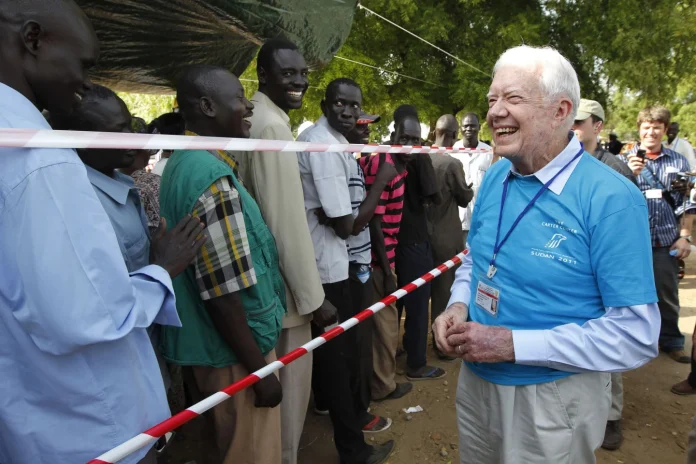
Former U.S. President Jimmy Carter, right, greets Southern Sudanese men waiting to cast their vote at a polling station in Juba, Southern Sudan, Jan 9, 2011, during a weeklong referendum on independence that is expected to split Africa’s largest nation in two. Photo: Jerome Delay/AP File
Former U.S. President Jimmy Carter, right, greets Southern Sudanese men waiting to cast their vote at a polling station in Juba, Southern Sudan, Jan 9, 2011, during a weeklong referendum on independence that is expected to split Africa’s largest nation in two. Photo: Jerome Delay/AP File
NAIROBI, Kenya (AP) — Jimmy Carter was the first U.S. president to make a state visit to sub-Saharan Africa. He once called helping with Zimbabwe’s transition from white rule to independence “our greatest single success.” And when he died at 100, his foundation’s work in rural Africa had nearly fulfilled his quest to eliminate a disease that afflicted millions, for the first time since the eradication of smallpox.
The African continent, a booming region with a population rivaling China’s that is set to double by 2050, is where Carter’s legacy remains most evident. Until his presidency, U.S. leaders had shown little interest in Africa, even as independence movements swept the region in the 1960s and ‘70s.
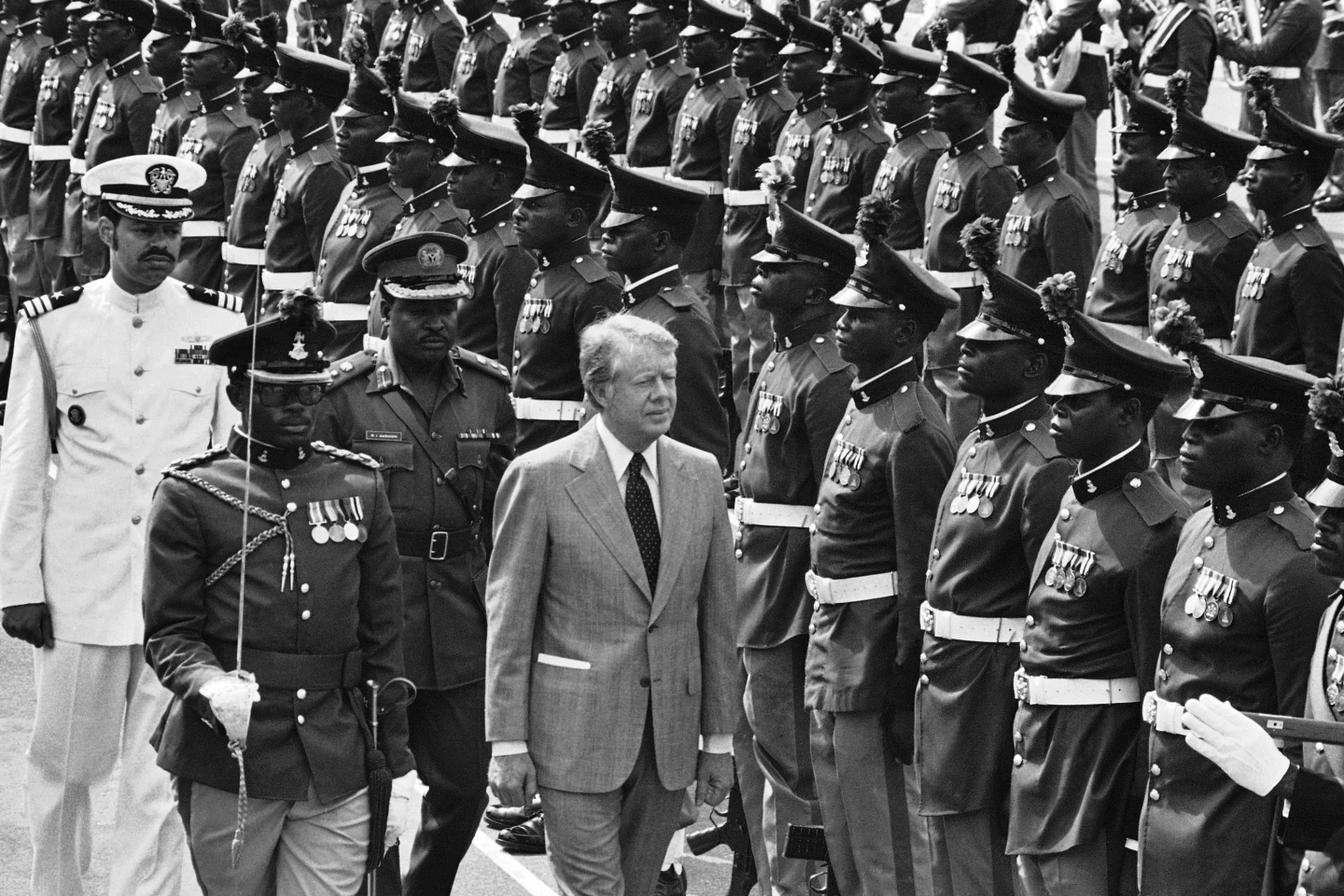
“I think the day of the so-called ugly American is over,” Carter said during his warm 1978 reception in Nigeria, Africa’s most populous country. He said the official state visit swept aside “past aloofness by the United States,” and he joked that he and Nigerian President Olesegun Obasanjo would go into peanut farming together.
U.S. President Jimmy Carter reviews honor guards during arrival ceremonies at the Dodan Barracks in Lagos, Nigeria, April 1, 1978. Photo: AP File
Cold War tensions drew Carter’s attention to the continent as the U.S. and Soviet Union competed for influence. But Carter also drew on the missionary traditions of his Baptist faith and the racial injustice he witnessed in his homeland in the U.S. South.
“For too long our country ignored Africa,” Carter told the Democratic National Committee in his first year as president.
African leaders soon received invitations to the White House, intrigued by the abrupt interest from the world’s most powerful nation and what it could mean for them.
“There is an air of freshness which is invigorating,” visiting Zambian President Kenneth Kaunda said.
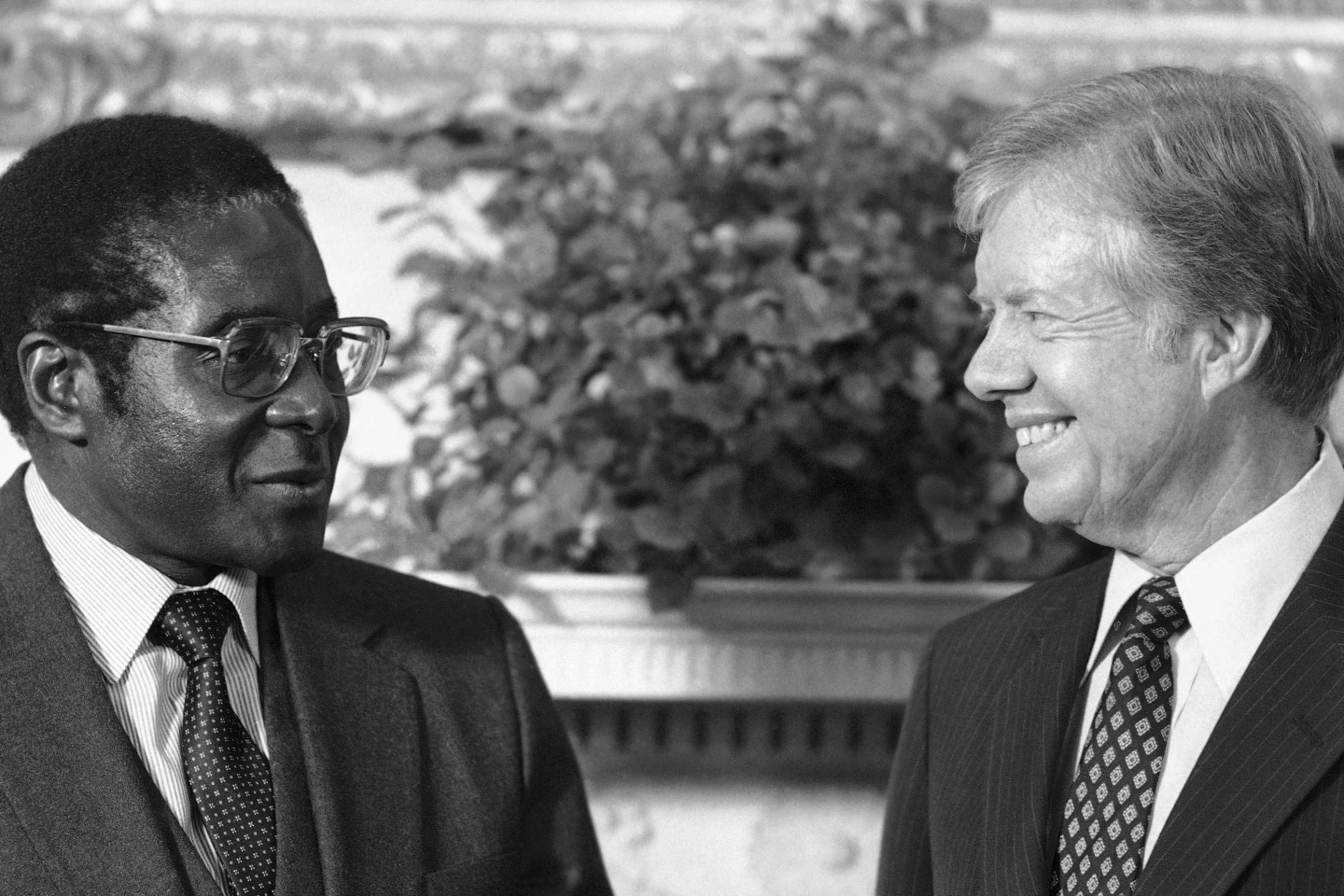
President Jimmy Carter meets with Zimbabwean Prime Minister Robert Mugabe in the Oval Office of the White House in Washington, Aug. 27, 1980. Photo: Barry Thumma/AP File
Carter observed after his first Africa trip, “There is a common theme that runs through the advice to me of leaders of African nations: ‘We want to manage our own affairs. We want to be friends with both of the great superpowers and also with the nations of Europe. We don’t want to choose up sides.’”
The theme echoes today as China also jostles with Russia and the U.S. for influence, and access to Africa’s raw materials. But neither superpower has had an emissary like Carter, who made human rights central to U.S. foreign policy and made 43 more trips to the continent after his presidency, promoting Carter Center projects that sought to empower Africans to determine their own futures.
As president, Carter focused on civil and political rights. He later broadened his efforts to include social and economic rights as the key to public health.
“They are the rights of the human by virtue of their humanity. And Carter is the single person in the world that has done the most for advancing this idea,” said Abdullahi Ahmed An-Naim, a Sudanese legal scholar.
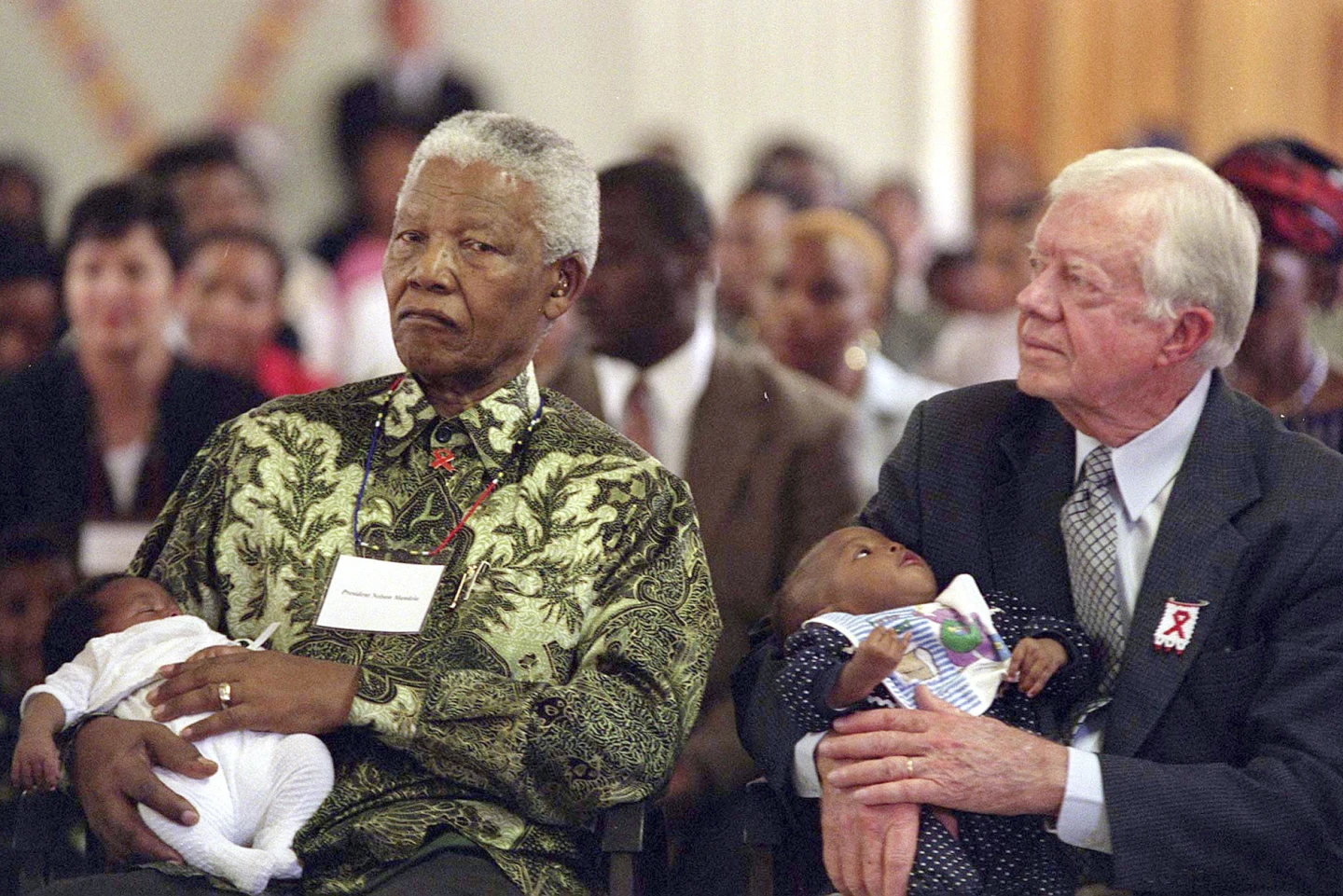
Former South African President Nelson Mandela, left, and former U.S. President Jimmy Carter, right, hold HIV-positive babies at the Zola Clinic in Soweto, March 7, 2002. Photo: Nonthemba Kwela/AP File
Even as a candidate, Carter mused about what he might accomplish, telling Playboy magazine, “it might be that now I should drop my campaign for president and start a crusade for black-majority rule in South Africa or Rhodesia (now Zimbabwe). It might be that later on, we’ll discover there were opportunities in our lives to do wonderful things and we didn’t take advantage of them.”
Carter welcomed Zimbabwe’s independence just four years later, hosting new Prime Minister Robert Mugabe at the White House and quoting the Rev. Martin Luther King, Jr.: “Injustice anywhere is a threat to justice everywhere.”
“Carter told me that he spent more time on Rhodesia than he did on the entire Middle East. And when you go into the archives and look at the administration, there is indeed more on southern Africa than the Middle East,” historian and author Nancy Mitchell said.
Relations with Mugabe’s government soon soured amid deadly repression, and by 1986 Carter led a walkout of diplomats in the capital. In 2008, Carter was barred from Zimbabwe, a first in his travels. He called the country “a basket case, an embarrassment to the region.”
“Whatever the Zimbabwean leadership may think of him now, Zimbabweans, at least those who were around in the 1970s and ’80s, will always regard him as an icon and a tenacious promoter of democracy,” said Eldred Masunungure, a Harare-based political analyst.
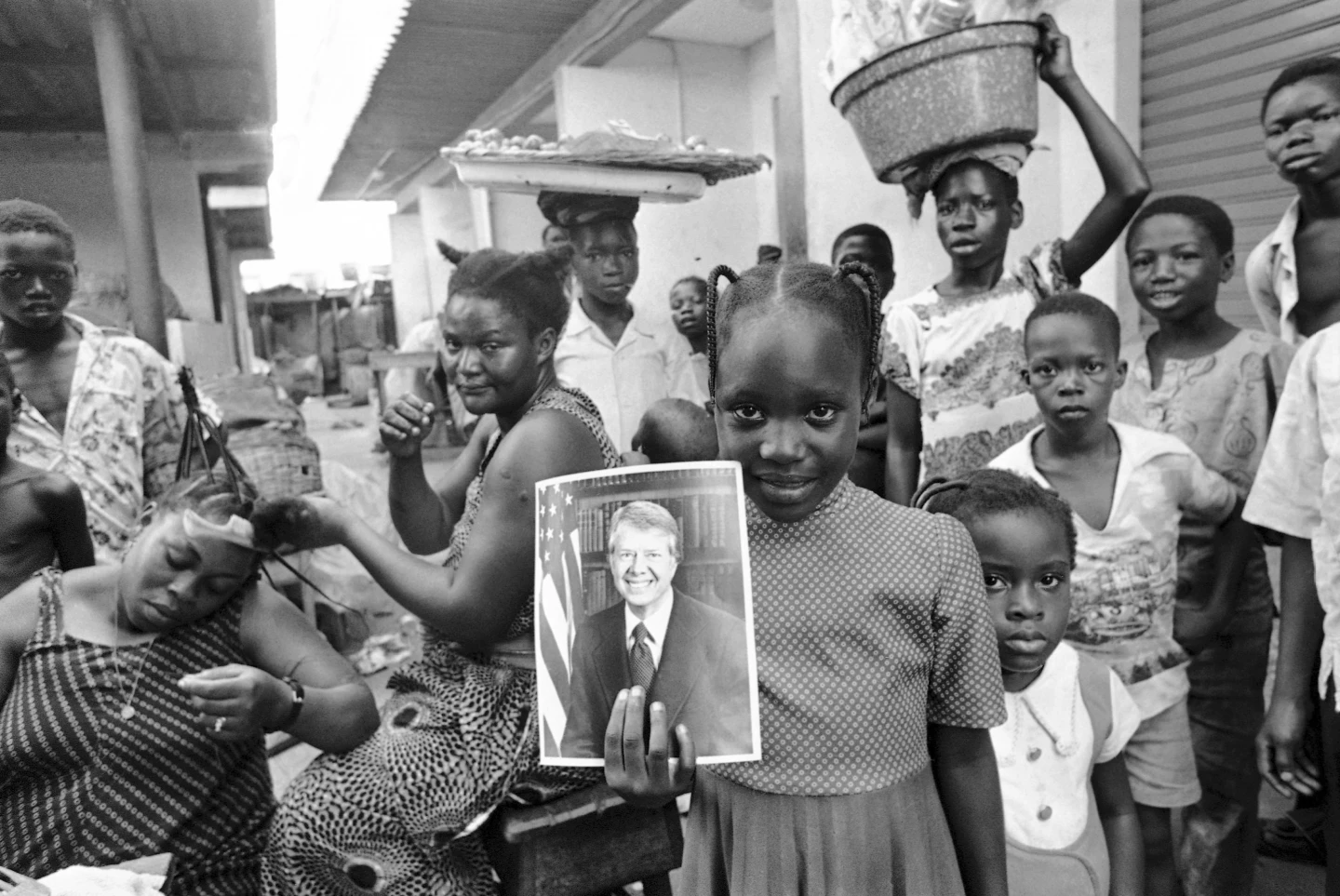
A girl holds a portrait of U.S. President Jimmy Carter in a market in Lagos, Nigeria, March 31, 1978, the day of his arrival for a state visit, the first to Africa by an American president. Photo: Dieter Endlicher/AP File
Carter also criticized South Africa’s government for its treatment of Black citizens under apartheid, at a time when South Africa was “trying to ingratiate itself with influential economies around the world,” current President Cyril Ramaphosa said on X after Carter’s death.
The think tank Jimmy and Rosalynn Carter founded in 1982 played a key role in monitoring African elections and brokering cease-fires between warring forces, but fighting disease was the third pillar of The Carter Center’s work.
Former U.S. President Jimmy Carter helps in the contruction of a low-income housing project in Durban, South Africa, June 6, 2002. Carter was among 4,500 volunteers, organized by Habitat for Humanity, building 100 homes in the coastal city during the week. Photo: Themba Hadebe/AP File
“The first time I came here to Cape Town, I almost got in a fight with the president of South Africa, Thabo Mbeki, because he was refusing to let AIDS be treated,” Carter told a local newspaper. “That’s the closest I’ve come to getting into a fist fight with a head of state.”
Carter often said he was determined to outlive the last guinea worm infecting the human race. Once affecting millions of people, the parasitic disease has nearly been eliminated, with just 14 cases documented in 2023 in a handful of African countries.
Carter’s quest included arranging a four-month “guinea worm cease-fire” in Sudan in 1995 so that The Carter Center could reach almost 2,000 endemic villages.
“He taught us a lot about having faith,” said Makoy Samuel Yibi, who leads the guinea worm eradication program for South Sudan’s health ministry and grew up with people who believed the disease was simply their fate. “Even the poor people call these people poor, you see. To have the leader of the free world pay attention and try to uplift them is a touching virtue.”
Such dedication impressed health officials in Africa over the years.
“President Carter worked for all humankind irrespective of race, religion, or status,” Ethiopia’s former health minister, Lia Tadesse, said in a statement shared with the AP. Ethiopia, the continent’s second most populous country with over 110 million people, had zero guinea worm cases in 2023.
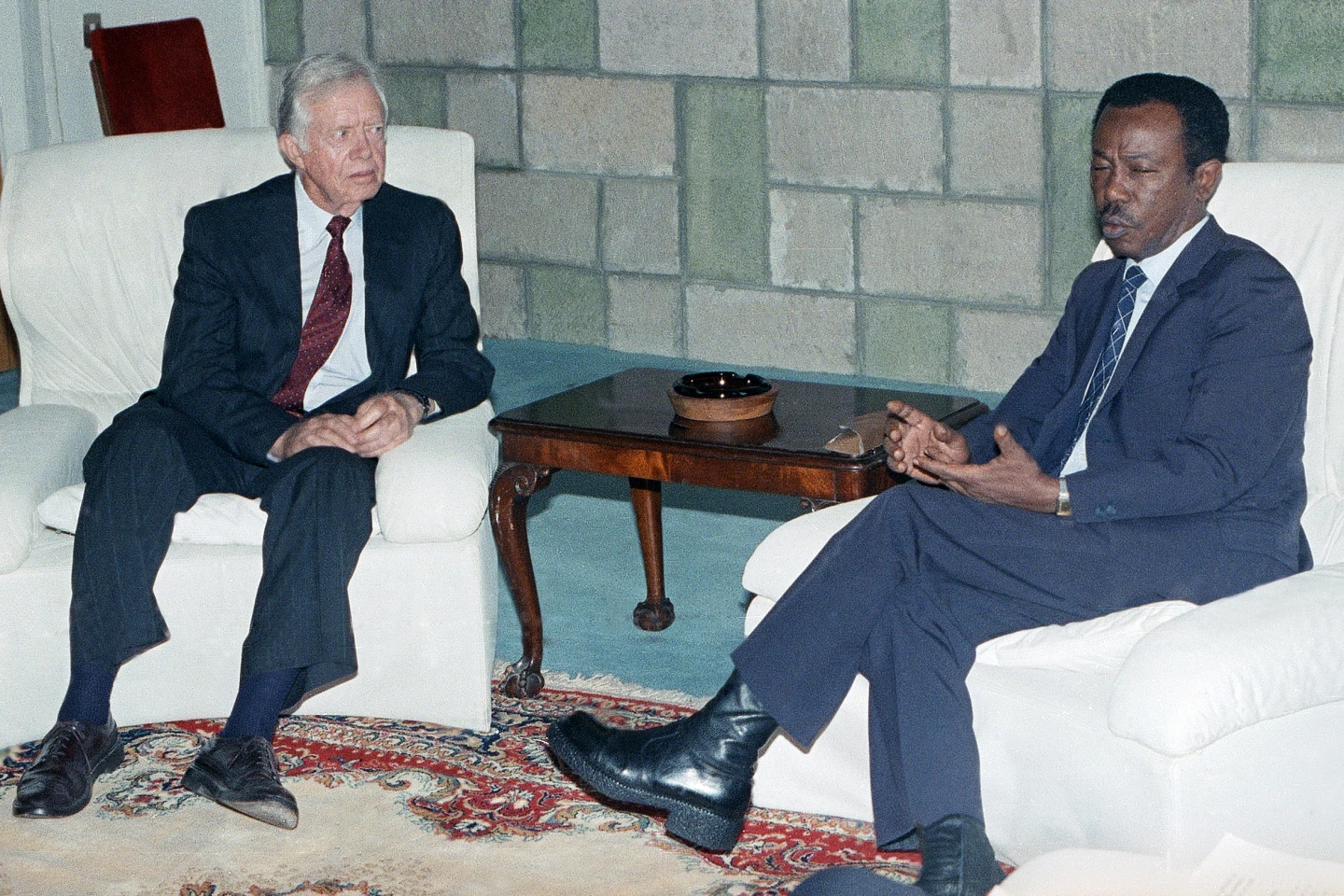
Former U.S. President Jimmy Carter, left, speaks with Ethiopian President Mengistu Haile Mariam in Addis Ababa, July 11, 1990, during the 26th summit of the Organization of African Unity. Photo: Aris Saris/AP File
___
Associated Press reporters Farai Mutsaka in Harare, Zimbabwe, and Michael Warren in Atlanta contributed.
Mariama Bassama, left, is helped with her hood by Charlotte Pandraud before the Commencement Ceremony for Hult International Business School in Boston. Photo: Scott Eisen/AP
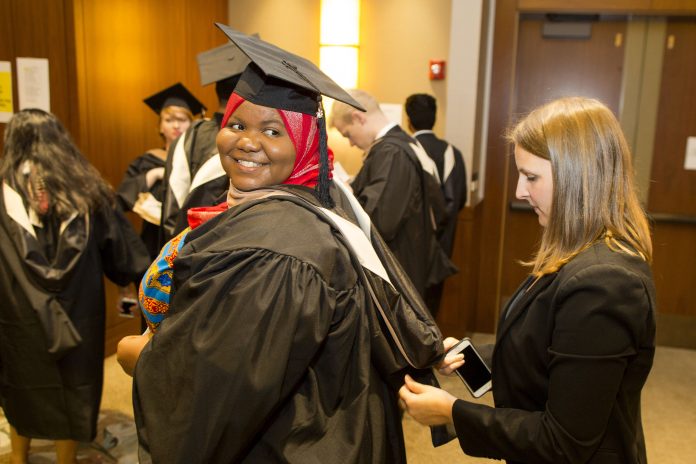
Mariama Bassama, left, is helped with her hood by Charlotte Pandraud before the Commencement Ceremony for Hult International Business School in Boston. Photo: Scott Eisen/AP
CONCORD, N.H. (AP) — A growing number of U.S. colleges and universities are advising international students to return to campus before President-elect Donald Trump is inaugurated, over concerns that he might impose travel bans like he did during his first administration.
More than a dozen schools have issued advisories, even though Trump’s plans remain uncertain. At some schools, the spring semester begins before Trump will take office, so students may have to be back in class anyway. But for anyone whose ability to stay in the United States depends on an academic visa, they say it’s best to reduce their risks and get back to campus before Jan. 20.
Here’s a look at what Trump has said and done and how schools and students are preparing for his second term:
What did Trump do in the past?
Trump issued an executive order in January 2017 banning travel to the U.S. by citizens of seven predominantly Muslim countries — Iraq, Syria, Iran, Sudan, Libya, Somalia and Yemen. Travelers from those nations were either barred from getting on their flights or detained at U.S. airports after they landed. They included students and faculty as well as business people, tourists and visitors to friends and family.
Trump later removed some countries and added others to the list — 15 nations were affected at some point during his presidency. More than 40,000 people were ultimately refused visas because of the ban, according to the U.S. State Department. President Joe Biden rescinded the orders when he took office in 2021.
How are students being affected?
More than 1.1 million international students were enrolled in U.S. colleges and universities during the 2023-24 school year, according to Open Doors, a data project partially funded by the U.S. State Department. Students from India and China have accounted for more than half of all international students in the U.S., and about 43,800 come from the 15 countries affected by Trump’s travel restrictions.
Jacky Li, a third-year environmental studies major at University of California, Berkeley, will be traveling home to China Dec. 21 and returning Jan. 16. Though he made his plans months before Berkeley officials sent the advisory, he said worry is growing among international students.
“There’s a fear that this kind of restriction will enlarge into a wider community, considering the geopolitical tensions nowadays around the world, so the fear is definitely there,” said Li, who urged Trump to support, rather than thwart, important academic research.
“If the U.S. is really a champion of academic freedom, what you should do is not restrict this kind of communications between different countries of the world,” he said.
What might Trump do now?
Trump’s transition team did not respond to questions on the topic this week, but in the past he has said he’ll revive the travel ban and expand it, pledging new “ideological screening” for non-U.S. citizens to bar “dangerous lunatics, haters, bigots and maniacs.”
“We aren’t bringing in anyone from Gaza, Syria, Somalia, Yemen or Libya or anywhere else that threatens our security,” Trump said at an October 2023 campaign event in Iowa.
Trump also vowed to “revoke the student visas of radical anti-American and anti-Semitic foreigners at our colleges and universities” in response to campus protests.
What are schools telling students?
School officials have advised international students heading home for winter break to return before Inauguration Day and to prepare for possible delays at immigration control.
The list includes Ivy League universities such as Harvard and Brown, Boston schools such as Northeastern University and the Massachusetts Institute of Technology, and other schools around the country, from Johns Hopkins University to the University of Southern California. Some offer classes that begin the day after Inauguration Day.
Cornell University told its students that a travel ban involving the 13 nations Trump previously targeted “is likely to go into effect soon after inauguration,” and that new countries could be added to the list, particularly China and India. It advised students, faculty and staff from those countries to return to campus before the semester starts Jan. 21.
Other schools didn’t go so far as to say a ban is likely but instead advised students to plan ahead and prepare for delays.
New lower fares for Metro Transit local bus and light rail went into effect Jan. 1, 2025. Photo: Courtesy Metro Transit
New lower fares for Metro Transit local bus and light rail went into effect Jan. 1, 2025. Photo: Courtesy Metro Transit
Metro transit fares went down as the new year kicked in yesterday with a cheaper and simpler fare structure. For local bus rides and light rail adults will pay just $2 while seniors and youth and those on Medicare will pay $1. The fare applies to any time of the day and there will be no different fares for rush hour or peak times.
A seven-day pass will cost you $20 with all-day passes averaging $2-$4.
The lowered and simpler fare structure only applies to local bus service and does not apply to express buses, Northstar, or Metro micro.
If you are a Metro Mobility-certified rider, you can ride for one cent through June 30, 2025.
The 17-member Metropolitan Council, which is in charge of Metro Transit, approved the new changes at its Nov. 13 meeting.
According to the Council, Metro transit took in $54 million in fare revenue in 2023 which is slightly above 8 percent of its $558 million budget. The fares changes for 2025 are expected to drop its revenue by $4 million, but ridership is expected to climb by 926,000 rides.
This is the first time since 2017 that Metro Transit is changing fares. In 2017 they increased local buses and light rail fares by 25 cents.
A Minnesota Department of Commerce employee checks the accuracy of a gas pump at a gas station during Weights & measures Week in March 2024. Photo: Courtesy Minnesota Dept. of Commerce
A Minnesota Department of Commerce employee checks the accuracy of a gas pump at a gas station during Weights & measures Week in March 2024. Photo: Courtesy Minnesota Dept. of Commerce
The Minnesota Department of Commerce is asking the public to consider a new year resolution: to be a scam spotter in 2025 and help to identify and prevent scams that harm Minnesota consumers, organizations and communities.
In a news release on Monday, Jacqueline Olson, the assistant commissioner of enforcement in the Department of Commerce said the department is seeing an increase in scammers who are tricking people into sharing their private financial information and losing money in the process.
The department is urging the public to learn on how to spot scams and protect themselves.
“As you set goals for the new year, especially with plans to improve how you manage money, we want to empower you to arm yourself with tools to prevent losing money to fraud. Make a resolution to have conversations with your family, friends, neighbors and co-workers on how to spot and prevent scams,” Olson said.
Olson shared the following some tips from federal and state consumer protection and enforcement agencies in how to protect yourself:
Jacqueline Olson, Assistant Commissioner of enforcement in the Minnesota Department of Commerce. Photo: Courtesy of MN Dept. of Commerce
Verify first. Scammers are using technology to look and sound like a person or business you know. Do not respond. Instead, contact the person or business directly to verify whether there is a problem. Among the top imposter scams:
Scammers use caller ID to make it look like they are calling from an official government or business. They will demand you urgently need to share your account info or pay money.
Scammers pretend to be a grandchild or other relative who needs emergency financial help.
Charity scammers pretend to be from a real or fake charity to try to get you to contribute.
Technology scammers tell you your computer’s security is at risk and try to remotely access your device.
Beware when someone plays on your emotions or claims there’s an urgent situation. Slow down and consider that the call or text could be from a scammer trying to trick you into feeling fear and panic. Advances in artificial intelligence make it easier for scammers to clone phone numbers and voices. They may also alter images to look like a person or organization you know. Contact the person yourself to verify the story. Use contact information you know is theirs. If you can’t reach them, try to get in touch with them through another trusted person, like a family member or their friends.
Too good to be true? Ask yourself why someone is trying so hard to give you a “great deal.” If it sounds too good to be true, it probably is.
Never pay up front for fees, taxes or prizes: It’s a scam if you are told that you must pay fees or taxes to receive a prize or other financial windfall.
After hearing a sales pitch, take time to compare prices. Ask for information in writing and read it carefully.
Watch out for deals that are only “good today” and that pressure you to act quickly. Walk away from high-pressure sales tactics that don’t allow you time to read a contract or get legal advice before signing. Also, don’t fall for the sales pitch that says you need to pay immediately, for example by wiring the money, sending it by courier or over a payment app, or by sending cryptocurrency.
Don’t click on links or scan QR codes. These can take you to scammers’ malicious websites or give them access to your device.
Put your number on the National Do Not Call Registry. Go to www.donotcall.gov or call (888) 382-1222.
Minnesota consumers and businesses can contact Commerce’s Enforcement Division about concerns or complaints about scams:
Award-winning journalist Michele Norris, a Minnesota native, will keynote the 2025 MLK Breakfast in Minneapolis on Jan. 20. Photo: Michele Norris Instagram
Award-winning journalist Michele Norris, a Minnesota native, will keynote the 2025 MLK Breakfast in Minneapolis on Jan. 20. Photo: Michele Norris Instagram
Award-winning journalist and author Michele Norris will deliver the keynote speech at the 35th annual Martin Luther King Jr. Breakfast in Minneapolis on Jan. 20, 2025. It will start at 7:00 a.m. to 9:30 a.m.
The annual event by General Mills and the United Negro College Fund (UNCF) is one of the largest in the nation held to honor the legacy of the late civil rights leader. Funds raised at the breakfast go towards funding college scholarships for Twin Cities students through the United Negro College Fund.
“This event helps provide life-changing support for students to help them get to and through college and go after their dreams,” said Dr. Michael L. Lomax, president and CEO of UNCF in a written statement.
Most students that receive scholarships through UNCF attend Historically Black Colleges and Universities (HBCUs) but are not required to. Enrollments at HBCUs have continued to climb since the murder of George Floyd in May 2020 and Vice President Kamala Harris coming to office. VP Harris attended Howard University, an HBCU. Since taking office, the Biden-Harris Administration says it has invested $16 billion in HBCUs from Fiscal Year 2024.
The late Rev. Dr. Martin Luther King, Jr. also attended Morehouse College, one of the oldest HBCUs.
40% of Black engineers in America and 80% of Black judges in America, as well as 50% of lawyers have been educated at HBCUs, according to the White House.
Norris, a Minnesota native, will speak on race, culture and communication in America under the breakfast’s 2025 theme of “One People.” University of Minnesota professor and researcher, Dr. Rachel Hardeman, one of TIME Magazine’s 100 Most Influential People of 2024, will moderate the discussion.
The Minnesota native was the first Black female host at NPR and for almost ten years hosted its flagship news program “All Things Considered.” She stepped down from the role when her husband Mr. Broderick Johnson joined Barack Obama’s reelection campaign in 2011. Following President Obama’s reelection in 2012, Obama appointed him White House Cabinet Secretary.
Norris is the founding director of The Race Card Project which won a 2014 Peabody Award “for encouraging public discussion about diversity in ways that cut through obvious differences to present unique and individual lived experiences.”
She joined the Washington Post as a high profile columnist in 2019 and resigned in protest in October after the paper’s planned endorsement of Kamala Harris, which had been written and ready to be published, was blocked by the paper’s owner Amazon founder Jeff Bezos. The paper’s editor-at-large Robert Kagan also resigned.
Writing on X in a post viewed over 6 million times, Norris said: “The Washington Post’s decision to withhold an endorsement that had been written & approved in an election where core democratic principles are at stake was a terrible mistake & an insult to the paper’s own longstanding standard of regularly endorsing candidates since 1976.”
Martin Luther King, Jr. Day is observed annually on the third Monday in January to mark the Jan. 15 birthday of King who was assassinated in April 1968 in Memphis, Tenn. It has been observed as a federal holiday since January 20, 1986 – three years after President Ronald Reagan signed the bill on November 2, 1983 making it a holiday.
Tickets for the 2025 MLK Breakfast in Minneapolis on Jan. 20 can be purchased at MLKBreakfast.com.
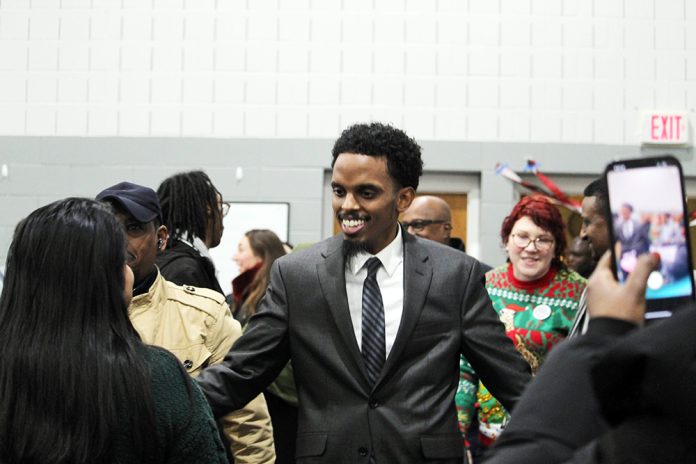
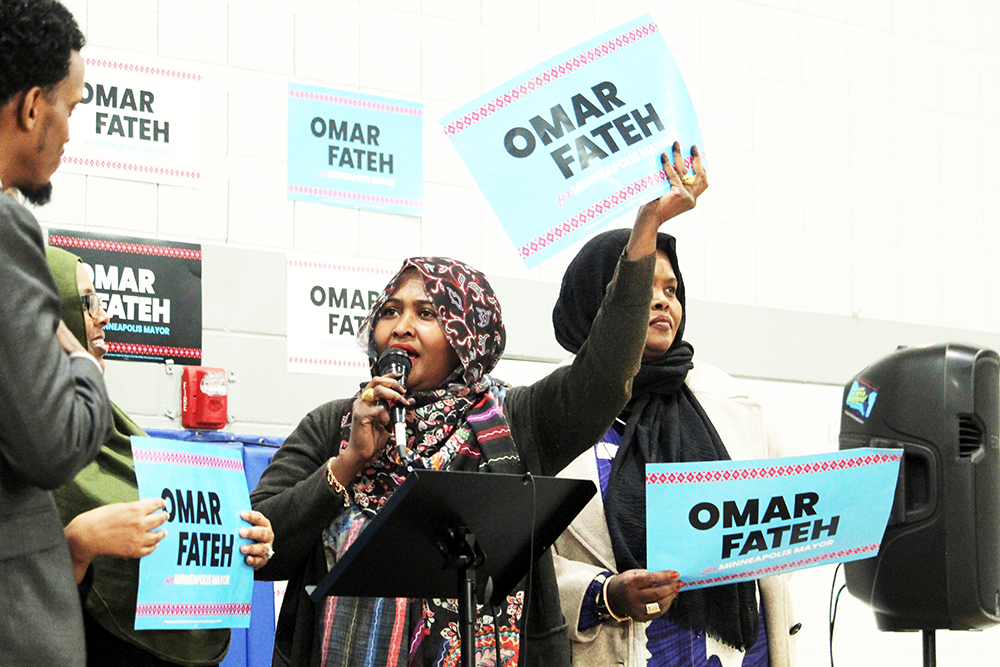
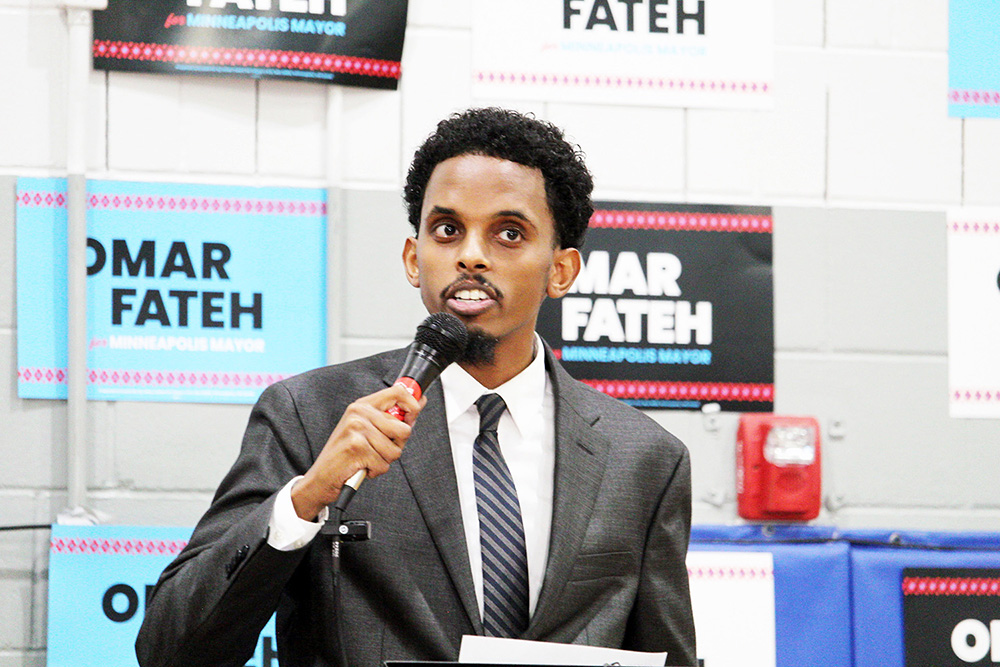
State Sen. Omar Fateh greets supporters during his mayoral campaign kickoff at the Brian Coyle Center in Minneapolis on Saturday, Dec. 14, 2024. Mshale Staff Photo by Jasmine Webber
State Sen. Omar Fateh greets supporters during his mayoral campaign kickoff at the Brian Coyle Center in Minneapolis on Saturday, Dec. 14, 2024. Mshale Staff Photo by Jasmine Webber
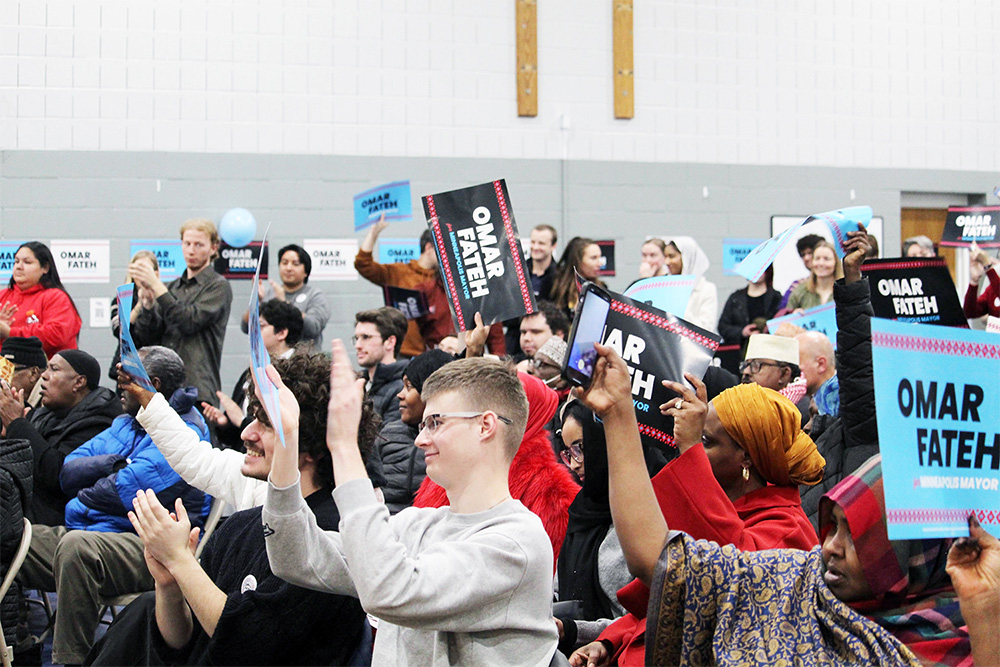
State Sen. Omar Fateh hosted his mayoral campaign kick-off event at the Brian Coyle community center on Saturday, less than two weeks after he announced he is running. Enthusiastic local residents packed the center’s gym along with community elders and local politicians to show their support for Fateh’s run to challenge incumbent mayor Jacob Frey.
If elected in November, he will be the first Black man to be mayor of Minneapolis.
Mayor Jacob Frey, and all 13 council members, are up for reelection in 2025. There is no primary for mayor ahead of the November election as the city uses Ranked Choice Voting (RCV) to elect its mayor and council members. The last race for mayor in 2021 attracted 17 candidates. The Minneapolis City Council is a full-time council with elected members earning $109,846 a year and the mayor $140,814.
The crowd reacts as state Sen. Omar Fateh speaks during his mayoral campaign kick-off at the Brian Coyle Community Center on Saturday, Dec. 14, 2024. Mshale Staff Photo by Jasmine Webber
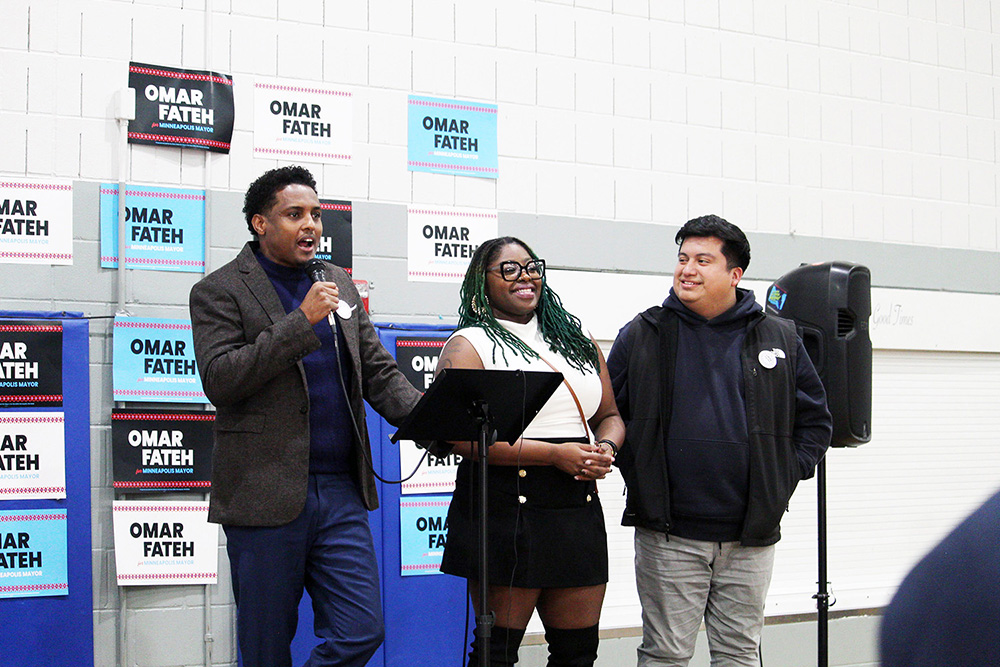
At Saturday’s kickoff, speeches from notable elected officials, including Parks and Recreation Commissioner Becky Alper, Minneapolis School District board member Adriana Cerrillo, Councilmembers Robin Wonsley, Jamal Osman, Jason Chavez and Fateh himself, focused heavily on the demonstrated leadership qualities they believe Fateh has shown during his time in the state Senate and his approach of putting people ahead of corporate interests.
The kickoff event also served as a fundraiser with those in the audience pledging amounts ranging from $5 to $250. Multiple hands went up as the emcee solicited for pledges from the stage emphasizing this was going to be a “people powered” campaign. $250 is the maximum an individual can give to a mayoral campaign in a non-election year like 2024, but in 2025 which will be an election year, individuals can give a maximum of $1,000.
Councilman Chavez began his remarks in Spanish before switching to English and explained, amid cheers, why he chose to do so.
“I wanted to speak in Spanish to show the big, broad and diverse coalition Sen. Omar Fateh is bringing to Minneapolis,” he said.
Chavez said the city needs a mayor like Fateh who has demonstrated during his time at the Capitol that he can fight for those marginalized by society and gave examples of how Ward 9, which the councilman represents, has benefited during the senator’s two terms.
“He has the led the fight at the Capitol during the time the city has been struggling with homelessness,” Chavez said.
Minneapolis City Council members Jamal Osman (Ward 6), Robin Wonsley (Ward 2) and Jason Chavez (Ward 9), speak in support of state Sen. Omar Fateh’s mayoral candidacy during the campaign kickoff held at the Brian Coyle Community Center in Minneapolis on Saturday, Dec. 14, 2024. The venue is in Osman’s Ward 6. Mshale Staff Photo by Jasmine Webber
Councilman Osman who represents Ward 6, where the kickoff took place, called the current council-mayor relationship as “super divided” and told the crowd it has been challenging to work with Mayor Frey.
“I had a conversation with Jacob and I told him that ‘the city of Minneapolis and my community has elected you twice, but today we have Omar Fateh who has my full support and my community and the East African community, and Ward 6 will vote to put him over the edge’ and come November the city will have better leadership than it has right now,” Osman said.
Councilwoman Wonsley who described herself as the “only independent Democratic Socialist” supporting Fateh, echoed his council colleagues’ sentiments, but also praised Fateh for what she called the “fearless” way he goes about using his office to serve those that are marginalized.
“I had the opportunity to work with him in winning one of the strongest rideshare bill in U.S. history for Uber and Lyft drivers and seeing Omar Fateh not be afraid to use his power with so many people in his own party wanting to cave to the wealthiest corporations in the United States,” Wonsley said. “But I saw time and time again how Fateh stood up, fought tooth and nail and said no.”
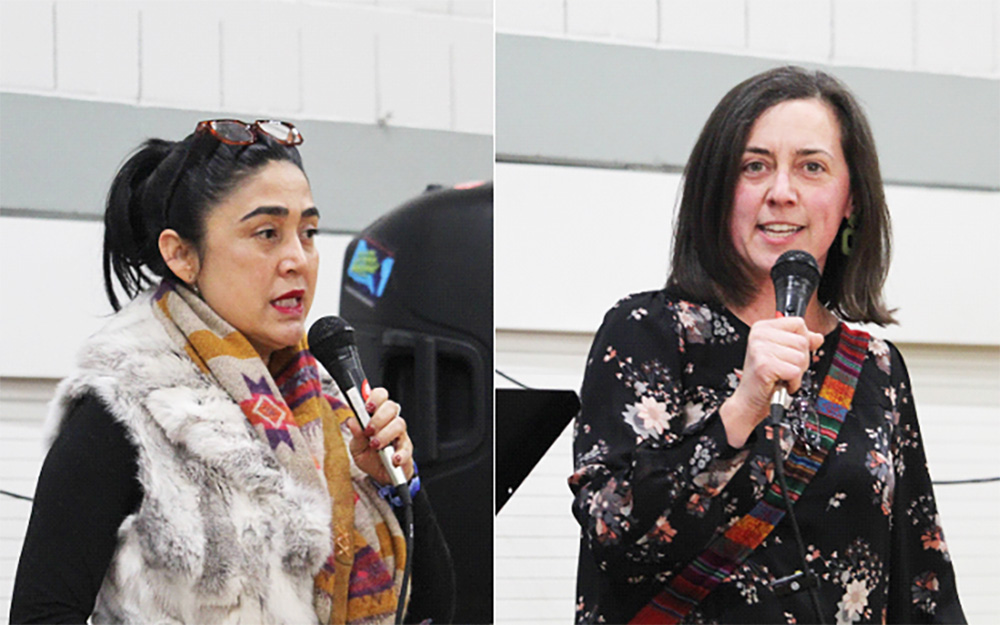
Minneapolis School District board member Adriana Cerrillo and Parks and Recreation Commissioner Becky Alper voice their support for State Sen. Omar Fateh’s bid to be the next mayor of Minneapolis during a kickoff event held at the Brin Coyle Center in Minneapolis on Saturday, Dec. 14, 2024. Mshale Staff Photo by Jasmine Webber
“Right now, in the mayor’s office we have someone who runs the city by fear and we have seen the dark shadow that has placed over our city for almost 10 years,” said Wonsley, adding that the city needs a leader in charge and not a fearmonger.
In his address that lasted a little over five minutes, Fateh said along with being the son of Somali immigrants and a husband, he is an advocate for working people that is running to make Minneapolis “a welcoming and prosperous city that we know it can be.”
To start off his speech, he acknowledged the presence of Mr. Mahamoud Wardere, the first Somali American to run for Mayor of Minneapolis in 2001.
Ms. Asha Buranburtoy, who is Aunt to state Sen. Omar Fateh, spoke passionately in support of his nephew’s candidacy ahead of his address at the Brian Coyle Community Center to kick off his mayoral campaign on Saturday, Dec. 14, 2024. Mshale Staff Photo by Jasmine Webber
As he did at the official announcement of his candidacy on December 2, Fateh said Mayor Frey and the “status quo” are failing the city, and criticized his veto of the latest city budget – which the council was able to override. The crowd booed at the mention of the veto. If elected, he promised to put forward a budget that “puts your interests above those of corporate interests,” drawing loud applause from the crowd. He said the city deserves a mayor that works with the residents “instead of against us,” and one that makes people want to live and start businesses in the city.
The first to announce that they will be challenging Mayor Frey was Rev. DeWayne Davis. Others that have also announced their candidacy include former Minneapolis City Council candidate Brenda Short and current Councilmember Brenda Koski who represents Ward 11.
The candidate filing period for the city’s 2025 mayoral and council elections will begin on July 25 and run through August 12.
State Sen. Omar Fateh speaks during his mayoral campaign kickoff at the Brian Coyle Center in Minneapolis on Saturday, Dec. 14, 2024. Mshale Staff Photo by Jasmine Webber
Ms. Zahra Farah, a 12-year special education teacher in the city, is putting her faith in Fateh’s candidacy and believe the city is ready for a change.
“I have been following his career and he is one of the few politicians I see that are 100 percent committed to the community, he doesn’t hide behind a publicist and not afraid to talk to us directly, in these times the city needs someone like him,” Farah said.
Jack Neely of Falcon Heights graduated two years ago from Hamline University. He interned at the Capitol with Sen. Fateh’s office in the last Legislative session and came out impressed with the senator’s commitment to working people, and above all his integrity. Though he can’t vote in the city, he plans to volunteer and canvass for his former boss.
“What stood out for me about Sen. Fateh when I interned with him was the fact that he was willing to stand up for working people, more than any other politician that I have seen at the Legislature,” Neely said.
This story has been updated to state Brenda Short is a former City Council candidate and not a former City Council member as previously reported.
Participants line up for a 5K run during the Brooklyn Center Community Health Fair on Aug. 13, 2022. Mshale Staff Photo by Panashe Matemba-Mutasa
Participants line up for a 5K run during the Brooklyn Center Community Health Fair on Aug. 13, 2022. Mshale Staff Photo by Panashe Matemba-Mutasa
Brooklyn Center is seeking community members to serve on the Cultural and Public Arts Commission and the Sister Cities Commission.
Cultural and Public Arts commissioners get to advise the city on beautification and public art initiatives. The Commission guides planning and decision-making to “promote civic pride, diversity, equity, and inclusion through public art.”
Its commissioners serve a three-year term and it includes a chairperson and six members.
The Sister Cities Commission reviews applications for sister city affiliations and forward their recommendations to the City Council for the establishment of future Sister City agreements.
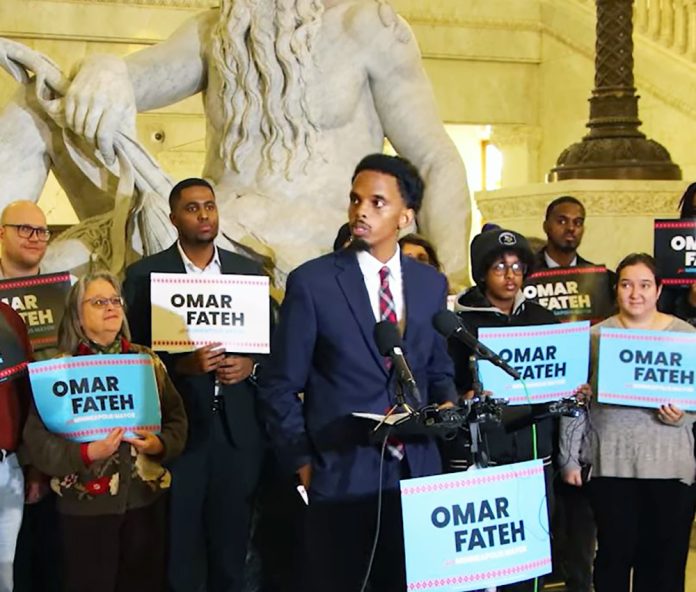
State Sen. Omar Fateh with supporters infront of the "fathers of Water" statue at city hall on Monday, Dec. 2, 2024 as he announced he will be challenging Minneapolis Mayor Jacob Frey in 2025 to become mayor of Minnesota's largest city and commercial capital. Photo: Somali TV of MN Screen Grab
State Sen. Omar Fateh, the first Somali American and first Muslim to serve in the Minnesota Senate, announced his bid for Minneapolis Mayor on Monday at City Hall.
Minneapolis has only elected a Black mayor once before – in 1993 when Sharon Sayles Belton won and served two terms.
Sen. Fateh, a son of Somali immigrants, was elected to the Minnesota Senate in 2020 and represents District 42 which includes the Phillips and Powderhorn neighborhoods of Minneapolis. He sent shockwaves in the political world when he announced his plan to challenge a powerful incumbent, and one of only two Black people on the Senart at the time, Sen. Jeff Hayden. He went on to win the DFL endorsement and ultimately defeated Hayden on the primary ensuring victory in the November election.
Making his official announcement at the city hall rotunda with supporters and the statue of the “Father of Waters” behind him, Fateh described the tenure of current Mayor Jacob Frey as one that is “failing” the people of Minneapolis.
“Minneapolis residents are working hard for the city that they love and they deserve a mayor that works as hard as they do,” Fateh said.
State Sen. Omar Fateh (D-Minneapolis) gets hoisted in the air by Minnesota Uber Lyft Drivers Association (MULDA) supporters after the passage of a bill that improves compensation for Minnesota rideshare drivers Sunday, May 19, 2024. He announced his candidacy for Mayor of Minneapolis on Dec. 2, 2024. Photo: Catherine Davis/Minnesota Senate
A member of the Democratic Farmer Labor Party (DFL), as the Democratic Party is known in the state, Fateh however self-identifies as a Democratic socialist, as do close to half of the 13-member Minneapolis City Council.
Answering questions from the media during his announcement, Fateh touted his bipartisan legislative accomplishments as a benefit in his quest for mayor of Minnesota’s largest city.
Among the accomplishments he called out were the North Star Promise Act that Gov. Walz signed into law. It guarantees free college tuition for students whose families had a yearly income of $80,000 in any of the state’s public colleges and universities. He chairs the Higher Education Committee in the Minnesota Senate.
Specific to the city of Minneapolis, he pointed out the $19 million he secured for the city for public safety. He was also the first lawmaker to push for legislation that increased the wages of Uber and Lyft drivers in 2023. The bill passed but Gov. Walz who until that time had never vetoed a bill as governor issued vetoed it. On May 28, 2024 Gov. Walz signed a new bill that sets pay minimums for the drivers. It went into effect on Dec. 1, 2024, a day before Fateh officially announced his bid for Minneapolis Mayor.
The current council is considered the most progressive in the city’s history, a fact Fateh said is one reason it deserves the right executive such as him that is equally progressive.
“As mayor, I’ll work with the progressive city council to achieve real wins for our neighbors and uplift those who are struggling to get by,” Fateh said.
Mayor Jacob Frey, and all 13 council members, are up for reelection in 2025. The city uses Ranked Choice Voting (RCV) to elect its mayor and council members.
Fateh was born in Washington, D.C. and grew up in nearby Virginia. He moved to Minnesota in 2015.
The first to announce that they will be challenging Mayor Frey was Rev. DeWayne Davis, with former Minneapolis City Council member Brenda Short following him. On Wednesday, current Councilmember Emily Koski also joined the race.
The last race for mayor in 2021 attracted 17 candidates and recorded the highest registered voter turnout. Under RCV, Mayor Frey received about 43 percent of first choice votes and prevailed with a final count of 53 percent in his favor after second and third choice ballots were allocated to him. The 2021 election also ushered in the current city council that has a majority people of color.
The Minneapolis City Council is a full-time council with elected members earning $109,846 a year and the mayor $140,814. Under Minnesota law it is classified as a Class A city (cities with populations of more than 100,000) with a “strong mayor” system.
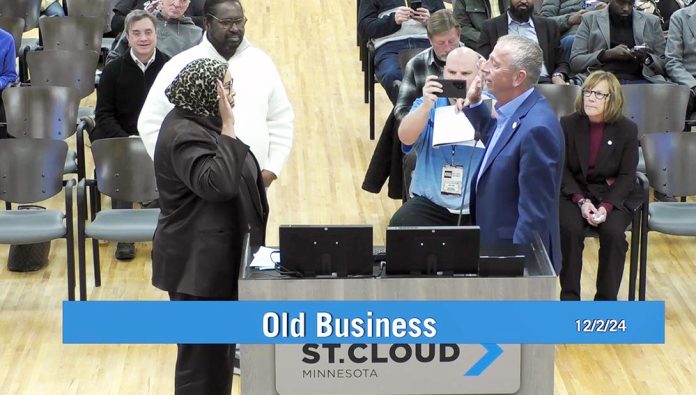
Retiring St. Cloud Mayor Dave Kleis administers the oath of office to Hudda Ibrahim on Monday, Dec. 2, 2024 after the City Council unanimously voted to appoint her to represent Ward 3 to replace the current representative Jake Anderson who is now Mayor-elect. She becomes the first Black and Somali American to serve on the council. Photo: GovTV 181 Screengrab
Retiring St. Cloud Mayor Dave Kleis administers the oath of office to Hudda Ibrahim on Monday, Dec. 2, 2024 after the City Council unanimously voted to appoint her to represent Ward 3 to replace the current representative Jake Anderson who is now Mayor-elect. She becomes the first Black and Somali American to serve on the council. Photo: GovTV 181 Screengrab
The St. Cloud City Council on Monday, after interviewing nine candidates, appointed Somali-born Hudda Ibrahim to represent Ward 3 replacing Councilmember Jake Anderson who won his election for Mayor in November. Ibrahim will serve the rest of Anderson’s term which was to end in 2026.
Mayor-elect Anderson, who doesn’t take office until January, resigned his council seat after his mayoral win to give time to the city council to start the process of appointing a replacement.
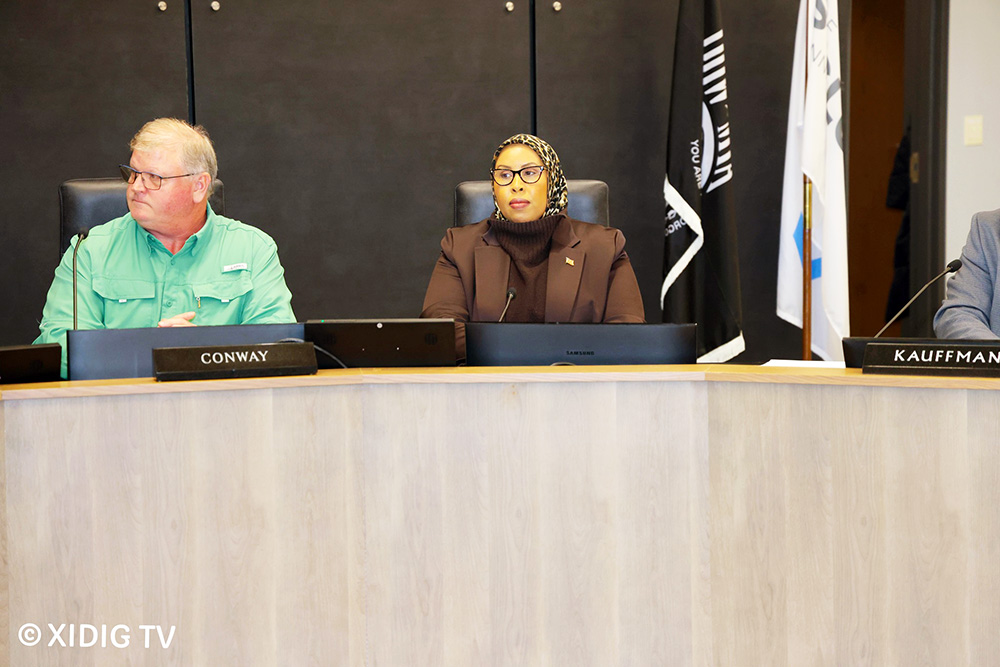
Ibrahim’s appointment, which was unanimous, makes her the first Black person to serve on the council as well as the first Somali. Blacks in the central Minnesota city of 68,000 comprise 18 percent of the population, according to the research nonprofit Minnesota Compass.
Ibrahim and husband Abdi Mahad have been St. Cloud residents for 19 years.
Councilmember Hudda Ibrahim takes her seat on the St. Cloud City Council minutes after taking the oath of office on Monday, Dec. 2, 2024 after the City Council unanimously voted to appoint her to represent Ward 3 to replace the current representative Jake Anderson, who is now Mayor-elect. She becomes the first Black and Somali American to serve on the council. Photo: Courtesy of Xidig TV
She was on the ballot in November with five other candidates to fill one of three at-large Council seats but was unsuccessful, coming in fifth with 13 percent of the vote.
An author, academic and businesswoman, she has been an instructor at St. Cloud Technical and Community College for 10 years and has served on numerous boards. She has served on the St. Cloud Area Chamber of Commerce, The Central Minnesota Community Foundation and a stint on the Mayor’s Downtown St. Cloud Task Force, which is working on the revitalization of downtown.
She brings some massive brainpower to the council. She has a master’s degree in Conflict Resolution from the University of Notre Dame. She has two bachelor’s degrees from the College of Saint Benedict and Saint John’s University – in conflict resolution and English literature respectively. As part of her continuing education, she has a human resource certificate from Cornell University in New York. She just recently completed coursework for her doctorate degree in education and leadership from Saint Mary’s University.
St. Cloud Mayor David Kleis, who has been mayor for 20 years and is retiring, administered the oath of office to Ibrahim. Shortly after takeing the oath, she took her seat on the council and cast her first vote to cancel a Dec. 9 council meeting that was deemed no longer necessary.
President Joe Biden, accompanied by Angola's President Joao Lourenco, center, and President Felix Tshisekedi of the Democratic Republic of the Congo visits the Carrinho food processing factory near Lobito, Angola on Tuesday, Dec. 3, 2024. Photo: Ben Curtis/AP
Remarks by President Biden Honoring the Past and Future of the Angolan-U.S. Relationship on Tuesday, December 3, 2024
Transcript provided by The White House Press Office
THE PRESIDENT: You are a brave crowd to come out in the rain. I brought my hat just in case. I don’t have much hair to help me. (Laughter.)
Leaders of Angola, government and civil society, students, young leaders, staff of the National Slavery Museum, distinguished guests, I sincerely mean this when I say thank you for being here in the rain with us today. Thank you for allowing me to be here. It’s an honor — a genuine honor to be with you today in Angola.
I just got off the phone with the vice president, telling her I’m sorry she’s not with me to be here today, you know, with you in Angola, the — a vibrant city. And — and I — look, not the city. The city, I know, is not Angola, but in Angola in a vibrant city.
And I’m joined by members of the United States Congress, senior officials of my administration, and American business and civic leaders. We think that it’s important that we get together. We thank all people of Angola for your warm hospitality, and I mean that s- — please sit down if you have a seat. Don’t — I’m sorry. (Laughter.) I wasn’t sure you all had seats.
We are gathered at a someln — a solemn location. Because to fully consider how far our two countries have come in our friendship, we have to remember how we began.
We hear them in the wind and the waves. Young women, young men born free in the highlands of Angola, only to be captured, bound, and forced on a “death march” along this very coast to this spot by slave traders in the year 1619.
In the building next to us, they were baptized into a foreign faith against their will, their names changed against their will to Anthony and Isabella. Then they were condemned to a slave ship bound for the Middle Passage, packed together in hundreds by hundreds. A third of those souls did not survive the journey. One third died on the way.
But Anthony and Isabella made it to the British colony in Virginia, where they were sold into servitude and became two of the first enslaved Americans in a place that, 150 years later, would become the United States of America. They had a son, considered the first child of African descent born in America: William Tucker.
It was the beginning of slavery in the United States. Cruel. Brutal. Dehumanizing. Our nation’s original sin — original sin — one that haunted America and casts a long shadow ever since.
From the bloody Civil War that nearly tore my nation apart to the long battle with Jim Crow in the ni- — to — into the 1960s for the civil rights and voting rights movement — which got me involved in public life — during which American cities were burned, to the still unfinished reckoning with racial injustice in my country today.
Historians believe people of Angola accounted for a significant number of all enslaved people shipped to America. Today, millions of African Americans have roots in Angola.
As I said at the U.S.-African Leaders Summit that held in Washington two years — I held in Washington two years ago, “Our people lie at the heart of the deep and profound connection that forever binds Africa and the United States together. We remember the stolen men and women and children who were brought to our shores in chains, subjected to unimaginable cruelty.”
Here with us today are three Americans who are direct descendants of Anthony and Isabella, those first enslaved Americans — Afri- — Africans in America. Wanda Tucker of Hamilton [Hampton], Virginia. Wanda, are you there? There you are, Wanda. God love you. (Applause.) Her brother Vincent and Carolita as well. Thank you for being here. We’re going to write history, not erase history.
The Tuckers learned their family history around the dinner table. That history led Wanda here in Angola a few years ago. She did not know how to speak the language, but that didn’t matter. When she arrived, Wanda said she felt something profound, like she’d come home. That was her comment to me. She called it the “connection without words.”
Ladies and gentlemen, I am here today to honor that connection between our people and to pay tribute to the generations of Angolans and American families, like the Tuckers, who have served in government for over — I’ve served in government for over 50 years. I know I only look like I’m 40 years old, but I’ve been around hanging in the government for — (laughter) — I hate to admit it — for 50 years.
But in that 50 years, I’ve learned a lot. Perhaps most importantly, I have learned that while history can be hidden, it cannot and should not be erased. It should be faced. It’s our duty to face our history: the good, the bad, and the ugly — the whole truth. That’s what great nations do.
That’s why I chose to speak here at the National Slavery Museum today, just as I toured. And that’s why your president visited the National Museum of African American Culture in the — in Washington, D.C. — the second most-visited museum in the States — and he did it a few years ago.
He saw what I see: the stark contradiction between my country’s founding principles of liberty, justice, and equality and the way we long treated people from Angola and from throughout Africa.
I’ve often said America is the only nation in the world founded on an idea. Most countries are founded based on race, ethnicity, religion, geography, or some other attribute. But in the United States, founded on idea, one embedded in our Declaration of Independence, and that is that all men and women are created equal and deserve to be treated equally throughout their lives.
It’s abundantly clear today we have not lived up to that idea, but we’ve never fully walked away from it either. And that’s due in no small part to the determination and dreams of African Americans, including Angolan Americans.
The proud descendants of the diaspora who helped build my nation as they rebuilt their own families and their own sense of self. They were the forebearers as well — resilient, faithful, even hopeful — hopeful that joy would cometh in the morning, as it says in the Bible; hopeful that our past would not be the story of our future; and hopeful, in time, the United States would write a different story in partnership with the people brought here in chains to my nation from Africa. It’s a story of mutual respect and mutual progress.
That’s the history that brings me here, the first American president ever to visit Angola. Over time — (applause) — and I’m proud to be. Over time, the relationship beca- — between our countries has been transformed from distance to genuine warmth. Today, our relationship is the strongest it’s ever been.
Throughout my presidency, it’s been my goal — goal of the United States to build a strong partnership with peoples and nations across the continent of Africa — true partnerships aimed at achieving shared goals, bringing to bear the dynamism of America’s private sector and the expertise of our government to support aspirations of African entrepreneurs, experts, leaders both inside and outside of government.
Because we know the challenge that define our age demand African leadership. One out of every four human beings on Earth will live in Africa by the year 2050. And the ingenuity and determination of young Africans in particular, like the young society leaders I just met with here today, will be undeniable forces in that human progress.
That’s why I’m so optimistic, because of that generation. In no small part, it will be in their hands and the hands of people across Africa to expand access to clean energy, to tackle threats of global health, to grow global — a global middle class.
In many ways, Africa’s — Africa’s success is and will be the world’s success. As I said at the United States — U.S.-Africa Summit: The United States is all in on Africa’s future.
Two years ago, I pledged to deliver $55 million [billion] in new investments in Africa and to mobilize American businesses to close new deals with African partners. Two years ago, we are out way ahead of schedule. More than 20 heads of U.S. government agencies and members of my Cabinet have traveled to Africa, delivering over $40 billion in investments thus far.
And we have announced nearly 1,200 new business deals between African and American companies — and American companies — total will be worth $52 billion, including investments in solar energy, telecom, mobile finance, infrastructure, and partnerships with American airlines to expand opportunities for tourism so you don’t have to fly to Paris to get here — although Paris is pretty nice. (Laughter.)
Here in Angola alone, the United States has invested $3 billion during my short presidency. We see the bonds between our countries across sectors, from clean energy to health care to sports. The American Basketball Associat- — National Basketball Association launched Basketball Africa League and Angola is the reigning champion. (Applause.)
And we see the impact of American culture across — African culture across the American culture, from music to entertainment to fashion to arts and so much more.
Student exchanges between our countries are essential and must increase. Students in both countries can be — better understand one another if they know the country, if they visit the country, if they’re educated in the other country. An increased connection between us makes a big difference.
Being all in on Africa means making sure African voices are heard at the tables that matter most. Under my leadership, the United States brought — we brought in the African Union as a permanent member of the G20 economies, and we insisted on more African representation among the leaders of the International Monetary Fund and other world financial institutions.
We’ve also pushed to ensure that developing nations do not — do not choose — have to choose between paying down unsustainable debt and being able to invest in their own people. And we’re using our voi- — our own voice to increase Africa’s presence on the U.N. Security Council at the United Nations. That should happen. You can clap for that, folks. You should be in there. (Applause.)
The United States continues to be the world’s largest provider of humanitarian aid and development assistance. And that’s going to increase. You know, that’s the right thing for the wealthiest nation in the world to do.
And today, I’m announcing over $1 billion in new humanitarian support for Africans displaced from homes by historic droughts and food insecurity. (Applause.)
But we know African leaders and citizens are seeking more than just aid. You seek investment. And so, the United States is expanding our relationship all across Africa — from assistance to aid to investment to trade — moving from patrons to partners to help bridge the infrastructure gap.
I was told, by the way, when I got elected I could never get an infrastructure bill passed because the last guy spent eight years saying, “Next month” — four years saying, “Next month.”
Well, guess what, folks? We’ve done it. (Applause.) A trillion — a trillion three hundred billion dollars for infrastructure to narrow the digital divide, drive inclusive, sustainable economic growth.
We’re looking for partners who understand that the right question in the year 2024 is not “What can the United States do for the people of Africa?” It’s “What can we do together for the people of Africa?” (Applause.) That’s what we’re going to do.
Nowhere in Africa is the answer more exciting than here in Angola. It starts with our governments, whose partnership is stronger, deeper, and more effective and active than any point in history. It’s testament to your president, who had the vision to carry out this relationship — carry this relationship forward. And it’s a testament to Angolan citizens across the private sector and civil society who have forged strong bonds with your American counterparts.
And together, we’re engaged in a major joint project to close the infrastructure gap for the benefit of Angolans, Africans across the continent, Americans, and the world. We’ll all benefit, as you benefit. You’re — you can produce much more agriculture, for example, than states that can’t. You’re going to increase their longevity, and you’re going to increase your impact and profit.
It’s called the Lobito Corridor. We’re building railroad lines from Angola to the Port of Lobito, in Zambia and the DRC, and, ultimately, all the way to the Atlantic — from the Atlantic Ocean to the Indian Ocean. It’ll be the first trans-continental railroad in Africa and the biggest American rail investment outside of America.
And I must tell you up front, with American press here, I’m probably the most pro-rail guy in America. (Laughter.) I’ve ri- — I’ve ridden over 1,300,000 miles on a daily basis to my work, 210 — -20 miles a day for the last 50 years.
Well, I didn’t do it as president. I stayed in the White House a lot.
But all kidding aside, folks, we can do this. We can do this. It’s in our power.
It will not only generate significant employment, it will also allow individual countries to maximize their own domestic resources for the benefit of their people and sell critical minerals that power the world’s energy transformation and our fight against climate change and to transport them in a fraction of the time and lower cost. A shipment that used to take over 45 days will now take 45 hours. That’s a game changer. That increases profit. That increases opportunity.
The Lobito Corridor represents the right way to invest in full partnership with a country and its people.
As part of this project, we will install enough clean energy power to power hundreds of thousands of homes, expand high-speed Internet across — for millions of Angolans, which is a cos- — as consequential today as electricity was two generations ago.
And we’re investing in agriculture and food security, fulfilling the needs of countries without agricultural capacity and expanding opportunities for countries growing the crops; connecting farmers across the Lobito — along the Lobito Corridor to new markets, expanding opportunity and prosperity — you doing that, having the means to do it.
The United States understands how we invest in Africa is as important as how much we invest. In too many places, 10 years after the so-called investment was made, workers are still coming home on a dirt road and without electricity, a village without a school, a city without a hospital, or a country under crushing debt.
We seek a better way: transparent, high-standard, open-access investments that protect workers and the rule of law and the environment. It can be done and will be done. (Applause.)
And, folks, the partnership between Angola and the United States also extends to supporting peace and security in this region and beyond.
Pl- — Pr- — President Lourenço, I want to thank him for his leadership and mediation in regional conflicts. I also want to thank him for Angola speaking out against Russia’s unprovoked war against Ukraine. It matters. It matters when leaders speak out. (Applause.)
Ladies and gentlemen, as you know, I am in the final weeks of my presidency. You don’t have to clap for that. (Laughter.) You can if you want.
But I wanted to come to Angola. Although I’ve been chairman of the Africa America subcommittee for a long time, I had never made it to Angola. Because although I don’t know exactly what the future will hold, I know the future runs through Angola, through Africa. I mean it sincerely. (Applause.) I’m not kidding.
I know that any nation that wants to thrive in the next century must work as partners with workers, entrepreneurs, and businesses here in Africa. I know that the connection between our communities, our universities, our sports, our civil societies, our families, our people will only grow deeper. We have to stay focused.
The story of Angola and the United States holds a lesson for the world: two nations with a shared history in evil of human bondage; two nations on opposite sides of the Cold War, defining struggle in the late part of the 20th century; and now, two nations standing shoulder to shoulder, working together every day for the mutual benefit of our people.
It’s a reminder that no nation need be permanently a — the adversary of another, a testament to the human capacity for reconciliation, and proof that from every — from the horrors of slavery and war, there is a way forward.
So, I stand here today — I mean this sincerely — deeply optimistic.
When I — by the way, 20 years ago, when I was a senator, I had a cranial aneurysm. They s- — got me to the hospital in time. I remember asking the doctor, “What are my ch-” — he said, “Oh, your chances are good. They’re about 30 percent.” (Laughter.) (Inaudible.) When it was all over, he was deciding whether or not it was congenital or environmental. And I said, “I don’t give a damn. I’m here.” He said, “You know what your problem is, Senator? You’re a congenital optimist.” (Laughter and applause.) I am.
About the possibilities and progress that lie just beyond the horizon. Together, we can and will chart a futuche worther [future worthy] of great nations, worthy of the highest aspirations of our people. We just have to remember who we are: We’re Angolans; we’re Americans.
As I often say in Ameri- — to the American people: There’s nothing — nothing beyond our capacity if we work together. And today, I say to the people of Angola and all the people of Africa, there is nothing beyond our capacity if we do it together.
Thank you. And God bless you and keep you all safe. (Applause.) Thank you, thank you, thank you. And thank you for waiting.
And I got my hat. Thanks, everybody. I really mean it. You’re very patient.
Q Mr. President, anything on South Korea and martial law?
THE PRESIDENT: I’m just getting briefed on it. I’m just getting briefed. I haven’t heard the details.