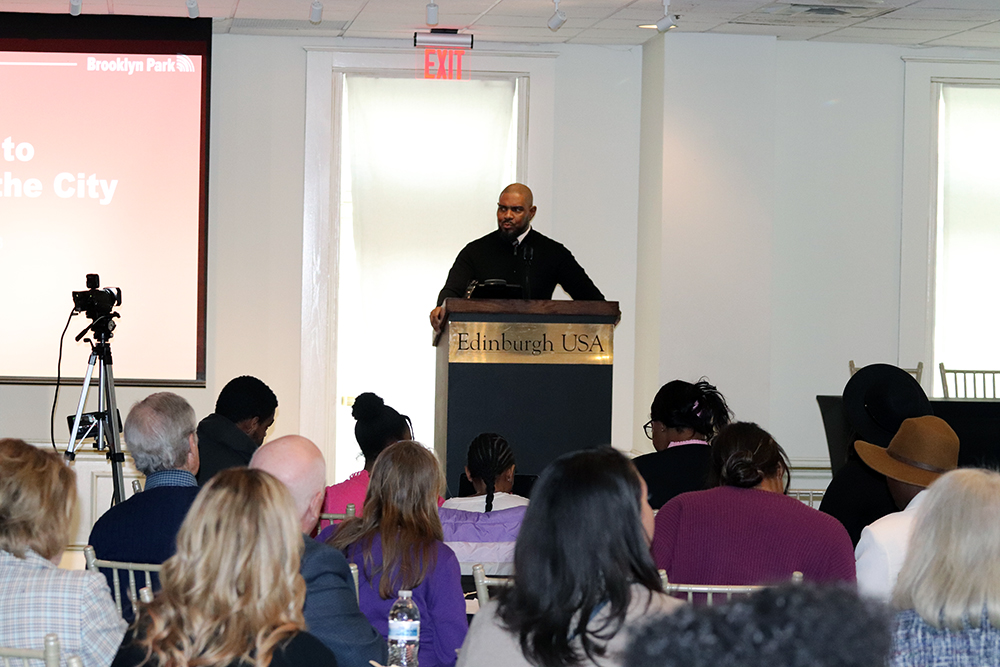
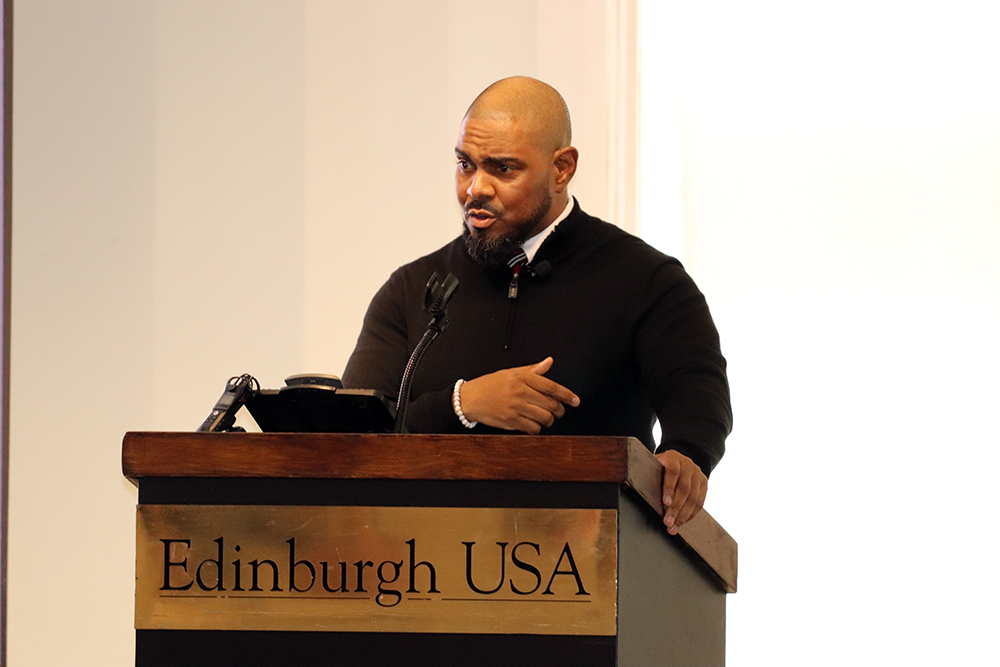
Brooklyn Park Mayor Winston opened his State of the City address at the city-owned Edinburgh USA on Tuesday by reflecting on a year marked by both tragedy and resilience in the community. He acknowledged the March 29, 2025, plane crash that struck a home in the city. “Thankfully, the homeowners survived, but the trauma of seeing their home destroyed and the loss of the pilot weighs heavily on our community,” Winston said, offering prayers for the pilot’s family and the residents affected.
He also remembered the assassination of former Minnesota Speaker Melissa Hortman, her husband Mark, and their golden retriever Gilbert, calling it “a loss that shook the city and the entire state.” Winston praised Speaker Hortman’s legacy, highlighting her work on universal free school meals, clean energy initiatives, police accountability reforms following the George Floyd era, and housing investments. He recounted how Hortman personally mentored youth, teaching them about civics and encouraging their involvement in the community.
Winston extended support to Senator John Hoffman and his family, who survived an assassination attempt. “Our prayers with him and his family, our support needs to continue to be with that family as well,” he said, noting that the trauma of that day continues to affect their lives and the surrounding neighborhood.
Addressing Operation Metro Surge, The Trump administration’s large-scale federal immigration enforcement operation primarily targeting the Minneapolis–Saint Paul metro area, Winston said, “Brooklyn Park, like much of Minnesota, saw real effects from that federal operation. Businesses reported drops in customers, people were afraid to go out, and our service providers felt the strain as families sought stability.” Although the intense enforcement phase has largely ended, he emphasized that the city must incorporate lessons from the operation into long-term planning, from housing and schools to public safety, to support residents who felt the impact most directly.
A key topic of the address was reforming congregate care facilities, commonly known as group homes. Winston noted that Brooklyn Park has more of these facilities than any other city in the state, including Minneapolis and St. Paul. While many facilities provide excellent care, the city is seeking statewide consistency and better support for residents while also ensuring housing remains available for new families.
The mayor highlighted programs such as the alternative response team, which responds to mental health episodes in congregate care settings without relying on police intervention. “We want to get people the help and the support they need,” Winston said. He noted that congregate care facilities make up roughly 1.7 percent of the city’s housing stock, yet account for approximately 11 to 12 percent of police department calls, costing the city an estimated $4–5 million annually — a significant share for a city with a modest budget.
Winston also addressed the city’s fiscal strategy and approach to managing growth. He reminded residents that the council had chosen to limit city levy growth to 4.5 percent in order to balance public safety, essential services, and affordability. “A safer city costs money. The investments we made in public safety — community policing, alternative response teams, and domestic violence programs — are not free. They require sustained funding,” he said. He noted that residents are already feeling pressure from school board and county taxes, rising gas, food, and housing costs, and that maintaining affordability requires both careful budgeting and strategic economic growth.
Brooklyn Park currently has approximately $2.7 to $3 billion in commercial property value, Winston said, compared with Bloomington’s roughly $5.5 billion. “Until that gap closes, homeowners carry the load for the city services they expect,” he said. To strengthen the tax base, the city is pursuing initiatives such as the Northwest Area Growth Plan and the Biotech Innovation District, projected to create 10,000 jobs and 3,000 housing units, and offering municipal bond authority similar to Rochester’s Destination Medical Center designation.
The mayor also discussed reimagining Brooklyn Boulevard, citing plans to attract housing, businesses, and services that draw residents and visitors, while maintaining the city’s character. Strategic public investment in the southern part of the city, he said, is revitalizing older neighborhoods, lifting property values, and attracting private capital to rebuild the tax base. He cautioned that these changes will take time — three to five years before significant tax relief is felt — but stressed the importance of speed and alignment in economic development to prevent pricing residents out of the community.
He also noted a city program milestone: the upcoming addition of curbside organics collection, which he described as the most significant expansion of the city’s recycling program in more than 20 years, crediting city employee Tim Pratt for the initiative.
Winston framed the city’s vision around long-term opportunity for residents. “Imagine a young family buying their first home in Brooklyn Park because this city is still the kind of place where that’s possible,” he said. “Their kids can find careers here, seniors can stay in right-sized, dignified housing, and the community grows without displacing those who helped build it.”
The mayor encouraged residents to remain engaged with city priorities and advocacy at the state level. “Visit our website, read our legislative agenda, and contact your state representative,” he said. “Whether it’s the biotech district, youth and senior programs, congregate care reform, or water infrastructure, your voice makes all the difference.”
Brooklyn Park is united, Winston said, and no longer undiscovered. “You deserve to feel safe where you live. You deserve to live in a city that is growing, not just managing. You deserve a city that fights to keep you here because it values the people who choose to call it home,” he said.
About Tom Gitaa, Editor-in-Chief
Born and raised in Kenya's coastal city of Mombasa, Tom is the Founder, Editor-in-Chief and Publisher of Mshale which has been reporting on the news and culture of African immigrants in the United States since 1995. He has a BA in Business from Metro State University and a Public Leadership Credential from Harvard’s Kennedy School of Government. He was the original host of Talking Drum, the signature current affairs show on the African Broadcasting Network (ABN-America), which was available nationwide in the United States via the Dish Network satellite service. On the show, he interviewed Nobel laureates such as 2004 Nobel Peace prize winner, Professor Wangari Maathai, the first woman from Africa to win the peace prize and heads of states. Tom has served and chaired various boards including Global Minnesota (formerly Minnesota International Center), the sixth largest World Affairs Council in the United States. He has previously served as the first Black President of the Board of Directors at Books for Africa. He also serves on the board of the Minnesota Multicultural Media Consortium. He has previously served two terms on the board of the United Nations Association. An avid runner, he retired from running full marathons after turning 50 and now only focuses on training for half marathons.
- Web |
- More Posts(517)
 (No Ratings Yet)
 Loading...