


Malawi’s chief justice told a Minnesota audience that judicial independence is facing growing global pressure, warning that the erosion of legal norms is not confined to any one country.
Speaking at the Humphrey School of Public Affairs, Rizine Mzikamanda described the rule of law as “foundational to democracy,” cautioning against what he called the reemergence of the “rule of men” over legal institutions.
“We are seeing the reemergence of the rule of men, trying to replace the rule of law,” he said. “We ought to stand on guard.”
The event, attended by about 100 people in a reception-style setting with guests seated and standing throughout the forum space, was hosted by the Law & Democracy Initiative of Books For Africa, a St. Paul–based nonprofit founded in 1988 that has grown into the world’s largest shipper of donated school textbooks to Africa.

Mzikamanda’s keynote drew connections between Malawi’s recent constitutional challenges and broader global threats to judicial independence. He was a Humphrey Fellow at the University of Minnesota during the 1997–98 academic year—a program that brings accomplished mid-career professionals from around the world to the United States for academic study and professional exchange.
He pointed to the country’s disputed 2019 presidential election, which was annulled by the courts after widespread irregularities, including altered vote tallies. Judges who ruled on the case faced intimidation, including attacks on court buildings and threats to their lives.

“They were so scared that they began saying their final prayers,” Mzikamanda said. “But they remained committed to doing what was right according to law.”
The court-ordered rerun election ultimately led to a peaceful transfer of power—an outcome widely cited as a rare example of judicial intervention strengthening democracy.
Before the keynote, U.S. District Judge Jerry Blackwell framed the rule of law not as an abstract concept, but as something sustained through individual commitment.
“The rule of law is not just a slogan,” Blackwell said. “It lives in whether a judge enforces the rule even when it is inconvenient.”
Drawing parallels between Malawi and the United States, he added: “It is as true in Malawi as it is in Minneapolis. The rule of law is, at its core, a restraint on power—and power everywhere resists restraint.”

Blackwell, who gained national prominence as lead prosecutor in the Derek Chauvin trial before his appointment to the federal bench, emphasized that legal systems endure only when those in power are held accountable.
Minnesota Supreme Court Chief Justice Natalie Hudson—the first person of color to serve as chief justice of the court—echoed those themes, underscoring the shared challenges courts face across borders.
“We are part of a broader global effort to sustain democratic values and public trust,” said Hudson.
Hudson described the rule of law as “the foundation upon which stable and just societies are built,” adding that courts must remain steady even as public trust is tested.
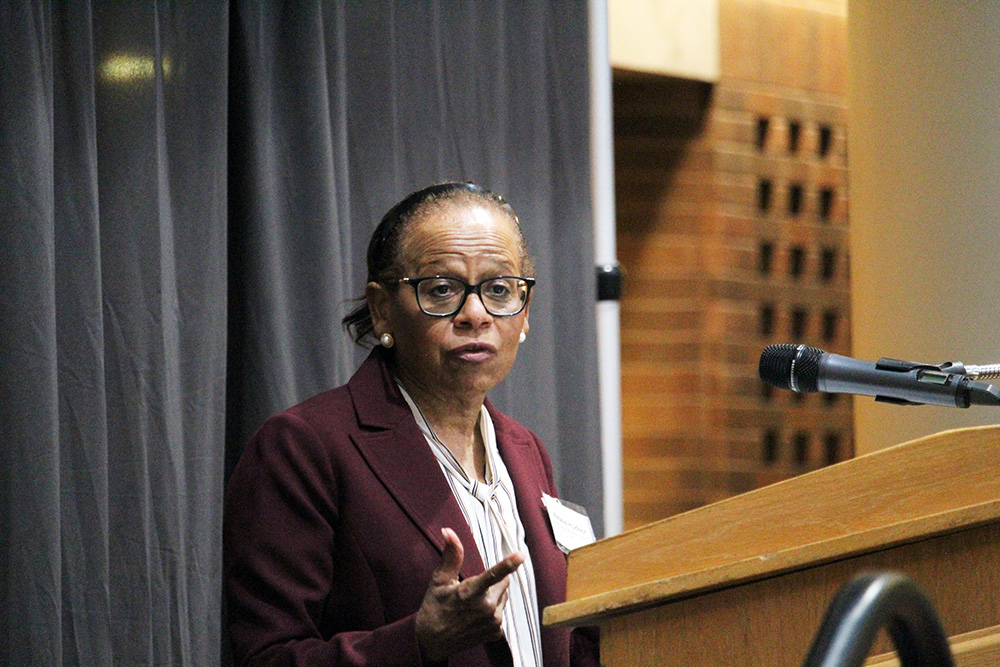
“There will be moments when courts are tested, when decisions are questioned, and when trust is strained,” she said. “And it is in those moments that our commitment to the rule of law must remain steady.”
For aspiring lawyers in the audience, the message resonated beyond theory.
Ja’Shaylee Minor, a first-year student at Mitchell Hamline School of Law, said the event reinforced the responsibility future attorneys carry.
“The most important thing is to uphold the rule of law,” she said. “It was very inspiring to see both of the justices speak about that as a law student and a future attorney.”
Minor, who previously studied at Howard University, said the discussion deepened her understanding of how legal systems operate across borders.
Audrey Sarpong, also a first-year law student, said the event highlighted the role individuals play in sustaining legal institutions.
“Each one of us has a part to play in the legal profession,” she said. “It has really inspired me to do my part.”

Sarpong, a Minnesota native with family roots in Ghana, said she saw the event as a reminder of the importance of strengthening the rule of law both in the United States and across Africa.
The program concluded with remarks from Fatima Lawson, board president of Books For Africa, who emphasized the organization’s work in expanding access to legal knowledge and educational resources across the continent.
“At Books For Africa, we believe that access to legal knowledge is a fundamental part of sustaining democracy,” she said. “To that end, we are currently raising funds to send a comprehensive reference law library to allow graduates to join us in this mission.”
But it was the students in the room who left with the final word—reflecting on what they had heard, and what it meant for their future in law.
About Tom Gitaa, Editor-in-Chief
Born and raised in Kenya's coastal city of Mombasa, Tom is the Founder, Editor-in-Chief and Publisher of Mshale which has been reporting on the news and culture of African immigrants in the United States since 1995. He has a BA in Business from Metro State University and a Public Leadership Credential from Harvard’s Kennedy School of Government. He was the original host of Talking Drum, the signature current affairs show on the African Broadcasting Network (ABN-America), which was available nationwide in the United States via the Dish Network satellite service. On the show, he interviewed Nobel laureates such as 2004 Nobel Peace prize winner, Professor Wangari Maathai, the first woman from Africa to win the peace prize and heads of states. Tom has served and chaired various boards including Global Minnesota (formerly Minnesota International Center), the sixth largest World Affairs Council in the United States. He has previously served as the first Black President of the Board of Directors at Books for Africa. He also serves on the board of the Minnesota Multicultural Media Consortium. He has previously served two terms on the board of the United Nations Association. An avid runner, he retired from running full marathons after turning 50 and now only focuses on training for half marathons.
- Web |
- More Posts(515)
 (No Ratings Yet)
 Loading...