
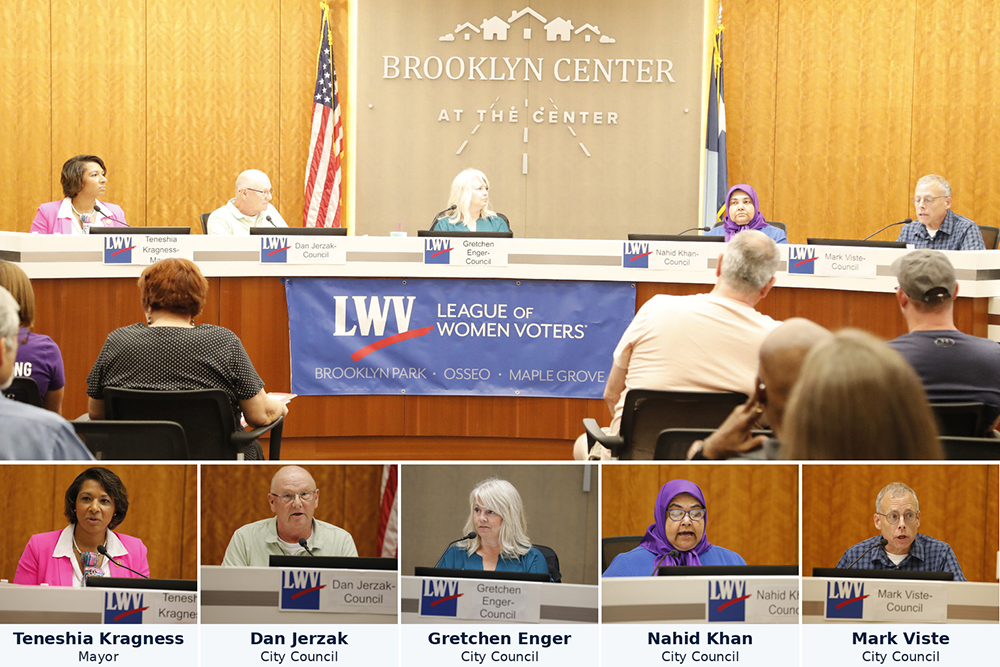

BROOKLYN CENTER, Minn. — Brooklyn Center candidates drew sharp distinctions Tuesday over police surveillance cameras, property taxes and the city’s response to federal immigration enforcement, offering voters some of the clearest differences yet in races that will determine the city’s next mayor and two City Council members.
But only one of the city’s two mayoral candidates was there to make her case.
City Councilmember Teneshia Kragness joined all four council candidates — Gretchen Enger, incumbent Councilmember Dan Jerzak, Nahid Khan and Mark Viste — for the roughly 80-minute forum hosted by the League of Women Voters of Brooklyn Park, Osseo and Maple Grove at Brooklyn Center City Hall.
Alexander Koenig, who is challenging Kragness for mayor, did not attend. At the conclusion of the forum, the moderator said Koenig had been invited but did not participate. She did not give a reason for his absence.
Mshale emailed and texted Koenig Wednesday morning and attempted to reach him by phone, leaving a voicemail seeking an explanation for his absence and asking whether he had notified forum organizers in advance. He did not respond before publication.
The forum came less than two weeks before early voting begins Sept. 18 in races that will shape the leadership of one of Minnesota’s most diverse suburbs. The Nov. 3 election will determine who succeeds Mayor April Graves, who is not seeking reelection, and which two of the four council candidates win the city’s two at-large seats.
RELATED: Brooklyn Center candidate positions at a glance
Candidates split over Flock cameras
The clearest divide of the night emerged over Brooklyn Center’s use of automated license plate readers, commonly known as Flock cameras.
Viste said he initially had been open to the technology but changed his position after talking with residents and learning more about how it works.
“I think the best thing to do is to stop their use,” Viste said, arguing that the technology is more invasive than many residents realize.
“If we are going to be building a surveillance state, that needs to be a council decision with robust residents’ input,” he said.
Khan also expressed concerns about surveillance and said the council should examine the technology further before allowing its continued use.
“We do not want a police state,” Khan said, calling for a community discussion about the cameras and how information they collect can be used.
Jerzak defended the cameras as an effective law enforcement tool that has helped police investigate crimes and locate vehicles, while acknowledging concerns about privacy. He pointed to an independent audit of the city’s system and policies governing its use.
Enger also supported continued use of the cameras with oversight, citing restrictions on access and the system’s 30-day data-retention period.
Kragness took a more conditional position. She said police should have access to technology that helps them do their jobs but that residents’ privacy must be protected. She also said more public education is needed about what the cameras can and cannot do.
Brooklyn Center police deployed 10 automated license plate readers with funding from a Minnesota Auto Theft Grant. An independent audit conducted last year found the system compliant in major areas including data collection, retention, access controls and interagency sharing, while identifying an issue involving breach-notification procedures.
An 8% levy proposal hangs over the race
Taxes and the city’s financial position produced another dividing line as candidates debated how aggressively Brooklyn Center should cut spending, seek new revenue or ask property owners to pay more.
The discussion comes as city officials consider a proposed 2027 budget calling for an 8% increase in the property tax levy, from about $28.3 million this year to $30.5 million next year — an increase of roughly $2.26 million.
For a median-valued residential homestead, estimated at $290,300 next year, the city projects its share of the property tax bill would rise from $1,679 to $1,892, an increase of $213. If the home’s value remained unchanged, the city estimates the increase would be about $142 annually.
The proposal is not final. The City Council is scheduled to consider the proposed 2027 General Fund budget and property tax levy Sept. 28, with final adoption scheduled for December.
Viste cited the proposed 8% increase during the forum and questioned whether residents should bear the cost of replenishing the city’s Capital Reserve Emergency Fund. City budget documents show the proposal includes $260,000 for the fund.
Khan argued that Brooklyn Center has relied too heavily on property owners and should more aggressively pursue grants and other state and federal funding.
“Our property tax is tapped out,” Khan said.
She earlier described a city budget as “not a mathematical exercise, but a moral document,” saying spending decisions reflect what city leaders value.
Jerzak emphasized prioritizing essential city services. He said the city cannot control rising household costs such as groceries and gasoline but can control how it spends taxpayers’ money.
Enger rejected framing the choice as simply raising taxes or cutting services. She said city officials should examine whether services are required, whether they protect health and safety, what results they produce and what would happen if they were eliminated.
Kragness, an accountant who repeatedly emphasized her financial background, said eliminating employees should be among the city’s last options when balancing its budget.
She suggested discretionary expenses, including the city’s fireworks display, should be considered for cuts before employees or essential resources.
The proposed budget illustrates some of those trade-offs. It includes four additional firefighters and an embedded mental health professional. After outside revenue is applied, the firefighters would add about $406,000 to the levy and the mental health position about $31,000.
Broad agreement on alternatives to police
The candidates found considerably more common ground on Brooklyn Center’s use of mental health professionals and other alternatives to sending police officers to every call.
Kragness described the programs as additional tools rather than services that should be consolidated or eliminated.
Khan said alternative responders can help de-escalate situations in which sending an armed police officer may not be the best initial response.
Enger said she “100%” supports expanded response, particularly for mental health calls, but wants the city to measure whether people are successfully connected with services, whether the programs reduce demand on police and whether taxpayers are getting results.
Jerzak also supported multiple response options but suggested Brooklyn Center consider regional partnerships where they could reduce costs.
Viste argued that the city may need more social workers, not fewer, particularly to ensure appropriate responders are available beyond limited hours.
The city’s proposed 2027 budget would add one embedded mental health professional to the General Fund.
Candidates address ICE enforcement
Immigration produced some of the forum’s strongest language when candidates were asked how Brooklyn Center could ensure immigrants and other vulnerable residents feel safe interacting with police officers and city employees.
Jerzak sharply condemned recent federal immigration enforcement in Minnesota.
“What happened with the ICE invasion that occurred in Minnesota, no matter what side you’re on, can only be described as traumatic, chaotic, inhumane and a failed policy at its worst,” Jerzak said. “There’s no excuse for it.”
Viste went further in questioning whether simply declining to participate in federal immigration enforcement is enough.
He noted that Brooklyn Center police do not assist U.S. Immigration and Customs Enforcement with civil immigration enforcement but argued the city should take a more affirmative position in support of residents who feel threatened.
Viste said that when ICE was “pulling people out of their homes,” merely declining to assist federal agents was not the same as supporting residents.
He said vulnerable residents should know that “the city supports them and wants to defend them,” rather than viewing city government as neutral.
Brooklyn Center has said its police officers do not enforce civil immigration laws, participate in federal immigration raids or deportation efforts, detain people solely on ICE requests or share a person’s undocumented status with federal immigration authorities.
Khan called for rebuilding the city’s community engagement efforts, educating immigrant residents about their rights and increasing diversity among city employees and police officers.
Enger emphasized rebuilding trust with residents who may be uncomfortable interacting with law enforcement, while Kragness said residents should be treated fairly and with the same dignity city officials would expect for themselves.
Outside campaign spending enters the debate
The night’s most pointed political attack came during Viste’s closing statement.
Although Brooklyn Center municipal races are nonpartisan, Viste identified himself, Kragness and Khan as candidates supported by the DFL and contrasted them with candidates he said were benefiting from “special interest money.”
“These special interests seek to install candidates ready to prioritize business interests over our residents,” Viste said.
Viste did not identify the candidates or groups by name.
Mshale previously reported that Citizens for Safer Cities, a political committee funded primarily by apartment-owning companies, made independent expenditures supporting Koenig in the mayoral race and Enger and Jerzak in the council race.
The committee reported spending $5,589.60 supporting Koenig ahead of the August primary and $2,824 each supporting Enger and Jerzak. Independent expenditures are made without coordination with the candidates they support.
Kragness gets the mayoral stage to herself
Koenig’s absence left Kragness as the only mayoral candidate answering questions throughout the forum.
Kragness, who serves as mayor pro tem, framed her campaign around what she called “public safety, pride and prosperity.”
She said public safety extends beyond policing, argued that Brooklyn Center should turn vacant and underused property into new businesses and housing, and emphasized helping residents build generational wealth.
Housing affordability was among the concerns she said she hears most frequently while campaigning, particularly from longtime homeowners worried about whether they can afford to remain in the city.
The forum also produced an unusual moment between Kragness and Jerzak, who have served together on the council.
Jerzak said he and Kragness have disagreed on issues but told her he believed she would be able to bring council members together if elected mayor.
“I do believe that if you’re elected, you will do a good job of bringing us together,” Jerzak said.
Kragness finished first in the Aug. 11 mayoral primary with 52.86% of the vote. Koenig advanced with 19.71%, edging Councilmember Laurie Ann Moore by seven votes for the second spot on the November ballot.
In the council primary, Enger finished first with 17.72%, followed by Jerzak with 17.22%, Khan with 13.62% and Viste with 10.98%. Voters will elect two of the four in November.
Early voting begins Sept. 18 at Brooklyn Center City Hall. Election Day is Nov. 3.
About Tom Gitaa, Editor-in-Chief
Born and raised in Kenya's coastal city of Mombasa, Tom is the Founder, Editor-in-Chief and Publisher of Mshale which has been reporting on the news and culture of African immigrants in the United States since 1995. He has a BA in Business from Metro State University and a Public Leadership Credential from Harvard’s Kennedy School of Government. He was the original host of Talking Drum, the signature current affairs show on the African Broadcasting Network (ABN-America), which was available nationwide in the United States via the Dish Network satellite service. On the show, he interviewed Nobel laureates such as 2004 Nobel Peace prize winner, Professor Wangari Maathai, the first woman from Africa to win the peace prize and heads of states. Tom has served and chaired various boards including Global Minnesota (formerly Minnesota International Center), the sixth largest World Affairs Council in the United States. He has previously served as the first Black President of the Board of Directors at Books for Africa. He also serves on the board of the Minnesota Multicultural Media Consortium. He has previously served two terms on the board of the United Nations Association. An avid runner, he retired from running full marathons after turning 50 and now only focuses on training for half marathons.
- Web |
- More Posts(517)
 (No Ratings Yet)
 Loading...