BROOKLYN PARK, Minn. — For Liberians living in Minnesota and across the Midwest, obtaining a passport, securing a visa or handling other official matters with their home country no longer necessarily means traveling hundreds of miles to Washington or New York.
Liberia has established a full consulate in Brooklyn Park, marking a significant expansion of the West African nation’s diplomatic presence in the United States and bringing essential government services closer to one of its largest communities abroad.
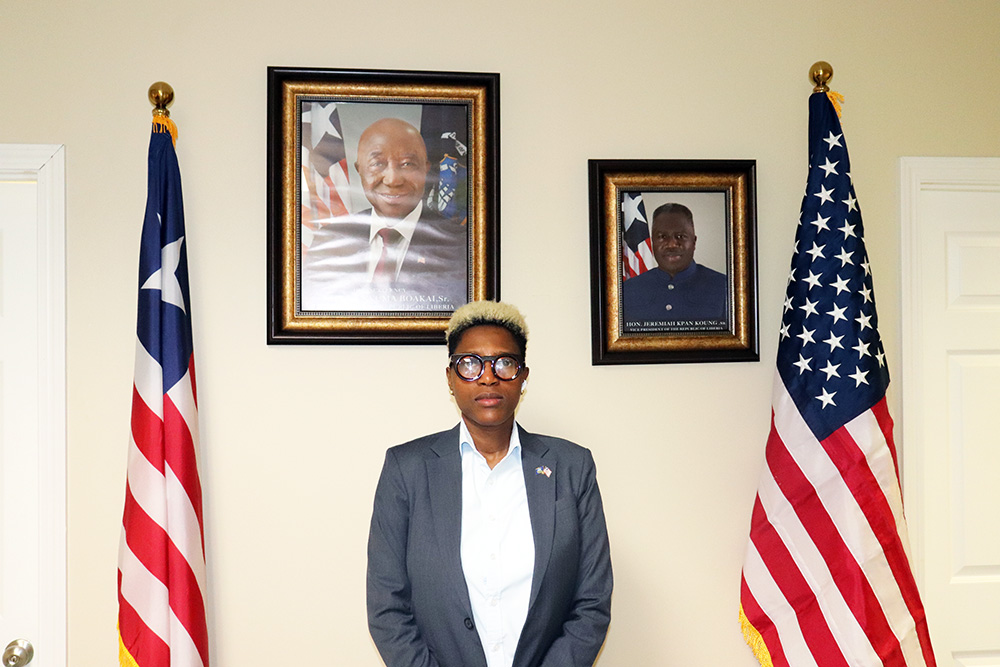
The consulate, located in the Edinburgh Office Plaza, began full operations in March 2026 under Consul General Tracy Ashley Grigsby, a career diplomat whose previous assignments have taken her to China and France.
Its opening represents the culmination of years of efforts to strengthen Liberia’s official presence in Minnesota, home to a substantial Liberian immigrant community and a longstanding center of Liberian American civic and cultural life.
For community leaders who advocated for the consulate, the development is both a diplomatic milestone and a practical victory for residents who previously faced costly travel to obtain essential documents.
“The community is very excited about the consulate being here as I have talked with many who have saved hundreds of dollars not having to travel to Washington to get services,” said Kamaty Diahn, executive director of the Organization of Liberians in Minnesota (OLM).
From honorary representation to a full consulate
Liberia’s new diplomatic mission builds on the work of Jackson George, a Liberian American businessman who served as honorary consul in Minnesota for nearly five years.
George provided consular assistance to Liberians throughout the region, establishing a local presence that helped demonstrate the demand for more comprehensive services.
But the push for a full consulate began before the current Liberian administration took office.
“The conception for the consulate opening started a couple of years ago with the previous (George Weah) administration,” Grigsby told Mshale during an interview at her Brooklyn Park office.
The effort gained momentum under President Joseph Boakai, whose administration moved to establish a permanent diplomatic mission in Minnesota.
According to Grigsby, the government appointed a group of diplomats in 2025, including her as head of mission.
“We took over from Mr. George’s team in September (2025),” she said. “We had to begin the work of opening the consulate.”
After months of preparations, the office began full operations in March.
Grigsby confirmed that Minnesota’s large Liberian population was an important consideration in the government’s decision.
The state has long been a major destination for Liberian immigrants, whose community organizations, churches, businesses and political networks have helped maintain close ties between Minnesota and Liberia.
Diahn, who said he was among those advocating for a full consulate, believes the community’s size made the case compelling.
“I mean the numbers here (of Liberians) speak for themselves,” he said.
A diplomatic milestone for Minnesota
The opening also adds a new dimension to Minnesota’s international diplomatic community.
Although the state has extensive international business connections and sizable immigrant populations, relatively few foreign governments maintain full consulates here. Many countries instead operate their principal Midwestern diplomatic offices in Chicago.
According to the Minnesota Consular Corps, an independent association of career and honorary consular officials representing more than 30 countries in the state, most of its members serve as honorary consuls rather than full-time diplomatic personnel.
Honorary consuls generally provide limited consular assistance and help strengthen relations between their countries and local communities, while full consulates are staffed by government-appointed diplomatic personnel and offer a broader range of official services.
Canada, Mexico, Ecuador and El Salvador are among the countries with full consular operations in Minnesota. Liberia joins that relatively small group, giving the state a full consular presence from an African country.
South Africa has maintained honorary consular representation in Minnesota through retired state Judge LaJune Lange.
Christina Selander Bouzouina, France’s honorary consul in Minnesota and president of the Minnesota Consular Corps, told Mshale by email that she recalled another African nation previously operating a consulate general in the state, although she could not identify the country or when the office closed.
“Previously there were Honorary Consuls for Tanzania and Ethiopia,” she said.
Tanzania’s former honorary consul, businessman Kjell Bergh, was appointed in 2000 and maintained the office until 2015. Bergh, chairman and CEO of Borton Volvo and Borton Overseas, previously told Mshale that he stepped away from the position to concentrate on his business interests.
Liberia’s arrival as a full consular presence therefore represents a notable development in a state where African diplomatic representation has historically been limited.
A quiet office with an international mission
The American and Liberian flags flying outside Edinburgh Office Plaza offer a clue that this otherwise ordinary suburban office building houses something unusual: an international diplomatic mission.
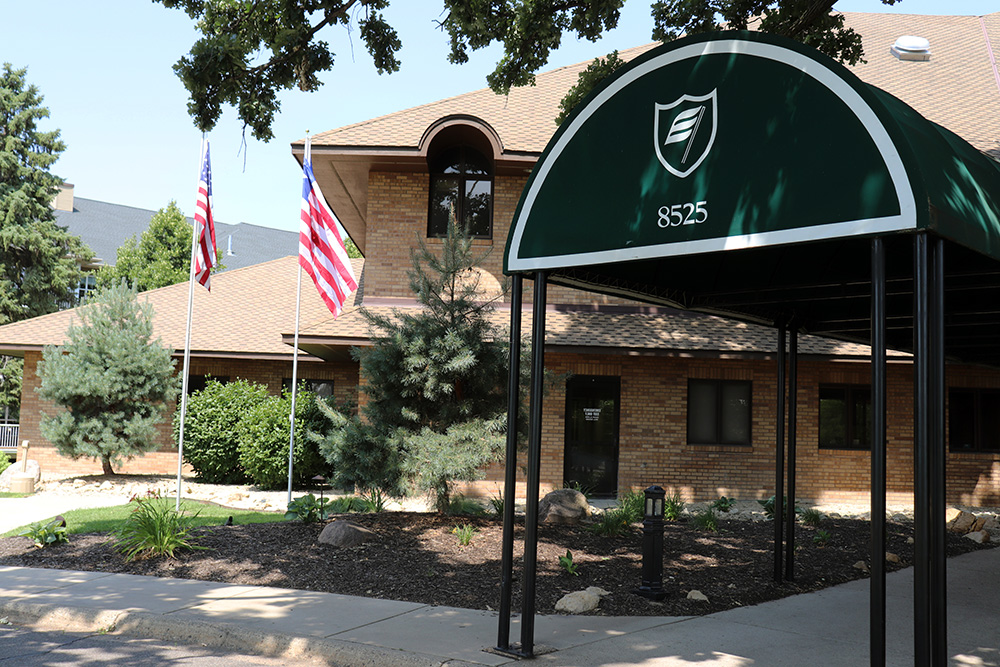
Liberia’s flag, with its red and white stripes and single white star against a blue field, bears a striking resemblance to the American flag, reflecting the historical ties between the two nations.
The low-rise, red-brick building sits among mature trees and landscaped grounds across from Edinburgh USA golf course in Brooklyn Park.
On a summer morning when Mshale visited, dozens of vehicles occupied the parking lot as customers and employees came and went from the building’s offices and businesses, including several African-owned enterprises.
The Liberian consulate occupies space on the building’s lower level, where the suburban office setting gives way to the official symbols of a sovereign nation.
Inside, the Liberian and American flags stand alongside portraits of President Joseph Boakai and Vice President Jeremiah Kpan Koung.
It is here that Grigsby and her staff are building an operation intended to serve Liberians across 12 Midwestern states.
Yet one of the consulate’s immediate challenges has been making the community aware that its doors are open.
During the July interview, Grigsby acknowledged that the office was handling substantially fewer visitors than George’s former honorary consulate.
“Compared to what Jackson George was doing, as we heard, that the workload was huge in Minnesota. Now, it’s just 20%,” she said.
She attributed the difference partly to limited public awareness of the new mission and said the number of people seeking services was gradually increasing.
Diahn was not troubled by the comparatively slow start.
He said the existence of a permanent office changes how people approach consular services. Rather than trying to arrange assistance during limited opportunities, Liberians now know there is an established location they can visit when the need arises.
An experienced diplomat takes the helm
Grigsby brings extensive international experience to the Brooklyn Park assignment.
A career foreign service officer with Liberia’s Ministry of Foreign Affairs, she began her diplomatic career at the Liberian Embassy in Beijing, where she served as vice consul and principal passport officer.
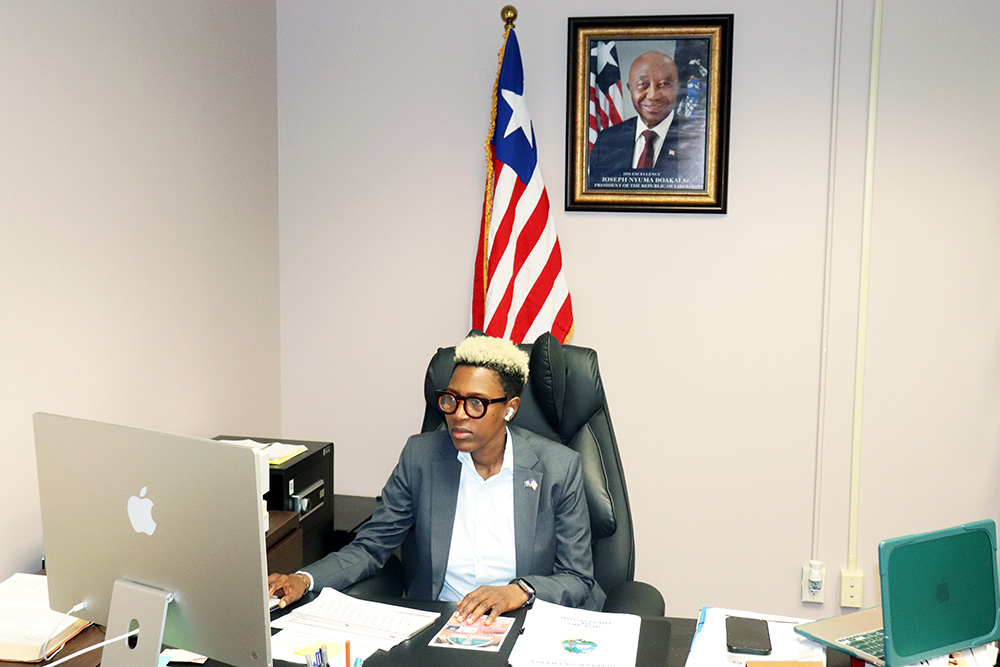
Her subsequent assignments took her to Paris, where she served as chargé d’affaires at Liberia’s Permanent Delegation to UNESCO.
Her responsibilities also included representing Liberia in dealings with the Bureau International des Expositions and the Organization for Economic Co-operation and Development.
She additionally served as chargé d’affaires at Liberia’s Embassy in Paris, which carried diplomatic responsibilities for several European countries, including Spain, Greece, Portugal and Cyprus.
Although Minnesota is her newest professional posting, Grigsby was already familiar with the state through personal friendships. Most of her extended family lives on the East Coast, and she has traveled to the United States since approximately 2010.
Her new assignment places her at the intersection of traditional diplomacy and the everyday needs of a diaspora community with deep connections to its country of origin.
Passports, visas and the promise of dual citizenship
Among the consulate’s most consequential responsibilities is helping Liberians navigate passport and citizenship documentation.
The services have taken on additional significance following Liberia’s 2022 decision to recognize dual citizenship for natural-born Liberians who acquire another nationality.
The change, signed into law by then-President George Weah following years of diaspora advocacy, addressed a longstanding concern among Liberians who had become citizens of other countries but wanted to preserve their legal ties to Liberia.
For Liberian Americans, that means access to consular documentation can be an important part of maintaining connections to their homeland.
The Brooklyn Park consulate provides passport-related services, birth affidavits and visas for foreign nationals seeking to travel to Liberia.
Liberians seeking a new passport can use an old, even expired, Liberian passport as proof of citizenship, making it easier for longtime immigrants to obtain the country’s newer ECOWAS biometric passport.
The consulate also assists with emergency travel documents and paperwork required to repatriate the remains of deceased Liberians for burial in their home country.
The range of services extends to less frequently discussed travel needs, including documentation for people transporting pets to Liberia, a service the consulate calls “Pet Clearance.”
Liberian passports also carry the branding of the Economic Community of West African States, or ECOWAS, reflecting Liberia’s participation in the regional organization and the travel arrangements available to eligible citizens under its rules.
For many residents, however, the most immediate advantage is simpler: services that once required an expensive trip can now be sought much closer to home.
A relationship stretching back more than 160 years
The establishment of the Brooklyn Park consulate is the latest chapter in a diplomatic relationship between Liberia and the United States that stretches back to the 19th century.
According to the U.S. Department of State’s Office of the Historian, formal diplomatic relations were established Feb. 23, 1864, when American Commissioner and Consul General Abraham Hanson presented his credentials to the Liberian government.
On July 25, 1947, Charles D.B. King, a former Liberian president who served from 1920 to 1930, became Liberia’s first ambassador to the United States. He presented his credentials to President Harry Truman and served until 1952.
The United States elevated its legation in Monrovia to embassy status on May 6, 1949, when Ambassador Edward R. Dudley presented his credentials to the Liberian government.
For decades, Liberia’s diplomatic and consular representation in the United States has been concentrated primarily on the East Coast, including its embassy in Washington and consulate general in New York.
The establishment of a full consulate in Minnesota extends that relationship into a region where generations of Liberians have built new lives while retaining strong ties to their homeland.
For Grigsby, the immediate task is ensuring that Liberians across Minnesota and the Midwest know the consulate exists and understand the services available.
For community leaders who spent years advocating for a permanent diplomatic presence, its establishment represents recognition of the importance of Minnesota’s Liberian diaspora — and relief from the expense and inconvenience of seeking services hundreds of miles away.
Diahn believes the consulate’s value will become even more apparent as awareness grows.
“It will get better as people don’t need consular services at the same time,” he said. “This consulate was absolutely needed here.”
About Tom Gitaa, Editor-in-Chief
Born and raised in Kenya's coastal city of Mombasa, Tom is the Founder, Editor-in-Chief and Publisher of Mshale which has been reporting on the news and culture of African immigrants in the United States since 1995. He has a BA in Business from Metro State University and a Public Leadership Credential from Harvard’s Kennedy School of Government. He was the original host of Talking Drum, the signature current affairs show on the African Broadcasting Network (ABN-America), which was available nationwide in the United States via the Dish Network satellite service. On the show, he interviewed Nobel laureates such as 2004 Nobel Peace prize winner, Professor Wangari Maathai, the first woman from Africa to win the peace prize and heads of states. Tom has served and chaired various boards including Global Minnesota (formerly Minnesota International Center), the sixth largest World Affairs Council in the United States. He has previously served as the first Black President of the Board of Directors at Books for Africa. He also serves on the board of the Minnesota Multicultural Media Consortium. He has previously served two terms on the board of the United Nations Association. An avid runner, he retired from running full marathons after turning 50 and now only focuses on training for half marathons.
- Web |
- More Posts(519)
 (No Ratings Yet)
 Loading...