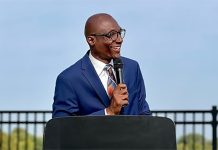


The son of immigrants who fled Eritrea during its struggle for independence has been elected to one of the highest positions in U.S. House Democratic leadership, marking another milestone in the growing political influence of Americans with African roots.
“Only in America.”
Those were the words Rep. Joe Neguse, a 42-year-old Colorado Democrat, chose to celebrate his unanimous election as assistant speaker on Nov. 18.
For Neguse, whose parents left Eritrea in the early 1980s, the achievement reflects a family journey from the Horn of Africa to the upper ranks of American political power.
His election came the same day House Democrats nominated Rep. Hakeem Jeffries of New York to become speaker, positioning him to become the first Black American to lead the chamber when the 120th Congress convenes in January.
Both men have ancestral connections to Africa, although their family histories and paths to Congress differ.
“Only in America could the son of African immigrants — who grew up in Highlands Ranch and is a proud product of Colorado’s public schools — become Assistant Speaker of the U.S. House of Representatives,” Neguse said in a statement.
His election places an Eritrean American in the fourth-ranking position in House Democratic leadership and makes him the highest-ranking Colorado lawmaker in modern history, according to his office.
It also raises a question that extends beyond the symbolism of the moment: What will greater representation mean for immigrant communities seeking a stronger voice in national policy?
‘Joe Neguse is like my young brother’
For Minnesota Rep. Ilhan Omar, Neguse’s election carries personal significance.
“Joe Neguse is like my young brother,” Omar told Mshale in remarks conveyed through a spokesperson. “We traveled to East Africa together as part of a congressional delegation. He is one of the best legislators and one of the smartest. I am so happy for him.”
Omar, who was born in Mogadishu, Somalia, became the first Somali American elected to Congress in 2018. She is also the first African refugee to serve in the institution.
Since taking office in January 2019, she has remained the only African-born member of Congress. That distinction is set to change when the new Congress convenes in January, with the arrival of two newly elected Democrats: Melat Kiros of Colorado, who was born in Ethiopia, and Adam Hamawy of New Jersey, who was born in Egypt.
Omar’s relationship with Neguse reflects another dimension of African representation in Congress: the connections between lawmakers whose family histories reach across the continent.
In March 2019, Omar and Neguse joined then-Rep. Karen Bass of California on the first U.S. congressional delegation to visit Eritrea in 14 years.
The trip came months after Eritrea and neighboring Ethiopia signed a peace agreement ending two decades of hostility.
According to a report by The Associated Press, the lawmakers visited Eritrea’s capital, Asmara, where they met with the country’s foreign minister, a presidential adviser and its head of economic development.
The visit held particular meaning for Neguse. His parents had fled Eritrea during its long war for independence from Ethiopia, which ended in 1993.
For Omar, whose family fled Somalia’s civil war and spent four years in a Kenyan refugee camp before coming to the United States, the trip was another opportunity to engage with a region central to her own history.
The delegation’s visit came during a period of cautious optimism in the Horn of Africa. Ethiopia and Eritrea had restored diplomatic ties, and families separated by years of conflict were reconnecting. Questions remained, however, about Eritrea’s human rights record and whether the diplomatic opening would lead to political reforms.
Bass expressed hope at the time that improved relations would help advance human rights and secure the release of political detainees.
For Neguse, the trip brought his family’s history into direct contact with his responsibilities as a member of Congress.
Seven years later, Omar’s description of him as a younger brother offers a glimpse into a relationship that has endured as both lawmakers have advanced their careers.
From immigrant roots to congressional leadership
Born in California and raised in Colorado, Neguse attended public schools before entering law and public service.
He served as a University of Colorado regent and executive director of the Colorado Department of Regulatory Agencies before winning election to Congress in 2018.
His victory made him the first Eritrean American elected to the U.S. House.
Representing Colorado’s 2nd Congressional District, which includes Boulder, Fort Collins and communities in the Rocky Mountains, Neguse quickly gained a national profile.
He served as an impeachment manager during President Donald Trump’s second impeachment trial in 2021, helping present the House’s case following the Jan. 6 attack on the Capitol.
He later chaired the House Democratic Policy and Communications Committee and became assistant Democratic leader, building relationships within the caucus and gaining experience in congressional leadership.
His election as assistant speaker makes him the youngest member of the incoming senior House Democratic leadership team and its only member from a noncoastal state.
Neguse’s campaign for the position emphasized giving younger Americans and communities in the country’s interior, including the Rocky Mountain West, a stronger voice in congressional decision-making.
His elevation also marks a significant expansion of Colorado’s influence in the House.
For African immigrant communities, his rise illustrates how the children of immigrants are moving beyond individual electoral breakthroughs into positions where national legislative priorities are shaped.
A historic moment for Black political power
Neguse’s election came as House Democrats prepared to take control of the chamber following the November midterm elections.
Jeffries, who has led House Democrats since 2023, won his party’s nomination for speaker by a vote of 251-11.
If elected by the full House in January, the Brooklyn-born Democrat will become the first Black speaker in the institution’s history.
The milestone would come more than two centuries after the House first convened, reflecting a transformation in an institution that long excluded Black Americans from political power.
The incoming leadership team also includes Katherine Clark of Massachusetts as majority leader and Pete Aguilar of California as majority whip.
Clark is positioned to become the first woman to serve as House majority leader, while Aguilar would become the first Latino to hold the majority whip position.
Rep. Ted Lieu of California was selected as Democratic Caucus chair, becoming the first Asian American to hold that post.
Neguse will become the first Black lawmaker to serve as assistant speaker.
The leadership elections reflect the changing racial, ethnic and geographic backgrounds of lawmakers occupying influential positions in Congress.
But they also exposed divisions within the Democratic caucus.
Eleven Democrats opposed Jeffries’ nomination, including incoming progressives seeking stronger commitments on health care, immigration enforcement and other policy priorities.
The dissent underscored the challenges awaiting the new leadership, even with Democrats preparing to govern with a substantial House majority.
Historic representation does not eliminate the difficult work of building consensus and passing legislation.
The promise and limits of representation
For immigrant communities, seeing someone with a shared background reach a position of power can challenge longstanding assumptions about who belongs in American political life.
But representation alone does not guarantee policy changes.
African immigrant communities face concerns ranging from immigration enforcement and family reunification to economic opportunity, education and U.S. relations with their countries of origin.
Addressing those issues requires legislation, negotiations and decisions that extend beyond the identities of individual officeholders.
Neguse acknowledged the responsibilities accompanying his election.
“I’m deeply grateful to my colleagues for electing me to serve in this role,” he said in his statement, adding that he looked forward to work aimed at ending corruption in Washington and expanding opportunity for Coloradans.
His office said he intends to pursue reforms targeting corruption, support rural communities and promote economic opportunity.
Those priorities reflect the demands of a congressional district that includes university communities, growing cities, rural areas and mountain towns.
Jeffries has similarly emphasized affordability and the economic pressures facing American families as priorities for the incoming Democratic majority.
Whether the new leadership can turn those commitments into legislative results will provide a measure of its effectiveness.
For Neguse, the challenge will be to use his new position to influence policy while helping lead a caucus representing communities with widely different political and economic interests.
A milestone beyond Colorado
Neguse’s election resonates beyond his home state.
Across the United States, African immigrants have spent decades building businesses, religious institutions, civic organizations and political networks while raising families and establishing roots in American communities.
Minnesota offers a particularly visible example.
Home to established Somali, Ethiopian, Liberian, Kenyan and other African immigrant communities, the state has witnessed growing political participation among immigrants and their children.
Omar’s election in 2018 marked a breakthrough for Somali Americans and for refugees seeking representation at the highest levels of government.
Her journey differs from Neguse’s. She was born in Africa and came to the United States as a refugee. He was born in America to parents who fled political upheaval in their homeland.
Yet both represent the expanding role of African immigrants and their descendants in American political institutions.
Their shared congressional trip to Eritrea also illustrates how those connections can extend beyond domestic politics to questions of diplomacy, human rights and relations with African countries.
For communities that have often struggled with barriers to employment, political participation and recognition, such milestones carry meaning.
Still, the growing presence of African immigrant voices in elected office does not erase the challenges facing many families.
The test is whether political visibility produces meaningful influence over decisions affecting their lives.
Omar’s tribute to Neguse suggests that African representation in Congress is no longer solely a story of individual breakthroughs. It is also becoming a story of relationships and shared experiences among lawmakers whose family histories connect the United States to different parts of Africa.
The weight of three words
There is unmistakable optimism in Neguse’s choice of words.
“Only in America” invokes a familiar national ideal: that a person’s origins need not determine the limits of their future.
It is an idea that has drawn generations of immigrants to the United States, even as the country’s history shows how unevenly that promise has been fulfilled.
For Black Americans, access to political power required generations of organizing, litigation and demands for equal rights.
For immigrants, the promise of opportunity has often existed alongside restrictive immigration policies, discrimination and uncertainty about their place in American society.
Neguse’s rise does not erase those contradictions. It places them in sharper relief.
His parents fled Eritrea during a war for independence. Their son attended public schools in Colorado, became a lawyer, entered public service and won election to Congress.
He later traveled to his parents’ homeland as a member of Congress, accompanied by a Somali-born colleague from Minnesota who now describes him as a younger brother.
Jeffries, meanwhile, stands poised to cross a barrier that has remained intact throughout the House’s more than two centuries of history.
He, too, has ancestral ties to Africa.
His great-grandfather, Manuel Gomes, emigrated from Cabo Verde, the island nation off the coast of West Africa, to New Bedford, Massachusetts, in 1915. Jeffries has publicly embraced that heritage and identifies himself as the only member of Congress with Cape Verdean roots.
That connection took on added significance during the 2026 FIFA World Cup.
After Cabo Verde’s national soccer team held Spain to a scoreless draw in its World Cup debut, goalkeeper Josimar “Vozinha” Dias revealed that his mother had been unable to attend the match because of visa difficulties.
Jeffries contacted Secretary of State Marco Rubio and urged the State Department to help secure her entry into the United States in time for Cabo Verde’s next match against Uruguay in Miami.
“No mother should miss the chance to see her child make history,” Jeffries said in a June 17 statement announcing that arrangements had been made for her to obtain a visa.
The episode offered a tangible example of how Jeffries’ ancestral ties intersected with his responsibilities as a congressional leader.
The two men arrived at this moment through different family histories and political journeys, but their leadership selections intersect in a larger story about African heritage, immigration, race, opportunity and political power in the United States.
When the 120th Congress convenes in January, the historic character of the new leadership will be unmistakable.
What remains to be determined is how that leadership will govern — and whether expanded representation at the top of the House will produce meaningful changes for the communities whose histories are now reflected there.
For Neguse, the moment began with three words connecting his parents’ African origins to his place in American political history.
Only in America.
About Tom Gitaa, Editor-in-Chief
Born and raised in Kenya's coastal city of Mombasa, Tom is the Founder, Editor-in-Chief and Publisher of Mshale which has been reporting on the news and culture of African immigrants in the United States since 1995. He has a BA in Business from Metro State University and a Public Leadership Credential from Harvard’s Kennedy School of Government. He was the original host of Talking Drum, the signature current affairs show on the African Broadcasting Network (ABN-America), which was available nationwide in the United States via the Dish Network satellite service. On the show, he interviewed Nobel laureates such as 2004 Nobel Peace prize winner, Professor Wangari Maathai, the first woman from Africa to win the peace prize and heads of states. Tom has served and chaired various boards including Global Minnesota (formerly Minnesota International Center), the sixth largest World Affairs Council in the United States. He has previously served as the first Black President of the Board of Directors at Books for Africa. He also serves on the board of the Minnesota Multicultural Media Consortium. He has previously served two terms on the board of the United Nations Association. An avid runner, he retired from running full marathons after turning 50 and now only focuses on training for half marathons.
- Web |
- More Posts(527)
 (No Ratings Yet)
 Loading...