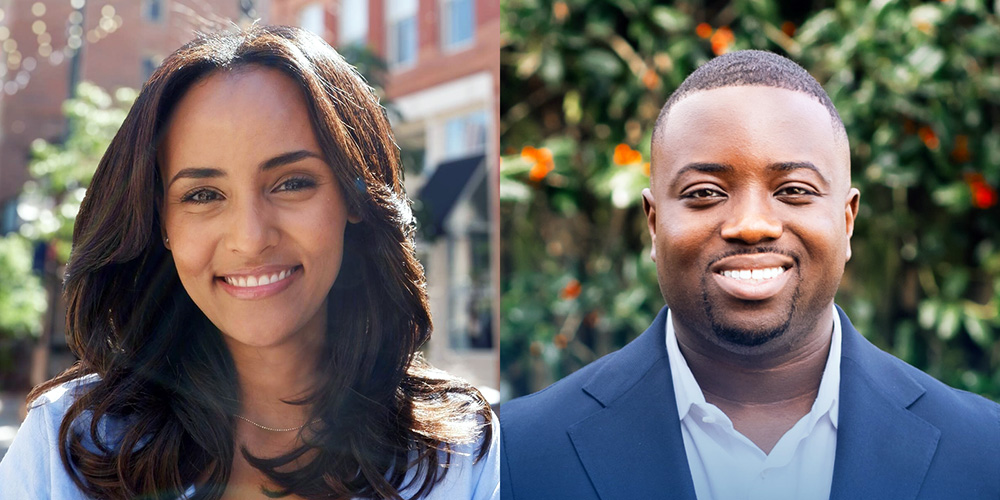

The Congressional Black Caucus announced Tuesday that it will enter the 120th Congress in January with a record 68 members, including two newly elected lawmakers of African immigrant heritage: Ethiopian-born Melat Kiros of Colorado and Ghanaian American Adrian Boafo of Maryland.
The caucus, commonly referred to as the CBC, will welcome 18 incoming members, the largest incoming class in its history. Its membership will include 62 members of the House of Representatives, including nonvoting delegates, and six U.S. senators.
The announcement comes three weeks after the Nov. 3 midterm elections and as Democrats prepare to assume control of the House in January.
The CBC began the current Congress with 62 members, which at the time was the largest membership in its history.
“As we enter the 120th Congress with the largest Congressional Black Caucus in history and welcome the largest incoming class of new members, we do so with an unwavering commitment to the communities who sent us to Washington to fight for them,” CBC Chair Rep. Yvette Clarke of New York and members of the caucus said in a joint statement.
The caucus credited Black voters, particularly those in the South, for its historic growth amid efforts to diminish Black voting power.
The caucus’s historic expansion comes against the backdrop of a contentious mid-decade congressional redistricting battle, championed by President Donald Trump as part of an effort to increase Republican representation in the House. Despite that push, the Congressional Black Caucus is poised to enter the next Congress with its largest membership in history.
Its members identified lowering costs, expanding access to affordable housing and quality health care, and creating economic opportunities for working families as legislative priorities. They also pledged to hold the Trump administration accountable.
Growing African immigrant representation
The arrival of Kiros and Boafo will expand the number of lawmakers in the caucus with direct ties to the African continent.
Kiros, 29, was born in Addis Ababa, Ethiopia, and immigrated to the United States with her family as an infant. A lawyer, she defeated longtime Democratic Rep. Diana DeGette in Colorado’s Democratic primary before winning the general election to represent the state’s 1st Congressional District, which encompasses most of Denver.
Her election carries two historic distinctions: She will become the first Black woman to represent Colorado in Congress and the first woman from Generation Z to serve in Congress.
Kiros will serve alongside fellow Colorado Democrat Joe Neguse, the son of Eritrean immigrants, who was recently selected by his Democratic colleagues for the position of assistant speaker.
Boafo, 32, the son of Ghanaian immigrants, will represent Maryland’s 5th Congressional District, succeeding retiring Rep. Steny Hoyer, a former House majority leader who endorsed his candidacy.
Before his election to Congress, Boafo served on the Bowie City Council and as the city’s mayor pro tem. He was elected to the Maryland House of Delegates in 2022 and previously served as Hoyer’s campaign manager.
His election means that two Americans of Ghanaian immigrant parentage will serve in Congress simultaneously. Rep. Gabe Amo of Rhode Island, whose father is from Ghana and mother is from Liberia, was first elected to Congress in 2023.
Minnesota’s Rep. Ilhan Omar, a Somali-born Democrat who was first elected to Congress in 2018, will also return as a member of the caucus.
The expansion of African immigrant representation in the incoming Congress extends beyond the Congressional Black Caucus. Two Americans of Egyptian heritage, New Jersey Congressman-elect Adam Hamawy and Michigan Sen.-elect Abdul El-Sayed, will also take office in January. Neither was among the incoming members announced by the CBC on Tuesday.
Growing influence in Congress
The caucus’s historic expansion comes as Black lawmakers are poised to occupy influential positions in congressional leadership.
House Democratic Leader Hakeem Jeffries of New York, a member of the CBC, was nominated by his Democratic colleagues last week to become speaker of the House. If elected by the full House in January, he would become the first Black speaker in the nation’s history.
Neguse’s elevation to assistant speaker would place the son of African immigrants in the the fourth highest-ranking representative in the chamber’s incoming Democratic majority.
The incoming CBC membership will also include two newly elected senators, Juliana Stratton of Illinois and Scott Colom of Mississippi, bringing the caucus’s Senate representation to six.
“Our charge is clear: to lead boldly, deliver results, and ensure that no community is left behind,” the caucus said.
Incoming Congressional Black Caucus members
The following 18 lawmakers were announced Tuesday as incoming members of the Congressional Black Caucus:
Incoming Congressional Black Caucus members
The following 18 lawmakers were announced Tuesday as incoming members of the Congressional Black Caucus:
- Melat Kiros (Colorado, 1st District)
- Robert C. White Jr. (District of Columbia)
- Oliver Gilbert III (Florida, 24th District)
- Jasmine Clark (Georgia, 13th District)
- Juliana Stratton (Illinois, U.S. Senate)
- Donna Miller (Illinois, 2nd District)
- La Shawn K. Ford (Illinois, 7th District)
- Adrian Boafo (Maryland, 5th District)
- Donavan McKinney (Michigan, 13th District)
- Scott Colom (Mississippi, U.S. Senate)
- Darializa Avila Chevalier (New York, 13th District)
- Raymond E. Smith Jr. (North Carolina, 3rd District)
- Cyril Jefferson (North Carolina, 6th District)
- LaKesha Womack (North Carolina, 14th District)
- Chris Rabb (Pennsylvania, 3rd District)
- Frederick Douglass Haynes III (Texas, 30th District)
- Colin Allred (Texas, 33rd District)
- Janelle Sarauw (U.S. Virgin Islands)
The 120th Congress is scheduled to convene on Jan. 3, 2027.

About Mshale Staff
The byline “By Mshale Staff” is used for stories that involve limited or no original reporting by our newsroom. These stories are often based on press releases or information provided by official sources, including corporations, government agencies and public institutions. The byline also may be used for reports compiled from multiple contributors, wire services, previously published material or aggregated sources when listing individual authors is impractical. Outside sources are generally identified within the story.
 (No Ratings Yet)
 Loading...