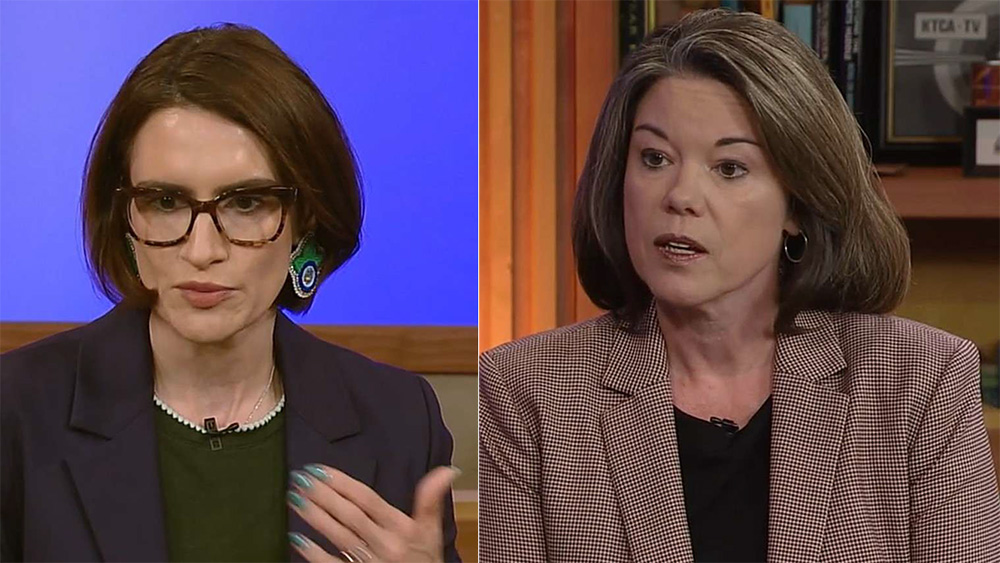

The first televised debate Friday in Minnesota’s closely watched Democratic U.S. Senate primary quickly turned into a referendum on the Laken Riley Act, with Lt. Gov. Peggy Flanagan repeatedly attacking U.S. Rep. Angie Craig over her vote for the immigration law and Craig defending both her initial decision and her later public regret over supporting it.
Immigration has become a defining issue in the race to succeed retiring U.S. Sen. Tina Smith at a time when nearly one in 10 Minnesota residents is foreign-born. According to U.S. Census figures, about 9% of the state’s population was born outside the United States, including 33% from Asia, 28% from Africa and 27% from Latin America, making federal immigration policy an issue closely followed by many immigrant communities in the state.
The contest also carries historic significance. If elected in November, Flanagan, a member of the White Earth Band of Ojibwe, would become the first Native American woman elected to the U.S. Senate. Craig, meanwhile, is seeking to bring the experience she gained winning four elections in Minnesota’s politically competitive 2nd Congressional District to the Senate.
The Laken Riley Act requires federal immigration authorities to detain certain non-U.S. citizens accused of specified crimes, including theft-related offenses, while their immigration proceedings are pending. Immigration attorneys and legal analysts have argued that although the Trump administration did not publicly cite the law as the legal basis for Operation Metro Surge, it expanded federal detention authority in ways that could facilitate broader immigration enforcement.
Craig was one of 46 House Democrats to vote for the legislation and the only member of Minnesota’s Democratic congressional delegation in either the House or Senate to support it.
As the Senate campaign has intensified, Flanagan has made Craig’s vote one of her central lines of attack.
Opening the debate Friday on Twin Cities PBS’ Almanac, host Cathy Wurzer asked Craig why it took months after the deaths of Renee Good and Alex Pretti during Operation Metro Surge before she publicly expressed regret for supporting the measure.
Craig said witnessing the immigration crackdown in Minnesota changed her thinking.
“As I stood at the Whipple Center, I couldn’t help but regret giving this administration any additional authority under immigration,” she said. “And so I felt like I needed to be honest with Minnesotans that I did regret that vote.”
Pressed by Wurzer on why she supported the bill in the first place, Craig said that at the time several Democratic senators, including John Ossoff, Raphael Warnock, Mark Kelly and Ruben Gallego, also voted for the measure.
“As I’ve seen what they’ve done in detention centers across this country, I have to be honest with the people that I represent,” Craig said. “I regret the vote.”
Craig framed her change in position as an example of accountability, arguing that witnessing immigration enforcement under the Trump administration convinced her she had made the wrong decision.
Flanagan argued Craig’s vote reflected poor judgment from the outset, saying other Minnesota Democrats recognized the potential consequences before the legislation became law.
“I think it’s important to say that what the Laken Riley Act does … it allows for indefinite detention of individuals, including children. It essentially does away with due process for immigrants.”
She added that every other Minnesota Democrat in Congress opposed the legislation.
“Amy Klobuchar, Senator Tina Smith, Kelly Morrison, Betty McCollum, Ilhan Omar — they all knew what was coming, and they had the judgment to vote no.”
The immigration exchange set the tone for much of the hour-long debate, with Craig emphasizing experience, accountability and electability while Flanagan cast herself as the progressive alternative willing to reject what she described as corporate influence in Democratic politics.
Beyond immigration, the candidates also sparred over fraud in Minnesota government, campaign fundraising, corporate political action committee money, cryptocurrency regulation, the war in Gaza and which Democrat is best positioned to defeat Republicans in November’s general election.
The debate ended on a notably more cordial note. Craig praised Flanagan’s leadership in expanding free school meals for Minnesota students, while Flanagan commended Craig’s advocacy for increasing federal funding for special education.
The Aug. 11 DFL primary has emerged as one of Minnesota’s most closely watched races. Flanagan secured the DFL Party endorsement at its state convention in May, while Craig bypassed the endorsement process and opted to compete directly in the primary.
Craig has maintained a significant fundraising advantage. Campaign finance reports filed for the first quarter of 2026 show Craig raised about $2.6 million compared with approximately $1.3 million for Flanagan during the reporting period. Overall, Craig has raised about $9.29 million during the campaign, compared with roughly $4.65 million for Flanagan. At the close of the quarter, Craig reported $4.9 million cash on hand, while Flanagan reported about $1.14 million.
Early voting for Minnesota’s Aug. 11 primary begins Friday, June 26. Voters may cast ballots in person before Election Day or request absentee ballots by mail. The winner of the Democratic primary will advance to the Nov. 3 general election.
About Tom Gitaa, Editor-in-Chief
Born and raised in Kenya's coastal city of Mombasa, Tom is the Founder, Editor-in-Chief and Publisher of Mshale which has been reporting on the news and culture of African immigrants in the United States since 1995. He has a BA in Business from Metro State University and a Public Leadership Credential from Harvard’s Kennedy School of Government. He was the original host of Talking Drum, the signature current affairs show on the African Broadcasting Network (ABN-America), which was available nationwide in the United States via the Dish Network satellite service. On the show, he interviewed Nobel laureates such as 2004 Nobel Peace prize winner, Professor Wangari Maathai, the first woman from Africa to win the peace prize and heads of states. Tom has served and chaired various boards including Global Minnesota (formerly Minnesota International Center), the sixth largest World Affairs Council in the United States. He has previously served as the first Black President of the Board of Directors at Books for Africa. He also serves on the board of the Minnesota Multicultural Media Consortium. He has previously served two terms on the board of the United Nations Association. An avid runner, he retired from running full marathons after turning 50 and now only focuses on training for half marathons.
- Web |
- More Posts(517)
 (No Ratings Yet)
 Loading...