
Home Blog Page 15

Rep. Omar condemns Trump’s ‘Big Beautiful Bill’ as harmful and immoral

0
U.S. Rep. Ilhan Omar addresses the media in Minneapolis on the impact of President Donald Trump’s One Big Beautiful Bill on Thursday, July 10, 2025. Photo: Tom Gitaa/Mshale

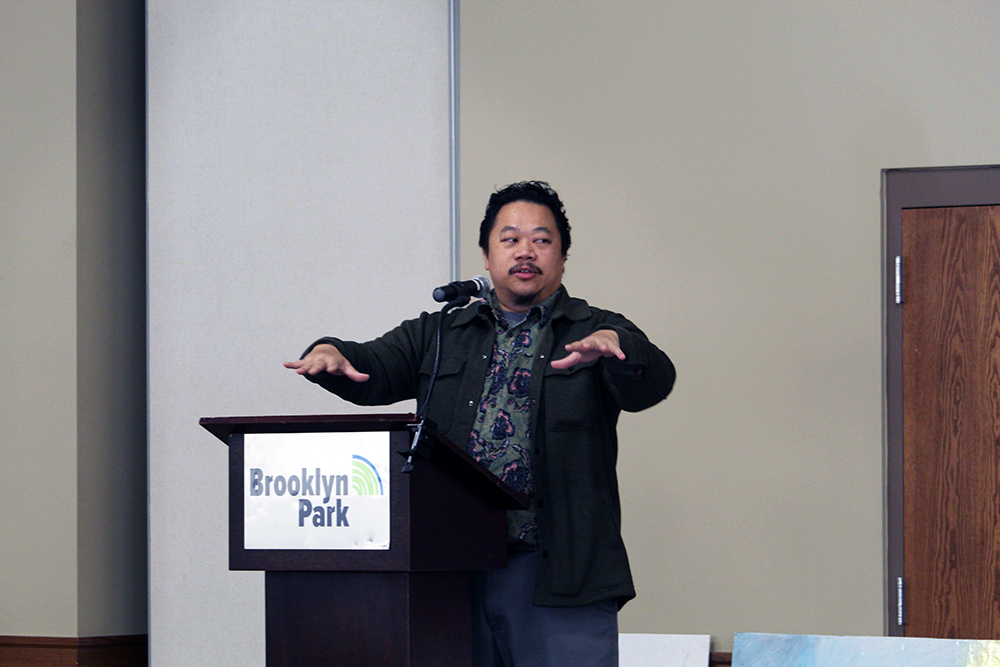
The Trump Administration and Republican lawmakers’ “One Big Beautiful Bill” that passed last week and signed into law “is the most harmful, immoral budget we have seen in modern American history,” U.S. Rep. Ilhan Omar, flanked by local elected officials and nonprofits heads, declared in a July 10 press conference in Minneapolis.

Omar spoke from a community food shelf in the basement of Sabathani Community Center, where she was joined by state Sen. Omar Fateh; Hennepin County Commissioner Irene Fernando; state Rep. Sidney Jordan; Moriah O’Malley of UNIDOS; Peter Wiggins of the Sierra Club; and Ruth Richardson, president and CEO of Planned Parenthood North Central States.

Rep. Omar’s District Office is also housed at Sabathani.

Since Trump’s signing of the bill, early polling, as reported by the Associated Press suggests it is deeply unpopular, including among independents and Republicans due to the projected cuts in funding and services that will affect even Republican states.

The bulk of the press conference centered on the severe cuts and cessation of services that are expected, with Rep. Omar stating “this bill rips $186 billion from SNAP. That’s food off the tables of our seniors, of children, and single mothers, people who are already struggling to get by. Here in the 5th District, that’s nearly 90,000 people who rely on SNAP. I’ve spoken to them and many of them are asking, ‘how do I feed my kids and still pay my bills?’ This is the United States of America. No one should ever have to make that choice.”

Omar warned that the bill will further widen the income and wealth divide between the rich and poor in America.

” While families are being told to tighten their belts, billionaires are getting a windfall, permanent tax cuts for the rich and temporary scraps for everyone,” she said. “This is the largest upward transfer of wealth in our lifetime. It makes the rich richer and leaves working people behind.”

President Trump signed the bill into law on his self-imposed deadline of July 4 after a narrow 218-214 vote in the House with all Democrats voting against it. In the Senate, it required President JD Vance to cast a tie-breaking vote after a 50-50 tie.

The massive bill makes permanent his 2017 Tax Cuts and Jobs Act that was set to expire at the end of this year. When it was passed in 2017, it lowered taxes for corporations.

The bill boosted greatly the budget for the military by $150 billion. Immigration and Customs Enforcement (ICE) received a whopping $100 billion so it can hire more personnel, and also build and expand detention centers.

ICE’s budget before this massive allocation was $8 billion and the non-profit Brennan Center for Justice has said this will make it the largest federal law enforcement agency.

Prior to the “Big Beautiful Bill,” the federal government fully funded the Supplemental Nutrition Assistance Program (SNAP), but with the new law, states will be required to contribute more, which has raised fears that many states will not be able to do so. The 90,000 in Omar’s district that use SNAP are part of the 40 million people nationwide that use the program.

Ruth Richardson, Peter Wiggins, Moriah O’Malley, Rep. Ilhan Omar, State Rep. Sidney Jordan, Commissioner Irene Fernando and State Sen. Omar Fateh pose for a group photo after addressing the media at Sabathani Community Center in Minneapolis on Thursday, July 10, 2025 about the effects of Trump’s One Big Beautiful Bill on Minnesotans. Photo: Tom Gitaa/Mshale

Those at the press conference Thursday took turns outlining the impending catastrophic impact of the new law.

Commissioner Fernando who followed Omar at the podium described the new law as “completely nonsensical.”

“Last year in Hennepin, we were able to connect residents with $200 million in SNAP benefits. $200 million. If that goes away, where else will those funds come from? How will we nourish our residents, our neighbors, our youngest children to dream and live the future that they deserve to have?” Fernando said.

Fernando also criticized the law over its cuts on Medicaid, noting that cutting healthcare to society’s most vulnerable runs counter to the shared humanity of all Americans.

“Most elderly are receiving their health care through Medicaid. So, if we are enriching, further enriching a small population at the expense of our children and elders, then what does that say about us? What does that say about us collectively?” Fernando said.

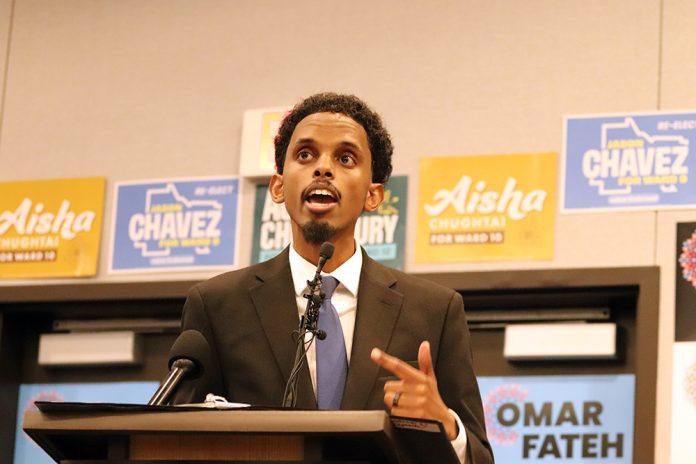
State Sen. Omar Fateh, who represents south Minneapolis and is also a candidate for Mayor of Minneapolis, said the bill will slash Pell Grants by an average of $3,000 per grant and will have an “outsized” impact on marginalized communities that rely on them to attend college. He added that the Pell Grant reduction will see students of color, working class students, and students from rural areas lose their ability to attend colleges and universities.

“As announced yesterday in the Star Tribune, the University of Minnesota will be forced to lay off 60 SNAP county educators that are funded by grants that will abruptly be eliminated. SNAP educators provide vital resources for students to be able to access food and critical nutrition services.,” Fateh said. “This will be extremely destabilizing both for the people losing their jobs suddenly and to students losing this needed service.”

Moriah O’Malley of UNIDOS delivered perhaps one of the most scathing remarks, calling the new law “One Big Evil Bill.”

“The Trump administration and his kowtowing lackeys in Congress have put their fascist tactics on full display. They use the word criminal. They use the word illegal. They use the word alien to justify this treatment, to dehumanize our fellow humans,” O’Malley said. “But I will not, and we will not, all people of conscience will not be fooled. These are our neighbors, our friends, our fathers, our mothers, our grandparents, and our children. ICE is stealing away human beings, disappearing the very people who make our lives and our communities stronger.”

State Rep. Sidney Jordan, who represents northeast Minneapolis and southeast Como, and was the chief author of the state’s Universal School Meals law which provides breakfast and lunch to every child in the state of Minnesota, described the law as reckless and would have catastrophic effects that the state might not be able to fix.

“This bill not only hurts students at school, but at home where they and their families count on nutritional supports like SNAP,” Jordan said. “Our food shelves and banks, like the one we’re standing in, count on nutritional supports and are bracing for the impacts of these cuts. They need stable and predictable funding, which this bill throws into question.”

Peter Wiggins of the Sierra Club accused Trump of corruption, recalling a Washington Post story that reported during the campaign last year candidate Trump held an energy roundtable with oil and gas executives at Mar-a-Lago where he sought $1 billion in campaign contributions from them in exchange for helping their industries when he becomes president.

“Because of the big ugly bill, Americans are now going to start to feel the impact of Trump’s corruption. Americans will feel it. Minnesotans will feel it in higher energy bills, job losses, and more pollution.,” Wiggins said. “It will eliminate thousands of good paying jobs and raise everyone’s energy bills, increasing the average family’s power bill by $110 next year and as much as $400 a year in the next 10.”

One of the immediate effects of the new law was felt at  Planned Parenthood North Central States where the law said Medicaid cannot be used and did not distinguish between birth control services that Planned Parenthood provides and medical services such as cancer screenings that can also be obtained at their clinics. The new law stated that health care organizations that provide abortions from receiving federal Medicaid reimbursements.

Planned Parenthood has sued the Trump administration over this provision in the law and a judge issued a temporary injunction to allow the organization to continue receiving funding for services unrelated to abortion.

“When President Trump signed the bill last week, it had an immediate impact on Planned Parenthood patients who rely on Medicaid. The bill blocks patients from using Medicaid funds to pay for our services, including birth control, cancer screening, annual wellness visits, mental health and STI testing and treatment,” said Ruth Richardson, president and CEO of Planned Parenthood North Central States.

Richardson who rounded up the list of speakers said Medicaid enabled 27,000 patients to access healthcare at the clinics she heads in the region through $11 million in funds.

How services and food to the most vulnerable can continue to be provided with this new law is to “fight this enormously devastating plan to make sure that those of us who do not have a million dollars, or a billion dollars to donate to a presidential candidate are protected. And we only do that when we collectively understand that our destinies are tied together,” Omar said as she ended the press conference.

Many Liberians take offense after Trump praises their president’s English

0
President Donald Trump speaks with African leaders including Senegalese President Bassirou Diomaye Faye, Liberian President Joseph Nyuma Boakai, Bissau-Guinean President Umaro Sissoco Embal€, Mauritanian President Mohamed Ould Ghazouani and Gabonese President Brice Oligui Nguema during a lunch in the State Dining Room of the White House, Wednesday, July 9, 2025, in Washington. Photo: Evan Vucci/AP

By Mark Mengonfia, Monika Pronczuk and Wilson Mcmackin

MONROVIA, Liberia (AP) — U.S. President Donald Trump’s praise of the “beautiful” English of Liberia’s President Joseph Boakai drew confusion Thursday in the English-speaking African country and umbrage over what many considered condescending remarks.

“Such good English,” Trump said to Boakai during an event at the White House, with visible surprise. “Such beautiful English.”

Although English has been the official language of Liberia since the country’s founding in the 1800s, Trump asked Boakai where he had learned to speak the language “so beautifully,” and continued as Boakai murmured a response. “Where were you educated? Where? In Liberia?”

The exchange took place Wednesday during a meeting in the White House between Trump and five West African leaders, amid a pivot from aid to trade in U.S. foreign policy.

Boakai’s government said it took no offense at Trump’s remarks, but other groups in Liberia described the remarks as an insult.

Liberia’s President Joseph Boakai poses for a photo, prior to the start of the ECOWAS meeting, in Abuja, Nigeria, July 7, 2024. Photo: Olamikan Gbemiga/AP FILE

The White House declined to comment on whether Trump was aware that English was Liberia’s official language. Massad Boulos, the president’s senior adviser for Africa, stressed that Trump “actually complimented the language skills of the Liberian president,’’ and that everyone at the meeting was ”deeply appreciative” of the president’s time and effort.

Trump’s comments draw mixed reaction

Liberia has had deep ties with the United States for centuries, stemming from the drive to relocate freed slaves from the United States.

Liberian Foreign Minister Sara Beysolow Nyanti said on X that “President Trump’s comment on Boakai’s ‘beautiful English’ simply acknowledged Liberia’s familiar American-rooted accent and no offense was taken.”

“Our linguistic heritage is deeply American‑influenced, & this was simply recognized by @realDonaldTrump. We remain committed to strengthening Liberia‑U.S. ties, built on mutual respect, shared values, and meaningful partnership,” the minister said.

Foday Massaquio, chairman of Liberia’s opposition Congress for Democratic Change-Council of Patriots, said the remarks exemplified Trump’s lack of respect for foreign leaders, particularly African ones.

“President Trump was condescending, he was very disrespectful to the African leader,” Massaquio said, adding that it “proves that the West is not taking us seriously as Africans.”

Comments add to alarm over aid cuts

For many observers, Trump’s comments added to the sense of alarm and even betrayal over cuts in U.S. aid to the African country.

The decision by U.S. authorities earlier this month to dissolve theU.S. Agency for International Development sent shockwaves across Liberia. American support previously had made up almost 2.6% of the gross national income, the highest percentage anywhere in the world, according to the Center for Global Development.

Liberians thought they would be spared from Trump’s cuts because of the countries’ close relationship. Their political system is modeled on that of the U.S., along with its flag. Liberians often refer to the U.S. as their “big brother.”

Liberia was one of the first countries to receive USAID support, starting in 1961. The street signs, taxis and school buses resemble those in New York.

“Liberia is a long standing friend of the USA, therefore Trump should have understood that we speak English as an official language,” said Moses Dennis, 37, a businessman from Monrovia.

Condescension or praise?

Siokin Civicus Barsi-Giah, a close associate of former President George Weah, echoed the notion that Trump should have known that Liberians speak English.

“Liberia is an English speaking country,” he said. “Former slaves and slave owners decided to organize themselves to let go of many people who were in slavery in the United States of America, and they landed on these shores now called the Republic of Liberia.”

For him, the exchange was “condescending and ridiculing,” and he said: “Joseph Boakai was not praised. He was mocked by the greatest president in the world.”

Some observers, however, said that they believed Trump’s remarks genuinely were intended as praise.

“To some, the comment may carry a whiff of condescension, echoing a long-standing Western tendency to express surprise when African leaders display intellectual fluency,” said Abraham Julian Wennah, a researcher at the African Methodist Episcopal University.

But if one looks at “Trump’s rhetorical style,” the remarks were “an acknowledgment of Boakai’s polish, intellect, and readiness for global engagement,” he said.

___

AP writer Aamer Madhani in Washington contributed to this report.

Kenyans put their president on notice over broken campaign promises, corruption and violence

President Joe Biden welcomes Kenya’s President William Ruto to the White House in Washington, Wednesday, May 22, 2024. Photo: Susan Walsh/AP

NAIROBI, Kenya (AP) — Kenyans disaffected with President William Ruto hold placards proclaiming “WANTAM,” a sensational slogan distilling their efforts to disgrace him as a “one-term” leader. They stick their index fingers in the air, saying Ruto must vacate the presidency when his term expires in 2027.

For others who want him gone only three years after he was elected, even that’s a long time.

Kenya’s fifth president became a remarkably unpopular leader barely two years into his presidency after proposing aggressive tax measures that many saw as a betrayal of his campaign promise to support working-class people. Ruto said new taxes were necessary to keep the government running.

Protests intensify

Ruto survived the tax-protest movement last year as thousands of young people took to the streets in an unsuccessful attempt to force his resignation. In the most violent incident that left at least 22 people dead, protesters sacked and attempted to burn the parliamentary building in the capital, Nairobi. Ruto said that would never happen again.

Ruto now faces a new wave of protests provoked most recently by the death of a blogger in police custody. Many Kenyans saw the incident as symptomatic of bad rule in Kenya, with the president firmly in control of the legislature and security apparatus.

“He has control of the institutions, but he doesn’t have control of the people,” said Karuti Kanyinga, an analyst and professor of development studies at the University of Nairobi. He noted Ruto suffers such “a low level of public confidence” that he is probably the most hated man in Kenya.

Ruto likely will stay in power until 2027, but “violence will continue to deepen” as young people, opposition politicians and others try to make an example of him in an escalating campaign to reform Kenya’s government, Kanyinga warned.

Public discontent

Protesters say they want to rid the government of corruption, marked by theft of public resources and the seemingly extravagant lifestyles of politicians. Some disparage Ruto as “Zakayo,” referring to the biblical tax collector Zacchaeus, and others call him “mwizi,” Kiswahili for thief.

The demonstrators also are inflamed by what they see as incessant deal-making under Ruto, who last year was forced to terminate an agreement worth an estimated $2 billion that would have seen Kenya’s main airport controlled by the Indian conglomerate Adani Group.

That deal, which became public months after security forces violently quelled anti-tax protests, reignited public discontent and reinforced a view of Ruto as unrepentant and unwilling to listen to his people.

To a degree rare for an African leader, Ruto constantly speaks about efforts to expand the tax base. His negotiations for new debt with the International Monetary Fund have drawn criticism from those who say proposed reforms will hurt poor people while benefitting politicians and the business class.

Last year, he told Harvard Business School’s Class of 2025 that he wasn’t going to preside over “a bankrupt country.”

Protesters are “not feeling heard and there’s a sense that things have not really changed since the protests last year,” said Meron Elias, an analyst in Kenya with the International Crisis Group. “There’s a lot of grief and bitterness from last year’s protest that is also feeding into current tensions.”

Peter Kairu, a 21-year-old student, agreed, saying he didn’t expect the government to address issues of corruption and nepotism raised by the protesters.

“Until we ourselves become the change we want,” he said.

Eileen Muga, who is unemployed in Nairobi, expressed safety concerns about disappearing “the moment you say something about the government.”

After thousands of people marched in Nairobi last week to mark the anniversary of the previous year’s anti-tax protests, Ruto said he was not going anywhere, warning if there was no Kenya for him, that also would be the case for others.

“If we go this route, we will not have a country,” he said of the protest movement. “Yes, and the country does not belong to William Ruto. The country belongs to all of us. And if there’s no country for William Ruto, there’s no country for you.”

The speech was characteristic of Ruto and underscored why many Kenyans are afraid of him even as they try to challenge him.

Kipchumba Murkomen, Ruto’s interior minister, has also spoken forcefully against protesters, saying they will be dealt with harshly.

A history of political maneuvering

Years ago, as Kenya’s deputy president, Ruto outmaneuvered his predecessor, Uhuru Kenyatta, in a bad-tempered power struggle that the president lost.

Photos sometimes showed Ruto glowering over Kenyatta. The local press reported an incident when Ruto was so angry with his boss that he felt he wanted to slap him. The two embodied a close, almost brotherly relationship in their first term but quickly fell out at the beginning of their second when Kenyatta tried to dismantle Ruto’s sway over the official bureaucracy.

Ruto won the 2022 presidential election by a narrow margin, defeating opposition leader Raila Odinga, who had Kenyatta’s backing. Ruto has since co-opted Odinga, drawing him close as a political ally but also eliminating a potential rival in the next election.

Ruto fell out with his deputy, Rigathi Gachagua, within the first two years of the presidency. In October, legislators with the ruling party impeached Gachagua in a parliamentary process Ruto said he had nothing to do with. Gachagua insisted lawmakers were acting at Ruto’s instigation.

Ruto did to Gachagua what Kenyatta chose not to do to Ruto, and some saw Gachagua’s removal as yet another sign that Ruto is intolerant and can’t be trusted, political analyst Macharia Munene said.

When he ran for president, Ruto positioned himself as an outsider and rallied for electoral support as the leader of a so-called “hustler nation,” a campaign that he said would economically empower ordinary Kenyans.

The strategy appealed to millions struggling with joblessness and inequality. Informal traders, passenger motorcyclists and market women were often among his supporters. Ruto also aligned himself with the evangelical Christian movement, often seen carrying a Bible and preaching at pulpits.

After taking office, Ruto spoke of an urgent need to make Kenya’s debt sustainable. The tax hikes in a controversial finance bill came months later. He also removed the fuel subsidies that many Kenyans had come to take for granted.

“I think it’s a question of overpromising and underdelivering,” said attorney Eric Nakhurenya, a government policy analyst. “That’s why Kenyans are angry.”

___

Muhumuza reported from Kampala, Uganda.

NIH pulls plug on Black infant health study

Photo: iStockphoto / NNPA

A federally funded study exploring why Black babies in Detroit are disproportionately born prematurely has been abruptly terminated by the National Institutes of Health (NIH), as part of a wider effort by the federal government to eliminate research tied to diversity, equity, and inclusion.

The study, which focused on how stress associated with racism and poverty might alter gene function and contribute to adverse birth outcomes, lost its funding under a new NIH directive targeting research areas deemed inconsistent with national priorities. In termination letters sent to researchers, the NIH claimed the project relied on “artificial and non-scientific categories” linked to DEI and asserted it did not “enhance health or advance science.”

Researchers behind the project strongly contest that explanation, calling the decision politically motivated. The cancellation aligns with a broader initiative by the Trump administration to dismantle DEI initiatives across the federal government, including within health and science agencies. Numerous projects focused on minority and LGBTQ health have been defunded under the same rationale.

An internal NIH email dated March 13, 2025, from Michelle Bulls, director in the NIH Office of Policy for Extramural Research Administration, directed senior officials to issue revised Notices of Award (NOAs) formally terminating affected grants. Bulls provided termination language and a spreadsheet of canceled projects, urging officials to act swiftly. She also made clear that “hard funds restrictions” would be applied and future years of funding eliminated.

Among the targeted research areas were studies focused on DEI, gender identity, vaccine hesitancy, and those affiliated with Chinese institutions. According to NIH guidance, DEI-based research “provides low returns on investment” and may support “unlawful discrimination.” Gender identity studies were called “unscientific,” while research into vaccine hesitancy was dismissed as not benefiting “the American people.”

The Detroit-based study’s termination has sparked concern among medical professionals and community health leaders. Dr. Alex Peahl, an OB-GYN at the University of Michigan and co-director of the Partnering for the Future Clinic—which serves pregnant patients dealing with opioid and other substance use—warned of the far-reaching impact.

“Health-related social needs are health care,” Peahl told NPR. “And if we want to improve the health of pregnant people and their families, we have to care for every part of their lives, not just the clinical pieces.”

Peahl noted that access to prenatal care is deeply tied to social determinants like transportation and food security—stressors the defunded study was directly examining. “It is really hard to come to your prenatal visit if you don’t have a car, or to take a medication if you don’t have food on the table,” she added.

Despite the NIH’s actions, a federal judge recently ruled that the agency’s cuts to minority health research were illegal. That ruling could face appeal, and its outcome may determine whether similar projects can be reinstated.

In the meantime, the research team in Detroit is scrambling to secure private funding to continue its work, even as the NIH stated in its termination notices that its decision is final unless formally appealed within 30 days.

Livestream of the private funeral service for Melissa and Mark Hortman

0
Minnesota Speaker Emerita Melissa Hortman and husband Mark at the DFL Party's 13th annual Humphrey-Mondale Dinner on Friday, June 13, 2025 just hours before they were assassinated along with their golden retriever Gilbert. Photo: DFL

Minnesota House Speaker Emerita Melissa Hortman and her husband Mark were shot and killed June 14 at their Brooklyn Park home. Family, friends and dignitaries from across the country are attending their funeral today at the Basilica of St. Mary in Minneapolis.

Bitcoin comes to Kibera, with risks and rewards

0
A roadside grocery stall accepts bitcoin payments at Kibera Slums in Nairobi, Kenya, Sunday, May 4, 2025. Photo: Andrew Kasuku/AP

By Jack Denton and Moses Ndungu

KIBERA, Kenya (AP) — Dotting the roadside in what is widely considered Africa’s largest urban slum are typical stands selling vegetables. What isn’t typical is their acceptance of bitcoin as a form of payment.

Around 200 people use bitcoin in Soweto West, a neighborhood of the Kibera slum in Kenya ‘s capital. It’s part of an initiative to extend financial services to one of the country’s poorest and most under-banked areas.

Its promoters say the adoption of crypto fits with the ideals of bitcoin as an accessible, democratic technology — but experts say it also has major risks.

Bitcoin came to Soweto West via AfriBit Africa, a Kenyan fintech company, through its nonprofit initiative to improve financial inclusion.

“In many cases, people in Kibera do not have an opportunity to secure their lives with normal savings,” said AfriBit Africa co-founder Ronnie Mdawida, a former community worker. With bitcoin, “they do not need documentation to have a bank account … that gives them the foundation for financial freedom.”

Kevin Gundo buys chips at a shop that accepts bitcoin payments at Kibera Slums in Nairobi, Kenya, Sunday, May 4, 2025. Photo: Andrew Kasuku/AP

Bitcoin, the first and largest crypto, was created in 2009 in the wake of the global financial crisis as a decentralized digital asset that could act as an alternative method of payment.

The asset has found more popular use as a store of value, like a digital form of gold. Bitcoin has attracted enthusiastic supporters as prices have climbed almost 1,000% in the last five years. But its volatility and lack of regulation are concerns.

AfriBit Africa introduced bitcoin into Soweto West in early 2022 through crypto-denominated grants to local garbage collectors, who are often funded by nonprofits. The groups are made up of dozens of young people, who Mdawida says are more likely to be open to new tech.

After gathering on a Sunday to collect trash, garbage collectors are paid a few dollars’ worth of bitcoin. AfriBit Africa estimates that it has put some $10,000 into the community, with garbage collectors acting as the main agents of spreading bitcoin in Soweto West. In Kibera, many people earn about a dollar a day.

Now a small number of other residents hold bitcoin, and some merchants and motorcycle taxis accept payments in crypto.

Damiano Magak, 23, a garbage collector and food seller, said he prefers bitcoin to M-PESA, the ubiquitous mobile money platform in Kenya, because M-PESA transaction costs are higher and the network can be slower.

Members of the Livegreat Foundation who engage in waste management display their bitcoin wallets and QR codes in their mobile phones as they receive payments using bitcoin after a cleanup exercise at Kibera Slums in Nairobi, Kenya, Sunday, May 4, 2025. Photo: Andrew Kasuku/AP

There are no fees for M-PESA transactions between individuals or businesses up to 100 Kenyan shillings (78 cents), but after that the fees increase with transaction size. Fees for the Lightning bitcoin network where transactions take place are free if people use a platform that AfriBit Africa introduced into the community.

Onesmus Many, 30, another garbage collector, said he feels safer with his money in a bitcoin wallet instead of in cash because of crime.

Some merchants have found benefits to accepting crypto, including Dotea Anyim. She said around 10% of customers at her vegetable stand pay in bitcoin.

“I like it because it is cheap and fast and doesn’t have any transaction costs,” she says. “When people pay using bitcoin, I save that money and use cash to restock vegetables.”

The possibility that crypto prices could keep rising also appeals to residents of Soweto West. Magak and Many said they now have around 70% to 80% of their net worth in bitcoin, a far higher level of exposure than most people.

“It is my worth and I’m risking it in bitcoin,” Magak said.

That concerns Ali Hussein Kassim, a fintech entrepreneur and chair of the FinTech Alliance in Kenya.

“In an extremely volatile asset like bitcoin, it’s overexposure. I can’t afford to lose 80% of my wealth. How about a guy in Kibera?” Kassim said. “You are exposing a vulnerable community to an ecosystem and to financial services that they can’t necessarily afford to play in.”

Kassim acknowledged the potential benefits that digital assets could bring, particularly in facilitating cheaper cross-border payments like remittances, but failed to see the benefit in Kibera.

Bitcoin’s volatility could negate the benefits of cheaper transaction fees, Kassim said, and bitcoin does not have the same protections as other financial services due to a lack of regulation.

The AFRIBIT co-founder Ronnie Mdawida interacts with students learning bitcoin technology at Afribit offices on the outskirts of Kibera Slums in Nairobi, Kenya, Sunday, May 4, 2025. Photo: Andrew Kasuku/AP

Mdawida disagreed, calling bitcoin’s unregulated nature a benefit.

“We don’t shy away from the risks involved,” the AfriBit Africa co-founder said, noting the group’s investments in bitcoin education in Kibera, including financial literacy training and crypto courses in the community.

Efforts to introduce bitcoin into developing countries have faced challenges. Bitcoin was adopted as legal tender in El Salvador and Central African Republic but both countries have reversed their decision.

In Kenya, the digital asset sector has faced legal and regulatory challenges, including crackdowns on cryptocurrency giveaways. This small project, focusing only on Soweto West, has been allowed.

“On my phone I put notifications on when bitcoin rises … and it’s all smiles,” Magak said. “Whenever it fluctuates up and down, I know at the end of the day it will just rise.”

Rev. Jamal Bryant’s corporate challenge earns top Black press honor

Rev. Dr. Jamal Harrison Bryant will receive the National Newspaper Publishers Association’s 2025 Newsmaker of the Year Award on June 27. Photo: Courtesy New Birth Missionary Baptist Church

At the annual convention of the National Newspaper Publishers Association (NNPA), held under the theme “The Black Press: Engaging Black America—Empowerment, Justice and Prosperity,” Rev. Dr. Jamal Harrison Bryant will receive the NNPA’s prestigious 2025 Newsmaker of the Year Award. Bryant will be honored during a ceremony on June 27 where the organization will recognize Bryant’s bold leadership in confronting corporate America’s retreat from diversity, equity, and inclusion (DEI), most notably through his ongoing boycott of Target.

The NNPA is the trade association representing more than 200 African American-owned newspapers and media companies that comprise the 198-year-old Black Press of America.

Bryant, the Senior Pastor of New Birth Missionary Baptist Church in metro Atlanta, launched a 40-day fast—aligned with Lent—as an economic protest against Target after the company announced in January it would end its DEI initiatives and cancel a $2 billion pledge it made in 2020 to support Black-owned businesses following the murder of George Floyd.

“After the murder of George Floyd, [Target] made a $2 billion commitment to invest in Black businesses,” Bryant said during an earlier appearance on the Black Press’ Let It Be Known news program. “That commitment was due in December 2025. When they pulled out of the DEI agreement in January, they also canceled that $2 billion commitment.”

Target has told Black Press USA that it has exceeded its commitments made after Floyd’s death.

However, Bryant cited the $12 million spent daily by Black consumers at Target as a driving reason to focus the protest on the retailer. Within just one week of launching the petition at targetfast.org, 50,000 people had signed on. “This is just phase one,” he said. “Amazon and others come right after. America has shown us time and time again: if it doesn’t make dollars, it doesn’t make sense.”

Beyond the restoration of DEI programs, Bryant has called on Target to invest $250 million in Black-owned banks to help scale Black businesses and to partner with HBCUs located near the company’s 10 distribution centers. “White women are the number one beneficiaries of DEI,” he said. “What I am asking for is a quarter of a billion dollars to be invested in Black banks so that our Black businesses can scale.”

The NNPA, in response to widespread corporate rollbacks, also launched a national public education and selective buying campaign.

“We are the trusted voice of Black America, and we will not be silent or nonresponsive to the rapid rise of renewed Jim Crow racist policies in corporate America,” said NNPA Chairman Bobby R. Henry Sr.

“Black Americans spend $2 trillion annually,” said NNPA President and CEO Dr. Benjamin F. Chavis Jr. “We must evaluate and realign to question why we continue to spend our money with companies that do not respect us.”

Bryant has also partnered with Ron Busby, President and CEO of the U.S. Black Chambers, to provide consumers with a directory of over 300,000 Black-owned businesses. “You can’t tell people what not to do without showing them what to do,” Bryant said. “If you’re not going to Target or Walmart but need essentials like toilet paper, soap, or detergent, we’ll show you where to get them and reinvest in Black businesses.”

He said the impact has proved major. “Since Black people have been boycotting Target, the stock has dropped by $11. Stockholders are now suing Target because of the adverse impact this boycott has had on their stock,” Bryant proclaimed.

He also addressed Target’s recent $300,000 agreement with the National Baptist Convention. During a sermon, he accused the convention of allowing the company to sidestep accountability. “You thought you were going to go around me and go to the National Baptist Convention and sell out for $300,000?” Bryant demanded. “Are you crazy to think that we gonna’ sell out for chump change? You must not know who we are!”

Rev. Boise Kimber, president of the National Baptist Convention, said the denomination is working on a three-year plan with Target that “will be very beneficial to the Black community.”

Bryant has spent decades as a leading voice for justice. From his early work as National Youth and College Director of the NAACP, where he mobilized over 70,000 young people in nonviolent campaigns, to founding Empowerment Temple AME Church in Baltimore—once the fastest-growing church in the AME denomination—to now leading New Birth, supporters said Bryant has never wavered in his commitment to mobilizing faith, economic power, and activism.

A Presidential Lifetime Achievement Award recipient and two-time Grammy Award winner, Bryant has established ministries that combat injustice, foster entrepreneurship, and empower economically disadvantaged individuals. He rose from earning a GED to receiving a Ph.D., reaching across generations and building bridges between the Civil Rights era and today’s movements.

Chavis said Bryant’s award at this year’s NNPA convention aligns directly with the event’s theme.

“Dr. Bryant has shown that prophetic voices still matter in the marketplace,” Chavis affirmed. “And the Black Press will always amplify those voices who fight for empowerment, justice, and prosperity.”

For the first Time in its 116 year history, the NAACP won’t invite the sitting president to their annual convention

0
President Donald Trump answers questions from the press on Thursday, June 11, 2025, in the East Room of the White House. Official White House Photo by Joyce N. Boghosian

Citing Trump’s “attacking our democracy,” the National Association for the Advancement of Colored People (NAACP) will not invite President Donald Trump to its national convention this year. The decision marks the first time that America’s oldest civil rights organization will exclude a sitting president at its convention.

In a statement on the evening of June 16, the reasons were made clear. “Donald Trump is attacking our democracy and our civil rights. He believes more in the fascist playbook than in the U.S. Constitution. This playbook is radical and un-American. The president has signed unconstitutional executive orders to oppress voters and undo federal civil rights protections; he has illegally turned the military on our communities, and he continually undermines every pillar of our democracy to make himself more powerful and to personally benefit from the U.S. government,” the statement from the NAACP read in part.

The NAACP’s statement referred to President Trump’s recent decision to send the National Guard to Los Angeles after protests against ICE detentions and abductions sent fear through parts of the Los Angeles community.

The White House responded to the NAACP’s June 16 statement. “The NAACP isn’t advancing anything but hate and division, while the President is focused on uniting our country, improving our economy, securing our borders, and establishing peace across the globe. This is the same vision for America that a record number of Black Americans supported in the resounding reelection of President Trump,” stated White House spokesperson Harrison Fields said in a written statement.

Derrick Johnson, president and CEO of the NAACP, speaks at the National Museum of African American History and Culture in Washington, Friday, May 17, 2024. Photo: Susan Walsh/AP File

Since he took office in January 2025 for his second term in The White House there has been a clear anti-Black policy focus pushed by the Trump Administration. Trump and members of his cabinet have constantly attacked diversity and inclusion since taking office.

The Trump Administration has also fired without cause several Black officials in top roles such as General CQ Brown, who was Chair of the Joint Chiefs of Staff, and Dr. Carla Hayden, who served as the Librarian of Congress. It was reported in early April that books on racism civil rights and the Black experience have been removed from the library at the U.S. Military Academy in Annapolis. The reason was the stated policy by the Trump Administration against “diversity” and “inclusion.”

“For 116 years, the NAACP has invited the sitting president of the United States to address the NAACP National Convention — regardless of their political party. There is a rich history of both Republicans and Democrats attending our convention — from Harry Truman to Dwight D. Eisenhower, Ronald Reagan, Bill Clinton, George W. Bush, Barack Obama, and beyond. We’re nonpartisan and always welcome those who believe in democracy and the Constitution,” the organization led by Derrick Johnson, also stated.

Republican Presidents Ronald Reagan and George W. Bush addressed racism during their speeches to the NAACP. The organization’s annual convention is one of the largest gatherings of Black leadership in the U.S. each year.

Nationwide ‘No Kings’ protests push back on Trump’s parade, policies, and power

Demonstrators standoff against law enforcement on horseback during a protest Saturday, June 14, 2025, in Los Angeles. Photo: Ethan Swope/AP

From Bethesda, Maryland, to Atlanta, Georgia, across New York, Chicago, Los Angeles, Denver, and more than 2,000 other cities and towns nationwide, tens of thousands of Americans turned out Saturday in unified protest Donald Trump’s military parade, his 79th birthday, and what they described as his authoritarian leadership.

In many cities, demonstrators carried signs and photos of former President Barack Obama — a visual rebuke of Trump, who has frequently lashed out at his predecessor. Some participants called Obama a symbol of the democratic ideals they believe Trump is working to dismantle.

The largest crowds gathered in major urban centers, where chants of “No Kings” rang out alongside “This is what democracy looks like.” In Philadelphia, where thousands marched from Love Park to the Philadelphia Museum of Art, Rep. Jamie Raskin of Maryland asked, “So what do you say, Philly? Are you ready to fight back? Do you want a gangster state, or do you want free speech in America?”

Atlanta’s Liberty Plaza reached its 5,000-person capacity early in the day. Thousands more lined the streets around the Georgia State Capitol holding placards and waving flags — many held upside down as a sign of national distress. In New York City, protesters filled Bryant Park, where organizers distributed “No Kings” posters and Obama portraits.

Demonstrations stretched coast to coast, from Honolulu to Homer, Alaska. In Los Angeles, thousands more took to the streets following a week of tense standoffs between demonstrators and law enforcement. Elidia Buenrostro, 29, marched with her daughter, holding a sign that read “Families Belong Together,” explaining that she was protesting on behalf of her undocumented family members.

Protesters in Philadelphia included a 61-year-old nurse named Karen Van Trieste. “I just feel like we need to defend our democracy,” she said, noting her concern about staffing cuts Trump made to the Centers for Disease Control and Prevention. Some marchers wore costumes inspired by popular culture.

Jacqueline Sacrona attended a Michigan protest with her daughters dressed as characters from The Handmaid’s Tale, while in Philadelphia, Dennis Hannan wore a bedazzled Elvis Presley outfit and carried an American flag. “We’re here to downplay any other kings,” he said. The 50501 Movement, which organized the protests under the slogan “50 states, 50 protests, one movement,” said the demonstrations were timed to coincide with Trump’s military parade in Washington, D.C., and to counter what the group described as “authoritarianism disguised as patriotism.”

In Washington, protesters carried a large banner through the streets reading, “Trump must go now.” Others held signs that read “No Kings,” “Dissent Is Patriotic,” and “Democracy, Not Dictatorship.” In Charlotte, police on bicycles blocked demonstrators from moving through the downtown area. Protesters chanted, “Let us walk,” while helicopters flew overhead. In northern Atlanta, tear gas was deployed to prevent marchers from reaching Interstate 285. One journalist was detained. Mexican flags — symbols of solidarity during recent immigration raids — were also present at several demonstrations.

The day’s peaceful resistance was disrupted in Minnesota, where organizers canceled local protests after two Democratic lawmakers and their spouses were targeted in deadly shootings in separate incidents early Saturday. Former Minnesota House Speaker Melissa Hortman and her husband, Mark, were killed in their Brooklyn Park home. Sen. John Hoffman and his wife, Yvette, were injured at their residence in Champlin, nine miles away. Gov. Tim Walz called it “a politically motivated assassination.” Authorities said the suspect posed as a police officer, carried “No Kings” flyers, and had writings referencing the victims and other public officials.

Organizers emphasized that the “No Kings” movement remains committed to nonviolence. They urged participants to avoid confrontation with counter-protesters and to adhere to local safety protocols.

In cities like Tallahassee, St. Louis, Providence, and Albuquerque, the message remained consistent: the country must reject authoritarianism. At the heart of the demonstrations were visible reminders of the president many see as a contrast to Trump. In dozens of cities, Obama’s image was lifted above the crowds — a silent but potent statement about the kind of leadership many Americans said they want to return to. “We are not loyal subjects,” a protester in Chicago told a local television station. “We are citizens of a democracy, and we’re not going to be ruled by a king.”

Rep. Huldah Momanyi-Hiltsley grateful that gunman who scared her into hiding is caught

0
Minnesota State Rep. Huldah Momanyi-Hiltsley on the Minnesota House floor contributing to a bill in May 2025. Photo: Courtesy Minnesota House of Representatives

Minnesota State Rep. Huldah Momanyi-Hiltsley, who was forced to evacuate her home Saturday following the shooting of State Sen. John Hoffman and the subsequent assassination of Rep. Melissa Hortman and her husband, said she was relieved the alleged gunman had been apprehended.

“HE’S BEEN CAPTURED,” she wrote on her X account on Monday morning, after police announced that they had caught the suspected gunman. “Thank you, Jesus! I just need to sit with this moment—for peace, for breath, for gratitude.”

News of the tragedy broke early Saturday morning after police responded to calls reporting that State Sen. John Hoffman and his wife Yvette had been shot in their home in Champlin, a suburban city north of Minneapolis. Shortly after, police responded to another call from the home of Rep Hortman and her husband, Mark, who were fatally shot multiple times by a gunman impersonating a police officer.

Following the shootings, law enforcement officials told residents in the Brooklyn Park area to shelter in place and not answer their doors as they launched a manhunt for the alleged gunman, who was identified as 57-year-old Vance Boelter.

Minnesota State Representative Melissa Hortman (L) and State Senator John Hoffman. Photo: Minnesota Senate Photographer’s Office

With the gunman still at large, Momanyi-Hiltsley, a Democrat who represents District 38A in the Minnesota House of Representatives, and her family were forced to flee their home for fear of her safety. In a statement released on Saturday on her social media, Momanyi-Hiltsley said she was heartbroken by the tragedy her colleagues and their families suffered and had taken measures to ensure that she and her family are safe from harm.

“Like many of you, I’m heartbroken and outraged by the tragic assassination of Speaker Emeritus Melissa Hortman and her beloved husband, Mark” she said on Facebook. “Rest in power, Speaker Hortman. You were deeply loved, and you will never be forgotten.”

In 2024 Momanyi-Hiltsley became the first Kenyan immigrant to be elected to a state assembly seat anywhere in the United States.

The assassination of Rep. Hortman is the latest incident of political violence in a country that is increasingly becoming polarized along race and party lines, and comes less than a year after a gunman attempted to assassinate President Donald J. Trump during a rally when he was a Republican Party nominee for president. Trump released a statement on Saturday condemning the assassination of Hortman and her husband.

“Such horrific violence will not be tolerated in the United States of America,” Trump said. “God bless the great people of Minnesota, a truly great place.”

This photo made available by the Ramsey County Sheriff’s Office shows Vance Luther Boelter, the man accused of assassinating the top Democrat in the Minnesota House, as he was arrested late Sunday, June 15, 2025. Photo: Ramsey County Sheriff’s Office

Saturday’s incident is likely to reignite the debate on gun control. The latest data from the U.S. Center for Disease Control (CDC) shows that in 2023 there were nearly 47,000 deaths by firearm. A Pew Research Center analysis of the CDC data revealed that 79% of murders in the United States involved a firearm. While advocates of gun control cite the this as evidence for reform, their opponents argue that stricter gun laws would violate the Second Amendment of the U.S. constitution, which guarantees individuals the right to bear arms.

On Saturday, Minnesota Gov. Tim Walz said he was shaken by the tragedy as he reflected on Hartman’s death and condemned the violent acts.

“Minnesota lost a great leader, and I lost a friend,” he said. “We are not a country that settles our differences at gunpoint. We must stand united against all forms of violence – and I call on everyone to join me in that commitment.”

Leaders from Minnesota’s African community expressed shock and disbelief when they learned about the assassination of Rep. Hortman, who many considered a great ally of immigrants from the continent.

“I’m heartbroken by this tragic loss of our former House Speaker Melissa Hartman and her husband Mark” said Liberian-born Wynfred Russell, a former member of the Brooklyn Park City Council.

Russell said described Hortman as a colleague with whom he worked on initiatives of the environment as well as the Liberian Refugee Immigration Fairness (LRIF) program, which provided an opportunity for certain Liberian nationals in the United States to obtain lawful permanent resident status and a pathway to citizenship. The program was signed into law in December 2019 as part of the National Defense Authorization Act for Fiscal Year 2020.

On Sunday night, Brooklyn Park police Chief Mark Bruley announced that police had arrested Boelter at a field near his property in Green Isle, a town located about 50 miles southwest of Minneapolis. Although the suspect was still heavily armed as he fled, Bruley said police were able to take him onto custody without incident, ending what the chief called “the largest manhunt in state history.”

Minnesota Speaker Emerita Melissa Hortman killed and State Sen. John Hoffman wounded in ‘politically motivated’ shooting

0
House Speaker Emerita Melissa Hortman when she cut the ribbon to officially open the newly expanded Liberian Community Center in Brooklyn Park on Saturday, July 23 2022. Mshale Staff Photo by Panashe Matemba-Mutasa

By Tim Sullivan, Steve Karnowski and Alanna Durkin Richer

BROOKLYN PARK, Minn. (AP) — Hundreds of law officers fanned out across a Minneapolis suburb Saturday in pursuit of a man who authorities say posed as a police officer and fatally shot a Democratic state lawmaker in her home in what Gov. Tim Walz called “a politically motivated assassination.” Authorities said the suspect also shot and wounded a second lawmaker and was believed to be trying to flee the area.

Democratic former House Speaker Melissa Hortman and her husband, Mark, were killed in their Brooklyn Park home. Sen. John Hoffman, also a Democrat, and his wife, Yvette, were injured at their Champlin address, about 9 miles (about 15 kilometers) away.

Minnesota Senate Minority Whip John Hoffman presents a gift to Kenya’s Parliamentary Majority Leader Aden Duale when the latter visited the Minnesota State Capitol to meet with legislators on January 24, 2020. Photo: Ibrahim Ali for Mshale

Authorities identified the suspect as 57-year-old Vance Boelter, and the FBI issued a reward of up to $50,000 for information leading to his arrest and conviction.

Authorities displayed a photo taken Saturday of Boelter wearing a tan cowboy hat and asked the public to report sightings. Drew Evans, superintendent of the Minnesota Bureau of Criminal Apprehension, said investigators obtained video as well.

He did not give details on a possible motive.

This image provided by the FBI on Saturday, June 14, 2025, shows part of a poster with photos of Vance L. Boelter. Photo: FBI via AP

Boelter is a former political appointee who served on the same state workforce development board as Hoffman, records show, though it was not clear if or how well they knew each other.

The early morning attacks prompted warnings to other elected officials around the state and the cancellation of planned “No Kings” demonstrations against President Donald Trump, though some went ahead anyway. Authorities said the suspect had “No Kings” flyers in his car and writings mentioning the names of the victims as well as other lawmakers and officials, though they could not say if he had any other specific targets.

A Minnesota official told The Associated Press that the suspect’s writings also contained information targeting prominent lawmakers who have been outspoken in favor of abortion rights. The official spoke on the condition of anonymity because the investigation was ongoing.

Law enforcement officers including local police, sheriffs and the FBI, stage less than a mile from a shooting in Brooklyn Park, Minn. on Saturday, June 14, 2025. Photo: Alex Kormann/Star Tribune via AP

The shootings happened at a time when political leaders nationwide have been attacked, harassed and intimidated amid deep political divisions.

“We must all, in Minnesota and across the country, stand against all forms of political violence,” Walz, a Democrat, said at a news conference. “Those responsible for this will be held accountable.”

The governor also ordered flags to fly at half-staff in Hortman’s honor.

Law enforcement agents recovered several AK-style firearms from the suspect’s vehicle, and he was believed to still be armed with a pistol, a person familiar with the matter told AP. The person could not publicly discuss details of the investigation and spoke on condition of anonymity.

An overnight shooting

Police responded to reports of gunfire at the Hoffmans’ home shortly after 2 a.m., Champlin police said, and found the couple with multiple gunshot wounds.

After seeing who the victims were, police sent officers to proactively check on Hortman’s home. There they encountered what appeared to be a police vehicle and a man dressed as an officer at the door, leaving the house.

“When officers confronted him, the individual immediately fired upon the officers who exchanged gunfire, and the suspect retreated back into the home” and escaped on foot, Brooklyn Park Police Chief Mark Bruley said.

Multiple bullet holes could be seen in the front door of Hoffman’s home.

John and Yvette Hoffman each underwent surgery, according to Walz.

“We are cautiously optimistic they will survive this assassination attempt,” the governor said at a morning news conference.

Trump said in a statement that the FBI would join in the investigation.

“Our Attorney General, Pam Bondi, and the FBI, are investigating the situation, and they will be prosecuting anyone involved to the fullest extent of the law. Such horrific violence will not be tolerated in the United States of America. God Bless the great people of Minnesota, a truly great place!”

Two Democratic lawmakers targeted

Hortman, 55, had been the top Democratic leader in the state House since 2017. She led Democrats in a three-week walkout at the beginning of this year’s session in a power struggle with Republicans. Under a power sharing agreement, she turned the gavel over to Republican Rep. Lisa Demuth and assumed the title speaker emerita.

Hortman used her position as speaker in 2023 to help champion expanded protections for abortion rights, including legislation to solidify Minnesota’s status as a refuge for patients from restrictive states who travel to the state to seek abortions — and to protect providers who serve them.

Walz called her a “formidable public servant, a fixture and a giant in Minnesota.”

“She woke up every day, determined to make this state a better place,” he said. “She is irreplaceable.”

Hortman and her husband had two adult children.