
Home Blog Page 17

Rwanda says it’s talking with the US about taking in third-country deportees. Here’s why

0
Rwanda’s Foreign Minister Olivier Nduhungirehe, speaks during a Declaration of Principles signing ceremony with Secretary of State Marco Rubio and Congo’s Foreign Minister Therese Kayikwamba Wagner, Friday, April 25, 2025, at the State Department in Washington. Photo: Jacquelyn Martin/AP

Rwanda drew international attention, and some outrage, by agreeing to take in Britain’s rejected asylum-seekers in a plan that collapsed last year. Now Rwanda says it is talking with the Trump administration about a similar idea – and it might find more success.

The negotiations mark an expansion in U.S. efforts to deport people to countries other than their own. It has sent hundreds of Venezuelans and others to Costa Rica, El Salvador and Panama but has yet to announce any major deals with governments in Africa, Asia or Europe.

Rwanda has long stood out on the continent for its recovery from the genocide that killed over 800,000 ethnic Tutsis and moderate Hutus in 1994, as it has promoted itself under longtime President Paul Kagame as an oasis of stability. But human rights groups allege that the veneer of order has a painful price, with sometimes deadly crackdowns on perceived dissent.

Rwanda has argued that despite being one of Africa’s most densely populated countries, it has space to help alleviate what many countries in Europe – and the United States – consider to be a growing problem with unwanted migrants.

What’s been said so far

Rwanda’s foreign minister confirmed to The Associated Press on Monday that talks were under way with the U.S. about a potential agreement to host deported migrants, after telling state media the talks were in the “early stage.” Olivier Nduhungirehe did not give details but said it was consistent with Rwanda’s long-standing commitment to the pursuit of migration solutions.

The U.S. State Department declined to comment on a potential deal, but said engagement with foreign governments is an important part of the U.S. government’s policy to deter illegal migration.

Local media reports in Rwanda have suggested the U.S. likely would fund a program to have migrants integrated into society through stipends and job assistance initiatives.

The failed Rwanda-Britain deal

The U.K. struck a deal with Rwanda in 2022 to send migrants who arrive in the U.K. as stowaways or in boats to the East African country, where their asylum claims would be processed and, if successful, they would stay.

The plan was stalled by legal challenges and criticized by human rights groups, who called it unethical to deport migrants to a country 4,000 miles (6,400 miles) away that they don’t want to live in.

The plan collapsed last year after the new Labour government took charge. The U.K.’s new home secretary called the plan the “most shocking waste of taxpayer money I have ever seen” and estimated the cost at 700 million pounds ($904 million) in public funds.

No flights to Rwanda took off under the plan, but the U.K. government said the failed plan’s costs included 290 million pounds in payments to Rwanda. Rwanda has said it was not obligated to refund the money.

Human rights concerns

Human rights advocates have long raised concerns over the deaths in Rwandan custody of some perceived government critics, as well as the alleged killings of others who sought exile in places like South Africa. Rwanda at times has responded with angry denials to reports documenting human rights abuses – including the abduction and imprisonment of a U.S. resident who was tricked onto a Kigali-bound aircraft while visiting Dubai. He was later freed after Biden administration pressure.

Rwanda is also criticized over its aggressive military actions in the region. United Nations experts have documented Rwandan support for the rebel uprising that this year seized two cities in neighboring eastern Congo, an area rich in mineral wealth. The unrest led to fears of a resurgence of regional war, and a number of Western countries cut relations or restricted aid. Rwanda has said it is defending ethnic Tutsis in Congo.

The Trump administration, which sanctioned a Rwandan government minister and cited links to the rebels, is trying to broker a peace deal. Agreeing to take in deportees from the U.S. could improve Rwanda’s standing with Washington and others.

Rwanda’s history with migrants

Rwanda in 2019 struck a deal with the U.N. refugee agency to help take in migrants removed from Libya, where many people trying to reach Europe have reported abuses in detention. The U.N. says the transit center in Rwanda has capacity for 700 evacuees. Late last year, it said over 2,400 people had been assisted in what is meant to be a temporary stay during efforts to find “long-term solutions” including resettlement elsewhere.

Before its deal with Britain collapsed, Rwanda showed off another transit center, a refurbished hostel in Kigali, that could host 100 people, with more accommodations made available as needed.

Rwanda said migrants would have their papers processed within three months. People could stay or authorities would assist those who wished to return to their home countries. Rwanda said it would bear full financial responsibilities for five years.

It is not clear whether such terms would be part of a deal with the United States.

The DEI deception: White women benefit, Black Americans blamed

President Donald Trump speaks to reporters as he signs executive orders in the Oval Office of the White House, Thursday, Jan. 23, 2025, in Washington. Photo: Ben Curtis/AP

While President Donald Trump and his allies at the Heritage Foundation work to gut diversity, equity, and inclusion (DEI) programs across America, a dangerous narrative continues to spread—that DEI is some handout to Black Americans. But the truth, backed by decades of data and recent studies, reveals a different picture entirely: the primary beneficiaries of DEI have not been Black people, but white women.

Since returning to the White House, Trump has waged a relentless war on what his administration calls “woke” policies. His rhetoric has stoked resentment against DEI, falsely painting it as favoritism for Black Americans. Yet, according to experts and multiple studies, white women have long been the ones gaining the most from these very initiatives. “Actually, everyone but Black folks benefit [from DEI],” Texas Congresswoman Jasmine Crockett said in an earlier published interview. “We were always the intended target to benefit, but the way that most policies are written, people learned how to game the system.”

Reecie Colbert, a political commentator, told the Root that this false narrative has been pushed strategically. “The notion that Black people are the primary beneficiaries of DEI, despite evidence to the contrary, has fueled irrational hostility—often from those who benefited most,” she said.

According to data compiled by Zippia and cited in The Root and Philly Women’s Network, 76% of Chief Diversity Officers in corporate America are white, and 54% are white women. A Forbes analysis found that white women hold nearly 19% of all C-suite positions, while women of color account for just 4%. White women have also received the lion’s share of affirmative action benefits in both employment and education.

A 2025 study cited by the League of Women Voters revealed that as early as 1997, at least 6 million white women held positions they would not otherwise have obtained without affirmative action.

Yet Trump continues to vilify DEI, recently expanding tariffs that hurt companies like Nike and Adidas while using “anti-white” rhetoric to justify his DEI rollbacks. These moves are not just cultural, they are economic. McKinsey & Company reports that companies with diverse teams are 35% more likely to outperform their industry peers financially.

Meanwhile, Black professionals are still fighting to be seen and supported. The 2019 Coqual report, Being Black in Corporate America, found that Black professionals are more likely to face racial prejudice at work, less likely to receive sponsorship, and more likely to be passed over for promotions—even when equally or more qualified. Lanaya Irvin, CEO of Coqual, noted the disconnect. “The barriers Black employees face to advancement seem to be largely invisible to their white colleagues,” Irvin stated in the report. With DEI programs now being slashed from corporations and universities and Trump purging federal workers and programs that support equity, the cost is not being borne by those who’ve benefited most but by those who’ve fought hardest just to be included.

“Despite decades of DEI, white men still hold the vast majority of C-suite positions,” diversity consultant Susan X Jane stated. “No matter what the administration is saying, there is no evidence of anti-white discrimination”. Dr. Walter Greason put it plainly in a previously published interview. “Diversity, equity, and inclusion initiatives offered a compromise to narrowly tailor goals in response to white fears,” Greason stated. “And now, those same people who benefited are trying to burn it all down.”

Green Card Lottery results for 2026 will be out on May 3

0
The Green Card lottery results for DV-2026 will be announced on Saturday, May 3, 2025. The program makes 55,000 visas available annually. Photo: Courtesy USCIS

Results for the 2026 Diversity Visa Program (DV-2026), popularly known as the Green Card Lottery, will be available online starting tomorrow (May 3, 2025) at 12 p.m. EST.

The U.S. government program that is run by the State Department makes 55,000 immigrant visas available each year. The visas are awarded randomly to people from countries with historically low immigration rates to the United States.

Congress established the program through the Immigration Act of 1990 to boost the rates of immigration from countries with lower rates of admission into the U.S.

(Disclosure: This writer won the Green Card Lottery when he was an international student at a Minnesota state university).

More than 55,000 applicants are usually notified that they have won. In DV-2o23 for instance, 119,262 prospective applicants were notified that they have won. The State Department says this is because “selection is blind to the number of family members who might immigrate with the selectee, and it is likely that some of the selectees will not complete their cases or will be found ineligible for a visa.”

Those born in all African countries with the exception of Nigeria are eligible for the program. The program is open to countries that have sent less than 50,000 immigrants to the United States over the past five years.

The entry period for Fiscal year 2026 was October 2, 2024 to November 5, 2024. Those who win the lottery on May 3, 2025 can apply for an immigrant visa starting October 1, 2025 through September 30, 2026. One must have a minimum of a high school diploma or two years of work experience within the past five years in a qualifying occupation to apply for the visa.

After winning the lottery one has to still be vetted by a U.S. consular officer after applying for their immigrant visa by September 30, 2026. Thousands lose their spots by not having their visa by the deadline or for failing to be vetted successfully.

President Trump in his first term attempted to scrap the diversity visa lottery before a judge ordered his administration to resume the program.

The last Diversity Visa lottery (DV-2025) had almost 20 million qualified entries. All African countries had at least one person winning the lottery with the top ten being Algeria (5,526), Egypt (5,515), Sudan (5,505), Kenya (4,459), Morocco (4,237), Cameroon (3,962), Ethiopia (3,674), Democratic Republic of the Congo – DRC (2,729), Ghana (2,686) and Togo (2,286). Mauritius and Western Sahara had the least number of winners at two each.

The website to check if one has won is: https://dvprogram.state.gov/ESC/

The Cedar unveils 2025 outdoor summer music lineup

0
The Cedar Cultural Center in Minneapolis on Tuesday, April 29, 2025 unveiled its summer lineup of free outdoor summer concerts. Photo: Tom Gitaa/Mshale

Tuesday evening, April 29th, nearly 200 people gathered at The Cedar Cultural Center in the Cedar-Riverside neighborhood of Minneapolis to taste not only an assortment of cheeses, olives, and other hors d’oeuvres, but also the sampling of music slated for this summer on the Cedar’s outdoor plaza.

The Cedar’s board president, Maryam Yusefzadeh, opened the first ever Summer Plaza Preview Event. She reminded the invited audience of sponsors, board members, Cedar volunteers, and media that the Cedar presents unique music.

“We share some musicians with other [venues], but not all the musicians,” Yusefzadeh said. For instance, artists such as Seun Kuti have performed at Rock the Garden and the Dakota, both Minneapolis venues as well as at the Cedar. But only the Cedar has presented artists such as Jupiter & Okwess from the Democratic Republic of Congo. Or Cameroonian Gaëlle Wondje.

Jeffrey Bissoy-Mattis, another board member, took the stage to introduce the line-up happening from July 9th – August 20th. Every Wednesday from 6 – 8 pm for seven weeks straight, the Cedar’s plaza will welcome guests to listen, groove, and mingle. Food by local vendors will be available for purchase and refreshments from the Cedar’s concession stand.

Abinnet Berhanu and his ensemble Ahndenet, seen here after performing at the Little Africa festival in St. Paul, Minn. on Aug. 4, 2024, is one of two African infused bands that will feature in the Cedars’ free outdoor music concert series that will run July 9-Aug. 20, 2025 in Minneapolis. Photo: Abinnet Berhanu’s Instagram

The annual series since 2023 includes acts from five continents this year. The kickoff will start with Sinkane, a band headed by Ahmed Gallab, a hard-working musician, son of Sudanese parents, who grew up in Ohio. His sound combines electronica, reggae, jazz, and funk rock with Sudanese pop. His 7th album just released, We Belong!, informs his most recent setlist.

On July 23rd, The Cedar Plaza features Abinnet Berhanu, a resident of the Twin Cities, but his ancestry is Ethiopian. He will perform with his ensemble, Ahndenet, which means Unity. His sound, steeped in Jazz with both traditional and modern Ethiopian flavors is played on the drum set.

The full line-up:

July 9 – Sinkane, Sudanese Afrofuturist Funk Rocker
July 16 – Yeison Landero, Colombian Cumbia Accordion Virtuoso
July 23 – Abinnet Berhanu’s Ahndenet, Ethiopian Experimental Jazz Fusion
July 30 – The Buddha Prince, an immersive outdoor theatrical  experience
August 6 – Combo Daguerre, Psychedelic Franco-Latin Chanson
August 13 – The Burroughs, High-energy Colorado Soul Collective
August 20 – Ukrainian Village Band, Ukrainian Zabava Folk Ensemble

In the event of stormy weather or air quality advisory, shows will move indoors at The Cedar and remain free.

More info at the Cedar website.

The US government has a new policy for terminating international students’ legal status

0
Students march at Arizona State University in protest of ASU’s chapter of College Republicans United-led event encouraging students to report “their criminal classmates to ICE for deportations”, Jan. 31, 2025, in Tempe, Ariz. (AP Photo/Ross D. Franklin, File)

By  Moriah Balingit

WASHINGTON (AP) — The U.S. government has begun shedding new light on a crackdown on international students, spelling out how it targeted thousands of people and laying out the grounds for terminating their legal status.

The new details emerged in lawsuits filed by some of the students who suddenly had their status canceled in recent weeks with little explanation.

In the past month, foreign students around the U.S. have been rattled to learn their records had been removed from a student database maintained by Immigration and Customs Enforcement. Some went into hiding for fear of deportation or abandoned their studies to return home.

On Friday, after mounting court challenges, federal officials said the government was restoring international students’ legal status while it developed a framework to guide future terminations. In a court filing Monday, it shared the new policy: a document issued over the weekend with guidance on a range of reasons students’ status can be canceled, including the revocation of the visas they used to enter the U.S.

Brad Banias, an immigration attorney representing a student whose status was terminated, said the new guidelines vastly expand ICE’s authority beyond previous policy, which did not count visa revocation as grounds for losing legal status. In the past, if a student had their visa revoked, they could stay in the U.S. to finish their studies — they simply would not be able to reenter if they left the country.

“This just gave them carte blanche to have the State Department revoke a visa and then deport those students even if they’ve done nothing wrong,” Banias said.

Many of the students who had visas revoked or lost their legal status said they had only minor infractions on their record, including traffic violations. Some did not know why they were targeted at all.

Lawyers for the government provided some explanation at a hearing Tuesday in the case of Banias’ client Akshar Patel, an international student studying information systems in Texas. Patel’s status was terminated — and then reinstated — this month, and he is seeking a preliminary court ruling to keep him from being deported.

In court filings and in the hearing, Department of Homeland Security officials said they ran the names of student visa holders through the National Crime Information Center, an FBI-run database that contains reams of information related to crimes. It includes the names of suspects, missing persons and people who have been arrested, even if they have never been charged with a crime or had charges dropped.

In total, about 6,400 students were identified in the database search, U.S. District Judge Ana Reyes said in the hearing Tuesday. One of the students was Patel, who had been pulled over and charged with reckless driving in 2018. The charge was ultimately dropped — information that is also in NCIC.

Patel appears in a spreadsheet with 734 students whose names had come up in NCIC. That spreadsheet was forwarded to a Homeland Security official, who, within 24 hours of receiving it, replied: “Please terminate all in SEVIS.” That’s a different database listing foreigners who have legal status as students in the U.S.

Reyes said the short time frame suggested that no one had reviewed the records individually to find out why the students’ names came up in NCIC.

“All of this could have been avoided if someone had taken a beat,” said Reyes, who was appointed by President Joe Biden. She said the government had demonstrated “an utter lack of concern for individuals who have come into this country.”

When colleges discovered the students no longer had legal status, it prompted chaos and confusion. In the past, college officials say, legal statuses typically were updated after colleges told the government the students were no longer studying at the school.

In some cases this spring, colleges told students to stop working or taking classes immediately and warned them they could be deported.

Still, government attorneys said the change in the database did not mean the students actually lost legal status, even though some of the students were labeled “failure to maintain status.” Instead, lawyers said, it was intended to be an “investigative red flag.”

“Mr. Patel is lawfully present in the U.S.,” Andre Watson of the Department of Homeland Security said. “He is not subject to immediate detention or removal.”

Reyes declined to issue a preliminary injunction and urged lawyers from both sides to come to a settlement to ensure Patel could stay in the U.S.

____

The Associated Press’ education coverage receives financial support from multiple private foundations. AP is solely responsible for all content. Find AP’s standards for working with philanthropies, a list of supporters and funded coverage areas at AP.org.

Rev. Bryant says ‘full Target boycott’ is now on following a 40-day ‘Target fast’

Customers walk into the rebuilt Target store at 2500 East Lake Street in Minneapolis on Monday, April 14, 2025. It was destroyed during the George Floyd demonstrations. It is across the street from the Third Precinct Minneapolis police station that was set on fire during the riots. Mshale Photo by Tom Gitaa

Rev. Jamal Bryant is urging Black Americans to keep the pressure on Target by continuing the national boycott that began as a 40-day economic “fast.” The move, sparked by the retail giant’s decision to end its diversity, equity, and inclusion (DEI) initiatives, has already cost the company an estimated $12 billion, Bryant said. “Because of your fast, Target has lost $12 billion,” Bryant told his congregation. “I am so grateful that there is power in unity, and we know the strength of Black economics.”

Since the fast began, Target’s stock has plummeted from $138 to $94 per share, and in-store foot traffic is down by 7.9%. The boycott gained traction after Target announced it would wind down racial equity programs it introduced following the 2020 police killing of George Floyd. The company, which operates nearly 2,000 stores and employs over 400,000 people, said it had always planned to sunset the programs after three years. However, many saw the decision as a retreat from commitments made to Black communities.

After meeting with Target executives, Bryant confirmed that the company agreed to just one of the boycott’s four major demands: fulfilling its $2 billion pledge to support Black businesses through product placement, services, and investments in Black-owned media. The company has yet to meet demands to deposit $250 million into Black-owned banks, reinstate DEI programs, or fund community pipeline centers at 10 HBCUs focused on teaching retail business. Bryant said Target’s response wasn’t enough. “Target cannot selectively decide which parts of our dignity they’re willing to honor,” he said.

A growing coalition of African American leaders and organizations—including the National Newspaper Publishers Association (NNPA)—has continued meeting to strategize further action. At the center of the discussion is the role of the Black Press, which Target has yet to acknowledge in a meaningful way, despite more than a year of outreach by the NNPA under President Dr. Benjamin F. Chavis Jr., with assistance from former U.S. Sen. Laphonza Butler.

Civil rights attorney Nekima Levy Armstrong speaks during a press conference outside of Target headquarters in downtown Minneapolis on Jan. 30, 2025 calling for a boycott of the retailer. Photo: KingDemetrius Pendleton/ListenMedia USA Livestream Screengrab

Chavis stressed that any agreement with Target must include investment in Black-owned media, including outlets like BlackPressUSA.com, The Washington Informer, Philadelphia Tribune, and Chicago Defender. “The dissemination of this message and narrative is only accurately done by the Black Press in 2025 and beyond,” Chavis said.

For nearly 200 years, the Black Press has played a pivotal role in American life, particularly for African Americans. From its inception in 1827 with Freedom’s Journal, the Black Press has informed, educated, and empowered Black communities while countering the negative portrayals that dominate mainstream media. As documented by the Oxford Bibliographies, the Black Press has served as “agents of social change” and “defenders of shared values and interests.”

During Reconstruction and Jim Crow, Black journalists like Ida B. Wells used the press to expose racial violence and injustice. Wells’ work documenting lynchings and countering white supremacist propaganda laid the foundation for the Black Press to serve as a vital corrective force in American media. That legacy remains just as urgent today. Modern studies show that negative portrayals of Black people in media lead to harmful outcomes, from over-criminalization and over-sexualization to negative health effects and social exclusion. The Black Press continues to challenge that narrative.

Cheryl Smith, publisher of Texas Metro News and Garland Journal, said the importance of the Black Press cannot be overstated. “If we look back at every period in our lives since its inception, we can see how significant the Black Press was,” Smith said. “We need to see it and believe it every day we get up, and I promise you, we will be stronger, more vibrant, and more powerful people.”

The NNPA currently represents more than 200 Black-owned newspapers across the country, continuing a legacy that is nearly as old as the United States itself. As America nears its 249th birthday, the Black Press marks 198 years of continuous service. “The largest Black population in American history are now openly and unapologetically demanding freedom, justice, equality, democracy, and equity,” Chavis said. “And the only media institutions that have always stood with us are our own.”

As Bryant calls for continued boycott efforts, he and Chavis are reminding Black America that real leverage comes not only from what it refuses to accept—but also from what it insists on valuing. “We’ve seen what happens when we stand together,” Bryant said. “Now we keep standing.”

‘The runners are coming’: Sharon Lokedi of Kenya breaks Boston Marathon course record, John Korir takes men’s race

0
Boston Marathon winner John Korir, of Kenya, right, and women’s division winner Sharon Lokedi, of Kenya, celebrate after the race, Monday, April 21, 2025, in Boston. Photo: Charles Krupa/AP

By  Jimmy Golen

BOSTON (AP) — A rider dressed as Paul Revere eased his horse up to the Boston Marathon finish line and proclaimed, “The runners are coming.”

And down Boylston Street they came.

In record time. With a historic family first. And even “The Star-Spangled Banner” got some air time as the race and the region commemorated the 250th anniversary of the first shots fired in the American Revolution.

Sharon Lokedi of Kenya broke the Boston Marathon course record by more than 2 1/2 minutes on Monday, outkicking two-time defending champion Hellen Obiri a year after losing to her in one of the closest finishes in race history.

Fellow Kenyan John Korir recovered from a starting line fall to join his brother as a race champion — the first relatives to win the world’s oldest and most prestigious annual marathon in a history that dates to 1897.

Marcel Hug, of Switzerland, right, and Susannah Scaroni, of the United States, hold up the winner’ss trophy after winning the men’s and women’s wheelchair divisions during the Boston Marathon, Monday, April 21, 2025, in Boston. Photo: Charles Krupa/AP

On a day that also marked the 50th anniversary of Bob Hall’s pioneering wheelchair race, Marcel Hug of Switzerland claimed his eighth victory and Susannah Scaroni of the United States took the women’s title.

“I always feel emotional when the national anthem is played,” said Scaroni, who won in 2023 but couldn’t defend her title last year because of an injury. “And to have ours played on this amazing, historic anniversary gives me goosebumps.”

Lokedi finished in 2 hours, 17 minutes, 22 seconds to claim the $150,000 first prize and another $50,000 bonus for breaking the course record of 2:19:59 set by Buzunesh Deba in 2014. A year after sprinting to an 8 second victory, Obiri was 19 seconds back in her attempt to become the first woman to win three straight since Fatuma Roba in 1999.

Boston Marathon winner Sharon Lokedi high-fives spectators in front of Boston College in Newton, Mass. while in the lead group of runners Monday, April 21, 2025. Photo: Jennifer McDermott/AP

“Where she passed me last year, I passed her this year,” Lokedi said with a laugh. “I didn’t even believe. I kept looking back and thinking, ‘Where is she?’ I’m just so grateful to her for pushing me all the way through.”

Six months after winning on Chicago’s flatter course, Korir finished in 2:04:45 — the second-fastest winning time in Boston history as the runners took advantage of perfect marathon weather to conquer the 26.2 miles (42.2 kilometers) from Hopkinton to Boston’s Copley Square.

And he did it despite getting tripped up from behind near the start and falling. He got up to rejoin the lead pack at the rear.

“What came to my mind was should I stay down, or should I (get) up and go?” he said. “Something told me to (get) up and go, and that everything will be OK. … And everything went away.”

Korir’s race bib fell off and he tucked it into his running tights, pulling it out as he sprinted to the finish line. Waiting to congratulate him: 2012 Boston winner Wesley Korir, his older brother.

John Korir, of Kenya, breaks the tape to win the Boston Marathon, Monday, April 21, 2025, in Boston. Photo: Charles Krupa/AP

Although the race has been won by a pair of unrelated John Kelleys and two different Robert Cheruiyots, the Korirs are the first brothers to have won.

“He explained to be tough and believe in yourself,” said John Korir, who finished fourth and ninth in his two previous Boston attempts. “So I believed in myself and I followed his advice.”

Conner Mantz of Provo, Utah, finished fourth after losing a three-way sprint to the finish with Alphonce Felix Simbu of Tanzania, who finished second, and Cybrian Kotut of Kenya, who was third.

Sharon Lokedi, of Kenya, dons a wreath by Boston Mayor Michelle Wu after winning the women’s division of the Boston Marathon, Monday, April 21, 2025, in Boston. Photo: Charles Krupa/AP

Yalemzerf Yehualaw of Ethiopia was third in the women’s race. Jess McClain of Phoenix was the top American, in seventh place; 2018 winner Des Linden, who had announced she would retire from competitive running, won the masters division and was 17th overall.

When she crossed the finish line, the other American women bowed to her in tribute.

“I had those folks in front of me who paved the way, and I looked up to them. And they always made me feel like I belonged, made me feel like my dreams are valid, helped me along the way,” Linden said. “So I’ve always tried to do that for the folks in this sport as well.”

A field of 30,000 left Hopkinton on Monday morning for Boston’s Back Bay, where riders in Revolutionary War garb — accompanied by a fife and drum playing “Yankee Doodle” — rode down Boylston Street in a reenactment of Paul Revere’s ride.

The ceremony came to a temporary halt when the horses was spooked by the finish line decal on the street and pulled up. The actor portraying the colonial silversmith and patriot had to hop off and walk the last few steps himself as the small early crowd laughed and clapped.

An actor portraying Paul Revere tries to pull his horse, which refused to advance over the line, during a ceremony for the Patriot’s Day holiday at the finish prior to the Boston Marathon, Monday, April 21, 2025, in Boston. Photo: Charles Krupa/AP

After reading a proclamation, Revere gently tugged the horse the rest of the way before riding off to more ceremonies commemorating the midnight ride on April 19, 1775, that warned the Sons of Liberty that the British were on the march.

Linden, the last American runner to win Boston, read the voice-over that introduced the reenactment.

“I wondered, ‘Are these professional horses?’ Because it seemed like a lot for them,” she said afterward. “It turns out, it was.”

Hug had no such trouble completing the course, zooming into Copley Square in 1:21:34 for his eighth Boston wheelchair title. He beat two-time winner Daniel Romanchuk by more than four minutes.

Boston Marathon winner John Korir, of Kenya, kisses the trophy while celebrating after the race, Monday, April 21, 2025, in Boston. Photo: Charles Krupa/AP

Scaroni finished in 1:35:20 on a day the Boston Athletic Association celebrated Hall’s push to add a wheelchair division in 1975.

“I am only here today because so many incredible individuals had integrity, tenacity — they knew they belonged as athletes and they allowed us to have what we have today,” she said. “And I’m so beyond grateful.

“I’m not brave like them,” Scaroni said. “I’m only here because of how awesome those people are.”

___

Associated Press writer Jennifer McDermott in Hopkinton, Mass., contributed to this story.

Target reels from boycotts, employee revolt, and massive losses as activists plot next moves

The rebuilt Target store at 2500 East Lake Street in Minneapolis on Monday, April 14, 2025. It was destroyed during the George Floyd demonstrations. It is across the street from the Third Precinct Minneapolis police station that was set on fire during the riots. Mshale Photo by Tom Gitaa

Target is spiraling as consumer boycotts intensify, workers push to unionize, and the company faces mounting financial losses following its rollback of diversity, equity, and inclusion (DEI) initiatives. With foot traffic plummeting, stock prices at a five-year low, and employee discontent boiling over, national civil rights leaders and grassroots organizers are vowing to escalate pressure in the weeks ahead.

Led by Georgia pastor Rev. Jamal Bryant, a 40-day “Targetfast” aligned with the Lenten season continues to gain traction. “This is about holding companies accountable for abandoning progress,” Bryant said, as the campaign encourages consumers to shop elsewhere. Groups like the NAACP, the National Newspaper Publishers Association, and The People’s Union USA are amplifying the effort, organizing mass boycotts and strategic buying initiatives to target what they call corporate surrender to bigotry.

Meanwhile, Target’s workforce is in an open revolt. On Reddit, self-identified employees described mass resignations, frustration with meager pay raises, and growing calls to unionize. “We’ve had six people give their two-week notices,” one worker wrote. “A rogue team member gathered us in the back room and started talking about forming a union.” Others echoed the sentiment, with users posting messages like, “We’ve been talking about forming a union at my store too,” and “Good on them for trying to organize—it needs to happen.”

Target’s problems aren’t just anecdotal. The numbers reflect a company in crisis. The retail giant has logged 10 straight weeks of falling in-store traffic. In February, foot traffic dropped 9% year-over-year, including a 9.5% plunge on February 28 during the 24-hour “economic blackout” boycott organized by The People’s Union USA. March saw a 6.5% decline compared to the previous year. Operating income fell 21% in the most recent quarter, and the company’s stock (TGT) opened at just $94 on April 14, down from $142 in January before the DEI cuts and subsequent backlash. The economic backlash is growing louder online, too.

“We are still boycotting Target due to them bending to bigotry by eroding their DEI programs,” posted the activist group We Are Somebody on April 14.

“Target stock has gone down, and their projections remain flat. DEI was good for business. Do the right thing.” Former congresswoman Nina Turner, a senior fellow at The New School’s Institute on Race, Power and Political Economy, wrote, “Boycotts are effective. Boycotts must have a demand. We will continue to boycott until our demands are met.”

More action is on the horizon. Another Target boycott is scheduled for June 3–9, part of a broader campaign targeting corporations that have abandoned DEI initiatives under pressure from right-wing politics and recent executive orders by President Donald Trump. The People’s Union USA, which led the February 28 boycott, has already launched similar weeklong actions against Walmart and announced upcoming boycotts of Amazon (May 6–12), Walmart again (May 20–26), and McDonald’s (June 24–30). The organization’s founder, John Schwarz, said the goal is nothing short of shifting the economic power balance.

“We are going to remind them who has the power,” Schwarz said. “For one day, we turn it off. For one day, we shut it down. For one day, we remind them that this country does not belong to the elite, it belongs to the people.”

As for Target, its top executives continue to downplay the damage. During a recent earnings call, Chief Financial Officer Jim Lee described the outlook for 2025 as uncertain, citing the “ripple” effects of tariffs and a wide range of possible outcomes. “We’re going to be focusing on controlling what we can control,” Lee said. But discontent is spreading internally. A Reddit post from a worker claimed, “The HR rep is doing his best to stop the bleeding, but all he did was put a Bluey band-aid on what is essentially a severed limb.”

Several employees criticized the company’s internal rewards system, “Bullseye Bucks,” for offering what amounts to play money. “Can’t pay rent or buy food with Bullseye Bucks,” one wrote. Others urged their colleagues to join unionizing efforts. “Imagine how much Target would lose their mind if they were under a union contract,” one team leader wrote. “It needs to happen at this point.”

One former manager said they left the company after an insulting raise. “Quit last year when they gave me a 28-cent raise. Best decision I’ve ever made.” From store floors to boardrooms, the pressure is growing on Target. And as calls for justice, equity, and worker rights get louder, one worker put it plainly: “We’re all screwed—unless we fight back.”

Trump revoking record number of international student visas

0
A map of the United States that showing states with colleges and universities that have had international student visas revoked which stood at 700 revoked visas as of the morning of April 11, 2025. Photo: Courtesy Inside Higher Ed

International students in at least 29 U.S. states have seen their student visas revoked by the Trump administration with no explanation.

As of 9:00 a.m. CST on April 11, Inside Higher Ed, a news site that covers the higher education community, reported that 140 colleges and universities have identified 700-plus international students and recent graduates who have had their legal status changed by the State Department.

There have been no reports of visa violations by those having them revoked.

Those being targeted are mostly those on F-1 or J-1 visas. An F-1 visa allows a noncitizen to enter the U.S. as a full-time student at accredited education institutions. One must always prove to a U.S. consular officer that they can support themselves financially before one is issued.

The J-1 visa is for those “who intend to participate in an approved program for the purpose of teaching, instructing or lecturing, studying, observing, conducting research, consulting, demonstrating special skills, receiving training, or to receive graduate medical education or training,” according to a description provided by U.S. Citizen and Immigration Services.

After their J-1 program is complete one is required to return to their country within 30 days.

Inside Higher Ed this week published a data set of colleges and universities that have indicated visa revocations of current students or recent alumni. The publication said it will update the database at least twice a day.

You can track the number of visas revoked at this link.

Brooklyn Park mayor says city has been ‘underfunded and under recognized’ in State of the City address

0
Brooklyn Park Mayor Hollies Winston, with a rendering of the upcoming new $10 million Teen Center in the background, delivers his 2025 State of the City address on Tuesday, April 8, 2025 at Edinburgh USA. Photo: Tom Gitaa/Mshale

Brooklyn Park Mayor Hollies Winston presented the annual State of the City Address on Tuesday evening, his third since taking office on Jan. 9, 2023.

He preceded his speech by thanking first responders from the cities of Plymouth, Fridley and Osseo for assisting the Brooklyn Park fire department when U.S. Bank executive Terry Dolan’s single-engine Socata TBM7 plane crashed into a Brooklyn Park home on March 29. Dolan, who died in the crash, was the only occupant of the plane. The home was a total loss but the only occupant at the time was able to escape.

In a 30-minute speech delivered at the city-owned Edinburgh USA, and livestreamed on Facebook, Winston reflected on the mostly positive developments of the past year and laid out a vision that demonstrated “it’s not all doom and gloom.”

“I’m going to speak very plainly, as I normally do. Last year, I told you a long unacknowledged truth, Brooklyn Park has been underfunded and under recognized for far too long.” Winston said.

He pointed to Local Government Aid (LGA), where he said the city has not received the level of aid from the state it deserves compared to peer cities like Bloomington. This, he claimed, has resulted in a higher tax burden for city tax payers, especially homeowners.

City residents listen as Brooklyn Park Mayor Hollies Winston delivers his State of the City address on Tuesday, April 8, 2025 at Edinburgh USA. Photo: Tom Gitaa/Mshale

In existence since 1972, the level of LGA that a city receives is largely driven by its property tax base using what the League of Minnesota Cities describes as a “complex formula.” A city with a large property tax base will receive less compared with cities that do not. The Minnesota Department of Revenue is the body tasked by law the role of certifying the amount of aid a city receives. The department on its website says what is allocated to each city is “based on current LGA statutes, including any changes enacted during the most recent legislative session.”

The revenue department in its most recent report has the total amount of LGA certified for all cities in 2025 at $644,398,012, of which Brooklyn Park will receive $917,834 while Bloomington, Champlin and Maple Grove will receive $0. Neighboring Brooklyn Center which does not have a big property tax base as Brooklyn Park will receive $3,034,626.

“We’ve made great progress, both on the ground, but also with adjusting the state’s perception of us and our role in larger state conversations,” Winston said. “While we may still face gaps in economic development compared to peer cities like Bloomington, people are starting to listen. The legislature is listening. Our regional partners are listening.”

To drive home his point, Winston pointed to the success of the upcoming BioTech Innovation District, which he said was successful because city leadership and state-level elected officials “are increasingly speaking with one very effective and powerful voice.” The district is expected to break ground in 2026 and create an estimated 10,000 jobs. The city was given the authority last year by the Minnesota Legislature to issue bonds.

Brooklyn Park Mayor Hollies Winston mingles with residents after delivering his 2025 State of the City address on Tuesday, April 8, 2025 at Edinburgh USA. Photo: Tom Gitaa/Mshale

Winston drew parallels between Destination Medical Center (DMC) in Rochester and his city’s Biotech Innovation District, which he said would place it on the global map.

“That’s why they (Rochester) get to be first in class not just in this country, but in the entire world, Brooklyn Park has a similar recognition now at the state level for biotech, ” Winston said. “We’re going to be known as the city that houses biotech and that is first in class in biotech. That’s important. That vision is also becoming a reality.”

Public safety was a major talking point for Winston during his speech.

“We’ve also expanded our alternate response team, which diverted hundreds of mental health calls from traditional emergency services, lightening the load on our (police) officers and making sure residents got the care and get the care they needed, ” Winston said. “In fact, mental health-related 911 calls dropped by 15%, which allows our police to focus on more upstream or sometimes more dangerous situations.”

Additionally, Winston mentioned the success of the city’s police crime analysts that were able to link a recent shooting suspect to other crimes in the metro.

Wins by the police department was not the only issue Winston spoke on regarding public safety. What was possibly the most unpredictable part of his speech was when he addressed the proliferation of group homes in the city.

” We’re leading efforts to change state policy around congregate care facilities, these homes, often called group homes, are a critical part of Minnesota’s care model. They’re necessary, and we very much support them as a city. But in Brooklyn Park, their density has become a public safety concern” Winston said. “While they percentage-wise constitute 1.7% of our homes, nearly one in ten police and fire calls originate from these facilities, costing us $3 million to $4 million annually. But additionally, we have more of these facilities than Minneapolis.”

A sign directs attendees at Brooklyn Park Mayor Hollies Winston’s State of the City address on Tuesday, April 8, 2025 at Edinburgh USA. Photo: Tom Gitaa/Mshale

Winston said the city is working with Sen. John Hoffman (DFL-Champlin), who chairs the Senate Human Services Committee at the Legislature, to change the law to give cities his size some oversight at what happens at group homes, the same way First Class cities like Minneapolis can to address the density issue. First Class cities are those with a population of over 100,000 as defined by statue.

The groundbreaking of the city’s new teen center, which happened the day before his address, was also a major talking point for Winston in his speech.

“For all the investment we’ve made in traditional policing, we’re also focused on continuing to invest in prevention activities that we know reduce crime. So, on a lighter note, that’s why we broke ground yesterday on a brand-new teen center,” Winston said. “It will feature a gym, arts and music space, a workforce development office, and a Best Buy teen tech center. And here’s why this is important. And I wish I could take credit for that again, but that’s actually Marcus Hill and Director Brad Tolberg have been fighting for this for quite some time.”

Brooklyn Park breaks ground on new $10 million Teen Center: ‘Where a kid has hope, anything is possible’

Hennepin County Commissioner Jeffrey Lunde and Brooklyn Park Mayor Hollies Winston were joined by elected leaders and city staff in the groundbreaking of the new $10 million Brooklyn Park Teen Center on Monday, April 7, 2025. The center is expected to be completed by the end of 2025. Mshale Staff Photo by Richard Ooga

The city of Brooklyn Park hosted a groundbreaking ceremony for its new teen center on Monday, where officials touted new amenities, they believe will improve the quality of life for area youth and young adults.

The new center will be located at the existing Zane Recreation Center on 7100 Zane Avenue North and will feature a tech center by Best Buy, a gymnasium and a game lounge among other amenities. It will also house the offices of the Brooklyn Bridge Alliance for Youth, a partnership between the cities of Brooklyn Park and Brooklyn Center and Hennepin County that supports youth development.

“Every resident in our city of Brooklyn Park matters, their future is incredibly important, and when we say a village, we’re not talking about a village for the folks who are just doing great, doing well, right?” Mayor Hollies Winston said. “We’re talking about folks that maybe are figuring it out, or they’re just on the path to figuring it out, but they need just a little bit of extra resource, or they need something positive for youth to do.”

Winston said the teen center is for the benefit of all the youth in the city and not just those south of 85th Avenue.

“Because there are things that kids below 85th got access to that are not necessarily above 85th, and vice versa,” said Winston.

The project has been in the works since 2018 when city voters passed a $26 million park referendum that allocated $2 million to the teen center. The city council last year approved $7 million of the referendum funds to go towards the center, with the rest coming in the form of grants from Hennepin County and other sources.

Hennepin County Commissioner Jeffrey Lunde, who was the mayor when voters passed the referendum, said at the groundbreaking that city leaders – as far back as Mayor Steve Lampi that preceded him – and to the current Winston administration, have always valued the youth and committed to ensuring they feel important.

“We are all united by the simple idea that when we invest in youth, great things can happen,” Lunde said. “I always think the missing ingredient is hope, and where a kid has hope, anything is possible. Nothing is possible for anybody if they don’t have hope.”
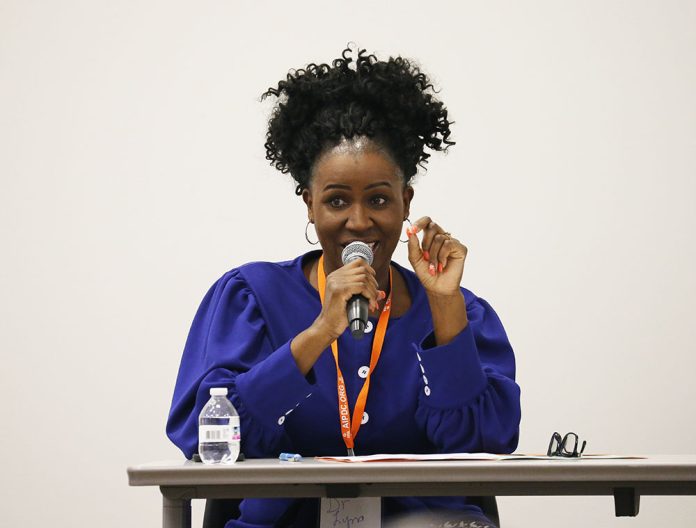
Lunde praised the city for earning the distinction of providing the data and analysis to justify the need for the center saying “We track. We can catalog. We can prove the value of this.”
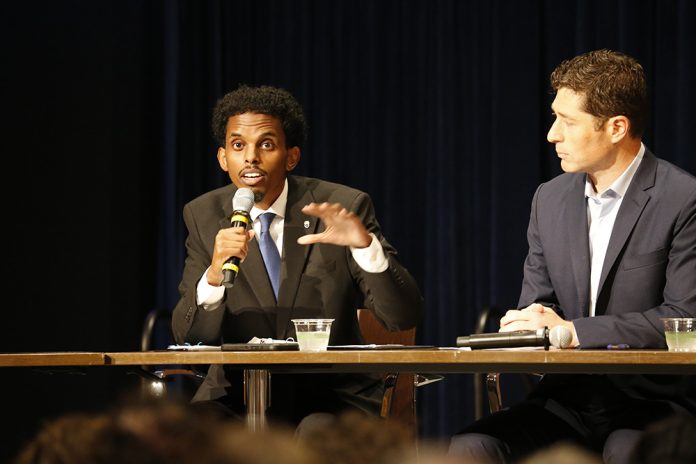
Jon Kainz, president and CEO of Donlar Construction, was on hand for the groundbreaking ceremony. His company was in September 23, 2024 awarded a $9.8 million contract by the city for the construction. He said his company has a long history of building projects such as the teen center and has as its mission the goal to “improve people’s lives by building better communities” and that he is committed to ensuring the new center will have state-of-the-art amenities and spaces tailored to the youth.

“We understand that this project belongs to the community, and we are committed to working closely with the city and the stakeholders involved along the way,” Kaiz said. “Donlar prioritizes safety, efficiency, and communication on all our projects, and we will continue to do this throughout the construction process on your new community center.”

“This facility will be a hub of activity,” he continued. “Fostering community connections, and empowering the next generation of leaders.”

The architectural firm Design By Melo did the architectural design for the center. One of its latest projects is the six-story $66 million Opportunity Crossing project on the corner of Nicollet Avenue and Lake Street in Minneapolis.

Damaris Hollingsworth, Design By Melo’s principal architect in brief remarks at the groundbreaking said “I see this project as something that even before the door is open, even before the amazing staff is doing the work they do, it’s already doing something.”

Parks and Facilities Manager Marcus Hill said that the teen center will help address the number one thing he has heard from young people – that they want food and access to jobs and internships.

“We are set to open our doors right around Christmas of 2025, the building (Zanewood) is closed during construction for eight weeks during the summer” Hill said. “We’re super excited about this project, two years in the making, and we’re finally here.”