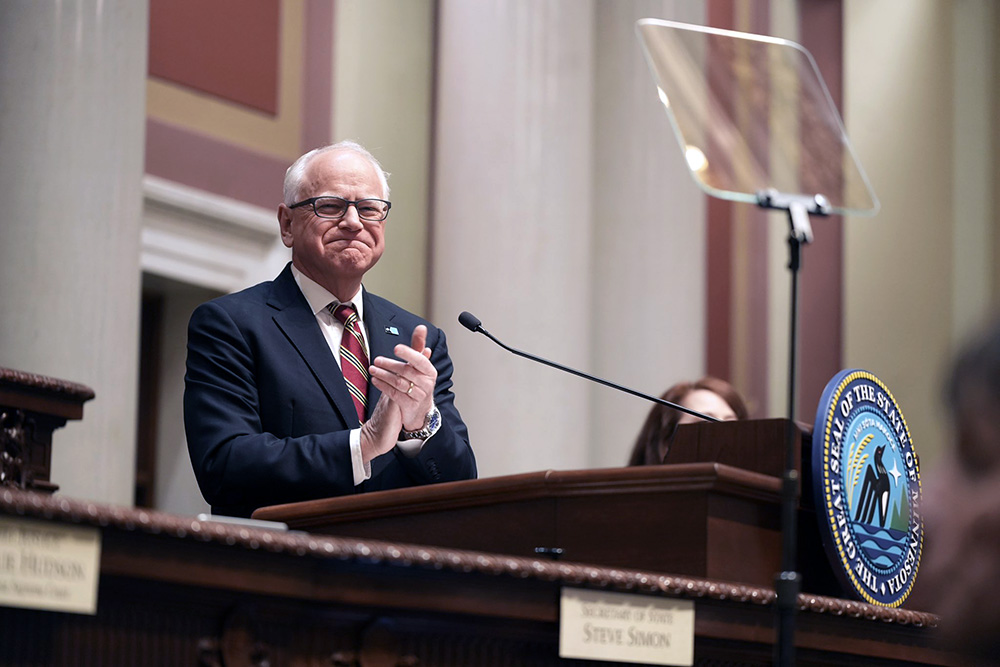
Gov. Tim Walz used his final State of the State address Tuesday night in St. Paul to reflect on a year marked by loss, political upheaval and recovery efforts across Minnesota, while defending his record and pressing lawmakers to strengthen fraud prevention.
Walz opened the speech in a lighter tone, greeting lawmakers, judges and family members in the House chamber and joking that his son was “wandering around” the Capitol. But the mood quickly shifted as he turned to a series of tragedies and disruptions that have shaped the state’s recent history.
He asked lawmakers to stand in honor of former House Speaker Melissa Hortman and her husband, Mark Hortman, longtime Brooklyn Park residents whose deaths last year continue to resonate across Minnesota politics and their home community.
“We didn’t just lose treasured friends,” Walz said. “We lost the most consequential speaker in Minnesota’s history.”
A moment of silence followed as members of the Hortman family looked on.
A year marked by loss and disruption
Walz described the past year as one defined by overlapping crises — including political violence, mass shootings and a federal immigration enforcement operation known as Operation Metro Surge that brought widespread disruption across the Twin Cities.
He said the period left many families in fear and strained relationships between neighbors as enforcement actions unfolded across workplaces and residential areas.
Even after the operation wound down earlier this year, its effects have lingered — from economic losses to lasting trauma for families and businesses. Local officials have estimated the operation caused more than $200 million in economic impact in Minneapolis alone. Combined estimates for Minneapolis and St. Paul place losses at more than $600 million, reflecting a broader disruption to the region’s economic base.
The ripple effects have been felt well beyond the urban core. In Brooklyn Park, city leaders have pointed to strained small businesses, shaken community trust and a long recovery still ahead following months of disruption.
Walz said his administration is now focused on helping communities recover.
“And even as our collective psyche tries to recover from the after-effects of Operation Metro Surge, we can take decisive action to help our economy recover as well,” he said.
He pointed to proposals including $10 million in partially forgivable loans for affected businesses and rental assistance for more than 9,000 households through housing stability programs.
Defending investments in Minnesota families
Walz used much of the speech to highlight long-term investments in Minnesota families, schools and working communities.
He pointed to free school meals, expanded child tax credits, tuition-free college for qualifying families, and major investments in early childhood education and workforce training programs.
“We feed our kids,” Walz said, noting that Minnesota has served more than 300 million free school meals since launching the program.
He also highlighted tax cuts, rebate checks, infrastructure spending and climate initiatives, framing them as efforts to ease financial pressure on working families facing rising costs.
Fraud crackdown and calls for legislative action
Walz also addressed growing scrutiny over fraud in state-funded programs, one of the most politically sensitive issues of his administration.
Minnesota has faced multiple investigations involving misuse of public funds, including high-profile cases tied to nonprofit programs such as Feeding Our Future, which have resulted in dozens of guilty pleas.
Walz said his administration has implemented a nine-part fraud prevention strategy that includes stronger oversight, additional investigators and expanded use of data analytics to detect suspicious activity earlier.
“People who have ripped us off are getting caught, and they are going to jail,” he said.
He acknowledged political criticism but said reforms are already underway and require legislative support to be fully effective.
“I’ve said the buck stops with me,” Walz said, urging lawmakers to pass stronger oversight measures, increase penalties and centralize fraud prevention efforts.
He also proposed restructuring parts of the state’s human services system to reduce administrative complexity and prevent improper payments before they occur.
“If you’re taking fraud seriously, take your responsibility seriously and pass legislation to stop it,” he said.
Republican response
House Speaker Lisa Demuth pushed back after the address, saying Walz did not adequately address concerns about fraud and state spending.
Demuth, who is running for governor in 2026, said Minnesota needs stronger accountability and tighter oversight of public programs as the state continues to deal with the fallout from large-scale fraud investigations.
“The people of Minnesota deserve a government that protects their tax dollars and prioritizes transparency,” Demuth said, adding that Republicans believe the state must do more to prevent misuse of public funds and reduce costs for taxpayers.
She said lawmakers still have “significant work to do” this session, particularly on restoring trust in government programs and addressing long-term fiscal concerns.
Closing a chapter in Minnesota politics
Walz, who is not seeking reelection after eight years in office and a 2024 run as the Democratic vice presidential nominee, framed the speech as both a reflection on progress and a call to complete unfinished work.
“This is not a goodbye,” he said. “But it is my last State of the State.”
He closed by sharing a story of a Minnesotan who traveled to Texas to help reunite a detained immigrant with his family — a moment he said reflected the state’s identity during difficult times.
Walz ended with a final appeal to unity and resilience.
“For seven years, we’ve been writing a story together,” he said. “Let’s get to work.”
About Tom Gitaa, Editor-in-Chief
Born and raised in Kenya's coastal city of Mombasa, Tom is the Founder, Editor-in-Chief and Publisher of Mshale which has been reporting on the news and culture of African immigrants in the United States since 1995. He has a BA in Business from Metro State University and a Public Leadership Credential from Harvard’s Kennedy School of Government. He was the original host of Talking Drum, the signature current affairs show on the African Broadcasting Network (ABN-America), which was available nationwide in the United States via the Dish Network satellite service. On the show, he interviewed Nobel laureates such as 2004 Nobel Peace prize winner, Professor Wangari Maathai, the first woman from Africa to win the peace prize and heads of states. Tom has served and chaired various boards including Global Minnesota (formerly Minnesota International Center), the sixth largest World Affairs Council in the United States. He has previously served as the first Black President of the Board of Directors at Books for Africa. He also serves on the board of the Minnesota Multicultural Media Consortium. He has previously served two terms on the board of the United Nations Association. An avid runner, he retired from running full marathons after turning 50 and now only focuses on training for half marathons.
- Web |
- More Posts(515)
 (No Ratings Yet)
 Loading...