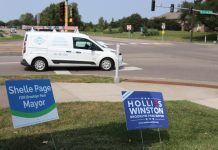
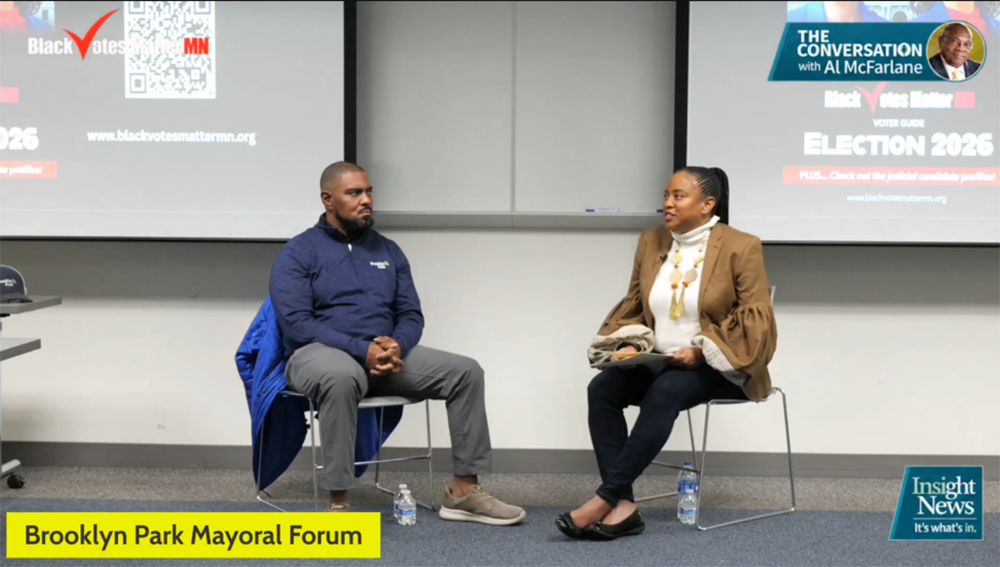
BROOKLYN PARK, Minn. — Five years after Hollies Winston found himself answering questions alone at a mayoral forum organized by minority-owned news organizations, history repeated itself Thursday when his challenger, City Councilmember Shelle Page, did not participate in a forum organized by Black Votes Matter Minnesota.
But this time, Winston was the incumbent mayor, Page was the challenger, and a dispute over how the event was organized spilled into a public discussion on Facebook as Brooklyn Park voters prepared to choose their next mayor Nov. 3.
Anika Robbins, founder of Black Votes Matter Minnesota, told the audience at North Hennepin Community College on Oct. 15 that Page had been invited several times and that organizers had offered to accommodate her schedule.
“We did reach out and extend an invitation to candidate Page,” Robbins said. She told the audience that Page initially said she was unaware of the event and subsequently was invited to suggest alternative dates.
Robbins said Page ultimately declined, saying she was tired.
Page offered a different account in a Facebook discussion about the forum, questioning the timing of the invitation.
“We learned after the fact from organizers this event had been in planning for more than 90 days and publicly advertised since the beginning of September, but our office was not contacted until the 17th when we initiated it,” Page wrote.
Page also said two sponsoring organizations had separately contacted her with apologies.
“That timeline is important context,” she wrote.
The two accounts differ on how the invitation was handled, and neither Page nor Robbins has provided Mshale with a detailed timeline of their communications.
Reached by Mshale on Monday, Page declined to elaborate on her absence, saying she wanted to focus on running a positive campaign and building Brooklyn Park.
Mshale also emailed Robbins seeking clarification about the invitation timeline, the offer of alternative dates and Page’s account of apologies from sponsoring organizations. Robbins had not responded as of Tuesday.
The forum proceeded with Winston answering questions about his record and plans for Brooklyn Park, including housing development, crime, property taxes, light rail and a proposed biotechnology district.
Robbins moderated after Al McFarlane, editor-in-chief of Insight News, was unable to attend because of the flu. Insight News was among the media partners involved in the event.
A familiar scene from 2021
The absence of a mayoral candidate from a forum involving Black-led organizations has a precedent in Brooklyn Park’s recent political history.
In July 2021, then-mayoral candidate Lisa Jacobson declined to participate in an Aug. 3 forum organized by Mshale, Insight News and Hmong TV. Jacobson cited what she considered unfavorable coverage by Mshale.
Winston, who was challenging Jacobson in that year’s special mayoral election, participated without his opponent.
Jacobson went on to defeat Winston in a closely contested election that required a recount.
Winston returned to the ballot in 2022 and won, becoming Brooklyn Park’s first Black mayor.
The circumstances surrounding the two forum absences are not identical. Jacobson publicly identified her objections to one of the organizing news outlets in 2021. Page has questioned the invitation process in 2026 but declined Mshale’s request to explain her decision further.
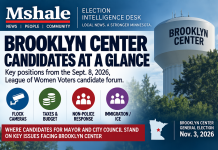
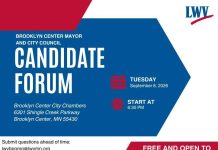
Page and Winston previously appeared together at an Aug. 27 candidate forum organized by the League of Women Voters of Brooklyn Park, Osseo and Maple Grove, where they addressed taxes, city spending, public safety and economic development.
Winston pushes market-rate housing
With no opponent onstage to challenge his positions, Winston used the Oct. 15 forum to defend his vision of a more economically prosperous Brooklyn Park, arguing that the city needs additional commercial development, higher-paying jobs and housing that can attract residents across income levels.
His comments on housing were particularly pointed.
“We want market rate. We want luxury. We want single family homes” Winston said.
The mayor argued that Brooklyn Park already has a substantial supply of affordable housing and should prioritize market-rate apartments, single-family homes and higher-end development.
“We have a glut of affordable housing in Brooklyn Park,” Winston said, arguing that the city had provided affordable housing long before it became a major policy priority.
He described an approach in which roughly 80% of the city’s housing development efforts would focus on market-rate housing.
Winston also suggested that some resistance to Brooklyn Park’s development ambitions reflects assumptions about what a racially diverse suburb should look like.
“I’m not sure if you’re not getting the memo or you have a racialized view of Brooklyn Park and what we deserve,” he said, referring to continued calls for affordable housing.
He argued that creating better-paying jobs would allow more residents to purchase homes without relying on housing assistance.
“I don’t want a city where people come in saying, well, you know, people in Brooklyn Park, they need affordable housing. I want people in Brooklyn Park to afford a house,” Winston said.
Winston has made attracting higher-paying jobs and changing perceptions of Brooklyn Park central to his economic development agenda.
His approach also raises questions about how the city would balance its ambitions for higher-end development with the housing needs of lower-income residents.
Biotech district at the center of economic plans
Winston repeatedly returned to the city’s proposed biotechnology district as a cornerstone of his administration’s economic development agenda.
He said the city has approximately 750 acres available for development along the Medical Alley corridor and wants to attract biotechnology, medical technology and advanced manufacturing companies.
The mayor projected that the district could eventually support 5,000 to 10,000 jobs and approximately 3,000 housing units.
Those figures represent development projections, not jobs or housing units already delivered.
Winston said the city wants to connect young residents with future employment opportunities through education, training and apprenticeship programs.
He also compared Brooklyn Park’s commercial property value with Bloomington’s, arguing that a gap of approximately $3.5 billion limits the city’s ability to fund services without placing greater pressure on homeowners.
“We have to close a $3.5 billion gap,” Winston said.
“That gap in commercial value, who has to shoulder that is residents, is homeowners,” he said.
Winston argued that attracting more commercial investment could eventually ease the pressure on residential property taxpayers.
His administration, he said, wants to use state-authorized economic development tools and partnerships with private developers to attract investment.
Winston also identified Brooklyn Boulevard as a redevelopment priority, saying the older commercial corridor needs additional retail, restaurants, housing and mixed-use development.
Data centers raise questions
The biotechnology discussion prompted audience questions about whether data centers might become part of the city’s development strategy and what their electricity and water demands could mean for residents.
Winston acknowledged the concerns but stopped short of endorsing or rejecting data centers.
“I haven’t committed to them or committed against them,” he said.
He argued that data centers could generate substantial property tax revenue and help attract other technology businesses, but said their infrastructure demands would have to be evaluated.
Winston said Xcel Energy would need to be involved in discussions about electricity capacity and that the City Council would have to consider the potential costs and benefits.
He also said the city would not be inclined to assume the infrastructure costs associated with a data center.
“I’m not going to commit one way or the other,” Winston said. “What I will commit to is I’m never going to create — I’m not going to enter into a deal that is bad for the city.”
His remarks left open the possibility of data center development while acknowledging that no decision had been made.
Crime and policing
Public safety was another major theme.
Winston said crime in Brooklyn Park has fallen to a 37-year low, crediting a combination of additional police officers, community violence intervention and alternative response programs.
The mayor said the city’s police staffing had grown from approximately 88 officers when he took office to about 105, with an authorized strength of 109.
He also pointed to efforts to recruit a more diverse police force.
Winston described community intervention teams that can respond to potentially volatile situations involving young people and alternative response workers who can handle some mental health and family-related calls without immediately involving police.
“You can be humane and you can have lower crime,” Winston said.
He argued that those approaches allow officers to concentrate on more serious emergencies while reducing unnecessary involvement with the criminal justice system.
“They’re not in the criminal justice system,” Winston said of people helped through alternative response. “They get to go on with their lives.”
The crime statistics and staffing figures were presented by Winston during the forum and were not independently verified by Mshale for this report.
Light rail and economic opportunity
Winston also defended his support for the planned METRO Blue Line light rail extension, portraying the project as an economic development opportunity rather than simply a transportation investment.
He said improved transit connections could help Brooklyn Park residents reach jobs and educational institutions while attracting additional commercial development.
The mayor acknowledged historical concerns about transportation projects that displaced Black communities, including St. Paul’s Rondo neighborhood and Chicago neighborhoods affected by highway construction.
But he argued that Brooklyn Park should position itself to benefit from new investment rather than reject transportation expansion because of past injustices.
Winston also challenged arguments that expanding transit would bring crime into suburban communities, saying some opponents were repeating fears associated with earlier battles over racial integration.
“The reality of the situation is the vast majority of people do not get on light rail to just do something stupid,” he said. “They’re trying to get to and from work or to and from school or to and from a loved one.”
He also rejected the suggestion that expanding bus service alone would generate the same level of economic development as light rail.
Winston said better transportation connections could help residents access jobs in the proposed biotechnology district and elsewhere in the Twin Cities.
An election approaching
The Oct. 15 event was part of a series of candidate forums organized by Black Votes Matter Minnesota and its partners ahead of the general election.
Robbins told attendees that the organization was nonpartisan and encouraged voters to research both candidates before casting their ballots.
She said the organization’s voter guide included information about both Winston and Page despite Page’s absence.
For Winston, the forum provided an opportunity to present his record and future plans without a direct challenge from his opponent.
For Page, the event became a dispute over the invitation process that she has chosen not to discuss further with Mshale.
Brooklyn Park voters will decide the contest Nov. 3. Early voting is underway, and polls will be open from 7 a.m. to 8 p.m. on Election Day.
Voters can find registration information, polling locations and sample ballots at mnvotes.gov.
About Tom Gitaa, Editor-in-Chief
Born and raised in Kenya's coastal city of Mombasa, Tom is the Founder, Editor-in-Chief and Publisher of Mshale which has been reporting on the news and culture of African immigrants in the United States since 1995. He has a BA in Business from Metro State University and a Public Leadership Credential from Harvard’s Kennedy School of Government. He was the original host of Talking Drum, the signature current affairs show on the African Broadcasting Network (ABN-America), which was available nationwide in the United States via the Dish Network satellite service. On the show, he interviewed Nobel laureates such as 2004 Nobel Peace prize winner, Professor Wangari Maathai, the first woman from Africa to win the peace prize and heads of states. Tom has served and chaired various boards including Global Minnesota (formerly Minnesota International Center), the sixth largest World Affairs Council in the United States. He has previously served as the first Black President of the Board of Directors at Books for Africa. He also serves on the board of the Minnesota Multicultural Media Consortium. He has previously served two terms on the board of the United Nations Association. An avid runner, he retired from running full marathons after turning 50 and now only focuses on training for half marathons.
- Web |
- More Posts(516)
 (No Ratings Yet)
 Loading...