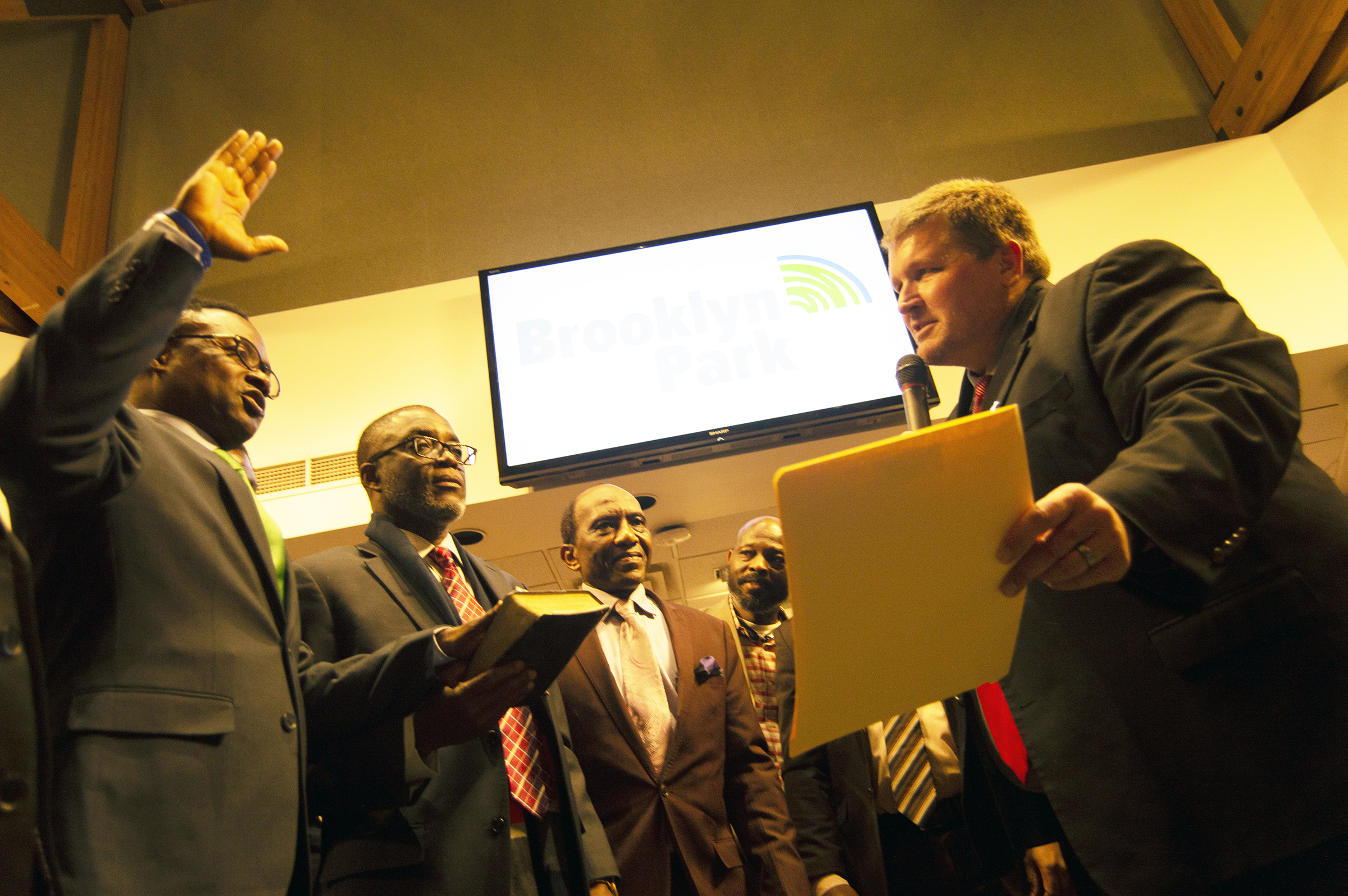
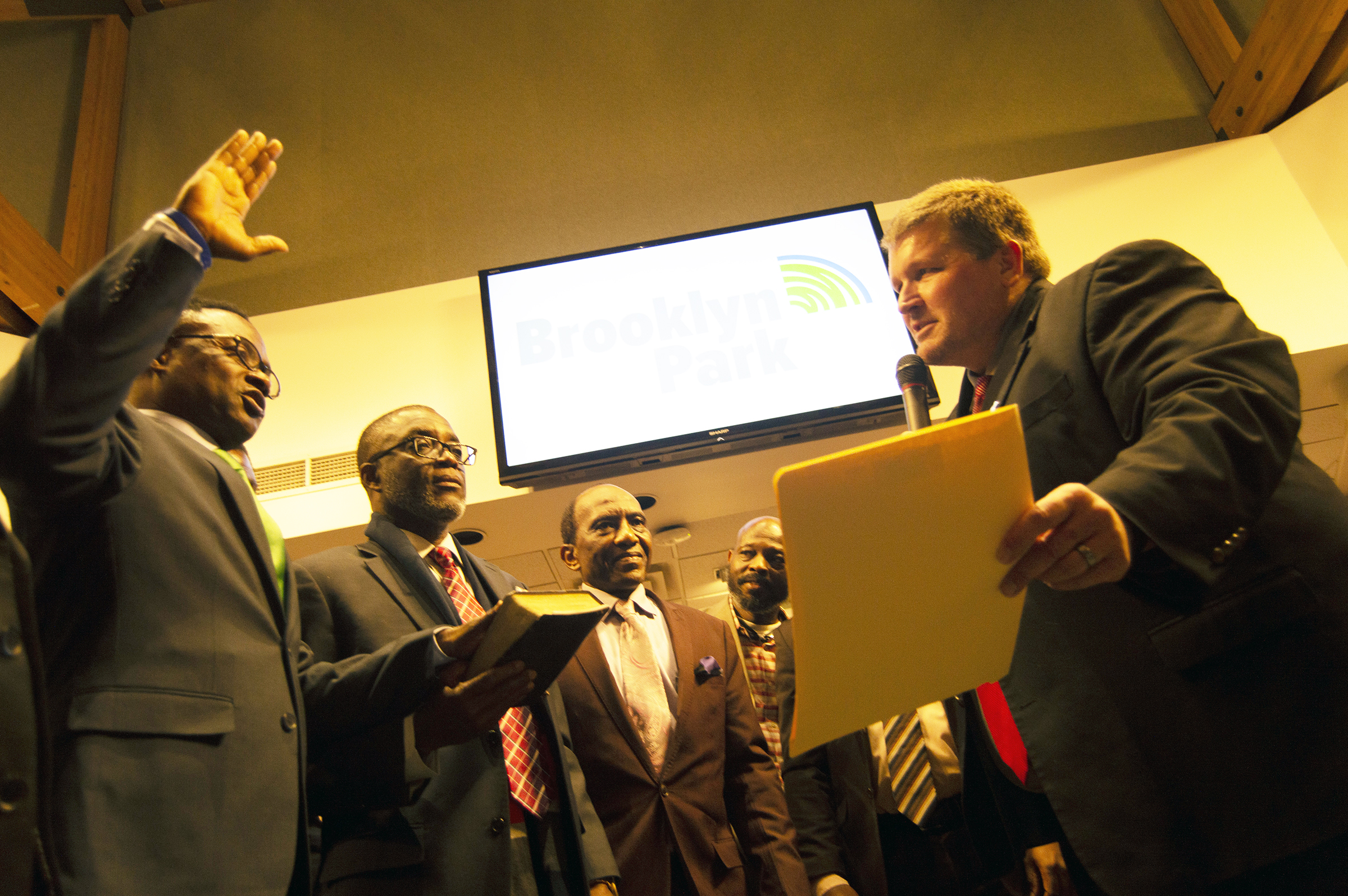
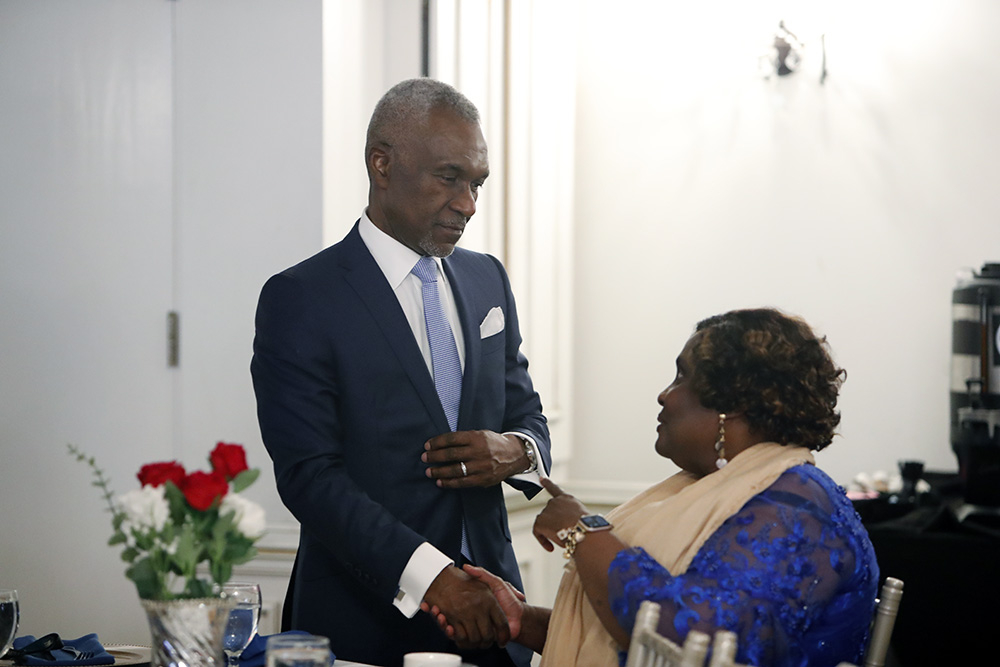
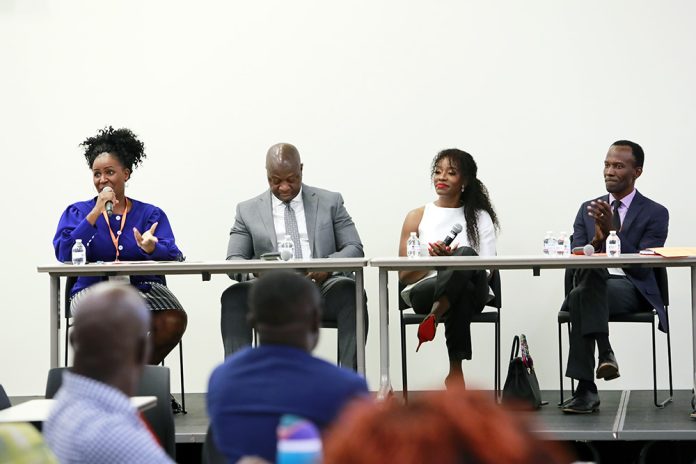
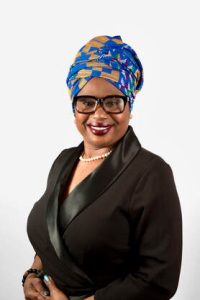
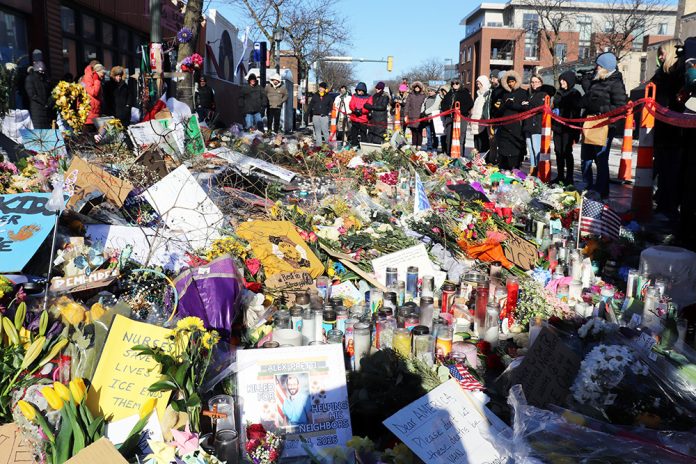
Brooklyn Park mayor, Jeff Lunde, right, administers the oath of office on Wynfred Russell to serve on the Brooklyn Park City Council on Monday, January 7, 2019 at the council's chambers. Russell who was born and raised in Liberia becomes the first black person to ever serve on the council. Photo: Bethel Gessesse/Mshale
Brooklyn Park mayor, Jeff Lunde, right, administers the oath of office on Wynfred Russell to serve on the Brooklyn Park City Council on Monday, January 7, 2019 at the council's chambers. Russell who was born and raised in Liberia becomes the first black person to ever serve on the council. Photo: Bethel Gessesse/Mshale
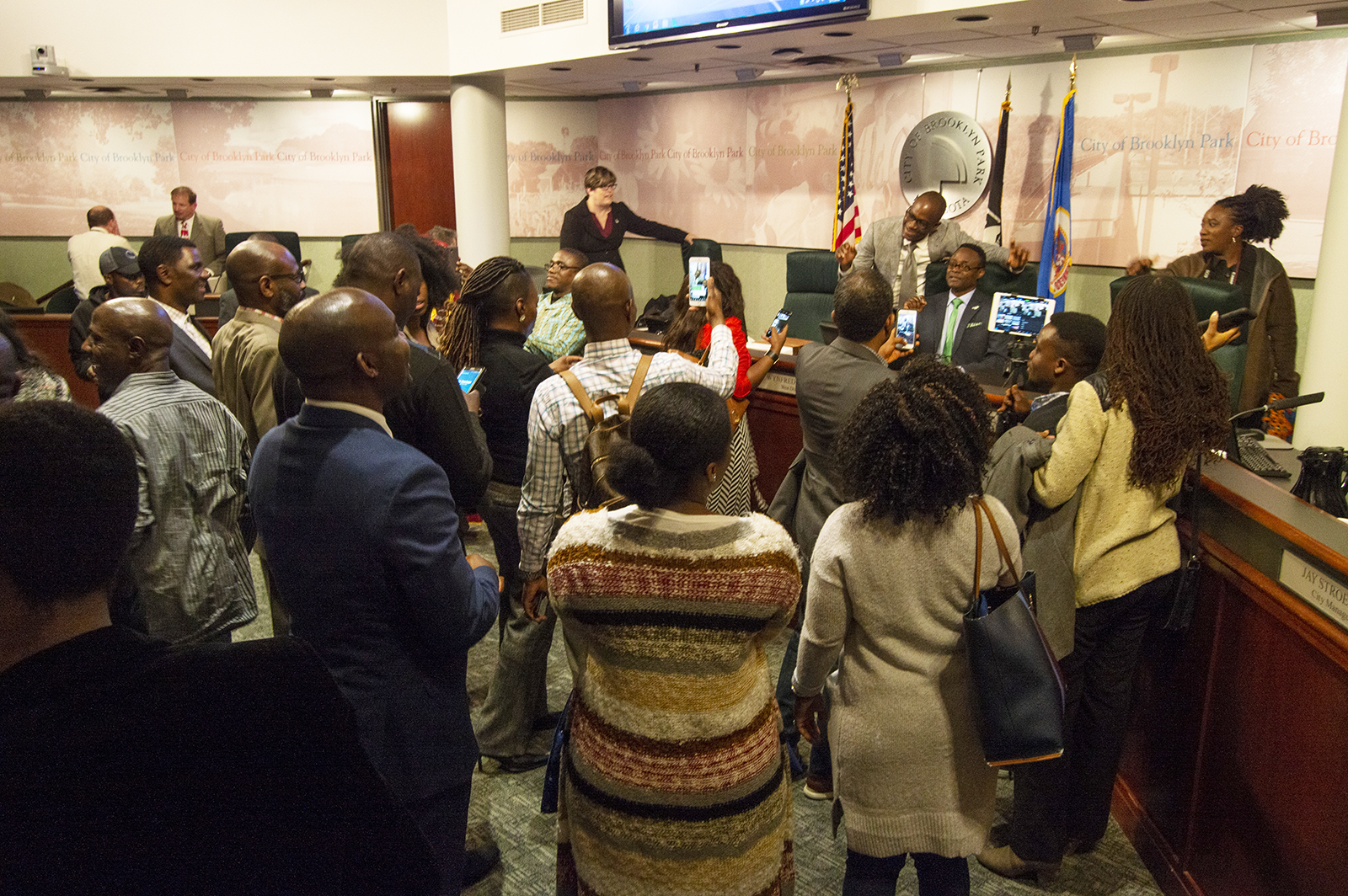
Dozens of Brooklyn Park residents last evening crammed into city council chambers to witness history being made in Minnesota’s sixth largest city, the swearing in of the city’s first black council member, Wynfred Russell, who was born and raised in Liberia.
Russell, a former instructor at the University of Minnesota, defeated former council member Bob Mata by garnering a convincing 55% of the vote in November’s midterm elections to make him the second person of color elected to the council after that of his now fellow council member, Susan Pha, two years ago. In 2012, Russell, who at the time served on the city’s planning commission, ran for a seat on the same council and lost by just five votes. This time, it was a joyous occasion as friends and family cheered and recorded the historic event.
Minnesota is home to the largest population of Liberians in the United States with Brooklyn Park home to most of them. Many of them were present last night to witness the brief yet monumental event as one of their own placed his hand on his late father’s bible to take the oath of office. The bible had been sent over from Liberia a few days ago in time for the swearing in.
In an interview with Mshale shortly after being elected in November, he said he looks forward to working with others to improve the economic well being of the city’s residents.
“I also intend to focus on the small businesses of which many are run by people of color and do not get the same tax breaks or incentives other big companies get from our city,” he said. “But if we can get some grants to support them, the small business is the backbone of the economy and it will benefit our city if they thrive.”
International student enrollment at US colleges and universities declined as schools opened for the fall 2018/2019 school year, new number show. Photo: Wikimedia
International student enrollment at US colleges and universities declined as schools opened for the fall 2018/2019 school year, new number show. Photo: WikimediaInternational student enrollment at US colleges and universities declined as schools opened for the fall 2018/2019 school year, new number show. Photo: Wikimedia
New enrollments of international students fell by 6.6 percent at American universities in academic year 2017-18 compared to the year before, marking the second straight year in declines in new enrollments, according to new data from the annual Open Doors survey.
New enrollments fell 6.3 percent at the undergraduate level, 5.5 percent at the graduate level and 9.7 percent at the nondegree level from 2016-17 to 2017-18.
A separate survey of institutions found that the decline in new international enrollments is continuing this fall, though the drop was less severe than that reported last year.
Institutions that responded to this fall’s enrollment survey reported on average a 1.5 percent continuing drop in new international enrollments, a drop that comes on top of last year’s declines. However, while about half (49 percent) of respondents reported declines in new international enrollments this fall, another 44 percent reported increases, and 7 percent said their numbers were stable.
“This is very much a mixed picture,” said Rajika Bhandari, a senior adviser for research and strategy and director of the Center for Academic Mobility Research & Impact at the Institute of International Education, which conducts the survey with funding from the Department of State. “We’re seeing those new enrollment numbers really vary based on institutional characteristics.”
Unlike in past years, IIE did not release the full findings of the current fall enrollment survey to reporters in advance along with the Open Doors data, but Bhandari and Peggy Blumenthal, a senior counselor to the president at IIE, shared several top-line findings in an interview last week with Inside Higher Ed. Among the findings, institutions in the center of the country — specifically the South Central region, which includes Texas, and the West North Central region — are seeing sharper declines than are institutions on the coasts. Less selective institutions are also seeing steeper declines.
“The large research institutions, many of them are seeing growth,” Blumenthal said. “The less well-known abroad schools and the schools giving associate degrees are seeing much sharper declines.”
Over all (as opposed to new) international enrollments did increase by 1.5 percent from 2016-17 to 2017-18, according to the Open Doors survey, which collected data from 2,075 institutions. But that growth is being driven by a boom in the number of students participating in the optional practical training program, OPT, which enables graduates of U.S. colleges to stay in the country and work for up to three years after graduating while remaining on their student visas. A change in 2016 to the duration of OPT for students studying STEM fields means that students are staying in the OPT pipeline for longer after they graduate from their program.
The increases in OPT participation by recent international graduates can mask declines in the number of international students who are currently enrolled in degree programs — the number that really matters to colleges when it comes both to their financial bottom lines and their goals of building diverse campuses. The total number of students participating in OPT grew by 15.8 percent from 2016-17 to 2017-18, while the total number of enrolled international students increased by 0.8 percent at the undergraduate level and decreased by 2.1 percent at the graduate level. The number of nondegree students — a category that includes students in intensive English programs — fell for the third year in a row, by 10.1 percent.
Among the big changes in the Open Doors data for academic year 2017-18 was an 8.8 percent drop from the prior year in the number of graduate and professional students from India, the second-largest country of origin for international students in the U.S. after China.
Another notable shift was a 6.4 percent drop in the number of international graduate students studying engineering, the most popular field of study for international students in the U.S.
Universities also saw a 15.5 percent overall decline in the number of students from the No. 4 sending country, Saudi Arabia. The number of Saudi students declined at all academic levels, a change that’s largely attributable to the Saudi government scaling back a foreign scholarship program that has sent thousands of Saudi students to study at U.S. universities.
At the undergraduate level, higher education institutions reported double-digit year-over-year increases in students from the No. 6 sending country, Vietnam, No. 10 Brazil and No. 11 Nepal.
The number of students from the No. 1 sending country, China, continued to increase at both the undergraduate and graduate levels, by 4 and 2 percent respectively, but declined at the nondegree level. Chinese students account for 33.2 percent of international students in the U.S.; together with India, students from the two countries account for more than half (51.1 percent) of all international students.
Among other notable shifts involving top sending countries, the numbers of students from the No. 3 sending country, South Korea, fell for the seventh straight year, by 7 percent, a trend that Blumenthal attributes to the changing demographics of South Korea and to the improving quality of the Korean higher education system.
There were also declines in the overall number of students coming from America’s neighbors, Canada and Mexico, two countries where President Trump is deeply unpopular. While there were drops at all academic levels for Canadian and Mexican students — except for the OPT level — the steepest decline was in the number of Mexican students coming for nondegree study, including intensive English, which fell by 39.1 percent.
This year’s Open Doors data also provide a first glimpse of the impact on international enrollments of President Trump’s various travel bans barring entry to the U.S. for citizens of a group of mostly Muslim-majority countries.
Iran, the No. 12 sending country, is the only country affected by Trump’s travel ban that sends substantial numbers of students to the U.S. Although an Inside Higher Ed analysis of State Department data showed a sharp drop in the number of student visas awarded to Iranians in the year after the first iteration of the ban went into place in January 2017, the Open Doors data do not suggest there was a big effect on Iranian student enrollments that fall. On the contrary, the Open Doors data show a 1.2 percent increase in the number of Iranian students at the graduate level — significant, since about three-quarters of all Iranian students in the U.S. study at the graduate level. The number of Iranian students did decline at the undergraduate (-16.8 percent) and nondegree levels (-35.7 percent), but from a much smaller base.
Among other countries covered by the first and second versions of Trump’s travel ban — which were in effect for parts of the application cycle of the 2017-18 year — there were drops in the total numbers of students from Iraq (-15.3 percent), Libya (-18.8 percent), Syria (-12.2 percent) and Yemen (-21.4 percent), and increases in the number of students from Somalia (+34 percent) and Sudan (+2.2 percent).
A third and current version of the ban bars all students from North Korea and Syria from applying for student visas unless they obtain a waiver. Nationals of the other affected countries are eligible to apply for student visas, though in practice they may have difficulty obtaining them.
Political and Social Factors?
International educators have been deeply concerned that international students could be deterred by more restrictive policies on visas coupled with the Trump administration’s rhetoric on immigration. The president reportedly described most Chinese students in the U.S. as spies and entertained a proposal from a senior adviser to stop awarding student visas to Chinese nationals. The Trump administration has introduced new, enhanced visa questionnaires for certain applicants and has introduced a controversial new policy making it easier for international students to accrue what’s known as “unlawful presence” in the U.S., a determination that can subject them to future three- or 10-year bars on re-entry.
There is also continuing uncertainty about what future changes may be in the offing to visa programs that let students stay in the U.S. and work, including the OPT program and the H-1B visa program.
“Institutions are reporting that the social and political environment continues to be a challenge for international recruitment,” Bhandari said in relation to the survey of institutions conducted this fall. “Institutions are also reporting that they’re concerned about recruitment from Asia.”
She added, “We have about 43 percent of institutions saying that cost continues to be a challenge and that they are trying to ameliorate the situation through approaches like providing more tuition waivers and scholarships and waiving the application fee.”
In a press call with reporters, officials at IIE and the State Department seemed to want to downplay the degree to which political and social factors — including a rise in mass shootings — might be deterring international students. In the call IIE officials emphasized a number of other factors for the drop in new students, including the rising cost of U.S. higher education, increased competition for students from other countries and changes to foreign government scholarship programs, including Saudi Arabia’s.
“It’ll always be a very, very mixed picture, and the international education consumer is always concerned about access, diversity, quality, cost, safety, but in the past couple of years for me the biggest new development is that there are real competitor countries out there that we’ve never had before,” said Allan E. Goodman, IIE’s president.
“This flattening started in 2015-2016, when applications were being filled out in 2014, so it’s quite frankly unwarranted to say that it is completely the result of a political environment,” Caroline Casagrande, the deputy assistant secretary for academic programs at the State Department’s Bureau of Educational and Cultural Affairs, said during the press call. The Open Doors data show that new international enrollments at U.S. colleges increased in 2015-16, but by a slower rate (2.4 percent) compared to the prior year (8.8 percent). The first recorded drop in new enrollments came in academic year 2016-17.
Rahul Choudaha, the executive vice president of global engagement and research at StudyPortals, a company that offers an online international student recruitment platform, said it’s difficult to gauge just how much of an effect political factors have had, but he believes the political climate has dampened growth potential from certain source countries. “It’s a scenario of lost opportunity, because from the institution’s side there is clearly an interest to internationalize and attract more international students for a variety of reasons,” Choudaha said.
Choudaha added that another phenomenon to note is “the big getting bigger.”
“There are institutions in the Midwest that are facing a much sharper decline — and a bigger effect of this Trump effect, you might say — but then on the other side there are institutions in California, New York and Massachusetts, and if they are higher in the Carnegie classification, which means they are highly ranked, they are not seeing any effect.”
Among the top 10 states hosting international students, there were increases in the total number of international students (including OPT participants) in No. 1 destination California (+3.2 percent), No. 2 New York (+2.4 percent), No. 4 Massachusetts (+8.4 percent), No. 5 Illinois (+2.2 percent), No. 6 Pennsylvania (+1.3 percent) and No. 7 Florida (+1.7 percent), and declines in No. 3 Texas (-0.9 percent), No. 8 Ohio (-2.8 percent), No. 9 Michigan (-0.7 percent) and No. 10 Indiana (-2 percent).
Detailed tables from Open Doors showing changes in international enrollment by country of origin and field of study from 2016-17 to 2017-18 are below. Another table shows percent changes in total international enrollment in all 50 states, plus the District of Columbia, and notes which candidate the state went for in the 2016 presidential election, Hillary Clinton or Trump.
Percent Change in Total International Enrollments from 2016-17 to 2017-18 From Top 15 Countries of Origin by Academic Level
Undergraduate
Graduate
Nondegree
OPT
Overall
World Total
+0.8%
-2.1%
-10.1%
+15.8%
+1.5%
1. China
+4%
+2%
-7.7%
+9.8%
+3.6%
2. India
+6.2%
-8.8%
-16.6%
+32%
+5.4%
3. South Korea
-8.1%
-5.5%
-16.1%
-0.9%
-7%
4. Saudi Arabia
-15%
-10.2%
-34%
-2.4%
-15.5%
5. Canada
-4.6%
-5.9%
-5.8%
+2.7%
-4.3%
6. Vietnam
+10.9%
+5.7%
-3%
+3.4%
+8.4%
7. Taiwan
+7%
+3.2%
-4.4%
+6.5%
+4.4%
8. Japan
+1%
-1.7%
-2.4%
+3.7%
-0.1%
9. Mexico
-6.3%
-6.5%
-39.1%
+15.3%
-8.1%
10. Brazil
+16.6%
+5.8%
+17.1%
+3.6%
+11.7%
11. Nepal
+17.9%
+13.7%
-50%
+7.6%
+14.3%
12. Iran
-16.8%
+1.2%
-35.7%
+14.3%
+1.1%
13. Nigeria
+1.5%
+12.3%
-23.5%
+29.8%
+8.4%
14. United Kingdom
-1.5%
-4.1%
+1.9%
+12.3%
-0.3%
15. Turkey
-1.3%
-0.3%
-33.1%
+18.3%
-0.6%
Enrolled International Students by Field of Study and Academic Level
2016-17 Undergraduates
2017-18 Undergraduates
Percent Change
2016-17 Graduates
2017-18 Graduates
Percent Change
Agriculture
4,026
4,151
+3.1%
6,281
5,852
-6.8%
Business and Management
106,669
101,755
-4.6%
57,167
57,506
+0.6%
Communications and Journalism
12,395
12,460
+0.5%
5,759
5,691
-1.2%
Education
4,503
4,166
-7.5%
10,867
10,735
-1.2%
Engineering
71,622
71,151
-0.7%
105,060
98,307
-6.4%
Fine and Applied Arts
29,955
31,999
+6.8%
20,196
19,894
-1.5%
Health Professions
12,331
12,410
+0.6%
16,454
16,475
+0.1%
Humanities
5,037
5,077
+0.8%
9,877
9,555
-3.3%
Legal Studies and Law Enforcement
2,321
2,226
-4.1%
9,053
10,092
+11.5%
Math and Computer Science
43,847
49,566
+13%
76,113
76,352
+0.3%
Physical and Life Sciences
26,965
27,902
+3.5%
37,056
37,098
+0.1%
Social Sciences
42,761
43,579
+1.9%
28,188
27,734
-1.6%
Change in International Enrollments by State, Ranked by International Enrollments
Candidate Supported in 2016 Presidential Election
Percent Change in International Enrollments from 2016-17 to 2017-18
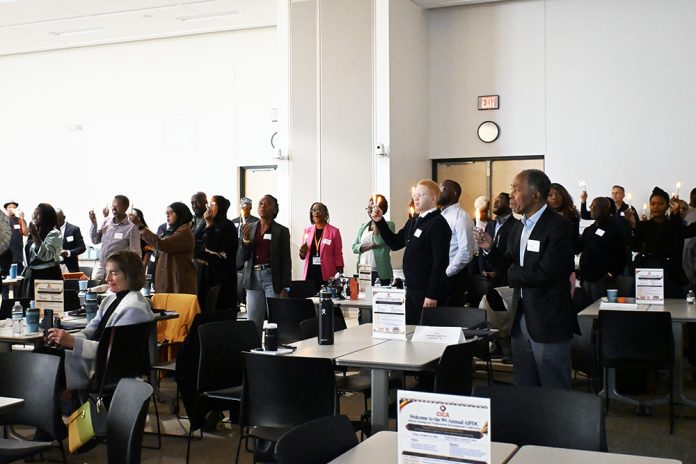
Participants raise illuminated candles during an exercise led by keynote speaker Rosemond Sarpong Owens at the ninth annual African Immigrant Professional Development Conference on Oct. 16, 2026, at North Hennepin Community College in Brooklyn Park. Owens encouraged participants to recognize their strengths and build relationships that can open doors to new opportunities. | Lizzy Nyoike/Mshale
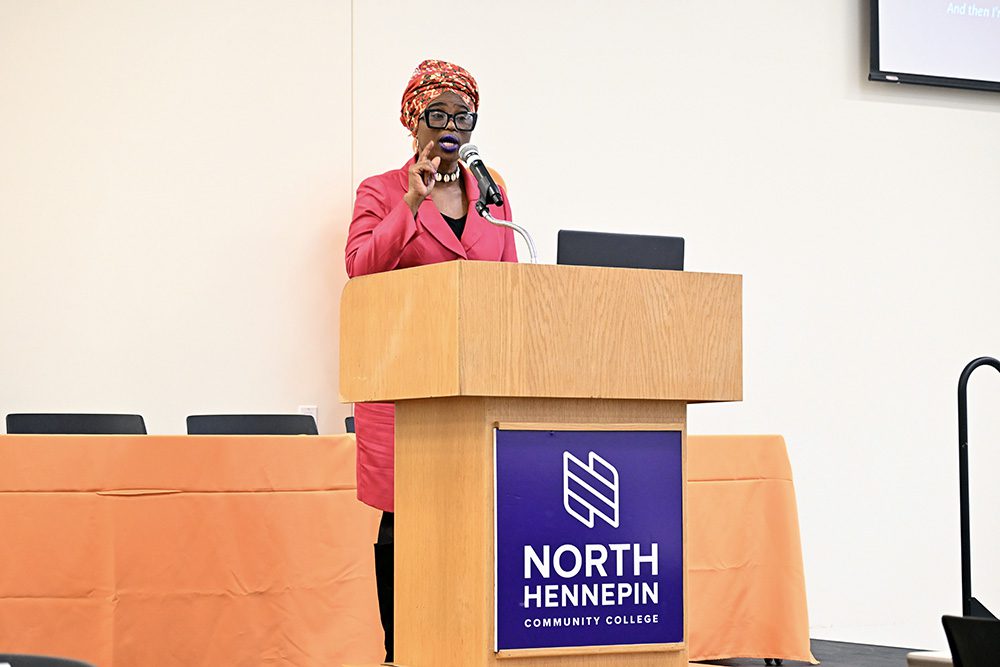
Participants raise illuminated candles during an exercise led by keynote speaker Rosemond Sarpong Owens at the ninth annual African Immigrant Professional Development Conference on Oct. 16, 2026, at North Hennepin Community College in Brooklyn Park. Owens encouraged participants to recognize their strengths and build relationships that can open doors to new opportunities. | Lizzy Nyoike/MshaleInside Helling Hall at North Hennepin Community College, Rosemond Sarpong Owens asked participants to hold a candle and think about personal strengths they had minimized. Owens, who was delivering the keynote speech at the ninth annual African Immigrant Professional Development Conference (AIPDC), told members of her audience to also think about relationships they had hesitated to build on, and the rooms they wondered whether they belonged in.
“You can begin with what you have, where you are and you can begin today,” Owens said, as participants picked up candles that had been provided to them, turned them on and raised them.
Owens’ candle exercise was about recognizing personal strength and building relationships that help those abilities become visible. Those ideas set the tone for the conference.
Organized by the Center for Immigrant Career Advancement (CICA), the conference explored how African immigrants could turn their education, experience and community connections into opportunities for growth and leadership. This year’s theme, “Repositioning through uncertainty: leveraging social capital for career growth and leadership,” guided conversations about mentorship, entrepreneurship and navigating workplace barriers when traditional pathways become difficult to access.
Keynote speaker Rosemond Sarpong Owens addresses participants at the ninth annual African Immigrant Professional Development Conference on Oct. 16, 2026, in Brooklyn Park. Owens urged African immigrant professionals to recognize their strengths and invest in relationships before they need help advancing their careers. | Lizzy Nyoike/Mshale
Such conversations have become common in Minnesota as contributions of African immigrants to the state’s labor force and economy continues to grow. According to the latest Department of Employment and Economic Development (DEED) report released in March 2025, African-born residents accounted for 28.3% of Minnesota’s foreign-born population in 2023. The state’s African Immigrant population grew by 61,035 between 2013 and 2023, a surge of 78.8%. Immigrants overall accounted for more than 344,000 people, 10.9% of Minnesota’s labor force in 2023. The population also accounted for nearly half the state’s labor force growth over the decade, according to the DEED report. Those workforce figures cover immigrants from all regions, rather than African immigrants specifically.
CICA provides career development and leadership opportunities for skilled immigrants through networking, mentorship, training and strategic partnerships. Its six-month pilot program pairs African immigrants with Twin Cities professionals in their intended fields, combining mentorship with training on resumes, networking and workplace culture.
The annual conference traces its origins back to AIPDC co-founder Dr. S. Miata Getawah’s doctoral research examining African immigrants’ advancement into leadership and senior positions. During the defense of her dissertation in 2018, she was asked how she would share her findings with the African community.
When opening this year’s conference, Getaweh acknowledged the uncertainty surrounding participants’ professional aspirations. She described how the troubling immigration enforcement crackdown posed fear and affected African immigrant families, businesses and workplaces in Minnesota.
“Our presence today is a testimony to resilience, but we also deserve more than simply surviving difficult times,” Getaweh said. “We deserve to feel safe, valued and to thrive.”
The day combined professional headshots, panel discussions, audience questions and a community networking lunch. Participants heard from professionals in various careers about relationships that helped shape their careers.
Panelist Karen Fomafung shared how one connection helped redirect a career that initially offered little room for her qualifications. After moving to the United States from Cameroon in 2013, Fomafung said she found herself in a community where healthcare was presented as the only career path worth pursuing. Despite holding a bachelor’s degree in economics, business management and enterprise administration, she began working as a nursing assistant. Within seven months, she said she knew she needed another direction.
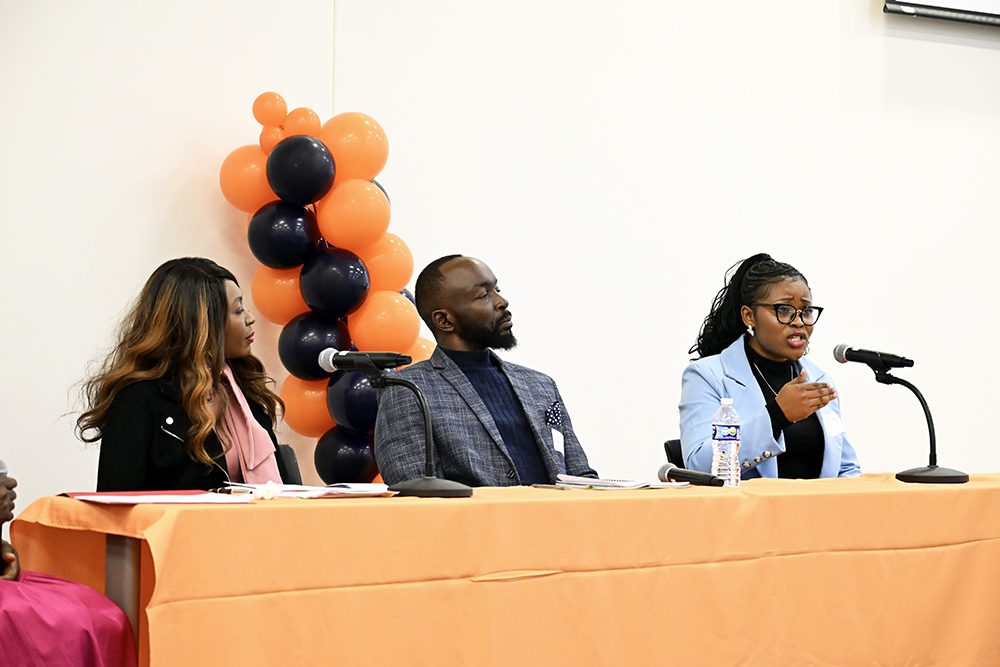
Karen Fomafung, right, speaks during a panel discussion titled “Creating Your Own Opportunities, Entrepreneurship, Wealth and Community Impact” at the African Immigrant Professional Development Conference in Brooklyn Park on Oct. 16, 2026. Also pictured are Harriet Kerubo, left, and Alex Masika. Fomafung described how a professional connection helped her transition from working as a nursing assistant into a corporate career. | Lizzy Nyoike/Mshale
“I was so traumatized, I figured out very quickly that this cannot be for me,” she said. “I had to quit without any Plan B.”
Later at church, she connected with an old university friend who introduced her to corporate career possibilities. He trained her for three months helping her prepare for a project coordinator position she later secured at Xcel Energy, the Minneapolis-based electricity and natural gas company.
Fomafung began documenting and sharing her transition, eventually developing work in career, business and financial coaching. Her experience connected to common distinctions throughout the conference, having qualifications and not knowing how to access opportunities can be challenging.
Kenyan-born panelist Alex Masika described building professional connections before relocating to the United States. Educated in Kenya, he intentionally pursued international opportunities, including work with U.S.-headquartered startups operating in African markets.
During the conference, he shared how those experiences helped him establish relationships and demonstrate relevant skills when he relocated to the U.S.
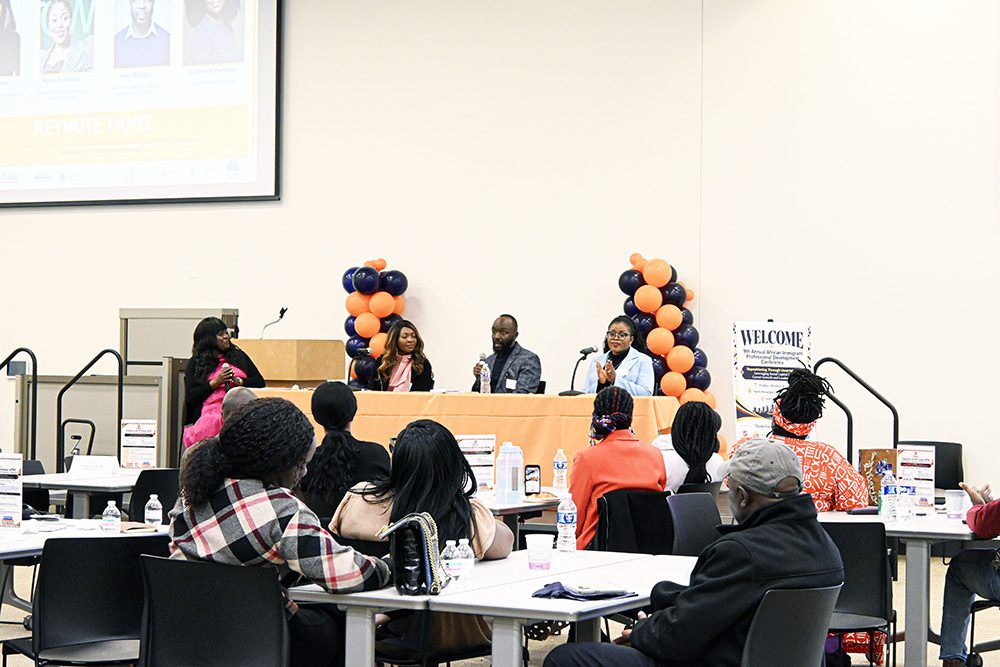
Attendees listen to a panel discussion on entrepreneurship, wealth creation and community impact during the African Immigrant Professional Development Conference at North Hennepin Community College in Brooklyn Park on Oct. 16, 2026. Panelists included Harriet Kerubo, Alex Masika and Karen Fomafung. | Lizzy Nyoike/Mshale
“I started positioning myself before coming here,” Masika said. “While I was in Kenya, one of the things I did for myself was always looking for international opportunities because international opportunities expose you to the other parts of the world.”
Now as a business consultant at Metropolitan Economic Development Association, he encouraged participants to advocate the value of their experience.
“Don’t just ask for a seat at the table; demonstrate the value that you bring to the table,” Masika said. “Sometimes you just need to create your own doors.”
Panelists also addressed sustaining careers and community work. Comfort Dondo, the founding executive director of Phumulani, a nonprofit that provides services to immigrants and refugees to help them transition smoothly and settle into their new lives in the United States, emphasized mentorship, trusted relationships and rest. Audience questions extended those discussions to balancing employment with family time and supporting relatives abroad while saving for the future.
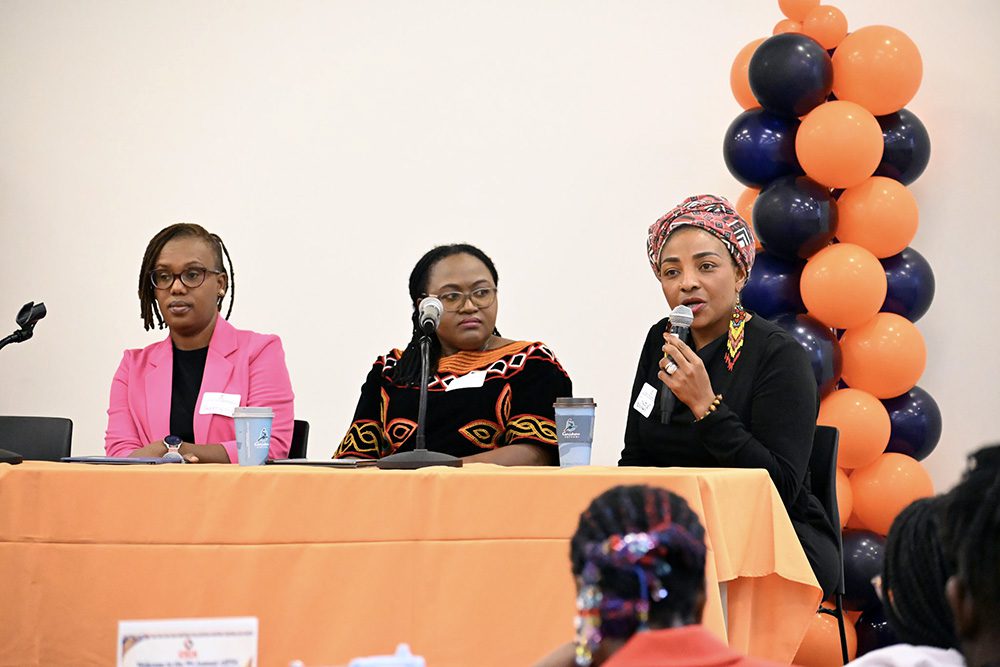
Comfort Dondo, right, founding executive director of Phumulani, speaks during a panel discussion on building social capital for career advancement and leadership at the African Immigrant Professional Development Conference in Brooklyn Park on Oct. 16, 2026. Also pictured are Jamsetta Ross Diggs, left, and Dr. Manka Nkimbeng. | Lizzy Nyoike/Mshale
Owens, the keynote speaker, encouraged participants to view relationships as an ongoing investment in others.
“Your social capital is your savings account,” Owens said. “You make deposits long before you know you have to make a withdrawal. Don’t wait till you need people before you start building relationships. Build them now.”
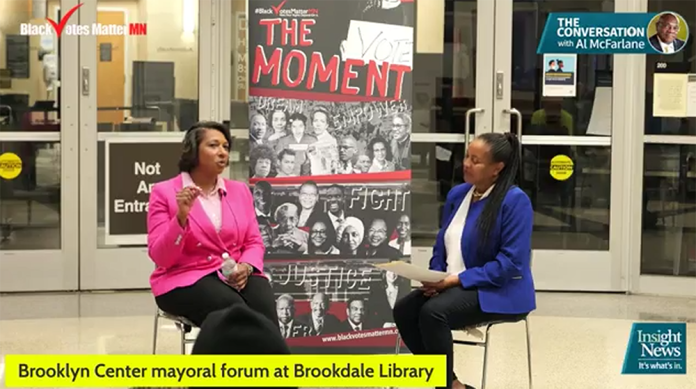
Brooklyn Center mayoral candidate Teneshia Kragness, left, speaks during a Black Votes Matter Minnesota candidate forum at Brookdale Library on Tuesday, Oct. 20, 2026. Her opponent, Alexander Koenig, did not attend the forum, the third candidate forum he has missed since September. | Screenshot courtesy of Black Votes Matter Minnesota
Brooklyn Center mayoral candidate Teneshia Kragness, left, speaks during a Black Votes Matter Minnesota candidate forum at Brookdale Library on Tuesday, Oct. 20, 2026. Her opponent, Alexander Koenig, did not attend the forum, the third candidate forum he has missed since September. | Screenshot courtesy of Black Votes Matter MinnesotaBROOKLYN CENTER, Minn. — Brooklyn Center mayoral candidate Teneshia Kragness said Tuesday that the city’s police surveillance cameras were installed without prior City Council approval, raising questions about public oversight as she faced scrutiny over policing, housing and economic development at a forum her opponent did not attend.
The Oct. 20 forum, organized by Black Votes Matter Minnesota at Brookdale Library, was intended to bring together the two candidates seeking to succeed Mayor April Graves, who is not running for reelection.
Instead, Kragness, a City Council member and mayor pro tem, answered questions alone as her opponent, Alexander Koenig, missed his third candidate forum since September.
“This was supposed to be a debate with two candidates,” said Anika Robbins, founder of Black Votes Matter Minnesota, as she opened the event.
Robbins said organizers had invited both campaigns and sought a mutually agreeable time. Kragness accepted, she said, but Koenig’s campaign did not respond.
With Koenig absent, Kragness fielded questions about her record on policing, tenant protections, economic development and the city’s future.
Flock cameras and questions of oversight
One of the most consequential exchanges came when Robbins questioned Kragness about Brooklyn Center’s use of Flock automated license plate readers, technology police use to identify vehicles associated with crimes and other investigations.
The cameras have been a contentious issue in the city’s elections, with candidates divided over their usefulness and the potential for government surveillance.
Kragness said she had participated in a police ride-along to better understand how officers use the cameras. But she also raised concerns about how the technology was introduced.
“Flock cameras were not approved by the City Council prior to being there,” Kragness said. “So I believe there were some steps missed.”
She said the city missed an opportunity to explain to residents why the cameras were being used and how they would operate.
Robbins pressed her on how such equipment could be installed without council involvement.
Kragness did not identify who authorized the installation or explain whether council approval was required. Instead, she compared the technology to artificial intelligence, saying tools introduced for one purpose can develop additional uses that were not originally anticipated.
“We want to make sure that, A, we’re utilizing the resources that the police need to do their job, but it’s not being abused,” she said. “And then it’s not doing more harm than good.”
Kragness called for greater public education about the cameras and said residents should have a voice in decisions about their use.
Her remarks left unanswered whether she would seek a formal council review, changes to the cameras’ operating policies or additional restrictions on how collected information can be accessed and shared.
As Mshale previously reported, Brooklyn Center police deployed 10 automated license plate readers using funding from a Minnesota Auto Theft Grant. An independent audit conducted in 2025 found the system compliant in several major areas, including data collection, retention and access controls, while identifying an issue involving breach-notification procedures.
Tuesday’s exchange shifted the discussion from the cameras’ usefulness to a broader question of who should decide when surveillance technology is introduced into a community.
An earlier vote on traffic stops
Robbins also challenged Kragness about her earlier vote against restrictions on pretextual traffic stops, asking why she voted that way and whether she would make the same decision today.
Pretextual traffic stops involve officers stopping motorists for relatively minor violations while investigating suspected unrelated offenses. Critics argue that the practice can lead to unnecessary police encounters and disproportionately affect drivers of color.
Kragness did not give a detailed explanation of her original vote. Instead, she said elected officials must make decisions based on the information available at the time and remain willing to reconsider their positions.
“At the time, that was the information that I had,” she said. “And that was the decision that I made.”
She suggested that a differently structured proposal or a different council might lead to another discussion.
“You may have got it wrong,” she said, acknowledging that elected officials sometimes need to reconsider past decisions.
But she stopped short of saying whether she would support the same restrictions if they came before the council again.
On police accountability more broadly, Kragness said officers who fail to uphold their responsibilities should face consequences, while those doing their jobs properly should have the tools they need.
She described participating in police ride-alongs and attending officer swearing-in ceremonies as ways to build relationships with the department.
Kragness also argued that public safety cannot be the responsibility of police alone. She pointed to the city’s expanded response system, intended to direct certain calls to personnel equipped to handle situations that do not necessarily require a police response.
Housing protections and affordability
Housing affordability produced one of Kragness’ clearest commitments.
Asked whether she would preserve Brooklyn Center’s existing tenant protections, Kragness said she opposed rolling back rights residents already have.
“You can’t give people protection rights and then take those back,” she said.
She described housing stability as essential to residents’ well-being, saying uncertainty about where someone will live can affect other aspects of life.
Kragness said she supports maintaining existing protections and educating tenants about their rights, including during conversations with residents while campaigning.
But she acknowledged that preserving those protections would require agreement from other council members.
“I recognize that that is not a one person decision,” she said.
Asked about the balance between affordable and market-rate housing, Kragness questioned whether developments described as affordable are actually within reach of Brooklyn Center residents.
“We can say affordable housing, affordable to who?” she asked.
She said the city must consider what residents can realistically afford while also protecting tenants and creating opportunities for homeownership.
Kragness, who said she has worked in accounting for 25 years, also pointed to the cumulative pressure of property taxes, rent, mortgages, utility bills and other household expenses.
She argued that attracting more businesses could strengthen the city’s tax base and said city officials should examine spending for possible reductions.
She did not identify specific budget cuts during the forum.
Development plans still taking shape
Kragness described Brooklyn Center’s vacant and underused commercial properties as opportunities rather than liabilities.
She said the city should welcome entrepreneurs, particularly small-business owners and people of color who may face barriers to establishing businesses elsewhere.
Rather than waiting for a major retailer or large development, she argued that Brooklyn Center should build on businesses already operating in the community.
“I think instead of us waiting for this big box center that’s going to come here, we develop what we have,” she said.
She cited the expansion of a New Horizon child care center as an example of a business choosing to grow within the city.
But when Robbins asked what kinds of businesses Kragness particularly wanted to attract, the candidate did not identify a specific industry or commercial target.
“None in particular,” Kragness said, before returning to her support for small businesses.
She also criticized what she described as City Council micromanagement of professional staff, arguing that city employees should have greater freedom to use their expertise to recruit businesses and pursue development opportunities.
The discussion turned to Brooklyn Center’s Opportunity Site, a major redevelopment area that has figured prominently in the city’s long-term planning.
Kragness acknowledged that the city has plans but has not broken ground on redevelopment.
“We have some plans, but we have nothing,” she said. “We have not dug ground yet.”
She said she wanted residents and other stakeholders involved in shaping the site’s future and hoped the city would demonstrate measurable progress over the next four years.
But she offered no specific timetable, financing approach or development proposal during the forum.
Young residents and community participation
Kragness also called for giving young people a more direct role in city decisions.
Responding to an audience question, she supported establishing a youth advisory board and expanding opportunities for young residents to serve on boards, commissions and committees.
She said adults frequently make decisions affecting young people without consulting them.
“If we want to make decisions for them, we need to have them at the table before the decisions are made,” she said.
Kragness described speaking with young residents about the city’s community center and encouraging them to address the City Council about recreational needs, including basketball courts and gathering spaces.
She argued that spending on youth programs should be viewed as an investment even when it does not produce an immediate financial return.
“Sometimes things don’t have a monetary return,” she said. “When it comes to our youth, that’s an investment.”
She also encouraged residents to participate in council meetings, contact city staff and submit concerns in writing.
Koenig misses third candidate forum
Koenig’s absence Tuesday marked the third time since September that he has not participated in a Brooklyn Center candidate forum.
He did not attend the Sept. 8 League of Women Voters forum at Brooklyn Center City Hall, where organizers said he had been invited.
He was also absent from an Oct. 15 community forum at Brookdale Library organized by five nonprofit organizations serving immigrant and renter communities.
Organizers of that forum said all candidates had been invited and referred generally to scheduling conflicts, without specifying which candidates were affected.
Koenig is also the only candidate among the six running for Brooklyn Center mayor and City Council without a recorded candidate statement on CCX Media, a nonprofit community media organization serving nine northwest Twin Cities suburbs.
CCX says it offered all general election candidates an opportunity to record video statements addressing voters.
Statements are available from Kragness and City Council candidates Gretchen Enger, Dan Jerzak, Nahid Khan and Mark Viste.
Koenig’s candidate page instead states, “No candidate statement for Alexander Koenig.”
The missing statement and forum absences do not establish why Koenig did not participate or whether he has been campaigning through other channels.
Mshale emailed, texted and left Koenig a voicemail following the September forum but received no response before publication.
On Wednesday, Mshale again contacted Koenig by telephone and email, seeking an explanation for his absence from the Sept. 8 and Oct. 20 forums and asking whether he intended to participate in any public candidate forums before the Nov. 3 election.
He did not respond by the 8 p.m. Wednesday deadline.
Kragness emphasizes showing up
Near the end of Tuesday’s forum, Kragness returned to the question of why voters should choose her.
She said she had worked at her regular job earlier that day, gone door-knocking afterward and then rushed home to prepare for the evening’s event.
“Nothing is going to be given to you,” she said.
Kragness, who finished first in the August mayoral primary with 52.86% of the vote, said she was not taking the general election for granted.
“I’m not expecting people to just vote for me,” she said. “I am earning these votes.”
Her campaign has emphasized continuity with Graves, who has endorsed her, alongside promises to strengthen public safety, encourage economic development and make city government more responsive to residents.
But Tuesday’s forum also underscored the challenges she would inherit if elected, including unresolved questions about police surveillance, the pace of redevelopment and the city’s ability to deliver affordable housing while managing taxpayer costs.
Brooklyn Center voters will elect a mayor and two City Council members on Nov. 3. Polls will be open from 7 a.m. to 8 p.m.
Early voting is already underway. Voters can find registration information, polling locations and sample ballots at mnvotes.gov.
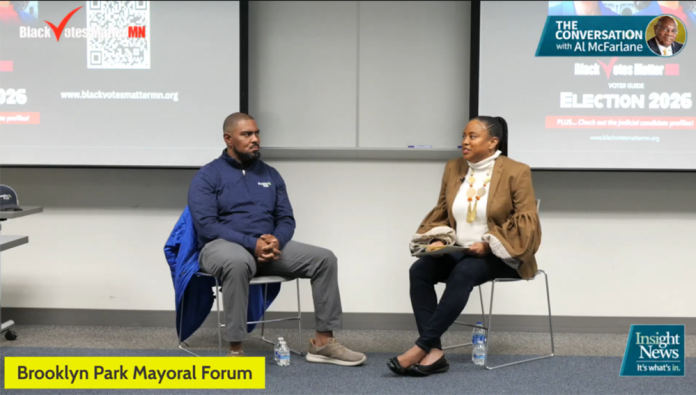
Brooklyn Park Mayor Hollies Winston, left, answers questions from Black Votes Matter Minnesota founder Anika Robbins during an Oct. 15, 2026, mayoral forum at North Hennepin Community College. Winston's challenger, City Councilmember Shelle Page, did not participate. | Screenshot: Black Votes Matter Minnesota/Insight News
Brooklyn Park Mayor Hollies Winston, left, answers questions from Black Votes Matter Minnesota founder Anika Robbins during an Oct. 15, 2026, mayoral forum at North Hennepin Community College. Winston's challenger, City Councilmember Shelle Page, did not participate. | Screenshot: Black Votes Matter Minnesota/Insight NewsBROOKLYN PARK, Minn. — Five years after Hollies Winston found himself answering questions alone at a mayoral forum organized by minority-owned news organizations, history repeated itself Thursday when his challenger, City Councilmember Shelle Page, did not participate in a forum organized by Black Votes Matter Minnesota.
But this time, Winston was the incumbent mayor, Page was the challenger, and a dispute over how the event was organized spilled into a public discussion on Facebook as Brooklyn Park voters prepared to choose their next mayor Nov. 3.
Anika Robbins, founder of Black Votes Matter Minnesota, told the audience at North Hennepin Community College on Oct. 15 that Page had been invited several times and that organizers had offered to accommodate her schedule.
“We did reach out and extend an invitation to candidate Page,” Robbins said. She told the audience that Page initially said she was unaware of the event and subsequently was invited to suggest alternative dates.
Robbins said Page ultimately declined, saying she was tired.
Page offered a different account in a Facebook discussion about the forum, questioning the timing of the invitation.
“We learned after the fact from organizers this event had been in planning for more than 90 days and publicly advertised since the beginning of September, but our office was not contacted until the 17th when we initiated it,” Page wrote.
Page also said two sponsoring organizations had separately contacted her with apologies.
“That timeline is important context,” she wrote.
The two accounts differ on how the invitation was handled, and neither Page nor Robbins has provided Mshale with a detailed timeline of their communications.
Reached by Mshale on Monday, Page declined to elaborate on her absence, saying she wanted to focus on running a positive campaign and building Brooklyn Park.
Mshale also emailed Robbins seeking clarification about the invitation timeline, the offer of alternative dates and Page’s account of apologies from sponsoring organizations. Robbins had not responded as of Tuesday.
The forum proceeded with Winston answering questions about his record and plans for Brooklyn Park, including housing development, crime, property taxes, light rail and a proposed biotechnology district.
Robbins moderated after Al McFarlane, editor-in-chief of Insight News, was unable to attend because of the flu. Insight News was among the media partners involved in the event.
A familiar scene from 2021
The absence of a mayoral candidate from a forum involving Black-led organizations has a precedent in Brooklyn Park’s recent political history.
In July 2021, then-mayoral candidate Lisa Jacobson declined to participate in an Aug. 3 forum organized by Mshale, Insight News and Hmong TV. Jacobson cited what she considered unfavorable coverage by Mshale.
Winston, who was challenging Jacobson in that year’s special mayoral election, participated without his opponent.
Jacobson went on to defeat Winston in a closely contested election that required a recount.
Winston returned to the ballot in 2022 and won, becoming Brooklyn Park’s first Black mayor.
The circumstances surrounding the two forum absences are not identical. Jacobson publicly identified her objections to one of the organizing news outlets in 2021. Page has questioned the invitation process in 2026 but declined Mshale’s request to explain her decision further.
Page and Winston previously appeared together at an Aug. 27 candidate forum organized by the League of Women Voters of Brooklyn Park, Osseo and Maple Grove, where they addressed taxes, city spending, public safety and economic development.
Winston pushes market-rate housing
With no opponent onstage to challenge his positions, Winston used the Oct. 15 forum to defend his vision of a more economically prosperous Brooklyn Park, arguing that the city needs additional commercial development, higher-paying jobs and housing that can attract residents across income levels.
His comments on housing were particularly pointed.
“We want market rate. We want luxury. We want single family homes” Winston said.
The mayor argued that Brooklyn Park already has a substantial supply of affordable housing and should prioritize market-rate apartments, single-family homes and higher-end development.
“We have a glut of affordable housing in Brooklyn Park,” Winston said, arguing that the city had provided affordable housing long before it became a major policy priority.
He described an approach in which roughly 80% of the city’s housing development efforts would focus on market-rate housing.
Winston also suggested that some resistance to Brooklyn Park’s development ambitions reflects assumptions about what a racially diverse suburb should look like.
“I’m not sure if you’re not getting the memo or you have a racialized view of Brooklyn Park and what we deserve,” he said, referring to continued calls for affordable housing.
He argued that creating better-paying jobs would allow more residents to purchase homes without relying on housing assistance.
“I don’t want a city where people come in saying, well, you know, people in Brooklyn Park, they need affordable housing. I want people in Brooklyn Park to afford a house,” Winston said.
Winston has made attracting higher-paying jobs and changing perceptions of Brooklyn Park central to his economic development agenda.
His approach also raises questions about how the city would balance its ambitions for higher-end development with the housing needs of lower-income residents.
Biotech district at the center of economic plans
Winston repeatedly returned to the city’s proposed biotechnology district as a cornerstone of his administration’s economic development agenda.
He said the city has approximately 750 acres available for development along the Medical Alley corridor and wants to attract biotechnology, medical technology and advanced manufacturing companies.
The mayor projected that the district could eventually support 5,000 to 10,000 jobs and approximately 3,000 housing units.
Those figures represent development projections, not jobs or housing units already delivered.
Winston said the city wants to connect young residents with future employment opportunities through education, training and apprenticeship programs.
He also compared Brooklyn Park’s commercial property value with Bloomington’s, arguing that a gap of approximately $3.5 billion limits the city’s ability to fund services without placing greater pressure on homeowners.
“We have to close a $3.5 billion gap,” Winston said.
“That gap in commercial value, who has to shoulder that is residents, is homeowners,” he said.
Winston argued that attracting more commercial investment could eventually ease the pressure on residential property taxpayers.
His administration, he said, wants to use state-authorized economic development tools and partnerships with private developers to attract investment.
Winston also identified Brooklyn Boulevard as a redevelopment priority, saying the older commercial corridor needs additional retail, restaurants, housing and mixed-use development.
Data centers raise questions
The biotechnology discussion prompted audience questions about whether data centers might become part of the city’s development strategy and what their electricity and water demands could mean for residents.
Winston acknowledged the concerns but stopped short of endorsing or rejecting data centers.
“I haven’t committed to them or committed against them,” he said.
He argued that data centers could generate substantial property tax revenue and help attract other technology businesses, but said their infrastructure demands would have to be evaluated.
Winston said Xcel Energy would need to be involved in discussions about electricity capacity and that the City Council would have to consider the potential costs and benefits.
He also said the city would not be inclined to assume the infrastructure costs associated with a data center.
“I’m not going to commit one way or the other,” Winston said. “What I will commit to is I’m never going to create — I’m not going to enter into a deal that is bad for the city.”
His remarks left open the possibility of data center development while acknowledging that no decision had been made.
Crime and policing
Public safety was another major theme.
Winston said crime in Brooklyn Park has fallen to a 37-year low, crediting a combination of additional police officers, community violence intervention and alternative response programs.
The mayor said the city’s police staffing had grown from approximately 88 officers when he took office to about 105, with an authorized strength of 109.
He also pointed to efforts to recruit a more diverse police force.
Winston described community intervention teams that can respond to potentially volatile situations involving young people and alternative response workers who can handle some mental health and family-related calls without immediately involving police.
“You can be humane and you can have lower crime,” Winston said.
He argued that those approaches allow officers to concentrate on more serious emergencies while reducing unnecessary involvement with the criminal justice system.
“They’re not in the criminal justice system,” Winston said of people helped through alternative response. “They get to go on with their lives.”
The crime statistics and staffing figures were presented by Winston during the forum and were not independently verified by Mshale for this report.
Light rail and economic opportunity
Winston also defended his support for the planned METRO Blue Line light rail extension, portraying the project as an economic development opportunity rather than simply a transportation investment.
He said improved transit connections could help Brooklyn Park residents reach jobs and educational institutions while attracting additional commercial development.
The mayor acknowledged historical concerns about transportation projects that displaced Black communities, including St. Paul’s Rondo neighborhood and Chicago neighborhoods affected by highway construction.
But he argued that Brooklyn Park should position itself to benefit from new investment rather than reject transportation expansion because of past injustices.
Winston also challenged arguments that expanding transit would bring crime into suburban communities, saying some opponents were repeating fears associated with earlier battles over racial integration.
“The reality of the situation is the vast majority of people do not get on light rail to just do something stupid,” he said. “They’re trying to get to and from work or to and from school or to and from a loved one.”
He also rejected the suggestion that expanding bus service alone would generate the same level of economic development as light rail.
Winston said better transportation connections could help residents access jobs in the proposed biotechnology district and elsewhere in the Twin Cities.
An election approaching
The Oct. 15 event was part of a series of candidate forums organized by Black Votes Matter Minnesota and its partners ahead of the general election.
Robbins told attendees that the organization was nonpartisan and encouraged voters to research both candidates before casting their ballots.
She said the organization’s voter guide included information about both Winston and Page despite Page’s absence.
For Winston, the forum provided an opportunity to present his record and future plans without a direct challenge from his opponent.
For Page, the event became a dispute over the invitation process that she has chosen not to discuss further with Mshale.
Brooklyn Park voters will decide the contest Nov. 3. Early voting is underway, and polls will be open from 7 a.m. to 8 p.m. on Election Day.
Voters can find registration information, polling locations and sample ballots at mnvotes.gov.
Cabo Verdean singer Neuza will perform at the Dakota in Minneapolis on Oct. 20, 2026, replacing Lucibela, whose appearance was canceled because of visa difficulties. | Photo courtesy of the Dakota
Cabo Verdean singer Neuza will perform at the Dakota in Minneapolis on Oct. 20, 2026, replacing Lucibela, whose appearance was canceled because of visa difficulties. | Photo courtesy of the DakotaCabo Verdean singer Neuza will replace fellow artist Lucibela at the Dakota in Minneapolis on Tuesday, Oct. 20, after visa difficulties forced Lucibela to cancel her scheduled performance.
The Dakota informed ticket holders Sunday that Neuza, who is already in the United States, will perform at 7 p.m. in place of Lucibela. The venue said it learned Wednesday evening that Lucibela would be unable to appear.
“Due to ongoing challenges with visa arrangements, Lucibela, who is scheduled to perform on October 20, will no longer be able to appear,” the Dakota said in its message to ticket holders.
The venue apologized for the change, saying the circumstances were beyond its control.
Neuza, who was born in Praia, Cabo Verde’s capital, spent much of her childhood on Fogo, one of the country’s volcanic islands. Her music draws heavily on the island’s traditional rhythms and folk styles.
Her debut album, Flor di Bila, released in 2013, showcases musical traditions from Fogo, including folk styles that have rarely been recorded. Like Lucibela, Neuza celebrates Cabo Verde’s rich musical heritage through her performances.
The two singers are also label mates.
Lucibela, whose music is rooted in Morna, the melancholy musical tradition associated with Cabo Verde, previously performed at the Dakota in 2019 and at the Cedar Cultural Center in Minneapolis in 2022.
The Dakota said it is exploring plans to bring Lucibela back to Minneapolis next summer, although no new performance date has been announced.
Tickets purchased for Lucibela’s Oct. 20 concert will remain valid for Neuza’s performance, with the same seats.
Ticket holders who prefer not to attend may request a refund or raincheck by contacting the Dakota box office at 612-332-5299 or [email protected].
The Dakota is located at 1010 Nicollet Mall in downtown Minneapolis and tickets for Neuza’s show are available on this Dakota link.
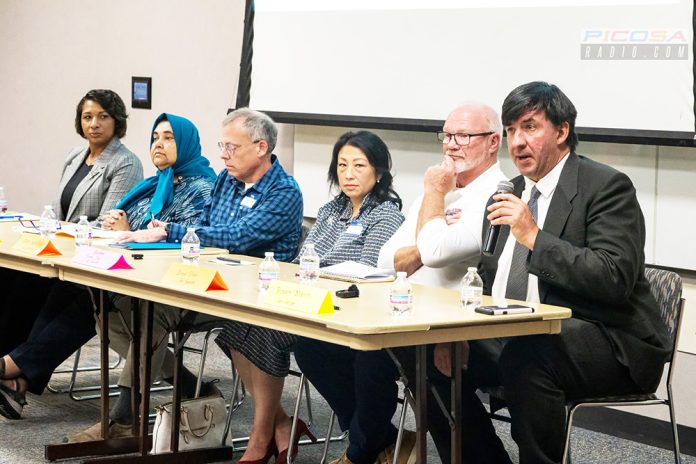
From left, Brooklyn Center mayoral candidate Teneshia Kragness, City Council candidates Nahid Khan and Mark Viste, state Sen. Susan Pha, Senate candidate Brad Olson and House candidate Robert Marvin participate in a community candidate forum at Brookdale Library in Brooklyn Center on Thursday, Oct. 15, 2026. The discussion focused on immigrant rights, tenant protections and police surveillance ahead of the Nov. 3 election. | Photo courtesy Picosa Radio
From left, Brooklyn Center mayoral candidate Teneshia Kragness, City Council candidates Nahid Khan and Mark Viste, state Sen. Susan Pha, Senate candidate Brad Olson and House candidate Robert Marvin participate in a community candidate forum at Brookdale Library in Brooklyn Center on Thursday, Oct. 15, 2026. The discussion focused on immigrant rights, tenant protections and police surveillance ahead of the Nov. 3 election. | Photo courtesy Picosa RadioBROOKLYN CENTER, Minn. — With less than three weeks remaining before the Nov. 3 election, candidates seeking local and state offices faced questions Thursday night about immigration enforcement, tenant protections and police surveillance during a community forum organized by five nonprofit organizations serving immigrant and renter communities.
The Oct. 15 gathering at Brookdale Library brought together candidates for Brooklyn Center City Council and mayor, along with candidates for Minnesota Senate District 38 and House District 38B. Organizers provided interpretation in Somali, Hmong and Spanish, seeking to make the discussion accessible to residents who might otherwise be left out of local political conversations.
The forum was organized by Fey Justicia, African Career, Education and Resources (ACER), Hispanic Advocacy and Community Empowerment Through Research (HACER), CAPI and Minnesota Immigrant Movement.
Unlike a traditional candidate debate, the gathering focused on questions developed with community members. Organizers said the event was nonpartisan and intended to give residents an opportunity to meet candidates and discuss issues affecting their neighborhoods.
Those questions exposed differences over immigration enforcement and the city’s use of surveillance technology, while producing broad support among local candidates for a proposal to give immigrant and refugee residents a more formal voice in city government.
Immigration enforcement and community trust
The first question asked candidates what they would do to protect immigrant families, improve access to services and rebuild trust between immigrant communities and government following recent immigration enforcement operations.
State Sen. Susan Pha, a DFLer seeking reelection, said the effects of Operation Metro Surge continue to shape how immigrant families view government and law enforcement.
Pha, who came to the United States as a refugee, said she had urged police chiefs in her district to publicly reassure immigrant residents that their departments would protect them from discrimination and harassment.
“I don’t think our community will ever feel safe again,” Pha said, describing the lasting trauma of the enforcement operation. “But what we can do is we can start feeling like we are at least safe enough to live our normal lives.”
Her Republican opponent, Brad Olson, offered a sharply different perspective, emphasizing the distinction between people legally residing in the country and those who have overstayed their authorized visits.
Olson argued that local leaders, including Minneapolis Mayor Jacob Frey and Gov. Tim Walz, bore some responsibility for problems associated with Metro Surge because of their approaches to federal immigration enforcement.
Brooklyn Center mayoral candidate Teneshia Kragness, a current City Council member and mayor pro tem, emphasized building relationships with residents beyond election season.
She said officials need to visit neighborhoods, understand different cultures and make residents comfortable approaching government.
City Council candidate Nahid Khan called for improved city communications, including more translated materials and information delivered through video and audio rather than relying primarily on written English.
Her fellow council candidate, Mark Viste, connected the question of trust to the city’s use of Flock automated license plate reader cameras, criticizing what he described as insufficient public involvement in their deployment.
Tenant protections become a dividing line
Brooklyn Center’s tenant protections also figured prominently in the discussion.
The city has adopted a just-cause ordinance intended to protect renters from having their leases terminated or not renewed without a qualifying reason.
Pha said she has been working to extend similar protections statewide through legislation now called Right to Renew.
She argued that families should not have to uproot their lives simply because a landlord decides against renewing a lease without providing a legitimate reason.
“Every time they move, their children have to move schools,” Pha said. “Sometimes school districts. It costs thousands of dollars to move.”
Kragness said she supports maintaining the city’s existing tenant protections.
“I don’t believe you give people protections and then you take them back,” she said.
Viste also defended the ordinance and warned against efforts to repeal it. He suggested the city consider additional measures to address landlords who fail to maintain their properties.
Khan described stable housing as a basic human right and said keeping residents housed should be a priority for city government.
Republican House candidate Robert Marvin, however, emphasized balancing tenant protections with the rights of property owners. He said landlords need reasonable opportunities to address nonpayment, property damage and criminal activity associated with rental properties.
Olson similarly stressed the responsibilities of both landlords and tenants, arguing that maintaining rental properties requires mutual respect.
Surveillance cameras draw scrutiny
The forum’s discussion of Flock cameras revealed another difference among candidates.
The automated license plate readers, which can record vehicle information and make it available to law enforcement agencies, have raised questions in Brooklyn Center about privacy, oversight and how collected information is shared.
Viste reiterated his opposition to the cameras, calling for their removal.
“I don’t want to live in a surveillance society,” he said.
At a Sept. 8 League of Women Voters forum covered by Mshale, Viste said he had initially been open to the technology but changed his position after speaking with residents and learning more about how it works.
At Thursday’s forum, he said that if the city continued using the cameras, officials should at least consider restrictions on data sharing and how long information is retained.
Khan called for a public discussion of the cameras, suggesting a town hall meeting where residents could question their use and hear from police.
Kragness also maintained the position she outlined at the September forum, saying police should have access to tools necessary for their work but that those tools should not infringe on residents’ privacy.
She said she had accompanied police officers on ride-alongs to learn how the cameras are used and had called for more public education about the technology.
Pha criticized the deployment of surveillance cameras without public engagement or City Council involvement. She also called for clear limits on data retention, access and permissible uses.
The candidates also discussed the potential environmental and financial effects of data centers, including water consumption, energy use and possible tax incentives.
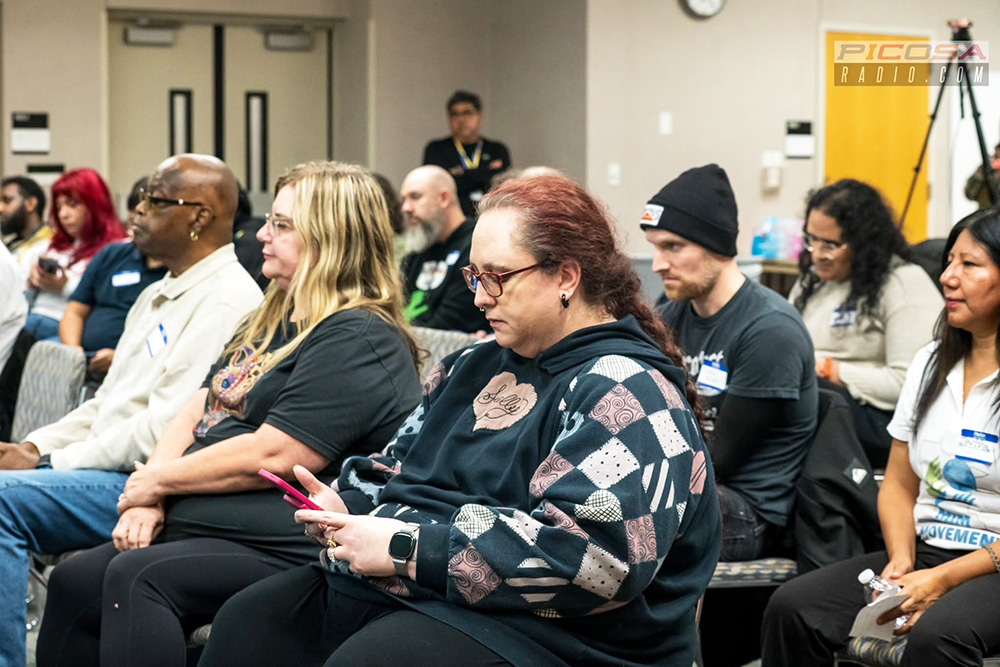
Community members attend an Oct. 15, 2026, candidate forum at Brookdale Library in Brooklyn Center. Five nonprofit organizations organized the gathering, which included questions about immigrant representation in city government. | Photo courtesy Picosa Radio
A proposal for immigrant representation
Despite their disagreements on other issues, the candidates generally welcomed a proposal that could give Brooklyn Center’s immigrant and refugee communities a more direct role in city decision-making.
In one of the evening’s final questions, candidates were asked whether they would support creating an immigrant and refugee advisory group to work with the mayor, City Council and police chief.
Viste endorsed the idea immediately.
“Yes, it’s a fantastic idea. Let’s do it,” he said.
Khan suggested the city consider neighborhood- or precinct-level advisory groups rather than relying entirely on a single citywide body. She said such an approach could help officials hear concerns from residents who do not ordinarily participate in city meetings.
Kragness said advisory commissions help elected officials make informed decisions by bringing together people with different experiences and perspectives.
“I welcome any advisory council,” she said.
Pha also supported the proposal, pointing to state boards and commissions that provide lawmakers with community perspectives on emerging issues.
Marvin said community organizations could play an important role in communicating residents’ concerns to elected officials, whether through a formal advisory commission or other arrangements.
The proposal was presented as an idea for future consideration, not an existing city initiative.
Development and investment remain concerns
Candidates also addressed Brooklyn Center’s economic development challenges, including vacant commercial properties, the loss of major retailers and efforts to attract new investment.
Pha pointed to state funding she said had been secured for the city, including $5 million for the community center and $3.1 million for infrastructure associated with the Opportunity Site redevelopment.
Kragness said she had worked with Pha and state Rep. Samantha Vang to advocate for those investments.
Viste suggested that redevelopment near the former Target property could become an opportunity to showcase immigrant-owned businesses and the city’s cultural diversity.
Marvin argued that the decline of Brooklyn Center’s commercial tax base had contributed to the financial pressures facing homeowners. He called for more aggressive efforts to attract businesses and redevelop vacant properties.
Olson said the state should reduce regulations that he believes discourage small-business growth.
Not all candidates attend
Six candidates participated in the forum: Kragness, Khan, Viste, Pha, Olson and Marvin.
Mayoral candidate Alexander Koenig, City Council candidates Dan Jerzak and Gretchen Enger, and state Rep. Samantha Vang were not among the participants.
Organizers said all candidates had been invited and referred generally to scheduling conflicts, without specifying which candidates were affected.
The forum concluded with a voter education session covering registration, early voting, ballot access and voters’ rights.
Minnesota’s general election is Tuesday, Nov. 3. Eligible voters can cast ballots early in person or vote at their assigned polling places on Election Day.
For the organizations behind Thursday’s forum, the gathering offered a way to bring communities that often face language and other barriers into local political discussions.
Whether the proposed immigrant and refugee advisory group becomes a reality will depend on what city leaders do after the election.
Liberian opposition leader Alexander B. Cummings claps as he enters the Alternative National Congress diaspora convention banquet at Edinburgh USA Clubhouse in Brooklyn Park, Minnesota, on Saturday, Oct. 10, 2026. Supporters welcomed him with music and dancing as the party gathered to rebuild support ahead of Liberia's 2029 presidential election. | Photo: Richard Ooga/MshaleBROOKLYN PARK, Minn. — The song was familiar to supporters of Alexander B. Cummings. So was the political message behind it.
But the scene unfolding on the dance floor at Edinburgh USA Clubhouse on Saturday night was something few might have imagined during Liberia’s last presidential election.
As “Who Y’all Want?,” a campaign song from Cummings’ unsuccessful 2023 presidential bid, filled the banquet hall, the opposition leader found himself dancing face to face with Success A.B. Dennis, chairman of the United States branch of former President George Weah’s Congress for Democratic Change.
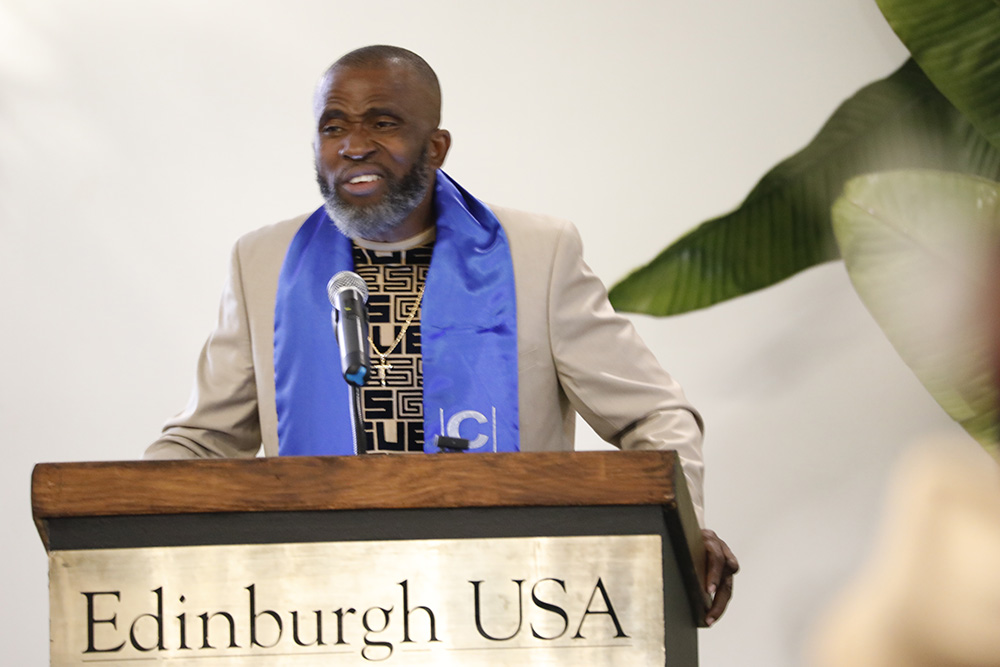
Dennis, wearing a blue CDC sash, danced enthusiastically as supporters formed a circle around the two men, waving scarves and cheering them on.
For a few minutes, the political divisions that had separated their camps appeared to dissolve into music and celebration.
But the dance was not a declaration of an electoral alliance.
“We haven’t decided that yet,” Cummings told Mshale in a one-on-one interview, discussing a cooperation agreement reached by opposition parties in Liberia. “So what we established was a framework for cooperating to hold the current government accountable. So it is not an electoral coalition yet. It may evolve to that.”
The distinction matters as Liberia’s political opposition begins maneuvering toward the 2029 presidential election, with Cummings and Weah among the figures whose ambitions could determine whether the parties unite or compete against one another.
For Cummings, who has made no secret of his intention to seek the presidency again, the weekend gathering in Brooklyn Park was an opportunity to rally supporters, rebuild a political organization bruised by electoral defeat and make the case that Liberia’s future requires a different kind of leadership.
“I’m running for president,” he told Mshale.
A nearly full house
The Saturday banquet was the centerpiece of the Alternative National Congress’ diaspora convention, which brought supporters and party officials to the Twin Cities for a series of meetings and events.
Cummings’ visit began with a Thursday economic forum at the Brooklyn Park Small Business Center, an event added after the convention’s original program was circulated. The ANC diaspora convention continued Friday and Saturday, culminating in an evening fundraising banquet and ball at Edinburgh USA Clubhouse.
Although the banquet was scheduled to begin at 6 p.m., the formal program did not get underway until approximately 8:15 p.m.
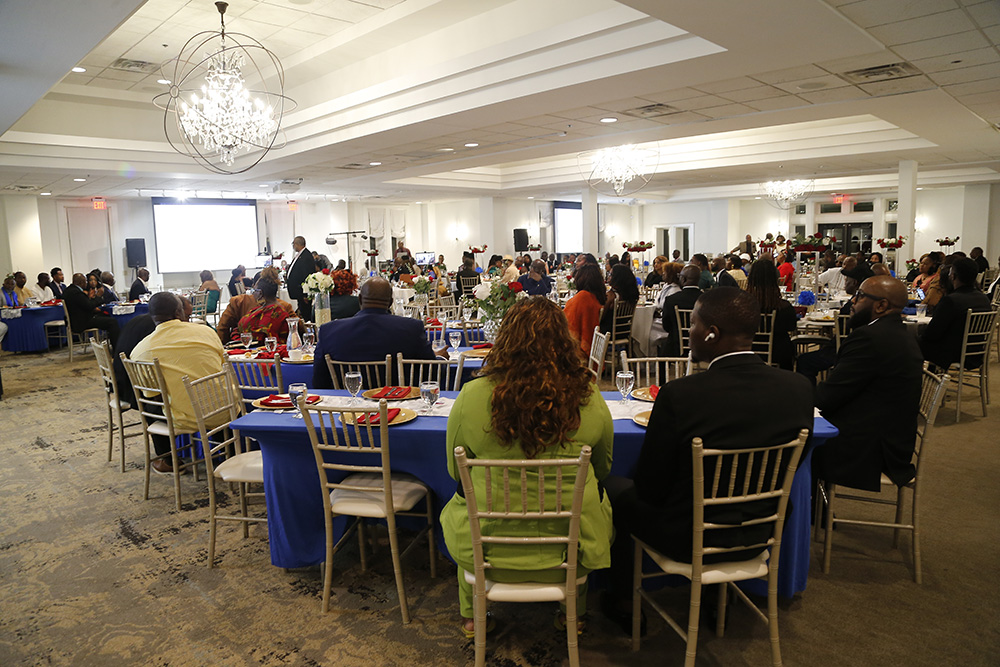
By then, the room was nearly full. Of approximately 226 seats counted in the banquet hall, fewer than eight appeared unoccupied.
Cummings made his entrance accompanied by women dressed in elegant lappa suits and grand boubous as “Liberia Will Rise Up” played over the sound system.
The evening blended politics with the familiar atmosphere of a Liberian community celebration. Guests exchanged greetings, posed for photographs and gathered around tables before a buffet dinner. Cummings joined the buffet line and served himself.
Between speeches, the DJ repeatedly returned to “Money Na Water,” by Liberian musician King Dennis.
But beneath the music and festivities was the serious business of rebuilding a political movement.
Guests attend the Alternative National Congress diaspora convention banquet at Edinburgh USA Clubhouse in Brooklyn Park, Minnesota, on Oct. 10, 2026. The nearly full banquet hall brought together party officials, supporters and members of Minnesota’s Liberian community as the ANC looked toward the 2029 presidential election. | Photo: Richard Ooga/Mshale
The ANC entered the convention still confronting the consequences of the 2023 election, when Cummings finished fifth in the first round of Liberia’s presidential race, receiving 29,613 votes, or 1.61% of the total. He did not advance to the runoff.
The defeat was particularly difficult for supporters who had invested time, money and personal hopes in his candidacy.
Rebuilding after defeat
For Magdalene Menyongar, a Maple Grove resident who works as a hospital technician, the ANC has become more than a political organization.
Menyongar, who served as an acting global diaspora chair during the party’s formative organizing, said she became involved after years of disappointment with Liberia’s political direction following the country’s civil war.
She traveled to Georgia to meet Cummings and later made trips to Liberia to register and cast her ballot in the 2023 election.
The loss left some supporters discouraged, she said, but she believes the party cannot afford to retreat.
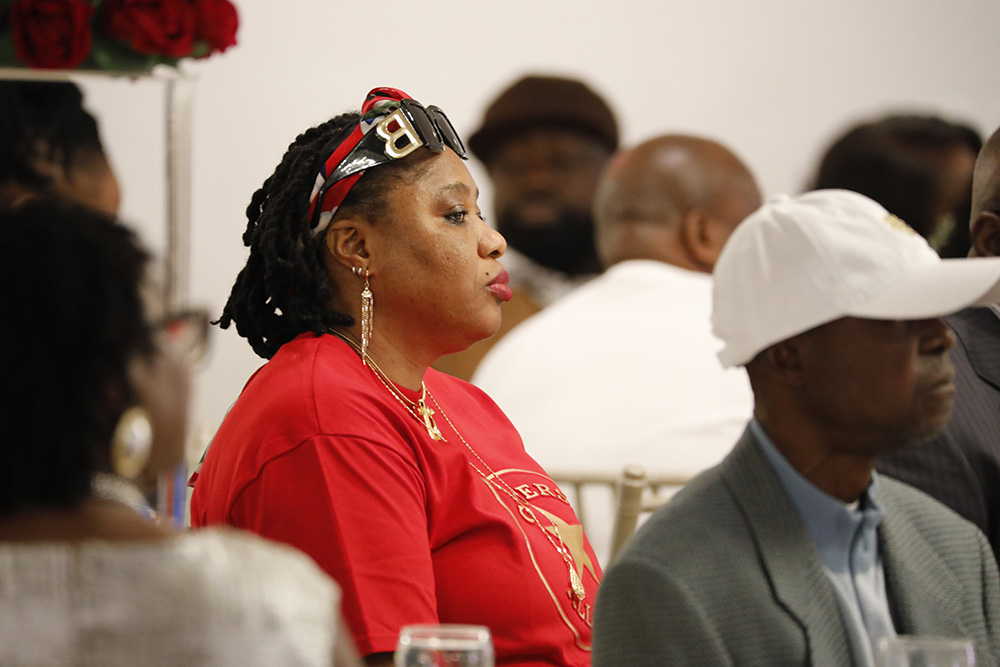
Magdalene Menyongar of Maple Grove listens during the Alternative National Congress diaspora convention banquet in Brooklyn Park on Oct. 10, 2026. Menyongar, who helped organize the party’s diaspora operations, urged members to reconnect with supporters discouraged by Alexander B. Cummings’ defeat in Liberia’s 2023 presidential election. | Photo: Richard Ooga/Mshale
“You don’t give up. If you give up, then you lose,” she said.
Speaking at the banquet, Menyongar urged party members to reconnect with supporters who had become inactive after the election.
“We need to get our members that are sitting back, back on the train,” she said.
Her appeal extended beyond electoral politics.
“Liberia is our heart. Liberia is where we want to retire,” she told the gathering.
That sentiment helps explain why a political convention thousands of miles from Monrovia could draw such strong interest in a Minneapolis suburb.
For many Liberian immigrants, the country’s political and economic future remains inseparable from their own plans, investments and families.
Benedict Brown, a New Hope resident who works in insurance and employee benefits, arrived at the banquet wearing a tan suit and matching hat.
Benedict Brown of New Hope attends the Alternative National Congress diaspora convention banquet in Brooklyn Park on Oct. 10, 2026. Brown, who has followed the party’s activities for about five years, said he hoped the gathering would provide a clearer path forward and expressed support for cooperation among Liberia’s opposition parties. | Photo: Richard Ooga/Mshale
Brown, who described himself as a supporter rather than necessarily a party member, said he had followed ANC activities for about five years, participating in virtual meetings and attending conventions in California and North Carolina.
He came to Brooklyn Park looking for a clearer path forward.
“I’m expecting to hear, you know, a way forward,” he said.
Brown favors opposition cooperation and hopes Cummings ultimately emerges as a unified presidential candidate. But he also recognized that such an agreement has not been reached.
“We don’t have a coalition yet,” he said.
In a follow-up message after the banquet, Brown said Cummings had emphasized his intention to run again and appealed for financial and moral support from Liberians abroad. He said the opposition leader also encouraged members to reconnect with supporters demoralized by the 2023 loss.
The political weight of the diaspora
Dr. Emmanuel George, the ANC’s global diaspora chairman, said the party’s American organization has nearly 1,500 members spread across four regions.
The eastern region is headquartered in Rhode Island, the southern region in North Carolina, the Midwest in Minnesota and the western region in California.
Members pay annual dues of $120, according to George.
He said diaspora supporters raised more than $1 million during the 2023 election cycle, although Mshale could not independently verify that figure.
George also described a renewed fundraising effort this year, including a virtual campaign that he said brought in more than $50,000 toward a $100,000 goal.
Participants in the Birth Month Queen Contest take part in a fundraising activity during the Alternative National Congress diaspora convention banquet in Brooklyn Park on Oct. 10, 2026. The contest raised $7,600, according to Ernest Harmon, the ANC diaspora’s assistant financial vice chair. | Photo: Richard Ooga/Mshale
Money is only one part of the challenge.
George said the party lacked representatives at some polling places during the 2023 election, an organizational weakness he believes must be addressed before Cummings makes another presidential run.
The convention offered an opportunity to strengthen that network.
During Saturday’s banquet, fundraising QR codes were displayed to encourage contributions. A Birth Month Queen Contest raised $7,600, according to Ernest Harmon, the ANC diaspora’s assistant financial vice chair, who confirmed the figure in a follow-up telephone interview.
The party did not provide a total for banquet ticket sales or overall proceeds from the gathering.
For an organization trying to recover from defeat, however, the event served another purpose: demonstrating that its supporters had not disappeared.
A message about business and opportunity
Cummings’ political argument is closely tied to his experience in the corporate world.
A former Coca-Cola executive, he has long presented private-sector development, investment and job creation as central to his vision for Liberia.
Those themes dominated Thursday’s economic forum at the Brooklyn Park Small Business Center, where he fielded questions about access to credit, government bureaucracy, corruption and the difficulties of building businesses in Liberia.
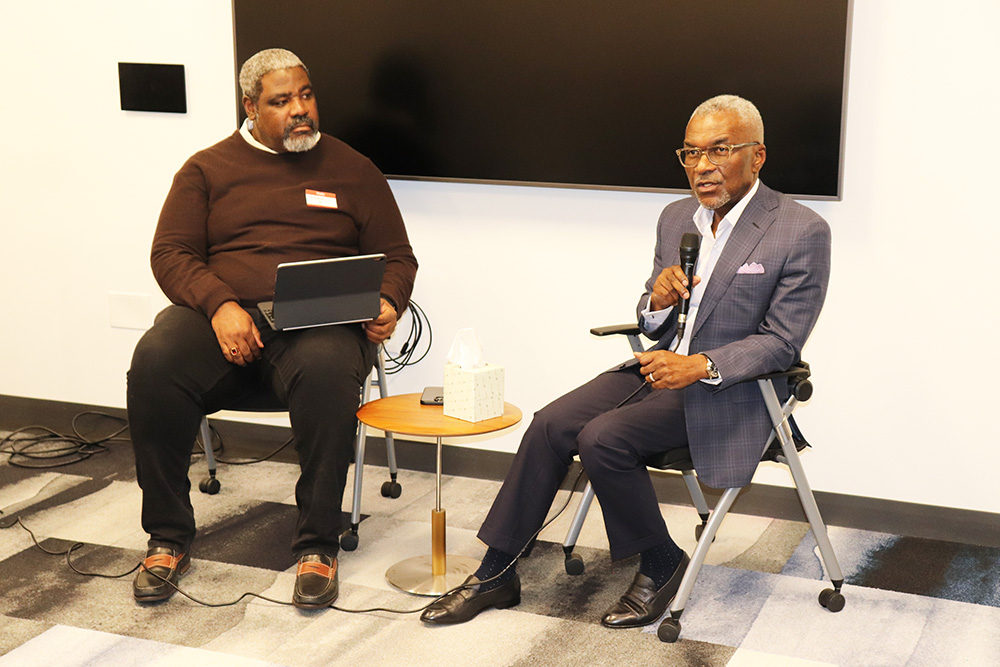
Liberian opposition leader Alexander B. Cummings, right, speaks during a fireside chat with Trokon Page at an economic forum at the Brooklyn Park Small Business Center on Thursday, Oct. 8, 2026. The forum was held ahead of the Alternative National Congress diaspora convention, which continued through Saturday. | Photo: Tom Gitaa/Mshale
He discussed the importance of sound financial management and opportunities in agriculture, tourism, housing and local manufacturing.
He also raised the possibility of a professionally managed diaspora investment fund, while making clear that such a fund had not been established.
After the forum, Wynfred Russell, a Minnesota-based supporter involved in organizing the visit, took Cummings on a tour of the Small Business Center, showing him coworking areas and retail spaces intended to support entrepreneurs.
At Thursday’s forum, Cummings acknowledged that corruption was a problem in both Liberia and Kenya. But he argued that the difference lay in how businesses were treated before they had a chance to establish themselves.
He returned to the point during Saturday’s banquet, recounting the experience of a Liberian entrepreneur who, he said, abandoned plans for an agricultural business in Liberia and instead invested in Kenya.
“In Kenya, they would let the calf become a cow before they milk it; in Liberia we will try to milk the calf,” Cummings said.
The analogy captured his argument that Liberia’s business environment discourages investment by imposing demands on entrepreneurs before their ventures have had an opportunity to grow.
Cummings also acknowledged the responsibilities of Liberians living abroad.
While urging diaspora members to invest their money and expertise in their homeland, he said some returnees must also change their own behavior and respect the rules they expect governments to enforce.
“Unfortunately, diasporas get to the airport and their behaviors change,” he told Mshale.
His message to the gathering was that Liberians possess the entrepreneurial ability to transform their country but need institutions that make investment and opportunity possible.
The Weah question
The most politically revealing moment of the banquet came when representatives of Weah’s CDC joined the ANC gathering.
Dennis, the CDC’s U.S. chairman, told the audience that Weah had personally asked him to attend the ANC convention on his behalf. His presence underscored the emerging cooperation between opposition parties seeking to challenge President Joseph Boakai’s Unity Party administration.
Success A.B. Dennis, U.S. chairman of former Liberian President George Weah’s Congress for Democratic Change, addresses the Alternative National Congress diaspora convention banquet in Brooklyn Park, Minnesota, on Oct. 10, 2026. Dennis told attendees that Weah had personally asked him to represent him at the gathering, which came weeks after opposition parties signed a cooperation agreement. | Photo: Richard Ooga/Mshale
On Sept. 27, Cummings and Weah joined leaders of three other opposition parties in signing a cooperation agreement in Monrovia. The agreement brought together the ANC, Weah’s CDC, the Movement for Economic Empowerment, the Movement for Progressive Change and the Union of Liberian Democrats Party.
The parties agreed to coordinate their efforts to hold President Joseph Boakai’s administration accountable while retaining their separate political identities. They stopped short of forming an electoral alliance for 2029.
Cummings reinforced that distinction in his interview with Mshale, describing the agreement as a framework for building trust and working together on issues of national concern.
He said the parties could consider supporting a single presidential candidate closer to the 2029 election, depending on how their cooperation develops.
The caution reflects lessons from Liberia’s previous opposition alliances, including the Collaborating Political Parties arrangement that fractured before the 2023 election.
“Don’t formalize it too early because things can change, interests can change,” Cummings said.
He believes cooperation must be tested before the parties make binding electoral commitments.
That leaves a significant question unresolved: If both Cummings and Weah seek the presidency, which one would step aside?
For now, neither the opposition framework nor the convivial atmosphere in Brooklyn Park answers that question.
The dance between Cummings and Dennis was therefore striking precisely because of what it did — and did not — signify.
As supporters cheered to Cummings’ old campaign anthem, representatives of rival political organizations celebrated together.
But their shared opposition to the current government has not yet settled their competing ambitions.
Remembering Bennie Perkins
Amid the political speeches and fundraising appeals, the convention also paused for a more personal remembrance.
Cummings paid tribute to Bennie Perkins, a longtime supporter and senior adviser who had died before the gathering.
He described Perkins as a loyal friend who had stood by him during his political journey and asked the audience to observe a moment of silence.
Perkins’ influence extended beyond the party’s leadership.
Sayan Shar Konneh, a Brooklyn Park resident who works in a nursing home, said Perkins had introduced her to the ANC.
Sayan Shar Konneh of Brooklyn Park listens during the Alternative National Congress diaspora convention banquet on Oct. 10, 2026. Konneh, who was introduced to the party by the late ANC adviser Bennie Perkins, said she hopes Liberia will become a country that children of immigrants growing up abroad can visit with pride and perhaps someday call home. | Photo: Richard Ooga/Mshale
Konneh, who has lived in the United States for about 21 years, is not a party member. Her husband, Kayfa Konneh, lives in Liberia and supports the ANC.
She attended the banquet with hopes that Liberia might one day offer greater opportunities for young people, including those growing up abroad.
“We have a lot of kids here, some of them do not want to go home,” she said.
For Konneh, the stakes go beyond whether Cummings wins the presidency.
She wants Liberia to become a country that children of immigrants can visit with pride, share with their friends and perhaps someday consider home.
The road to 2029
Cummings spent part of his banquet address urging supporters to make sacrifices for the political work ahead.
He appealed for financial contributions, stronger organizing and renewed engagement with those who had grown disappointed after the previous election.
He also challenged party members to acknowledge mistakes and reach out to people who had drifted away.
Liberian opposition leader Alexander B. Cummings greets an attendee during the Alternative National Congress diaspora convention banquet at Edinburgh USA Clubhouse in Brooklyn Park, Minnesota, on Oct. 10, 2026. The gathering brought together party officials and supporters as the ANC sought to rebuild its political organization ahead of Liberia’s 2029 presidential election. | Photo: Richard Ooga/Mshale
The task is formidable.
Cummings must persuade voters in Liberia that his business experience offers a credible alternative to the country’s established political leadership. He must rebuild an organization that struggled in the last election and navigate a complicated relationship with other opposition figures, including a former president with ambitions of his own.
And he must convince Liberians abroad that another investment of their time, money and hopes will be worthwhile.
For one evening in Brooklyn Park, the music, dancing and crowded banquet hall offered evidence that the ANC still has an engaged diaspora constituency.
Whether that enthusiasm can be translated into electoral strength in Liberia remains an open question.
For Konneh, who listened to the speeches and watched the celebrations, the measure of success is larger than any one candidate.
“It’s not about Mr. Cummings,” she said. “It’s about Liberia.”
A “Vote Here” sign directs voters to a polling location in Minneapolis during a previous election. Community organizations are launching a “Power of Five” initiative to encourage Twin Cities residents to help friends, relatives and neighbors prepare to vote in the Nov. 3, 2026, general election. | Mshale file photo by Jasmine Webber
A “Vote Here” sign directs voters to a polling location in Minneapolis during a previous election. Community organizations are launching a “Power of Five” initiative to encourage Twin Cities residents to help friends, relatives and neighbors prepare to vote in the Nov. 3, 2026, general election. | Mshale file photo by Jasmine WebberMINNEAPOLIS — Community organizations in the Twin Cities are launching a voter mobilization effort that encourages residents to reach out to five people they know and help them prepare to cast ballots in the Nov. 3 general election.
The initiative, called “Power of Five,” will kick off Monday, Oct. 19, with a community gathering from 5 to 7 p.m. at the University of Minnesota’s Urban Research and Outreach-Engagement Center (UROC), 2001 Plymouth Ave. N. in Minneapolis.
Organized by NAZ Parents in Power, We Go High – Minnesota and the 2026 Community Campaign, the nonpartisan effort seeks to turn personal relationships into greater civic participation.
Under the Power of Five approach, participants are encouraged to identify five relatives, friends, neighbors or other people in their communities, discuss issues important to them and help them develop a plan to vote.
The gathering will feature voting information, presentations by community organizers, highlights from candidate interviews and activities designed to help participants begin reaching out to their five contacts. Organizers also plan to serve food, including chili, with chicken, beef and vegan options.
Community Campaign Manager Anndrea Young said the initiative is intended to make voting more accessible while strengthening relationships beyond the election.
“The goal is to make civic participation practical and personal while building trusted community connections that last beyond Election Day,” Young said in a media advisory.
Participants who cannot bring five guests are still encouraged to attend. Organizers say they will provide voting information packets for people who cannot attend in person and offer assistance to those who have not yet identified their five contacts.
Following Monday’s kickoff, organizers plan a 10-day outreach effort from Oct. 20-30, followed by a final voter mobilization push beginning at noon Oct. 30 and continuing until polls close on Election Day.
The effort comes as Minnesotans are already casting ballots in an election that will determine the state’s next governor, members of Congress, state legislators and several other statewide and local offices.
Absentee voting began Sept. 18, while a new early voting process that allows voters to place their ballots directly into voting machines begins Friday, Oct. 16, at designated locations.
Minnesota’s advance voter registration deadline passed Oct. 13, but eligible residents who missed it can still register when they vote, including at their polling places on Election Day. Voters registering in person must provide acceptable proof of residence.
Early in-person voting continues through Monday, Nov. 2. Polling places will be open from 7 a.m. to 8 p.m. on Tuesday, Nov. 3.
Residents can check their registration status, find early voting locations, view sample ballots and locate their Election Day polling places through the Minnesota Secretary of State’s website at mnvotes.gov.
Monday’s Power of Five gathering is free, but participants are encouraged to register in advance at bit.ly/PowerOfFive.
Attendees at Brooklyn Park’s Business Forward Forum on Nov. 14, 2023. The city will host its 15th annual forum Oct. 28, 2026, at Edinburgh USA, with a focus on helping local businesses explore international markets and access resources for growth. | Photo courtesy City of Brooklyn Park
Attendees at Brooklyn Park’s Business Forward Forum on Nov. 14, 2023. The city will host its 15th annual forum Oct. 28, 2026, at Edinburgh USA, with a focus on helping local businesses explore international markets and access resources for growth. | Photo courtesy City of Brooklyn ParkBROOKLYN PARK, Minn. — Brooklyn Park business owners looking to expand into new markets will have an opportunity to connect with international trade experts and business resource organizations when the city hosts its 15th annual Business Forward Forum on Oct. 28.
The free event, themed “Global Growth Starts Here,” will bring together local business owners, elected officials and representatives of organizations that provide business and financial assistance.
The forum will be held from 11 a.m. to 1:15 p.m. Wednesday, Oct. 28, at Edinburgh USA Clubhouse, 8700 Edinbrook Crossing in Brooklyn Park. Admission is free, but registration is required.
This year’s gathering will focus on how businesses can use local, regional and federal resources to explore new markets, build connections and compete in an increasingly global economy.
Featured speakers include Silvia Ontaneda, CEO of Trade Center of Americas, and Chris Peterson, senior international trade representative with the U.S. Commercial Service in Minneapolis. Brooklyn Park business leaders are also expected to participate in the panel discussion.
The U.S. Commercial Service, part of the U.S. Department of Commerce, helps American businesses explore export opportunities and connect with potential customers in international markets.
The forum will also feature business updates, networking opportunities and information about organizations that offer business development and financial services. Lunch will be provided.
The annual event comes as Brooklyn Park continues efforts to support local entrepreneurs and small businesses, including through its Small Business Center, which provides resources to help businesses start, operate and grow.
Although the forum will focus on international growth, the city is inviting members of its broader business community to attend, including entrepreneurs interested in learning about available resources and building relationships with other business owners.
Registration and event information
The Business Forward Forum will take place Wednesday, Oct. 28, from 11 a.m. to 1:15 p.m. at Edinburgh USA Clubhouse, 8700 Edinbrook Crossing, Brooklyn Park.
The event is free, but advance registration is required. Business owners and other interested participants can register through the city’s Business Forward Forum webpage at this link.
For additional information, contact Josephine Thao at [email protected] or 763-493-8145.
U.S. Rep. Ilhan Omar speaks at the DFL election night party in St. Paul on Nov. 5, 2024, when she won another term representing Minnesota's 5th Congressional District. Omar is seeking reelection this November as the Congressional Black Caucus condemns a federal search of her Washington-area home. | Photo: Jasmine Webber/Mshale
U.S. Rep. Ilhan Omar speaks at the DFL election night party in St. Paul on Nov. 5, 2024, when she won another term representing Minnesota's 5th Congressional District. Omar is seeking reelection this November as the Congressional Black Caucus condemns a federal search of her Washington-area home. | Photo: Jasmine Webber/MshaleThe Congressional Black Caucus on Monday condemned a federal raid on U.S. Rep. Ilhan Omar’s Washington-area home, accusing the Trump administration of using law enforcement to intimidate a political opponent just three weeks before the midterm elections.
In a strongly worded statement, the caucus, led by Chair Yvette D. Clarke of New York, described the search of the Minnesota Democrat’s residence as a politically motivated effort to undermine her credibility ahead of the Nov. 3 election.
“The raid carried out this morning at the home of Congresswoman Ilhan Omar by the Trump Administration is a sham designed to cast suspicion on the Congresswoman and manufacture an appearance of wrongdoing on the eve of the midterm elections, without any apparent legal basis,” the caucus said.
The condemnation came hours after Homeland Security Investigations agents executed a search warrant at Omar’s residence in the Washington, D.C., area as part of an ongoing federal criminal investigation.
A Justice Department spokesperson confirmed the search to ABC News, saying agents had obtained a warrant authorized by a judge. ABC News reported that the investigation involves Omar’s immigration paperwork.
Omar, who represents Minnesota’s 5th Congressional District, has denied wrongdoing and has not been charged with a crime.
The Congressional Black Caucus questioned the administration’s motives, pointing to President Donald Trump’s repeated attacks on Omar and his administration’s immigration enforcement operations targeting Somali American communities in Minnesota.
“It should come as no surprise that the Trump Administration, desperate to hold on to power, would weaponize federal law enforcement against a sitting member of Congress — particularly a member like Congresswoman Omar, who has been an outspoken critic of the President and his policies,” the caucus said.
The group said the administration’s actions raised serious concerns about the use of government power against political opponents.
“The sustained campaign of attacks against Congresswoman Omar by the President and his allies should raise grave concerns about the politicization of federal law enforcement and the use of government power to intimidate political opponents,” the statement said.
The caucus also connected Monday’s search to the administration’s broader treatment of Somali Americans, particularly in Minnesota, which is home to the nation’s largest Somali community.
“President Trump’s fixation on Congresswoman Omar has been evident for years,” the caucus said.
It accused Trump of repeatedly targeting Somali Americans and Minnesota with racist rhetoric while deploying thousands of immigration agents to the Twin Cities during enforcement operations that resulted in the deaths of two Americans.
The reference was to the administration’s immigration crackdown in Minnesota earlier this year, which drew widespread protests and heightened tensions between federal authorities and immigrant communities.
Omar, who was born in Somalia and came to the United States as a refugee, became one of the first two Muslim women elected to Congress in 2018. She is the first Somali American to serve in Congress and the only African-born member of the current House.
Her political career has frequently placed her at odds with Trump, who has repeatedly attacked her immigration background and questioned her place in American politics.
ABC News reported that Trump suggested during a rally Saturday that his administration was examining allegations involving Omar. Vice President JD Vance had previously said the administration was looking into immigration fraud allegations against her.
The Justice Department has not publicly detailed the allegations underlying the investigation or disclosed what agents were seeking during Monday’s search.
In a statement to Mshale, a spokesperson for Omar called the search an abuse of federal authority and accused Trump of using law enforcement to target political opponents.
“This raid by Trump’s DHS is an outrageous abuse of power and an unprecedented escalation in the weaponization of federal law enforcement to target political enemies,” the spokesperson said. “For a decade, Donald Trump has relentlessly targeted Congresswoman Ilhan Omar with inflammatory rhetoric, repeatedly putting a target on her back. Now, those attacks have escalated to a pointless federal raid.”
The spokesperson maintained that Omar had committed no wrongdoing.
“The Congresswoman has done nothing wrong. No president should be able to use the power of the federal government to intimidate his political enemies.”
In an email sent to supporters Monday, Omar also denounced the search, saying Homeland Security agents had entered her Washington-area home as part of what she described as a politically motivated investigation into her immigration status.
“Donald Trump’s fascism and abuse of power has now come to my literal front door,” Omar wrote.
She accused the president of escalating his attacks against her ahead of an election in which she is seeking another term.
“I will repeat what I have long said: This is a sham investigation, and Trump’s escalation is only further proof that he is willing to use the power of the federal government to try to intimidate and silence anyone who stands up to him,” she wrote.
The timing of the search has drawn scrutiny because of longstanding Justice Department guidance discouraging overt investigative actions involving candidates close to an election. The search occurred 22 days before voters go to the polls.
Federal authorities have described the search as part of a criminal investigation. The existence of a court-authorized warrant does not establish that Omar committed a crime.
The Congressional Black Caucus rejected the suggestion that the investigation should diminish public confidence in Omar, saying she deserves the same legal protections afforded to every American.
“The Congressional Black Caucus stands unequivocally with our colleague, Congresswoman Ilhan Omar,” the statement said. “She deserves fairness, due process, and the same protections under the law afforded to every American.”
The caucus also praised Omar’s work representing Minnesota since taking office in 2019 and expressed confidence that her constituents would continue to support her.
“We are confident that the people of Minnesota’s Fifth Congressional District will see through the Trump Administration’s attempts at intimidation and stand firmly behind their duly elected representative,” the statement said.
Panelists participate in a discussion during the 2025 African Immigrant Professional Development Conference in Brooklyn Park, Minnesota. The annual gathering returns Oct. 16, 2026, for its ninth edition, focusing on professional networking, career advancement and leadership opportunities for African immigrants. | Photo: Richard Ooga/Mshale
Panelists participate in a discussion during the 2025 African Immigrant Professional Development Conference in Brooklyn Park, Minnesota. The annual gathering returns Oct. 16, 2026, for its ninth edition, focusing on professional networking, career advancement and leadership opportunities for African immigrants. | Photo: Richard Ooga/MshaleBROOKLYN PARK, Minn. — African immigrant professionals looking to advance their careers, expand their networks or move into leadership positions will gather at North Hennepin Community College on Friday, Oct. 16, for a conference that has become an annual meeting place for the community’s professionals and aspiring leaders.
The ninth annual African Immigrant Professional Development Conference will focus on how African immigrants can use professional relationships and networks to create opportunities in a changing workplace.
This year’s theme, “Repositioning Through Uncertainty: Leveraging Social Capital for Career Growth and Leadership,” reflects a challenge that has been at the heart of the conference since its founding: how to ensure that African immigrants’ education, skills and professional experience translate into career advancement and economic success.
The free conference, organized by the Center for Immigrant Career Advancement (CICA), will run from 10 a.m. to 3:30 p.m. at Helling Hall on the college’s Brooklyn Park campus. Registration and networking begin at 9:15 a.m., with free professional headshots also available to attendees.
Dr. S. Miata Getaweh, CICA’s executive director and founder of the conference, said African immigrant professionals have much to offer Minnesota employers but often need access to the relationships and networks that help people advance.
“African immigrant professionals bring tremendous education, experience, resilience and leadership capacity to Minnesota’s workforce, but talent alone does not always create access to opportunity,” Getaweh said in a statement announcing the conference.
“AIPDC is about creating the relationships, information and social capital that help people move from simply participating in the workforce to advancing, leading and creating opportunities for themselves and others.”
The conference will feature Rosemond Sarpong Owens, an author, philanthropist and longtime health care leader, as its keynote speaker.
Rosemond Sarpong Owens, an author, philanthropist and longtime health care leader, will deliver the keynote address at the ninth annual African Immigrant Professional Development Conference on Oct. 16, 2026, at North Hennepin Community College in Brooklyn Park. | Photo courtesy AIPDC
Owens has more than two decades of leadership experience in health care and is an advocate for maternal health, health equity and literacy. She served as the first Black woman president of Books for Africa, founded Lion’s Historian Press and has authored 10 books. Her community service and leadership have earned her several honors, including a Presidential Lifetime Achievement Award in 2022.
Her keynote is expected to draw on her experiences in leadership, professional growth and navigating change.
Other speakers listed by organizers include Comfort Dondo, founding executive director of Phumulani: African Women Against Violence; Dr. Manka Nkimbeng, an associate professor at the University of Minnesota School of Public Health; and Felix Okoth, an engineering leader and executive leadership coach.
Sessions will address career transitions, mentorship, professional visibility, entrepreneurship, wealth creation and the role of relationships in opening doors to opportunities that may otherwise remain out of reach.
The conference’s emphasis on professional networks builds on conversations that have taken place at previous gatherings.
At the 2022 conference, participants discussed the barriers African immigrants face in moving into leadership positions and the importance of building relationships beyond their immediate communities.
Wokie Daboh, then director of diversity and inclusion at ESPN, spoke about the difficulty of establishing professional connections while remaining true to one’s cultural identity. Other speakers urged African immigrants to become more visible in their workplaces and seek opportunities in fields where Black professionals remain underrepresented.
Two years later, the conference returned to similar questions about advancement and opportunity.
At the 2024 gathering, Mshale founder and publisher Tom Gitaa delivered the keynote address, discussing African immigrants’ growing economic contributions to Minnesota and the importance of accessing financial resources for business development.
That year’s conference also featured professionals who described the obstacles they encountered while establishing careers in the United States.
Among them was Dr. Mankpondehou Etienne Djevi, a physician trained in Benin who had to learn English and repeat medical training after immigrating to the United States. Despite sending hundreds of applications for a medical residency, he struggled to secure a position until a professional connection helped him find an opening.
His experience underscored a recurring message at the conference: qualifications and hard work matter, but relationships can also determine whether opportunities become accessible.
The conference grew out of Getaweh’s doctoral research examining the professional experiences of African immigrants in the United States. Established in 2018, it initially sought to bring those findings to the community and has since developed into an annual forum for professional development and networking.
According to organizers, more than 1,000 professionals have participated in the conference’s networking, mentorship and professional development activities since its founding.
Next year will mark the conference’s 10th anniversary.
For this year’s gathering, organizers say they want participants to leave with more than information gained from presentations and workshops.
“Social capital is ultimately about relationships — who knows you, who advocates for you, who opens a door and whose door you are willing to open for someone else,” Getaweh said.
“We want participants to leave with relationships that continue creating opportunities long after the conference ends.”
The conference is open to African immigrant professionals, students, employers, entrepreneurs and community members interested in career and leadership development.
Admission is free, but registration is required. Participants can register and find additional information at www.aipdc.org.
The conference will be held Friday, Oct. 16, at Helling Hall, North Hennepin Community College, 7411 85th Ave. N., Brooklyn Park. Registration, networking and free professional headshots begin at 9:15 a.m., followed by conference programming from 10 a.m. to 3:30 p.m.
A makeshift memorial for Renee Good and Alex Pretti at Nicollet Avenue and 26th Street in Minneapolis on Jan. 27, 2026. New research examines the economic, health care and public safety consequences of Operation Metro Surge, the federal immigration crackdown during which the two Minnesota residents were killed. | Photo: Tom Gitaa/Mshale
A makeshift memorial for Renee Good and Alex Pretti at Nicollet Avenue and 26th Street in Minneapolis on Jan. 27, 2026. New research examines the economic, health care and public safety consequences of Operation Metro Surge, the federal immigration crackdown during which the two Minnesota residents were killed. | Photo: Tom Gitaa/MshaleOperation Metro Surge, the Trump administration’s immigration crackdown that sent thousands of U.S. Immigration and Customs Enforcement (ICE) officers to Minneapolis/Saint Paul, had a devastating impact on Minnesota’s economy, according to new research.
“There were indirect and induced impacts on the economy, and we really want to know the full scale of this impact,” said Aaron Rosenthal, a research director at North Star Policy Action.
The operation began in December 2025 in what the U.S. Department of Homeland Security called “the largest immigration operation ever” with an initial 2,000 ICE officers sent to the Minneapolis-St. Paul metro area. By the time it ended 74 days later 4,000 federal enforcement agents had been deployed and arrested 3,789 immigrants. They also arrested 131 U.S. citizens for protesting, and shot dead two of them, Renee Good, a mother of three, and Alex Pretti, a 37-year-old nurse.
Researchers say the effects of Operation Metro Surge on Minnesota reached beyond the arrests made. People missed work, businesses lost customers, and patients delayed seeking medical care, as many immigrants stayed indoors to avoid possibly getting detained. The researchers convened at the University of Minnesota’s Humphrey School of Public Affairs recently to share their findings with community leaders and advocates, to discuss how research could guide recovery efforts.
The studies measured different geographical locations in the state, which showed that the disruption did not end when the most intense weeks of enforcement passed. Some businesses reported lower revenue months later. Researchers said they were still working to understand what the long-term effects of missed wages and medical visits would have on families.
A separate analysis Rosenthal presented focused mainly on the state’s leisure and hospitality industry from January through March, compared to a statistical model of what the industry would otherwise have been expected to do. Researchers estimated about 4,600 fewer jobs, 3.8 million fewer worker hours and a $71 million decline in wages. Those figures cover a different area and period from the Twin Cities payroll study and should not be added to its $106 million estimate as they measured separate losses, he said.
“We’re talking about lost wages, but when people lose wages, they don’t spend that money,” Rosenthal said.
Reduced spending can create an additional economic loss, Rosenthal said, which researchers still needed to examine to understand the full impact of the operation.
The research suggested damage on small business extended beyond the first weeks of the operation. Researchers identified eight economic nodes that represent different affected businesses across the region including Minneapolis, St. Paul, Columbia Heights, Burnsville, and Eden Prairie. In June, 54% of businesses owners interviewed said their revenue was lower than the previous year. Researchers also described businesses delivering groceries, extending credit and connecting customers with resources, even as they lost sales themselves.
Businesses supporting neighbors
Darcie Vandegrift, a research manager at The Metropolitan Council, said her research team conducted 265 qualitative interviews across eight economic nodes, including locations in the cities mentioned above.
“Through our research, we’ve also come to understand how these broader experiences affect business owners, employees, and the communities they serve,” Vandegrift said.
Businesses also had to grapple with added pressures of surging cost of living, which complicated recovery. Vandegrift said that businesses continued to support residents even as their own sales declined.
“They became trusted community anchors,” Vandegrift said. “They connected people to resources and protected both customers and employees during a period of significant uncertainty.”
At a grocery store in west St. Paul, Vandegrift showed an image of posters of a business advertising grocery delivery for customers afraid to leave home. The store recruited volunteers and raised money for people who were unable to work.
However, access to assistance still remains a concern. Responding to questions about fraud in aid distribution, Vandegrift argued that insufficient funding and information also deserved attention.
“We would argue that the biggest risk is that there’s not enough aid, but also that a lot of businesses that would be eligible have not received any information,” Vandegrift said.
Financial pressure
Carl Swanson, Minnesota coalition strategist for the Minnesota Community Development Financial Institutions (CDFIs), which provide financing for underserved communities, said business losses also affected the financing organizations.
“We were hearing all these stories and all this anecdotal evidence about the kind of trauma and enormous harms that were being inflicted on small businesses because of Operation Metro Surge, but didn’t have data to back it up,” Swanson said.
His coalition used existing business data to estimate losses of $213 million in selected Minneapolis and St. Paul commercial corners. A designed survey received responses from 25 CDFIs. Swanson said that when small business lenders saw increased delinquency and soaring risk of default, they modified loans to help clients to continue operating.
“CDFIs are really economic first responders working with small businesses at all levels,” Swanson said. “These ripple effects within the economy are being felt by CDFIs.”
City of Minneapolis officials also shared their impact assessment, gathering information from city staff and community partners across areas including livelihoods, housing, health and food security. They put the combined financial impact and needs at $697.8 million. The officials emphasized that the assessment was an emergency response tool and it did not put a dollar figure on the loss residents experienced.
Rosenthal said state relief should remain part of the discussion in the 2027 legislative session. Researchers meanwhile continue to document consequences that may take longer to compile, including the effects of missed work, school and medical care.
Delays in Healthcare visits
Using records from seven Minnesota health systems, researchers documented declines in the number of visits to healthcare centers, during the operation, compared previous months. The data covered an estimated 70% of the state’s population, according to Peter Bodurtha, a senior data scientist at Hennepin Healthcare Research Institute.
For Spanish-speaking patients, the team estimated roughly 3,000 fewer emergency department visits, 459 fewer inpatient visits, and nearly 30,000 fewer outpatient visits than expected during the period it studied. Although telehealth visits rose by about 700, they were too few to make up for the decline in in-person care. Bodurtha said more data was needed beyond the operation to understand whether patients later obtained the care they missed. They also cautioned that language was an imperfect way to identify who was vulnerable to enforcement. The lost visits show a change in healthcare use. However, researchers’ presentations did not establish what happened medically to each patient who stayed away.
Examining public safety
Christopher Uggen, a professor of sociology, law, and public affairs at the University of Minnesota, presented research examining deterrence or destabilization, what he called a synthetic control analysis of Operation Metro Surge on Crime in the Twin Cities.
Uggen’s team dug into whether the operation changed crime in the seven-county Twin Cities metro. They compared local crime trends with a weighted combination of other counties, accounting for broader decline in crime and seasonal patterns.
“We have no evidence of a crime drop across any of those categories,” Uggen said.
The models estimated roughly 750 additional crimes with an increase of 10% over the synthetic control. However, the increase did not meet the conventional threshold for statistical significance, Uggen said. He placed the findings in the context of earlier changes in Minneapolis. He described sharp increases in crime from 2020 through 2022 following the murder of George Floyd and during the pandemic, followed by substantial declines. Those existing trends made it important to examine what might have happened without the operation.
Uggen also discussed how fear, disruption and distrust of government could’ve affected public safety, along with resistance to immigration enforcement. Protest activity can sometimes lead to reported offenses he said. At the same time, residents fearful of immigration enforcement might become less willing to report crimes. These changes in reporting could complicate researchers’ understanding in what occurred.
“Was there a crime increase? Maybe,” Uggen said.
Uggen cautioned that the study had limited statistical power and that his team had not directly tested the explanations he outlined. Their findings offered no evidence that the operation reduced crime.
Measuring recovery
Other researchers questioned whether immigration enforcement affected the tools used to measure economic conditions. Casey McNichols, a doctoral student of applied economics at the University of Minnesota, presented research with Sojourner, the economist, examining response rates to the Current Population Survey, which helps produce national employment status. The team examined whether previously participating households became less likely to respond. It did not find a statistically clear decline associated with the operation.
“We have very noisy results, so we can’t say that these are systematically different from other metro areas,” McNichols said.