“We’ve been to New York, LA, and Chicago. People ask me, ‘How’s America?’ And I say, I don’t know. We haven’t been to Minneapolis, yet,” said Derek Gripper classical guitarist from South Africa as he opened their show on January 31st from the sanctuary of St. Olaf Catholic Church in Minneapolis, Minnesota.
His acknowledgment of the unprecedented actions of ICE and Border Patrol in Minnesota set the tone that both he and his musical partner, Ballaké Sissoko, Malian griot, were tuned into the current events of our city and country.
The church nave was filled almost to capacity with over 800 in attendance. Derek Gripper had told Mshale earlier in an interview that the pair only ever played together during sound-checks at a venue and then while on stage for a performance. Each time they perform, the sound is new and unique. As each musician took their seat, we prepared for an anticipated unorthodox sound.
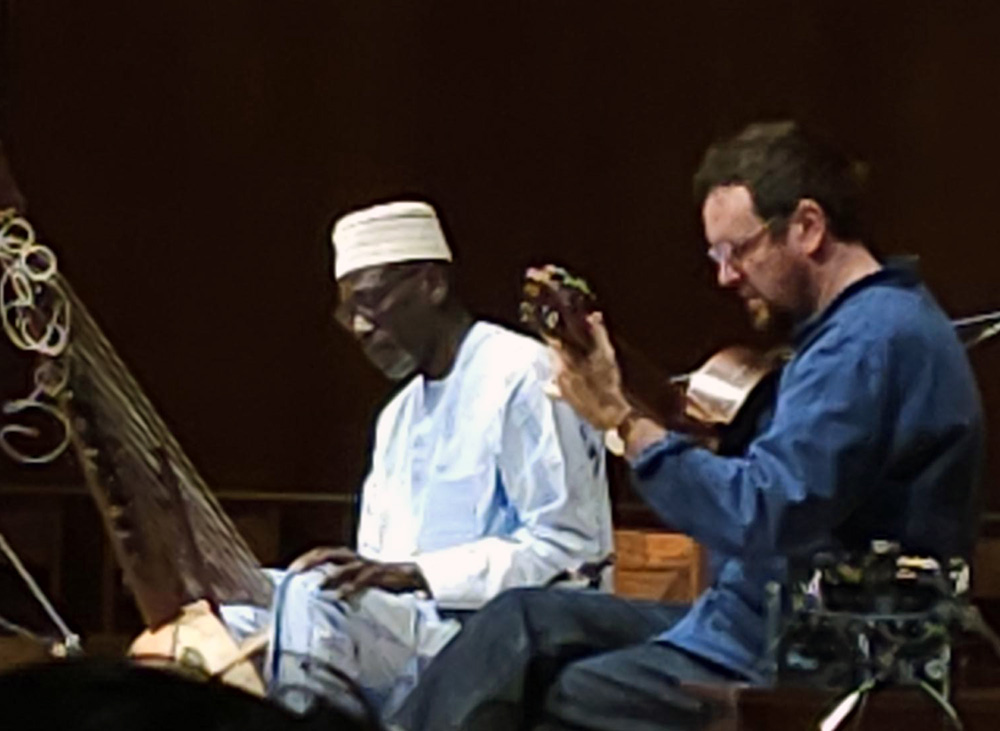
As I looked at them playing together, Ballaké dressed in white wearing a tunic, lounge pants, and fez, glittering sparkles shimmered in the light from his trousers. Derek wore a more Western look in denim jeans and blue shirt.
They sat about four or five feet apart, not on top of one another, but close enough that the sound from their instruments—kora and guitar—could weave together as it slid off the strings. The physical space was acoustically energetic, bouncing with their music, which was absorbed by the ears and bodies of the audience.
A perfect visual came to mind. I envisioned the pair producing a murmuration with their notes. How the body of sound projected in one direction and then an invisible hand pointed a section of notes on a new bearing and mysteriously all of the notes suddenly now followed this altered course.
It was not like the gradual flux and rhythm of an ocean’s tide. The duo’s sound changed with a decisive, but not jarring movement, one section shifted and then the rest followed suit. It was as if Derek and Ballaké could read one another’s minds.
Since music is their only common language, neither fluent in one another’s spoken language, perhaps there was some mind-reading going on. It also occurred to me how cool it would be to have a screen behind them, tapped into their brains so we could have an artist’s roadmap of where their songs were headed.
There was almost no chatter between numbers. Song titles weren’t prefaced before the pair started to play their next number. The pattern tended to be that Ballaké plucked some notes on his kora and Derek answered with his guitar either echoing or contrasting what had already been presented. Then the pair fell into synchronicity for the next several minutes until they concluded their song.
My ear is not skilled enough to differentiate between when the kora is leading the song or the guitar has taken the lead. Although yes, I can certainly hear and identify when a kora or a guitar is played, when Gripper and Sissoko are playing, their notes swirl in such a fashion that I can no longer separate which plucked string belongs to which instrument.
Derek was more physically engaged in the music. His head bobbed and swayed, he rocked back and forth, his left knee jigging up and down in rapid, rhythmic staccato. Ballaké sat with more reserve, showing his engagement through his shoulders and neck, eskista-like, intermittently vocalizing a throaty “Yeah!”
Wrapping up a song was also mysterious. It was as if we were being led blindfolded into a dream. There wasn’t a chorus or repetition, no words or bookends. There might be a bit of call and response, a set-up and resolution, but without predictability. It was as if the audience decided the song was finished. The musicians slowed their playing, softening and easing back without fully stopping. If the spectators started to clap, the song concluded and the applause increased.
At one point, Derek exited and Ballaké soloed on his kora. I loved what he played. It ended much too soon. Then Derek returned and played some Bach on his guitar. I liked Derek’s solo as well. Individually, their music fits into a container with which I am familiar. When they play together, it’s outside of my understanding and harder for me to fully appreciate, but at the same time, left me in awe.
When they played in tandem, it was trance-inducing. But one needed to stay present to hear what they were playing. It was easy to lose focus and relax into their sound, floating away on the music.
As the show came to an end, Derek conversed with us more, conveying how the current political climate in the US compared, for him, with the dismantling of apartheid when he was a boy and teen in Cape Town. He said, what’s interesting is that all those politicians who supported apartheid suddenly disappeared once apartheid was demolished. He intimated that the same would happen here.
With that, their 90-minute show ended and we forced ourselves back into reality.

About Susan Budig
Susan is based in Minneapolis and reports on general assignments for Mshale with a focus on entertainment. In addition to reporting, she is also a writer, poet, teacher and coach.
- Web |
- More Posts(185)
 (2 votes, average: 5.00 out of 5)
 Loading...