
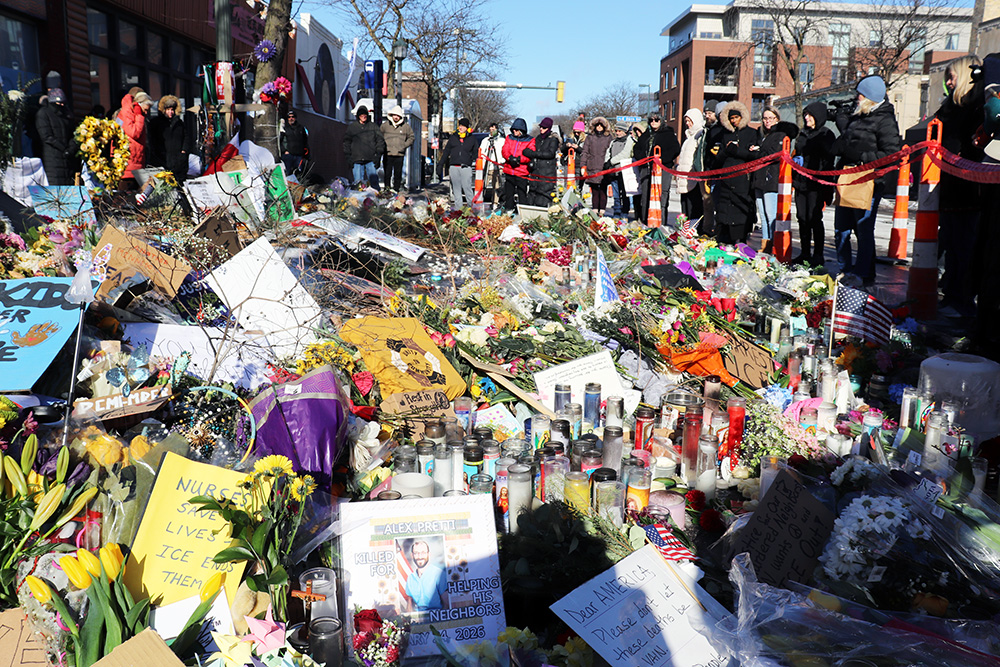
Operation Metro Surge, the Trump administration’s immigration crackdown that sent thousands of U.S. Immigration and Customs Enforcement (ICE) officers to Minneapolis/Saint Paul, had a devastating impact on Minnesota’s economy, according to new research.
“There were indirect and induced impacts on the economy, and we really want to know the full scale of this impact,” said Aaron Rosenthal, a research director at North Star Policy Action.
The operation began in December 2025 in what the U.S. Department of Homeland Security called “the largest immigration operation ever” with an initial 2,000 ICE officers sent to the Minneapolis-St. Paul metro area. By the time it ended 74 days later 4,000 federal enforcement agents had been deployed and arrested 3,789 immigrants. They also arrested 131 U.S. citizens for protesting, and shot dead two of them, Renee Good, a mother of three, and Alex Pretti, a 37-year-old nurse.
Researchers say the effects of Operation Metro Surge on Minnesota reached beyond the arrests made. People missed work, businesses lost customers, and patients delayed seeking medical care, as many immigrants stayed indoors to avoid possibly getting detained. The researchers convened at the University of Minnesota’s Humphrey School of Public Affairs recently to share their findings with community leaders and advocates, to discuss how research could guide recovery efforts.
The studies measured different geographical locations in the state, which showed that the disruption did not end when the most intense weeks of enforcement passed. Some businesses reported lower revenue months later. Researchers said they were still working to understand what the long-term effects of missed wages and medical visits would have on families.
Lost work and wages
Rosenthal and economist Aaron Sojourner compared daily payroll activity in the Twin Cities combined with other metropolitan areas. From Jan. 3 through Feb. 17, their analysis estimated that the number of employees working decreased by 2.8%, hours worked declined by 1.9%, and number of business locations open fell by 1.7%. Using conservative wage assumptions, they estimated $106 million in lost wages over the period. The payroll data came from a platform commonly used by small businesses, therefore Rosenthal cautioned that its results may not represent the entire metro economy equally.
A separate analysis Rosenthal presented focused mainly on the state’s leisure and hospitality industry from January through March, compared to a statistical model of what the industry would otherwise have been expected to do. Researchers estimated about 4,600 fewer jobs, 3.8 million fewer worker hours and a $71 million decline in wages. Those figures cover a different area and period from the Twin Cities payroll study and should not be added to its $106 million estimate as they measured separate losses, he said.
“We’re talking about lost wages, but when people lose wages, they don’t spend that money,” Rosenthal said.
Reduced spending can create an additional economic loss, Rosenthal said, which researchers still needed to examine to understand the full impact of the operation.
The research suggested damage on small business extended beyond the first weeks of the operation. Researchers identified eight economic nodes that represent different affected businesses across the region including Minneapolis, St. Paul, Columbia Heights, Burnsville, and Eden Prairie. In June, 54% of businesses owners interviewed said their revenue was lower than the previous year. Researchers also described businesses delivering groceries, extending credit and connecting customers with resources, even as they lost sales themselves.
Businesses supporting neighbors
Darcie Vandegrift, a research manager at The Metropolitan Council, said her research team conducted 265 qualitative interviews across eight economic nodes, including locations in the cities mentioned above.
“Through our research, we’ve also come to understand how these broader experiences affect business owners, employees, and the communities they serve,” Vandegrift said.
Businesses also had to grapple with added pressures of surging cost of living, which complicated recovery. Vandegrift said that businesses continued to support residents even as their own sales declined.
“They became trusted community anchors,” Vandegrift said. “They connected people to resources and protected both customers and employees during a period of significant uncertainty.”
At a grocery store in west St. Paul, Vandegrift showed an image of posters of a business advertising grocery delivery for customers afraid to leave home. The store recruited volunteers and raised money for people who were unable to work.
However, access to assistance still remains a concern. Responding to questions about fraud in aid distribution, Vandegrift argued that insufficient funding and information also deserved attention.
“We would argue that the biggest risk is that there’s not enough aid, but also that a lot of businesses that would be eligible have not received any information,” Vandegrift said.
Financial pressure
Carl Swanson, Minnesota coalition strategist for the Minnesota Community Development Financial Institutions (CDFIs), which provide financing for underserved communities, said business losses also affected the financing organizations.
“We were hearing all these stories and all this anecdotal evidence about the kind of trauma and enormous harms that were being inflicted on small businesses because of Operation Metro Surge, but didn’t have data to back it up,” Swanson said.
His coalition used existing business data to estimate losses of $213 million in selected Minneapolis and St. Paul commercial corners. A designed survey received responses from 25 CDFIs. Swanson said that when small business lenders saw increased delinquency and soaring risk of default, they modified loans to help clients to continue operating.
“CDFIs are really economic first responders working with small businesses at all levels,” Swanson said. “These ripple effects within the economy are being felt by CDFIs.”
City of Minneapolis officials also shared their impact assessment, gathering information from city staff and community partners across areas including livelihoods, housing, health and food security. They put the combined financial impact and needs at $697.8 million. The officials emphasized that the assessment was an emergency response tool and it did not put a dollar figure on the loss residents experienced.
Rosenthal said state relief should remain part of the discussion in the 2027 legislative session. Researchers meanwhile continue to document consequences that may take longer to compile, including the effects of missed work, school and medical care.
Delays in Healthcare visits
Using records from seven Minnesota health systems, researchers documented declines in the number of visits to healthcare centers, during the operation, compared previous months. The data covered an estimated 70% of the state’s population, according to Peter Bodurtha, a senior data scientist at Hennepin Healthcare Research Institute.
For Spanish-speaking patients, the team estimated roughly 3,000 fewer emergency department visits, 459 fewer inpatient visits, and nearly 30,000 fewer outpatient visits than expected during the period it studied. Although telehealth visits rose by about 700, they were too few to make up for the decline in in-person care. Bodurtha said more data was needed beyond the operation to understand whether patients later obtained the care they missed. They also cautioned that language was an imperfect way to identify who was vulnerable to enforcement. The lost visits show a change in healthcare use. However, researchers’ presentations did not establish what happened medically to each patient who stayed away.
Examining public safety
Christopher Uggen, a professor of sociology, law, and public affairs at the University of Minnesota, presented research examining deterrence or destabilization, what he called a synthetic control analysis of Operation Metro Surge on Crime in the Twin Cities.
Uggen’s team dug into whether the operation changed crime in the seven-county Twin Cities metro. They compared local crime trends with a weighted combination of other counties, accounting for broader decline in crime and seasonal patterns.
“We have no evidence of a crime drop across any of those categories,” Uggen said.
The models estimated roughly 750 additional crimes with an increase of 10% over the synthetic control. However, the increase did not meet the conventional threshold for statistical significance, Uggen said. He placed the findings in the context of earlier changes in Minneapolis. He described sharp increases in crime from 2020 through 2022 following the murder of George Floyd and during the pandemic, followed by substantial declines. Those existing trends made it important to examine what might have happened without the operation.
Uggen also discussed how fear, disruption and distrust of government could’ve affected public safety, along with resistance to immigration enforcement. Protest activity can sometimes lead to reported offenses he said. At the same time, residents fearful of immigration enforcement might become less willing to report crimes. These changes in reporting could complicate researchers’ understanding in what occurred.
“Was there a crime increase? Maybe,” Uggen said.
Uggen cautioned that the study had limited statistical power and that his team had not directly tested the explanations he outlined. Their findings offered no evidence that the operation reduced crime.
Measuring recovery
Other researchers questioned whether immigration enforcement affected the tools used to measure economic conditions. Casey McNichols, a doctoral student of applied economics at the University of Minnesota, presented research with Sojourner, the economist, examining response rates to the Current Population Survey, which helps produce national employment status. The team examined whether previously participating households became less likely to respond. It did not find a statistically clear decline associated with the operation.
“We have very noisy results, so we can’t say that these are systematically different from other metro areas,” McNichols said.
Author

About Lizzy Nyoike - Mshale Contributing Reporter
Lizzy Nyoike is a Hubbard School of Journalism & Mass Communication student.
 (No Ratings Yet)
 Loading...