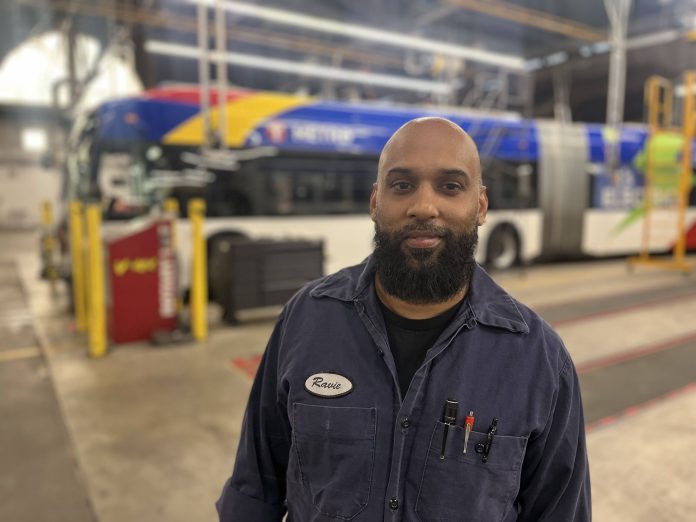
Mechanic Technician Ravie Sawh repairs and maintains buses – including electric buses – at Metro Transit’s Heywood Garage in Minneapolis. “The benefits are great, management listens, and it’s just a great place to work,” Ravie says. Photo: Metro Transit
Mechanic Technician Ravie Sawh repairs and maintains buses – including electric buses – at Metro Transit’s Heywood Garage in Minneapolis. “The benefits are great, management listens, and it’s just a great place to work,” Ravie says. Photo: Metro Transit
To provide clean, safe, and reliable service, Metro Transit has hundreds of technicians working behind the scenes on buses, trains, rail systems and facilities. Here, we introduce you to those who are committed to their craft and hear why they enjoy what they do.
My dad and grandfather were farmers, so I was driving tractors and trucks when I was as young as seven. You learn early, and that stays with you. As a teenager, my family moved from New York to North Minneapolis (Camden), and I often took the bus to work and school. While I was training here, I ran into the operator who used to take me to school. We reminisced about those days and he said, ‘That’s a great story, but don’t tell anyone, or they’ll know I’m old!’
What brought you to Metro Transit?
After high school, I went straight to work to help my single mother. At the same time, I kept busy fixing up cars I bought at auctions and selling them for extra money. My brother worked in Metro Transit’s parts department, and he encouraged me to apply here. Luckily, I was able to join a program that allowed me to earn income while working alongside technicians here and getting the formal education I needed to apply for a full-time technician role.
What do you enjoy most about working here?
I like seeing the results. When you finish a job and know a bus is back on the road because of what you did, that feels like a great accomplishment. And we all work together. I’ve especially enjoyed being part of a team that competes in the annual Bus Maintenance Rodeo. Even if we come in second or third, it’s good practice and it sharpens your skills.
What’s next for you?
I feel the same way now as I did when I started. The benefits are great, management listens, and it’s just a great place to work. People say once you’ve been here a while, you’re here for life and I believe that. Metro Transit has been good to me and I’m proud to be part of it.
AcQumen Medical co-founder and CEO Dori Jones receives the 2025 MN Cup. Photo: Courtesy University of Minnesota
AcQumen Medical co-founder and CEO Dori Jones receives the 2025 MN Cup. Photo: Courtesy University of Minnesota
The University of Minnesota’s Carlson School of Management recently announced entries for its annual MN Cup competition are now open, with a combined $400,000 in prize money up for grabs “with no equity taken or strings attached.”
Eligible businesses must be based in Minnesota with less than $1 million in annual revenue and cannot be past winners of the competition.
In addition to the prize money, winners will also have access to networking opportunities and mentorship by leaders in their respective industries.
The deadline to apply is April 3.
After the entry deadline, volunteer panels of judges consisting of industry veterans will select the top 90 companies to advance to the semifinal stage. Through a series of educational workshops and events throughout the summer, the semifinalists will “prepare and submit presentations, short videos and business plan summaries to be reviewed.”
The semifinal round will taker place between May 18 and August 7, according to the organizers, with a grand finale on September 14.
The grand prize winner takes home $100,000 while the runner-up receives $40,000. Besides those two main prizes, there are also nine competition divisions that companies can compete in, according to organizers: Education & Training, Energy/Clean Tech/Water, Food/Ag/Beverage, General, High Tech, Life Science/Health IT, Impact Ventures, Student, Youth.
Last year’s grand prize winner was Minneapolis-based AcQumen Medical for their UltraTrac system that helps doctors manage the heart function of critically ill infants and children. Proprietary technology by Minneapolis-based Swinergy that allows for the conversion of livestock waste into renewable natural gas and fertilizer won it the 2025 runner-up MN Cup prize of $40,000.
Since its inception in 2005, MN Cup has drawn participation from over 20,000 entrepreneurs and given away $5 million in seed money. Past winners have gone on to raise nearly $1 billion in capital.
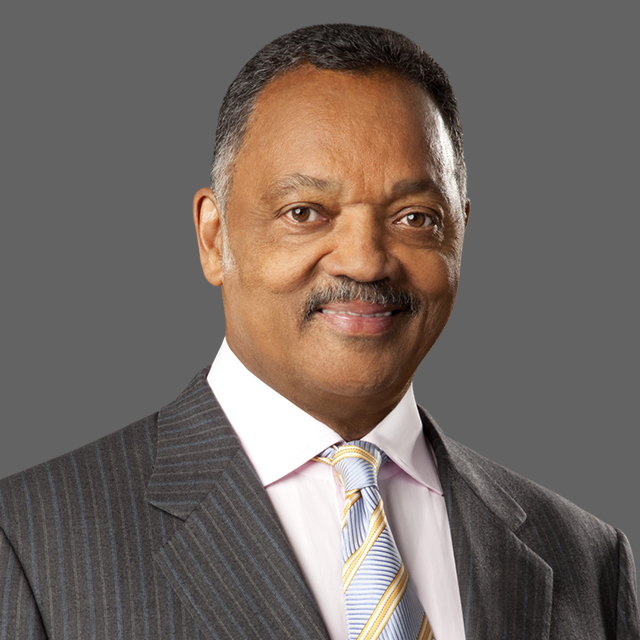
Rev. Jesse Jackson's public funeral service will be on Friday, March 6, 2026 with former presidents Clinton, Obama and Biden attending. The private home going is the next day. Photo: Courtesy Rainbow PUSH Coalition
Rev. Jesse Jackson's public funeral service will be on Friday, March 6, 2026 with former presidents Clinton, Obama and Biden attending. The private home going is the next day. Photo: Courtesy Rainbow PUSH Coalition
Former Presidents Bill Clinton, Barack Obama, and Joe Biden are among dignitaries set to attend Jesse Jackson’s funeral in Chicago on Friday, March 6 following a series of cross-country memorial services.
Jackson died on Feb. 17 at age 84 of progressive supranuclear palsy, a life-threatening neurological disorder.
The March 6 service will also feature performances by Bebe Winans and Pastor Marvin Winans. Jennifer Hudson, a Chicago native, will also perform.
Time: Doors open at 9 a.m. CT. with the service beginning at 11 a.m. CT.
Location: 752 E. 114th St., Chicago, Illinois, 60628
Private Homegoing at Rainbow PUSH
Date: Saturday, March 7
Time: Service begins at 10 a.m. CT
Location: 930 E. 50th St., Chicago, IL 60615
Stevie Wonder is scheduled to give a music tribute at private homegoing on March 7 as well as performances by Marvin Sapp, Hezekiah Walker and Terisa Griffin.
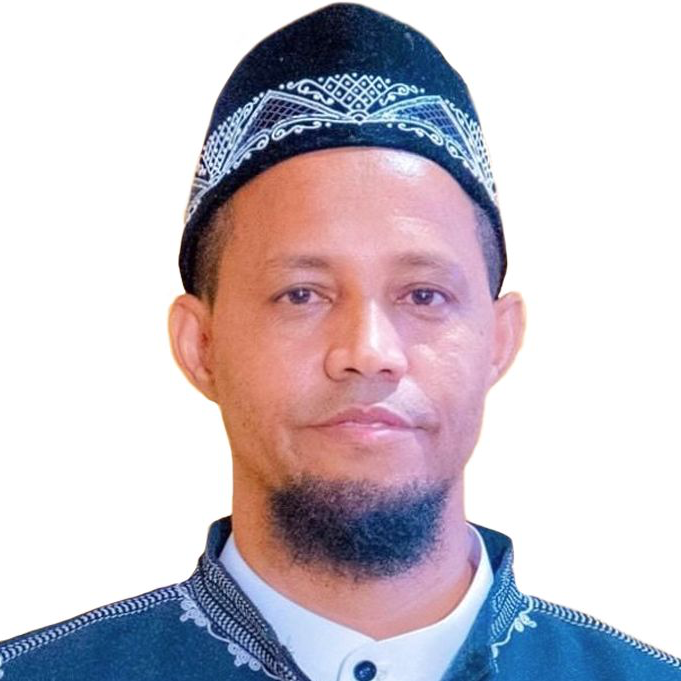
Imam Yusuf Abdulle is the Executive Director of the Islamic Association of North America (IANA). Photo: Courtesy IANA
Imam Yusuf Abdulle is the Executive Director of the Islamic Association of North America (IANA). Photo: Courtesy IANA
PATERSON, N.J. (AP) — Midway through Ramadan, Muslims across the United States are striving to maintain the holy month’s traditional mix of prayers and festive spirit under a cloud of worrisome events.
The federal government’s immigration crackdown has affected many of their communities. Virulent anti-Muslim rhetoric is surging. And now the Middle East — where many have loved ones — is buffeted by the Iran war.
In Paterson, New Jersey — home to one of the country’s highest per capita Muslim populations — 18-year-old Haneen Alatiyat regrets that fear and uncertainty are keeping many community members from gathering to embrace Ramadan’s communal traditions.
“The meaning of the holiday is to be together with the people you love,” said Alatiyat, who is half Palestinian, half Jordanian.
“Unfortunately, because of the ICE raids that are happening, people don’t want to do that,” she added, speaking outside the Islamic Center of Passaic County in Paterson about Immigration and Customs Enforcement actions happening under President Donald Trump. It’s the mosque where she worships every year with family during Ramadan.
Paterson’s Palestinian community — one of the largest outside the Middle East — had been grieving loved ones and trying to help the survivors of the Israel-Hamas war in Gaza even before the latest anxiety-fueling developments.
“This Ramadan has already been heavy for many families in our community with the immigration crackdowns,” said Rania Mustafa, executive director of the Palestinian American Community Center in Clifton, New Jersey.
“Now, as the war on Iran started, many people here are experiencing another layer of fear and grief,” she added.
Impact of Minnesota crackdown
In Minnesota, where many are reeling from the recent large-scale immigration crackdown, Ramadan came amid a powerful mix of emotions, according to Imam Yusuf Abdulle. He is executive director of the Islamic Association of North America.
Many feel “blessed that we are alive and well,” said Abdulle. “Also, we feel like we’re … bruised, affected, devastated economically, psychologically.”
Abdulle’s organization is an umbrella group for a number of Islamic centers, including some in Minnesota.
Abdulle said the Abubakar As-Saddique Islamic Center in Minneapolis, where he’s on the board, has canceled hosting communal iftar, the sunset meals that break the daily fast, and instead is serving only dates and water. He attributed the change to the economic hit that many of the community’s businesses that typically would have sponsored such meals took during the crackdown, as people stayed away.
“Eating together and sharing stories while eating, it was beautiful,” he said. “I hope that comes back.”
Even after withdrawal of most of the roughly 3,000 immigration officers, some community members — especially asylum-seekers and refugees — remain cautious about venturing out, including to the mosque, Abdulle said.
“The fear … is very much there and it will be there for a while.”
Yet family nurse practitioner Munira Maalimisaq sees reason to be thankful amid the stresses. She works as CEO of Inspire Change Clinic, which serves marginalized communities in Minnesota.
“Even with the challenges, there’s a strengthened sense of community, resilience, and hope alongside the usual spiritual reflection, prayer, and charity that Ramadan brings,” she said.
Know your rights message
Coinciding with Ramadan, some Muslim groups have issued know-your-rights guidance for navigating immigration enforcement interactions, including for mosques. The Muslim Public Affairs Council, for example, created a safety guide.
MPAC official Dahlia M. Taha said the included guidance for imams aims to help them address congregants’ fears without causing panic or spreading misinformation.
Questions from imams, she said, have included: Can houses of worship be subject to enforcement operations? How to reassure people without giving legal advice? How to address immigration anxiety while keeping Ramadan spiritually centered?
“There is a deep sense of community and peace that always comes with Ramadan,” said Taha, adding that many mosques are well-attended and families are gathering.
Nonetheless, “people are carrying fear, anxiety, and uncertainty alongside our faith,” she said. “Devotion and concern are existing side by side. I think everyone is just exhausted.”
Ibrahim Dyfan, executive director of Masjid Al Shareef, a 2,000-strong mosque in Long Beach, California, said his community, like other Muslim congregations, is coping with stress related to rising Islamophobia, immigration enforcement and the Middle East conflicts.
The mosque also boosted security for prayer services during Ramadan, he said.
“All we can do is continue praying and fasting,” he said. “This, like everything else, will pass. At the same time, we also need to pay attention to what is happening around us, and take the necessary precautions.”
Islamophobia in politics
A wave of anti-Muslim language intensified in Republican campaigns early this election year, most prominently in Texas, which held its primaries Tuesday. Gov. Greg Abbott, who clinched the GOP nomination for a fourth term, helped lead efforts to stop a Muslim-centered planned community near Dallas.
In Congress, several bills have been introduced recently targeting Shariah — the framework that guides Muslims, including on prayer and ethical conduct. Rep. Randy Fine, R-Fla., in a recent social media post, compared Muslims unfavorably to dogs, prompting the Council on American-Islamic Relations and some Democratic members of Congress to call for his resignation.
Muslim American leaders view the vitriol as election-year scaremongering — more intense now than in recent campaign seasons. Their alarm was only partially eased by recent election victories for Muslim candidates, notably Zohran Mamdani becoming mayor of New York.
“Every election year, you see an increase in anti-Muslim bigotry in certain parts of the country, where politicians see Muslims Americans a useful political football,” said CAIR’s national deputy director, Edward Ahmed Mitchell. “We expect that — but it’s so much worse than usual this time.”
War worries emerge
In Paterson, according to Rania Mustafa, many families worry about relatives in conflict-wracked parts of North Africa and the Middle East, including those in Gaza struggling to access sufficient food supplies.
But she is proud of her community’s perseverance.
“Despite what’s going on in the world, Ramadan reminds us of the strength and resilience of our community,” she said. “People are still gathering for prayer, sharing meals, checking on one another, and supporting families who are struggling.”
As the sun set on a section of Paterson’s Main Street renamed “Palestine Way” — flanked by Palestinian and U.S. flags — people arrived at homes and restaurants to break the fast on a recent evening. Some rushed to pastry shops, others headed to the Palestine Hair Salon.
Raed Odeh, the salon’s owner and top barber, lamented how the Middle East’s tumult and the U.S. immigration crackdown were dampening what should be a joyful month.
“This is not only affecting those who don’t have documents, this is also affecting everyone else around,” said Odeh, Paterson’s deputy mayor, as he shaved a client’s beard.
Like other city leaders, he urged the release of Leqaa Kordia, a Palestinian woman and Paterson resident who has been held in an immigration jail for a year after attending a protest in New York. Recently, Kordia said she suffered a seizure, an episode she linked to “inhumane” conditions inside the detention facility.
At a time of turmoil, Odeh said he shares the hope of many — regardless of their ethnicity or religion — during Ramadan: “Of course, everybody is hoping for peace.”
___
By LUIS ANDRES HENAO and MARIAM FAM Associated Press
Fam reported from Cairo. AP journalists Deepa Bharath in Los Angeles and David Crary in New York contributed.
M23 rebels negotiate with Rwanda Army to release captured Romanian mercenaries to Rwanda Government, who were fighting alongside Democratic Republic of Congo army (FRDC), at Gisenyi border point in Congo, Jan. 29, 2025, after the M23 rebels advanced into eastern Congo’s capital Goma. Photo: Brian Brian Inganga/AP
M23 rebels negotiate with Rwanda Army to release captured Romanian mercenaries to Rwanda Government, who were fighting alongside Democratic Republic of Congo army (FRDC), at Gisenyi border point in Congo, Jan. 29, 2025, after the M23 rebels advanced into eastern Congo’s capital Goma. Photo: Brian Brian Inganga/AP
KINSHASA, Congo (AP) — The U.S. imposed sanctions Monday on the Rwandan Defence Forces and four of its senior officials for supporting the March 23 Movement, an armed group responsible for human rights abuses in the central African nation of Congo.
The latest penalties come after a U.S.-mediated peace agreement was signed in December by Congolese President Felix Tshisekedi and Rwandan President Paul Kagame in Washington, alongside U.S. President Donald Trump.
Trump at the time praised the leaders for their courage, as the deal also opened the region’s critical mineral reserves to the U.S. government and U.S. companies.
Despite the agreement, fighting between the two parties continues on several fronts in eastern Congo, claiming numerous civilian and military casualties.
M23 is the most prominent of about 100 armed factions vying for control in eastern Congo, near the border with Rwanda. The conflict has created one of the world’s most significant humanitarian crises, with more than 7 million people displaced, according to the U.N. agency for refugees.
Congo, the U.S. and U.N. experts accuse Rwanda of backing M23, which has grown from hundreds of members in 2021 to around 6,500 fighters, according to the U.N.
The U.S. Treasury Department’s Office of Foreign Assets Control alleged that M23’s offensives would not have been possible without the active support of the Rwandan government and key senior officials.
Included in Monday’s sanctions are Vincent Nyakarundi, the RDF’s army chief of staff; Ruki Karusisi, a major general; Mubarakh Muganga, chief of defense staff; and Stanislas Gashugi, special operations force commander.
Rwandan government spokesperson Yolande Makolo said in a statement Monday that the sanctions “unjustly” target Rwanda and “misrepresent the reality and distort the facts of the conflict” in eastern Congo. She accused Congo of violating the peace agreement by allegedly conducting “indiscriminate” drone attacks and ground offensives.
U.S. Treasury Secretary Scott Bessent said in a statement that the department “will use all tools at its disposal to ensure that the parties to the Washington Accords uphold their obligations.”
“We expect the immediate withdrawal of Rwanda Defence Force troops, weapons and equipment,” Bessent said.
Thomas Pigott, a U.S. State Department spokesman, said M23 “is responsible for horrific human rights abuses, including summary executions and violence against civilians, including women and children.”
M23 is already under U.S. sanctions since 2013.
The Congolese government and M23 are in ongoing negotiations for a peace deal, mediated by Qatar and the U.S.
——
Associated Press reporters Fatima Hussein in Washington and Khaled Kazziha in Nairobi, Kenya contributed to this report.
James Hickman holds a photo montage of the late Reverend Jesse Jackson before a public visitation at Rainbow/PUSH Coalition in Chicago, Thursday, Feb. 26, 2026.
Photo: Nam Y. Huh/AP
CHICAGO (AP) — A line of mourners streamed through a Chicago auditorium Thursday to pay final respects to the Rev. Jesse Jackson Sr. as cross-country memorial services began in the city the late civil rights leader called home.
The protege of the Rev. Martin Luther King Jr. and two-time presidential candidate will lie in repose for two days at the headquarters of the Rainbow PUSH Coalition before events in Washington, D.C., and South Carolina, where he was born.
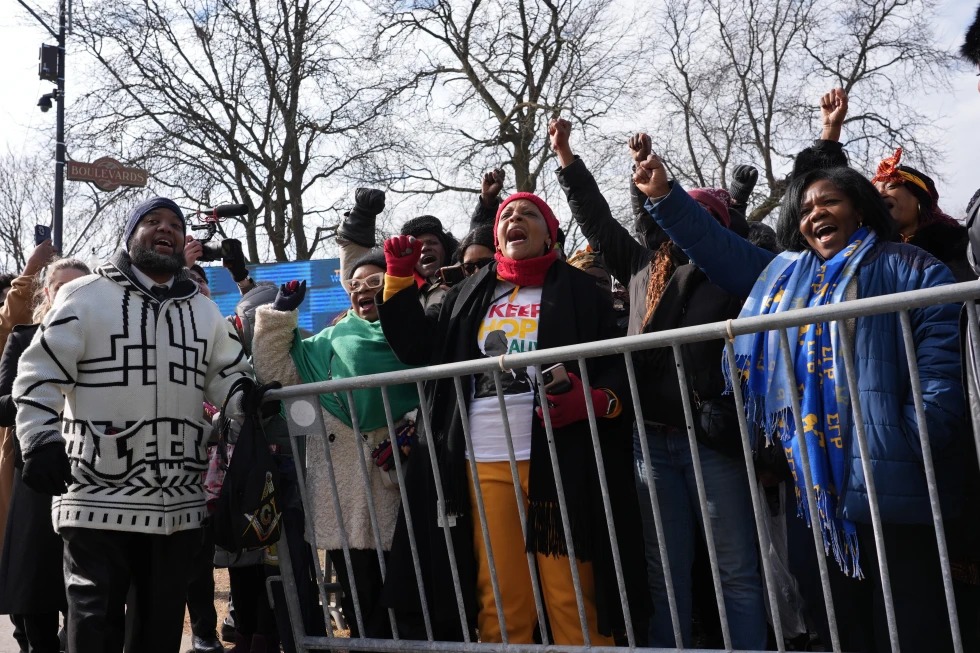
Family members wiped away tears as the casket was brought into the stately brick building. Flowers lined the sidewalks where people waiting to enter watched a large screen playing video excerpts of Jackson’s notable speeches. Some raised their fists in solidarity.
Inside, Jackson’s children, Chicago Mayor Brandon Johnson and the Rev. Al Sharpton were among those who stood by the open casket to shake hands and hug those coming to view the body of Jackson, dressed in a suit and blue shirt and tie.
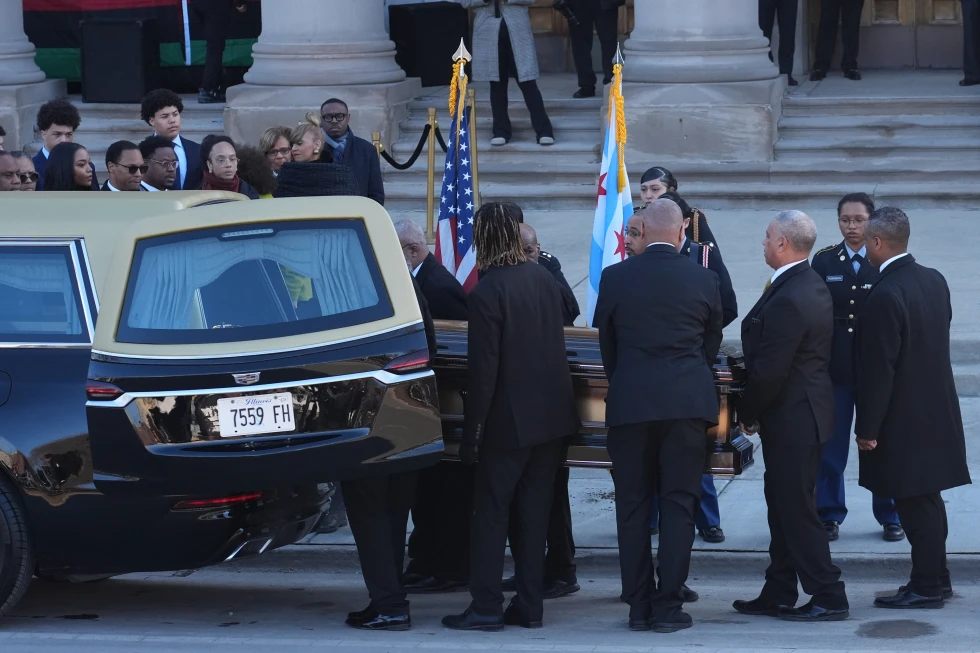
he casket with Reverend Jesse Jackson arrives before a public visitation at Rainbow/PUSH Coalition in Chicago, Thursday, Feb. 26, 2026. Photo: Nam Y. Huh/AP
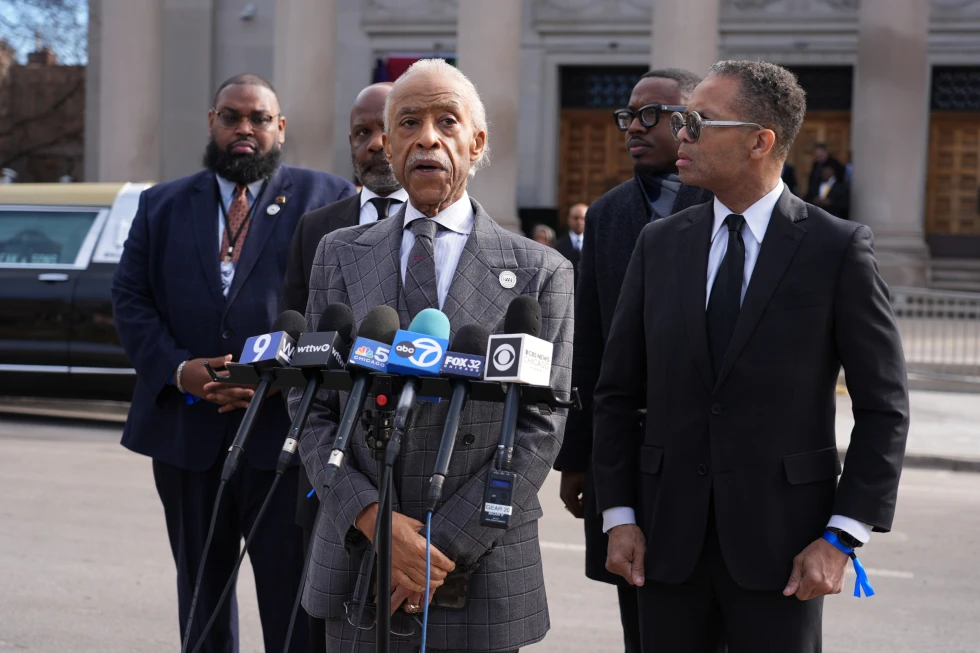
“The challenge for us is that we’ve got to make sure that all he lived for was not in vain,” Sharpton told reporters. “Dr. King’s dream and Jesse Jackson’s mission now falls on our shoulders. We’ve got to stand up and keep it going.”
Jackson died last week at age 84 after battling a rare neurological disorder that affected his mobility and ability to speak in his later years.
Remembrances have already poured in from around the globe, and several U.S. states, including Minnesota, Iowa and North Carolina, are flying flags at half-staff in his honor.
But perhaps nowhere has his death been felt as strongly as in the nation’s third-largest city, where Jackson lived for decades and raised his six children, including a son who is a congressman.
Bouquets have been left outside the family’s Tudor-style home on the city’s South Side for days. Public schools have offered condolences, and city trains have used digital screens to display Jackson’s portrait and his well-known mantra, “I am Somebody!”
His causes, both in the United States and abroad, were countless: Advocating for the poor and underrepresented on issues including voting rights, job opportunities, education and health care. He scored diplomatic victories with world leaders, and through his Rainbow PUSH Coalition, he channeled cries for Black pride and self-determination into corporate boardrooms, pressuring executives to make America a more open and equitable society.
“We honor him, and his hard-earned legacy as a freedom fighter, philosopher, and faithful shepherd of his family and community here in Chicago,” the mayor said in a statement.
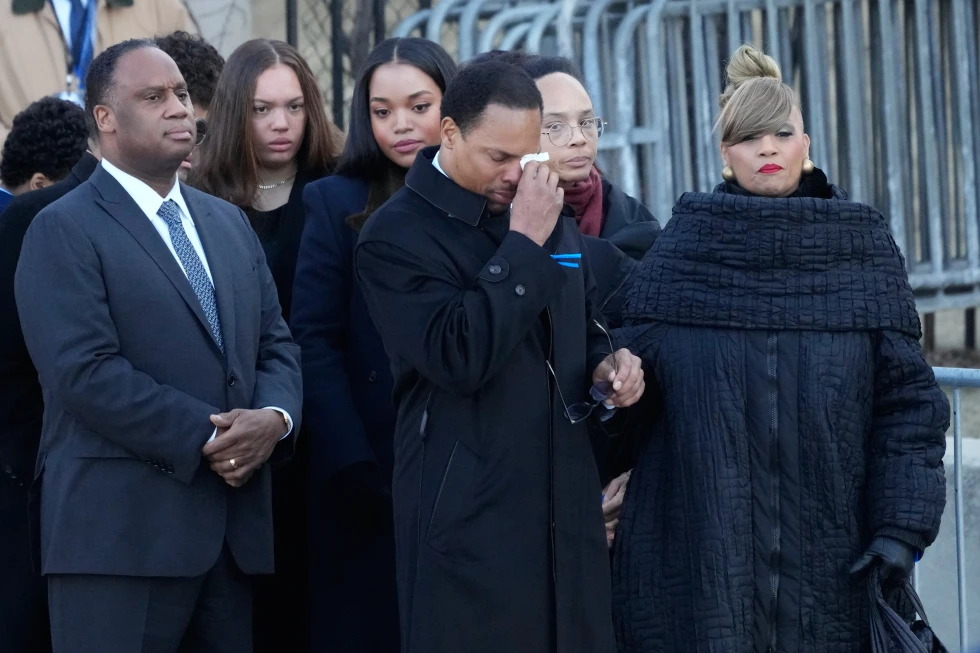
The family of Reverend Jesse Jackson arrives as Yusep Jackson wipes his eyes before public visitation at Rainbow/PUSH Coalition in Chicago, Thursday, Feb. 26, 2026. Photo: Nam Y. Huh/AP
Next week, Jackson will lie in honor at the South Carolina Statehouse, followed by public services. According to Rainbow PUSH’s agenda, Gov. Henry McMaster is expected to deliver remarks; however, the governor’s office said Thursday that his participation wasn’t yet confirmed. Jackson spent his childhood and started his activism in South Carolina.
Details on services in Washington have not yet been made public. However, he will not lie in honor at the United States Capitol rotunda after a request for the commemoration was denied by the House Speaker Mike Johnson’s office.
The two weeks of events will wrap up next week with a large celebration of life gathering at a Chicago megachurch and finally, homegoing services at the headquarters of the Rainbow PUSH Coalition.
Family members said the services will be open to all.
The Rev. Al Sharpton, speaks as Jesse Jackson Jr. listens after the public visitation for Reverend Jesse Jackson at at Rainbow/PUSH Coalition in Chicago, Thursday, Feb. 26, 2026. Photo: Nam Y. Huh/AP
“Our family is overwhelmed and overjoyed by the amazing amount of support being offered by common, ordinary people who our father’s life has come into contact with,” his eldest son, Jesse Jackson Jr., said before the services began. “This is a unique opportunity to lay down some of the political rhetoric and to lay down some of the division that deeply divides our country and to reflect upon a man who brought people together.”
The services included prayers from some of the city’s most well-known religious leaders, including Chicago Cardinal Blase Cupich. Mourners of all ages — from toddlers in strollers to elderly people in wheelchairs — came to pay respects.
Video clips of his appearances at news conferences, the campaign trail and even “Sesame Street” also played inside the auditorium.
People wait to enter the security check point for the public visitation for Reverend Jesse Jackson at Rainbow/PUSH Coalition in Chicago, Thursday, Feb. 26, 2026. Photo: Nam Y. Huh/AP
Claudette Redic, a retiree who lives in Chicago, said her family has respected Jackson, from backing his presidential ambitions to her son getting a scholarship from a program Jackson championed.
“We have generations of support,” she said. “I’m hoping we continue.”
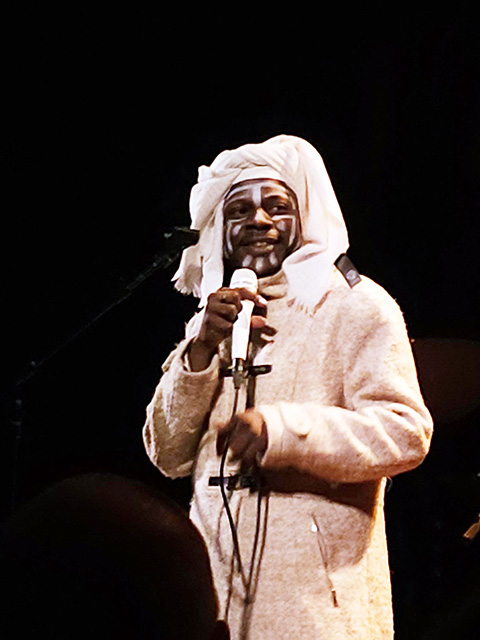
“I’m a griot. I was born surrounded by storytellers so that’s my way of keeping my roots,” said Richard Bona when Mshale spent time with him over a phone call recently. In the midst of his European tour—last week he and his trio were in Italy and Germany—having just landed in Paris, he continued, “I don’t even need to travel back to Africa, I was born into [my culture]. I communicate with the Universe. I keep telling my own African story.”
Bass-playing Bona and his band will take the Dakota’s stage on March 16th. It’ll be the second time he’s played there, his first time was an unquestionable hit. This time around, he’ll arrive knowing the Minnesota climate and its turmoil. “That broke my heart,” he said referencing ICE, “it turned me upside down.”
He likes to bring new music to his shows, but acknowledged that the fans request songs and he wants to honor their requests as well.
“It’s hard to manage that,” he said, “because I want to present something different, but they [his fans] say, you didn’t play my favorite song. The fans get attached to a certain song.”
Bona laughs at this fully intending on indulging his audience by playing the songs they have heard before and want to hear again.
“Most of them don’t understand the language, but it’s the melodies, the way we play them, that resonate with the audience. We take the song and elaborate more and more, trying to get it to a better place. We add momentum and listen to each other,” he said, while also admitting, “Sometimes we don’t even know where we’re going [with the music], but we let it flow.”
Bona’s compendium of music goes all the way back to his childhood in Cameroon. Over three decades later, he won his first Grammy in 2002. He has a wealth of material from jazz to AfroPop to Latin to Flamenco upon which to draw.
“We want to be extremely focused when we’re playing so that we can if not reach excellence, then at least touch it,” Bona said. In their quest to reach perfection, they’ll bring along their instruments such as guitars and a looper.
Bona has a pet name for this electronic device that records a riff or phrase and then immediately plays it back in a loop. “I will bring my Magic Voodoo Machine. People love it. It’s becoming a signature tool for me…what you gonna do? I’ll bring it. I’ll bring it,” he said chuckling.
Tickets for Richard Bona’s 7 pm show on March 16th at The Dakota can be purchased here.
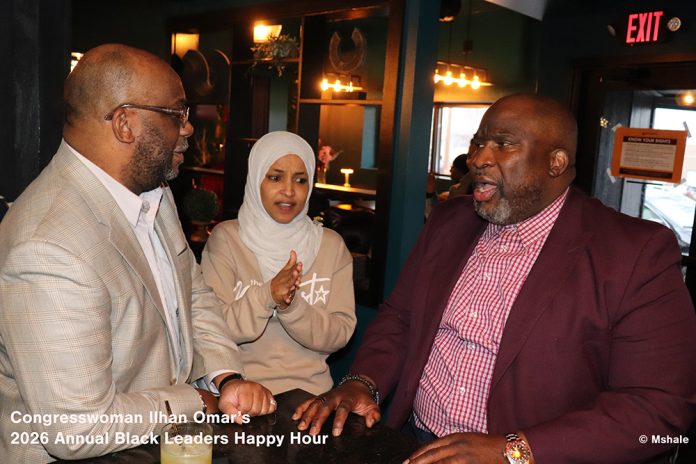
Rep. Omar in an animated discussion with MidWestOne Bank vice-president Trent Bowman and former state Senator Jeff Hayden of Fredrikson Government Relations during the Black leaders happy hour she hosted at The Camden Social on Tuesday, Feb. 17, 2026. Mshale Staff Photo by Tom Gitaa
Rep. Omar in an animated discussion with MidWestOne Bank vice-president Trent Bowman and former state Senator Jeff Hayden of Fredrikson Government Relations during the Black leaders happy hour she hosted at The Camden Social on Tuesday, Feb. 17, 2026. Mshale Staff Photo by Tom Gitaa
U.S. Rep. Ilhan Omar hosted her annual happy hour for Black leaders on Tuesday, Feb. 17 at The Camden Social in north Minneapolis. The event which featured heavy hors d’oeuvres, drew elected officials, nonprofit and business executives from around the Twin Cities metro area.
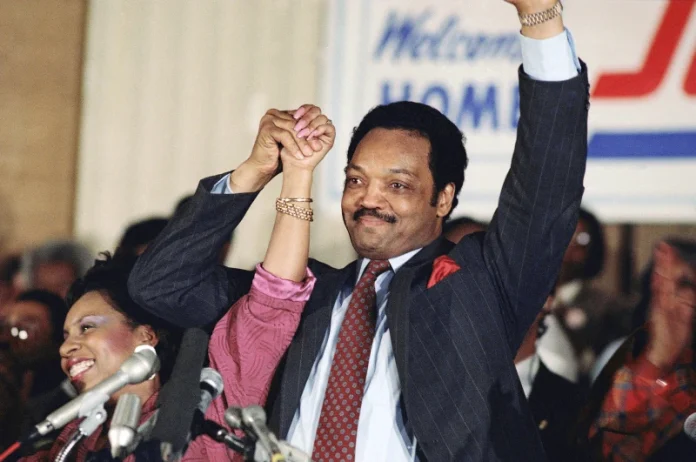
Democratic presidential hopeful Jesse Jackson with his wife, Jacqueline, salutes the cheering crowd at Operation Push in Chicago, March 10, 1988. He died Tuesday, Feb. 17, 2026 at his home in Chicago. Photo: Fred Jewell/AP
Democratic presidential hopeful Jesse Jackson with his wife, Jacqueline, salutes the cheering crowd at Operation Push in Chicago, March 10, 1988. He died Tuesday, Feb. 17, 2026 at his home in Chicago. Photo: Fred Jewell/AP
CHICAGO (AP) — The Rev. Jesse L. Jackson, a protege of the Rev. Martin Luther King Jr. and two-time presidential candidate who led the Civil Rights Movement for decades after the revered leader’s assassination, died Tuesday. He was 84.
As a young organizer in Chicago, Jackson was called to meet with King at the Lorraine Motel in Memphis, Tennessee, shortly before King was killed, and he publicly positioned himself thereafter as King’s successor.
Santita Jackson confirmed that her father, who had a rare neurological disorder, died at home in Chicago, surrounded by family.
Jackson led a lifetime of crusades in the United States and abroad, advocating for the poor and underrepresented on issues, including voting rights, job opportunities, education and health care. He scored diplomatic victories with world leaders, and through his Rainbow/PUSH Coalition, he channeled cries for Black pride and self-determination into corporate boardrooms, pressuring executives to make America a more open and equitable society.
And when he declared, “I am Somebody,” in a poem he often repeated, he sought to reach people of all colors. “I may be poor, but I am Somebody; I may be young; but I am Somebody; I may be on welfare, but I am Somebody,” Jackson intoned.
It was a message he took literally and personally, having risen from obscurity in the segregated South to become America’s best-known civil rights activist since King.
“Our father was a servant leader — not only to our family, but to the oppressed, the voiceless, and the overlooked around the world,” the Jackson family said in a statement posted online. “We shared him with the world, and in return, the world became part of our extended family.”
Fellow civil rights activist the Rev. Al Sharpton said his mentor “was not simply a civil rights leader; he was a movement unto himself.”
“He taught me that protest must have purpose, that faith must have feet, and that justice is not seasonal, it is daily work,” Sharpton wrote in a statement, adding that Jackson taught “trying is as important as triumph. That you do not wait for the dream to come true; you work to make it real.”
Despite profound health challenges in his final years, including the disorder that affected his ability to move and speak, Jackson continued protesting against racial injustice into the era of Black Lives Matter. In 2024, he appeared at the Democratic National Convention in Chicago and at a City Council meeting to show support for a resolution backing a ceasefire in the Israel-Hamas war.
“Even if we win,” he told marchers in Minneapolis before the officer whose knee kept George Floyd from breathing was convicted of murder, “it’s relief, not victory. They’re still killing our people. Stop the violence, save the children. Keep hope alive.”
Calls to action, delivered in a memorable voice
Jackson’s voice, infused with the stirring cadences and powerful insistence of the Black church, demanded attention. On the campaign trail and elsewhere, he used rhyming and slogans such as “Hope not dope” and “If my mind can conceive it and my heart can believe it, then I can achieve it,” to deliver his messages.
Rev. Jesse Jackson answers questions at a rally, April 19, 2021, in Minneapolis, as the murder trial against the former Minneapolis police Officer Derek Chauvin in the killing of George Floyd advances to jury deliberations. Photo: Morry Gash/AP
Jackson had his share of critics, both within and outside of the Black community. Some considered him a grandstander, too eager to seek the spotlight. Looking back on his life and legacy, Jackson told The Associated Press in 2011 that he felt blessed to be able to continue the service of other leaders before him and to lay a foundation for those to come.
“A part of our life’s work was to tear down walls and build bridges, and in a half century of work, we’ve basically torn down walls,” Jackson said. “Sometimes when you tear down walls, you’re scarred by falling debris, but your mission is to open up holes so others behind you can run through.”
In his final months, as he received 24-hour care, he lost his ability to speak, communicating with family and visitors by holding their hands and squeezing.
“I get very emotional knowing that these speeches belong to the ages now,” his son, Jesse Jackson Jr., told the AP in October.
A student athlete drawn to the Civil Rights Movement
Jesse Louis Jackson was born Oct. 8, 1941, in Greenville, South Carolina, the son of high school student Helen Burns and Noah Louis Robinson, a married man who lived next door. Jackson was later adopted by Charles Henry Jackson, who married his mother.
Jackson was a star quarterback on the football team at Sterling High School in Greenville, and he accepted a football scholarship from the University of Illinois. But after reportedly being told that Black people couldn’t play quarterback, he transferred to North Carolina A&T in Greensboro, where he became the first-string quarterback, an honor student in sociology and economics, and student body president.
Arriving on the historically Black campus in 1960 just months after students there launched sit-ins at a whites-only lunch counter, Jackson immersed himself in the blossoming Civil Rights Movement.
By 1965, he joined the voting rights march King led from Selma to Montgomery, Alabama. King dispatched him to Chicago to launch Operation Breadbasket, a Southern Christian Leadership Conference effort to pressure companies to hire Black workers.
Jackson called his time with King “a phenomenal four years of work.”
Jackson was with King on April 4, 1968, when the civil rights leader was slain. Jackson’s account of the assassination was that King died in his arms.
With his flair for the dramatic, Jackson wore a turtleneck he said was soaked with King’s blood for two days, including at a King memorial service held by the Chicago City Council, where he said: “I come here with a heavy heart because on my chest is the stain of blood from Dr. King’s head.”
Former South African President Nelson Mandela, left, walks with the Rev. Jesse Jackson after their meeting in Johannesburg, South Africa, Oct. 26, 2005. Photo: Themba Hadebe/AP
However, several King aides, including speechwriter Alfred Duckett, questioned whether Jackson could have gotten King’s blood on his clothing. There are no images of Jackson in pictures taken shortly after the assassination.
In 1971, Jackson broke with the Southern Christian Leadership Conference to form Operation PUSH, originally named People United to Save Humanity. The organization based on Chicago’s South Side declared a sweeping mission, from diversifying workforces to registering voters in communities of color nationwide. Using lawsuits and threats of boycotts, Jackson pressured top corporations to spend millions and publicly commit to hiring more diverse employees.
The constant campaigns often left his wife, Jacqueline Lavinia Brown, the college sweetheart he married in 1963, taking the lead in raising their five children: Santita Jackson, Yusef DuBois Jackson, Jacqueline Lavinia Jackson Jr., and two future members of Congress, U.S. Rep. Jonathan Luther Jackson and Jesse L. Jackson Jr., who resigned in 2012 but is seeking reelection in the 2026 midterms.
The elder Jackson, who was ordained as a Baptist minister in 1968 and earned his master’s of divinity degree in 2000, also acknowledged fathering a child, Ashley Jackson, with one of his employees at Rainbow/PUSH, Karen L. Stanford. He said he understood what it means to be born out of wedlock and supported her emotionally and financially.
Presidential aspirations fall short but help ‘keep hope alive’
Despite once telling a Black audience he would not run for president “because white people are incapable of appreciating me,” Jackson ran twice and did better than any Black politician had before President Barack Obama, winning 13 primaries and caucuses for the Democratic nomination in 1988, four years after his first failed attempt.
His successes left supporters chanting another Jackson slogan, “Keep hope alive.”
“I was able to run for the presidency twice and redefine what was possible; it raised the lid for women and other people of color,” he told the AP. “Part of my job was to sow seeds of the possibilities.”
U.S. Rep. John Lewis said during a 1988 C-SPAN interview that Jackson’s two runs for the Democratic nomination “opened some doors that some minority person will be able to walk through and become president.”
Jackson also pushed for cultural change, joining calls by NAACP members and other movement leaders in the late 1980s to identify Black people in the United States as African Americans.
“To be called African Americans has cultural integrity — it puts us in our proper historical context,” Jackson said at the time. “Every ethnic group in this country has a reference to some base, some historical cultural base. African Americans have hit that level of cultural maturity.”
Jackson’s words sometimes got him in trouble.
In 1984, he apologized for what he thought were private comments to a reporter in which he called New York City “Hymietown,” a derogatory reference to its large Jewish population. And in 2008, he made headlines when he complained that Obama was “talking down to Black people” in comments captured by a microphone he didn’t know was on during a break in a television taping.
Still, when Jackson joined the jubilant crowd in Chicago’s Grant Park to greet Obama that election night, he had tears streaming down his face.
“I wish for a moment that Dr. King or (slain civil rights leader) Medgar Evers … could’ve just been there for 30 seconds to see the fruits of their labor,” he told the AP years later. “I became overwhelmed. It was the joy and the journey.”
Exerting influence on events at home and abroad
Jackson also had influence abroad, meeting world leaders and scoring diplomatic victories, including the release of Navy Lt. Robert Goodman from Syria in 1984, as well as the 1990 release of more than 700 foreign women and children held after Iraq’s invasion of Kuwait. In 1999, he won the freedom of three Americans imprisoned by Yugoslav President Slobodan Milosevic.
In 2000, President Bill Clinton awarded Jackson the Presidential Medal of Freedom, the country’s highest civilian honor.
“Citizens have the right to do something or do nothing,” Jackson said, before heading to Syria. “We choose to do something.”
In 2021, Jackson joined the parents of Ahmaud Arbery inside the Georgia courtroom where three white men were convicted of killing the young Black jogger. In 2022, he hand-delivered a letter to the U.S. Attorney’s Office in Chicago, calling for federal charges against former Chicago Police Officer Jason Van Dyke in the 2014 killing of Black teenager Laquan McDonald.
Jackson, who stepped down as president of Rainbow/PUSH in July 2023, disclosed in 2017 that he had sought treatment for Parkinson’s, but he continued to make public appearances even as the disease made it more difficult for listeners to understand him. Last year, doctors confirmed a diagnosis of progressive supranuclear palsy, a life-threatening neurological disorder. He was admitted to a hospital in November for nearly two weeks.
During the coronavirus pandemic, he and his wife survived being hospitalized with COVID-19. Jackson was vaccinated early, urging Black people in particular to get protected, given their higher risks for bad outcomes.
“It’s America’s unfinished business — we’re free, but not equal,” Jackson told the AP. “There’s a reality check that has been brought by the coronavirus, that exposes the weakness and the opportunity.”
___
Associated Press writers Amy Forliti in Minneapolis and Aaron Morrison in New York contributed to this report, as well as former AP writer Karen Hawkins, who left AP in 2012.
__
This story has been corrected to show that Jackson was diagnosed with progressive supranuclear palsy last year, not this year.
Kenyan American musician Ondara brought his Jet Stone Conspiracy tour to Minneapolis with a show at the Cedar Cultural Center on Jan. 30, 2026. Photo: Susan Budig/Mshale
Kenyan American musician Ondara brought his Jet Stone Conspiracy tour to Minneapolis with a show at the Cedar Cultural Center on Jan. 30, 2026. Photo: Susan Budig/Mshale
Ondara came over to the United States from Kenya with the intention of following Bob Dylan’s footsteps as a folk singer and successful musician. Friday night, January 30th, if I closed my eyes, I could have sworn I was transported into a Bob Dylan space odyssey time warp.
Everything about the evening was surreal or at the least unexpected. The Cedar Cultural Center’s floor was crowded with attendees, over 400 of them milling about for this standing show with minimal seating. It’d been a while since they’d had such a robust turn-out.
Ondara and the Jet Stone Conspiracy opened with a number that couldn’t have been more appropriate in light of what’s happening right outside the doors of The Cedar in the Cedar-Riverside neighborhood of Minneapolis.
“Look now what I’ve become, an alien, an alien…someone from another space and time…just anyone, no one…” lyrics from An Alien in Minneapolis.
The crowd, mostly white Millennials with strong input on either side of Gen X and Gen Z, found themselves falling in love with Ondara’s sound and message if they weren’t already. Some might have recognized Bob Dylan’s influence and would even agree if Ondara proclaimed himself a protégée of Dylan.
The musician’s inflection, lyric choices—all his songs the band performed were original—all the way to the mumbling were straight up Dylan-esque. I’m not sure Ondara’s lyrics would qualify for a Nobel Prize in Literature as Dylan’s did, but give him time. He’s only 33 years old.
Kenyan American musician Ondara performs at the Cedar Cultural Center in Minneapolis on Jan. 30, 2026. Photo: Susan Budig/Mshale
Ondara, like Dylan, also emanated an unapologetic energy for his music. Even when singing cryptic lines such as “She was always but a miracle / The scientist kind / her man was a neanderthal / With pain came design” from his third number, A Nocturnal Heresy.
Honestly, many times, I couldn’t even understand his words. But that did not take away from the sound and for the many times when his message was perfectly clear. With ache in his voice and his hand gestures waving to the distance, the piano sensitively reflecting Ondara’s emotions, we all wanted to sob even as we sang with him, “I’m just getting good at saying goodbye, getting good at saying goodbye…there goes my innocence…”
Someone called from the audience, “We needed this, we needed you so much…” perhaps voicing how our collective political pain needed his lyrics to speak for us and give us some relief.
The opening act, Montevale, a pair of Americana musicians with the chops to host the entire evening started promptly at 8 pm. They gave us 45 minutes of entertaining harmonies with an Appalachian flavor playing guitar and banjo and engaging us with warm chatter between songs.
Although they’d opened for Ondara in Chicago and Madison, on the surface, they seemed an unlikely combo to balance the evening’s ticket. But Ondara proved Montevale was exactly right when he teamed up with the duo calling them back to the stage at the end of the evening.
He also brought up a string trio that included Jacqueline Ultan on cello further demonstrating his wide repertoire.
His final song, a solo, included the lyrics, “When my body cannot keep up with my enthusiasm…” It’d been a long night. It was past 11 pm. It was time to go home even though none of us wanted to head back into the subzero weather, we did it with Ondara’s warmth in our souls.
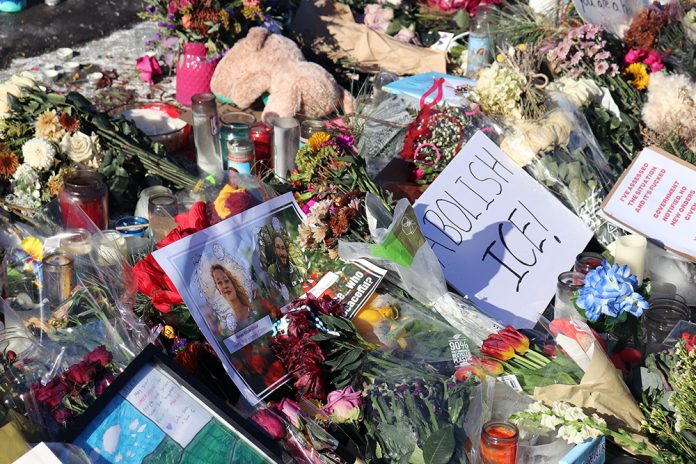
A “ABOLISH ICE” sign is seen next to photos of Renee Good and Alex Pretti on Jan. 27 at a memorial for Pretti on Nicollet Ave. and 26th St. in Minneapolis. The two American citizens were shot and killed by federal immigration agents during Trump’s Operation Metro Surge. Mshale Staff Photo by Tom Gitaa
A “ABOLISH ICE” sign is seen next to photos of Renee Good and Alex Pretti on Jan. 27 at a memorial for Pretti on Nicollet Ave. and 26th St. in Minneapolis. The two American citizens were shot and killed by federal immigration agents during Trump’s Operation Metro Surge. Mshale Staff Photo by Tom Gitaa
President Trump’s border czar Tom Homan announced in Minneapolis the morning of Feb. 12 that the administration’s Operation Metro Surge was coming to an end.
The operation saw over 3,000 agents brought to Minnesota starting in December 2025. The agents killed two American citizens during their activities in Minnesota. Renee Good, a Minneapolis mother of three was killed by ICE agent Jonathan Ross on Jan. 7. Good’s fatal shooting was followed less than three weeks later with that of Alex Pretti, an intensive-care nurse at the Minneapolis VA Medical Center.
Pretti was shot and killed by Customs and Border Protection officer Raymundo Gutierrez and Border Patrol agent Jesus Ochoa on Nicollet Avenue and 26th Street in Minneapolis on Jan. 24. The location is just four blocks from Mshale’s office.
Homan in announcing the end of the surge claimed that the 3,000 agents arrested 4,000 people.
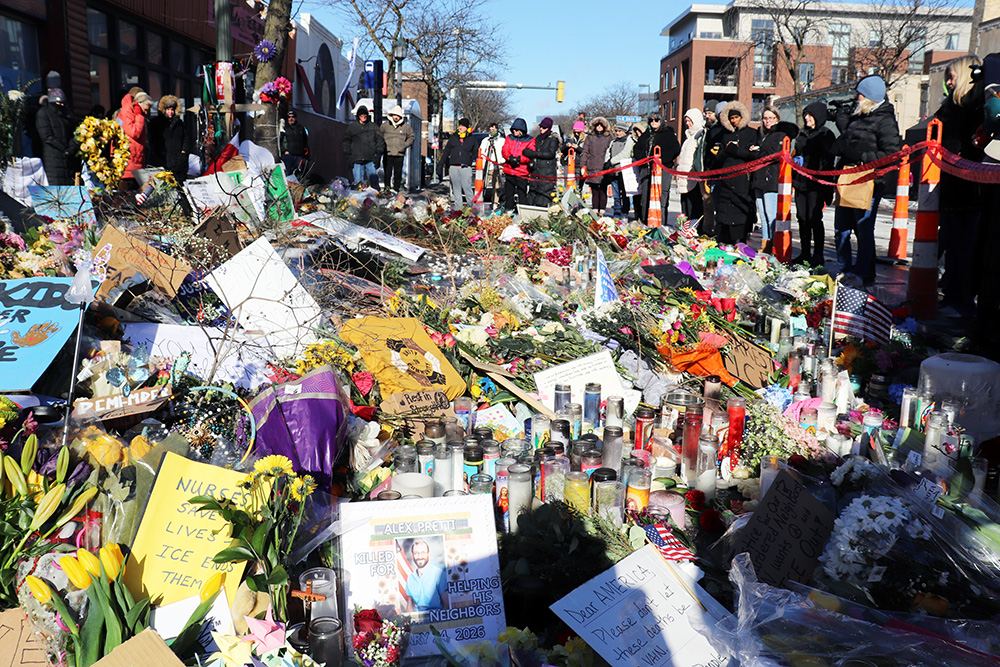
People pay their respects to Alex Pretti at a memorial to him on Nicollet Avenue and 26th Street in Minneapolis on Tuesday, Jan. 27, 2026. He was killed there by Customs and Border Protection officer Raymundo Gutierrez and Border Patrol agent Jesus Ochoa on Jan. 24, 2026. Mshale Staff Photo by Tom Gitaa
“I’m very pleased to report that this surge operation and our work here with state and local officials to improve coordination, and achieve mutual goals, as well as our efforts to address issues of concern here on the ground have yielded the successful results, we came here for in the Twin Cities,” Homan said.
Gov. Walz who had predicted a few days ago that a withdrawal was imminent, described the surge as “an unprecedented federal invasion in all aspects of life.”