Home Blog Page 238

Blair and Africa: The Critics Are Wrong

0

Iraq may be a failure, but the prime minister’s achievements in Africa and in science should not be overlooked

Failure in Iraq: those three words seem to define (for many Britons) the legacy of their soon-to-be-former prime minister, Tony Blair. But ask an African and an environmentalist, and the answer to the question of Blair’s defining legacy may well be different.

Tony Blair will be remembered by Africans for his courage in articulating their continent’s needs, especially through his Commission for Africa, through increased spending in the continent, and leveraging much, much more through his sponsorship of Africa as one of two agenda items for Britain’s presidency of the G8 in 2005. The environmental world will also remember him as being among the first leaders of his generation to take seriously the threat of global climate change.

It was during his decade-long tenure that the world community started to focus on Africa’s quest for building its own institutions for development, and jettisoning once and for all, the idea the traditional focus for so much aid policy on providing poor countries with relief.

Africans will remember Blair not simply as a champion of their cause, but also as someone who sought to help them to define their future, and helped to give them a sense that creativity, self-confidence and hard work are among the most important sources of success.

A leader with vision has a knack of attracting (or identifying) like-minded souls, and in listening to advice from unlikely places. Britain’s political leaders of the recent past have not been known for listening to the pronouncements from the country’s research community. Blair was different. Britain’s science community was both listened to and tasked with helping him to map out his vision.

I will pick four from the many names that deserve a mention. The first is the African chemist, Sir David King, his chief scientific adviser. The second, Lord Robert May, President of the Royal Society and King’s predecessor. Third is Sir Gordon Conway, former President of The Rockefeller Foundation, who was brought into the Department of International Development. The economist is Sir Nicholas Stern, the chief architect of the Commission for Africa before he went on to produce his landmark report on the economics of climate change.

Leaders with courage also find that luck tends to smile on them at the right moment. Blair’s tenure in Downing Street coincided with that of United Nations Secretary-General Kofi Annan, whose own efforts to find solutions to the problems of the world’s poorest are second to none. While they may have differed over aspects of British foreign policy in the Middle East, Blair and Annan were one and the same on Africa.

Together, Annan and Blair redefined development cooperation from the traditional focus on relief to a new vision that defines international development as an expression of endogenous human capabilities, especially through science, technology and innovation. Put another way, Blair helped to reinforce the critical message of empowerment and responsibility.

When Blair spoke of Africa, many of Africa’s own leaders were skeptical, and not without some justification. Memories of colonial rule remain. And for a dwindling generation, these are not happy memories. Some leaders feared broken promises and shattered dreams. But Blair and Gordon Brown proved them wrong. They backed the rhetoric with action.

The British press seems happy to characterize the Blair years as a decade of policy failures and spin. But a leader’s legacy unfolds; it cannot be decided by today’s news. Britons should learn from tomorrow’s historians and not today’s chroniclers.

It was the Finnish composer Jean Sibelius, who said: "Pay no attention to critics; no statue has ever been erected in honor of a critic."

Why Limit Immigration When We Need More Workers?

0

If we’re going to debate immigration, let’s at least get our facts right. Contrary to heated rhetoric coming from both the left and right, we’re not being flooded with foreign-born residents.

The annual inflow of immigrants, legal and illegal, amounts to about five people for every 1,000 U.S. residents. The rate was twice as high in the early years of the 20th century.

Do we need to fix our immigration laws? Yes. But does the primary focus need to be on keeping unwanted people out? Emphatically, no.

Major American industries like agriculture, construction and information technology would shrink without ready access to immigrant workers. As Congress debates immigration reform, its primary goal should be to provide the work force our economy needs.

To that end, it’s encouraging to see Democratic leaders reach a compromise with President Bush that includes a path to citizenship for some people who are in the country illegally. The compromise bill also includes an increase in the number of visas for skilled workers, and it creates a "points" system that would favor immigrants with education and job skills.

Business groups, though, are already griping about the bill. Compete America, a coalition that includes companies from Altria and Coca-Cola to Google and Microsoft, complains that the number of H1B visas for skilled workers still won’t be enough, and that the points system "will take key personnel decision-making out of the hands of U.S. employers."

In short, companies would rather recruit the workers they want, not have to choose among those the government lets in. The high-tech folks point out that a majority of U.S. advanced degrees in science, math and engineering are earned by foreigners, and that immigration quotas are too narrow to let those valuable graduates stay in this country.

Lower-tech industries aren’t satisfied either. The Associated General Contractors of America, a trade group for the construction industry, says it’s concerned about the immigration bill’s enforcement provisions, which would require companies to check workers’ records against a giant government database.

It sounds cumbersome, especially for an industry where time is money. "On a construction job, you can’t wait around for weeks or even several days to get your workers cleared," says Ken Simonson, the AGC’s chief economist. "They’re looking at implementing some streamlined verification procedure, but that remains a hypothetical at this point. We’re very concerned about the details and the expense."

The contractors also are worried about the idea of requiring illegal workers, if they want a path to legitimacy, to leave the country and then apply to come back. Simonson said the construction industry likes the idea of "greater certainty" about immigrants’ legal status, but fears a disruption in business if large numbers of workers are forced to leave temporarily.

Doing without immigrants simply isn’t an option. "We’ve been concerned for years about there not being enough workers entering construction and the large numbers approaching retirement age," Simonson said. "We certainly see immigration as an important part of the solution."

So, after we get our facts straight, let’s acknowledge one thing: We need hardworking people from other parts of the world. We need them to build our houses, harvest our crops, design our new high-tech devices.

Yes, we should enforce our immigration laws. But first we need to write laws that meet the needs of a 21st-century economy.

Conflict Resolution Training Sessions

0

Conflict resolution and mediation are needed in the work place and in organizations where arising ideas and different personalities might result in conflict.

Community Mediation Services, Inc. (CMS) and the Minneapolis Mediation Program (MMP) will be offering thirty hour training in the basic skills of the art of mediation, from July 11 through August 2. This training will include the theory, techniques and process of mediation and conflict resolution, as well as discussion of the rules and ethics governing mediation, according to Jessica Kuchta-Miller, Senior Project Manager for CMS. 

Participants who complete the training will become qualified to mediate in the State of Minnesota, either professionally or as volunteers.  Both CMS and MMP rely on volunteer mediators for their work in courts, schools and in the community.

However, Kuchta-Miller says that the value of mediation skills and insights reach far beyond the mediation table.  This training will provide important skills for the home, workplace, and/or community.  For example, participants can learn how:
–       To help individuals and organizations move beyond conflict and find common ground;
–       To better understand one’s approach to conflict, and gain confidence in dealing with conflict
–       To help facilitate difficult conversations, enabling individuals to hear and be heard;
–       To infuse decision-making processes with an air of dignity and respect; and,
–       To help people get “unstuck” through a more creative dispute resolution process.
 
Anyone interested in participating in this training can learn more and register by visiting the CMS website here, or by writing to [email protected].

Homeowner Records: What to Keep and How Long

0
Homeowner Records: What to Keep and How Long

Keeping full and accurate homeowner records is vital for determining not only your home deductions but also the basis or adjusted basis of your home. These records include your purchase contract and settlement papers if you bought the property or other objective evidence if you acquired it by gift, inheritance, or similar means.

You should also keep any receipts, canceled checks, and similar evidence for improvements or other additions to the basis. Some examples:
•    Putting an addition on your home
•    Replacing an entire roof
•    Paving your driveway
•    Installing central air conditioning
•    Rewiring your home
•    Assessments for local improvements
•    Amounts spent to restore damaged property

In addition, you should keep track of any decreases to the basis. Some examples:
•    Insurance or other reimbursement for casualty losses
•    Deductible casualty loss not covered by insurance
•    Payment received for easement or right-of-way granted
•    Value of subsidy for energy conservation measure excluded from income
•    Depreciation deduction if home is used for business or rental purposes

How you keep records is up to you, but they must be clear and accurate and must be available to the IRS. And you must keep these records for as long as they are important for the federal tax law.

Keep records that support an item of income or a deduction appearing on a return until the period of limitations for the return runs out. (A period of limitations is the limited period of time after which no legal action can be brought.)

For assessment of tax, this is generally three years from the date you filed the return. For filing a claim for credit or refund, this is generally three years from the date you filed the original return or two years from the date you paid the tax, whichever is later. Returns filed before the due date are treated as filed on the due date.
You may need to keep records relating to the basis of property (discussed earlier) longer than the period of limitations.

Note:
Technically, basis is needed to determine gain on home sale (loss is not deductible). That need has diminished for most homeowners now that gain up to $250,000 ($500,000 in some sales by married couples) is tax-exempt. Basis is still important, however, in figuring casualty loss, on conversion of the home to business use, or where there’s a gift of the home (in this case, important to the donee).   
Keep those records as long as they are important in figuring the basis of the property. Generally, this means for as long as you own the property and, after you dispose of it, for the period of limitations that applies to you.

A Look @ Mshale.com – One Year After Relaunch

0

A year ago, Mshale re-launched its website making it a lot more user-friendly, while bringing updated African news as they happen. This has allowed Mshale to not only have a national presence, but also an international one.

For those who are not tech savvy or those who have not had the time to visit the Mshale website, here are some vital tips that will enable easy, but substantial intake of vital events within the African community. The Mshale website has several appealing features such as the RSS feeds, the photo gallery, comment section, classifieds, directory, archives, and calendar. In addition, there are a variety of articles and columns that address vital topics relevant to our daily lifestyles such as finance, technology, immigration, entertainment, news and sports.

•    RSS (Really Simple Syndication) feeds: The Mshale RSS makes it easy for people to keep up with their favorite articles or news headlines in an automated manner than checking them manually. The RSS content can be read using a tool called a “feed reader” or an RSS aggregator. The user subscribes to a Mshale RSS feed by entering the feed’s link into the reader or by clicking on the RSS icon and then selecting the category of articles that you want continue receiving updated content on. These articles include the Atlanta Forum, Business, Entertainment, Features, Finance, Immigration, Lifestyle, News, Opinion, Sports, and Technology etc. 

•    Photo Gallery: This includes images of stories covered by Mshale staff.

•    Calendar: The Mshale calendar contains upcoming events by Africans all over the country. Users can also add their events to the calendar to alert the community on dates and venues.

•    Mshale Mailing List: To sign up for an updated Mshale newsletter, please click on the “Mailing List Sign Up” button, then enter your name and email address, check the “Interests” check box, then click the “Submit” button to submit your request. The newsletter generally contains a round-up of weekly news of nation and local events.

•    Comments: Sometimes a reader is compelled to react to an article as they read it. As has become common on many news sites, the comments feature is an interactive aspect that allows Mshale readers and authors to engage in dialog. Also note that all readers have an email address where they can be contacted directly.

•    Sharing Articles: If you have been to the Mshale website, you have no doubt seen next to each article links that allow you to share your favorite articles with others.

Columns and Sections
•    Technology: This column enlightens Mshale readers about the latest or upcoming technology such as high-tech gadgets, latest software, futuristic houses, high-tech footwear etc.

•    News Headlines: This article informs the reader of the latest events that pertain to our community.

•    Finance: This article gives financial insight to the reader concerning various financial aspects such as taxes and loans.

CNN Bio on Former Africa Correspondent Jeff Koinange

3
CNN Bio on Former Africa Correspondent Jeff Koinange

Jeff Koinange is CNN’s Africa correspondent, responsible for reporting for CNN from across the African continent. Since joining CNN in 2001, he has reported on news events throughout Africa for the international news network.

Since joining CNN, Koinange has covered a range of African issues and events with a dedication to professional impartiality while using his experience to report on his topics sympathetically.

He has reported on major events from all across the African continent. These have included the violent civil war that led to the overthrow of Charles Taylor in Liberia – where he secured an exclusive interview with the out-going president – to the subsequent inauguration of Ellen Johnson-Sirleaf in Liberia as Africa’s first female-elected president and the arrest and deportation of Charles Taylor in 2006. He has reported from Sudan on the crisis in Darfur and also from Uganda on the refugees who have fled Sudan’s Lords Resistance Army. He has covered Nigeria extensively, its politics, its economy and its people and has travelled to numerous other African countries reflecting life on the continent to CNN’s global audience.

Although Koinange is CNN’s Africa correspondent, his journalistic talents mean he frequently reports from outside the continent. In 2005 he was part of CNN’s Peabody award winning team who covered the devastation wreaked on News Orleans by Hurricane Katrina. He has also reported from Baghdad on the post-war insurgency, reconstruction and the historic 2005 elections in Iraq.

Other significant events that Koinange has covered during his time with CNN include the US President, George W. Bush’s Africa tour, the first by a sitting US Republican President; the ten-year anniversary of the genocide that killed up to a million people in a hundred days of savage slaughter in Rwanda; Africa’s preparation and anticipation of the FIFA World Cup’s debut on the African continent in 2010; elections in Zimbabwe, Uganda and Sierra Leone; troop deployments in the war on terror in Djibouti on the Horn of Africa; the attempted coup and evacuation of French and American civilians in the Ivory Coast, as well as the ensuing peace talks; and the World Summit on Sustainable Development in Johannesburg.

Prior to joining CNN, Koinange worked for Reuters Television from 1995 to 2001, covering the majority of the African continent. In 1999, he was promoted to chief producer for the Southern African region, where he was responsible for news coverage in 15 African countries.

He reported on numerous stories including the election of Thabo Mbeki in 2000 and the assassination of President Kabila in Kinshasa in 2001. Before being appointed to this position, he was senior producer for West Africa, where he oversaw television coverage for 24 nations and documented the vast changes in Nigeria following the death of Sanni Abacha. In 1995, Koinange joined Reuters Television as a producer for the Eastern and Central African region where he covered the Ethiopian Airlines hijacking in 1996, the overthrow of Mobutu by Kabila and the subsequent creation of the Democratic Republic of Congo in 1997.

Previously Koinange spent a year as an associate producer for NBC News in New York in 1994, where he worked as an overnight producer for the Today Show. Between 1992 and 1994 he was a reporter/associate producer for the Medical News Network. In 1991, Koinange began his career as a desk assistant/off air reporter, for ABC News in New York, where he worked on the U.S. and international desks.

2006 saw him collect a number of awards for his work, including a Television EMMY for coverage of the Niger Famine, ‘Starving in Plain Sight’, the Peabody Award as part of CNN’s coverage of Hurricane Katrina, the Prix des Lyceens Basse-Normandie for coverage of rape victims in the DRC, and the National Association of Black Journalists award for work on the famine in Malawi, Desperation in Malawi’. This last package also earned Koinange the 2005 Vernon Jarrett Award from the Institute of Advanced Journalism at the North Carolina A&T State University for ‘Best Feature’. In 2002, Koinange’s coverage of the crisis in Liberia earned him second runner-up in the Headliner Awards in the USA. In 1999, Koinange was a finalist in the Prix Bayeux for his coverage of the war in Sierra Leone.

He is also a panellist on the CNN African Journalist of the Year Award judging committee and a regular Masters of Ceremonies for the event. In 2005 Koinange was part of the CNN News team that won the 2005 Peabody Award for "Coverage of Hurricane Katrina and its aftermath"

Koinange is Kenyan and holds a Bachelor of Arts degree in broadcast journalism from New York University.

Congressman Payne Calls for Stronger U.S. Action Against Vulture Funds

0
Congressman Payne Calls for Stronger U.S. Action Against Vulture Funds

Yesterday, Congressman Donald M. Payne, Chairman of the Subcommittee on Africa and Global Health, held a hearing on the topic "Vulture Funds and the Threat to Debt Relief in Africa: A Call to Action at the G-8 and Beyond." During the hearing, Payne urged the US government to take action against the predatory practices of a class of commercial creditors appropriately known as "vulture funds".

These companies try to use the sanguine term "distressed-debt investors" to mask the fact that they buy debt of highly-indebted poor African countries for pennies on the dollar only to turn around and demand through litigation the full value of the initial debt plus interest and fees.   Many times, these odious debts were acquired by authoritarian regimes and were not used in the legitimate interests of their people.

When creditor nations and multinational institutions like the International Monetary Fund (IMF) and the World Bank decided to offer debt relief and cancellation, the intent was to give these nations the opportunity to reallocate newly freed financial resources towards achieving the UN Millennium Development Goals.   Vulture funds threaten to derail progress made on debt relief in Africa.   During the hearing, Representative Payne stated, "Instead of servicing millions of dollars in debt annually, these nations could finally begin to service their own people.   Schools could be built, teachers and nurses could be hired, life-saving medication could be distributed.   Yet, with the threat of vulture funds waiting in the wings to swoop down and prey on struggling, impoverished African nations, poverty reduction programs and plans for economic development could come to a grinding halt.   Thus, a few Americans are begetting fortunes at the expense of the misfortune and further impoverishment of millions of Africans. This is morally reprehensible and exploitative."

Congressman Payne was joined at the hearing by Mr. Danny Glover, Actor/Activist and Chairman of the Board of TransAfrica Forum, Ms. Emira Woods, Co-Director of Foreign Policy in Focus at the Institute of Policy Studies, and Mr. Neil Watkins, National Director at JubileeUSA Network who all testified to the detrimental effects that vulture funds, if left unchecked, could have on African nations.   "The morally bankrupt actions of vulture funds render the commitments to debt relief made by the US and other wealthy nations meaningless.   We urge the international community to come up with effective means to protect countries pursued by vulture funds in the future," Mr. Glover declared.

As the industrial nations meet in Germany at the G-8 Summit on June 6-8, 2007, the United States must play an active role in the vulture funds discussion.   Given that the United States is a prime destination for litigation by these funds and is a leading nation on debt relief, it has the ability to generate policy proposals and garner support among other nations.   Congressman Payne vowed, "I, along with other Members of Congress, will be sending a letter to President Bush calling upon him to take a stronger stand against vulture funds by assisting nations that have or could potentially under come attack.    We must encourage G-8 nations to close the legal loopholes that allow these vulture funds to prosper."

East Africa Federation Faces Challenge of Globalization, Says International Scholar

0
East Africa Federation Faces Challenge of Globalization, Says International Scholar

A deliberate attempt to ensure that under developed regions of Kenya, Uganda and Tanzania are a priority in allocating scarce resources is critical to the success of the envisioned East Africa political federation, a leading international scholar, Dr. Ahmed Samatar has said. Dr. Samatar, the Dean of International Studies and Programming at Macalester College in Saint Paul was speaking during a listening session to gather views from the three countries’ nationals living in Minnesota.

Dr. Samatar said issues that led to the earlier collapse of the East African Community have to be dealt with head-on. He said success is dependent on the political federation being better, more grounded and constitutionally based than the African Union which he described as a big joke “have you looked at the budget of the AU, it cannot even do anything” he said. Dr. Samatar said the federation ahs to have an institutional basis. He added that the challenges facing the new East Africa cooperation are different than what led to its collapse in the 1970s. The new cooperation between the three countries has to be examined in the context of globalization which was not as pressing in early years. “All of these three countries need each other”, he said as none can stand on its own.

The listening session was organized by the three countries’ respective Minnesota associations (Umoja Society – Tanzania, Kenya Community in Minnesota – KCM and Uganda Association in Minnesota – UGAMN) and was held at a conference room at the Hennepin County Brookdale Library in Brooklyn Center, just outside of Minneapolis. Views are being collected around the United States from nationals of these countries to be eventually forwarded to the EAC Secretariat in Arusha under the aegis of the East African Cooperation Forum in Hudson, New Hampshire and the Atlanta based East Africa America Business Council. Dr. John Wathum-Ocama, an adjunct professor at the University of Minnesota presented a PowerPoint presentation outlining the progress achieved so far as the countries march towards a federation.

Rwanda and Burundi are also expected to join the regional bloc this summer with the EAC Secretariat formally acknowledging last week that Rwanda will be formally accepted on June 18. With the two countries coming to the fold, the domestic market for the East African Community will grow to 120 million.

Prof. Samatar opined that Africa’s failing has been its unwillingness to make investments in what he called an “intellectual culture”. He said Botswana’s stature as an African success story is due in part to its ability to marry both modern ways of governance with African traditional systems that are still relevant in our age.

Those who did not make it to any of the sessions around the country can fill out a survey online to express their views on the proposed federation.

Minnesota International Center Celebrates Ireland

0

What do you know about Ireland? Perhaps you have heard of its beautiful countryside or Irish beer or Irish Step Dancing? This year the Minnesota International Center in line with its goal of educating the community about different countries around the world honored Ireland. In a series of events throughout the year the culminated in a huge fundraiser benefit, MIC brought together Irish nationals, Irish Americans and Minnesotans whose interaction was as diverse from cultural exchanges to strengthen trade relations.

MIC President Carol Byrne described the MIC Gala Benefit thus, "It is a springboard for socializing while showing love for the MIC community and the country of the year. There is a strong Irish community here in the cities and it is MIC’s role to reach out to them."

This year’s fundraising saw MIC raise more than $140,000 in ticket sales, donations and the sale of auction items. Auctioned items included dinner with Irish diplomats in the US and holiday packages to Ireland. Karen Sorbo, former Mrs. Minnesota was the nights auctioneer working her way into the pockets of guests as she urged them on to purchase the packages. Guests were treated new Irish cuisine and Irish musicians with an ensemble that included some of the members of the original Irish River Dance.

Sean Farrell, the Irish Consul General, who was the guest speaker, commended MIC in its development and strengthening of trade relations between Ireland and Minnesota. He looked forward to a continued growth in this relationship. Lunch with him was one of the highlights of the auction.

MIC is the sixth largest world affairs council in the US. Each year, MIC puts together a gala benefit focusing on a specific country. Last year MIC’s highlight was Morocco. Other events leading up to this year’s gala included a literary session with artistic director of the Guthrie Theater, Joe Dowling. He spoke “about the significant contributions Irish playwrights had on the dramatic literary cannon with names such as George Farquhar, Oscar Wilde, Samuel Beckett, Brendan Behan and Brian Friel.”

MIC annual programs include: world affairs forums, an international visitor leadership program, and international classroom connection program among others.

Sam Ongeri: “Kanu Is Clean”

0

Minnesota Kenyans continue to be the faithful Diaspora in receiving Kenyan politicians interested in running for office in Kenya’s general election later this year. The latest to make a stop here was former Health Minister, Professor Sam Ongeri. He is the former Member of Parliament for the Nyaribari Masaba constituency. He declared at the meeting that he will contest in the upcoming elections to try and reclaim the seat he lost to Mr. Hezron Manduku a fellow physician.

Prof. Ongeri addressed members of the Minnesotan Kenyan community that consisted largely of people from the constituency he once represented in parliament. Ongeri is impressed by the support the Minnesotan Diaspora has continued to offer their communities in Kenya. As a result, he wanted to engage them in dialog on the political and economic growth of the country.

Running on the former ruling party KANU (Kenya African National Union) ticket, Ongeri is confident that his party has the right platform for the future of Kenya since it “built the infrastructure and allowed for freedom of speech.”

On questions of all the controversy that has mired KANU, Ongeri quipped, “KANU is now pure since all the inefficient and corrupt leaders have left for other political parties.” However, Ongeri is also convinced that no single party will win a majority in the elections and leaders will have to get into coalitions.

With Kenya’s electorate getting smarter, it is without a doubt that this year’s election will demand accountability and deliverance from its political leaders. Ongeri feels that he can step up to the plate. He prides in himself as initiating polytechnics and other post-secondary institutions in Kenya. He developed a healthcare system plan, which with several phases including development of healthcare infrastructure and personnel will lead to a universal healthcare system. His experience working with the healthcare industry in bringing down the cost of retro-viral HIV/AIDS drugs, he declares will make him more than able to represent members of his Nyaribari Masaba constituency in Kisii district.

Ongeri expressed his concern in blind promises made by politicians. For instance, he cites the rush to free primary education was not phased in well to accommodate the needs of Kenyan children. Hundreds of children, especially girls, are still not getting basic primary education thanks to poverty. Ongeri also cited the need to develop post secondary institutions to meet the gross need of primary school graduates. “The core of Kenya’s future lies in its youth so we have to create alternative sources of employment and skills so that we do not have a frustrated youth.”

As the chair of the board of governors at a local high school in his district, Ongeri, even when away from active politics, has made a model school showing what can be done with few resources. By empowering the teachers through education seminars and visits to well-performing schools in other parts of the country, Ongeri and his board have made it possible for disenfranchised students to get admissions into the national universities.

As is the case in these types of meetings, the most interesting part is the question and answer session. Answering questions from the audience, Prof. Ongeri took issues with what he called the “rosy picture” that the Kibaki administration has been painting regarding economic performance. He said there was a disconnect between the rosy picture painted and The Kenya Integrated Household Budget Survey released in late April. The survey indicated poverty levels in the country dropped from 56.8% in 2000 to 46% in 2005. He said the poverty figures confirmed government critics’ worst fears that there was inequitable distribution of resources in the country. The survey results showed Nairobi and Central Kenya where president Kibaki and his inner circle are from have the lowest poverty rates at 21% and 30% respectively with Prof. Ongeri’s Nyanza province at 47%. The most poverty stricken province is North-Eastern at 73%.

Prof.Ongeri also shared his position on current jostling within the Orange Democratic Movement (ODM) indicating that he will not endorse any candidate until a clear nomination is made and ODM presents a candidate that will square off with president Kibaki. He urged his Gusii community to not blindly get behind a candidate. His criticism of the Kibaki government found a receptive audience. One of those disappointed with the performance of the current administration is a former civil servant now living in Minnesota, Linet Nyabuto. She accused the Kibaki government of purging the government of the Abagusii giving an example of Professor Ratemo Michieka who was fired as Vice-Chancellor of Jomo Kenyatta University of Agriculture and Technology after Kibaki took over. She wanted to know what Dr. Ongeri can do to ensure job security when new administrations take over.

Also making brief remarks at the meeting was the Mwanyagetinge Umoja chairman, Paul Morande, who commended Professor Ongeri on his early work to combat HIV/AIDS in Kenya before it was fashionable to do so.

Tom Gitaa contributed to this report.

African Non-Profits in Minnesota to Acculturize

0
African Non-Profits in Minnesota to Acculturize

African immigrants in Minnesota today comprise 25% of the black community in this state and should learn to understand the funding culture of philanthropic organizations in America if they are to attract any money to meet their ever-growing needs.

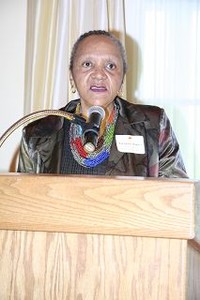
Delivering a keynote address at the Center for Families in North Minneapolis on April 26 on a community dialogue on the impact of African non-profits, Dr Jacqueline Copeland admitted that there is a cultural and communication gap between funding agencies and non-profits that has to be addressed.

She told a fully packed assembly of stakeholders that many philanthropists in America do not have a clear understanding of the intrinsic African culture and core values. She said they mainly relied on the mainstream media exposition of the African stereotypes that depict Africans as unreliable, corrupt and a people on the lookout for handouts.

She said contrary to those racist stereotypes, Africans have a long tradition of volunteer work and “do take care of their communities here and at home.” She cited a World Bank Report that pointed out that in the year 2006, the Africans in the Diaspora remitted to the mother continent $ 20 billion, the largest single net-flow of capital to Africa.

Through a process of acculturation, she noted, African-led non profits must learn to adjust to a complex culture, understand the funding trends as public expectations change over time and collaborate with other successful non-profits by learning from their experiences to succeed.

She noted that in America today about 300 no-profits are established each week and thus the competition for limited funding resources is intense. African non-profits should be focused in their core missions and articulate their priorities as a way to respond to their community needs and attract funding.

The community dialogue on African nonprofits was organized by the Minnesota Council of Nonprofits (MCN) in collaboration with the Leadership Empowerment and Development Group (LEAD). Research findings compiled by a University of Minnesota student pursuing a masters program in public health, Omar Fernandes, comprised recommendations that formed the bedrock of a lively discussion. The co-presenter  was the Executive Director of LEAD, Qamar Ibrahim.

In their recommendations, they urged funders to compare and contrast the amount and impact of resources going to mainstream organizations as opposed to smaller African-led organizations to ensure optimal distribution and use of resources. They noted that funders should periodically examine their commitments as their investments have lacked continuity and have not kept pace with the growing needs of the African immigrant population in Minnesota.

 The presenters noted that African-led non-profits should take part in future surveys and research as a means of communicating their needs. They are to learn how to communicate directly, openly and honestly with the stakeholders on organizational strengths and weaknesses and resource capacity needs to be able to have their expectations met.

Norman Harrington Jr., President of NWH & Associates – a management consulting firm – advised African non profits to approach funders “with an asset base instead of a deficit.” He said they should articulate their requests with a Pan-Africanist mission that resonates with the changing political climate of the day. He said they look more credible when they bring something of their own on the table rather than coming empty-handed.

A member of the public complained that as African-led non-profits succeeded in capacity building, their dependable staff are lured into greener pastures thus leaving the organization with a cycle of training experts that end up serving more stable institutions where employees get a fat paycheck.

Some 32 nonprofits were examined over a five-year period (2001 – 2005) to determine their historical financial trends of annual revenues and expenditure. Throughout the five-year period, the average revenue was close to $ 150,000 – relatively small nonprofits but the cumulative resources more than tripled during this period. Expenses for the organizations in 2005 averaged $ 190,000. Of the 32 nonprofits surveyed, 77 percent of their revenue sources came from charitable contributions, gifts and grants, and 19 % came from program service revenue, including government fees and contracts, and 4 percent came from other sources.

In terms of expenses by functional categories, 80 percent of African-led nonprofits’ total expenses went to program services, 16 percent went to management and general expenses while 4 percent went to fundraising activities.

The African Nonprofits 2007 Report noted that as of expenses in categories, “50 percent of the African-led nonprofits’ total expenses went to salaries, other compensation and employee benefits, 9 percent went to occupancy, rent, utilities and maintenance, 6 percent went to travel, conferences and meetings, 3 percent went to professional fees and other payments to independent contractors, 1 percent went to printing, publications, postage and shipping, and 31 percent went to other expenses.”

It was further noted that as no single organization has exclusive contact with a client, it was imperative for nonprofits to collaborate with one another to share valuable information, utilize resources efficiently, and provide a variety of programs and service to clients.

Minnesota’s African immigrant population has seen more than a threefold increase since 2000, and includes representation from 45 nationalities. Large numbers of immigrants come from Somalia, Ethiopia, Liberia, Kenya and Nigeria. Nonprofits provide key services to immigrants, refugees and asylum seekers.

The Guest of Honor, Dr Jacqueline Copeland has 25 years experience as grant-maker, researcher and evaluator in the philanthropic nonprofit sector. She has taught philanthropy to graduate and professional students at the University of Minnesota and at St Mary’s University.

Apart from being Founder and Partner of Copeland Carson & Associates, a national philanthropic services and evaluation firm, she has authored two books: Creating Africa in America and Creating Evaluation Anthropology. She now lives in San Jose California with her husband and teenage daughter.