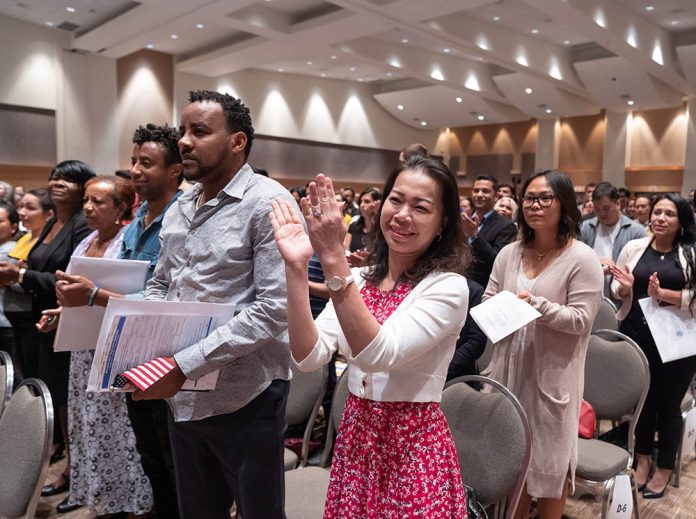

A wide view shows delegates gathered during the Senate District 38 DFL convention Sunday, April 12, 2026, at Woodland Elementary School in Brooklyn Park. Mshale Staff Photo by Richard Ooga
DFL delegates at Sunday’s Senate District 38 convention deadlocked on an endorsement for state senator, with neither candidate securing enough support to win the party’s backing.
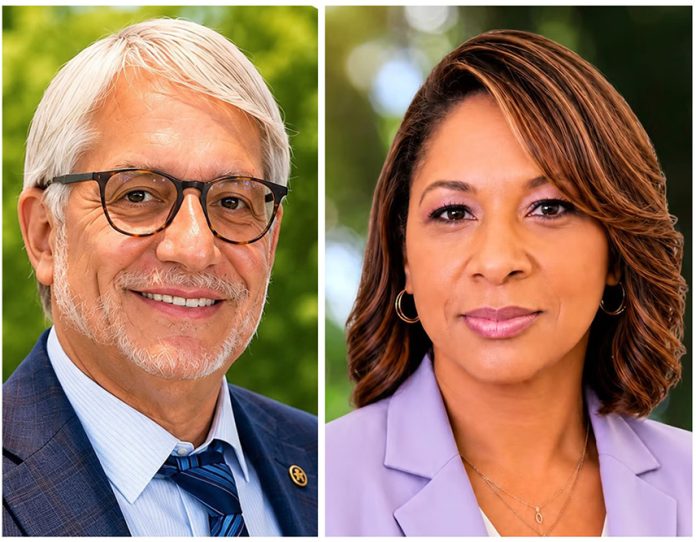
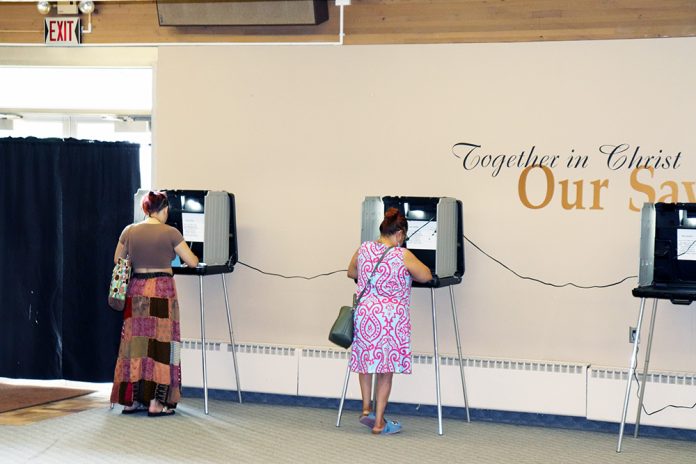
Incumbent Sen. Susan Pha and challenger Nehemiah Garley each fell short of the 60% threshold required for endorsement among the 184 credentialed delegates during the nearly six-hour convention Sunday afternoon at the gymnasium of Woodland Elementary School in Brooklyn Park.
Senate District 38, a heavily DFL-leaning district, includes all of Brooklyn Center and Osseo and about half of Brooklyn Park. It spans both the 3rd and 5th Congressional Districts.
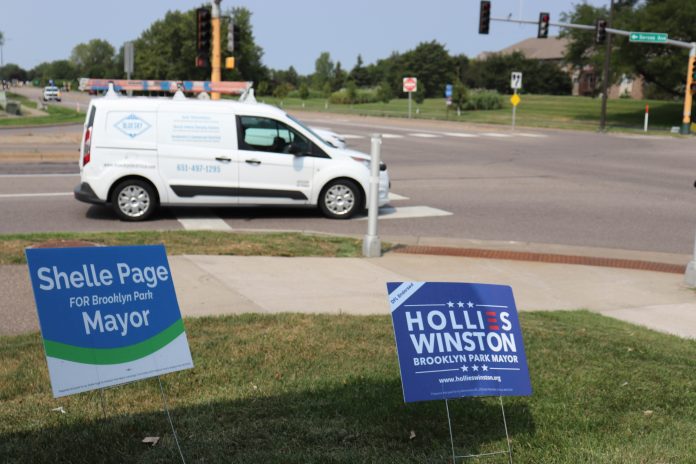
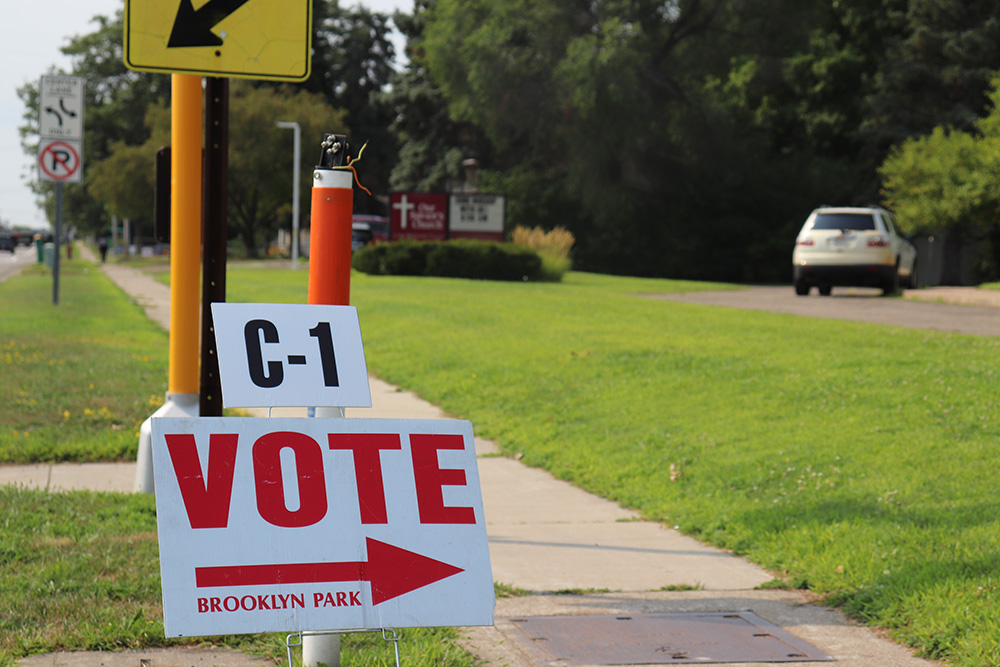
A variety of candidate yard signs are displayed at the entrance to Woodland Elementary School during the Senate District 38 DFL convention Sunday, April 12, 2026, in Brooklyn Park. Mshale Staff Photo by Richard Ooga
Sunday’s gathering was a continuation of a March 7 convention that also failed to produce an endorsement after three rounds of voting and left party business unfinished. April 12 marked the final day the Minnesota DFL allows local organizing units such as Senate District 38 to hold conventions.
Delegates conducted one additional round of voting Sunday — the fourth overall — with Pha receiving 53% and Garley 47%. After it became clear a fifth round would not break the impasse, Pha moved for a no-endorsement outcome, which Garley seconded.
The convention was not without controversy.
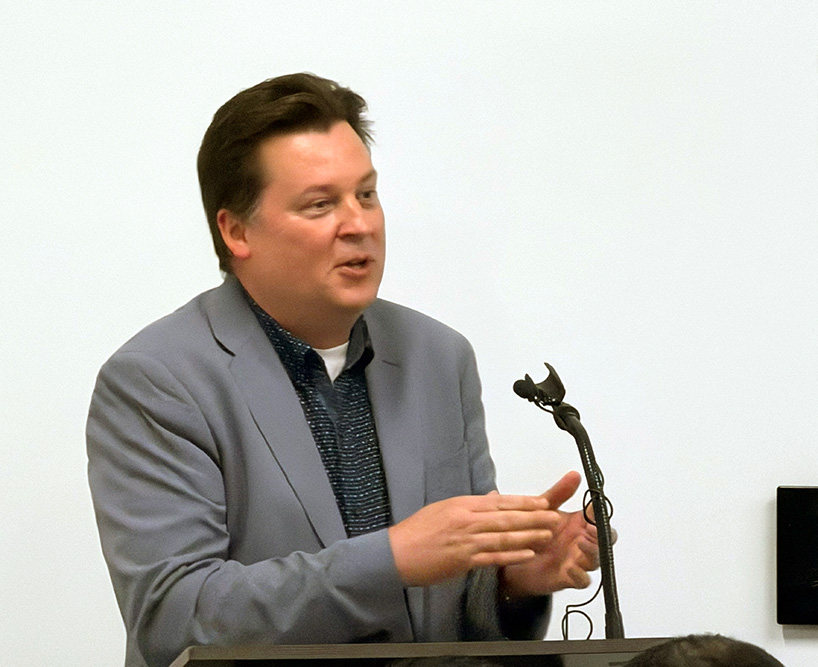
Martino Nguyen addresses delegates Sunday, April 12, 2026, at the Senate District 38 DFL convention at Woodland Elementary School in Brooklyn Park after being given the opportunity to defend himself. Mshale Staff Photo by Richard Ooga
Delegate Martino Nguyen, an immigrant from Vietnam, was accused by Pha’s campaign of supporting Republican positions, prompting an effort to remove him from the convention. Pha supporters said they had screenshots of Nguyen expressing views aligned with Republican talking points, and pointed to a social media video in which he criticized Pha’s reelection bid.
After review, the credentials committee confirmed Nguyen had participated in the February DFL caucus and recommended he be allowed to remain a delegate under party rules. However, delegates later approved a motion backed by Pha’s campaign to strip Nguyen of his voting privileges.
The primary election is Aug. 11.
Sen. Susan Pha addresses delegates Sunday, April 12, 2026, at the Senate District 38 DFL convention at Woodland Elementary School in Brooklyn Park. Pha later moved to strike a delegate from participation during the convention. Mshale Staff Photo by Richard Ooga
Senate District 38 DFL Chair Hassanen Mohamed said he was not concerned by the lack of endorsement, emphasizing party unity in November.
“Both candidates have shown a strong commitment to our community,” Mohamed said. “Once voters decide in August, DFLers in the district will unite to ensure a win in November.”
Pha’s inability to secure the party endorsement is not unprecedented. In 2022, she also failed to win the endorsement for the open seat but went on to prevail in the primary.
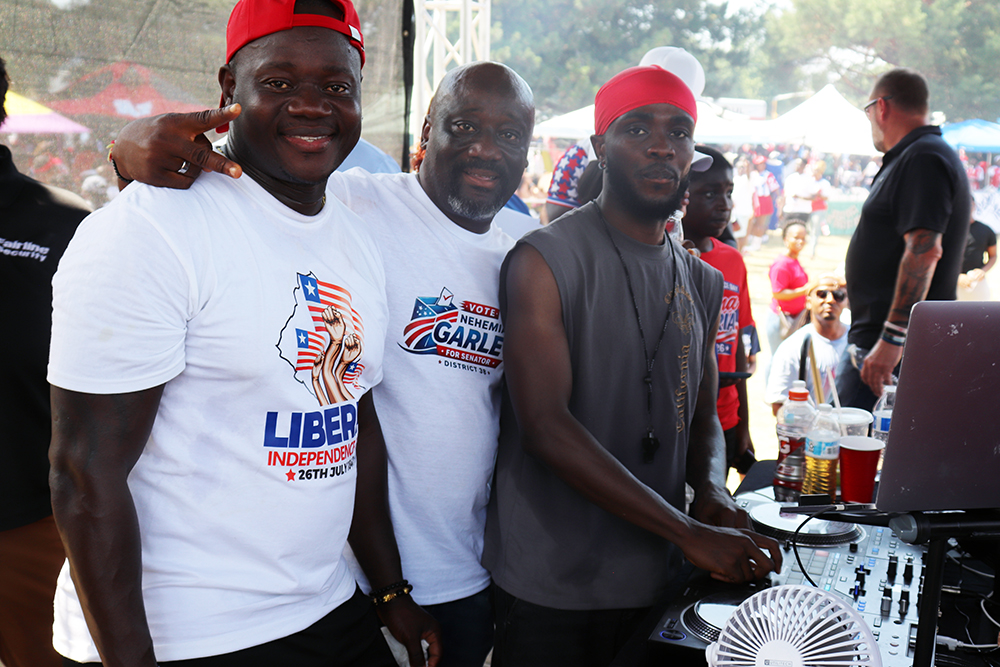
Both candidates spent much of Sunday working the convention floor, speaking with delegates and clarifying procedures. Their outreach often reflected their bases of support: Pha focused largely on Asian and white delegates, while Garley engaged primarily with Black delegates, including African immigrants and African Americans.
Among the delegates was Brooklyn Park Mayor Hollies Winston, a former chair of the Brooklyn Park DFL.
Nehemiah Garley speaks with a seated delegate during the Senate District 38 DFL convention Sunday at Woodland Elementary School in Brooklyn Park. Mshale Staff Photo by Richard Ooga
“I am sure you know the endorsement that really matters is the one that the DFL voters give,” Garley told Mshale. “I’m very confident that we are going to win the primary.”
Pha campaign co-chair Linda Freemon said the senator was grateful for her supporters and noted that Pha received a majority of votes in all four ballots across the two-part convention.
“She looks forward to winning DFL endorsement at the primary,” Freemon said in a statement.
SD 38 DFL chair Hassanen Mohamed, left, and Brooklyn Park Mayor Hollies Winston observe proceedings Sunday, April 12, 2026, at the Senate District 38 DFL convention at Woodland Elementary School in Brooklyn Park. Mshale Staff Photo by Richard Ooga
While delegates did not reach consensus in the state Senate race, they did elect representatives to attend upcoming congressional district conventions.
Cyrille Brotto, left, and Ablaye Cissoko will perform at St. Olaf Catholic Church in Minneapolis on May 1. The concert marks Cissoko’s first appearance in Minneapolis. Photo: Courtesy
“Behind the instruments, there are above all human beings and when they have a story to tell,” Ablaye Cissoko told Mshale via a translated interview recently, “everything becomes easier—creation and connection come more naturally. Everything starts from there.”
Ablaye Cissoko, now living in Saint Louis in Senegal, son of a griot and a griot himself, embodies both the Mandinka traditions and contemporary music in his own created musical form playing the kora.
May 1st he’ll join French accordionist Cyrille Brotto in the sanctuary of St. Olaf Catholic Church as part of the church’s music series program. Their unique blend of a European instrument and another from West Africa has been happening since 2021. Cissoko said, “collaboration between musicians can work very well, even though some instruments may seem difficult to combine at first.”
The story behind this pair’s collaboration involves a bit of chance and a bit of carpe diem. “Cyrille invited me to his home through my manager for a private concert, as his wife is a big fan of my music,” explained Cissoko. “He jokingly said he wanted to score points with his beloved. I accepted, because that is part of the role of a griot.
That’s when I discovered that he was an accordion player. I suggested we play a few pieces together, to which he agreed. I then discovered a true master of this instrument, for whom I have great respect today,” said Cissoko.
In the end, the kora and the accordion were meant to meet. The kora is played with plucked and articulated strings, while the accordion brings layers and breathing through its bellows. “The two instruments complement each other perfectly,” said Cissoko, “and beyond that, the accordion enhances the sense of melancholy that I sometimes express in my songs.”
For griots, the kora’s function supersedes that of an instrument—it is a sacred vessel of history, identity, and storytelling. The kora’s expansive power allows the griot to evoke deep emotions, preserve history, and bring healing through music.
Cissoko described how the allure of the kora mesmerizes musician and non-musician alike. “Some are drawn to the instrument itself, others to the philosophy behind it,” he said. “There is a legend that says the kora was brought to Earth to heal people’s souls. There is a deeply soothing effect both in listening to it and in playing it.”
Friday, May 1st will be Cissoko’s first time performing in Minneapolis. “We are really looking forward to it. So far, we have mainly played on the East and West coasts,” he said.
Cissoko said he hopes the audience will discover a unique meeting between two musical worlds and two instruments. “Above all, we hope to offer them a beautiful concert and that they will leave feeling happy and at peace.”
‘Renew the Blue’ continues for the METRO Blue Line
After two decades of service, we are making improvements to the METRO Blue Line as part of the ‘Renew the Blue’ initiative. This includes four distinct projects that will help preserve and protect this critical piece of our infrastructure investment, helping it remain safe, reliable, and affordable. These projects include Track & Signals (now in Phase 2), Lake Street/Midtown Station renovation, Franklin Station renovation, and Your Station, Renewed (which includes the renewal of lighting, benches, other amenities, and masonry etc.).
Replacement Blue Line bus and track repair work between Fort Snelling and Mall of America stations.
Track & Signals | Phase 2 begins
This summer, Phase 2 of the Track & Signals project will take place, which will include track replacement and upgrades to signals and other equipment that guide Metro Transit’s light rail train movements. The upgrades will allow safer and more efficient routing of trains, reducing delays, and improving schedule reliability. Buses will replace trains over multiple dates in 2026 along the Blue Line to allow for the planned maintenance in the corridor.
Replacement Blue Line bus service will operate during these dates in 2026*:
May 9 – May 10: Buses replace trains between Target Field and Fort Snelling stations
May 30 – May 31: Buses replace trains between Target Field and Fort Snelling stations
June 29 – Aug. 19: Buses replace trains between Target Field and Mall of America stations
The shared downtown Minneapolis METRO Green Line stations will also be affected during segments of the above June 29 – Aug. 19 Blue Line maintenance period (see below):
June 29 – July 26: Buses replace Green Line trains between Target Field and West Bank stations. (Note: METRO Green Line customers on board the train can transfer to a Blue Line bus at West Bank Station to continue west into downtown Minneapolis or south toward Mall of America. Green Line customers should exit replacement bus at West Bank station to continue east to St. Paul on the Green Line.)
METRO Green Line trains will operate fully between Union Depot and Target Field stations July 27 – Aug. 15.
16 – Aug. 19: Buses replace Green Line trains between Target Field and West Bank stations (Note: METRO Green Line customers on board the train can transfer to a Blue Line bus at West Bank Station to continue west into downtown Minneapolis or south toward Mall of America. Green Line customers should exit replacement bus at West Bank station to continue east to St. Paul on the Green Line.)
*Dates and affected stations are subject to change. Visit metrotransit.org/track-signals for the most current information.
Please plan extra time for your trip. Replacement bus timing can vary and trips will take longer. Metro Transit staff will also be on hand to assist customers.
The METRO D Line, with service between Brooklyn Center and Mall of America in Bloomington, is another good alternative for those traveling to or from downtown Minneapolis.
Dive into the details
A full renovation of the Lake Street/Midtown Station is now scheduled to begin in 2027 after no construction bids were received last year. The upgraded station will feature a new pedestrian ramp, wider stairways opening onto Lake Street, enhanced lighting and a transit service center.
A renovation of the Franklin Avenue Station is also expected to begin in 2027. Like the Lake Street/Midtown Station project, the goal is to provide enhanced safety, better station access, and a more welcoming rider experience. We are accepting input during this design phase, so get involved and learn more at metrotransit.org/franklin.
Upgrades, repairs, and overall improvements at stations and platforms will continue with Your Station, Renewed. A recent amenity upgrade was completed – watch the bench refurbishment process here.
The final phase of the Track and Signals project will occur in 2027 and include additional rail and signal work. Buses will replace Blue Line trains during the spring and summer.
Stay informed
Riders are encouraged to sign up now to receive timely updates of replacement bus schedules at metrotransit.org/alerts and visit metrotransit.org/renew-the-blue to learn about the work and sign up for the newsletter. Assistance is available in multiple languages by calling 612-373-3333.
Lieutenant Gov. Peggy Flanagan, a member of the White Earth Band of Ojibwe and the first Native American woman elected lieutenant governor in the United States, speaks at the 2023 African Heritage Day on the Hill event. Mshale Staff Photo by Richard Ooga
The Council for Minnesotans of African Heritage has announced that its annual African Heritage Day on the Hill will take place Friday, April 24, 2026, after being postponed from its original February date due to safety concerns, as Operation Metro Surge was at its peak.
The council is a state agency that advises the governor and Legislature on issues affecting Minnesotans of African heritage. It also serves as a liaison between the community and state government, working to ensure residents can fully participate in and benefit from public policies and programs.
African Heritage Day on the Hill is one of the council’s signature events, bringing together community members, advocates, and policymakers at the Minnesota State Capitol to highlight legislative priorities and encourage civic engagement.
Programming will begin with a Youth Summit at 9 a.m. at the Radisson Hotel in downtown St. Paul. The summit is designed to engage young people in leadership and advocacy. Registration is required, and participants can sign up by emailing [email protected].
The Day on the Hill program will follow at 1 p.m. in the Capitol Rotunda, where attendees can hear from speakers and connect directly with elected officials.
Organizers say the event provides an important platform for dialogue on key issues, including education, economic opportunity, health, and public safety.
Community members are encouraged to attend and take part in shaping policies that impact Minnesotans of African heritage.
Brooklyn Park Mayor Hollies Winston delivers his final State of the City address of his first term at Edinburgh USA on Tuesday, April 7, 2026. Mshale Staff Photo by Tom Gitaa
Brooklyn Park Mayor Winston opened his State of the City address at the city-owned Edinburgh USA on Tuesday by reflecting on a year marked by both tragedy and resilience in the community. He acknowledged the March 29, 2025, plane crash that struck a home in the city. “Thankfully, the homeowners survived, but the trauma of seeing their home destroyed and the loss of the pilot weighs heavily on our community,” Winston said, offering prayers for the pilot’s family and the residents affected.
He also remembered the assassination of former Minnesota Speaker Melissa Hortman, her husband Mark, and their golden retriever Gilbert, calling it “a loss that shook the city and the entire state.” Winston praised Speaker Hortman’s legacy, highlighting her work on universal free school meals, clean energy initiatives, police accountability reforms following the George Floyd era, and housing investments. He recounted how Hortman personally mentored youth, teaching them about civics and encouraging their involvement in the community.
Winston extended support to Senator John Hoffman and his family, who survived an assassination attempt. “Our prayers with him and his family, our support needs to continue to be with that family as well,” he said, noting that the trauma of that day continues to affect their lives and the surrounding neighborhood.
Brooklyn Park Mayor Hollies Winston said during his State of the City address on Tuesday, April 7, 2026, that businesses in the city reported a drop in customer traffic due to the recent Trump administration immigration enforcement operation known as Operation Metro Surge. Mshale Staff Photo by Tom Gitaa
Addressing Operation Metro Surge, The Trump administration’s large-scale federal immigration enforcement operation primarily targeting the Minneapolis–Saint Paul metro area, Winston said, “Brooklyn Park, like much of Minnesota, saw real effects from that federal operation. Businesses reported drops in customers, people were afraid to go out, and our service providers felt the strain as families sought stability.” Although the intense enforcement phase has largely ended, he emphasized that the city must incorporate lessons from the operation into long-term planning, from housing and schools to public safety, to support residents who felt the impact most directly.
A key topic of the address was reforming congregate care facilities, commonly known as group homes. Winston noted that Brooklyn Park has more of these facilities than any other city in the state, including Minneapolis and St. Paul. While many facilities provide excellent care, the city is seeking statewide consistency and better support for residents while also ensuring housing remains available for new families.
The mayor highlighted programs such as the alternative response team, which responds to mental health episodes in congregate care settings without relying on police intervention. “We want to get people the help and the support they need,” Winston said. He noted that congregate care facilities make up roughly 1.7 percent of the city’s housing stock, yet account for approximately 11 to 12 percent of police department calls, costing the city an estimated $4–5 million annually — a significant share for a city with a modest budget.
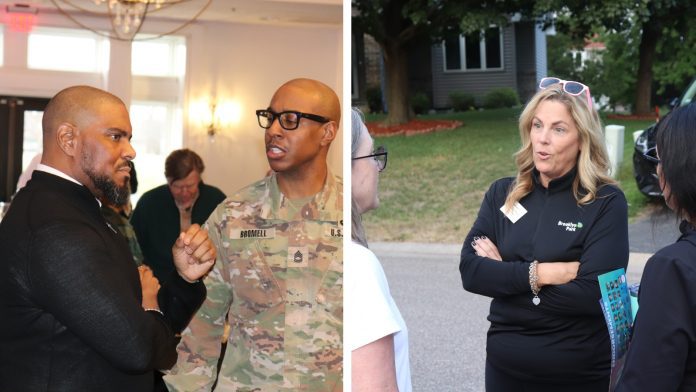
Brooklyn Park Mayor Hollies Winston speaks with U.S. Army Sgt. 1st Class Harlem Bromell after delivering his State of the City address at Edinburgh USA on Tuesday, April 7, 2026. Mshale Staff Photo by Tom Gitaa
Winston also addressed the city’s fiscal strategy and approach to managing growth. He reminded residents that the council had chosen to limit city levy growth to 4.5 percent in order to balance public safety, essential services, and affordability. “A safer city costs money. The investments we made in public safety — community policing, alternative response teams, and domestic violence programs — are not free. They require sustained funding,” he said. He noted that residents are already feeling pressure from school board and county taxes, rising gas, food, and housing costs, and that maintaining affordability requires both careful budgeting and strategic economic growth.
Brooklyn Park currently has approximately $2.7 to $3 billion in commercial property value, Winston said, compared with Bloomington’s roughly $5.5 billion. “Until that gap closes, homeowners carry the load for the city services they expect,” he said. To strengthen the tax base, the city is pursuing initiatives such as the Northwest Area Growth Plan and the Biotech Innovation District, projected to create 10,000 jobs and 3,000 housing units, and offering municipal bond authority similar to Rochester’s Destination Medical Center designation.
The mayor also discussed reimagining Brooklyn Boulevard, citing plans to attract housing, businesses, and services that draw residents and visitors, while maintaining the city’s character. Strategic public investment in the southern part of the city, he said, is revitalizing older neighborhoods, lifting property values, and attracting private capital to rebuild the tax base. He cautioned that these changes will take time — three to five years before significant tax relief is felt — but stressed the importance of speed and alignment in economic development to prevent pricing residents out of the community.
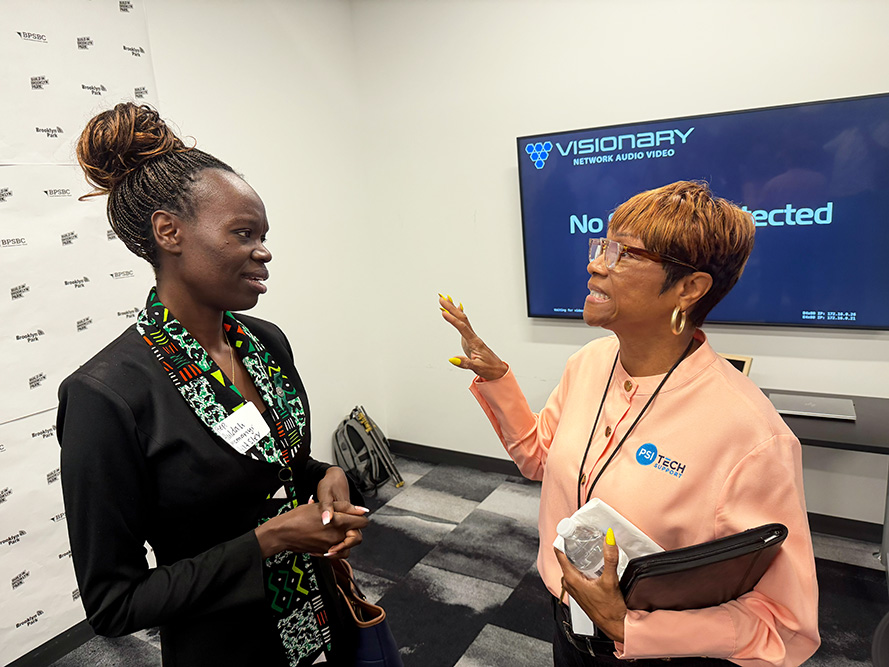
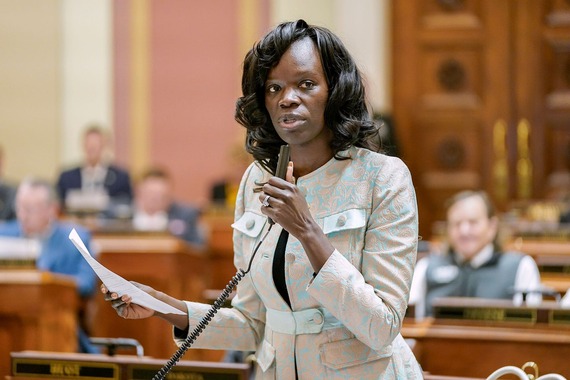
Brooklyn Park Fire Chief Shawn Conway speaks with Minnesota House Rep. Huldah Momanyi Hiltsley, DFL-Brooklyn Park, at the conclusion of the State of the City address by Mayor Winston on Tuesday, April 7, 2026. Mshale Staff Photo by Tom Gitaaed
He also noted a city program milestone: the upcoming addition of curbside organics collection, which he described as the most significant expansion of the city’s recycling program in more than 20 years, crediting city employee Tim Pratt for the initiative.
Winston framed the city’s vision around long-term opportunity for residents. “Imagine a young family buying their first home in Brooklyn Park because this city is still the kind of place where that’s possible,” he said. “Their kids can find careers here, seniors can stay in right-sized, dignified housing, and the community grows without displacing those who helped build it.”
The mayor encouraged residents to remain engaged with city priorities and advocacy at the state level. “Visit our website, read our legislative agenda, and contact your state representative,” he said. “Whether it’s the biotech district, youth and senior programs, congregate care reform, or water infrastructure, your voice makes all the difference.”
Brooklyn Park is united, Winston said, and no longer undiscovered. “You deserve to feel safe where you live. You deserve to live in a city that is growing, not just managing. You deserve a city that fights to keep you here because it values the people who choose to call it home,” he said.
Chief Justice Rizine Mzikamanda at the launch of Malawi Supreme Court’s first ICT Policy and Digital Laboratory, November 2025. He will be in Minnesota on April 13-17, 2026. Photo courtesy United Nations Development Programme (UNDP).
The Chief Justice of Malawi’s Supreme Court, Rizine Mzikamanda, will visit Minnesota later this month to headline a reception focused on the importance of the rule of law.
The April 17 event, hosted at the Humphrey School of Public Affairs, is part of the Law & Democracy Initiative of Books For Africa, a St. Paul–based nonprofit founded in 1988 that, over nearly four decades, has grown into the world’s largest shipper of donated school textbooks to Africa. The reception will bring together legal leaders from Malawi and the United States for a discussion on democratic institutions and judicial independence.
“In recent years, we have focused more on sending our reference law libraries to African court systems,” said Lane Ayres, project director of the Law and Democracy Initiative at Books For Africa and a retired Hennepin County prosecutor. “Last year, we sent one to the Supreme Court of Malawi and received an appreciative note and photos from the Chief Justice. Since then, he has helped connect us with other African courts and will be joining our advisory board. While in Minnesota, he will also visit Thomson Reuters, our main partner in this program. Inviting Chief Justice Mzikamanda to meet with our partners and supporters strengthens our work both here and in Africa.”
While in Minnesota, Mzikamanda will spend nearly a week meeting with legal partners and program collaborators, including a visit to Thomson Reuters, and participating in other engagements focused on rule-of-law initiatives. Organizers say the April 17 reception hosted by Books For Africa will be the centerpiece of his visit.
Mzikamanda, who currently leads Malawi’s highest court, will serve as keynote speaker. He will be joined by Natalie Hudson, chief justice of the Minnesota Supreme Court, and U.S. District Judge Jerry Blackwell.
The reception, scheduled from 6 to 7:30 p.m., centers on the theme “The Rule of Law,” a concept that has defined Malawi’s recent democratic trajectory. Mzikamanda was a member of the Supreme Court when it made international headlines in 2020 by nullifying the country’s presidential election over widespread irregularities—a rare judicial intervention seen as a major victory for democratic accountability.
That decision has since been widely cited as a model of judicial independence in emerging democracies. According to scholars writing in the African Human Rights Law Journal, Malawi’s courts and civil society have played a significant role in upholding democratic norms and accountability, translating legal protections into everyday political practice.
Mzikamanda’s visit also reflects longstanding ties to Minnesota. He was a Humphrey Fellow at the University of Minnesota during the 1997–98 academic year—a program that brings accomplished mid-career professionals from around the world to the United States for academic study and professional exchange, including judges, policymakers and civil society leaders—making his return both professional and personal, organizers say.
The event also highlights ongoing collaboration between Books For Africa and Malawi’s judiciary. The organization’s law book program—developed in partnership with Thomson Reuters—was expanded three years ago when the American Bar Association joined the effort, contributing legal texts that are included in shipments to courts, law schools, and bar associations across Africa. Together, the partners have supplied more than 100 law and human rights libraries to institutions across the continent, addressing chronic legal resource shortages and supporting the rule of law.
By bringing together legal leaders across continents, the reception aims to underscore how partnerships and shared democratic values can strengthen institutions globally.
Organizers say the discussion will offer attendees a chance to reflect not only on Malawi’s experience, but also on broader challenges facing the rule of law worldwide—at a time when democratic norms are under increasing pressure in many regions.
Details on how to attend the reception can be found at this link.
Dobet Gnahoré will perform April 12, 2026 at The Dakota in downtown Minneapolis. Photo: Courtesy
UPDATE: The scheduled performance by Dobet Gnahoré at The Dakota has been cancelled due to visa and travel complications. No new date has been announced, and the event is not expected to be rescheduled at this time. Ticket holders are advised to contact the venue for refund information and further updates.
Of the myriad skills it takes to bring a show to stage, Dobet Gnahoré excels in most of them. If you haven’t had the pleasure of seeing this Côte d’Ivoire musician perform, you might not know about her stage presence and the dynamic dance moves she possesses.
Mshale sat down with Ms. Gnahoré recently to find out more. She described how it can take weeks to create the program for the stage that they want to present to their audience.
“Before I create the choreography, I think about the song and the energy I want to bring to the people,” she said, carefully choosing her words in English. “Sometime my energy is maybe…I have two choice. Maybe sexy and very [sensual]. Or I think about how women are powerful and stronger and I think about my movement between these two things.”
Dobet confesses, “Dancing is my first love of the arts.” Following the dance, Dobet cites singing and then drumming as close to her heart.
She composes her own songs. “When I craft my song, I need to know the rhythm inside of it, the lyrics…when I write my song, I need to decide which languages I want to use. Every song has a story, every song has its own energy.” She likes to use different languages to acknowledge the power and diversity of her continent and to promote African culture.
Through these channels, Dobet seeks to bring a global understanding to her audience. “I think the world needs to know the world,” she said. “Sometimes when I speak to people from elsewhere, they think about Africa as one country. They don’t know Africa is a big continent and a lot of ethnicities, a lot of power.”
“For me it is important that people know Africa is not like a poor continent. Some parts of Africa are poor, like everywhere (in the world). But Africa is very rich. Our natural resources are more rich than other continents.” As Dobet spoke with fervor, French words slipped into her sentences, unable to express the depth of her feelings with her more limited English vocabulary.
In addition to music, Dobet teaches dance and has mentored other musicians. “I teach dance every,” Dobet says faltering, then quietly glances down and whispers, Monday, Tuesday, Wednes…she looks back up and with a smile that goes up into her bright eyes says confidently, “I teach dance every Wednesday.”
Two years ago, Dobet mentored four young women in Abidjan, the economic capital and largest city of Côte d’Ivoire. She wanted to share her love for music with them by helping with some of the technical skills surrounding music such as music production, management, and song arrangement. What Dobet discovered is that how she listens to music for herself differs from how she listens to music for others.
“It was very interesting,” she said, “when I compose music for other people, my ear is different.” The shift, she said, is that when she composes for herself, it’s subjective, but when she composes for others or in this case when she was mentoring these young women, music became more objective and outside of herself, no longer intrinsic.
Dobet Gnahoré will perform at 7 pm at The Dakota on April 12th. Tickets available here.
Brooklyn Park Mayor Hollies Winston mingles with residents after delivering his 2025 State of the City address on Tuesday, April 8, 2025 at Edinburgh USA. Photo: Tom Gitaa/Mshale
Brooklyn Park residents are invited to attend the 2026 State of the City address on Tuesday, April 7, where Mayor Hollies Winston will reflect on the past year and outline priorities for the future. The address will be Winston’s fourth and final of his first term, as he seeks reelection in November.
The event will be held at Edinburgh USA, 8700 Edinbrook Crossing, with doors opening at 5:30 p.m. and the program beginning at 6 p.m. The gathering is free and open to the public.
During the address, Winston is expected to highlight key accomplishments, acknowledge ongoing challenges, and share the city’s vision for continued growth and success. Community members will also have the opportunity to connect with one another over light refreshments following the presentation. The refreshments will be provided by NellyUp Mobile Bar Service, according to a news release from the city.
City officials encourage residents of all backgrounds to attend. Language assistance and disability accommodations are available upon request by contacting the city.
The annual State of the City event provides an opportunity for residents in the state’s sixth largest city to stay informed and engaged with local government while looking ahead to the year to come.
Author Wangeci Gitau will launch her bilingual poetry collection Coka Mũciĩ in Lawrence, MA on April 18. Photo: Courtesy
A community centered public art talk and poetry book launch exploring migration, memory and belonging is set for Apr. 18 in Lawrence, MA.
Hosted by author, artist and educator Wangeci Gitau, Coka Mũciĩ (come home) will take place from 4 p.m to 6 p.m. at Modular Studios and is free and open to the public, with books available for purchase.
Rather than a traditional reading, the event is designed to bring together film, spoken word, music, food and visual art.
The project is rooted in Gitau’s personal journey returning to Kenya for the first time in 24 years, where she connected with Gikũyũ, the native language of her ancestors. That experience shaped a bilingual poetry collection in Gikũyũ and English, reflecting themes of home, loss and survival. The work also speaks to broader immigrant experiences, including language loss, separation and the search for belonging.
The evening will include a short film documenting Gitau’s 2025 trip to Kenya, a bilingual poetry reading, facilitated art talk, and a book signing. Organizers say the space will also feature Kenyan cuisine and flower installation to create an environment centered on reflection and community.
Hosting the event in Lawrence is intentional, according to organizers, who describe the city to be sustained by immigrant communities who understand migration as a lived experience rather than an abstraction. The gathering aims to create space for open conversation about language loss, displacement, and belonging, and to challenge the notion that immigrants must prove their worth.
The event will also be livestreamed to reach beyond the local Lawrence community.
Equity Bank CEO James Mwangi appeared on KTN's Trading Bell show just days after reporting record profits. Photo: KTN Screengrab
In a substantive interview Friday on KTN’s Trading Bell—produced by the Nairobi Securities Exchange—Kenya’s Equity Group Chief Executive Officer James Mwangi laid out a broad strategic vision for the bank and African banking broadly, anchored in regional expansion, technology adoption, and inclusive finance.
The discussion comes just days after the group reported record profits, driven by regional growth and strong performance across its African operations. Mwangi’s interview offered insight into the strategies behind those results and the bank’s plans for the future.
Here are 10 key takeaways from the interview:
Record profits tied to purpose. Referencing the bank’s latest earnings, Mwangi said, “Our profits reflect not just growth in numbers, but growth in our ability to serve more people across Africa.”
Regional expansion remains a priority. Mwangi emphasized deepening Equity’s footprint across Africa while exploring new markets: “Regional integration is an opportunity we cannot ignore.”
Technology as an enabler. Digital banking and mobile platforms are central to Equity’s strategy. Mwangi noted, “Technology allows us to reach the underserved, efficiently and securely.”
Financial inclusion drives growth. Equity continues to focus on rural communities, women-led businesses, and SMEs. “Profit and purpose must go hand in hand,” Mwangi said, linking commercial success with social impact.
Resilience amid global shifts. Mwangi highlighted the need to navigate currency volatility, regulatory changes, and global market trends, emphasizing agility as key to sustaining growth.
Innovation fuels competitiveness. He pointed to ongoing investment in fintech solutions to improve customer experience. “Innovation is not optional; it is essential for us to stay relevant,” he remarked.
Supporting cross-border trade. Equity positions itself as a hub for facilitating regional commerce, strengthening opportunities for business and investment.
Investing in talent. Mwangi stressed that nurturing employees and building a strong corporate culture is central to long-term success.
Sustainable growth. Equity’s expansion strategy incorporates environmental and social responsibility alongside financial objectives.
Future-focused banking. Mwangi sees a sector transformed by digital adoption, regional connectivity, and inclusive finance. “Our goal is to be a catalyst for economic development, not just a financial institution,” he said.
Members of the Greater Twin Cities (MN) Chapter of The Links, in their signature green scarves, attend the 2023 African Heritage Day on the Hill at the Minnesota Capitol organized by the Council of Minnesotans of African heritage. Mshale Staff Photo by Richard Ooga.
A virtual public meeting focused on shaping policy priorities for Minnesota’s Black community will be held on April 2 from 6 to 8:30 p.m.
The event is hosted by the Council for Minnesotans of African Heritage, a council formed by statute in 2015 to replace the former Council on Black Minnesotans. The council serves as a liaison between state government and the African heritage community, advising the governor, legislature, and other partners on issues that impact Black Minnesotans. It also performs or contracts for studies on areas such as education, employment, health, human rights, housing, and social welfare to inform policies and programs.
Organizers say the April 2 meeting is an opportunity for community members to provide feedback, raise concerns, and contribute ideas on a range of issues affecting Black Minnesotans. Input gathered will help guide future policy recommendations and initiatives that better reflect the needs and perspectives of the community. Past initiatives by the council have included efforts to improve access to education, economic opportunities, health resources, and community services.
In addition to public meetings like this one, the council holds signature events such as its annual African Heritage Day on the Hill, which brings community members to the Minnesota State Capitol to meet with elected officials and discuss legislative priorities.
The meeting will be conducted virtually via Microsoft Teams. Organizers emphasize that community participation is central to the process, encouraging attendees to share their voices and help shape decisions that affect their communities.