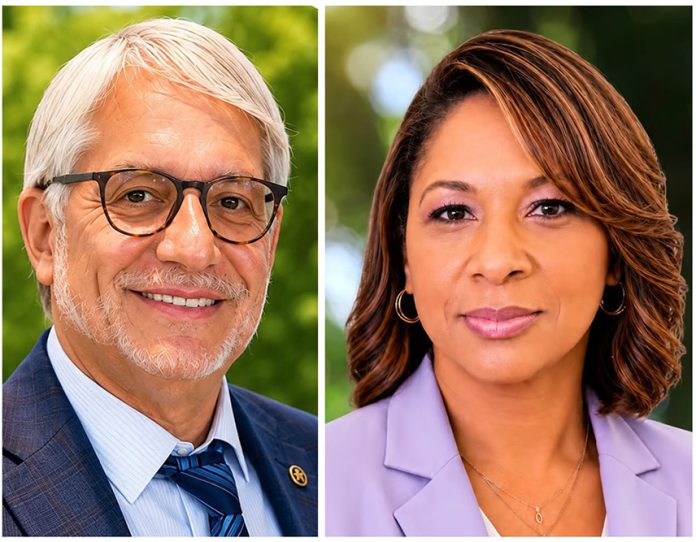
Brooklyn Center mayoral candidates Alexander Koenig, left, and Teneshia Kragness. Citizens for Safer Cities, a political committee funded primarily by apartment-owning companies, reported spending $5,589.60 on independent advertising supporting Koenig’s candidacy. The same committee supported Kragness during her 2022 City Council campaign. | Photos courtesy of Alexander Koenig and Teneshia Kragness
Brooklyn Center mayoral candidates Alexander Koenig, left, and Teneshia Kragness. Citizens for Safer Cities, a political committee funded primarily by apartment-owning companies, reported spending $5,589.60 on independent advertising supporting Koenig’s candidacy. The same committee supported Kragness during her 2022 City Council campaign. | Photos courtesy of Alexander Koenig and Teneshia Kragness
BROOKLYN CENTER, Minn. — An apartment-owner-funded political committee has spent nearly $5,600 to support Alexander Koenig’s campaign for Brooklyn Center mayor, an amount that dwarfs the fundraising reported so far by two of his rivals ahead of Tuesday’s primary election.
Citizens for Safer Cities reported raising $23,600 between Jan. 1 and July 20 and making $12,635 in independent expenditures supporting candidates in Brooklyn Center and Hennepin County, according to a campaign finance report filed with the Minnesota Campaign Finance and Public Disclosure Board. The committee entered the reporting period with another $12,494.09 already on hand and ended it with $16,635.41.
The largest expenditure benefiting a Brooklyn Center candidate was $5,589.60 for print advertising supporting Koenig’s mayoral candidacy. The expenditure, dated May 15, lists ECM Publishers as the vendor.
The committee also reported spending $2,824 each supporting Brooklyn Center City Council candidates Gretchen Enger and Dan Jerzak and $1,397.40 supporting Hao Nguyen in the Hennepin County attorney race. Altogether, the committee reported $12,635 in independent expenditures for local candidates.
The spending comes as the mayoral candidates themselves appear to be running comparatively modest campaigns.
Teneshia Kragness reported raising $1,249.83, including $300 she loaned her campaign, while Laurie Ann Moore reported raising $100. Campaign finance reports for the other two mayoral candidates, Alexander Koenig and Latrecia Mayo, had not been posted by the city when Mshale reviewed the filings. Koenig told Mshale he had requested an extension and described his campaign as largely self-funded.
“I don’t really have much of a campaign finance report. I’m self-funded,” Koenig told Mshale, saying he had received contributions from only three people.
Koenig strongly rejected any suggestion that Citizens for Safer Cities had contributed money directly to his campaign.
“I have received zero cash from them,” he said.
The committee’s own filing supports that distinction. Citizens for Safer Cities reported no direct contributions or approved expenditures to local candidate committees during the reporting period. Instead, the $5,589.60 attributed to Koenig is reported as an independent expenditure made by the committee in support of his candidacy.
Independent expenditures are made without coordination with the candidate or campaign they are intended to benefit.
Koenig said he did not solicit the committee’s support and had no involvement in its spending.
“Their independent expenditures are apart from me,” he said. “They don’t check with me and they’re not supposed to check with me.”
Koenig questions reported amount
Koenig said he became aware that Citizens for Safer Cities had placed two newspaper advertisements supporting his candidacy but questioned how those advertisements could account for the $5,589.60 reported to the state.
He described the advertisements as small banners at the bottom of pages in the Sun Post and said he believed similar advertisements supporting Enger and Jerzak had appeared more frequently.
“If mine is almost $6,000 and it only ran twice, and theirs has run eight times, and each one is only $2,000-some or $4,000 combined, is it logical that the expenditure on me would be listed as more?” Koenig said.
The Campaign Finance Board filing lists $5,589.60 paid to ECM Publishers for print advertising supporting Koenig. It does not provide further detail about how that amount was calculated.
Mshale contacted Citizens for Safer Cities Treasurer Erik Falkman by voicemail and email seeking comment about the committee’s reported independent expenditures, including how it calculated the reported amount supporting Koenig’s candidacy. He did not respond before publication.
Apartment companies provide committee funding
Citizens for Safer Cities’ contributors are dominated by limited liability companies bearing the names of apartment properties.
The largest contributor during the reporting period was Lake Pointe Apartments LLC, which gave $5,273.04. Other contributors included Melrose Gates Apartments LLC, $3,703.06; Second Street Station LLC, $2,542.67; Riverwood LLC, $2,520; Park Trails Apartments LLC, $2,064.84; and Garden Gates Apartments LLC, $1,638.23.
Additional contributions came from Uptown Square Apartments LLC and West End Apartments LLC, among others. The committee reported that all $23,600 it raised during the period came from itemized contributors.
The committee also reported spending $6,614 on legal services with Minneapolis law firm Winthrop & Weinstine during the reporting period.
Kragness: ‘Ultimately, the people decide’
Kragness, a current City Council member who is backed in the mayoral race by outgoing Mayor April Graves, said outside spending can increase a candidate’s visibility but does not determine who voters ultimately choose.
“Money may buy mailers and advertisements, but it cannot buy the trust or the votes of the people of Brooklyn Center,” Kragness told Mshale. “Ultimately, the people decide who represents them.”
Kragness has herself benefited from support by Citizens for Safer Cities in the past.
The committee’s involvement this year marks at least its second Brooklyn Center municipal election cycle. During Brooklyn Center’s 2022 elections, Mshale reported that the newly formed committee sent glossy mailers supporting Graves for mayor and Kragness and Jerzak for City Council. Falkman was also the committee’s treasurer at the time.
Kragness acknowledged that history while saying outside support has not controlled her decisions in office.
“I’ve received support from outside organizations in the past, and I’ve always been clear that outside support does not dictate my votes, my values, or my decisions,” she said. “My integrity remains at the center of how I serve.”
“My commitment remains the same: I will continue making decisions based on what’s best for our residents, not based on who supports my campaign financially,” Kragness added.
Tuesday’s Aug. 11 primary will determine which two mayoral candidates advance to the November general election. Early in-person voting continues through Monday, Aug. 10.
You can find your early voting location and hours at this Secretary of State link.
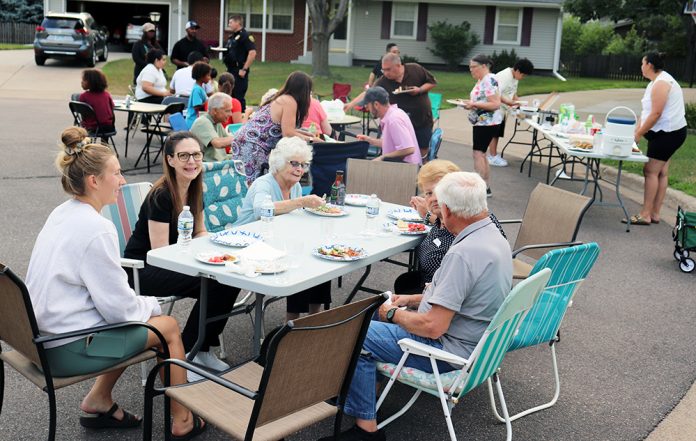
Neighbors gather for food and conversation during a National Night Out block party in Brooklyn Park's Brookdale Park neighborhood on Tuesday, Aug. 4, 2026. Residents across the city hosted 135 registered neighborhood gatherings as part of the annual event, which encourages neighbors to build relationships and strengthen community ties. | Photo by Tom Gitaa/Mshale
Neighbors gather for food and conversation during a National Night Out block party in Brooklyn Park's Brookdale Park neighborhood on Tuesday, Aug. 4, 2026. Residents across the city hosted 135 registered neighborhood gatherings as part of the annual event, which encourages neighbors to build relationships and strengthen community ties. | Photo by Tom Gitaa/Mshale
Residents on dozens of Brooklyn Park streets set out folding tables, shared homemade food, greeted newcomers and spent an evening getting to know the people who live just beyond their front doors during this year’s National Night Out.
Held each year on the first Tuesday in August, National Night Out encourages neighbors to gather while fostering stronger relationships with one another and with local law enforcement.
Brooklyn Park has become one of the country’s top participating communities. In 2025, the city ranked third nationally among midsize cities with populations between 50,000 and 100,000, trailing only neighboring Maple Grove and Gloucester Township, New Jersey.
This year, 135 block parties were registered across the city, according to Communications Specialist Teri Iverson. Mayor Hollies Winston, police leaders and other city officials spent the evening visiting neighborhood gatherings across the city.
Mshale visited celebrations in the Brookdale Park and Trinity Gardens neighborhoods, where residents described National Night Out as one of the few opportunities each year to slow down, reconnect and strengthen the sense of community that makes neighborhoods safer.
Brookdale Park
On a quiet cul-de-sac in Brookdale Park, longtime resident Sheila Weber greeted neighbors much as she has for the past two decades.
“It means a lot to our neighborhood,” said Weber, who has lived on 78th Avenue North for decades and has organized her block’s National Night Out gathering for the past 20 years. “It gives us a chance to meet newcomers to our neighborhood.”
Nearby, retired banker Emily Solstad reflected on how busy life has become.
“I always look forward to this day because it’s really the only time you can see, for an extended time, some of the younger and very busy professionals in our neighborhood,” Solstad said.
Neighbors filled tables with homemade dishes alongside pizza, while one dessert quickly became a favorite — chocoflan, a popular Mexican cake. Across the cul-de-sac, children rode bicycles while Hugo Cruz tossed a ball with his two sons. His wife, Gabby, was the baker behind the much-talked-about chocoflan.
“We always look forward to it because we get to meet others,” Cruz said.
Mayor Winston and Brooklyn Park Deputy Police Chief Elliot Faust also stopped by the gathering, chatting with residents about neighborhood concerns while others caught up over food and refreshments.
Trinity Gardens
Across town in the Trinity Gardens neighborhood, Corey and Bobbie Jacques welcomed neighbors to another cul-de-sac celebration.
The couple, who have lived on Kings Terrace North for nearly a decade, took over organizing the annual gathering three years ago after a neighbor moved away.
By the time Mshale arrived, most of the food had disappeared, but conversations were still going strong as Council Members Shelle Page and Nichole Klonowski joined state Rep. Huldah Momanyi Hiltsley in talking with residents.
Jacques, who works in trade and logistics, joked that his role as organizer began after losing a bean bag toss competition to Brooklyn Park police officers.
“The reason I’m the organizer is because I lost a bean bag toss competition to these guys, and this became my punishment,” he said with a laugh.
As adults continued their conversations, young Tori Swanson walked the family dog, Remington, through the gathering. The friendly dog made frequent stops near the food table, sniffing hopefully for leftovers.
Across Brooklyn Park, scenes like these played out at more than a hundred neighborhood gatherings. While every block party had its own personality, they shared a common purpose: giving neighbors a chance to know one another a little better before the next emergency, celebration or ordinary day brings them together again.
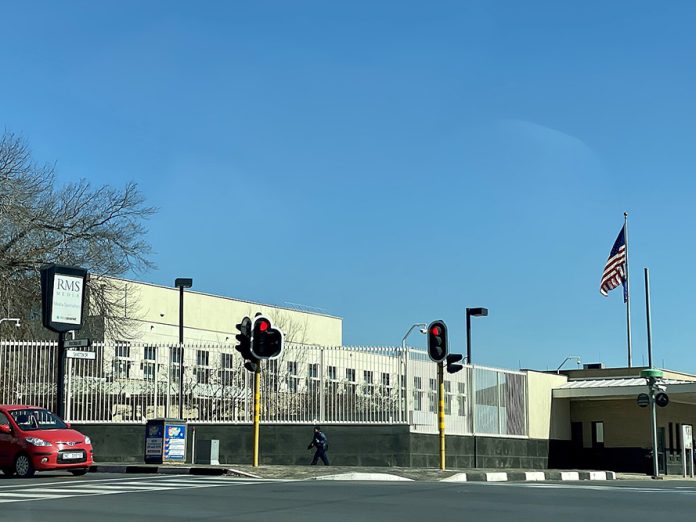
The U.S. Consulate General in Johannesburg, South Africa. President Donald Trump's executive order directs the State Department and the Department of Homeland Security to strengthen enforcement against so-called birth tourism through changes to visa and immigration policies. | Photo by TapticInfo/Wikimedia Commons (CC BY-SA 4.0)
The U.S. Consulate General in Johannesburg, South Africa. President Donald Trump's executive order directs the State Department and the Department of Homeland Security to strengthen enforcement against so-called birth tourism through changes to visa and immigration policies. | Photo by TapticInfo/Wikimedia Commons (CC BY-SA 4.0)
President Donald Trump on Thursday signed an executive order directing the Departments of State and Homeland Security to expand efforts to combat what the administration calls “birth tourism”—the practice of foreign nationals traveling to the United States on temporary visas for the purpose of giving birth so their children acquire U.S. citizenship.
The executive order authorizes the agencies to update rules, policies and operational guidance to prevent foreign nationals from obtaining visas or entering the country for that purpose. It also authorizes officials, within existing legal authority, to deny or revoke visas, refuse admission, remove individuals who engage in birth tourism, and take action against organizations or individuals that facilitate such travel.
The order defines birth tourism as entering the United States on a nonimmigrant visa “for the purpose of giving birth on American soil,” or helping others do so.
While the executive order marks a significant policy directive by the Trump administration, immigration attorney Paschal Nwokocha said its practical impact will depend on how the State Department and the Department of Homeland Security implement it through new rules and guidance.
“We learned in 2026 that the executive branch cannot abrogate birthright citizenship via executive order,” Nwokocha told Mshale. “So, the August 2026 executive order did not create new immigration laws. It directs federal agencies to create policies and legal interpretations aimed at preventing people suspected of planning to engage in ‘birth tourism’ from getting visas and entering the U.S.”
Birth tourism has not been a new concern for U.S. immigration authorities. Consular officers have for years scrutinized visa applicants suspected of traveling primarily to give birth in the United States, and existing regulations already allow officials to deny visas when they determine an applicant’s true purpose of travel differs from the stated reason.
The order also expands the administration’s enforcement approach by specifically authorizing additional actions against both participants and facilitators of birth tourism. Among the measures listed are visa denials, visa revocations, permanent bars to reentry in some cases, removal proceedings, and actions against businesses or individuals that organize or promote birth tourism.
Nwokocha said he believes the policy could result in greater scrutiny of women of childbearing age from some African countries and other developing nations.
“The consulates and CBP officers are going to be emboldened to deny visa applications and prevent the entry into the U.S. of anyone pregnant or suspected of being pregnant,” he said.
African applicants already face some of the world’s highest U.S. visa refusal rates in several visa categories, particularly student visas, and immigration advocates have long argued that applicants from the continent receive heightened scrutiny during the visa process.
Nwokocha said one of the biggest unanswered questions is how immigration officials will determine whether a traveler intends to engage in birth tourism.
“I am curious how officers will determine whether someone is coming to the U.S. to give birth,” he said. “Pregnancy test at the U.S. consulate or with U.S. Customs and Border Protection officers at the port of entry? Gut feeling? We don’t know, but I suspect that officers’ biases are going to play a role in how they adjudicate applicants.”
The executive order also allows the Secretary of State or the Secretary of Homeland Security to grant exemptions on humanitarian grounds or when admitting a foreign national is determined to be in the national interest.
The White House said the policy is intended to protect the integrity of the immigration system by ensuring temporary visa categories are used only for their intended purposes and by preventing foreign nationals from obtaining immigration-related benefits through birth tourism.
The executive order does not establish immediate new procedures for visa applicants. Instead, it directs the State Department and the Department of Homeland Security to issue whatever rules, policies or operational guidance they determine are necessary to carry out the order. Those implementation measures will determine how the policy is applied by U.S. consular officers abroad and immigration officials at U.S. ports of entry.
Nwokocha said travelers with legitimate reasons for visiting the United States should be prepared to clearly explain the purpose of their trip if questioned by immigration officials.
“Always be ready to explain the purpose of your travel and be prepared to prove it with documentation, such as a return ticket, demonstrating that your intention is not to travel to the United States to give birth,” he said.
DFL Rep. XP Lee, left, and Republican challenger Ruth Bittner will meet again in the Nov. 3 general election after facing each other in last year's House District 34B special election. Campaign finance reports show Lee outraised Bittner during the latest reporting period, while Bittner enters the fall campaign with more cash on hand. | Courtesy Photos
DFL Rep. XP Lee, left, and Republican challenger Ruth Bittner will meet again in the Nov. 3 general election after facing each other in last year's House District 34B special election. Campaign finance reports show Lee outraised Bittner during the latest reporting period, while Bittner enters the fall campaign with more cash on hand. | Courtesy Photos
District 34B in the Minnesota House of Representatives is currently represented by DFLer XP Lee, who won a special election last September to fill the seat left vacant following the assassination of Speaker Emerita Melissa Hortman. The district includes parts of Brooklyn Park, Champlin and Coon Rapids.
Lee is seeking his first full two-year term and will face Republican Ruth Bittner in a rematch after defeating her with 60.8% of the vote in last year’s special election. Unlike neighboring House District 38A, where voters will choose party nominees in next week’s primary, District 34B has no primary contests. Campaign finance reports filed by last week’s statutory deadline provide an early look at how the two candidates are positioned ahead of the Nov. 3 general election.
Lee reported raising $4,397.09 between Jan. 1 and July 20, all from individual contributions. With no campaign expenditures during the reporting period, he reported $4,330.24 in cash on hand as of July 20 and no outstanding debt.
Bittner reported raising $3,642.51 during the same period, including $2,642.51 from individual contributors and a $1,000 contribution from the Republican Party’s 3rd Congressional District organization. She entered the reporting period with $3,497.58 carried over from previous campaigns and reported $6,017.88 in cash on hand at the close of the reporting period. Her campaign also reported no outstanding debt.
Although Lee outraised Bittner during the reporting period, Bittner finished with the larger cash balance because she began the year with funds remaining from previous campaigns. Lee reported no campaign expenditures during the reporting period. Bittner, meanwhile, reported just over $1,050 in spending, including website hosting, the candidate filing fee and a post office box.
The November election will mark the second meeting between the two candidates. Lee won the September 2025 special election with 4,331 votes (60.82%) to Bittner’s 2,785 votes (39.11%). The election drew 7,121 voters, representing a turnout of about 26.8% of the district’s 26,596 registered voters.
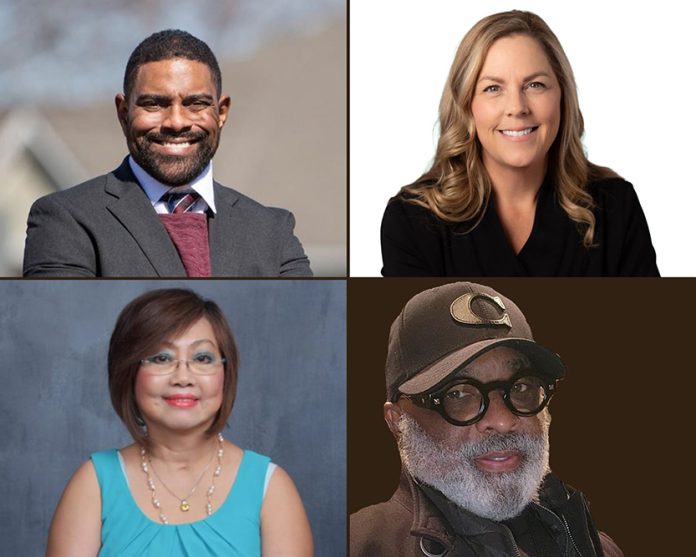
Clockwise from top left: Brooklyn Park Mayor Hollies Winston, mayoral challenger Shelle Page, former Council Member Boyd Morson and City Council Member Maria Tran. Campaign finance reports released by the City of Brooklyn Park on Aug. 5, 2026 show Winston and Page hold the fundraising advantage entering the final week before the Aug. 11 primary. | Courtesy photos
Clockwise from top left: Brooklyn Park Mayor Hollies Winston, mayoral challenger Shelle Page, former Council Member Boyd Morson and City Council Member Maria Tran. Campaign finance reports released by the City of Brooklyn Park on Aug. 5, 2026 show Winston and Page hold the fundraising advantage entering the final week before the Aug. 11 primary. | Courtesy photos
BROOKLYN PARK, Minn. — Campaign finance reports provided by the City of Brooklyn Park on Wednesday afternoon show incumbent Mayor Hollies Winston and challenger Shelle Page have established a clear fundraising advantage over the city’s two other mayoral candidates.
Winston reported raising $10,470 during the reporting period and had $6,561.68 in cash on hand entering the final week before the Aug. 11 primary. Page reported raising $6,094.52 and finished the reporting period with $3,304.52 in cash on hand. Former councilmember Boyd Morson reported raising $1,661.72, while City Council Member Maria Tran, who is also seeking the mayor’s office, reported $325 in contributions.
Cash on hand often determines how many mail pieces a campaign can send, how much digital advertising it can purchase and how extensively it can contact voters during the final week before Election Day. With less than a week remaining before the primary, Winston enters the final stretch with roughly twice as much cash available as Page and considerably more than the race’s other two opponents.
The fundraising reports suggest the race has separated into two financial tiers. Winston and Page have assembled the resources typical of competitive citywide campaigns, while Morson and Tran reported substantially smaller fundraising totals heading into the final week before voters narrow the four-candidate field to two.
Among Winston’s larger contributors were labor organizations including IAFF Local 531 PAC Fund and IUPAT District Council 82, along with business leaders, developers and community supporters. His campaign expenditures included digital advertising, voter file data, campaign printing, social media services and other campaign operations.
Page’s filing reflects a campaign focused heavily on traditional voter outreach, including campaign printing, signs, shirts and marketing materials.
Tran’s filing reported two contributions totaling $325 and no cash on hand at the close of the reporting period. Morson reported raising $1,661.72 and spending the full amount, leaving no remaining cash on hand.
While fundraising alone does not determine election outcomes, campaign finance reports provide one of the clearest public measures of a campaign’s organizational capacity during the closing days before an election.
East District primary
While the mayor’s race accounts for most of the campaign fundraising, the reports also shed light on the only contested City Council primary on the Aug. 11 ballot. In the East District, incumbent Christian Eriksen is seeking a second term in a four-candidate race where the top two finishers will advance to the Nov. 3 general election.
Eriksen reported raising $4,943.36 during the reporting period and had $2,083.69 in cash on hand entering the final stretch before the primary. His filing also shows support from labor organizations, including the Building Trades Union and IUPAT, as well as self-financing through campaign loans.
The filing shows Eriksen shared campaign literature expenses with Council Member Nichole Klonowski and City Council candidate Bernice Cooper, and also includes a $500 loan to Mayor Hollies Winston for joint campaign literature.
Philip Seton Gaye-Bai, the only one of Eriksen’s challengers with a campaign finance report posted by the city Wednesday afternoon, reported receiving $2,200, including $1,250 in in-kind contributions, and had $340 in cash on hand. His expenditures included campaign literature, signs and other campaign materials.
Financially, Eriksen enters the final week before the primary with more than twice the resources reported by Gaye-Bai and about six times as much cash available to spend before Election Day.
Of Eriksen’s three challengers, only Philip Seton Gaye-Bai had a campaign finance report posted by the city as of Wednesday afternoon. Aaron Endris and Allen Miskowiec did not have reports posted.
Central and West Districts
Although voters in the Central and West districts will not have City Council primaries on Aug. 11, because only two candidates filed in each race, campaign finance reports show those contests are also taking shape ahead of the Nov. 3 general election.
In the Central District, incumbent Nichole Klonowski is seeking re-election against challenger Ashyante Shantell Gill. Klonowski’s campaign finance report shows she raised $1,450 during the reporting period. The filing also reflects spending on campaign literature, website services and shared literature for council members. No campaign finance report for Gill had been posted by the city as of Wednesday afternoon.
In the West District, Bernice Cooper and former councilmember Tonja West-Hafner are competing for the open seat being vacated by mayoral candidate Maria Tran. Cooper’s campaign finance report shows she raised $1,901.53 and reported $600 in cash on hand. Her filing also includes spending on campaign literature, coordinated convention materials, campaign apparel and digital outreach. No campaign finance report for West-Hafner had been posted by the city as of Wednesday afternoon.
The reports provide the clearest picture yet of how candidates are positioned financially as Brooklyn Park enters the final days before next week’s primary, and the campaign season shifts toward the Nov. 3 general election.
Early voting is already underway for the Aug. 11 primary, which will narrow the four-candidate mayoral field and the four-candidate East District City Council race to two candidates each for the Nov. 3 general election.
To look up your early voting location or your voting place for Tuesday, visit this Secretary of State link.
State Sen. Susan Pha, left, and state Reps. Samantha Vang, center, and Huldah Momanyi Hiltsley participate in a District 38 legislative town hall on Aug. 26, 2025. Campaign finance reports show the three DFL incumbents entered the final week before Minnesota's Aug. 11 primary with significant fundraising advantages over their challengers. | Photo by Tom Gitaa/Mshale
State Sen. Susan Pha, left, and state Reps. Samantha Vang, center, and Huldah Momanyi Hiltsley participate in a District 38 legislative town hall on Aug. 26, 2025. Campaign finance reports show the three DFL incumbents entered the final week before Minnesota's Aug. 11 primary with significant fundraising advantages over their challengers. | Photo by Tom Gitaa/Mshale
Incumbent state Sen. Susan Pha and state Reps. Huldah Momanyi Hiltsley and Samantha Vang have flexed their financial muscle heading into next week’s primary, raising nearly 10 times as much as their main challengers Nehemiah Garley and Wynfred Russell.
Minnesota law requires candidates to file pre-primary campaign finance reports 10 days before the primary election. This year’s filing deadline was Friday, July 31.
Mshale’s review of campaign finance filings shows Pha began the calendar year with just $837.67 in her campaign account but raised $68,113.95 through July 20. After spending $28,327.76, she closed the reporting period with $40,623.86 in cash on hand, giving her a formidable campaign war chest heading into the DFL primary.
Pha’s contributions came from donors representing a wide range of professions, including healthcare, education, transportation, real estate, manufacturing, government service and small business, with entrepreneurs making up a significant share of itemized contributors.
Garley’s campaign told Mshale on Monday afternoon that it expected to file its pre-primary campaign finance report later that day. As of 11 a.m. Tuesday, however, no report had yet been posted on the Minnesota Campaign Finance and Public Disclosure Board’s website.
On the Republican side, Brad Olson, who is unopposed for his party’s nomination in Senate District 38, reported raising $7,920.84 in cash receipts, plus $100 in in-kind contributions, during the reporting period. After spending $1,060.95, Olson closed the period with $6,859.89 in cash on hand. His campaign was funded primarily through individual contributions, along with a $1,000 contribution from the 3rd Congressional District Republican Party.
The itemized individual donors listed in Olson’s report were retirees, although most of his individual contributions were reported as non-itemized donations.
On the House side for District 38A, Rep. Huldah Momanyi Hiltsley began the year with $6,414.13 in cash on hand and raised another $11,700 through July 20. After spending $9,080.79, she closed the reporting period with $9,033.34 in cash on hand. Her contributions came from healthcare professionals, human services workers, business owners, finance executives, self-employed professionals and political committees. In addition to individual donors, Hiltsley received contributions from lobbyists and political committees, including LeadingAge Minnesota PAC, the Multi Housing Political Action Committee and SEIU Healthcare Minnesota. The report also shows Hiltsley spent $375 on candidate security for caucus events, including threat assessment, security guards and guest screening.
Challenger Wynfred Russell reported no fundraising or campaign expenditures during the reporting period. His report shows he began the year with $1,472.95 in cash on hand and ended July 20 with the same amount after reporting no receipts or disbursements.
Democratic Socialist candidate Richard Klatte, who is also seeking the DFL nomination in House District 38A, had not filed a 2026 campaign finance report with the Campaign Finance and Public Disclosure Board as of Tuesday morning.
Although she does not face a primary challenger in District 38B, Rep. Samantha Vang also entered the election year in a healthy financial position. Campaign finance reports show she began the year with $13,247.76 in cash on hand, raised another $6,860 during the reporting period and ended July 20 with $12,192.37 cash on hand after spending $7,915.39. In addition to individual contributions, Vang received $1,200 from lobbyists and $1,050 from political committees, including the Minnesota State Patrol Troopers Association and the Saint Paul Teachers Pension PAC.
The report also shows Vang spent $1,025 in noncampaign disbursements for candidate security, including payments for threat assessment, security guards, guest screening and a protective detail.
On the Republican side, Robert Marvin, who will face Vang in the November general election, reported beginning the year with $1,002.40 in his campaign account. He raised $2,475 during the reporting period and reported no campaign expenditures, ending July 20 with $3,477.40 in cash on hand. Because Marvin reported no expenditures, his cash on hand increased by the full amount he raised during the reporting period. His fundraising consisted of individual contributions and a $500 contribution from the Republican Party’s Senate District 38 organization. Unlike the reports filed by Pha, Vang and fellow Republican Brad Olson, Marvin’s report did not identify any individual donors by name or occupation because all of his individual contributions were reported as non-itemized.
On the Republican side in House District 38A, Charlie Kistler reported raising $3,380.13 since launching his campaign in June, including $2,880.13 in individual contributions and a $500 contribution from the Republican Party’s Senate District 38 organization. After spending $1,962.86, he reported $1,417.27 in cash on hand. Like fellow Republican Robert Marvin, Kistler’s individual contributions were reported as non-itemized, meaning the filing does not identify donors by name or occupation.
Kistler’s Republican primary opponent, Yelena Kurdyumova, had not filed a 2026 campaign finance report with the Campaign Finance and Public Disclosure Board as of Tuesday morning.
The primary is on August 11 but early voting is already underway. Some locations will also have Saturday voting this weekend. To look up your early voting location or your voting place for Tuesday, visit this Secretary of State link.
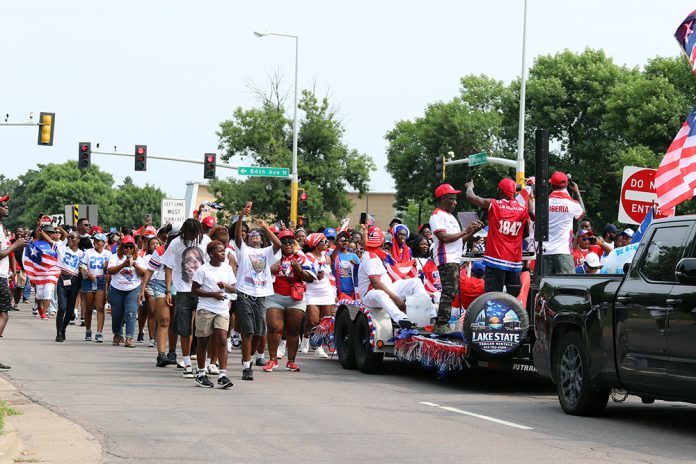
Participants make their way along West Broadway during the second annual Liberian Independence Day Parade in Brooklyn Park on Sunday, July 26, 2026. The parade led thousands of people to North Hennepin Community College for a daylong celebration of Liberia's independence. | Photo by Tom Gitaa/Mshale
Participants make their way along West Broadway during the second annual Liberian Independence Day Parade in Brooklyn Park on Sunday, July 26, 2026. The parade led thousands of people to North Hennepin Community College for a daylong celebration of Liberia's independence. | Photo by Tom Gitaa/Mshale
The second annual Liberian Independence Day Parade returned Sunday in Brooklyn Park, drawing thousands to what has become one of Minnesota’s largest African cultural celebrations. The event, which debuted last year in neighboring Brooklyn Center, is intended to become an annual celebration of Liberia’s independence.
Crowds braved triple-digit heat to gather for the 11 a.m. parade, but the soaring temperatures did little to dampen the festive atmosphere.
Leading the procession was a Ford F-150 draped with the Liberian flag and an advertisement for a local Liberian grocery store. Behind it, DJ Chinho blasted music from a trailer, including Skrewfaze’s “Liberia Independence Day,” which has become the unofficial anthem of the celebration. The music’s bass echoed along West Broadway as passing motorists rolled down their windows, danced behind the wheel and cheered marchers making their way through Brooklyn Park.
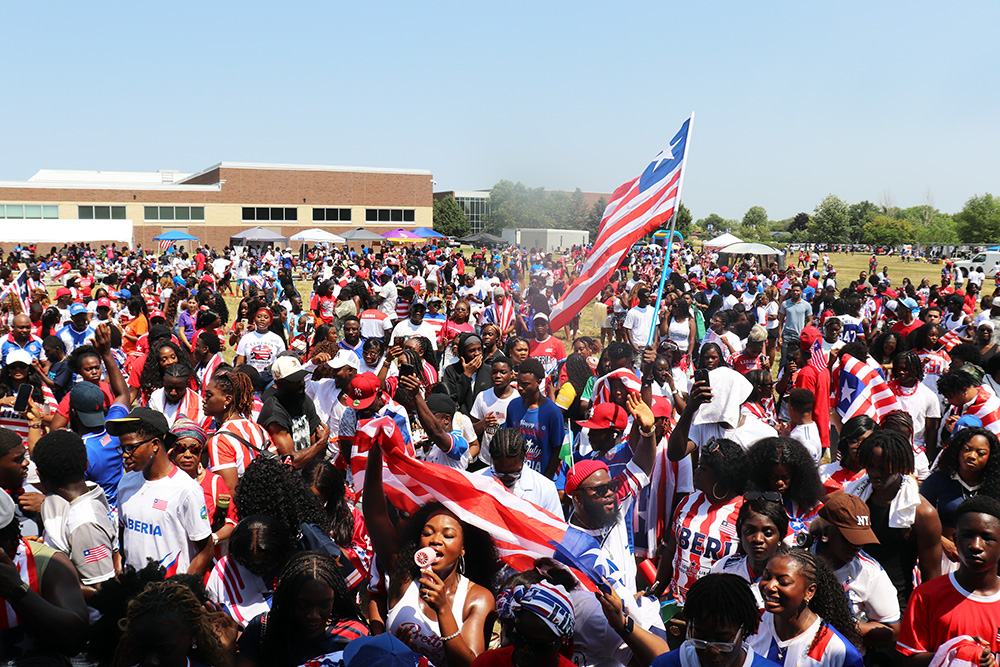
Thousands of people gather near the main stage during the Liberian Independence Day celebration at North Hennepin Community College in Brooklyn Park on Sunday, July 26, 2026. The event has quickly grown into one of Minnesota’s largest African cultural celebrations. | Photo by Tom Gitaa/Mshale
Marchers wore blue, red and white shirts inspired by the Liberian flag, whose single white star distinguishes it from the American flag. Liberia declared its independence on July 26, 1847, becoming Africa’s first modern republic after being established as a settlement for formerly enslaved and free Black Americans.
The parade began near the intersection of 84th Avenue and West Broadway before briefly turning onto West Broadway. Organizers soon rushed through the procession warning marchers they did not have a permit to remain on the busy roadway. The parade instead re-entered the North Hennepin Community College campus via College Parkway, where festivities continued without interruption.
The procession also reflected the growing political influence of Minnesota’s Liberian community. Brooklyn Park City Council candidate Bernice Cooper and state Senate candidate Nehemiah Garley rode in the parade alongside Rep. Huldah Momanyi Hiltsley and Brooklyn Park Mayor Hollies Winston, each representing milestones in the growing political representation of African immigrant communities.
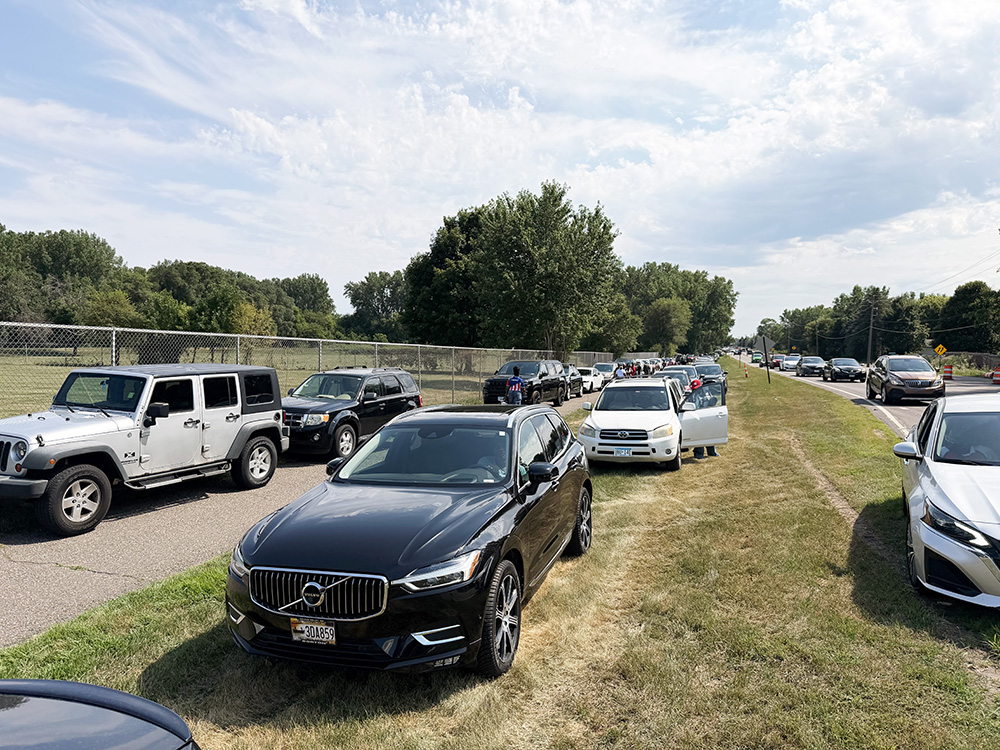
By early afternoon, attendance had swelled into the thousands, filling North Hennepin Community College’s parking lots and sending vehicles onto West Broadway, 85th Avenue and nearby side streets.
What began last summer in Brooklyn Center has evolved into one of Minnesota’s largest African cultural celebrations, drawing crowds large enough to test parking capacity, traffic management and special event planning. The long lines of parked vehicles stretching along West Broadway reflected both the scale of the gathering and the organizational effort now required to stage it.
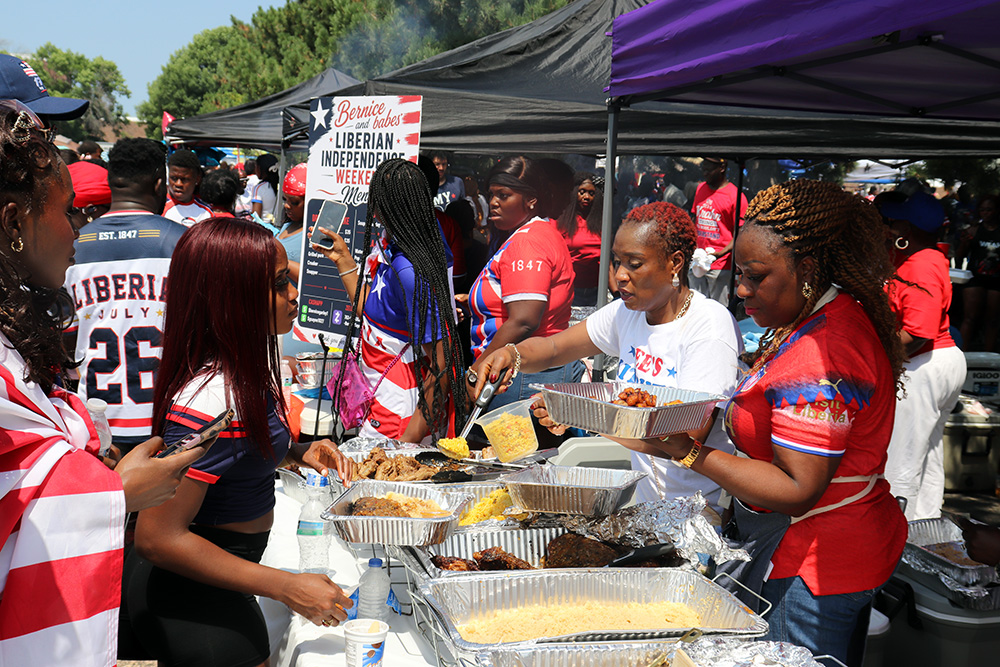
Food vendors did brisk business selling Liberian favorites including dumboy, cassava leaves and jollof rice, while cold drinks became one of the day’s hottest commodities.
Attendees are served traditional Liberian dishes at Tee’s Kitchen during the Liberian Independence Day celebration in Brooklyn Park. Food vendors were among the busiest attractions as thousands attended the all-day festival. | Photo by Tom Gitaa/Mshale
Among those enjoying the festivities was Brooklyn Park resident Gloria Kennedy, who danced with her 6-year-old son Jaydel in front of the main stage.
Recognizing Mshale’s press badge, Kennedy laughed as she recalled missing last year’s inaugural celebration.
“You know last year I missed the event because I didn’t know it was happening,” she said. “I saw it on your Facebook page and I said, by the grace of God, I am not missing it next year.”
The celebration was the largest Liberian community event Mshale has covered in Minnesota, surpassing even a major Liberian soccer exhibition at the National Sports Center more than two decades ago. Throughout the week leading up to the event, community elders praised the younger generation for organizing a celebration of this scale outside the umbrella of the long-established Organization of Liberians in Minnesota.
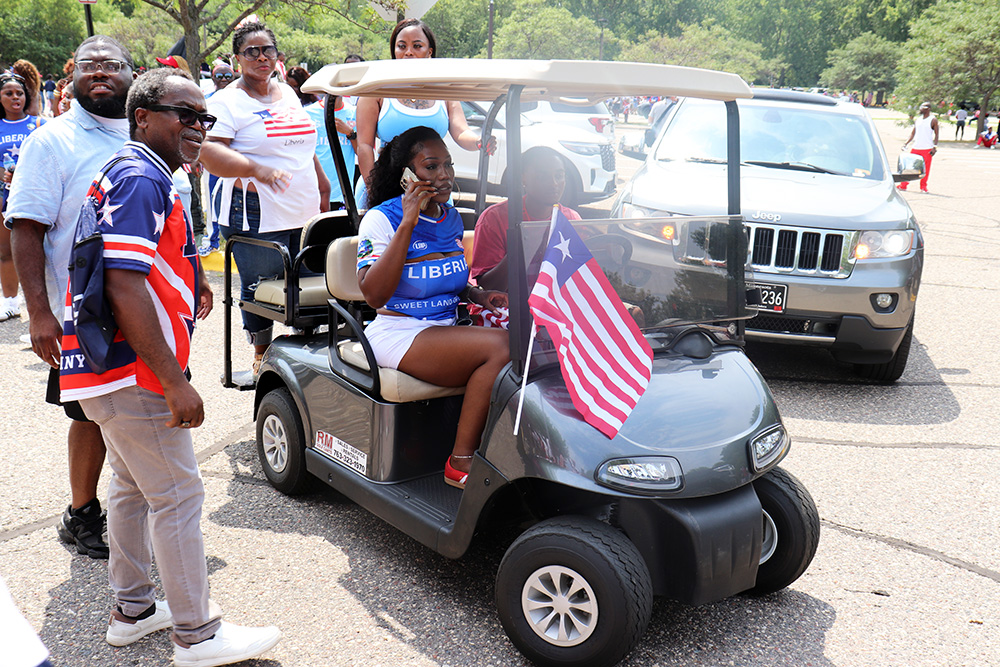
On parade day, one of the co-founders of We Are Liberian, Marie Dweh, could be seen riding a golf cart around the grounds, coordinating volunteers and making sure the celebration stayed on schedule.
While organizers initially said the event moved from Brooklyn Center to Brooklyn Park to accommodate a larger crowd, Dweh later told Mshale the decision was also influenced by what she described as increasingly difficult permitting requirements in Brooklyn Center.
Dweh said organizers had hoped to return there but ultimately concluded they could not meet the city’s permitting and public safety requirements. Among them, she said, was a request for approximately 20 police officers assigned to the event, with the nonprofit responsible for the associated overtime costs.
Parade organizer Marie Dweh takes a phone call while traveling through the festival grounds by golf cart during the Liberian Independence Day celebration in Brooklyn Park on Sunday. Dweh said organizing the rapidly growing event required months of planning and coordination. | Photo by Tom Gitaa/Mshale
“As a small nonprofit that is just not possible,” Dweh said. “Our event last year was very peaceful and I didn’t want our family-friendly event overpoliced because I don’t think our people would have liked that.”
In a statement to Mshale, Brooklyn Center said city staff began meeting with representatives of We Are Liberian in the fall of 2025 to discuss the proposed event and review the city’s special event permitting process. The city said organizers were granted additional time to complete their application, but the proposal ultimately did not meet the required permitting timeline.
Vehicles stretch along nearby roads as attendees search for parking during the Liberian Independence Day celebration in Brooklyn Park on Sunday. The turnout exceeded organizers’ expectations and filled parking areas around North Hennepin Community College. | Photo by Tom Gitaa/Mshale
Brooklyn Center said staffing requirements for special events are based on anticipated attendance, traffic management, the event route and overall public safety needs. The city added that organizers may be responsible for staffing costs when events require personnel beyond normal staffing levels.
“Brooklyn Center values community events that celebrate the city’s diverse cultures and traditions,” Communications Manager Joe Cardoza said in the statement. “The city welcomes future conversations with event organizers should they wish to host events in Brooklyn Center.”
Dweh said organizers then approached neighboring Brooklyn Park, where city officials welcomed the event but explained there was not enough time to obtain a full road-closure permit for this year’s parade. She said Brooklyn Park has already committed to working with We Are Liberian on next year’s celebration, including securing the permits needed to close West Broadway.
“I am hoping they come through for our community,” Dweh said.
The celebration’s growth was reflected not only in attendance but also in its impact beyond the festival grounds.
Several people in Minnesota’s Liberian community told Mshale that healthcare facilities experienced unusually high call-ins Sunday as many workers took time off to attend Independence Day celebrations. Within Minnesota’s Liberian community, the phenomenon has become informally known as “Liberian Weekend,” when many workers coordinate time off to attend major community events. This year’s Independence Day, however, fell outside the traditional weekend off when many had already planned their work schedules.
According to the Minnesota Department of Employment and Economic Development’s Office of New Americans, more than 30% of the state’s nursing assistants and home health aides—workers who care for elderly Minnesotans and people recovering from illness or injury at home—are foreign-born. After Somalis, Ethiopians and Kenyans, Liberians are the next-largest African immigrant community in Minnesota.
Bernice Cooper said the event’s economic impact was also visible throughout the surrounding area.
“The stores in the surrounding area were running out of water and all manner of drinks and had to start limiting the amount each person could buy so they would have enough for everyone, as did the restaurants,” she said.
“And we are just getting started. This is only the second year. I’ve already volunteered to help the young people organizing it by joining the cleanup crew next year.”
Suah Williams, was born and raised in Liberia and lives in Dublin, Ireland. He flew in for the weekend to be with his fiancée Sheya Zarzar who lives in Brooklyn Park and the two planned to join other Liberians in the festivities.
“I had to bring him out here,” Zarzar a finance professional said, as the two of them took in the music. “There is no better place to be.”
Brooklyn Park resident Sheya Freeman, left, and her fiancé, Suah K. Freeman, who was visiting from Ireland, pose during the Liberian Independence Day celebration in Brooklyn Park on Sunday, July 26, 2026. The couple told Mshale they planned his visit around the event, calling it “the best place to be.” | Photo by Tom Gitaa/Mshale
As the parade gave way to the main stage performances, hundreds more streamed onto the grounds, reinforcing Zarzar’s belief that there was “no better place to be.” By the time Mshale left at about 5 p.m., the celebration was still growing and would continue into the evening.
The couple said they were most looking forward to celebrating Liberia together through the parade and the music that filled the festival grounds.
“I like it,” Williams said, taking in the music and shouts from the crowd. “I hope to move here soon.”
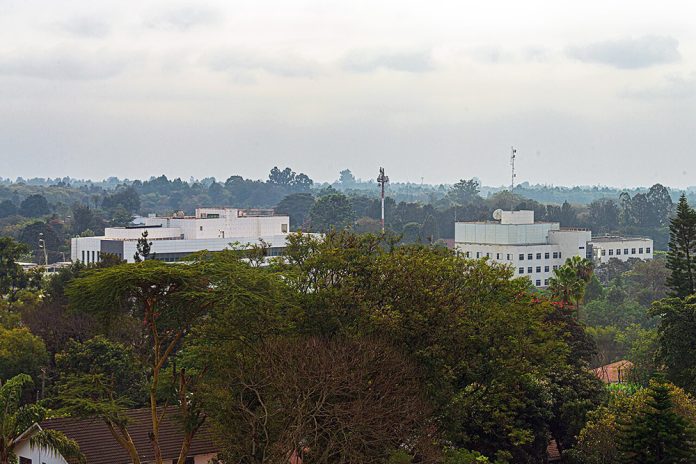
The U.S. Embassy in Nairobi, Kenya, photographed from the nearby Gem Hotel. Nairobi is one of 20 regional hubs that will handle routine U.S. immigrant and nonimmigrant visa interviews beginning Aug. 1, 2026. | Photo by Daniel Case/Wikimedia Commons
The U.S. Embassy in Nairobi, Kenya, photographed from the nearby Gem Hotel. Nairobi is one of 20 regional hubs that will handle routine U.S. immigrant and nonimmigrant visa interviews beginning Aug. 1, 2026. | Photo by Daniel Case/Wikimedia Commons
Millions of Africans seeking to visit the United States will soon face longer journeys, higher travel costs and additional logistical hurdles after the Trump administration announced it is ending routine immigrant and nonimmigrant visa services at 25 U.S. diplomatic posts across Africa and consolidating processing into 20 regional hubs beginning Aug. 1, 2026.
The overhaul represents one of the most significant changes to U.S. visa operations on the continent in years and is the latest in a series of Trump administration immigration restrictions affecting Africa. Since returning to office, the administration has pursued a range of policies aimed at tightening immigration and restricting travel from several African countries, arguing the measures strengthen national security and improve immigration enforcement.
Under the State Department’s plan, routine visa interviews will no longer be available at 25 U.S. diplomatic posts across Africa. Applicants from those countries will instead be directed to one of 20 regional visa processing hubs for routine immigrant and nonimmigrant visa interviews beginning Aug. 1.
The chart below compares the 25 diplomatic posts where routine visa services are ending with the 20 regional hubs that will handle routine immigrant and nonimmigrant visa interviews beginning Aug. 1.
Liberia is among the countries retaining routine U.S. visa services, with the U.S. Embassy in Monrovia designated as one of the continent’s regional processing hubs. Nigeria will also retain routine visa services through the U.S. Consulate General in Lagos, even as such services end at the U.S. Embassy in Abuja.
The State Department said emergency services for U.S. citizens, passport services and other routine consular assistance will continue at the affected embassies and consulates. Diplomats assigned to those posts will also continue carrying out their regular diplomatic responsibilities.
The administration said the restructuring is intended to improve operational efficiency, strengthen security screening and standardize visa adjudications across Africa.
For many Africans, however, the policy is expected to add another layer of cost and complexity to an already lengthy visa application process.
Family members hoping to visit relatives in the United States, students accepted to American universities, business travelers and tourists may now have to budget for international travel before they can even attend a visa interview.
The change could also affect members of Minnesota’s large African immigrant communities whose relatives regularly travel from the continent for weddings, funerals, graduations, family visits and other important events.
The State Department advises visa applicants to consult the website of their designated regional processing hub for appointment availability and application instructions before making travel arrangements.
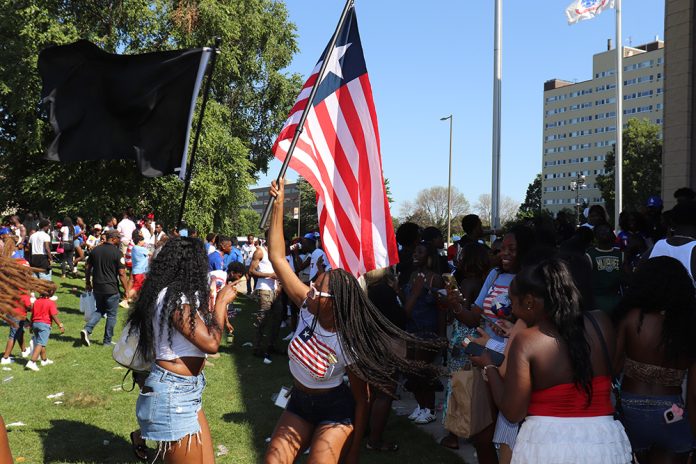
A participant waves the Liberian flag during the inaugural Liberian Independence Day parade in Brooklyn Center in July 2025. This year's celebration moves to Brooklyn Park on Sunday as thousands are expected to mark Liberia's 179th Independence Day. | Photo by Tom Gitaa/Mshale
A participant waves the Liberian flag during the inaugural Liberian Independence Day parade in Brooklyn Center in July 2025. This year's celebration moves to Brooklyn Park on Sunday as thousands are expected to mark Liberia's 179th Independence Day. | Photo by Tom Gitaa/Mshale
BROOKLYN PARK, Minn. — Brooklyn Park Mayor Hollies Winston is inviting Minnesotans from across the state and beyond to attend Sunday’s Liberian Independence Day parade, describing it as “more than local” and a celebration of “pride, community, family and culture” as one of the country’s largest Liberian communities marks Liberia’s 179th Independence Day.
The parade, which drew thousands during its inaugural last year in neighboring Brooklyn Center, moves to Brooklyn Park this year. Organizers with We Are Liberian, the local nonprofit that is organizing it, expect another large turnout for the free family-friendly celebration featuring a parade, live entertainment, games and Liberian food.
“This isn’t just a local celebration,” Winston said in a video invitation posted on social media. “This is a global celebration with folks coming from all over, but also a celebration of pride, community, family and culture.” He also praised the contributions of Brooklyn Park’s Liberian community and called the event “a partnership with the city of Brooklyn Park.”
Minnesota is home to the nation’s largest Liberian population, with Brooklyn Park serving as the community’s largest hub. The parade begins at 11 a.m. Sunday, July 26, at North Hennepin Community College, 7411 85th Ave. N., followed by a daylong celebration in the park.
Last year’s inaugural parade became one of Mshale’s most-read stories of 2025 and showcased the vibrancy of Minnesota’s Liberian community as hundreds lined the streets waving Liberian flags and celebrating the West African nation’s independence.
Mshale will provide on-the-ground coverage of Sunday’s parade and celebrations.
Candidates for Minnesota Senate District 38 and House districts 38A and 38B participate in a League of Women Voters candidate forum at Brooklyn Park City Hall on July 14, 2026. Immigration enforcement, government fraud, taxes and public safety emerged as the dominant issues ahead of the Aug. 11 primary election. | Screenshot from League of Women Voters livestream
Candidates for Minnesota Senate District 38 and House districts 38A and 38B participate in a League of Women Voters candidate forum at Brooklyn Park City Hall on July 14, 2026. Immigration enforcement, government fraud, taxes and public safety emerged as the dominant issues ahead of the Aug. 11 primary election. | Screenshot from League of Women Voters livestream
BROOKLYN PARK, Minn. — Immigration enforcement, government fraud, public safety and the rising cost of living emerged as defining issues during a League of Women Voters candidate forum, as candidates seeking to represent Minnesota Senate District 38 and House districts 38A and 38B offered voters contrasting approaches ahead of the Aug. 11 primary.
The July 14 forum brought together candidates for three legislative races covering Brooklyn Park, Brooklyn Center and Osseo. Candidates were given the same questions submitted by members of the public and one minute to respond to each.
While the event included candidates from both the DFL and GOP, much of the immediate attention is focused on two contested DFL primaries in this deep blue district.
Sen. Susan Pha is facing Nehemiah Garley in Senate District 38, while Rep. Huldah Momanyi Hiltsley is being challenged by former Brooklyn Park City Council member Wynfred Russell in House District 38A and a Democratic Socialists of America (DSA) candidate Richard “Lefty” Klatte.
Republican Brad Olson is running for the Senate seat with no primary challenger, while Charlie Kistler and Yelena Kurdyumova are the Republican candidates in House District 38A for the Aug. 11 primary. Rep. Samantha Vang, the DFL incumbent in House District 38B, and Republican Robert Marvin do not face primary opponents.
Candidates addressed a wide range of topics, but questions about the economic and community effects of the federal ICE Operation Metro Surge, government oversight following recent fraud cases, taxes and public safety produced some of the evening’s clearest differences.
Operation Metro Surge remains defining issue
The impact of Operation Metro Surge generated some of the most detailed responses of the forum, with candidates acknowledging that the federal immigration enforcement operation disrupted families and businesses while disagreeing about the state’s response and whether greater cooperation with federal authorities could have limited the operation.
Russell said the enforcement surge continued to affect residents and businesses after the most visible federal activity had subsided.
“There was a huge impact that the federal ICE Metro Surge caused on communities,” Russell said. “It disrupted their lives, disrupted our lives and businesses.”
Russell said the Legislature approved some assistance, but the recovery remained incomplete.
“There is still a lot of need,” he said. “The community is still struggling.”
Hiltsley said many immigrant- and minority-owned businesses in the district were already struggling to recover from the COVID-19 pandemic when Operation Metro Surge brought another period of disruption.
“A lot of our businesses, they were still recovering from COVID,” Hiltsley said. “And now to deal with Metro Surge, we have a long way to go to making sure that our businesses feel supported.”
Hiltsley said lawmakers attempted to approve a larger rapid-response package but were unable to secure sufficient support. She said legislators must continue working to assist businesses when they return to the Capitol.
Pha used some of the evening’s strongest language to describe the operation, saying it resulted in “families torn apart,” “neighborhoods terrorized” and freedoms being stripped away.
She said DFL legislators sought funding for families and a small-business recovery package but did not receive Republican support. Pha said she was the chief author of a proposed $100 million small-business recovery fund developed with nonprofit partners, but the proposal did not advance.
Olson offered a different view, arguing that Minnesota’s refusal to cooperate more closely with federal immigration authorities contributed to the size and visibility of the operation.
“If we would have cooperated with ICE, and if the state and the local law enforcement would have cooperated with ICE, it would have happened right then and there,” Olson said.
He nevertheless acknowledged concerns about the conduct of federal agents.
“On the other hand, ICE was a little aggressive,” Olson said.
The responses reflected a broader divide between DFL candidates, who emphasized financial assistance and accountability for federal authorities, and Republican candidates, who said state and local cooperation could have allowed immigration enforcement to occur in a more targeted manner.
Candidates agree on fraud, differ over responsibility
Candidates across party lines agreed that Minnesota must strengthen oversight of public money, but they differed sharply over whether lawmakers have responded adequately and who should bear responsibility for the failures.
Pha defended steps taken by the Legislature, including creation of an Office of Inspector General and efforts to improve communication among state agencies.
“There has to be responsible governance,” Pha said. “There has to be accountability for our taxpayer dollars.”
She said agencies had previously failed to share information that might have allowed suspicious activities to be identified sooner. Better coordination, she said, could help officials flag possible fraud more quickly.
Pha acknowledged that more work remains, saying those attempting to defraud government programs are increasingly using technology to exploit weaknesses in state systems.
Garley said the Legislature had not done enough.
“We have to be careful how we spend taxpayer money,” he said.
Garley called for additional investigations, stronger accountability and a more closely controlled process for distributing government funds.
Russell said fraud had brought unwanted national attention to Minnesota. He called for helping organizations develop the capacity to properly receive, manage and document government funding while closing loopholes and prosecuting misuse.
Russell said anyone receiving government money must be held accountable.
Hiltsley said fraud should be prosecuted regardless of political affiliation but cautioned against using the actions of individual offenders to target entire communities.
She defended measures passed by DFL lawmakers, including the inspector general’s office, and said fraud had existed long before it became a dominant campaign issue.
“Fraud didn’t just happen yesterday,” Hiltsley said, adding that Attorney General Keith Ellison’s office has been prosecuting fraud and that state agencies need “enough resources and staffing” to enforce the laws the Legislature has passed.
Republican candidates argued that state officials had ignored warning signs for too long.
Olson called fraud a central issue in the election and said programs associated with misuse of public funds should be eliminated or carefully reviewed before being restored.
The competing responses showed a division not over whether fraud should be prosecuted, but over whether recent reforms are sufficient and whether the problem reflects individual criminal behavior, weaknesses in state government or broader failures by DFL leadership.
Taxes expose competing economic approaches
Candidates also presented different strategies for reducing financial pressure on families.
Republicans generally called for lower spending, program reviews and reductions in waste as a way to ease the tax burden.
Olson said Minnesota’s state budget had grown substantially and called for spending cuts and a review of government programs to determine whether they remain necessary.
Garley similarly said state leaders should manage existing revenue more carefully rather than continually asking taxpayers for additional money. He pointed to the property-tax burden facing residents in Brooklyn Center and called for cutting waste and strengthening fraud prevention.
Russell said residents benefit from public services supported by taxes, including police and fire departments, and cautioned against promising to eliminate taxes altogether.
Instead, he said lawmakers should “cut costs, tighten our belts” and remove waste from government spending.
Pha and Hiltsley focused more heavily on corporate taxation and whether wealthy residents are paying an equitable share.
Pha called for ending tax breaks that allow corporations and wealthy taxpayers to claim deductions unavailable to ordinary families. She pointed to legislation she supported that would have limited deductions involving stadium luxury suites.
Hiltsley said lawmakers must determine whether publicly funded programs are achieving their intended results and shift money away from ineffective efforts. She also called for increasing taxes on wealthy residents and corporations that she said do not pay their fair share.
The responses revealed differences even within the DFL contests. Pha and Hiltsley placed greater emphasis on taxing corporations and high earners, while Garley and Russell emphasized spending restraint, efficiency and reducing waste.
Gun violence brings direct exchange
Public safety generated one of the few direct exchanges between candidates.
Olson argued that gun violence is concentrated in Democratic-led cities where, he said, prosecutors fail to prosecute offenders and courts too quickly release people accused or convicted of crimes.
“The first step, I think, in gun control is to control those who commit crimes and break the law using guns,” Olson said.
He argued that millions of lawful gun owners do not commit violent acts and said the focus should be on offenders and prosecutors.
Hiltsley responded directly, saying she respectfully disagreed with Olson’s assertion that gun violence is primarily a problem in Democratic districts.
She pointed to Brooklyn Park and said violence in the city had decreased. Hiltsley said House DFLers had fought to bring gun legislation to a vote during a tied legislative session but finished the session without one.
She said she would continue pursuing what she described as common-sense gun violence legislation if reelected.
“The common-sense gun violence that we worked so hard for that the families of Annunciation Church and our community who went through horrific gun violence and others, countless others the last two years, they deserve better. So my hope and my goal is to continue to fight for common sense gun violence,” Hiltsley said.
Pha highlighted universal background checks and Minnesota’s red-flag law as steps lawmakers had already taken but said additional action was necessary.
She also urged gun owners to securely store firearms and accused Republican lawmakers of refusing to participate in efforts to develop additional gun violence prevention measures.
Garley took a somewhat different approach from the DFL incumbents, questioning whether debates centered on assault-weapon bans had adequately addressed shootings involving young people.
“It’s about time that we get very serious on how do we get the guns off the street,” Garley said.
He said young people involved in shootings are not necessarily using assault-style weapons and argued that lawmakers must move beyond repeatedly discussing the same proposals without solving the broader problem.
Later in the forum, Garley said public safety efforts should include youth investment, mentorship and stronger relationships between law enforcement and the communities they serve.
“We have to empower our youth,” he said.
Garley also called for a more diverse police force whose members understand the communities they patrol.
Rep. Samantha Vang also emphasized prevention, calling investment in extracurricular and after-school programming for young people “one of the most effective, low-hanging fruits” for improving public safety. Vang said the issue also requires policies that raise wages and give working parents more time to spend with their families.
Incumbents point to records, challengers promise change
The district’s incumbent lawmakers used the forum to emphasize legislation and state investments secured during their current terms.
Pha highlighted the Minnesota child tax credit, paid family and medical leave, affordable housing investments, universal background checks, the red-flag law and legislation reforming homeowners’ associations.
She said she had directly worked to secure $69 million for projects in the district, including fire and community facilities in Brooklyn Park and Brooklyn Center and infrastructure improvements in Osseo.
Hiltsley pointed to funding for affordable housing, public safety, parks, community centers and infrastructure in Brooklyn Park and Osseo. She also cited legislation involving housing assistance, tenant protections and access to health care.
“Leadership isn’t about being the loudest person in the room,” Hiltsley said during her opening statement. “It’s about being the person who gets things done.”
She also recounted arriving in the United States from Kenya as a child and said community advocacy and the intervention of the late U.S. Sen. Paul Wellstone helped her family overcome possible deportation.
Russell emphasized his experience as a former Brooklyn Park City Council member, public health practitioner and nonprofit leader.
He said he would focus on affordability, health care, education, small-business development and public safety through community partnerships.
Garley highlighted his community service, work with the Brooklyn Park Human Rights Commission and involvement with nonprofit organizations. He identified education as a leading legislative priority and called for higher teacher pay, housing incentives for educators and expanded student mentorship.
Olson framed his campaign as an effort to change the direction of state government after years of DFL leadership. He emphasized lower taxes, stronger law enforcement and a business climate he said would encourage families and companies to remain in Minnesota.
Early voting in Minnesota’s Aug. 11 primary is underway.
DFL voters in Senate District 38 will choose between Pha and Garley, while voters in the House District 38A DFL primary will decide between Hiltsley and Russell.
The winners will advance to the Nov. 3 general election.
Candidates from Minnesota Senate District 38 and House districts 38A and 38B answered many of the same questions during the League of Women Voters candidate forum on July 14, 2026. Here’s a comparison of where they stood on several of the evening’s major issues.
Editor’s note: This guide summarizes candidates’ responses during the candidate forum. It is intended as a quick reference for voters and is not a comprehensive summary of each candidate’s platform. You can read our full story on the forum here.
Minnesota Senate District 38
Candidate
Fraud & accountability
Taxes & affordability
Public safety
ICE / Metro Surge
Nehemiah Garley (DFL)
Called for stronger oversight, investigations and accountability for taxpayer dollars.
Favored cutting wasteful spending and easing the property tax burden on homeowners.
Emphasized addressing root causes of gun violence and getting illegal guns off the streets while investing in education and mentoring.
Said more legislative assistance is needed for businesses and families affected by ICE enforcement.
Brad Olson (Republican)
Argued Minnesota has failed to prevent widespread fraud and called for major reforms and greater accountability.
Proposed reducing government spending and reevaluating state programs to lower taxes.
Focused on stricter prosecution of offenders and stronger enforcement rather than additional gun restrictions.
Said better cooperation with federal immigration authorities could have reduced the need for large-scale ICE operations while also criticizing some enforcement tactics as overly aggressive.
Susan Pha (DFL, incumbent)
Pointed to creation of the Office of Inspector General and stronger coordination among state agencies while acknowledging additional reforms are needed.
Defended investments in public services while advocating closing tax loopholes benefiting corporations and wealthy individuals.
Highlighted passage of universal background checks and the state’s red flag law while calling for additional gun violence prevention measures.
Said the Legislature responded with rental assistance and other measures but argued more support is needed for communities and businesses impacted by the federal operation.
Minnesota House District 38A
Candidate
Fraud & accountability
Taxes & affordability
Public safety
ICE / Metro Surge
Huldah Momanyi Hiltsley (DFL, incumbent)
Supported recent Democratic anti-fraud measures while cautioning against unfairly stigmatizing entire communities because of fraud cases.
Said government should evaluate programs for effectiveness while asking corporations and wealthy taxpayers to contribute more.
Backed additional gun violence prevention legislation and investments in youth, housing and health care.
Said immigrant-owned businesses suffered significant economic harm from the operation and called for continued legislative assistance.
Wynfred Russell (DFL)
Called for stronger oversight while also helping organizations build the capacity to properly manage public funds.
Supported controlling spending and eliminating waste while maintaining funding for essential public services.
Emphasized youth investment, diversion programs and community partnerships with law enforcement.
Said the Legislature should provide additional assistance to businesses and nonprofits still recovering from the operation’s economic effects.
Richard Klatte (Democratic Socialists of America/DFL)
Said government corruption persists because voters continue electing the same political establishment. He argued Minnesota should look to Nordic-style social democracies with stronger unions and greater public accountability.
Proposed a dramatic redistribution of wealth, including what he called a 90% “freedom fee” on the wealthiest individuals and large corporations, arguing trickle-down economics has failed working families.
Supports the Second Amendment but also backs what he described as common-sense gun safety laws. He argued military-style weapons are unnecessary for civilians and criticized the gun lobby’s influence on lawmakers.
Condemned defenses of ICE enforcement during the forum and argued that voters should reject those positions. He did not outline a detailed Metro Surge response but was clearly critical of ICE’s role and framed the issue as part of broader systemic injustice.
Charlie Kistler (Republican)
Said recent reforms were a start but called for broader accountability for both fraud perpetrators and government officials responsible for oversight failures.
Favored spending restraint and eliminating fraud to relieve pressure on taxpayers.
Opposed new gun restrictions, emphasizing enforcement, accountability and addressing repeat offenders.
Said both state and federal officials shared responsibility, arguing greater cooperation with ICE could have avoided broader enforcement actions while also criticizing some federal tactics.
Yelena Kurdyumova (Republican)
Called for stricter anti-fraud laws with no loopholes, arguing penalties should be certain and enforceable so offenders cannot avoid accountability.
Supports lowering taxes, particularly through greater tax credits for homeowners and reduced taxes for seniors. She also advocated property tax limits and financial protections for homeowners.
Opposes Minnesota’s red-flag law, arguing it lacks sufficient due process protections. She supports a Stand Your Ground law and stronger legal protections for lawful gun owners’ right to self-defense.
Did not directly answer the Metro Surge/ICE question during the forum. In her opening statement, she emphasized public safety, affordable health care, lower taxes and limiting corporate influence in politics, but she did not articulate a specific position on Operation Metro Surge or ICE enforcement.
Minnesota House District 38B
Candidate
Fraud & accountability
Taxes & affordability
Public safety
ICE / Metro Surge
Samantha Vang (DFL, incumbent)
Highlighted creation of the Office of Inspector General and previous grant oversight reforms while arguing government services need less privatization.
Supported higher taxes on top earners and corporations while opposing tax increases on working families.
Backed bans on high-capacity assault-style weapons and additional gun violence prevention legislation.
Said Democrats responded with rental assistance and other proposals but said legislative action was delayed because the Legislature was not in session when the federal operation began.
Robert Marvin (Republican)
Called for continued investigation of fraud and greater accountability throughout government.
Argued state spending is too high and said reducing waste would help lower taxes.
Emphasized enforcing existing laws and holding violent offenders accountable.
No major policy proposal beyond broader concerns about economic impacts and government response.