


With less than a week before Deferred Enforced Departure (DED) protections are set to expire for an estimated 2,800 Liberians in the United States, community leaders and immigration advocates are warning that many families remain uncertain about their future even as many others have already become U.S. citizens through a law signed during President Donald Trump’s first term.
Liberia’s government this week launched a last-minute diplomatic push in Washington, D.C., urging the Trump administration to extend DED before the program is scheduled to expire June 30.
According to the Liberian Embassy in Washington, Foreign Minister Sara Beysolow-Nyanti met with House Foreign Affairs Committee Chairman Brian Mast and appealed for either an extension of DED or another pathway that would allow affected Liberians to remain legally in the United States. The embassy said Mast acknowledged the urgency of the situation and pledged to work with colleagues and engage the White House in exploring administrative options while longer-term legislative solutions are considered.
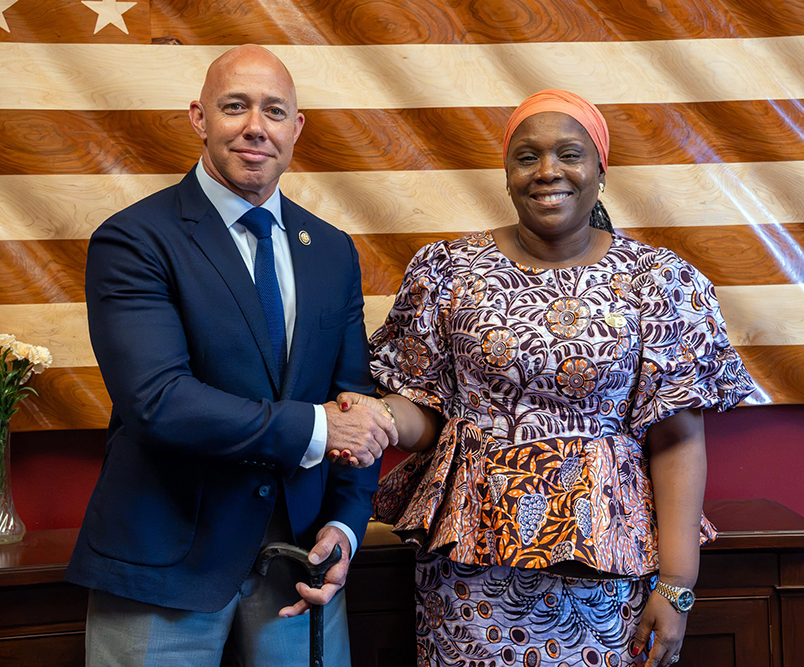
The Liberian Embassy has said more than 4,000 nationals could be affected, while USCIS says up to 2,800 people are currently covered by DED. The agency notes that because there is no application process for DED, the number is an estimate.
The approaching deadline comes even after many Liberians benefited from another immigration measure signed by Trump during his first term. In 2019, Trump signed the Liberian Refugee Immigration Fairness (LRIF) provision, allowing eligible Liberians already living in the United States to apply for lawful permanent residency.
Magdalene Menyongar, who was affectionately known within Minnesota’s Liberian community as the “DED Queen” for her years of advocacy on behalf of Liberians covered by Deferred Enforced Departure, is among those who ultimately benefited from the 2019 law.
Menyongar, whom Mshale photographed celebrating passage of the legislation in January 2020, told the newspaper she became a U.S. citizen about two years ago after pursuing permanent residency through the Liberian Refugee Immigration Fairness provision created by the 2019 law.
Community leaders say many Minnesotans successfully used that pathway and have since become U.S. citizens, while others remain dependent on DED because they were unable to qualify or faced other immigration complications.
Immigration attorney Paschal Nwokocha said he is concerned about the prospects for another DED extension given the administration’s recent immigration policies.
“Given the path the Trump administration has been going on lately, I do not expect them to extend DED for the Liberians as he has taken a hard-line approach to these matters,” Nwokocha said. “As you may recall, last year he ended TPS for Venezuelans, for example, and ultimately the Supreme Court upheld it.”
“It does not look good from where I am sitting,” he added. “I would advise any Liberian who is still on DED and is not already working with a lawyer to do so immediately for legal advice.”
Nwokocha, a former Minnesota assistant attorney general who has practiced immigration law for decades, said that in his experience many Liberians who remain on DED likely faced legal or eligibility issues that prevented them from taking advantage of the LRIF program.
“There may be other complicating factors that prevented them from obtaining green cards under the 2019 law,” he said.
Kamaty Diahn, executive director of the Organization of Liberians in Minnesota, said anxiety has been growing within the community as the June 30 deadline approaches.
“First of all, Tom, I am very happy that many of them have been able to take advantage of the law Trump signed in his first term and have become citizens,” Diahn said. “But we still have a number of people that are now in fear as June 30 comes and they don’t know what to do. There is a lot of anxiety.”
Diahn urged the administration to extend DED, citing the longstanding relationship between the United States and Liberia.
“I am pleading with President Trump to extend DED for Liberians because they are law-abiding residents,” Diahn said. “You know Liberians in Minnesota alone have about $1.6 billion in annual purchasing power, which contributes greatly to our state’s economy.”
Liberia was founded in the 19th century by formerly enslaved African Americans, and the two countries have maintained close diplomatic ties for generations. Thousands of Liberians settled in the United States after fleeing civil wars in the 1990s and early 2000s.
Deferred Enforced Departure remains a temporary presidential protection from deportation and provides work authorization for eligible beneficiaries. Unlike the Liberian Refugee Immigration Fairness program, DED does not itself provide a pathway to lawful permanent residency or U.S. citizenship.
As of Thursday, no announcement had been made on whether the Trump administration would extend DED for eligible Liberians beyond the June 30 expiration date, leaving thousands of beneficiaries awaiting a decision that could determine whether they can continue living and working legally in the United States.
For Liberians who remain covered by DED, Nwokocha said the most important step now is to seek legal advice before the June 30 deadline if they have not already done so.
“Anyone who is still relying on DED should be speaking with an immigration attorney immediately,” he said. “There may be legal options available depending on that person’s circumstances, but they need individualized legal advice.”

About Tom Gitaa, Editor-in-Chief
Born and raised in Kenya's coastal city of Mombasa, Tom is the Founder, Editor-in-Chief and Publisher of Mshale which has been reporting on the news and culture of African immigrants in the United States since 1995. He has a BA in Business from Metro State University and a Public Leadership Credential from Harvard’s Kennedy School of Government. He was the original host of Talking Drum, the signature current affairs show on the African Broadcasting Network (ABN-America), which was available nationwide in the United States via the Dish Network satellite service. On the show, he interviewed Nobel laureates such as 2004 Nobel Peace prize winner, Professor Wangari Maathai, the first woman from Africa to win the peace prize and heads of states. Tom has served and chaired various boards including Global Minnesota (formerly Minnesota International Center), the sixth largest World Affairs Council in the United States. He has previously served as the first Black President of the Board of Directors at Books for Africa. He also serves on the board of the Minnesota Multicultural Media Consortium. He has previously served two terms on the board of the United Nations Association. An avid runner, he retired from running full marathons after turning 50 and now only focuses on training for half marathons.
- Web |
- More Posts(517)
 (1 votes, average: 5.00 out of 5)
 Loading...