
MINNEAPOLIS — Just an hour before two candidates seeking to become Hennepin County’s next top prosecutor faced each other at a north Minneapolis debate Monday, state Rep. Cedrick Frazier accused his opponent, Anders Folk, of receiving support from Republicans in a race that has increasingly highlighted their political differences.
The accusation followed a text message distributed to voters by the 3rd Congressional District Republicans urging support for Folk, a former federal prosecutor who is running against the DFL-endorsed Frazier in the Nov. 3 election.
“Vote Anders Folk for Henn Cty Atny. Your West Metro GOP knows this is the only choice for Law & Order,” the message read.
The text identified itself as an independent expenditure paid for by the 3rd Congressional District Republicans and stated that it was not coordinated with or approved by Folk or his campaign.
Frazier, who represents New Hope and Crystal in the Minnesota House, seized on the message to portray Folk as politically aligned with Republicans and President Donald Trump’s administration.
In a statement released shortly before the debate, Frazier pointed to Folk’s previous service in the U.S. Department of Justice and his association with Jones Day, a law firm that advised Trump’s 2016 presidential campaign. Folk had previously acknowledged during an Oct. 13 debate that he applied to become Minnesota’s U.S. attorney under Trump but was not selected. He subsequently served as first assistant U.S. attorney under Trump appointee Erica MacDonald.
Folk has described himself as a career prosecutor who served under both Republican and Democratic administrations and has publicly criticized the Trump administration.
“The contrast between us could not be clearer,” Frazier said.
The Republican group’s independent expenditure promoted Folk’s candidacy but did not establish that his campaign coordinated with the organization. The Hennepin County attorney race is nonpartisan, although Frazier has received the DFL endorsement.
Folk, meanwhile, has sought to cast Frazier as a continuation of the policies of outgoing Hennepin County Attorney Mary Moriarty.
In an email sent to supporters shortly after the debate, Folk accused Moriarty’s administration of emphasizing rhetoric over results and argued that Frazier would represent more of the same.
“This election represents a fork in the road for Hennepin County,” Folk wrote. “My opponent would be a continuation of the status quo.”
Folk cited Frazier’s past support for Moriarty and his role as co-chair of her transition team.
Neither candidate’s written statement was a direct response to the other’s remarks at Monday’s forum. Instead, the communications illustrated the competing political arguments surrounding a contest for an office responsible for prosecuting serious crimes, overseeing child protection matters and providing legal representation to county government.
A debate rooted in north Minneapolis
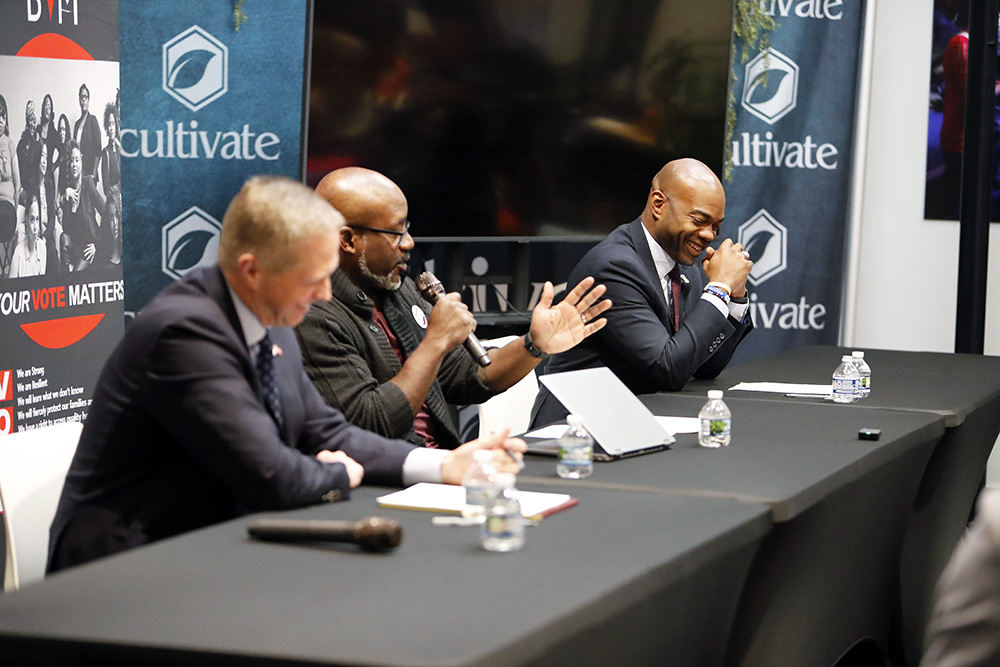
The debate, organized by Black Votes Matter Minnesota, brought both candidates to Sanctuary Covenant Church in north Minneapolis, a longtime powerhouse for Black political organizing.
Justin Terrell, who previously served as executive director of the Council for Minnesotans of African Heritage and now leads the Minnesota Justice Research Center, moderated the discussion.
Terrell asked the candidates how they would rebuild trust between the county attorney’s office and Black residents, particularly in communities that have experienced both disproportionate policing and persistent violent crime.
Folk acknowledged the troubled relationship between the Minneapolis Police Department and Black residents, citing his involvement in launching a federal investigation into the department’s policing practices while serving as acting U.S. attorney during the Biden administration.
He said north Minneapolis deserves the same level of justice and accountability as other parts of the county.
Folk also described a pattern in which communities of color have faced aggressive enforcement for minor offenses while serious crimes, including homicides and sexual assaults, have received insufficient attention.
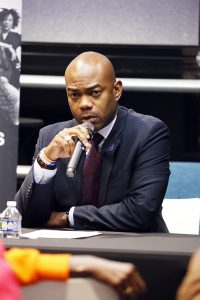
Frazier drew on his upbringing on Chicago’s South Side and his experience living in north Minneapolis while attending law school.
He said residents should not have to choose between public safety and constitutional policing.
“We want more safety,” Frazier said. “We’re not saying we need to get rid of police. We’re saying we want police that are going to be abiding by the Constitution and looking out for our best well-being.”
Frazier argued that prosecutors must develop relationships with communities before crises occur, rather than relying solely on enforcement after crimes have been committed.
Brooklyn Park murder case puts prosecutorial decisions under scrutiny
One of the debate’s most pointed exchanges concerned the 2022 murder of Zaria McKeever, a 23-year-old Brooklyn Park mother whose case became a flashpoint in the controversy surrounding Hennepin County Attorney Mary Moriarty’s handling of violent crimes.
McKeever was fatally shot in her apartment by one of two teenagers sent there by her former boyfriend, Erick Haynes, who had ordered them to kill her new partner.
The case drew statewide attention in 2023 after Moriarty’s office proposed plea agreements for the juvenile defendants that McKeever’s family considered too lenient. Moriarty defended the proposed approach, arguing that rehabilitation in the juvenile justice system offered a better outcome than lengthy adult prison sentences.
Following objections from McKeever’s family and Attorney General Keith Ellison, Gov. Tim Walz took the unusual step of removing the case from Moriarty’s office and assigning it to Ellison for prosecution.
Haynes subsequently pleaded guilty to first-degree felony murder and was sentenced to life in prison with the possibility of release after 30 years.
At Monday’s debate, Terrell raised the case during a discussion of domestic violence and asked both candidates what they would have done differently.
Folk criticized the county attorney’s handling of the prosecution, arguing that the office had failed both McKeever’s family and the broader community.
“The county got the charging decisions wrong in that case, and they should have worked much harder to ensure accountability for everybody who was involved in murdering Zaria McKeever,” Folk said.
He also faulted the office for failing to adequately explain its decisions.
“You as the county attorney owe real transparency, not just to the crime victims and their families, but to the entire community about what you’re doing, how you’re doing it, and why,” Folk said.
Frazier also criticized the handling of the case, pointing to his endorsement by Ellison, who ultimately took over the prosecution.
“Attorney General Ellison has endorsed my campaign and one of the main reasons is because he understands that I would approach that case differently,” Frazier said.
Frazier said he understood the family’s anger over what he characterized as a change in the expected outcome of the prosecution.
“I would have continued to move that case forward the way it was initially said it was going to be resolved, because that was what was promised to the family,” he said.
Both candidates criticized Moriarty’s handling of the McKeever case, even as Folk sought to link Frazier to her administration. Frazier, in turn, emphasized his endorsement by Ellison, whose intervention in the prosecution represented a significant public challenge to Moriarty’s authority.
The exchange highlighted the difficult balance facing the next county attorney between juvenile rehabilitation, accountability for violent crimes and the expectations of victims’ families.
Juvenile justice exposes differences
The candidates also discussed juvenile crime, an issue that has generated concern among residents and law enforcement officials.
Frazier emphasized prevention, early intervention and partnerships with schools and community organizations.
He said one of his first meetings after announcing his candidacy was with Minneapolis high school principals to discuss identifying young people at risk of entering the criminal justice system.
Frazier argued that the consequences of criminal involvement can follow young people for years, affecting education, employment, housing and access to other opportunities.
He also cited organizations such as A Mother’s Love Initiative, which works with young people and families in the community.
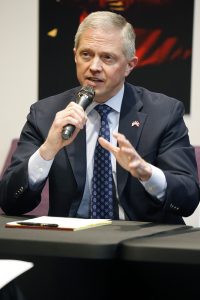
Folk agreed that prevention and intervention are essential but argued that Hennepin County has moved too far away from holding young people accountable for crimes.
“There have been for a long time in our history we’ve put too many kids into jail for too many reasons,” Folk said. “And I think we’re now at a place in Hennepin County in particular where we’ve gotten away from any kind of accountability.”
Folk called for a secure residential option for young people convicted of serious offenses within Hennepin County, saying the county should not have to send children elsewhere when residential intervention is necessary.
Both candidates supported combining intervention programs with accountability, although Folk placed greater emphasis on the need for secure facilities and consequences for serious offenses.
Questions about federal immigration enforcement
The debate also turned to Operation Metro Surge, the federal immigration enforcement operation that brought widespread controversy to Minnesota earlier this year.
Terrell asked how the candidates would hold federal agents accountable for violations of state law.
Folk said he would assemble a team with federal prosecution expertise to assist county prosecutors in pursuing cases against federal officers.
“Any federal agent who violated Minnesota law during Operation Metro Surge needs to be held accountable,” Folk said.
He said such prosecutions could involve complex federal legal questions and require attorneys familiar with federal courts.
Frazier also promised to pursue accountability, emphasizing his commitment to working with Minnesota Attorney General Keith Ellison and prosecutors already handling cases involving federal agents.
He said his first priority would be checking on the progress of those cases and ensuring they continued moving forward.
Both candidates condemned misconduct by federal immigration officers and praised Minnesota residents who organized in response to the enforcement operation.
Family preservation and sentencing reform
The candidates also addressed the African American Family Preservation Act, legislation intended to address racial disparities in Minnesota’s child protection system and reduce unnecessary family separations.
Frazier highlighted his legislative work supporting the measure and said he would prioritize its implementation within the county attorney’s office.
Folk also supported the law’s goals, emphasizing the county’s responsibility to protect vulnerable children while addressing disparities in child welfare decisions.
On mandatory minimum sentences, both expressed concerns about laws that restrict judicial discretion.
Folk said his experience as a federal prosecutor had changed his perspective on mandatory minimums, although he stopped short of supporting their elimination in every category of crime.
Frazier described a case involving a person who discovered a firearm in an inherited vehicle and reported it to authorities, only to face prosecution because of a prior felony conviction.
He argued that rigid sentencing requirements can punish people who attempt to do the right thing.
Residents press for meaningful accountability
During the audience discussion, Lisa Clemons, CEO of A Mother’s Love Initiative, challenged the candidates to provide clearer information about juvenile crime and to include people with differing views in their decision-making.
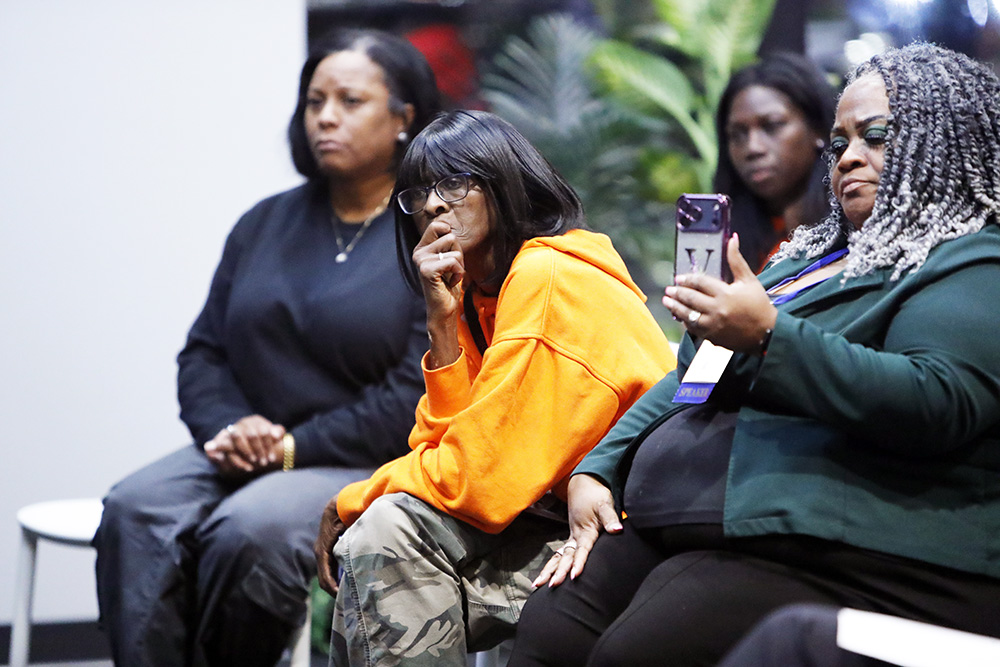
Clemons questioned whether declining crime statistics adequately reflected the experiences of residents who continue to confront violence in their neighborhoods.
She also called for more specific information about the number of young people involved in serious offenses.
Folk responded that the county attorney’s office should improve public access to data on youth crime, violence and repeat offending.
Frazier pointed to his legislative experience bringing together groups with competing perspectives, including law enforcement, educators and community advocates, to address school safety.
The exchange underscored a recurring theme throughout the debate: Residents want measurable improvements in safety, but also greater transparency and accountability from the institutions responsible for delivering it.
Voters to decide Nov. 3
Frazier, who has received endorsements from the DFL and several prominent Democratic officials, is seeking to move from the Legislature to one of Minnesota’s most influential prosecutorial offices.
Folk, a former acting U.S. attorney for Minnesota, has emphasized his prosecutorial experience and called for changes in the leadership and priorities of the county attorney’s office.
Mshale reported Frazier’s entry into the race in August 2025.
Hennepin County voters will choose their next county attorney Tuesday, Nov. 3. Polls will be open from 7 a.m. to 8 p.m.
Early voting is underway, and voters can find registration information, polling locations and sample ballots at mnvotes.gov.
About Tom Gitaa, Editor-in-Chief
Born and raised in Kenya's coastal city of Mombasa, Tom is the Founder, Editor-in-Chief and Publisher of Mshale which has been reporting on the news and culture of African immigrants in the United States since 1995. He has a BA in Business from Metro State University and a Public Leadership Credential from Harvard’s Kennedy School of Government. He was the original host of Talking Drum, the signature current affairs show on the African Broadcasting Network (ABN-America), which was available nationwide in the United States via the Dish Network satellite service. On the show, he interviewed Nobel laureates such as 2004 Nobel Peace prize winner, Professor Wangari Maathai, the first woman from Africa to win the peace prize and heads of states. Tom has served and chaired various boards including Global Minnesota (formerly Minnesota International Center), the sixth largest World Affairs Council in the United States. He has previously served as the first Black President of the Board of Directors at Books for Africa. He also serves on the board of the Minnesota Multicultural Media Consortium. He has previously served two terms on the board of the United Nations Association. An avid runner, he retired from running full marathons after turning 50 and now only focuses on training for half marathons.
- Web |
- More Posts(518)
 (No Ratings Yet)
 Loading...