For nearly 250 years, since the founding of the United States, no Black woman had ever been elected governor of an American state.
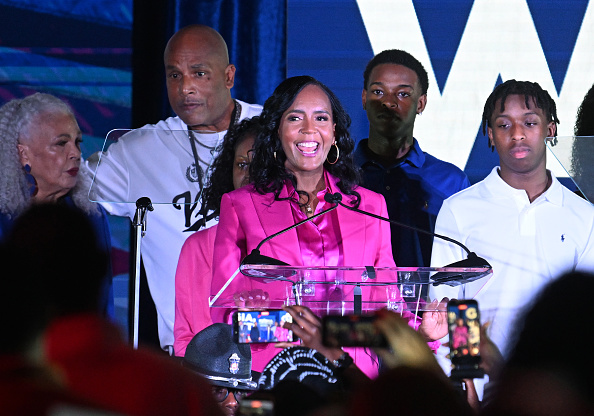
That changed Tuesday, Nov. 3, when Georgia voters elected former Atlanta Mayor Keisha Lance Bottoms, a Democrat, as the nation’s first Black woman governor.
Bottoms defeated Republican businessman Rick Jackson, becoming not only the first Black woman elected governor anywhere in the country, but also the first woman and first Black person elected to Georgia’s highest office. Her victory ended a Republican hold on the governorship dating to 2003.
The historic breakthrough came in a state where slavery was once central to the economy and where the struggle for Black voting rights helped shape the modern civil rights movement.
Before Tuesday’s election, only three Black Americans had ever been elected governor of a state.
Check out: Mshale Black Ballot – Election results for Black candidates around Minnesota.
The first was L. Douglas Wilder, elected governor of Virginia in 1989. Seventeen years later, Deval Patrick won the Massachusetts governorship in 2006. Wes Moore followed in Maryland in 2022, becoming the nation’s third elected Black governor.
An earlier Black governor, P.B.S. Pinchback, briefly served as Louisiana’s acting governor during Reconstruction in 1872, but he was not elected to that office.
Tuesday’s elections dramatically expanded that history.
In addition to Bottoms, Republican Byron Donalds became Florida’s first Black governor-elect, while Democrats David Crowley in Wisconsin and Aaron Ford in Nevada won their states’ gubernatorial races. Moore was reelected in Maryland.
The results bring the number of Black Americans elected governor in U.S. history to seven, with five Black governors expected to serve simultaneously when the newly elected governors take office in January.
Yet Bottoms’ election stands apart as a milestone for Black women, who had never previously won a governorship despite generations of political organizing and leadership.
In her election-night victory speech, Bottoms thanked voters across Georgia and pledged to represent residents regardless of their political affiliations.
“No matter who you voted for tonight, I will be a governor for all of Georgia,” she told supporters.
But it was her reflection on her family’s history that gave the occasion its most striking connection to America’s past.
In its reporting on Bottoms’ election, The Atlanta Journal-Constitution traced her ancestry to Sheppard Peek, an enslaved man listed as property in Georgia in 1860. His recorded value was $1,400, and on a surviving document, he signed his name with an X.
More than a century and a half later, his great-great-granddaughter has been elected to lead the state where he was enslaved.
Bottoms told supporters that the day before the election, she visited Crawfordville, Georgia, where her family traces its roots through at least five generations.
There, she visited the grave of her great-great-grandmother, Betsy Peek, who was born in 1845, before the abolition of slavery.
“I know I am standing on shoulders made of steel,” Bottoms said.
She also pointed to another figure associated with Crawfordville: Alexander H. Stephens, who served as vice president of the Confederate States of America.
“So yes, Crawfordville produced the Confederacy’s vice president, but tonight it also produced your next governor,” she declared.
Bottoms said her victory demonstrated that Georgia’s identity was not confined to any single chapter of its history.
More than 160 years after her ancestors lived under slavery in Georgia, Bottoms is preparing to govern the state as the first Black woman elected governor in American history.

About Mshale Staff
The byline “By Mshale Staff” is used for stories that involve limited or no original reporting by our newsroom. These stories are often based on press releases or information provided by official sources, including corporations, government agencies and public institutions. The byline also may be used for reports compiled from multiple contributors, wire services, previously published material or aggregated sources when listing individual authors is impractical. Outside sources are generally identified within the story.
 (No Ratings Yet)
 Loading...