What Obama’s Victory Means to My Daughter from Ethiopia
NEW YORK — About six months ago, my then seven-year-old daughter, Tibarek, awakened early one morning and called to me. “Jilly, I had a dream. Joe Biden won! And that means that if he wins, Obama will win, too. So, you don’t have to worry!” I told her that her dream was wonderful and I hoped she was right. “Kids just know these things,” she said. “Adults just have to listen to us sometimes.”
My prescient daughter was right and Wednesday, I awakened her to say, “OBAMA WON!” “Stop kidding me!” she responded with a smile. “You’re sure?” And we, like the vast majority of Americans, started our day with a profound smile.
I’m still digesting Obama’s victory and what it means to me. Each time I hear someone on TV, I think “Oh, that’s what it means.” Optimism. Potential. The fruits of hard work. The core of what America means to the world. My elation that a man of high intelligence, calm and caring has won is reinforced by the flood of emails from friends around the world who are SO excited with us – the friend in Amsterdam who was invited to FIVE parties to watch the results, the friend in Tel Aviv who sees a new day in the Middle East, my “sister” in Mexico City who is crying with emotions for future generations.
But there’s a profoundly personal joy in Obama’s victory that I haven’t quite articulated but it goes something like this: Because I am Tibarek’s mom, I feel an extra connection to the joy of the African American and African communities here and all over the world that a black man is the new leader of America. I am overjoyed that Tibarek has been in the United States during this formidable time, when women leaders are the norm, Spanish is the language she hears and is picking up, and black faces are those of our leaders.
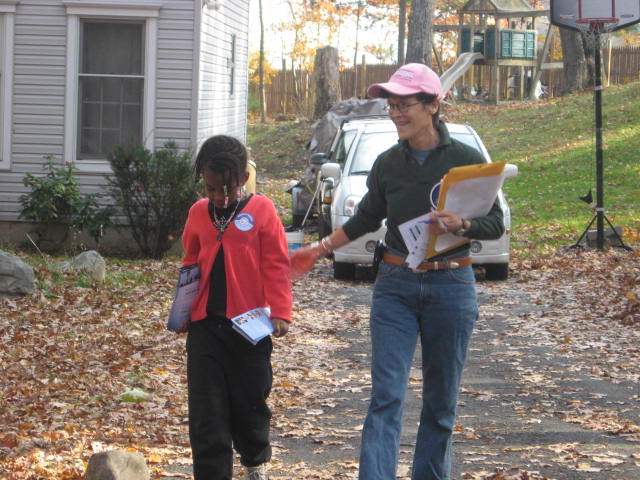
She voted with me for Hillary for senator and Obama for president; we canvassed for Obama in Pennsylvania; we talk about policy and fairness. I love it that she will see little girls who look like her living in the White House. I am proud to have participated in activities which show her in the importance of being involved.
Each time I hear Obama talk about world cultures, diversity in America, intercultural understanding, his comfort with true multiculturalism simply exudes from his words. And herein, I feel an almost secret connection, perhaps my own little invention of understanding. Obama’s anthropologist mother brought him up in a world where different cultures, looks, languages, religions and nationalities were daily fair. This was formative. We hear his even-handed comfort with culture in every utterance of foreign policy and take on domestic diversity.
I am Tibarek’s anthropologist mother who also lives in that world, with a huge embrace of “other” as the norm. Tibarek’s Ethiopian mother entrusted me to take her beyond their limited resources, expand her world, grow and blossom. I promised her I would and am taking this amazing person along for every possible opportunity that comes our way or that we can create. From knocking on a door in Pennsylvania, I figure she’ll soon be knocking on another door on Pennsylvania Avenue for a play date.
The Neighborhood House in St. Paul will screen a film this evening on an immigrant’s fear that he has contracted HIV.
The 26-minute film is about a Mexican migrant worker who has unprotected sex with several women. He must now face the possibility that he might have contracted HIV when one of these women tells him that she has been diagnosed with HIV.
Showing: Monday, December 1, 2008| 4:00 – 6:30 p.m.
Neighborhood House| 179 Robie Street East | Saint Paul, MN 55107
Written by local playwright and director Al Justiniano
What is a 212 (i) waiver? Section 212(i) of the Immigration and Nationality Act (INA) provides a discretionary waiver for immigrants who are subject to a ground of inadmissibility based on fraud or misrepresentation in procuring or attempting to procure an immigration benefit.
This type of waiver commonly arises when a foreign national uses another’s passport to enter the United States or when a foreign national gives false information to an immigration official or on an immigration application form. Specifically, the statute states that a misrepresentation is made when any alien who, by fraud or willfully misrepresenting a material fact, seeks to procure (or has sought to procure or has procured) a visa, other documentation, or admission into the United States or other benefit provided under this Act is inadmissible.
What are the eligibility standards?
When an immigrant applies for a 212 (i) waiver, they must have a “qualifying relative” and convince the U.S. Citizenship and Immigration Services (USCIS) that if they are not granted lawful permanent resident status, then their qualifying relative will suffer extreme hardship. A qualifying relative is the applicant’s U.S. citizen or lawful permanent resident spouse or parent. A U.S. citizen or lawful permanent resident child cannot be used as a qualifying relative, except in domestic violence cases.
Also, in the recent case of Matter of Federisco, the Board of Immigration Appeals held that a deceased relative cannot be used as a qualifying relative in the waiver context.
Who is not eligible for a 212(i) waiver? It is important to remember that only foreign nationals who make misrepresentations or use fraud to secure a visa, admission, or some other benefit under the INA are excludable under this section. This section of the law does not apply to those who make misrepresentations in other contexts, such as to obtain employment or Social Security cards.
The §212(i) waiver is not available to immigrants who make false claims to U.S. citizenship, unless the false claim was made before September 30, 1996. It is also unavailable to those immigrants who have a final order for document fraud in violation of INA §274C.
What is extreme hardship? In Matter of Cervantes, the leading case in this area, the BIA recognized that extreme hardship is not “a definable term of fixed and inflexible meaning.” Instead, the BIA stated that the elements to establish extreme hardship are dependent on the facts and circumstances of each case. USCIS should take the following into consideration in assessing extreme hardship to a qualifying relative:
Qualifying family member’s ties to the United States;
Qualifying family member’s ties outside the United States;
Political and economic conditions in the country of return;
Financial impact of departure on the qualifying family member;
Health conditions of qualifying family and of applicant, particularly if suitable medical care is unavailable in the country of return.
Hardships can be emotional, psychological, or even financial. However, even if an applicant makes a showing of extreme hardship to a qualifying relative, USCIS may decide to grant or deny the waiver as a matter of discretion, which requires balancing all factors, including the fraud.
Where do I apply?
There are three places where a §212(i) waiver application can be filed: (1) in connection with an adjustment of status application; (2) in connection with an application for an immigrant visa at a consulate abroad; or (3) in immigration court proceedings.
How do I apply?
The waiver is filed on a USCIS Form I-601 along with the appropriate filing fee of $545. The waiver application should also include a detailed statement from the qualifying relative explaining why they will suffer extreme hardship, a detailed statement from the applicant expressing remorse for committing the fraud as well as explaining any extraordinary circumstances surrounding the fraud. The waiver application should also include objective documentary evidence in support of the application such as medical records, financial records or a psychological from the treating physician or psychiatrist.
In a recent case, Igbanugo Partners Int’l Law Firm successfully obtained a 212(i) waiver for a foreign national who would have otherwise been separated for a long period of time from his U.S. citizen spouse. The applicant applied for permanent residence before the Immigration Court based on his marriage to a U.S. citizen, but had to apply for a fraud waiver because he entered the United States with another person’s passport. Igbanugo Partners prepared the I-601 waiver application and established, among other factors, that the U.S. citizen spouse suffered from severe depression and post-traumatic stress syndrome due to the possibility of her husband’s deportation. The Immigration Judge granted the I-601 waiver application and he was able to remain in the United States with his wife.
Consult an Immigration Attorney
Because of the difficulty in proving extreme hardship as well as the fact that the failure to prepare a thorough waiver application can result in a denial of the waiver and ultimately the application for permanent residence, it is important that all foreign nationals consult an immigration attorney.
Nothing in this article should be taken as legal advice for an individual case or situation. The information is intended to be general and should not be relied upon for any specific situation. For legal advice, consult an attorney experienced in immigration law.
Since the assassination of the first democratically-elected President of the DRC the beloved Patrice Lumumba, then the era of brutality of General Mobutu Sese Seko, followed by the assassination of Kabila Senior, the DRC has not known peace!
The mineral rich vast territory of the DRC had been the envy of foreigners and neighbors alike, and while the Congolese people are too busy excelling in the music entertainment industry, the enemies of the Congolese people are busy raping their territory.
DRC has a weak national army and over 20 splinter armed groups causing mischief in the land of milk and honey, some searching for the mineral wealth while others are bent on advancing their selfish tribal interests. Neighbors from Angola, Zimbabwe, Rwanda, and Uganda have at different times (by invitation or otherwise) and at varying levels of intensity engaged in the plunder of the DRC!
Today, rebel troops led by renegade General Laurent Nkunda, a native Congolese Tutsi, have taken control of Eastern Congo and the national Congolese army is ill-equipped to protect its citizens from the rebels. It looks as if this power-hungry general is bent on capturing Goma and then moving on to Kinshasa to un-sit the government of President Joseph Kabila. Who is behind this guy?
More than 1.2 million people have been displaced as a result of the endless wars in Eastern Congo while hundreds of thousands of innocent civilians have lost their lives. When will this bleeding stop and allow the Congolese people peace, tranquility and reap the benefits of their mineral rich economy?
Paul Kagame, the Rwandan President has a different story. He accuses the DRC government of harboring and supporting Rwandan Hutus, Hutu Democratic Forces for the Liberation of Rwanda (FDLR) based in the DRC with intent to overthrow the government of Rwanda. It is alleged that these troops are the ones that carried out the Rwandan genocide in 1994 who fled across the border to plunder the riches of the Congolese people.
So Paul Kagame is supporting Nkunda’s ranks while Joseph Kabila is in league with FDLR forces? This appears to be the crux of the matter and if not resolved, peace will not be known in Eastern Congo and civilians in the region will continue to pay dearly for these warring groups.
From the Ugandan side, Joseph Kony’s Lord’s Resistance Army (LRA) has been making incursions in Northern DRC killing civilians, abducting children, burning homes and schools. President Museveni of Uganda may from time to time find justification to cross into the DRC to chase the LRA rebels. This further complicates the equation.
The UN peacekeeping force in the DRC, MONUC, with 17,000 peace-keepers is said to have received approval from the Security Council for a further increase of 3,000 more soldiers. Will this move end atrocities in the DRC?
The UN Secretary General Ban Ki-moon has recently dispatched former Nigerian President Olusegum Obasanjo, now UN special envoy for the Great Lakes, to seek a political solution to the conflict. What the DRC needs immediately is a capable UN force that can protect civilians from further attacks from the various war-mongering groups in DRC and allow the smooth flow of humanitarian aid.
The International Criminal Court (ICC) has investigated crimes committed by LRA soldiers and issued warrants for the arrests of five top LRA soldiers, Joseph Kony, Vincent Otti, Okot Odhiambo, Raska Lukwiya and Dominic Ongwen. Of the five named in criminal proceedings, two are reportedly dead: Lukwiya and Otti.
It is not clear when and if the ICC will look into the other rebel forces fighting in the DRC as the killings of innocent civilians, rape of women and abductions continue.
The origins of the instability in Eastern DRC started with the inflow of Hutus involved in the Tutsi killings in Rwanda in 1994 prompting Tutsi-led Rwanda to invade the mineral rich eastern Congo while Nkunda who defected from the DRC army in 2004 claims to protect the Tutsi minority, one of the over 200 ethnic groups in the Congo.
Nkunda’s National Congress for the Defense of the People (CNDP) and the Hutu Democratic Forces for the Liberation of Rwanda (FDLR) are the epicenter of the this endless quagmire in the DRC. Add to it the LRA elements from Uganda, it is obvious that all parties from the DRC, Uganda, and Rwanda have to sit and negotiate a permanent solution to this African nightmare.
The UN peace-keepers are only a transitional window to help protect civilian lives and facilitate the flow of humanitarian aid to the distressed populations. Lasting peace will only come when the DRC has a strong army capable of disarming all rebel groups while the neighboring states agree to talk peace and observe a permanent ceasefire.
To the extent that rebel groups are able to obtain regular supplies of lethal weapons in the DRC and as long as Africa is living in denial to create a continental federal government with a rapid deployment force to quell internal strife within the continent, no foreign intervention will end this pathetic situation.
Let it be known that the same intervening forces are the same ones arming the rebel groups to the teeth. Africans must wake up to this international conspiracy aimed at robbing our continent of its riches for the benefits of others while giving us arms to divide and kill each other while they stand with arms akimbo laughing at our stupidity.
Once again, I call for African Unity now! The solution of African problems lies in unity. No unity, no peace and no economic prosperity. Africans must wake up to this reality if we are to be the future of human progress as it was destined by Creation.
AMANDLA!
Opinions expressed here are the author’s and do not represent those of Mshale.
Local clinic honors World AIDS Day with free HIV tests
The Family Tree Clinic in St. Paul’s Merriam Park neighborhood is offering free rapid HIV tests Mon. Dec. 1, in collaboration with World AIDS Day.
The screening test looks for the presence of HIV antibodies. If HIV antibodies are detected, a Western Blot test is used to confirm the results.
Barbara Peterson, a Family Tree clinician, said if an individual’s
tests come back positive, the clinic will help the individual line up
primary care, social workers, and insurance.
Last year, 325 new cases of HIV positive were
reported in Minnesota, a 30 percent increase from 2002 and an 81
percent jump from 1997. An estimated 2,500 Minnesotans are believed to
be living with HIV disease but don’t know they are infected, according to the Minnesota Department of Health’s 2007 HIV/AIDS Surveillance Report.
Minnesota is considered a low risk region for HIV/AIDS. Worldwide, the 2008 U.N. report on AIDS says:
The global epidemic is stabilizing but at an unacceptably
high level. Globally, there were an estimated 33 million [30 million—36
million] people living with HIV in 2007. The annual number of new HIV infections declined from 3.0 million [2.6 million—3.5 million] in 2001 to 2.7 million [2.2 million—3.2 million] in 2007.
“Even though we’re in a low risk community, we want it to stay that
way,” says Peterson. Risk increases when there’s a history of
unprotected sex and sharing of intravenously injected drugs.
Maneesha
Jain, Family Tree’s hotline coordinator, knows some people resist
getting tested because they fear the result. What does she tell them?
“It’s peace of mind. If you’re wanting to live in reality and take
control of your life you can know and make decisions on that. If you
know you have it you can monitor your health and the chance of living a
high quality of life is much higher. People also need to think about
the potential impact on others.”
Jain said the clinic was able to offer free tests through the generosity of its testing kit supplier, which donated the kits.
The
free tests are being given from 1-8 p.m. On normal days, the tests are
still low cost. Appointments are taken at 651-645-0478.
Mshale Editor’s Note: The following are other clinics that offer free or low cost HIV/AIDS testing:
Village Mentors: How grassroots advocates are leading the fight against AIDS in Kenya
DAGO VILLAGE, Kenya – While her husband and children still sleep, Pamela Adoyo rises in the early morning darkness to milk the family cow. Side-stepping watch dogs, she then walks to the market a mile up the road through fields of sugar cane, sells the milk for a few cents, and returns home to toast bread over an open fire.
Adoyo’s morning ritual is shared by women all over this area in southwest Kenya. Their daily struggle for subsistence living, while maintaining their traditional roles as mothers and wives, starts quietly and runs long. But for Adoyo and dozens of other Dago women, the generations-long fight for family survival includes leading the battle against HIV and AIDS, one house at a time, in a region that has been ravaged by the epidemic.
About 50 percent of Kenya’s 1.4 million annual HIV/AIDS cases originate in Nyanza province, home of Dago village. Health care here is rudimentary, and social services are practically non-existent. In past years, HIV and AIDS patients were more likely to be mocked or shunned than they were to be publicly cared for. Change has come slowly and only after great cost, but today the Dago Women’s Group, a grassroots group Adoyo helped found, is helping turn the tide.
In a day that starts with the 5 a.m. cow milking and ends at 10 p.m., when her family has finished its dinner, Adoyo squeezes time from her home and family to manage the 45 local women who are caregivers to the sick. Separately, they fan out to 511 households to check on the 365 men and women in the area who are “down” with HIV/AIDS, and the nearly 2,000 AIDS orphans and other children affected by the epidemic.
On one recent Saturday, traditionally a day of rest for the women in Dago, Adoyo was meeting with the caregivers, or “mentors,” to decide which houses they must visit during the coming week.
When a patient has been diagnosed with HIV and has received medication from the local health clinic, Adoyo’s caregivers take over. They make home visits, organize support groups and give comfort when patients phone them in despair. If they visit a home and suspect someone is HIV positive, they make sure all family members and neighbors are tested. They give out their cell phone numbers so that if someone requires urgent medical care in the middle of the night, they can provide transportation to the nearest hospital — a 40-minute motorbike ride, with the patient riding behind.
“You always say ‘yes’ whenever they call,” Adoyo says. “When you say ‘yes,’ that person has all the hope in the world – that you will come, that you are going to help them, that you will advise. If you say ‘no,’ you have already killed them.”
Adoyo’s three teenage daughters are home on a summer break from boarding school this day, helping with the dishes and laundry, giving her rare time to talk. Susan, Rachel and Christine sleep in the kitchen when they are home, a dark room detached from the main house because of the smoke. Adoyo and her husband Duncan, a retired schoolteacher, share the other room beside the dining table.
Adoyo explains how she and Duncan adopted Susan and Rachel when their birth mothers died from meningitis. She pauses, then adds in a whisper that meningitis also took the life of her three-year-old son Omondi. Her other sons — George, Edwin, Patrick and Isaiah — all live in Nairobi, six hours by bus from Dago, where they are attending university or looking for work.
The mentors – nearly all of them AIDS widows — who stop by throughout the morning treat Adoyo as one would a village elder. They wait patiently for a few words with her, asking for religious guidance and personal advice as well as their daily work assignments.
In between visits, Adoyo explains how she left her home in Kogelo, a village 150 miles away, and arrived in Dago 29 years ago as a wide-eyed bride of 20. The daughter of a chieftain, Adoyo was accustomed to a certain level of privilege. But in Dago, poverty was grinding and alcoholism was rampant. Children were kept home from school to collect firewood, as few parents believed an education offered any hope of advancement, Jobs were scarce – only the local sugarcane factory offered a handful of men and women employment.
But Adoyo settled in, raised her family and became a church leader. Over time, she became a community organizer.
A small prayer group of Adoyo’s that met under a tree raised funds to build a new church. Adoyo and her friends then launched a temperance movement and encouraged children’s re-enrollment in school. In 1996, the women formed the Dago Women’s Group, a support network and revolving bank based on the “merry-go-round” concept popular through much of Kenya: Group members contributed money and food to a community pot, which was used to fund member’s individual projects.
But their lives were soon turned upside down.
AIDS struck Dago with a force in the ‘90s, ripping apart the social fabric. The government was ill-prepared to cope with the crisis, so the Dago Women’s Group moved in. The women tended to the sick, and cared for the orphans and vulnerable children – the OVCs, as the relief groups call them – left behind by the deadly virus. The needs were great, and resources extremely limited. In the spring of 2001, Adoyo applied for assistance from the Peace Corps.
By the end of the year, Adoyo says, a Peace Corps volunteer was in place and assessing Dago’s needs. Separately, the Arkansas charitable group Heifer Project International trained many area women to raise dairy cattle, helping to reduce malnutrition in children under five. USAID, the U.S. government’s foreign aid agency, then opened an office in Dago and made Adoyo the “liaison officer” in charge of outreach to AIDS orphans and those with HIV.
USAID assistance came with stipends and titles. The women were now “mentors and social workers,” and the Dago Women’s Group became “a community-based organization.” What began as a group of neighbors working on behalf of one another and caring for the sick was now a “non-profit organization.” It’s a word Adoyo relishes, mainly because it gives her group the stamp of Western legitimacy and helps it raise funds at home and abroad – donors are always happier to give to “non-profits,” she explains, than to individuals or “grassroots” organizations.
AIDS has orphaned at least 1.9 million children in Kenya, and the number is certain to climb. The United Nations now estimates that 68 million people will die from AIDS in sub-Saharan Africa in the next 20 years.
The numbers are daunting. But even in the face of such heartbreak, Adoyo takes pride in the progress the Dago Women’s Group has made against the AIDS epidemic. She says they’ve been especially successful in reducing the shame once attached to the disease.
“There was the feeling that, ‘I can’t disclose my status no matter what happened, I can’t say that I am sick because people will laugh at me,’” Adoyo says. “The stigma was high. That was why people were just dying with the disease – they didn’t want people to know.” Many wouldn’t even get tested, she said, contributing to the spread of the epidemic.
“Now they are coming out to say their status. They go to get tested and they say to the mentor, ‘I am negative, or, I am positive.’ If they are positive they say, ‘how can you help me to live positively?'”
Adoyo is most proud of the orphanage the women built, Dago Dala Hera (“Home of Love”), with fundraising assistance from Dago’s first Peace Corps volunteer. On September 24th, 20 girls were moved in, cared for by “volunteer mothers,” most of whom are AIDS widows. Plans are being made to take in the first group of boys.
Adoyo’s successes have not come without personal stress. She struggles to balance her traditional duties as a wife and mother, with the meetings and trainings that take her away from the home.
“This is where I say it’s hard,” she says. “An African woman has her work to do, and the work is too much for them.” In the patriarchal order of her village, Adoyo says, a wife has always been expected to follow her husband’s orders without question. That has to change, she says.
“We say, okay, it is good to do this (housework), but now I am going to do this also (work outside of the house),” Adoyo says. “We want women to be part and parcel of the family, the conversation and the decision-making, everything.”
Her husband devotes his days to farming and to working on the orphanage. Touring the girls’ dormitory, Duncan Adoyo says he’s proud of his wife’s leadership in the community. “Pamela’s work has been a turning point for the village and a bright start for the present and future generations,” he says. “As the husband I appreciate so much the work and will keep supporting her in the quest to help the villages.”
Back at Adoyo’s home, Irene, one of the Dago Women’s Group caregivers, waits quietly for a moment to speak with her director. Like the other mentors, Irene is responsible for 13 households and scores of sick and vulnerable villagers. Adoyo will be away at a USAID training seminar the coming week, so Irene has stopped by to check in on what needs to be done.
While Adoyo is quick to acknowledge how much foreign aid has benefited her village and enabled her group to extend its reach, she says that more is needed. Since the beginning of the year, the cost of fuel has tripled in Kenya. Adoyo’s group has asked for more money to hire motorbike drivers to carry the sick to the hospital. USAID denied the request.
Adoyo points to the bicycle leaning against the house. USAID gives each woman a bicycle to reach the sick, she says. It’s better than walking, but it’s still nearly impossible to carry someone on the back for miles over rutted, pot-holed roads.
The motorbikes Adoyo and her caregivers have bought with their stipends are a faster and easier ride than their bikes, but they’re still difficult to use when carrying a sick patient. Imagine trying to do it in the middle of the night, Adoyo says, when your only light is the moon, stars and a dim headlight.
“Most of their funds are going directly to the orphans, to our people with HIV/AIDS. We don’t want to be greedy,” Adoyo says. “But if we could get an ambulance, that would help us tremendously, because of the distance to reach our people.”
Her son Isaiah, a student at Kenyatta University in Nairobi, grabs a calculator from the next room and comes back with the figure for a new Nissan ambulance: $30,000.
Trying to stay hopeful, Adoyo says, “So a used one would cost half!”
The moment passes, as she considers the improbability of such a gift. Then she adds, “However little bit we have, we say ‘thank you,’ because it is something.”
To learn more about the work of Dago Dala Hera orphanage, or to make a contribution to the boy’s dormitory visit Village Volunteers.
Minneapolis, MN- During a “Human Rights Defenders Speaking Tour” Amnesty International highlighted ongoing human rights’ violations in Somalia. Zamzam
Abdullahi, a young Somali activist accompanied them..
Abdullahi left Somalia in July following threats on her life because of her work as human rights activist.
“Consistently, I have been receiving threatening calls from
blocked numbers instructing me to drop my work or be killed,”
Abdullahi said.
Abukar
Albadri, a prominent Somali photojournalist and human rights activist
who was supposed to accompany Abdullahi and Lynn Fredriksson of Amnesty International to this tour, was denied entry to the U.S. citing
possible grounds for asylum. In an email response, Albadri told Mshale,“When I was forced to flee Mogadishu they [the LA Times] asked me
to write [an] article about myself. It was talking about the situation of
journalists after they fled their home, but the US counselor
[consulate] officers said because of this article
we can’t give you a VISA, because if you go to US automatically you
will qualify protection and we can’t force you to go back.”
Somalia
lost control when in 1989 a number of tribes took up arms against
General Mohamed Siad Barre’s government. Barre responded with arbitrary
arrests, torture and at times executions of tribesmen associated with
the rebels. The New
York Times
in 1989 reported that, “A report commissioned by the State Department
says the Somali Army ‘purposely murdered’ at least 5,000 unarmed
civilians.” A few years later, in 1991, Barre’s government was
overthrown. Subsequently, Somalia went into a brutal civil war that has
continued. As a result, over
the last three decades, Somalis have been subject to human rights
violations.
In
the recent past, Amnesty International has released three reports
detailing some of these atrocities. In December
2006 Ethiopia invaded Somalia resulting in the displacement of millions
of Somalis. Thousands more have been killed, while the whereabouts of
hundred others are unknown. The Ethiopian government and Somalia’s
Transitional Federal Government (TFG) have been accused of arresting
hundreds of Somali citizens without due process.
On the other hand, Somali insurgencies
battling the Ethiopian/TFG troops have been accused of making
assassination attempts on government officials. Amnesty International
concludes that all parties of the conflict have violated international
human rights laws. The U.S.
Department
agrees that “human rights abuses included unlawful and
politically motivated killings; kidnapping, torture, rape, and
beatings; official impunity; harsh and life-threatening prison
conditions; and arbitrary arrest and detention.”
Despite
these recognized violations and a UN arms
embargo against Somalia neither the Ethiopian government nor the TFG has held itself accountable. This
is in part because the U.S. government is supporting the occupation. USA
Today reports that “The
United States has quietly poured weapons and military advisers into
Ethiopia, whose recent invasion of Somalia opened a new front in the
Bush administration’s war on terrorism.”
Fredriksson makes a similar charge,“ [The] TFG and government of Ethiopia currently face little consistent
international pressure to ensure that their armed forces cease
committing human rights violations and violations of international
humanitarian law… Just in the last 48 hours, 15
innocent civilians have been killed.”
Fredriksson further stated that “At least 40 Somali human
rights defenders and humanitarian workers were killed between January
and September 2008 alone.”
Attending
Somalis seemed encouraged by Amnesty’s interest and approach to
inform both the Somali Diaspora and the international community.
Zainab Hassan, a human rights advocate based in Minneapolis,
acknowledged that “there needs to be some sort of
accountability. Recording human right abuses and informing
the Somalis in the Diaspora and the international community is a
positive step toward the right direction … I am gratified by
Amnesty International’s effort”
“Now
that Amnesty is involved vigorously, I am convinced that there is
going to be international protest as a result,” Abdullahi Abdi, another Somali attendee, said.
For
the most part, Somalis and humanitarian organization do not speak publicly about crimes committed against civilians for fear of
reprisal. “Function leader continue to carry out their illegal
work, intimidating, abducting, killing and looting, while
representing the public in the parliament or the government,”
Abdullahi stressed.
According to the Amnesty’s latest report, “humanitarian organizations have in large measure
yielded to this pressure in order to preserve their operational
presence on the ground.” Consequently, not even a fraction of
all violations is reported.
Amnesty international
and other human rights organizations continue to campaign to the
international community to treat the Somali crisis urgently.
Fredriksson told Mshale that about half a dozen organizations including Amnesty International and Human Rights Watch were at
the UN Security Council in November to urge the council to “confront the Somali crisis as interlinked human rights and
humanitarian crisis.”
Consequently, on November 20, 2008,
the UN Security Council passed resolution
1844
which stipulates travel restrictions and an asset freeze that would be
applied to individuals and entities that have engaged in activities
that threaten the peace and the political processes and obstruct
humanitarian assistance in Somalia.
“Because
of Abukar and Abdullahi’s hard work in the face of immense danger,
the international community now realized the gravity of the situation
in Somalia,” Zainab said.
The head of the UN’s body charged with combating piracy has advocated establishing a UN force to fight the piracy problem off Somalia’s coast—but the problem may be more complex than simple banditry on the high seas.
According to the UN secretary-general’s spokesman’s office, Secretary-General of the International Maritime Bureau Efthimios Mitropoulos said the Gulf of Aden, the gateway to the vital Suez Canal, and the eastern coast of Somalia rank as the world’s top piracy hot spots. The Gulf of Aden accounted for a third of all attacks on ships in the first nine months of 2008, said Mr. Mitropoulos. Thousands of cargo ships and tankers pass through on their way to Mombasa port in Kenya or destinations in southern Africa.
While the hijackings have been described as the work of criminals, officials admit the problem of waste dumped off the coast of Somalia may be a reason why ships have been commandeered.
In September, a Ukrainian freighter with Russian tanks on board, anti-aircraft guns and heavy weaponry was seized by Somali pirates and ransom negotiations are ongoing.
A spokesman for the pirates, who reportedly use the autonomous region of Puntland as their base, told Al Jazeera some of the ransom money will be used to help clean up waters off the Somali coast ravaged by years of toxic waste dumping. The ransom demand is a means of “reacting to the toxic waste that has been continually dumped on the shores of our country for nearly 20 years,” the spokesman said.
Ahmedou Ould-Abdallah, the UN special envoy for Somalia, said the world body had “reliable information” that European and Asian companies are responsible for the dumping. The United Nations has also been told that some Somali pirates claim to act as “coast guards,” protecting their country’s waters, he added.
“This is not something new, the accusation that toxic dumping is happening off the shores of Somalia, it is amazing though that it is now coming out,” said Sadia Aden, president of the Somalia Diaspora Network. “Opinions are mixed on the pirates. Some of the people are saying the pirates are defending our territory,” Ms. Aden told The Final Call.
A political solution in Somalia would solve the piracy problem, said Ms. Aden. “We need elections. We need a central government,” she argued.
Somalia has not had a central government since 1991 when late President Mohamed Siad Barre was ousted.
Analysts said the chaotic state of the Transitional Federal Government has meant no binding trade measures are in affect and Somalia has not signed the Basel Convention or the Bamako Convention, which ban the import of hazardous waste to African nations.
“While I know the subject of this interview is waste dumping in Somalia, I must say that toxic dumping is an issue all over West and East Africa,” said Nii Akuetteh, executive director of Africa Action, a member of the Scholars’ Council at Trans Africa Forum and founder of the Democracy and Conflict Research Institute in Accra, Ghana.
“The Somali toxic waste dumping issue is of great concern to me because it spills over to other African nations,” Mr. Akuetteh said. “Did you know that when the Islamic Courts Union was in charge of Somalia, piracy had come to a virtual halt? But thanks to the Bush administration and Ethiopia after the ouster of the ICU in 2006, the phenomenon returned,” said Mr. Akuetteh.
In early October, the UN Security Council unanimously passed Resolution 1838 (2008) which determined “that the incidents of piracy and armed robbery against vessels in the territorial waters of Somalia and the high seas off the coast of Somalia exacerbate the situation in Somalia which continues to constitute a threat against international peace and security.”
“The UN must monitor more closely the toxic waste issue; and there doesn’t seem to be any mention of that in Resolution 1838,” observed Professor Abdi Ismail Samatar, of the geography and global studies department at the University of Minnesota, in a Final Call interview.
While the media is covering piracy, there needs to be coverage of the plundering of Somali resources by rich companies and rich governments, said Prof. Samatar. “They are destroying the coral reefs—breeding grounds for the fisheries—destroying the livelihoods of Somalis, taking the food out of the mouths of the poor.”
According to Ms. Aden there are 3.5 million Somalis facing starvation. East African waters, particularly off Somalia, have huge numbers of commercial fish, including the prized yellow-fin tuna. Observers say the Somali coastline once sustained hundreds of thousands of people as a source of food and livelihoods.
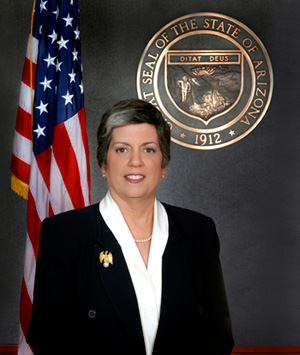
The anticipated selection of Arizona Governor Janet Napolitano to head the Department of Homeland Security demonstrates the incoming administration’s interest in highlighting immigration within the federal agency’s broad portfolio.
At the same time, it shows that Obama is seeking a moderate approach to this thorny issue, based on border security. In comparison to the Bush Administration, the selection is good news, although in terms of possibilities, it could have been better.
Arizona is ground zero in the immigration debate and Napolitano is definitely in the mix. The state has some of the country’s strictest laws in terms of punishment of employers who hire the undocumented, and the governor was an enthusiastic supporter of mobilizing the National Guard to protect the border. Yet, Napolitano opposes the wall between Mexico and the US as ineffective and instead supports using technology in the area.
Napolitano charted an independent course on immigration in order to be politically successful in this conservative state. This has made her a controversial figure on both sides of the immigration debate. While tough, she has also opposed a number of laws that set out to punish the undocumented, and she has criticized indiscriminate raids as well as the collaboration of police with immigration agents. She cut off state funds from Sheriff Joe Arpaio to stop his operations against the undocumented.
An individual with these qualities is a positive change for Homeland Security, which now engages in some of the most ruthless policies of recent times. The first steps must be taken to halt the massive raids that tear apart families, end deportation procedures that violate the rights of detainees, and stop the mistreatment of those in custody.
Napolitano can be invaluable in immigration reform because of her support for legalization and for temporary workers’ programs. This will depend upon whether Obama puts his effort on immigration reform during his first year, as he has promised.
The selection of Napolitano is an improvement over the current head of Homeland Security. Her experience as a governor and as a federal prosecutor will be useful when leading the federal agency’s huge bureaucracy as well as its other law enforcement responsibilities.
In considering her, Obama has made a positive statement for Homeland Security. That said, it will be the president who must balance between the more hard-line or moderate Napolitano.
“We need to maintain a sustained effort to ensure that our youth do not involve themselves in violent activities or gangsterism.” Abdullahi Farah said in a town hall-style forum, “Threats to Our Youth: Gangs, Drugs, Homicides, Dropping Out,” held November 14 at the Abubakar As-Saddique Islamic Center in South Minneapolis.
Representatives from Somali Youth Council Network (SYCN), Minneapolis police, and Abubakar and As-Saddique Islamic Center attended the public forum, which was held to explore the causes and possible solutions of the recent spike in violence among the Somali community in the Twin Cities that left up to six men dead.
Abdullahi Farah from SYCN who made a lengthy presentation, talked of what he hailed as Project Salaam-meaning peace-which he said was going to be a sustained effort to engage the community to be active participants on the affairs of the youth.
“Project Salaam,” said Abdullahi, “will be on-going forum which will open communication lines between the Somali community and the youth.” He said the forum will be youth-centered and will focus on: school/college awareness, mentoring and support, and talking to them about the vices such as involvement in gangs and drugs and how that could impact on their lives.
Abdullahi further noted that this would not only keep the community abreast of what the youth are doing, but also involve the youth with meaningful activities that prevent them from engaging in bad things. He, however, reminded the attendees that Project Salaam was a community-wide one and he used the opportunity to solicit for volunteers.
Sheikh Omar, the director of the Abubakar Islamic Center, said that many unique challenges face the Somali youth which need instant solutions. “We need to explore the killings among Somali youth which took the lives of 10 of our youth and if we don’t prevent it now, it will go out of hand,” said Sheikh Omar.
Omar said his center had played a leading role in offering the youth recreational and educational programs throughout the year.
A representative from the Council on American Islamic Relations (CAIR) of Minnesota warned the participants to not be overly excited about this new approach, saying it would not likely bear fruits overnight. He said he was encouraged by the recent arrests following the last two homicides because of community involvement.
But Abdia from the SYCN deplored the lack of results in the investigation of those who have been arrested. She said, “We don’t have any idea what the progress is, we just heard of the arrests.” She encouraged the police to keep the community abreast of what is going on.
Not everyone was convinced SYNC’s new proposal will be the magic bullet. One man, speaking in Somali, said that SYNC ideas were useful, but suggested that bringing the youth to Islamic Center was the best option. “Here,” he said, referring to the Islamic Center, “lies the solution to our children’s challenges.”
Another man who gave his name as Yussuf said that Somali parents, especially male parents, are the root cause of the current problems. He said, in Somali, “Somali men leave home in the morning and spend the entire day drinking coffee and talking politics at the coffee shops.” He said they have no idea whether their children went to school or not, or if the homework they were given is finished.
He added that it was time Somali men knew who their children associate with, and who their neighbors were. It is only from this point of knowledge that we can understand what behaviors our children can involve themselves out there.
As America celebrates President-Elect Barack Obama’s historic win, the Somali community in Minnesota is forced to deal with negative press brought about by one of their own. On Election Day, November 4th, stories about Somali volunteers allegedly influencing voters at the polling stations began to appear in the press.
Shortly after polls
opened at Brian Coyle Center, a precinct inhabited mostly by Somalis,
GOP challengers alleged that some voters were instructed to vote for Al
Franken by translators. However, two news stories, one by Mshale, and another by the Minnesota Independent reported that witnesses
claimed that a translator at the center was instructing people to vote
for
Coleman. Following these reports, Omar Jamal, a
self-described community leader, accused the Somali Action Alliance, a
non-partisan grassroots organization, and its volunteers, for pointing
voters towards Al Franken.
These community
volunteers were trained to help elderly Somali men and women vote by
translating the ballot. Many of them had taken time off from work to
serve the community. Unfortunately, rather than
rewarding or recognizing their sacrifice to support the community,
Jamal chose to accuse them of engaging in voting irregularities. The
motivations of Jamal are curious. Many in the Somali community suspect
tribal vengeance or other ulterior motives.
To add insult to injury, despite Jamal’s inability to establish
credible evidence or witnesses to corroborate his claims, WCCO,
a local TV station, chose to provide a platform for these stories. Worse, relying solemnly on the pure
speculations and personal interpretations of Jamal, WCCO aired a doctored
and inaudible video.
Unfortunately, no other media house asked
why two Republican challengers were present at the Brian Coyle Center
while Minnesota laws allows for the presence of only one challenger at
the polls. While it is illegal to record ballots in Minnesota, the
media has not bothered to find out the motive and the identity of the
person behind the camera. Also, it is important for people to realize
that Minnesota election laws permit citizens to be accompanied to the
voting booth. State
statute 204C, articles 5 through 7 clearly state that you are
lawfully permitted to obtain assistant should there be a need.
One wonders why local
media continually contacts Jamal on matters involving the Somali
community when Minnesota is home to high profile Somali
leaders, and activists: two former Somalia Prime Ministers, Abdirizak
Haji Hussein and Ali
Khalif Galeyr; the former Police Commander, General Mohamed Abshir
Muse; Professor Abdi I. Samatar and his older brother Prof. Ahmed I.
Samatar among others.
Jamal’s actions have
frustrated many of us Somalis who have taken Minnesota as our second
home. This negative publicity is not something we need. On the web,
many people have made disparaging remarks about the Somali community
where Somalis are referred as cheaters, ignorant,
lowlifes, etc. On the Minnesota Democrats Exposed website, one reader
writes
“A few Somali cheaters isn’t [aren’t] going to
change the result for angry Al.”
The degree to which
these accusations and claims have impacted the community is not
yet clear, However, Jamal’s destructive behavior needs to be checked.
Local media houses need to be held accountable by the American people
as they have given Jamal unchecked access on their airwaves. They need
to conduct a
thorough background investigation on Jamal and his questionable claims.
For the record,
Somali-Minnesotans are responsible and law-abiding citizens of this
great state and support a full investigation of this incident that is tarnishing the community’s
image.
As a silver lining this incident may signify a political maturity of the Somali
community and be a signal for the Republican Party to reach out to
them. Contrary to how Somalis have voted in the past, in this election
while voting overwhelmingly Democrat for the president they presumably
split on the senatorial race. Somali immigrants are a microcosm of the
larger US electorate and do not vote as a block. Whether the Republican
Party takes notice of this or not this unpleasant episode suggests that
both political parties have support within the Somali immigrant
community.
It is worth noting,
however, that Somalis here in Minnesota and elsewhere in the U.S.
collectively voted democrat in past elections, Al Gore in 2000 and
John Kerry in 2004.
Opinions expressed here are the author’s and do not represent those of Mshale.