Home Blog Page 219

Angelique Kidjo Honors Minnesotans with First Show of 2008 Tour

0
Angelique Kidjo Honors Minnesotans with First Show of 2008 Tour

ST. PAUL, Minn. – It is a cold Sunday evening on Jan. 13, as more than 1400 people gather at the Ordway Center in St. Paul.  They are here to see Angelique Kidjo, the five-time Grammy nominated singer, along with her five-piece band. 

Slated as a late afternoon concert, starting at 5:00, the crowd filters into the lush seating offered by the Ordway. Many of the patrons are quite young.  In fact, seated to my right is a gentleman escorting four children. Children are, after all, one of Kidjo’s passions. 

Without much delay, we see three guitarists and two percussionists cross the stage and take their places.  They warm up the audience with jazz-inspired music.  Kidjo appears and they perform a cut off her most recent album, Djin Djin, nominated in December, 2007 for a Grammy in the category of Best Contemporary World Album.

Instantly I note two items.  First, Kidjo is an amazing dancer.  Her silken, midnight-blue pants clearly outline her well-defined leg muscles.  And second, her electric-pink jacket, which falls midway down her hips, along with her too-high-heeled boots detract profoundly from my ability to enjoy watching her dance.

It seems catty to bring up her appearance only to tromp on it, but the truth is, I’d much rather see her in either African attire or something Westernized so that it also allowed us to see her distinctive African dance movements.  The heels throw her body out of line so that the trenchant staccato of her hips for which West African dance is known, looks imitative rather than organic to this Benin-born musician. 

This show, her first in 2008, starts off a string of concerts dipping down into the Caribbean and then flying up to the northwest corner of the United States and parts of Canada.  Her broad appeal ties into her ability to connect to her audience, often Kidjo is able to speak in the same language as the country in which she is performing. 

Kidjo shows her fans why her albums have been making a mark in the music world for over a quarter of a century.  She has remained true to her African roots, maintaining the beat and rhythm of West African music, but she’s transposed the sound onto Western instruments. 

Her sixth song opens like a creeping cat, seductively sliding up against our legs, making them want to get up and dance with her. People sway and bop in their seats.  It’s a shame that concert halls are built the way they are – omitting a central dance floor, although I see the practicality.  What’s lost is the intimate atmosphere of a small dance hall where a fan can see, up close, the effort and energy of the performer. 

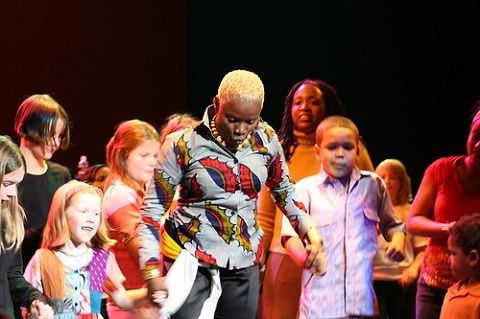
As if reading the collective mind of her audience, Kidjo invites her audience up on stage.  Well over a hundred people climb the steps and dance with this star performer.  Her percussionist from Senegal walks out into the throng playing his Congo drum.  Many in the audience are African immigrants who know how to dance and they take this opportunity to indulge.  Kidjo specifically talks to the children and holds their hands as she leads them in dance.

Kidjo spends much of her time advocating for children while off-stage.  As a Goodwill ambassador for UNICEF International, Kidjo has appeared in public service announcements as she seeks to make the world a safe place for children to live.

During the show, Kidjo speaks out against terrorists.  “When you believe in God, you can’t kill,” she speaks to the microphone. “If you want to kill yourself, go ahead, but do it alone and don’t claim you’re doing it in the name of God.”

HIV/AIDS Education: Progression of HIV to AIDS

0

The stigma associated with HIV/AIDS is still prevalent among many communities in the world. With progress made in the health care field, a positive HIV status is no longer an immediate death sentence. While there is neither cure nor vaccine to prevent an HIV infection, there are treatments that allow for a patient to live longer and have a comfortable life.

The Minnesota Health Department has recognized the need to offer culturally based media education on HIV/AIDS to fulfill the needs of Minnesota’s ever growing foreign born populations. To this end, the African Assistance Program and the Sub-Saharan African Youth and Family Services were awarded state funds to reach African in Minnesota.

The following is the first of a series of articles aimed at educating the general population on HIV/AIDS.

What is the difference between HIV and AIDS?
The human immunodeficiency virus (HIV) is a virus that attacks ones immune system progressively developing into AIDS (Acquired immunodeficiency syndrome) making the body unable to fight infections. HIV in itself is not fatal since a person can live for years before the immune system is completely weakened.

Progression of HIV
HIV virus enters the body from infected person through these body fluids: blood, semen, vaginal fluid, breast milk and other body fluids containing mucus.

There are three primary ways that the virus can be transmitted from one person to another:
•    Having anal, vaginal or oral sex with someone infected with HIV
•    Sharing needles and syringes with someone infected with HIV
•    From infected mother to child, either when the fetus is in the womb or through breastfeeding.

Because HIV cannot live outside the body for long, it cannot be transmitted via day to day activities such as shaking hands and sharing utensils.

Once HIV is in the body, it begins to progressively attack the immune system.

It is easy to miss the symptoms in the first stage since the symptoms are flu-like, and only last a few weeks. It is at this stage that the body’s immune system begins to produce HIV anti-bodies to fight off the virus.

The second stage lasts an average of ten years and is symptom-free for the most parts. Some patients suffer from swollen glands since HIV is not dormant, but mostly attack lymph nodes.

As the lymph nodes are damaged by the viral attack, the immune system becomes severely damaged. In this third stage, mutation of HIV makes it attack the immune system even more.

The final stage of HIV is what is known as AIDS, an acquired immunodeficiency syndrome. The immune system of a person with AIDS is very weak making it difficult for the body to fight infections that a healthy human body should be able to fight. It is these infections that make someone have AIDS.

According to the Center for Disease and Control HIV/AID is the leading cause of death of people between the ages of 25 and 44.

Free Testing Sites
There are several organizations in the Minneapolis/St. Paul Twin cities area that offer free testing, counseling and referral services such as Red door clinic in Minneapolis (525 Portland Avenue. Minneapolis MN, 55415) and Room 111 in St. Paul (555 Cedar Avenue St. Paul MN. 55101) while many of these organizations cater to the larger Minnesotan community, a few of them specifically cater to African immigrants living in Minnesota: SAYFSM an African organization located in St. Paul (1885 University Ave. W MN. 55104) and extend its testing services to people in Minnesota.
                           —————————————————————

The above research was gathered from the Center for Disease and Control and the Minnesota Department of Health.
Contact information
SAYFSM: 1885 University Ave, Suite 297, St. Paul. 651 644 3983

The Latest Attempt at Immigration Reform in Minnesota

The failure of the federal government to pass comprehensive immigration reform has led state and local governments to take this issue into their own hands.  At a news conference on Jan. 7, Minnesota Gov. Tim Pawlenty jumped back into the immigration fray, unveiling his new plan to crack down on illegal immigration.  The governor’s plan includes a mix of orders and proposals that reflect some of the steps taken by other states throughout the country.

At the start of 2007, the passage of major immigration legislation at the federal level seemed likely.  Both President George W.Bush and the newly Democratic-controlled Congress appeared eager to come to an agreement on immigration issues.  Ultimately, the federal efforts at reform were unsuccessful.  The topic of immigration, however, has not faded from the public forefront.  Many decision makers at the state and local level believe that immigration must be left up to the federal government.  At the same time, others are unwilling to wait for action from Washington D.C.  As a result, a number of states and cities have enacted measures to address immigration.  While some states adopted pro-immigrant measures, such as protecting undocumented workers from exploitation and extending education and health care to their children, most of the state laws serve to limit employment of undocumented workers and to make it harder for them to obtain driver’s licenses and other state identification documents.

Arizona, for example, approved the Legal Arizona Workers Act, which states that employers who knowingly hire undocumented workers may have their business licenses suspended for the first offense, and permanently lose their licenses for a second offense within three years.  In Tennessee, employers who “recklessly employ” an illegal immigrant may be charged with a criminal offense and ordered to pay fines up to $50,000.  Arkansas passed a law barring state agencies from contracting with businesses that hire undocumented workers.  Several states’ laws also prohibit undocumented workers from receiving employment benefits and prevent employers of undocumented workers from securing state contracts. States such as Kansas, Kentucky, Montana and Nevada enacted new laws or toughened current laws to bar illegal immigrants from obtaining driver’s licenses. Eleven states also passed 15 laws on public benefits, mostly barring illegal immigrants from obtaining public assistance.

No legislative approval required

With his Jan. 7 plan, Gov. Pawlenty aligned himself with those states whose primary focus is “cracking down” on illegal immigration. Much of the plan is a repeat of the governor’s 2006 attempt to pass immigration legislation.  That attempt ultimately failed to make it out of the House of Representatives, then controlled by Republicans. This time around, in addition to proposals for new laws, Pawlenty’s plan includes gubernatorial orders that do not require legislative approval.

The governor created three new mandates with his order:
•    State law enforcement officials must formalize their relationship with the U.S. Immigration and Customs Enforcement agency (ICE). This step includes immigration training for several dozen state employees who will work with ICE as needed.
•    The Department of Public Safety must review photos on the state’s driver’s license database for possible fraud.  The primary type of fraud targeted by this review is the use of duplicate photos on multiple drivers’ licenses.
•    New state employees and contractors who do business with the state must verify their immigration status through an Internet-based system operated by the federal government.

The governor also called for new laws that will require approval by the State Legislature and involve the following:
•    Strengthen the state’s human trafficking laws by expanding the definition of human trafficking.
•    Increase fines for businesses that knowingly hire illegal immigrants.
•    Increase penalties for identity theft and use of fraudulent documents.
•    Prohibit cities from forbidding their police officers from asking about a person’s immigration status.

This last prong would affect both Minneapolis and St. Paul, which currently place such a limitation on their police officers.  Advocates of such ordinances argue that they allow immigrants to feel more comfortable with police officers and that without the ordinances more crimes will go unreported.

This sort of opposition suggests that Governor Pawlenty faces a significant uphill battle in getting the Legislature to move forward with the new plan.  According to Senate Majority Leader Larry Pogemiller, DFL-Minneapolis, “these are warmed-over proposals that could not pass the House of Representatives when his party controlled the House.”

The 2008 legislative session begins on February 12th, at which time legislators will determine whether to hold hearings on the governor’s plan.

New procedures at border crossings

On Jan. 31, U.S. Customs and Border Protection (CBP) began to phase in new procedures that will affect U.S. and Canadian citizens entering the United States through land or sea ports of entry.  Border crossers will be asked to present documents showing citizenship and identity. Previously, CBP allowed U.S. and Canadian citizens to enter the United States based on oral declaration of citizenship alone.

The change is a response to a high level of false claims to U.S. citizenship by individuals attempting to cross into the United States.  CBP officers reported 1,517 such cases from October to December 2007 alone.

A list of acceptable documents is available at www.cbp.gov. Travelers may provide a single document that denotes both citizenship and identity, such as a valid passport, or two documents, such as a driver’s license and birth certificate, which separately show identity and citizenship.

The new document requirements will not be fully phased in until 2009.  Jan. 31, marked the beginning of what will in part be a public awareness campaign by CBP.  During the initial phase, travelers lacking the necessary documents can expect long delays while CBP officers, who will no longer rely on oral declarations, seek to verify identity and citizenship.  Children ages 18 and under will only need to present a birth certificate.  Full implementation of the new requirements will begin no sooner than June 2009.

Friends getting death threats

0

for daring to speak out against electoral malpractices, and human rights violations in the past weeks in Kenya. The threats arrrive by email, sms, phone. Their names are on lists, being circulated globally, that denounce them as "traitors to the Kikuyu people" and suggest they should be killed.

These are friends I grew up with, went to school with, worked with in the weeks following the election. They have dedicated their lives to truth and justice in Kenya.

Please sign the Amnesty Petition for their safety.

Thousands Attend Obama Rally in Minneapolis

0

Thousands of Minnesotans braved long windy queues on a cold wintry afternoon to hear Senator Barack Obama speak. Obama was in Minneapolis for a campaign stop ahead of February 5th, 2008 (Super Tuesday) when 22 states will hold their primaries. Minnesota will be one of the states caucusing on Tuesday.

The 20,000 capacity Target Center in downtown Minneapolis was filled with enthusiastic Obama supporters.

The Minnesota stop was in between campaign events in Idaho and Missouri. Obama gave a version of his stump speech where he talked about ending the war in Iraq, universal health care, the Bush tax cut, and the environment.

Obama reminded his supporters how many people thought he was not ready to run for the presidency. "I am not running because of some long-held ambition… I am running because of what Dr. [Martin Luther] King called the fierce urgency of now. There is such a thing as being too late and that moment is upon us."

Obama was funny and engaging bringing the audience to their feet several times during his hour long speech.

He received some of the loudest cheers when he invoked the memory of the late Minnesota Senator Paul Wellstone.

"Some of you know that when I first got to the United States Senate, I opened up the door of the desk where I was assigned. And it has the names of some of the greater senators who have served. They carved their names, in their own hand, into the desk drawer. One of those names was somebody who shared with me this belief that change doesn’t happen from the top down. A guy named Paul Wellstone. A guy who helped to build a movement here in Minnesota because he believed in you the way I believe in you. And this is part of that movement for change."

Obama has raised $32 million in January from over 170,000 donors. He attributed this to a successful grassroots campaign and a well organized campaign team that understands the utility of the internet.

Mitt Romney, Republican, addressed his supporters on Saturday in Edina. Democrat Hillary Clinton will be in Minnesota on Sunday at Augsburg College in Minneapolis. Ron Paul, Republican, will be at the University of Minnesota on Monday.

Click here to find your caucus precinct.

Direct Relief Aid for Kisumu

0

Sukuma Kenya was set up a few weeks ago by Dipesh Pabari, close friend, dedicated Kenyan journalist and activist. It’s the charity I recommend to everyone who asks where they can donate to ease the suffering of displaced Kenyans. First, because I can personally vouch that EVERY PENNY you donate, beyond transaction fees, goes directly to the relief effort. All those involved are volunteers – no overhead costs.

Secondly, because it channels the relief efforts through a Kisumu organization, Ladies in Action, that has been in operation for several years. The Ladies in Action are all long-term Kisumu residents (many were born there) who have chosen not to flee the crisis. They know Kisumu better than any outside relief organization.

Here is Dipesh’s appeal:

How many more must die? How many more must lose their homes, their farms, their livelihoods? The weekend was a bloodbath in Nakuru and Naivasha. I spoke to a close friend in Nakuru who is huddled in a house with other Kikuyus as they listen to the screams of people who were once friends calling for their blood. Already two of her aunts were killed in the earlier violence in Burnt Forest. A Reuters article has "Kenya’s Rift Valley burns and death toll soars" and Kisumu was ablaze again.

And as the people fight a battle against themselves instead of against the injustices brought on by years of exploitation by the very leaders we vote for, the Ladies in Action continue to feed. My mother founded the Ladies in Action several years ago to help orphans and elderly people primarily. When the post-election crises broke out my wife, Elodie and I created Sukuma Kenya as a way to reach out through our friends to help upscale the outreach for Ladies in Action. 

We have had an amazing response from people all around the world and in just three weeks, we collected £5000! Most of it has been used up to buy food items in bulk such as maize flour, cooking oil, sugar and also blankets and some medical supplies. With the escalating problem, Ladies in Action are going to need more help so please help and spread the word or make a small donation online. Ladies in Action are a registered charity in Kenya and are affliated to the Jersey Oversees Aid whose network of smaller organisations is helping receive the funds and transfer it to Kenya.

Senate Resolution Passed Unanimously!

0

Now we need to build and sustain pressure on the State Department and the White House to implement its recommendations. Please take these simple actions.

Congressman  Donald Payne (D-New Jersey) and Senator Russ Feingold have introduced a  concurrent bill into Congress: H.CON.RES.283.

The resolution calls for tough measures against PNU and ODM leaders who incite violence and refuse to engage in mediation,  including travel bans, and asset freezing.

Please take the following action steps:

1) Contact your Congress representatives and urge them to co-sponsor the bill.

2) Contact the White House, the State Department, and Jendayi Frazer, Assistant Secretary of State for Africa, urging them to act NOW to implement the recommendations of the Senate Resolution on Kenya

White House  Fax Number:      202-456-2461
White House Comment Line:    202-456-1111
White House Main Switchboard: 202-456-1414
White House Email:                   [email protected]
Vice-President’s email:             [email protected]

State Department, Condeleezza Rice, Secretary of State
Direct Office Line:        202-647-5291
Main Switchboard:          202-627-4000

Jendayi E.Frazer – Assistant Secretary of State for Africa Affairs
Direct Phone Line:  202-647-4440
Email:    [email protected]

Liberian Ministers Association Officials Inducted

0
Liberian Ministers Association Officials Inducted

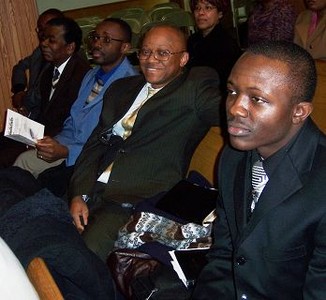
ROBBINSDALE, Minn. – At their Jan. 20 installation, officers of the Liberian Ministers Association (LMA) in Minnesota urged the Liberian community to seek God’s help as it struggles to reconcile after the last elections (Organization of Liberia in Minnesota, OLM, elections).

Delivering his induction speech, LMA President Rev. Josef Howard told Liberians residing in the State of Minnesota that he would not “babysit the OLM.”

 “If you know what you need to do, do it,” Rev. Howard said.

Rev Howard, who is the Pastor of the Bethel World Outreach Church, added, “We must be people that the community can look up to and see Christ in us. We must have vision.”

To his officers, the newly installed president said, “I will lead with few words. We will act; we will seek God’s face.”

Rev. Howard said God, in his sovereignty, had appointed his administration to lead the LMA at a time “when God is pouring out his latter rain upon his people; a time when God is saving and moving among his people in unusual ways, a time when Liberia after several years of civil war is finally experiencing God’s hands of blessings and protection and a time when Liberian pastors have taken up the challenge to break the stronghold of the enemy over the twin cities and set the captives free.”

He asked Liberians to keep his administration in their prayers.

The LMA was formed to create the spirit of fellowship among Liberian Ministers in the state of Minnesota, form prayer partnership among ministers, support each other in their individual ministries and assist Liberian pastors and churches through special projects.

Rev. Edward Neepay, a guest speaker at the occasion, challenged Liberians in Minnesota to “set the pace.”

“This is a sensitive time for Liberians in Minnesota,” he said.

Rev. Neepay, who is the senior pastor of Conqueror’s Christian Church, spoke on the theme: “Christ: The Great Reconciler” and used as his text St. John 13: 34. He said the Howard Administration would make a difference.

“History will judge your administration,” Rev. Neepay told Rev. Howard and his corps of officers. “You have to make a difference.”

The Chairman of the Board of the Liberian Ministers Association, Rev. Lee Anderson, noted that the Lord had called them to leadership.

“We have come to serve; we have come to unify,” he said.

OLM President Kerper A. Dwanyen, who won in December in one of the most divisive elections in the organization’s history, pledged to work with the LMA. He indicated that reconciliation was the only way forward. He said his administration had a duty to put the community before God.

“We forgive all in the past,” Dwanyen said. “We ask for forgiveness from all who have things against us.”

To begin the reconciliation process, Dwanyen smoked a peace pipe with Benoni Tarr Grimes, who did not support him in the last OLM elections.  The two men promised to work together for the betterment of their community.

Officers and Board Members
Officers inducted are:  Pastor Josef Howard of the Bethel World Outreach Church, Executive Director; Pastor Francis Tabla, Sr. of the Ebenezer Community Church, Assistant Executive Director; Pastor William Kallon of Pilgrims House of Praise Church, General Secretary and  Pastor Samuel Vansiea of the Joy World Mission Church, Treasurer.

Others installed are Pastor Joe Logan of Hallelujah Sanctuary Church, Chaplain, and Pastor Paul Zondo of River of Life Open Bible Church, Publicity Director.

Board members installed are Rev. Lee K. Anderson, Rev. Charles Goah, Rev. Kwiah Roberts and Fr. James Wilson. Others are Rev. Uriel Caine, Rev. Josef Howard and Rev. Paul Betiku.

Old Guard Won’t Lose Teeth in the United States of Africa

0

The seventy-something-year-olds dominating Africa’s politics can become members of the Cabinet of one country without borders drawn by 19th Century colonialists.

The envisaged United States of Africa is one huge country that stretches from Cape Town to Cairo and from Mogadishu to Cape Verde encompassing 53 sovereign states. This is the land of the mighty Nile River, the land that is washed by two huge oceans – the Atlantic and Indian oceans, and lies south of the Mediterranean Sea and borders the Middle East across the Red Sea.

Great events in history that have affected humanity have touched Africa in one way or another. The world’s greatest religions of Judaism, Christianity and Islam have had places like Egypt, Ethiopia and Mali (Timbuktu) play leading roles in their propagation. Egypt enslaved Jews for over 400 years, and Africans were exported as slaves to build great powers in Europe, America and elsewhere on the globe.

<<Unity is a way to restore the greatness of this amazing piece of earth that has always been – throughout history – the centerpiece of human advancement.>>

Africa has its great past and it has its great potential for the future. Senior African statesmen like Nelson Mandela, Kenneth Kaunda, Robert Mugabe, Hosni Mubarak, Paul Biya and Joaquim Chissano are our venerated leaders who can bring their age-tested wisdom to argue a case for African unity. Unity is a way to restore the greatness of this amazing piece of earth that has always been – throughout history – the centerpiece of human advancement.

Africa respects old age as a common traditional value. Thus our leaders like Abdoulaye Wade (82) of Senegal, Anerood Jugnauth (78) of Mauritius, Mwai Kibaki (77) of Kenya, Bingu wa Mutharika (74) of Malawi, Lansana Conte (74) of Guinea, and Abdillahi Yusuf Ahmed (74) of Somalia are our resource-bases for leadership and inspiration.

Other elderly notable statesmen in Africa include Hifikepunye Pohamba (73) of Namibia, Omar Bongo (73) of Gabon, Zine El Abdine ben Ali (72) of Tunisia and Abdelaziz Bouteflika (71) of Algeria. These respectable African leaders owe the young generation of Africans a bright tomorrow. In the globalized world, this future can only be attained by unity.

A strong united continental federal government that will enable our one billion people speak with one voice is the mechanism of jump-starting our economic empowerment. A United States of Africa will be justified to demand and obtain a permanent seat in the United Nation’s Security Council. A United States of Africa will be able to marshal its resources to improve infrastructure and communication by way of railway lines, tarmac roads, viable airlines and modern telecommunication super highways that will make even the remotest part of our continent reachable.

In a global economy, Africa’s ability to compete can only come through unity to enable the attainment of economies of scale. Polarized small African states cannot fill the long chain of supermarkets like Wal Mart, Walgreen or Target in America with our exports. Consider products like coffee, tea, cotton, pyrethrum, exotic flowers, cashew-nuts, cocoa, palm oil and many others that Africa can collectively supply to a hungry global market. But if we remain divided, we lose at the bargaining table!

Africa has to use its vast resources to invest in education, research and development, health education, and Information Technology to fight poverty, HIV/AIDS, and create a rapid deployment

A United States of Africa Won’t Work

0

This letter was written in response to Old Guard Won’t Lose Teeth in the United States of Africa.

 I don’t support the whole idea of uniting African countries into one state. It is a naïve idea that will take us nowhere and may lead to more civil wars and hatred. The United States of America was not like us when they unified their states. They didn’t have as many cultural differences as Africa does.
 
Let’s start with how different African countries observe the weekend. Most North African counties and some parts of Nigeria have weekends on Friday and Saturday and the rest of Africa, Saturday and Sunday. How many working days will a United States of Africa have?
 
What about the constitution and the rule of law? Some African countries have a lot of misunderstanding on how to enforce laws. Some want religious law, others have been doing nothing to respect constitutions and have resolved to use the military to scare people.  Do you think these differences will disappear once we have one state?

Another serious issue to settle regards the North African states membership in the Arab League. Will they withdraw their membership for the purpose of uniting Africa, or will they stay and have the United States of Africa become a member of Arab League? If so, then are we going to be African or Afro-Arab? What about our relationship with Israel?
 
Let’s be serious and careful about this trick of proposed unification.

David Markus Ntali
Mason City, Iowa

South Africa, Kenya Continue USA Sevens Tradition

South Africa, Kenya Continue USA Sevens Tradition

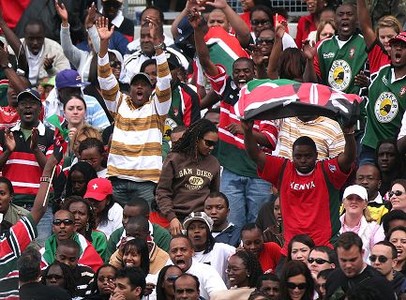
Like they do every February, South Africa and Kenya will head down to southern California for the annual USA Sevens rugby tournament.

The two-day competition begins on Feb. 9 and is the fourth event in the 2007/2008 International Rugby Board Sevens World Series.

Played on the same size field as traditional 15 a-side rugby, sevens rugby is played with only seven players per team. In addition to a keen understanding of how the game is played, pure speed and athleticism are the foundation for the sevens rugby standout. The demanding nature of the game – non-stop action and thrilling attacks – makes it possible for countries ranked low in 15 a-side tournaments to defeat power houses.

The USA Sevens debuted at the Home Depot Center in Los Angeles in February 2004, marking the first time the United States ever hosted an official IRB event of this magnitude and world importance. The tournament is now held at Petco Park in San Diego, Calif.

The host, US Eagles, will be facing a challenging opening day against South Africa and England.

Fiji finished runners-up to New Zealand in both events in December and face a tough challenge in pool B against island rivals Samoa, Australia and a combined West Indies side.

The New Zealand Kiwis, under Coach Gordon Tietjens, has stormed to an early lead in the Series with Cup wins in Dubai and South Africa. They top pool A, and will kick off the action on day one against Wales before also taking on Scotland and France.

Fiji finished runners-up to the Kiwis in both events in December and face a tough challenge in pool B against island rivals Samoa, Australia and a combined West Indies side.

After a strong start to the season rejuvenated Argentina are number three seeds in San Diego and top pool C, which also features Kenya, Canada and Chile.

South Africa, meanwhile, currently lie in third place in the series with two semi final appearances and they face England, Mexico and hosts USA, who will be hoping for more heroics from flying wing Takudswa Ngwenya in pool D.

“Having an IRB Sevens World Series event played in a baseball stadium for the first time was a new experience for the teams last year and one that proved hugely successful and popular with the players,” said IRB Sevens Manager Beth Coalter.

“General interest and ticket sales are already well up on previous USA Sevens and, given the support that the Pacific Island teams have in the States in particular, Fiji-Samoa on day one is bound to create a great atmosphere. More support is also guaranteed for the home team now that the Eagles have started winning on a regular basis. San Diego offers something different, definitely not one to miss,” Coalter added.

Coalter said television coverage of the series also continues to increase for fans not able to make it to the stadium. U.S.A., Scotland and the Middle East all increased their coverage of the first two events, Romanian broadcasters came on board for the first time and in-flight British Airways and Cathay Pacific joined Emirates in showing highlights, she said.

Apart from rugby, USA Sevens serves as an unofficial reunion for young Kenyans in the United States, who arrive in San Diego as early as two days earlier for nights of non-stop parties.

Pool A

Pool B

Pool C

Pool D

New Zealand

Fiji

Argentina

South Africa

Scotland

Samoa

Kenya

England

Wales

Australia

Canada

U.S.A

France

West Indies

Chile

Mexico