Home Blog Page 227

In True African Fashion, Nyamal Both Transcends

0

RICHFIELD, Minn. — Nyamal Both gently sits on her couch and positions herself to accommodate the weight of her eight-month pregnancy. She closes her eyes, tilts her head back a little.
    
“So, how did I get here?” she wonders loudly.

She’s been through a lot. Too much for her tender age of 19. For this young and extremely talented Sudanese fashion designer life has been anything but an easy pass.

Her journey began in the Gambela region of Ethiopia, where she was born. As a child she had always had a creative streak.

“I was into ceramic art,” she recalls. “I made little people by putting shapes together.”

Like any 5-year-old, Both had always wanted to see the city. She was excited when she finally got a chance to go visit an aunt in Addis Ababa. As she bade her family farewell, it did not occur to her that she would never go back – that she would end up in the United States.

Both was too young to remember how her aunt and her husband were able to include her in their visa to come to the United States. But she does have the memory of her father traveling to Addis Ababa to protest her leaving the country. In the end, her aunt prevailed by convincing him that America was the only chance his fragile and sickly child had to get good medical care. Little did Both know that America would be anything but the Paradise she envisioned.

In the faraway land she found her refuge in art. There was no mud to make little people, so she started drawing cartoons, which she still does today. By seventh grade she was making comics, but she was no ordinary seventh grader. At home she was taking care of her nieces and nephews and this made it hard to concentrate in school. There was no room to complain about the workload of caring for four young children, because she was punished whenever she did.

Nevertheless she was getting by fine in school; she even won a pillow-sewing project and focused her energy on sewing. She enjoyed it so much that by the 9th Grade she was tearing up her old clothes and re-patching them.

“Kids at school would ask where I’d bought my clothes,” she remembers.

She would give any excuse, but mention that she had made the clothes herself. Later a neighbor introduced Both to his mom, Joy Bliek, who taught her how to use a sewing machine and introduced her to numerous sewing patterns.

“We kind of struck a bond,” says Bliek. “She came alive when she came to my place. She was very creative and never used the same pattern twice. She had the talent, all she needed was access. She was like a rose bud just going into blossom.”

But this tender rose was not handled with the same care and affection at home. The aunt and uncle she lived with physically abused her. To escape the violence, Both spent as much of her free time as she could in front of the sewing machine at Bliek’s house. But her absence from the house only led to more abuse from her uncle and aunt, who accused her of avoiding chores and responsibilities to stay out late with boys.

Soon the abuse turned from physical to sexual. Her uncle entered her room when his wife was away at work.

“He would come to my room at around two or three in the morning,” she begins with a wavering voice, as tears roll down her eyes. “He came one day, then the next day, and would do so monthly.”

When she finally gathered courage to speak about the abuse, her aunt quickly dismissed her accusations as lies. She decided to go to another uncle who initially appeared to be friendly, but when he also tried to take advantage of her, she realized she could not trust anyone.

“I was angry with my parents,” she says. “How could they have abandoned me? Is this what they wanted for me?”

Both continued to seek solace at Bliek’s sewing machine to escape the trouble at home. For Christmas in 2003, Bliek surprised her with a brand new sewing machine for a present.

“I was extremely excited!” she recalls.

But the excitement would only last a week. On New Year’s Day, the tension that had been piling between and her uncle came to a climax. They got into a quarrel that prompted him kick her out of the house. She had no one to turn to other than Bliek and her uncle didn’t hesitate to relinquish his official duties as guardian over to Bliek. Bliek and Both were happy with the decision, but after a while Dakota County government officials ruled that Both could not live with Bliek. They moved her to foster care.

Between 2003 and August 2006, Both would live in six different foster homes. Before she could settle down in one home, it was time to move. But into each one of them she moved with her sewing machine. Sewing had become not only her passion, but also a form of therapy as she attempted to cope with her unstable life.

With each home came a new experience, a new challenge. At one home an uncle of her guardian sexually abused her, which led to a long, dragging case in court. As she tried to get justice, members of her community were busy trying to convince her to drop the case to avoid ruining the man’s life. She was so terribly confused that she changed her mind about testifying against the man.

In school she kept up a normal appearance and by the 11th Grade, her talent and friendly nature had won her many friends.

“I watched her grow up and later realized that she is not only my sister, but everyone’s friend,” says Bang Chawich, a close friend of hers. “She is a very nice person, generous and down to earth.”
 
Her cousin Wej Chang agreed.

“She treats everybody the same,” Chang says.

Her attitude also earned her loyal customers especially around prom and homecoming time. She was featured in her high school newsletter for her creative designs. At this time she was also making more ‘hip’ versions of Somali and other traditional African outfits. She likes African fabrics, because they are colorful but she tries to incorporate different styles.

“Younger people want to wear something African, yet more contemporary,” she explains. “I bring the color of African fabric to American fashion.”

Two months into her last year of high school, Both discovered she was pregnant.

“My caseworker freaked out, but I was happy,” she recalls. “I didn’t have anyone before and I was happy to finally have someone.”

She focused on graduating the following June and got all her requirements done by March. In May, she gave birth to a beautiful baby girl, Quianna Chei.

Living conditions in her foster home were unbearable as her guardian incessantly smoked inside the house, unhealthy for baby Quianna, who had asthma. Consequently, Both would every once in a while leave and go to Bliek’s house for a couple of days, much to the chagrin of her guardian and caseworker. By the time she was eighteen she wanted out of foster care. Her caseworker wanted otherwise, fearing that if Both was on her own she would not go to college.

“Had I not fought so hard to prove that I was responsible enough to take care of myself and my baby, I still would be in foster care,” she says.

Having been on her own since August last year, Both admits that it hasn’t been easy, but she is much happier and extremely optimistic about her future. Already this year she has showcased her creations at two major African events, the Miss U.S.A., Minnesota preliminaries and Afrifest, a festival celebrating African culture, held in August.

“Afrifest generated intrigue,” she says excitedly. “The models did a good job and people wanted to see more. The guys were also asking for the men’s fashions.”

She enrolled in fashion classes at Minneapolis Community Technical College and hopes that after two years she will be able to go to New York’s Parsons School of Design.

She isn’t quite sure what to name her clothing line. Maybe she’ll call it Nyamal Both, or her father’s name, Both Dol. Maybe it will have both names. Why not?

But for now, this up-and-coming African fashionista is too busy preparing for the next showcase of her talent to worry about a name yet. On Saturday, Oct. 6, Mall of America will feature her collection as part of Pan-African Investment Summit’s Africa Day at the Mall of America.


Igbanugo Joins Hands with Former ‘Foe,’ Cangemi

MINNEAPOLIS — Mark A. Cangemi and Herbert A. Igbanugo have a relationship that spans years. They were both involved in the justice system and occasionally shared a roof and sometimes had lunch together. But they were never on the same side.

Cangemi was a Special Agent of the U.S. Immigration and Customs Enforcement (ICE) in charge of the Twin Cities Area of Responsibility, which includes the five states of Minnesota, North Dakota, South Dakota, Iowa and Nebraska; Igbanugo, the Nigerian-born lawyer, was an immigration defense attorney. That meant that Igbanugo had to fight to win the freedom of some of the people Cangemi’s officers arrested for violation of immigration law.

“Mr. Cangemi and I have fought each other for many, many, years,” Igbanugo says, as Cangemi sits at a desk in his office with his arms crossed, attempting a smile. “But we always fought with mutual respect.”

Over the years that mutual respect led to trust. Igbanugo remembers a case where, following the terrorist attacks of Sept. 11, immigration officials went to arrest one of his clients, an Iraqi man suspected of having ties with terrorists. The man called Igbanugo in an apparent attempt to avoid spending a weekend in jail. When Igbanugo called Cangemi saying he knew the man well, and promised to take him to Cangemi’s office the following Monday, Cangemi did not object.

In addition to defending the accused, Igbanugo sued ICE on behalf of some of his clients.

Because Cangemi was the head of the law enforcement arm, he was always named as the defendant. Who won the cases?

“He will tell you differently, but I think I won most of them,” Igbanugo says jokingly and laughs.

Cangemi smiles in a mocking way, but does not say anything.

“But it was never personal,” Igbanugo adds.

Regardless of who won, the two men continued to treat each other with respect. Today, because of the courtesy they accorded each other, they are partners. Cangemi retired after 34 years in law enforcement and in August joined Igbanugo Partners Int’l Law Firm, a minority-controlled company.

For a layman, it might seem like Cangemi crossed over to the other side – to fight his former employer. But he doesn’t think so.

“I never saw the positions as one side or the other,” he says. “It’s more of defending the system with integrity.”

In the American justice system, strong defense is just as important as strong prosecution, says Cangemi. The strength of both ensures balance and therefore people working on either side are not necessarily working against each other, but towards a common goal of justice.

Having worked as a prosecutor, Cangemi say he has a lot to bring to Igbanugo Partners.

Cangemi specializes in business immigration law, corporate compliance, and corporate defense in administrative and criminal enforcement matters related to U.S. immigration laws. But he plans to take a preventive, rather than a defensive, approach.

“Isn’t it much better to encourage people to do things appropriately within the confines of the law so you never get into that position where you have to defend yourself?” he asks.

Cangemi compares the post-Sept. 11 government to a “major hourglass.” He grabs a pen and legal pad and begins to illustrate. He draws an hourglass that covers most of the entire page and scribbles little circles at its brim to represent various federal and local law enforcement agencies that have information-gathering mandate and investigative responsibilities.

“They are all feeding different levels of information,” he says, repeatedly circling the middle of his drawing. “At the section where the hourglass is constricted, that information is being analyzed, distributed, reviewed and coming to the other side.”

His goal will be to ensure that his corporate clients do not fall through the constricted. That, he says, will not only keep the companies out of trouble, but also restore the public’s trust.

Cangemi also plans to get into advising minority entrepreneurs, who he says often find themselves in trouble with the law because they do not understand the U.S. system.

“I look at the United States when I started 34 years ago and it’s not the same country it is today. That’s good, and challenging at the same time,” he says.

His experience will serve him well, says, Igbanugo.

“I couldn’t find a better partner,” Igbanugo says. “He knows the internal workings of the system its agencies. Very few people actually understand the way the U.S. government agencies are interconnected to one another from [Homeland Security], to the FBI, to the Labor Department.”

Cangemi graduated cum laude with a Juris Doctor degree from William Mitchell College of Law in 1992. During his years in the U.S. government he held various positions in the Department of Justice, the former Immigration and Naturalization Service, and the Department of Homeland Security.

Cangemi first joined the INS in 1973 as an Immigration Inspector in Port Huron, Michigan, where he remained until 1975. He then served as an INS Criminal Investigator in Chicago from 1975 to 1985, primarily as an anti-smuggling agent. For his investigative work in the high-profile alien smuggling case, “Operation Gypsy,” Cangemi received the prestigious Newton-Azrak award, and was nominated for the Attorney General’s Award for Excellence in Law Enforcement.

From 1985 to 1988, Cangemi was stationed in Phoenix, Arizona as an anti-smuggling agent and was later promoted to Assistant District Director for anti-smuggling.

In 1988, he was promoted to Assistant District Director for Investigations of the INS office in St. Paul, Minn. In this capacity, Cangemi managed the expansion of the office to include duty posts in Fargo, N.D, and Sioux Falls and Rapid City, S.D.

As Special Agent in Charge, Cangemi coordinated overall enforcement of 400 immigration and customs statutes and oversaw Resident Agents in Charge across the five states. He coordinated investigative and operational law enforcement activities related to document vending, drug smuggling, money laundering, commercial fraud, identity and benefits fraud, national security, strategic crimes, human trafficking, alien smuggling, human rights, and cyber crimes.

His highest profile role in law enforcement was coordinating the arrest of Zacarias Moussaoui, the would-be 20th hijacker of Sept. 11, who was taking flight lessons in Egan, Minn.

Cangemi is married and has two grown children, a daughter and a son.

Dhafer Youssef’s Music as Unique as His Birthplace, Tunisia

0
Dhafer Youssef’s Music as Unique as His Birthplace, Tunisia

‘As their sound built in strength, it mimicked whales calling to one another over hundreds of ocean miles.’

Music functions pragmatically, providing direction for dancers at a ball, or cueing actors on a stage performing a musical. Music creates suspense in the soundtrack of a movie and solemnity at the end of a military funeral. Sometimes music exists intrinsically for no other grander purpose. The later category defines the music of Dhafer Youssef. 

Under a moon just beginning to wane, an evening crowd of nearly 300 people sat in the McGuire theater of the Walker Art Institute mesmerized as Tunisian-born Youssef used his voice and oud, an Arabic lute, to introduce his audience to his new mix of traditional, classical, and jazz blended music. The show, along with a cast of new musicians in his band, debuted their eclectic sound, playing for over 90 minutes.

Tunisia, located on the northeastern edge of Africa with the Mediterranean Sea along its northern coast, embraces both its African soil and its Middle-East influences. Likewise, Youssef’s music encompasses these cultures, but with an added weight of European work – particularly Scandinavian forces – to shape his sound.

Youssef explained that he began life in Tunisia, moved to Europe, and traveled to New York where he might have begun a new home. But after Sept. 11, he changed his mind.

“I felt it would be best to return to Paris,” Youssef said during a recent phone interview.
Philip Bither, senior curator of performing arts at the Walker, selected Youssef’s band to kick off the season of a new series dubbed “New World Jazz.” Youssef seemed especially appropriate as his genre of music, Sufi-inspired, is rarely heard on a main stage in Minnesota. 

The band consisted of two violins played by Todd Reynolds (USA) and Daisy Jopling (England), a viola commanded by Caleb Burhans (USA), Mark Helias (USA) on double-bass, and Japanese-born Satoshi Takeishi rounding out with percussion and drums. Youssef told the audience that that was their first time playing together on a stage in public. But it seemed as though they were all hot-wired to one another, finishing one another’s thoughts via their instruments. Their synchronicity was stunning.

The show opened with Youssef, dressed in white, seated on a stool and the others, wearing somber blacks and grays, forming a ring around him, save for the sole woman in the group who wore a floor-length, halter-topped dress of hipster patterns. Takeishi, to Youssef’s left, was seated crossed-legged directly on the floor of the stage, his drums and shakers encircling him. His function in the band was like the skin of a body. He held together all the miraculous, auditory creations coming from the other players.

The first sounds were of Youssef breathing, his focused breath resonating in the hall. Then, as if we were transported into a cathedral, the musical notes echoed off the walls and his voice became one more string on the violin, so perfect in timbre and pitch. During several of the songs, Youssef laid his left finger along the side of his nose, creating an eerie dissonance that slid up and down the scale, fascinating his listeners.

As their sound built in strength, it mimicked whales calling to one another over hundreds of ocean miles. Or the music one might hear in a darkened theater as the protagonist walks down a pitch-black staircase, tunneling directly into a trap. The audience was treated to a work of art created before its eyes, poured richly into its ears. 

Youssef directed with his hand most often to create crescendo or piano volume coming from his band. Sometimes his whole body swayed like a Tai Chi practitioner with deliberate, meticulous movements. It was like watching a spider weave its web in slow motion with dazzling results.

No one tapped their toes or hummed along with the melody. It wasn’t that kind of music.  But many people in their seats nodded along, as if Youssef were a preacher and they were his flock nodding “Amen” in agreement. There was a definite spiritual element that ran through the songs. 

Music-lover, David Arnold, from Florida described what he expects of good music. 
“When I am alone and listening to music, I want it to grab me in an unconscious way and carry me along emotionally,” he said. “It can be happy or sad, inspirational or meditative, but the purpose of the music is to take me to a place that I cannot get to by myself.”

Youssef’s music took the audience on a magic rug and flew it over the Maritime Atlas Mountains, hooked around the island of Malta, then straight up to skim along the Sognefjord of Norway.

Liberia Appeals to Citizens Abroad to Invest Home

0

After 14 years of civil war, President Ellen Johnson Sirleaf’s government struggles to complete a gigantic reconstruction task.

Liberian government officials and members of the private sector called on their fellow citizens abroad to return home and help rebuild their country.

Speaking at a government-sponsored investment forum in Bloomington, Minn., on Sep. 8, the leaders said that more than ever their country needed the expertise of Liberians in the Diaspora.

“Liberia is open for business again,” said Richard Tolbert, the chairman of the National Investment Commission of Liberia.

Tolbert advised Liberians to identify small investment opportunities, which he said could greatly contribute toward the reconstruction of the country.

“Do your homework. Start something small and later move into bigger ventures,” Tolbert said.

Liberians have been involved in rebuilding their country since 2003, the year that marked the end of a 14-year civil war that left more than 200,000 people dead and sent hundreds of thousands more fleeing. Many Liberians resettled abroad and have been reluctant to return. The election of President Ellen Johnson Sirleaf in 2005 renewed hope, but her government has been struggling with limited funds.

In recent years African governments have come to realize that investments by their citizens abroad can help ease financial strain, and the Liberian government appears to be following suit.

The one-day Liberian Private Sector Investment Symposium, which was organized by the Government of Liberia through its Embassy in Washington, D.C., brought together approximately 200 Liberian professionals and potential investors.

The Liberian Ambassador to the United States, Charles Minor, said the symposium was intended to showcase what Liberia had to offer and to attract investors to the country.

More than a dozen speakers gave presentations showcasing investment opportunities in housing, transportation, agriculture, forestry, energy development, mining and natural resources investment in Liberia. Speakers also discussed health, education, Information Technology and financing options for investment.

Ben Mortimer of Air McPhillips and Gayah Fahnbulleh of Transworld International Consortium discussed housing and transportation. They noted that there are business opportunities in ground, sea and air transportation services in Liberia.

Mortimer said there was need to develop air transport in Liberia. Fahnbulleh emphasized the need to construct many low-cost homes in the country. He said there was also a shortage of hotels and encouraged Liberians to invest in that sector.

Dr. Eugene Shannon, the minister for Land, Mines and Energy, and Sunny Nyemah, a Liberian businessman in Minnesota, focused on agriculture and forestry. They discussed the possibilities for commercial farming such as rice, palm oil, coffee, cocoa, rubber and the development of a domestic agro processing industry.

The former managing director of the Liberia Electricity Corporation and presidential advisor on energy, Christopher Neyor, presented a paper on power and electricity development in Liberia. Neyor said electricity was important for the country and that the government had prioritized the rebuilding of the damaged hydroelectric power plant – which was destroyed during the civil war – for the production of electricity.  He said it would cost between $150 and $200 million to rehabilitate the industry.

Other investment opportunities exist in the education sector, said social activist, Dr. Mariah Seton. Seton pointed out that providing access to education, retaining students and creating relevant curriculum were major challenges in Liberia’s educational development. The worsening poverty level in the country, inadequate funding and the enormous destruction of the country’s educational facilities and infrastructure were to blame for the state of education, she said. Seton underscored the importance of primary education in people’s lives.

“For many young people, primary education is the one chance they will have to acquire the basic literacy, numeracy and essential life skills to enhance their chances of a sustainable livelihood,” Seton said.

The president of the Organization of Liberians in Minnesota, Martha Sinoe, congratulated the organizers and said the forum was a success. She called on Liberians to take advantage of the many opportunities to invest in Liberia.

The Liberian government plans to hold similar conventions in Pleasanton, Calif., Atlanta, Ga., Providence, R.I., and Washington, D.C., according to Minor, the ambassador.

Back-to-School Tax Breaks

0

The start of the school year is a good time to remind parents, students and teachers to save all receipts related to tax-advantaged education expenses. Good recordkeeping is essential and helps to avoid missing a deduction or credit at tax time.

Deductions reduce the income on which tax is figured. Credits reduce the overall tax. Though both can lower a person’s year-end tax bill or increase their refund, credits normally result in greater tax savings.

The educator expense deduction allows teachers and other educators to deduct the cost of books, supplies, equipment and software used in the classroom. Eligible educators include those who work at least 900 hours during a school year as a teacher, instructor, counselor, principal or aide in a public or private elementary or secondary school.

Worth up to $250, the educator expense deduction is available, whether or not the educator itemizes their deductions on Schedule A. Last year, teachers and educators deducted just over $893 million of these out-of-pocket classroom expenses. Under current law, this deduction is scheduled to expire at the end of this year.

There are three key tax breaks (the tuition and fees deduction, the Hope credit and the lifetime learning credit) that help parents and students pay for the cost of post-secondary education. All three are available, regardless of whether an eligible taxpayer itemizes their deductions.

Under current law, the tuition and fees deduction is scheduled to expire at the end of this year, but the two credits remain in effect. Last year, taxpayers claimed tuition and fees deductions totaling nearly $11 billion and education credits of almost $6.2 billion.

Normally, a taxpayer can claim tuition and required enrollment fees paid for their own and their dependent’s college education. A taxpayer cannot take both an education credit and the tuition and fees deduction for the same student in the same year. Income limits and other special rules apply to each of these provisions. Education credits are claimed on Form 8863, and the tuition and fees deduction for 2007 will be claimed on new Form 8917.

Contact us and we will help you to understand the special rules that apply and assist you in determining which tax breaks to claim. In addition, IRS Publication 970, Tax Benefits for Education, is available. The publication also describes other education-related tax benefits, including qualified tuition programs (also known as 529 plans), the student loan interest deduction, Coverdell education savings accounts and the education savings bond program

Pan African Summit a Must-Attend for Small Business Owners

0

M. Sans L’argent is an immigrant from the nation of Togo in West Africa.  Since arriving in the United States, he has successfully operated L’argent Realty and Mortgage Services, a small real estate and mortgage brokerage in a Minneapolis suburb. With the current slow-down in the housing market and ensuing credit crisis, M. L’argent is looking for alternatives.  He is determined not to return to his previous job as a stocker in a neighborhood grocery store.
 
A friend has forwarded an invitation to attend the 2007 Pan African Trade and Investment Summit, a unique event featuring a high-level conference, the African Diaspora Dinner and the African Day at the Mall of America.  He has started mulling over it.  A quick glance at the guest list – including Minnesota Governor Tim Pawlenty, the Vice-President of Nigeria, six African ambassadors and high-level state and federal officials – he is really considering registering.  As M. L’argent ponders whether or not to attend, he keeps wondering: what is in PATIS for a small business owner like him? 
 
The 2007 Pan African Trade and Investment Summit (PATIS) is an initiative of the Pan African Business Alliance (PABA), the chamber of commerce for African immigrant entrepreneurs, in collaboration with the Minnesota Trade Office, the Roy Wilkins Center of the Humphrey Institute at the University of Minnesota, the International Leadership Institute (ILI) and various African community and business organizations.
 
The Summit will offer participating countries and companies the opportunities to showcase trade and investment opportunities in Africa.  Additionally, PATIS will provide local minority and immigrant owned businesses, access to critical resource partners and opportunities to deepen existing relationships.  It commences on Thursday Oct. 4 with an opening address from Governor Pawlenty.
 
The principal benefit of PATIS can be summed up in one word: OPPORTUNITY.
Though, to varying degrees, the Summit will offer participating Fortune 500 companies, small and medium businesses, individuals, guests, host organizations, African, delegations, sponsors an opportunity unseen before in Minnesota. Its various facets – the three-day Summit at the Humphrey and the networking reception, the African Diaspora Dinner at Northland Inn and the African Day at the Mall of America – all promise unforgettable experiences.
 
Summit and Networking Reception
 
During the Summit, M. L’argent will be rubbing shoulders with some of the best and brightest in the business world.  Minnesota is home to over 20 Fortune 500 companies, some of which have interests in Africa. There will be representatives from Cargill, General Mills, Target, Best Buy, 3M, Medtronic, Wells Fargo, Donaldson IBM and others.  It often costs lots of money to meet and greet CEOs of such organizations.
 
Small to medium enterprises at the Summit will include Lemna International (a major sponsor of PATIS which has been very successful in infrastructure development in Africa), American Family Insurance, with a fast-growing number of African agents in the Twin Cities, Borton Overseas that operates cruises and tourist packages to Africa.
 
Other presentations by the Minnesota Trade Office, the US Small Business Administration (SBA) and panelists of successful entrepreneurs are certain to benefit business owners like M. L’argent.
 
M. L’argent will also have numerous opportunities to network with other business owners. As the convener of PATIS, PABA has mobilized other ethnic chambers and organizations to invite their members to attend.  At the very least, Mr. L’argent can be assured of a significant minority and ethnic representation at the Summit.  Members of these chambers come from a variety of industries including but not limited to hospitality, real estate, health care, transportation, professional services, education, mortgage, information technology, import/export.  He is well advised to carry tons of business cards to share.
 
African Diaspora Dinner
 
The African Diaspora Dinner will, in essence be, a reunion of people of African descent.  M. L’argent will have even more opportunities to meet and network.  This dinner, scheduled for the evening of October 5, 2007 at the Northland Inn in Brooklyn Park, is billed as the African family reunion 400 years in the making!  The objective of the dinner is to begin conversation on the role of Africans outside of Africa in the development of the continent.
 
Last summer, the African Union declared the African Diaspora as the sixth region of Africa. This means any person whose ancestry may be traceable to Africa, regardless of station in life and country of residence, is now a member of the Africa.  The new dispensation is overlooking the fact that the African may now be resident (or even a citizen) of the United States, Canada, Brazil or Germany. The dinner provides a unique opportunity for business people to appeal directly to people of African descent in the new spirit of the African Union. 
 
African Day at the Mall of America
 
At the Mall of America, M. L’argent can purchase a booth and showcase his products and services in real estate and mortgage.  He can partner with another business to share a table for only $500. Given that the Mall of America is the largest retail and entertainment complex in the country (the Mall contributes more than $1.8 billion in economic impact activity annually to Minnesota) M. L’argent’s fledgling business would get in front of hundreds of thousands of potential clients.  The megamall has declared Oct. 6 African Day at the Mall.
 
Opportunities in Africa
 
As expected, the South African delegation’s message will include World Cup 2010 in South Africa.  This marks the first time ever that the world’s premier sporting event will be held on African soil. Though South Africa offers First World economic infrastructure, there remains a need for infrastructure, accommodation, travel and other ancillary services.  It is reported that the construction of five stadia has already generated 10,400 direct jobs!
 
Emerging markets in Africa present remarkable opportunities for trade and investment. For example, the Kenyan government has a declared national goal of providing 150,000 units of affordable housing per year. M. L’argent could invest in this or his native Togo with the help of the Overseas Private Investment Corporation, an agency of the U.S. government that helps American businesses invest overseas.  In 2004, OPIC granted a U.S.-based company (owned by a Kenyan-American) $7.4 million for a housing development project. At the Summit, the Managing Director of Small and Medium Businesses at OPIC, Mr. John Aldonas will be making a presentation on how to access OPIC resources.
 
Similar opportunities abound in tourism, energy, technology, education, health, micro-enterprise, infrastructure, agriculture and other sectors across Sub-Saharan Africa.

It is undeniable that PATIS will be an event like no other.  And this is only the beginning.  Its motto: Africa, Open for Business, will become mainstream as more American companies reap incredible rewards from investing in Africa.  By attending PATIS, M. L’argent would have taken a significant step in the right direction.

The Hardship Waiver: A Must-Have for Those With Time-Related Bars of Admissibility

In today’s immigration climate involving massive crackdowns on the employment of undocumented workers, it is practically impossible for foreign nationals to live and work in the United States without lawful status. 

While some try to elude the authorities as they wait for immigration reform, others attempt to legalize their status under current laws. Unfortunately, foreign nationals who entered the country illegally without a visa or without inspection may not seek permanent residence from within the United States. Even if they have a U.S. citizen spouse or parent to petition for them, it is will be difficult unless the pending petition was filed before April 30, 2001.  Instead, they must leave the United States to obtain an immigrant visa at a consulate abroad. But once they leave the country, they generally trigger a three-year or 10-year bar to re-entering the country. 

While there are many bars to inadmissibility and permanent residence in the United States, such as past criminal convictions and the commission of fraud or misrepresentations to obtain immigration benefits, the most common one relates to illegal entry and unlawful presence in the country. A 1996 immigration law created two significant bars: A three-year bar for those who were unlawfully present in the United States for more than 180 days and departed the United States, and a ten-year bar for those who were unlawfully present for one year or more before they left the country.  No one’s “unlawful presence,” however, counted until April 1, 1997, when the law took effect.

Foreign nationals who are subject to the bars must obtain a “hardship waiver” to get their green card, re-enter the United States, and get on the road to citizenship, in spite of past immigration violations. To qualify for a hardship waiver, they must prove that their qualifying relative – a U.S. citizen or permanent resident spouse or parent – would suffer “extreme hardship” if they were not allowed to return to the United States. Children are not qualifying relatives.

A hardship waiver is required once the adjudications officer determines that the foreign national is barred from obtaining permanent residence in the United States as a result of past unlawful presence. The foreign national must then submit a Form I-601, Application for Waiver of Ground of Inadmissibility (filing fee of $545), to the U.S. Citizenship & Immigration Services that adjudicates waivers for that consulate. The foreign national must also submit a Form I-212, Application for Permission to Reapply for Admission into the United States After Deportation or Removal (filing fee of $545), if they are seeking admission after removal or deportation.

While there is no clear definition of “extreme hardship,” mere separation from a qualifying relative and the normal sadness and stress that accompany the separation are insufficient. Rather, the foreign national must present additional factors that rise to the level of extreme hardship. These include:

Health factors: A spouse or parent has a serious medical condition, cannot travel abroad, and needs the foreign national to provide care. Personal circumstances: The spouse or parent cares for an elderly or ill relative and needs the foreign national’s assistance. Financial situation: The spouse or parent is financially dependent on the foreign national. Political and economic conditions in the home country: There is unrest or other significant problems in the foreign national’s home country that would make it extremely difficult for the foreign national and the petitioning relative to relocate there.

This is by no means an exhaustive list of the factors that will prove extreme hardship.

Every case is different and it is important to account for all the ways, whether large or small, in which the petitioning spouse or parent will suffer if the foreign national is not allowed to return to the United States. The adjudications officer decides how to weigh the evidence, both positive and negative, and the grant of a waiver is a matter of discretion. Therefore, the applicant must present as many affidavits and supporting documents as possible to establish the extreme hardship the petitioning spouse or parent will experience. 

In one recent case, Igbanugo Partners Int’l Law Firm successfully obtained a hardship waiver for a foreign national who would have otherwise been separated for a long period of time from his U.S. citizen spouse, son and stepdaughter.  He hoped to obtain permanent residence based on his marriage to a U.S. citizen, but had to return to his home country to apply for an immigrant visa because of his unlawful entry into the United States. Igbanugo Partners prepared the I-601 waiver application and established, among other factors, that the couple’s son required special education classes and the foreign national was deeply involved in providing the son with the care he needed. His I-601 application was granted and he was able to return to the United States, obtain his green card, and be re-united with his family.

Dictator Mengistu’s ‘Disciples’ Behind Anti-Ethiopia U.S. Congressional Bill

3

‘If the Ethiopian government does not protest the invasive bill, Ethiopia will be a colony for the first time in history.’

Between 1977 and 1978, tens of thousands of Ethiopians died in a nightmare labeled the “Red Terror.” In this bloody period, where Ethiopia’s former leader Mengistu Haile Mariam dictated a military state, some analysts say that up to 150,000 Ethiopians might have been gunned down in the streets of Ethiopia. 

However, that period was ironically the most peaceful and successful period under Mengistu, because in the mid 1980s around 600,000 Ethiopians died in that world famous famine under Mengistu. Out of those dead, about 317,000 of them were said to be the victims of the dictator Mengistu’s revenge on the peasant population. The dark episode was not just risking starvation, because such risks have been normal in Ethiopia. Even during Emperor Haile Selassie, 200,000 Ethiopians died in the 1972 Wallo famine while millions were lucky to be in risk of starvation. The episode was not just negligence either. Instead, it was labeled an “economic war” where Mengistu purposely starved 317, 000 Ethiopians to death (while the remaining died due to natural causes.)

So much death, so much misery, it was a catastrophe filled with hate and brutality. After Mengistu’s government was overthrown by the Ethiopian People’s Revolutionary Democratic Front in 1991, many people standing and looking at the ruins wondered, how a person could be so cruel and cause so much destruction. The families of the victims were quick to conclude that Mengistu and his ministers were sheer devils and demons. But, that certainly was not the case, for Mengistu was not born evil. He grew up as any ordinary person.

Close relatives of the dictator say that his childhood was normal and nothing could forecast the destruction he would end up causing. But as he grew older, Mengistu adopted the same Ethiopian centralist and extremely patriotic policies that have never been compatible with democracy and tolerance during the last century in Ethiopia. The State of Ethiopia, as any ethnic Oromo refugee Minnesotan will tell, is a diverse country created by various conquests and black colonization of other black people of different ethnicities. Thus, naturally, to have a centralist policy in Ethiopia is suicidal.

Large ethnicities like Oromos are too big not to become their own countries, let alone be divided into four exploitable small provinces under Mengistu’s centralist policy. Only deep federalism and even better, ethnic federalism has been the antidote to keep all ethnicities united while keeping the formerly colonized ethnicities under one umbrella nation of Ethiopia.

Despite the centralist policy being disastrous, it has been famous and accepted by the people of Addis Ababa. Despite the death of 150,000 Ethiopians during Mengistu’s “Red Terror” and the death of 300,000 more people in his economic war, the pro-centralist population cried and complained when their hero Mengistu was deposed. No matter, the 85 percent rural Ethiopia overpowered the people of Addis Ababa in 1991 and destroyed Mengistu, along with his devastating centralist policy.

So in the last 35 years, two Ethiopian groups intensely have advocated this suicidal centralist policy. One was Mengistu’s government and the other is the Coalition for Unity and Democracy (CUD), a current opposition party in Ethiopia.

The CUD is ironically led by one of Mengistu’s favorite ministers, Hailu Shawel. Despite being an old man, Shawel found emotional strength from the same place that loved Mengistu, Addis Ababa. Shawel also found financial strength from the same people who used to work or support Mengistu and other Ethiopians who share his centralist policies in the Mengistu Diaspora. Just like the people of Addis Ababa, the Mengistu Diaspora living in Washington, D.C., and consisting mainly of people who fled Ethiopia during the civil war, cried and complained when their hero Mengistu fell. Thus, it was not a surprise that they quickly embraced Mengistu’s minister Hailu Shawel and his CUD opposition party when Mengistu resurrected in 2005 under the CUD disguise.

Just like Mengistu, the CUD leaders were not born evil but they possess those same famous policies that brought Ethiopia to the brink of self-destruction during Mengistu. Yet unlike Mengistu, the new EPRDF ruling party in Ethiopia brought the first multiparty elections in Ethiopian history, the first free press and the first multiparty parliament in Ethiopian history.

All of these new developments meant that the Mengistu disciples, CUD, did not need to use violence to express their grievances. (Unless, of course, they still prefer the old fashion way of violence to snatch power.) Indeed, dozens of other opposition parties joined the multi party parliament recently formed, with a sad exception of Shawel and his party who decided not to join the parliament. The excuse they gave was, “joining the parliament makes the ruling party appear democratic.”

So, indeed, the best way to make the ruling party appear very undemocratic was to start riots and use the Mengistu Diaspora resources for subsequent propaganda when the ruling party harshly responds to the riots. As expected by analysts, the CUD certainly used every Diaspora tool including initiating a U.S. House Bill HR 2003 to – as Ethiopian U.S Ambassador nicely put it – “employ the U.S. Congress in support of a partisan Ethiopian political agenda.”

Now, if the Ethiopian government does not protest the invasive bill, Ethiopia will be a colony for the first time in history.  Historically even the powerful Ottoman Empire, Egyptians, Mahdists, Italians and others failed to colonize old Abyssinia and modern Ethiopia. The Mengistu Diaspora and engineers of the riots have finalized their revenge bill with the leadership of Donald Payne, the famous New Jersey congressman leading his Newark District towards one with the highest crime rates in America.

The United Nation monitoring group’s report this year revealed that many Gulf and other organizations and nations including Eritrea have been arming and supporting the insurgency in Mogadishu and in other places to harm Ethiopia.

Ethiopia desperately needs the support of the United States, since many nations are arming anti-Ethiopian rebels everywhere in East Africa. By considering, let alone support, such a bill by the Mengistu Diaspora and its CUD party amounts to crimes against the state of Ethiopia. The bill attempting to reduce security assistance is one disastrous thing and the bill playing partisan politics is another thing. Security is very important for Ethiopia. And the fact that the Meles Zenawi government has tolerated such a confrontational group like CUD, all equipped with Mengistu’s policy and with an openly anti-state attitude, has itself become a miracle.

African Prestige

1

‘We have to break the curse of “mental slavery” that has reduced our people to copycats of other cultures.’

I may not be a historian, but I love history. History helps me put the dots together to create a clearer perspective of what happened yesterday. By derivative reasoning, I can better understand the present. By “present” here I mean the New International World Order.

Being African born and as old as the state of Israel, I claim to have seen a bit of the world over the last half a century or so of my earthly life. I have read books, including history books that tell us that a European man was the first to discover Mt. Kilimanjaro.

I have also read history books that credit Dr. David Livingstone, the British missionary, for playing a key role in helping end the slave trade. Slavery time was an epoch in human history where black people from Africa were sold as merchandise into foreign “property owners” to provide free labor without reward.

More importantly, I have lived for a while in America where I meet people from this great nation who look like the sisters and brothers I left back home. The major difference between them and us is that they speak American English. (I am still struggling to understand some of their slang as I am more conversant with the Queen’s language. What we call maize, they call it corn!).

One other thing on languages, those of us from Africa have a couple of other native languages that we speak, but my African-American brothers only speak their English, and find it hard to even point to the map of Africa and say that’s where their ancestors came from. Everything has been taken away from them – names, language, culture, etc…. They were stripped of all connection from Africa, except for their black color.

The history books that we read, written by those who had enslaved our people, are written from their perspective. Their agenda to make Africans appear like a people without a culture, vision, tradition and education – all these have succeeded to “enslave our minds” into believing that we are incapable of doing anything for ourselves without them.

It is those same history books that demonize the black race that our children and grandchildren will end up reading thus cementing their minds into a “westernized mindset.” They will, if not awakened, continue to drop their beautiful African names replacing them with Mary, Paul, Bob, Catherine, James, Edward and the like. This is the starting point.

Come to think about it, if our names now (as Africans) are John Joseph, Walter Francis, Catherine James and the likes of Elizabeth Brown etc and so on and so forth, what names will our next generation of Africans bear? Those African names with historical meanings, our languages that define who we are or where we come from will slowly disappear.

Africans in the Diaspora have been easy prey to this cultural erosion Dr. Maulana Karenga, the founder of Kwanzaa, has dried up his voice to arrest this trend, but how many of us are listening?

The agenda of those who have sought to subjugate Africans as an inferior race will do whatever it takes to make us grow with a low self-esteem. Parents please help your children overcome this malady!

Africa, far from being misnamed the “Dark Continent”, has indeed been the cradle of civilization. The University of Timbuktu (now Mali) flourished in the 1300s to the 1500s with students coming from the Arabian Peninsula to learn at the “feet of masters of law, literature and the sciences” at a time when Europe was emerging from the Middle Ages.

“The manuscripts paint a portrait of Timbuktu as the Cambridge or Oxford of its day, where African historians were chronicling the rise and fall of Saharan and Sudanese kings, replete with great battles and invasions,” observes Joshua Hammer, a South African who studied archeological records of the great ancient civilization of Mali.

“Astronomers charted the movement of the stars, physicians provided instructions on nutrition and the therapeutic properties of desert plants, and ethicists debated such issues as polygamy and the smoking of tobacco,” he adds.

Manuscripts written in Arabic have been discovered in archeological excavations in Mali dealing with diplomacy and Muslim scholars then spoke about the rights of women, inter faith tolerance and on such matters as conflict resolution.

At one time, the German explorer Heinrich Barth, who had been sentenced to death due to violating local traditions, was saved by the spiritual leader of Timbuktu, Sheikh Al-Bakkay Al-Kounti. The great Islamic scholar argued that the Sultan of Masina should spare the life of the German as “he did not make war on us and he is a human being.” The German explorer was allowed to leave unscathed.

Most historians believe that the city of Timbuktu was founded in the 1100s by a Tuareg woman named Bouctou. She operated a rest stop for camel caravans along the Niger River that grew and developed to a city. The city reached its peak in the early 16th century under King Askia Mohammed who united West Africa in the Songhai Empire.

Timber, gold, salt, spices, fabrics, foodstuffs, cowrie shells and nuggets of gold were the main trading items. Timbuktu was to become a major center of learning and a great commercial city in West Africa.

Today, our children do not hear these great stories. Fortunately, UNESCO has taken up the task with the present Mali government to recapture this legendary civilization of Timbuktu. More importantly, South Africa’s President Thabo Mbeki has also expressed support in ensuring that this rich history of our great African civilizations is preserved for future generations.

This is where it ought to begin. In order to reshape the destinies of the Africans and all black people in general in the Diaspora, our rich heritage must be passed on to future generations. Our children must be exposed to Africa’s great past. We have to help them believe in themselves as a people, a people with a past, a culture and a rich civilization. In so doing, we can help them curve their future.

African historians must come forward to tell African stories to our children. We have to re-write history books that form the bedrock of their formative years. We have to break the curse of “mental slavery” that has reduced our people to copycats of other cultures. We cannot afford to let other people define who we are, this is our topmost priority if we are to rescue future generations from this mental epidemic!

Next time you are asked who discovered the mighty Kilimanjaro, Africa’s highest mountain, tell them that my [the author of this article] great-great grandfather, Kimborido Kasei Righiria, born and raised at the foot of the mountain, lived with it before any white explorer set eyes on it. Give him credit for that!

The views expressed here solely belong to the author and Mshale does not necessarily subscribe to them. You can comment on this article.

African Immigrant Conventions Need Policing

African countries are increasingly realizing that they can not alienate their citizens abroad if they are to succeed in revitalizing their economies.

Earlier this year, the government of Kenya sent its finance minister, with an entourage that included members of the private sector, on a U.S. mission, calling on Kenyans to invest home. In the month of March, Zambians met in Dallas to explore investment opportunities that exist in their motherland.

During the Labor Day weekend, the Uganda North American Association held its 19th annual convention in San Francisco, where President Yoweri Museveni’s deputy, Gilbert Bukenya, urged his fellow citizens to – in addition to praising his boss – encourage relatives to start small businesses instead of spending the remittances they receive.

A week later, Liberians gathered in Bloomington, Minn., to listen to President Ellen Johnson Sirleaf’s emissaries talk about the investment prospects in their country. African ambassadors and other diplomats have been tirelessly trekking around the United States on campaigns to woo investors – African and foreign – into pumping cash into the economies of their respective African countries.

And on Oct. 4, the highly-publicized three-day Pan African Trade Summit comes to the University of Minnesota’s Hubert Humphrey Institute of Public Affairs. The summit will perhaps be one of the largest to come to Minnesota, and a keynote address from Gov. Tim Pawlenty and the Nigerian Vice President Dr. Goodluck E. Jonathan, is testimony. Scores of African immigrant businesses and some Fortune 500 companies will also participate.

As expected, the African Union and several African countries will send messengers to the convention, in a quest to get a piece of whatever cash will be flowing around.

Africa’s acknowledgement of the Diaspora’s role in developing the continent is understandable, considering countries like Kenya received remittances totaling nearly $1 billion last year. That is a lot of money for a country whose GDP is below $20 billion.

Mshale has covered many past conventions and, boy, are they fancy! Attendees pay hundreds of dollars and – in addition to the “the opportunity to network” – they get costly banquets, scenic tours, boat cruises and other niceties that most of us can only dream of. 

Once the conventions end – usually with a black-tie award galas held at prestigious hotels to honor people who have made “significant contributions” to the cause – it seems like whatever ideas and “commitments” made in the plenary sessions before dinner vanish into nothingness. Organizers of the events also seem to slowly fade away, only to resurface months later to urge their compatriots to register for the next conference, which they promise would be better than any previous one.

To live up to the hype and boost future registration, event organizers invite high-ranking government officials – vice presidents, ministers, ambassadors – who spend insane amounts of money, inconsistent with their meager economies, to travel to the United States.

Most of the African immigrants who shell hundreds of dollars to register for and travel to such conventions are well-meaning, genuine about wanting things in Africa to change for the better.

Unfortunately, the sincerity of some of the people who make up the machinery that organizes the conventions is questionable.

Many do so for self gratification and to advance their political ambitions, here and in their home countries. The overzealousness exhibited by such selfish individuals threatens to cause schisms within various African immigrant communities.

Africans who are serious about improving their own lives outside the continent and those of their relatives home have to come up with ways to police the organizations that do business in their name. Creating independent watchdogs that monitor governance, track progress of the goals set between conventions, and demand open-book accounting would be a great place to start. Members should also insist that officials incorporate annual financial reports into the programs of every convention.

If the Pan-African Trade Summit is a success and organizers decide to make it an annual event, we hope they will return next year with a long report on the strides they shall have made.

Otherwise African immigrant organizations will be seen as nothing but meaningless and wasteful yearly social gatherings.

The Africa-America Institute Honors Tanzania

The Africa-America Institute Honors Tanzania

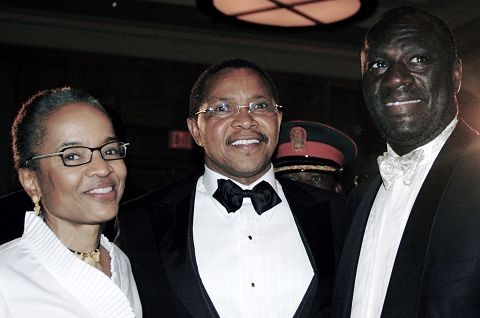
At its 23rd annual awards gala in New York last week, The Africa-America Institute recognized Tanzania for what the organization said was the country’s significant progress in education, environmental conservation, and creating a business-friendly environment.

“We commend Tanzania for its extraordinary commitment to build human capacity, particularly by strengthening its educational system at all levels,” said Mora McLean, president and CEO of the New York-based international education and policy organization.  “We celebrate their achievements and progress.”

In addition to the award, American financier and conservationist, Paul Tudor Jones II, announced the creation of The Kikwete Scholarship, a ten-year commitment to support tertiary level training for Tanzanian students to pursue studies in the field of environmental conservation at U.S. universities. The scholarships, which honors President Jakaya Kikwete’s leadership and commitment to conservation and environmental causes, will support the education of 20 students, said Jones, who is also the founder of The Grumeti Community and Wildlife Conservation Fund in Tanzania,

While accepting the award on behalf of his fellow citizens, Kikwete expressed gratitude for the scholarship fund, saying it would help further study on environmental conservation in Tanzania.

Tanzania has achieved nearly universal primary education, setting it on target to meet one of the United Nations’ Millennium Development Goals. The country’s higher education system has grown from just one university in 1961 at independence to some 200 training institutions at the end of 2006. The latest institution of higher learning to launch in Tanzania was Dodoma University, which opened its doors in September to 1,000 students.
 
Tanzania has also maintained a pledge it took in 1961 to safeguard its abundant wildlife and natural environment. Today, more than 25 percent of the country’s total land area is under conservation – an area higher than the world average, and exceeding UN goals.
 
In the business and investment sector, The World Bank recently cited Tanzania as one of Africa’s top two reformers, with its economy growing by 5.9 percent in 2006.

During the gala, Reginald Mengi, a Tanzanian businessman and media mogul, challenged Western media to show the thriving side of Africa to encourage foreign investment.

The Gala also honored several Americans and Africans for their contributions to Africa and the world.

AAI’s annual awards dinner also raises money to help Africa through education and training programs, and to develop programming and forums aimed at educating Americans about Africa. Last week’s event raised nearly $900,000, a record amount in the organization’s history.