
U.S. Immigration and Customs Enforcement (ICE), the investigative arm of the Department of Homeland Security (DHS), recently issued a final rule, effective Sep. 14, 2007, amending the regulation relating to the unlawful hiring or continued employment of unauthorized aliens. This amended regulation is part of the administration’s stepped-up enforcement effort to crack down on illegal immigration. It describes the employer’s legal obligations when the employer receives a no-match letter from the Social Security Administration (SSA) or receives a letter regarding employment verification forms from the DHS.
The final rule provides that when an employer receives written notice from the SSA (such as an “Employer Correction Request’” commonly known as an employer “no-match letter”) stating that the combination of an employee’s name and Social Security number does not match SSA records, or the employer receives written notice from DHS that the immigration status or employment-authorization documentation presented or referenced by the employee in completing the Form I-9 was not assigned to the employee according to DHS records, the employer must follow “safe-harbor” procedures to avoid being found to have “constructive knowledge” that undocumented workers are employed. (Form I-9 is filled out by employee and employer upon hire, retained by the employer, and is made available to DHS investigators on request, such as during an audit). This includes attempting to resolve the no-match and, if it cannot be resolved within a certain period of time, verifying again the employee’s identity and employment authorization through a specified process. (Checking the employer’s records to see if the discrepancy results from a clerical error in the employer’s records and if so, inform DHS and the SSA, make the necessary corrections, and keep a record of the manner, date and time of the verification).
DHS would consider such steps taken by the employer as reasonable if done within 30 days of receipt of the no-match letter. If the employer follows the “safe harbor procedures,” DHS would not use the no-match letter to support any charge that the employer had constructive knowledge of the employee’s lack of work authorization. If the employer, after taking reasonable steps to respond to the no-match letter, finds that the employee’s records are unverifiable, the employer must terminate the employee within ninety days of the receipt of the letter or risk prosecution for knowingly hiring illegal immigrants. The rule also states that DHS will continue to review the totality of relevant circumstances in determining if an employer had constructive knowledge that an employee was an unauthorized alien.
On Aug. 29, 2007 several labor unions, including the AFL-CIO, filed suit to prevent the implementation of this final rule. A couple of days later, the United States District Court for the Northern District of California granted an injunction enjoining defendants from “giving any effect or otherwise taking any action to implement” the new rule. Several chambers of commerce and other business groups moved to join the suit as plaintiffs in this case. The court granted their unopposed motion on Sep. 11. Then on Oct.10, the court granted an injunction enjoining the government from enforcing the new Social Security no-match rule.
The court held that relief was appropriate because plaintiffs raised serious questions about whether (1) the rule is arbitrary and capricious because DHS failed to supply a reasoned analysis for the agency’s new position that a no-match letter is sufficient, by itself, to put an employer on notice of an employee’s unauthorized status; (2) DHS exceeded its authority by interpreting Immigration Reform and Control Act’s provisions; and (3) DHS violated the Regulatory Flexibility Act by not conducting a final flexibility analysis.
Although the injunction came as sweet news to all immigrants and employers who might be affected by the rule, now is not the time for employers or individuals who are working without employment authorization to rest on their laurels. Instead, they should use this temporary reprieve to seek the advice of a qualified immigration attorney to bring themselves into compliance with the I-9 regulations because the government is still motivated to crackdown on illegal immigration by conducting criminal and civil investigations. In response to the judge’s ruling, the Secretary of Homeland Security, Michael Chertoff, noted, “ …[W]e will continue to aggressively enforce our immigration laws while reviewing the decision with Justice Department and will examine all of our legal options including appeal…”
Chertoff’s sentiments rang true when, on Oct. 18, the president of RCI. Inc. was ordered to pay a fine of $16 million after pleading guilty to conspiring to defraud the U.S. government by hiring and harboring illegal aliens. The U.S. attorney who prosecuted the case stated, “This case is an outstanding example of the cooperative efforts of federal law enforcement agencies. The prosecutors assigned to this case inform me that the success of this investigation is due, not just to the exceptional professionalism and diligence of the individual case agents, but also to the remarkable working relationship between ICE and the Internal Revenue Service.”
Nothing in this article should be taken as legal advice for an individual case or situation. The information is intended to be general and should not be relied upon for any specific situation. For legal advice, consult an attorney experienced in immigration law.
ICE Steps Up Worksite Enforcement Efforts
Cleaning the hard drive


If you are getting rid of your old computer and you still have your personal information saved on it, never forget to format your hard drive. The importance of purging your entire hard drive before giving it away is to reduce the possibility of it being placed in the wrong hands. This could lead to your personal or any other sensitive information being exposed.
When a file is deleted on your computer, it still remains on the computer and the old data can be recovered by an expert. Purging your hard drive comes into play especially if you are thinking of giving away your PC to a stranger, but if you’re giving it to a family member or a trusted colleague, then this is not necessary and a simple deletion of unnecessary files is adequate. But there are still chances of a trusted person unknowingly disposing of the computer without reformatting the drive.
Reformatting the hard drive
One of the simplest ways to reformat your hard drive is to reinstall a new operating system. If you already have a copy of Windows XP or Vista, you can simply pop the disk in the CD/DVD ROM after turning off the PC and letting it boot from the disk. You are then given an option to format the disk as it installs the new operating system.
Another method is to create a boot disk by going online to www.bootdisk.com, downloading the DOS file that is compatible with your Operating System, saving it to a floppy and then booting your PC from the floppy.
If this is too complicated for you or if you are not tech savvy, you can merely remove the hard drive from the PC (make sure that you touch the PC’s metal case before doing so or you might damage the motherboard as a result of the circuits getting damaged from static caused) and then shuttering the hard rive until it is completely ruined.
On the other hand, if you do not intend on giving away your PC and simply want to free up some space on your hard drive, here’s how to remove unnecessary files and documents.
Steps:
Click on accessories, system tools then disk clean up. Delete documents and files that you no longer need and empty the recycle bin after wards. You can also uninstall unwanted applications that are taking up too much space by going into the control panel, clicking on add/remove software and then select the software you want to uninstall. Delete temporary internet files first by going to tools, clicking on options and click on the “Delete cookies” and “Delete Files” buttons and then on “Clear History”. This does not remove all the temporary internet files. In order to do this you need to go to C:Users<username>AppDataLocalMicrosoftWindowsTemporary Internet Files if you have Windows Vista and C:Documents and Settings<username>Local SettingsTemporary Internet Files if you have Windows XP and 2000.
Grassroots Organizing Needed to Advocate for Debt Relief
It all started when the oil producing nations decided to hike oil prices in the late 1970’s. Just like that, these mostly Middle Eastern countries had vast sums of money. And they needed a secure place to keep it, so they put it in Western Banks. Now, suddenly, banks had more money than they knew what to do with it. So, they loaned it out. They loaned it out to developing nations at absurdly low interest rates.
Much of this money went to fund pork-barrel projects, which gave business to Western development corporations. Some loans were used to purchase hard-line laissez faire policies and allegiances during the Cold War. But many of the projects failed. And so did many of the economic policies that were part-and-parcel of the loans.
Much of the money was borrowed by dictators who spent it on military and weaponry, which was used to oppress their own people. In South Africa, for instance, international lending institutions and creditors loaned the apartheid government more than $20 billion, which they put directly to use in bolstering the racist system. When Nelson Mandela came to power in 1994 after being awarded the Nobel Peace prize, he was forced to make payments on money that had been used to pay for his 27-year imprisonment!
But when South Africa and other nations tried to pay down their debts, they found that the low interest rates that they had been paying were all of a sudden double or triple what they had been! Interest rates went, often as high as 47%, according to an independent congressional investigation (the Meltzer Commission). Faced with failed projects and economic policies, many countries could not make the loan payments as they were scheduled. So, the IMF and World Bank happily loaned them more money to cover their payments – with certain conditions. The trap was set.
The economic conditions that the IMF and the World Bank demanded fell into three basic categories: privatization, government spending cuts, or the use of Western corporations for development projects. Many development projects are controversial, like water privatization – providing extremely clean water to the wealthy, and leaving the poor majority with less access to clean water than before. When foreign, Western corporations are contracted for these jobs, it makes one suspicious that these economic conditions set up by the IMF and World Bank are designed to help corporations rather than the improvised countries they should represent.
But government spending cuts are the most devastating of these. Many countries have been forced to cut government spending in the areas of health care and education, which destroys their capacity to combat rapidly expanding HIV/AIDS rates or to provide primary education to children. More than 27 million people in Africa are currently infected with the HIV virus. Debt repayment to wealthy creditor institutions like the IMF and World Bank should not take precedence over AIDS prevention or the education of children. After all, how can sick or uneducated people construct an economy that will provide a living wage to all?
Foreign aid to debt-ridden countries often goes towards debt servicing. Aid without debt cancellation, then, is like pouring water into a sink with an open drain. Debt cancellation, therefore, is an important prerequisite to effective foreign aid. This is why debt cancellation is so necessary.
By 1996, even international lending institutions had realized that debt relief was necessary, and formed the Heavily Indebted Poor Countries initiative (HIPC) order to assess the need for and provide debt relief. But little debt relief was actually realized by this bureaucratic process that forced countries to adopt more of the same old harmful economic policies before even being eligible to recieve relief.
In 2000, under pressure from a worldwide Jubilee movement under leadership of important moral voices like Pope John Paul II, the U.S. Congress authorized the cancellation of part of the debt owed directly to the United States.
But there are still 67 counties that need 100 percent debt cancellation in order come out of extreme poverty and meet the Millennium Development Goals. That’s why Jubilee USA is working on a Bill, HR 2634, that will ask Congress to pressure international institutions to cancel the debt and reform lending practices. The United States has the power to cancel the debt.
US Congress people make decisions as a result of phone calls and letters they receive from ordinary people. That’s why we are asking people who care about debt cancellation to call their representatives and ask them to cancel the debt. It doesn’t matter whether or not you are even able to vote, you can still call 1-800-839-5276, ask for your Senator or Representative, and tell them to support HR 2634. You can visit www.jubileeusa.org or email [email protected] for more information or to get involved in Chicago.
PATIS Did Africa Proud
The three-day Pan African Trade and Investment Summit (PATIS) that took place in Minneapolis last month, the first of its kind, has come and gone! The energetic organizers of this momentous event, mainly African-born immigrants in Minnesota, gave their time and leadership skills for free to ensure its success.
On the one hand, they brought on the table the importance of Africa, a vast continent of almost a billion people with tremendous resources virtually crying out that “Africa is open for business.” It is not stretching its hands for handouts, it is not “a beggar-continent” – no, it is stretching an olive branch to the outside world, and more specifically to America, literally saying, “Come and invest in Africa, be our development partners.”
This kind of message being directed to America is both timely and imperative since Africa is the future of global trade and investment. The Chinese are aware of it as they are making in-roads in pouring vast investment dollars into Africa. The Americans have been late comers in this race, mainly because of the negative images that mainstream media houses in America project about African being land of the hungry, the begging, the sick and war-mongering Tarzans.
This distorted view of Africa in the eyes of many Americans will require the likes of many PATIS conventions to awaken the mindset of our American friends to the realization that there is much that Africa can offer to the rest of the world. Both in terms of global investment opportunities and trade “outside the box” of abject poverty and underdevelopment!
When America lately introduced the now famous African Growth Opportunity Act (AGOA) during the last term of the Clinton administration, now extended under the Bush administration, it was out of pity that sub-Sahara Africa’s share of global trade (by WTO statistics) in the world market was less than 2 percent! So miniscule that under AGOA, the region was granted access to the over 3 trillion dollar American market – “duty free / quota free” for a long list of its exports.
America is a consumerist society. But walk into a number of U.S. supermarkets like Target, Wal Mart, Rainbow and Walgreens, you can hardly come across any products with the label “Made In Africa”. I know there can never be any such thing since Africa is a continent of 53 sovereign nations. I used the expression deliberately to convey the American silly question of “how can the U.S. export to Africa?” – as if Africa was one country!
On a more serious note, I can challenge anyone to walk into those supermarkets and bring out a comfortable list of 53 items that come from the African continent. I am making the assumption that each African country is (at least) exporting one item to the U.S. market! There is no such list! This scenario is not good for Africa, and PATIS was all out to correct it.
The inaugural PATIS concluded last month was a young baby learning how to walk. At the end of the day, the participants agreed that they should make it an annual event, certainly more elaborate and more inclusive. The first attempt was virtually dominated by Nigeria, South Africa, Ghana and Kenya, making small nations like Rwanda and Burkina Faso virtually non-existent.
The MC of the event had to run up and down the Conference hall to seek compromises and rearrangement of a confusing schedule. Plenary sessions virtually fell apart and when they were to report back to the conference participants, there was a void. Some small countries when making their presentations were unable to attract any of the American firms that attended the conference.
Yet, we are proud to say that the good-intentioned organizers were able to bring to us heavyweights like Holly Vineyard, Deputy U.S. Assistant Secretary of Commerce for Africa, Gov. Tim Pawlenty of Minnesota, Ambassador Amina Salum Ali, the current African Union Permanent Representative to the U.S. Also a couple of senior African diplomats showed up. Networking was good, the fraternity dinner was a success and the Mall of America Africa Day was a brilliant showcase of African culture, merchandise and the ever-growing human capital from that region.
Regrettably, one of the organizers complained to our African American brothers in the U.S saying, “We do not feel you.” Like much of underdeveloped Africa, our black brothers in America are still struggling to be part of the American dream and – “we don’t feel you” was a wake up call for them to step up and find their rightful position in this U.S.-Africa emerging partnership.
The Kenyan diplomat who spoke at the closing ceremony, Ambassador Oginga Ogego, challenged his country men who have spent many years in the US “without valid papers and with nothing to show” to come out of the closet and be a part of the American dream. He may have been very blunt at best, but he was only expressing a desire to see such immigrants rise up to the challenge of being a part of this emerging partnership for progress between the United States and Africa.
PATIS has basically been a pacesetter. We look forward to an even more inclusive event next year and the years to come. Who knows, it could be a vital building bloc of the much talked about United States of Africa! PATIS is certainly on track. Good job organizers
Africa Ready for Information Technology Investment, UN Summit Told
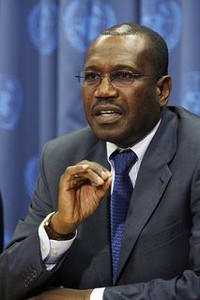
As a two-day summit on improving Africa’s information technology infrastructure wrapped up today in Rwanda, the head of the United Nations telecommunications agency reminded investors that Africa is “open for business and looking for partnerships.”
The Connect Africa Summit, held in the Rwandan capital, Kigali, brought together some 1,000 participants, including political leaders, executives of information and communication technology (ICT) companies and heads of development banks.
Hamadoun Touré, the Secretary General of the UN International Telecommunication Union (ITU) said that African leaders had committed themselves to creating the right regulatory environment, and private sector leaders had pledged to invest in the continent’s ICT sector. “Companies are ready to invest and they know they can make money here.”
Highlighting the impact of technology such as mobile phones, Mr. Touré said telecom companies were making profits, farmers were getting the information they need, and teachers were receiving educational aid. “Mobile phones even have an impact on democracy. During elections, people have used mobile phones to get election results fast and in a transparent manner.”
The technologies to connect the whole of Africa are available, said Craig Barrett, the Chair of the UN Global Alliance for ICT and Development and the Chairman of Intel Corporation. “What we are dealing with here is not a technology problem. The technology is ready to be delivered. It is a question of policies, of creating the right environment.”
“This is not a technology issue but an implementation issue,” Mr. Barrett said. “It is a question of taking existing technologies, existing models, and implementing them in Africa, as they have been implemented in other parts of the world.”
“Africa needs cost-effective connectivity,” he said, as it was currently saddled with the highest connectivity costs in the world. “All the universities of sub-Saharan Africa taken together pay $3 million per month in connectivity. This money could be used more effectively elsewhere.”
Providing technology, connectivity and content was not a problem one company or one government alone could solve, Mr. Barrett said. “We need to work together governments and the private sector,” capitalizing on the fact that the cost of access and hardware continued to decrease.
“The technology is there, even the financial resources are there,” said Rwanda’s President Paul Kagame, who hosted the meeting. “We have to be decisive and make a political choice about how to tap into these possibilities. The right policies and choices have to be made…. for these technologies to become a part of the solution.”
“The challenges are still significant, but let’s not underestimate what has been accomplished, especially by the telecom industry,” said Mohsen Khalil of the World Bank Group. Africa had jumped from 1 per cent to 20 per cent of telephone density within a few years. “We must now take this to the next level, and replicate the model of mobile telephony.”
The challenges ahead included extending ICT access to the poor, assisting governments in utilizing ICT for services to the public and to business, and harmonizing the legal and regulatory environment in the continent, Mr. Khalil said.
Among the partnerships announced today at the Summit, the ITU and the African Development Bank (ADB) agreed to work together on interconnecting all African capitals and major cities with ICT broadband infrastructure and on strengthening connectivity to the rest of the world by 2012.
ADB President Donald Kaberuka announced that the Bank had approved a $150 million loan for a pan-African cable, the East African Submarine Cable System, which would bring speedy and cheap bandwidth to at least 23 African countries. The system would run between South Africa and Sudan, with six landing points along the way, he said.
The Connect Africa Summit was attended by the Presidents of Burkina Faso, Burundi, Djibouti, Malawi and Senegal, together with 53 ICT ministers and 19 ICT companies, including Microsoft, Intel, Cisco and Ericsson.
The event was organized by ITU, the African Union, the World Bank Group and the Global Alliance for ICT and Development, in partnership with the ADB, the African Telecommunication Union, the UN Economic Commission for Africa and the Global Digital Solidarity Fund.
Lucky Dube Shot Dead!

Media reports from South Africa indicate that reggae icon, Lucky Dube, who less than two months ago performed at Afrifest in Minneapolis, was gunned down in a carjacking in Johannesburg. He was 43.
The reports say Dube was killed immediately after dropping off his son in Rosettenville, a suburb of Johannesburg. His daughter was also present at the time of the attack.
Police Captain Cheryl Engelbrecht told journalists the incident took place at around 8:20p.m local time.
“His son was already out of the car. When he saw what was happening, he ran to ask for help,” Engelbrecht said.
Born Philip Dube on August 3, 1964 on a small farm outside Ermelo, nearly 100 miles west of Johannesburg, his mother later named him Lucky for surviving poor health during his early childhood.
In 1982, Dube traveled to Johannesburg to begin working on his first album called “Lucky Dube and the Supersoul,” a blend of traditional Zulu rhythms with social commentary.
He did not record his first reggae album, “Rasta Never Die,” until1984, after five albums. The apartheid government banned “Rasta Never Die” the following year. By then the album had sold 4,000 copies, exceptional for a black artist in apartheid South Africa. His previous non-reggae records had sold around 30,000 copies.
By the time of his death, Dube had recorded 22 albums in Zulu, English and Afrikaans. His most successful album by far was “Victims,” which sold more than a million copies in 1993.
His latest album was “Respect”. Speaking about the challenge of making a living during the Internet piracy era, Dube told a standing-room-only crowd in Minneapolis on Aug. 20, “One does the work, the other reaps the profits.”
His killers did worse than prey on the fruits of his sweat; they took the life of a musical genius revered by millions around the globe.
To have your tribute to Lucky Dube published below please click here.
R.I.P LUCKY DUBE
I got the worst news on the site I always visit to just read about my best musician, Lucky Dube. His songs rock in Southern Sudan in mornings and evenings, simply because they give hope to the people of Southern Sudan. Now our hope is gone.
I love raggae because of two people i.e Bob Marley and Lucky Dube. They are all gone the same way. I am with all the African community who are mourning him. May his soul rest in peace. God bless his Family, relatives and friends.
Edna, Southern Sudan.
———————————————————————————————————————–
It is really shocking to hear of the tragic death of the reggae star. Here is in the Solomon Islands, Lucky Dube is very famous and there are heaps of his fans here. I am also a big fan of Lucky Dube and I’m very sorry to hear of his death.
Fred, Honiara, Solomon Islands.
———————————————————————————————————————–
What is South Africa turning into? killing our own? IT’S SO SAD LUCKY DUBE IS GONE. WHAT A SAD ENDING! LUCKY DUBE, MAY YOUR SOUL REST PEACE. I WILL NEVER STOP LISTNEING TO HIS MUSIC. Melinda.
Muslims Celebrate End of Ramadhan With Prayers and Sharing
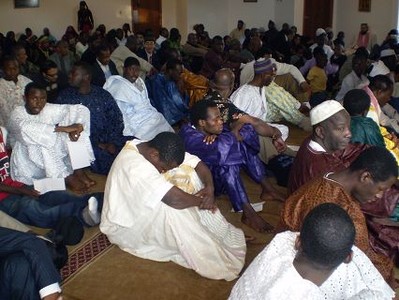
MINNEAPOLIS – Muslims in the Twin Cities joined their 1.5 billion brethren across the globe Saturday to celebrate the end of the holy month of Ramadhan with congregational prayers and gift exchanging.
Addressing a multitude of Muslim believers at the Masjid An-Nur mosque located along Lyndale Avenue in North Minneapolis during the Eid-el-Fitr prayers, Imam Makram El-Amin told his congregation that Muslims had emerged from the month of fasting with “renewed hope and expectations for great rewards from God.”
“You have every reason to smile, celebrate, exchange gifts, give to charity in the belief that Allah will return to us our good deeds in manifold measure,” the Imam told worshippers dressed in colorful attire.
The Imam said fasting was a period of exercising self-restraint, learning self-discipline, reconnecting with the Creator, building strong bonds in communities, and “a time of substituting the wrong with the good.”
He said that through fasting Muslims “restrained themselves from their strongest human urges because of Allah, and have repossessed the Garden (of Eden).”
“We have positioned ourselves in a point of strength and Allah has given us peace of mind and heart as ours is a religion of love, mercy and good neighborliness,” he said.
The Imam urged Muslims to spend time with their family members and friends, and to socialize with neighbors, for Eid-el-Fitr was a day of festivities. But he advised them not to make wasteful spending. He asked those with the means to give generously to the less privileged in society, and those who did not have material goods to give love.
“A smile, kind words and a hug is an act of charity,” he said.
The Muslim community venerates the Holy month of Ramadhan because it was during this month on the Night of Power that God revealed the Qur’an, the Islamic Book of guidance to Prophet Muhammad to deliver humanity from darkness into light.
Muslims take great delight in inviting friends and neighbors for tasty meals and soft drinks to mark the end of Ramadhan.
“My doors are open for great kuskus (spiced rice),” remarked Mahmoud, a businessman of Moroccan origin, as he hugged fellow worshippers outside the mosque.
Abdul Nasir, a taxi driver from Somalia, was overhead telling a couple who hired his cab to drop by at his Lake Street residence for special roast goat meat.
“We Somalis love a taste of tender goat meat during Eid, so please come join my family. On a day like this, we love to entertain guests,” he joyfully chuckled.
Enough About Homosexuality, African Anglican Clergymen Say
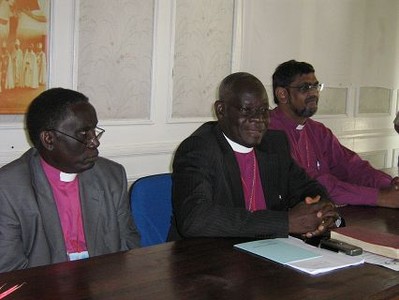
QUATRE-BORNES, Mauritius –The president of the Council of Anglican Provinces of Africa, Archbishop Peter Akinola of Nigeria, said at a convention in Mauritius that the Anglican Church in Africa had more serious problems to address than its stance on homosexuality.
The Anglican primate was speaking to journalists after the two-day closed-door CAPA meeting that began in the Indian Ocean island on Oct. 3. While responding to a question from the press, Archbishop Akinola said the church would focus on problems like the HIV/AIDS pandemic and the crises in Darfur and Zimbabwe, which he said threatened the wellbeing of Africa.
“Homosexuality is not our headache,” Archbishop Akinola said. “Everything that has to be said has been said. We are not going back to it.”
Affirming that unity in the communion was of course crucial, Archbishop Akinola pointed out that every organization has got its own problems.
“When we resolve our problem, we’ll let the world know through the media,” he said.
Homosexuality has been a contentious and divisive issue among Anglican believers. The crisis reached a climax in 2003 when the U.S. Diocese of New Hampshire elected V. Gene Robinson, an openly gay man, as bishop. The General Convention of the Episcopal Church confirmed him and its presiding bishop participated at Robinson’s consecration. In February 2004, 13 Global South Primates, including eight from Africa, denounced the actions of the Episcopal Church as a “direct repudiation of the clear teaching of the Holy Scriptures, historic faith and order of the church.” In April 2004, CAPA pledged to reject donations from the American dioceses that supported Robinson.
At the conference, Bishop Trevor Mwamba of Botswana read CAPA’s statement that in part addressed the division in the church. The report acknowledged that the church had been unable to ignore the current crisis in its communion, but denied that CAPA was to blame.
“The current situation is a twofold crisis for the Anglican Communion: A crisis of doctrine and a crisis of leadership, in which the failure of the instruments of the Communion to exercise discipline had called into question the viability of the Anglican Communion as a united Christian body under a common foundation of faith, as is supposed by the Chicago-Lambeth Quadrilateral,” Bishop Mwamba read from the report.
“Due to this breakdown of discipline, we are not sure that we can in good conscience continue to spend our time, our money and our prayers on behalf of a body that proclaims two Gospels: the Gospel of Christ and the Gospel of Sexuality,” he added.
Further in the statement Bishop Mwamba expressed CAPA’s distress concerning the oppression of Buddhist monks by Myanmar’s military junta, and the suffering and devastation that occurred in East, Central and West Africa as a result of recent drought and floods.
“We are also disturbed by accounts of military oppression in Myanmar, political oppression in Zimbabwe and by the conflict between Muslims and Christians in Darfur, Sudan,” Bishop Mwamba said.
The Council commended local churches and the wider world community for their response to the disaster.
“We are praying that all those affected will quickly receive the practical aid that is so sorely needed and the abiding comfort of God’s Holy Spirit,” Bishop Mwamba said.
In the statement CAPA said the church was trying to see how the Zimbabwean issue could be resolved in peace.
Archbishop Akinola added that the problem was of concern to the Southern African Development Community and was no longer confined to Zimbabwe.
CAPA commended Mauritius for its multi-ethnic society, a stable democracy, regular free elections, and a positive human rights record – qualities that the clergymen said not all African nations were blessed with.
However, CAPA acknowledged that there were encouraging signs in Africa.
“After years of devastating war, there are glimmers of hope in Democratic Republic of Congo,” the report said. “And the now vibrant economies of Kenya and Ghana have recently drawn plaudits from the World Bank.”
This year the theme of the Council’s meeting was “Called to a Life of Faithfulness.”
In the statement CAPA said obedience and faithful living was important to make progress in the work toward the eradication of HIV/AIDS.
“The disturbing growth in the numbers of new infections reminds us that the battle is far from over. This is especially true for many women in Africa who find themselves increasingly vulnerable to sexual oppression and abuse,” the report said.
CAPA also called upon the United Nations and the governments of the G8 nations “to fulfill their commitments so that the suffering of our most vulnerable sisters and brothers can be alleviated.”
When asked about the role of women in the communion in fighting back the problem of HIV/AIDS, the program coordinator of the council, Emmanuel Olatunji, said CAPA had a plan.
“The church in Africa has already developed a strategy which includes the involvement of women,” Olatunji said.
Concerning the financial support of CAPA, there had been unanimous conviction that all provinces presently in arrears will fulfill their commitments by the end of 2007, according to the report.
“We were also reminded that the number of people living in abject poverty within our provinces continues to grow and is a devastating indictment of poor governance in a continent that has been blessed by God with remarkable resources,” Bishop Mwamba said.
CAPA also urged churches to reach out to the youth of the provinces so that “they are empowered to stand against the false promises of materialism that bombard their minds.”
Provinces represented in the meeting included Burundi, Central Africa, Congo, Indian Ocean, Kenya, Nigeria, Rwanda, Southern Africa, Tanzania, Uganda and West Africa.
Africa a Safe Continent for Investment
A Pan-African Trade and Investment Summit panel discussion on models of doing business in Africa conducted by Minnesota businesspersons concluded that contrary to negative publicity about Africa, the continent was safer, friendly investment destination that has a lot to offer.
Africa’s “vibrant developing middle class will help stabilize the economies and the governments,” said Brad Gniffke, the founder of Praire Wind International, Inc. and one of the three panelists who participated in the discussion.
He said Africa may have a shortage of jobs, but its capacity to improve on its human capital through trained manpower was impressive.
The other panelists were Dr. Trevor Gunn, of Medtronic, Inc., and Poldi E. Gerard, vice president of Lemna International.
Poldi spoke of Africa as a vast market for technological products where challenges of trade, investment and cultural barriers were being addressed. Expressing the need for growth in Africa, she wondered why a country like Nigeria, Africa’s leading oil exporter, had only three operating refineries. Poldi said foreign investors had to learn local culture in order to be able to work with local personnel.
Issues the participants said were impeding foreign investment included infringement on intellectual property rights and pirating as well as technological transfers for processing raw materials for value addition and recycling of products hostile to the environment like plastic bags and containers.
Nigerian Independence Day: Scholar Asks President Yar’Adua to Resign

MINNEAPOLIS – A Nigerian-born Minnesotan scholar called on Nigeria’s newly elected President Alhaji Umaru Musa Yar’Adua to step down and call for fresh elections to save face and clear the mystery surrounding his nomination.
Addressing fellow compatriots in Minneapolis on a Saturday Oct. 6 celebration to mark the West African country’s 47th year of independence, Anthony Okubue, a professor of Environmental Science at St Cloud State University, asked Yar’Adua "to do the honorable thing" and resign from office to prepare for a fresh free and fair general elections for the benefit of all Nigerians and the African continent at large.
"I personally admire the Yar’Adua family,” Okubue said. “They are good people and have played a pivotal [role] in the country’s political history, but what I am simply saying is that why remain in office when you confess publicly that the elections were fraudulent?"
Yar’Adua of the ruling People’s Democratic Party won the presidency following the April elections, which were condemned by local and foreign observers, who alleged widespread vote rigging. Before assuming office Yar’Adua served as governor of the remote northern Katsina state since May 1999 and was little known in national politics.
Former president Olusegun Obasanjo surprised many Nigerians when he chose Yar’Adua as his successor.
Yar’Adua comes from a prominent political family. His father was a minister in the first government after independence and his late elder brother was an army general who served as deputy to Obasanjo during his military rule in the 1970s.
Okubue emphasized the need for politicians to preach the gospel of unity among Nigerians. Nigeria, Africa’s most populous nation, has faced consistent ethnic and religious chaos that threaten to tear the country apart. In 2000, more than 1,000 people were reportedly killed in Kaduna Province in violence related to the introduction of Sharia laws in the state.
Okubue also decried the rising levels of corruption in the country, calling it an "incurable ailment." Commenting on the recent media highlights exposing growing number Americans falling prey to Nigerian conmen, the don said all the parties engaged in the fake dealings were greedy individuals who would stop at nothing to enrich themselves. While he said he sympathized with anyone who might have been duped in the scandal, Okubue equally blamed successive Nigerian Federal Governments for not doing enough to revamp the country’s economy to counter the surging levels of unemployment, which he said led to the rising numbers in crime. He was, however, quick to add that not all Nigerians were tricksters.
"In every society there are bad apples and Nigeria is surely no exception," Okubue said.
The Independence Day ceremony was organized by Minnesota Institute for Nigerian Development (MIND). It gave an opportunity for Nigerian nationals residing in the Twin Cities metro area to intermingle freely and chat with personnel from the New York-based consulate, who offered passport renewal and other services onsite.
The provisions contained in a document distributed to the audience unveiled plans by the Nigerian government to issue ID cards to its citizens living in the United States. The government claimed the objectives were to enable the consulate to come to the aid of its citizens in the event of natural or man-made emergencies, and to unite Nigerians and their businesses to enhance their unity and cooperation, rather than competition. The document also cited efforts to consider approving absentee voting using the New York office as a pilot centre, as one of the potential benefits of the ID card system.
But a spot check by Mshale revealed that many Nigerians were skeptical about plans by the embassy to conduct a headcount on them, saying that their businesses and associations were already registered in the United States.
Gladys Igbo, the vice president of MIND, termed the move unnecessary and wondered what its motive was.
"I have been living in the United States for many years legally and see no reason why I should carry around a Nigerian identification card now,” Igbo said. “It’s simply not important."
Okubue also expressed his reservations of the move, saying he didn’t quite understand its goal.
"Everybody knows I am a Nigerian and living legally in the United States,” He said. “So what’s the need of giving me a number? Am I a cow?”
African Day at the Mall of America
Saturday October 6th was the close out day for the Pan African Trade and Investment Summit, fittingly titled African Day. A few friends and I rode on the light rail to the Mall of America where the celebration was taking place. On any given day, the Mall of America – the nations largest retail and entertainment complex – is a buzz with hundreds and hundreds of people. It is the kind of place that magnifies the life and culture of America, and to intergrate that with African culture and style was significantly monumental.
I knew we were running a little late, but I was determined to be a part of the day and festivities. I didn’t really have an idea of what to expect as I walked through the mall entrance toward the rotunda where the event was taking place.
It was a wonderful surprise to hear the sound of African beats way before I got to the rotunda. Jabali Afrika, a Kenyan music group that consists of four young men, was on stage entertaining a large crowd with beautiful African drum beats. We made our way to an empty space to get a better view. The group was dressed in traditional maasai print costumes and were expertly playing different beats on various percussion instruments. There was clapping and cheering as Jabali Afrika performed and invited a few people to join in the dancing on stage. Floor upon floor of the mall was lined with people looking in on the celebration while advertently moving to the African beat.
There was a feeling of warmth, joy, celebration, home in the atmosphere as people mingled and interacted with each other. There were families present, kids dancing gleefully as the parents contentedly enjoyed the entertainment.
There were booths too lined with different African arts, crafts, accessories, travel guides, catering service information, tea, coffee and books for Africa. The days celebration which started at twelve were also inclusive of a fashion show by Nyamal Both, contemporary African dance by dancers from Uganda and Congo, as well as poetry and spoken word by Abiola from Nigeria.
Though the event ended at four in the evening, the days celebrations continued way into the night at the Blue Nile Restuarant. Babu, a Kenyan DJ based in New Jersey, fused old school tracks, African music, Reggae, Soul and Hip-hop music that left an enthused eclectic crowd hot and worn out from dancing.
African Day turned out to be a heart warming memorable day, and a huge success to its’ sponsors, Mshale, Kilimanjaro Entertainment and the group of organisers of Pan African Trade and Investment Summit.