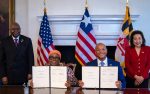
Nearly two centuries after Maryland played a pivotal role in Liberia’s early history, the two governments have signed what officials describe as a landmark partnership aimed at strengthening economic, educational and cultural ties for a new generation.
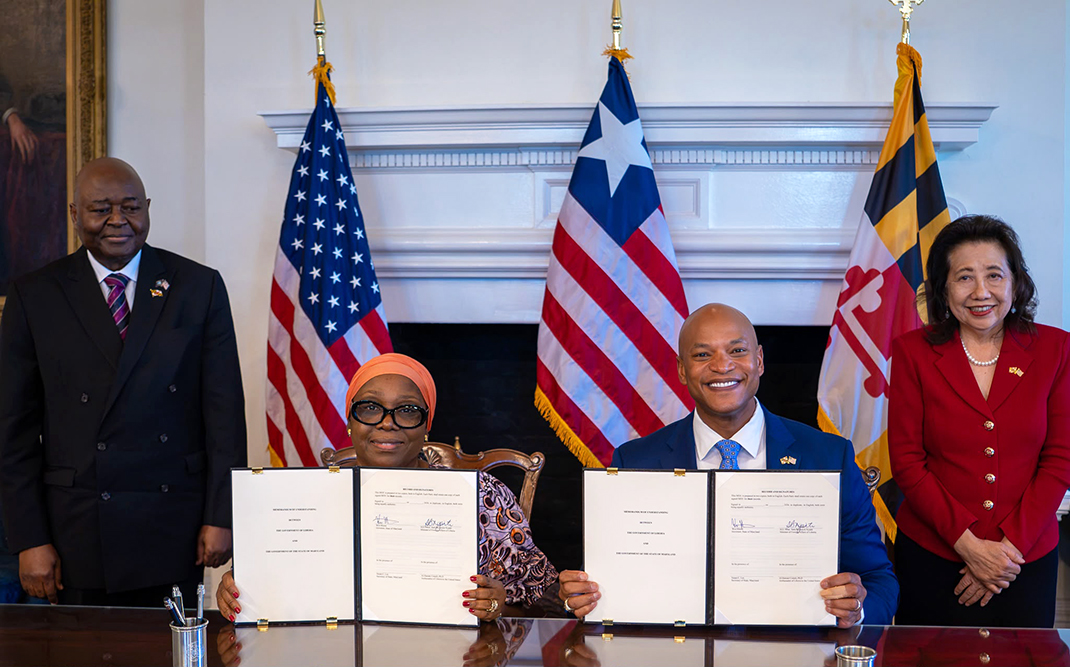
Liberian Foreign Minister Sara Beysolow-Nyanti and Maryland Gov. Wes Moore signed a sister-state memorandum of understanding on June 24, establishing what Maryland officials said is the first formal sister-state relationship between the state and an African nation.
The agreement creates a framework for cooperation in areas including trade, investment, education, agriculture, technology, infrastructure, public health and workforce development, while reaffirming a relationship that both sides say is rooted in nearly 200 years of shared history.
“This signing marks the reaffirmation of a relationship that stretches back nearly two centuries and is rooted in a shared history, common aspirations and enduring bonds,” Nyanti said during the signing ceremony.
For many Americans, Liberia’s founding is associated broadly with formerly enslaved and free Black Americans who settled there during the 19th century. Less widely known is Maryland’s unique role in that history.
Beginning in the 1830s, the Maryland State Colonization Society established a settlement along Liberia’s southeastern coast that later became Maryland County. Before joining the Republic of Liberia in 1857, the settlement briefly existed as the independent Republic of Maryland, giving the U.S. state an enduring historical connection unlike that of any other state.
Nyanti said Maryland continues to occupy “a special place” in Liberia’s national history, noting that modern relationships have expanded beyond history through exchanges involving Maryland and Liberia’s Maryland and Bong counties.
“The signing of this Memorandum of Understanding marks a historic new chapter in the longstanding relationship between the Republic of Liberia and the State of Maryland—a relationship rooted in nearly two centuries of shared history, friendship and enduring people-to-people ties,” she said.
The foreign minister said the agreement also aligns with President Joseph Nyuma Boakai Sr.’s ARREST Agenda for Inclusive Development, Liberia’s national development strategy aimed at promoting economic growth, improved infrastructure and human capital development.
Moore, Maryland’s first Black governor, opened his remarks by congratulating Liberia on its recent election as a non-permanent member of the United Nations Security Council, saying Liberia’s voice was long overdue on the global body.
He also reflected on the historical journey that connected Maryland and Liberia.
“In 1834, free Black men and women fled the United States from dehumanizing conditions to find a new home in Liberia,” Moore said, noting that Liberia’s second president, Stephen Allen Benson, was born in Cambridge, Maryland, before emigrating to Liberia.
Moore described the memorandum as the first agreement of its kind between Maryland and an African nation and said his administration intends to focus initially on four priority areas: trade, education, public health and civic exchange.
“These pillars will deliver real projects in real time and with tangible results,” Moore said.
The ceremony brought together Maryland officials, members of the Liberian diplomatic mission in Washington, D.C., and leaders from the Liberian community in the Washington metropolitan area.
Among those attending were Liberia’s Ambassador to the United States, Dr. Al-Hassan Conteh, Assistant Minister for American Affairs Christiana Konneh and Sebastian Teclar, president of the Liberian Association serving the Washington, D.C., Maryland and Virginia region.
While the agreement was signed in Maryland, its significance extends to Liberian communities across the United States, including Minnesota, which is home to the country’s largest Liberian population. Brooklyn Park, where many Liberian Americans have settled, has long maintained formal ties with a community in Liberia, reflecting the enduring people-to-people relationships that continue to connect the two countries.
Although largely symbolic at its signing, officials from both governments said they expect the memorandum to serve as a platform for expanded trade, educational exchanges, public health collaboration and investment in the years ahead.
For Liberia, the agreement represents an opportunity to deepen partnerships with a state whose history has been intertwined with its own since the country’s earliest beginnings. For Maryland, officials said it opens a new chapter in a relationship built not only on history but on a shared vision for future cooperation.
About Tom Gitaa, Editor-in-Chief
Born and raised in Kenya's coastal city of Mombasa, Tom is the Founder, Editor-in-Chief and Publisher of Mshale which has been reporting on the news and culture of African immigrants in the United States since 1995. He has a BA in Business from Metro State University and a Public Leadership Credential from Harvard’s Kennedy School of Government. He was the original host of Talking Drum, the signature current affairs show on the African Broadcasting Network (ABN-America), which was available nationwide in the United States via the Dish Network satellite service. On the show, he interviewed Nobel laureates such as 2004 Nobel Peace prize winner, Professor Wangari Maathai, the first woman from Africa to win the peace prize and heads of states. Tom has served and chaired various boards including Global Minnesota (formerly Minnesota International Center), the sixth largest World Affairs Council in the United States. He has previously served as the first Black President of the Board of Directors at Books for Africa. He also serves on the board of the Minnesota Multicultural Media Consortium. He has previously served two terms on the board of the United Nations Association. An avid runner, he retired from running full marathons after turning 50 and now only focuses on training for half marathons.
- Web |
- More Posts(517)
 (1 votes, average: 5.00 out of 5)
 Loading...