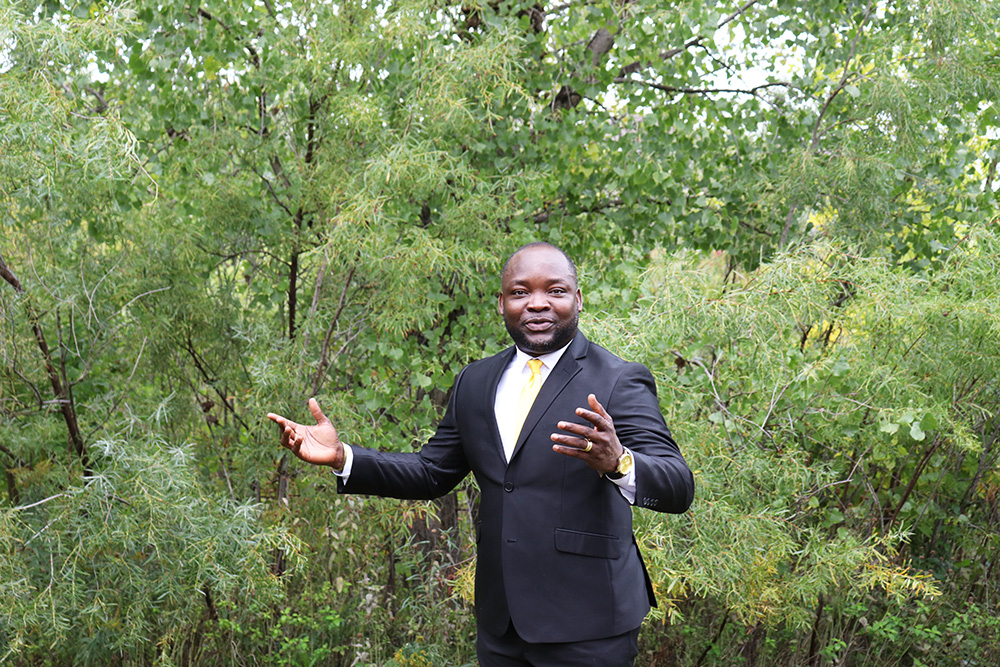

CHAMPLIN, Minn. — Charles A. Boakai has never run for elected office before.
But the Liberian immigrant and Ward 4 resident is entering his first campaign with no shortage of ideas about what he believes Champlin City Hall could do differently.
He wants residents more involved in decisions before the City Council votes. He wants greater scrutiny of city spending. He wants expanded youth programs and support for small businesses. And he wants Champlin to develop the kind of indoor recreational community center that he says would keep families from having to travel to neighboring cities for swimming and other activities.
Underlying those proposals is Boakai’s broader argument that a changing Champlin needs more voices represented in its government.
“We are becoming more and more diverse,” Boakai told Mshale in an August interview. “We need to get people on the table.”
Boakai is one of four candidates seeking the Ward 4 seat in a Nov. 3 special election. Samuel Mwangi, Lorraine Coan and Ryan Reider are also on the ballot. The winner will serve the final two years of a term that ends Dec. 31, 2028.
Absentee voting for the election began Sept. 18, while in-person early voting at Champlin City Hall begins Oct. 16. Election Day polls will be open from 7 a.m. to 8 p.m.
For Boakai, the campaign represents another chapter in a journey that began in Liberia and eventually brought him to Minnesota.
From Liberia to Minnesota
Boakai said he arrived in the United States around 2011 after being selected through the Diversity Visa program.
It was his first time outside Liberia.
He grew up during the country’s civil war, an experience he said shaped his views about community, security and the opportunities he later found in the United States.
“Coming from Liberia, going through the civil war, surviving the civil war, I think that was one of the greatest challenges,” Boakai said.
He initially settled in Pennsylvania before moving to Minnesota, where he attended college and built a career that he says has included work in banking, regulatory compliance and government.
Boakai said his professional experience has included work with Wells Fargo, U.S. Bank and the U.S. Small Business Administration. He said he holds degrees in criminal justice and pre-law and public policy.
He lives in Champlin with his wife, Henrietta, and their three children.
Boakai has also been involved in nonprofit work connected to Liberia. He told Mshale that he previously operated an organization called Focus Liberia and that he and his wife later expanded their work through the Charles A. Boakai Education Foundation, including establishing a school in Liberia.
It is that combination of his immigrant experience, professional background and community work that Boakai says led him toward local government.
‘We need to listen’
Boakai’s criticism of Champlin’s current leadership centers largely on what he describes as a disconnect between residents and City Hall.
He argues that residents should be brought into discussions earlier, particularly on major spending and development decisions, rather than learning about proposals shortly before the council is prepared to act.
“We need to listen to the residents,” Boakai said. “If we do not listen to our residents, then we don’t have a city.”
His campaign is also rooted in his belief that Champlin’s increasing diversity should be more visible in city leadership.
Boakai pointed during his Mshale interview to Mwangi, a Kenyan American and fellow Ward 4 candidate who has previously sought a council seat.
“He’s a very great gentleman,” Boakai said of Mwangi.
Boakai said the city’s changing demographics make it important for residents from different backgrounds to see themselves represented and involved in local decision-making.
A different vision for recreation
One of Boakai’s most concrete proposals is an indoor recreational community center with amenities such as a swimming pool, indoor soccer and volleyball.
He argues that Champlin families should not have to travel to neighboring cities for those activities.
The proposal also illustrates Boakai’s broader disagreement with some of the city’s spending priorities.
During his interview with Mshale, Boakai pointed to the city’s riverfront development and questioned whether residents were receiving the kind of public amenities they need from that investment.
The city-owned Mississippi Crossings Event Center is a riverfront facility designed for weddings, receptions, conferences and other gatherings. It is part of the larger Mississippi Crossings redevelopment, which also includes public gathering and recreational spaces.
Boakai said he would rather see the city invest in an indoor facility where families could swim, play sports and participate in activities throughout Minnesota’s winters.
His proposal would itself require money. Boakai said the city should look for federal and other outside funding and consider amenities that could generate revenue.
He has not presented a detailed financing plan for the facility.
Taxes, business and public safety
Property taxes are another central concern for Boakai.
He told Mshale that his own property-tax bill had risen by nearly $2,700 and said residents are increasingly feeling pressure from taxes and other household costs.
Boakai argues that city leaders should scrutinize spending more closely while looking for ways to broaden Champlin’s economic base and help small businesses grow.
He said the city could do more to connect entrepreneurs with financing and technical assistance, drawing on programs available through government agencies and financial institutions.
Public safety is another priority.
Boakai speaks favorably of Champlin police and firefighters and says law enforcement should have the resources it needs. At the same time, he argues that public safety also requires stronger relationships between residents and police and more attention to traffic and pedestrian safety.
He has also proposed mentorship and educational initiatives for young people.
For Boakai, those issues are connected: safe neighborhoods, opportunities for young people and economic stability all contribute to the kind of community he says he wants his children to inherit.
Challenging City Hall
Boakai is unusually direct for a first-time candidate in his criticism of existing city leadership.
He told Mshale he believes partisan politics have entered a municipal government whose elected offices are formally nonpartisan, and he specifically criticized Mayor Ryan Sabas.
“I don’t think party politics should be involved in city politics,” Boakai said.
His argument is that council members should approach local decisions based on residents’ interests rather than partisan identity.
Boakai said that would not prevent him from working with the mayor and other council members if elected.
A first campaign
Boakai’s first campaign puts him in a field that includes considerably more municipal experience.
Mwangi has twice run for the City Council and has served for years on Champlin’s Environmental Resources Commission. Coan was appointed to the vacant Ward 4 seat in April and is serving on the council through the end of the year.
Boakai does not present his lack of elected experience as a disadvantage.
Instead, he argues that his professional and community experience would bring another perspective to the council.
For someone who arrived in the United States for the first time about 15 years ago, the decision to seek public office also carries a personal dimension.
Boakai said the opportunities he found after leaving Liberia are part of why he now wants to serve the city his family calls home.
“This country has given me so much,” he told Mshale. “I think it is time to give back.”
About Tom Gitaa, Editor-in-Chief
Born and raised in Kenya's coastal city of Mombasa, Tom is the Founder, Editor-in-Chief and Publisher of Mshale which has been reporting on the news and culture of African immigrants in the United States since 1995. He has a BA in Business from Metro State University and a Public Leadership Credential from Harvard’s Kennedy School of Government. He was the original host of Talking Drum, the signature current affairs show on the African Broadcasting Network (ABN-America), which was available nationwide in the United States via the Dish Network satellite service. On the show, he interviewed Nobel laureates such as 2004 Nobel Peace prize winner, Professor Wangari Maathai, the first woman from Africa to win the peace prize and heads of states. Tom has served and chaired various boards including Global Minnesota (formerly Minnesota International Center), the sixth largest World Affairs Council in the United States. He has previously served as the first Black President of the Board of Directors at Books for Africa. He also serves on the board of the Minnesota Multicultural Media Consortium. He has previously served two terms on the board of the United Nations Association. An avid runner, he retired from running full marathons after turning 50 and now only focuses on training for half marathons.
- Web |
- More Posts(515)
 (1 votes, average: 5.00 out of 5)
 Loading...