
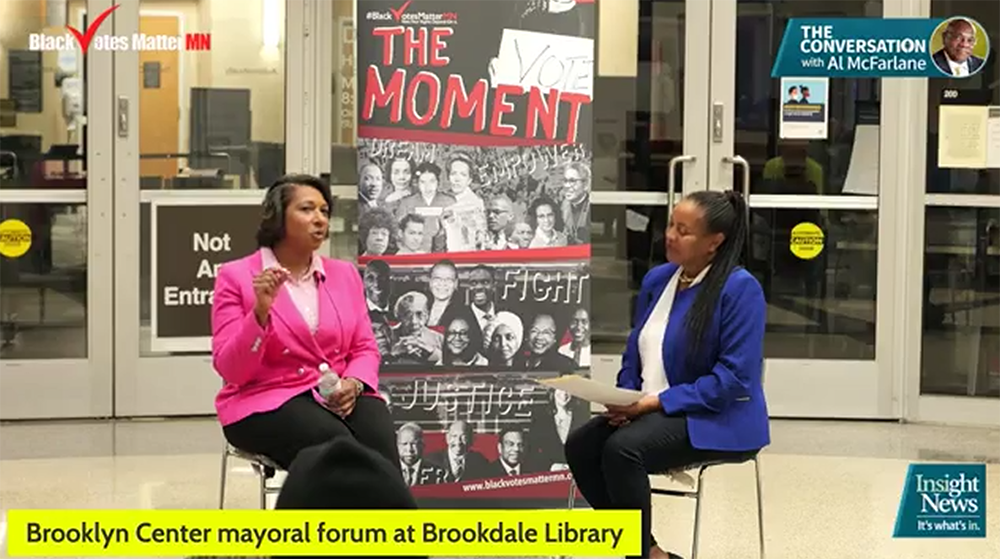

BROOKLYN CENTER, Minn. — Brooklyn Center mayoral candidate Teneshia Kragness said Tuesday that the city’s police surveillance cameras were installed without prior City Council approval, raising questions about public oversight as she faced scrutiny over policing, housing and economic development at a forum her opponent did not attend.
The Oct. 20 forum, organized by Black Votes Matter Minnesota at Brookdale Library, was intended to bring together the two candidates seeking to succeed Mayor April Graves, who is not running for reelection.
Instead, Kragness, a City Council member and mayor pro tem, answered questions alone as her opponent, Alexander Koenig, missed his third candidate forum since September.
“This was supposed to be a debate with two candidates,” said Anika Robbins, founder of Black Votes Matter Minnesota, as she opened the event.
Robbins said organizers had invited both campaigns and sought a mutually agreeable time. Kragness accepted, she said, but Koenig’s campaign did not respond.
With Koenig absent, Kragness fielded questions about her record on policing, tenant protections, economic development and the city’s future.
Flock cameras and questions of oversight
One of the most consequential exchanges came when Robbins questioned Kragness about Brooklyn Center’s use of Flock automated license plate readers, technology police use to identify vehicles associated with crimes and other investigations.
The cameras have been a contentious issue in the city’s elections, with candidates divided over their usefulness and the potential for government surveillance.
Kragness said she had participated in a police ride-along to better understand how officers use the cameras. But she also raised concerns about how the technology was introduced.
“Flock cameras were not approved by the City Council prior to being there,” Kragness said. “So I believe there were some steps missed.”
She said the city missed an opportunity to explain to residents why the cameras were being used and how they would operate.
Robbins pressed her on how such equipment could be installed without council involvement.
Kragness did not identify who authorized the installation or explain whether council approval was required. Instead, she compared the technology to artificial intelligence, saying tools introduced for one purpose can develop additional uses that were not originally anticipated.
“We want to make sure that, A, we’re utilizing the resources that the police need to do their job, but it’s not being abused,” she said. “And then it’s not doing more harm than good.”
Kragness called for greater public education about the cameras and said residents should have a voice in decisions about their use.
Her remarks left unanswered whether she would seek a formal council review, changes to the cameras’ operating policies or additional restrictions on how collected information can be accessed and shared.
As Mshale previously reported, Brooklyn Center police deployed 10 automated license plate readers using funding from a Minnesota Auto Theft Grant. An independent audit conducted in 2025 found the system compliant in several major areas, including data collection, retention and access controls, while identifying an issue involving breach-notification procedures.
Tuesday’s exchange shifted the discussion from the cameras’ usefulness to a broader question of who should decide when surveillance technology is introduced into a community.
An earlier vote on traffic stops
Robbins also challenged Kragness about her earlier vote against restrictions on pretextual traffic stops, asking why she voted that way and whether she would make the same decision today.
Pretextual traffic stops involve officers stopping motorists for relatively minor violations while investigating suspected unrelated offenses. Critics argue that the practice can lead to unnecessary police encounters and disproportionately affect drivers of color.
Kragness did not give a detailed explanation of her original vote. Instead, she said elected officials must make decisions based on the information available at the time and remain willing to reconsider their positions.
“At the time, that was the information that I had,” she said. “And that was the decision that I made.”
She suggested that a differently structured proposal or a different council might lead to another discussion.
“You may have got it wrong,” she said, acknowledging that elected officials sometimes need to reconsider past decisions.
But she stopped short of saying whether she would support the same restrictions if they came before the council again.
On police accountability more broadly, Kragness said officers who fail to uphold their responsibilities should face consequences, while those doing their jobs properly should have the tools they need.
She described participating in police ride-alongs and attending officer swearing-in ceremonies as ways to build relationships with the department.
Kragness also argued that public safety cannot be the responsibility of police alone. She pointed to the city’s expanded response system, intended to direct certain calls to personnel equipped to handle situations that do not necessarily require a police response.
Housing protections and affordability
Housing affordability produced one of Kragness’ clearest commitments.
Asked whether she would preserve Brooklyn Center’s existing tenant protections, Kragness said she opposed rolling back rights residents already have.
“You can’t give people protection rights and then take those back,” she said.
She described housing stability as essential to residents’ well-being, saying uncertainty about where someone will live can affect other aspects of life.
Kragness said she supports maintaining existing protections and educating tenants about their rights, including during conversations with residents while campaigning.
But she acknowledged that preserving those protections would require agreement from other council members.
“I recognize that that is not a one person decision,” she said.
Asked about the balance between affordable and market-rate housing, Kragness questioned whether developments described as affordable are actually within reach of Brooklyn Center residents.
“We can say affordable housing, affordable to who?” she asked.
She said the city must consider what residents can realistically afford while also protecting tenants and creating opportunities for homeownership.
Kragness, who said she has worked in accounting for 25 years, also pointed to the cumulative pressure of property taxes, rent, mortgages, utility bills and other household expenses.
She argued that attracting more businesses could strengthen the city’s tax base and said city officials should examine spending for possible reductions.
She did not identify specific budget cuts during the forum.
Development plans still taking shape
Kragness described Brooklyn Center’s vacant and underused commercial properties as opportunities rather than liabilities.
She said the city should welcome entrepreneurs, particularly small-business owners and people of color who may face barriers to establishing businesses elsewhere.
Rather than waiting for a major retailer or large development, she argued that Brooklyn Center should build on businesses already operating in the community.
“I think instead of us waiting for this big box center that’s going to come here, we develop what we have,” she said.
She cited the expansion of a New Horizon child care center as an example of a business choosing to grow within the city.
But when Robbins asked what kinds of businesses Kragness particularly wanted to attract, the candidate did not identify a specific industry or commercial target.
“None in particular,” Kragness said, before returning to her support for small businesses.
She also criticized what she described as City Council micromanagement of professional staff, arguing that city employees should have greater freedom to use their expertise to recruit businesses and pursue development opportunities.
The discussion turned to Brooklyn Center’s Opportunity Site, a major redevelopment area that has figured prominently in the city’s long-term planning.
Kragness acknowledged that the city has plans but has not broken ground on redevelopment.
“We have some plans, but we have nothing,” she said. “We have not dug ground yet.”
She said she wanted residents and other stakeholders involved in shaping the site’s future and hoped the city would demonstrate measurable progress over the next four years.
But she offered no specific timetable, financing approach or development proposal during the forum.
Young residents and community participation
Kragness also called for giving young people a more direct role in city decisions.
Responding to an audience question, she supported establishing a youth advisory board and expanding opportunities for young residents to serve on boards, commissions and committees.
She said adults frequently make decisions affecting young people without consulting them.
“If we want to make decisions for them, we need to have them at the table before the decisions are made,” she said.
Kragness described speaking with young residents about the city’s community center and encouraging them to address the City Council about recreational needs, including basketball courts and gathering spaces.
She argued that spending on youth programs should be viewed as an investment even when it does not produce an immediate financial return.
“Sometimes things don’t have a monetary return,” she said. “When it comes to our youth, that’s an investment.”
She also encouraged residents to participate in council meetings, contact city staff and submit concerns in writing.
Koenig misses third candidate forum
Koenig’s absence Tuesday marked the third time since September that he has not participated in a Brooklyn Center candidate forum.
He did not attend the Sept. 8 League of Women Voters forum at Brooklyn Center City Hall, where organizers said he had been invited.
He was also absent from an Oct. 15 community forum at Brookdale Library organized by five nonprofit organizations serving immigrant and renter communities.
Organizers of that forum said all candidates had been invited and referred generally to scheduling conflicts, without specifying which candidates were affected.
Koenig is also the only candidate among the six running for Brooklyn Center mayor and City Council without a recorded candidate statement on CCX Media, a nonprofit community media organization serving nine northwest Twin Cities suburbs.
CCX says it offered all general election candidates an opportunity to record video statements addressing voters.
Statements are available from Kragness and City Council candidates Gretchen Enger, Dan Jerzak, Nahid Khan and Mark Viste.
Koenig’s candidate page instead states, “No candidate statement for Alexander Koenig.”
The missing statement and forum absences do not establish why Koenig did not participate or whether he has been campaigning through other channels.
Mshale emailed, texted and left Koenig a voicemail following the September forum but received no response before publication.
On Wednesday, Mshale again contacted Koenig by telephone and email, seeking an explanation for his absence from the Sept. 8 and Oct. 20 forums and asking whether he intended to participate in any public candidate forums before the Nov. 3 election.
He did not respond by the 8 p.m. Wednesday deadline.
Kragness emphasizes showing up
Near the end of Tuesday’s forum, Kragness returned to the question of why voters should choose her.
She said she had worked at her regular job earlier that day, gone door-knocking afterward and then rushed home to prepare for the evening’s event.
“Nothing is going to be given to you,” she said.
Kragness, who finished first in the August mayoral primary with 52.86% of the vote, said she was not taking the general election for granted.
“I’m not expecting people to just vote for me,” she said. “I am earning these votes.”
Her campaign has emphasized continuity with Graves, who has endorsed her, alongside promises to strengthen public safety, encourage economic development and make city government more responsive to residents.
But Tuesday’s forum also underscored the challenges she would inherit if elected, including unresolved questions about police surveillance, the pace of redevelopment and the city’s ability to deliver affordable housing while managing taxpayer costs.
Brooklyn Center voters will elect a mayor and two City Council members on Nov. 3. Polls will be open from 7 a.m. to 8 p.m.
Early voting is already underway. Voters can find registration information, polling locations and sample ballots at mnvotes.gov.
About Tom Gitaa, Editor-in-Chief
Born and raised in Kenya's coastal city of Mombasa, Tom is the Founder, Editor-in-Chief and Publisher of Mshale which has been reporting on the news and culture of African immigrants in the United States since 1995. He has a BA in Business from Metro State University and a Public Leadership Credential from Harvard’s Kennedy School of Government. He was the original host of Talking Drum, the signature current affairs show on the African Broadcasting Network (ABN-America), which was available nationwide in the United States via the Dish Network satellite service. On the show, he interviewed Nobel laureates such as 2004 Nobel Peace prize winner, Professor Wangari Maathai, the first woman from Africa to win the peace prize and heads of states. Tom has served and chaired various boards including Global Minnesota (formerly Minnesota International Center), the sixth largest World Affairs Council in the United States. He has previously served as the first Black President of the Board of Directors at Books for Africa. He also serves on the board of the Minnesota Multicultural Media Consortium. He has previously served two terms on the board of the United Nations Association. An avid runner, he retired from running full marathons after turning 50 and now only focuses on training for half marathons.
- Web |
- More Posts(517)
 (1 votes, average: 5.00 out of 5)
 Loading...