

Twin brothers torn apart by a woman and brought together by necessity. The abandoning father who must care for his son.
Author Abraham Verghese speaks with New America radio on his book Cutting for Stone.

Twin brothers torn apart by a woman and brought together by necessity. The abandoning father who must care for his son.
Author Abraham Verghese speaks with New America radio on his book Cutting for Stone.
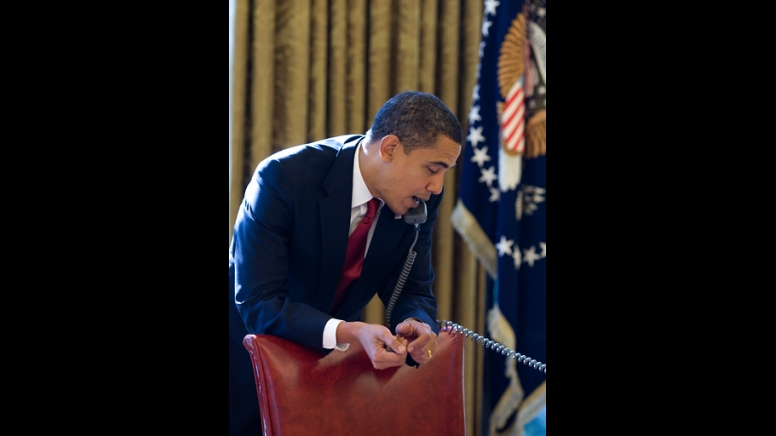

It’s been a year since President Barack Obama signed the $787 American Recovery and Reinvestment Act, better known as the stimulus package. The largest public investment in America’s infrastructure since the Great Depression, Obama called it “the most sweeping economic recovery bill in our history.”
But a year later, many Americans are still hurting. And while the Labor Department reports the unemployment rate for whites has begun to fall (to 8.4 percent in January), it continues to rise for ethnic minorities. For African Americans, it is 16.5 percent and for Latinos unemployment is 12.6 percent.
And the reasons for these disparities lie at least in part in the unfair and unjust way the stimulus package has been implemented.
A series of investigations coordinated by New America Media show that over the last year those dollars have systematically bypassed communities of color.
Consider the following: In the last year, 98 percent of stimulus contracts from the U.S Department of Transportation have gone to white-owned firms. Meantime, a new government-backed small business loan program created by the stimulus benefited white-owned businesses 91 percent of the time. These disparities run across almost every government agency that received money under the Recovery Act. Of the 630 grants given to arts organizations by the National Endowment for the Arts, for example, only 12 (less than 2 percent) went to Latino organizations .
In Minnesota, the apportionment of stimulus dollars has been so unfair that community leaders have begun circulating a petition formally requesting that their state immediately terminate all federally funded transportation contracts.
Nine projects with estimated costs at over $91 million are located in the Twin Cities’ outer suburban ring, while Minnesota’s 5th Congressional District, which has highest proportion of blacks and other people of color, received the lowest amount of transit work dollars ($3.8 million) among the state’s eight U.S. districts.
<object width=”480″ height=”300″><param name=”movie” value=”http://www.whitehouse.gov/sites/all/modules/swftools/shared/flash_media_player/player.swf”></param><param name=”allowFullScreen” value=”true”></param><param name=”bgcolor” value=”282828″></param><param name=”allowscriptaccess” value=”always”></param><param name=”flashvars” value=”file=http://www.whitehouse.gov/videos/2010/February/021710_EEOB.m4v&path_to_plugins=http://www.whitehouse.gov/sites/default/modules/wh_multimedia/wh_jwplayer/plugins&path_to_player=http://www.whitehouse.gov/sites/all/modules/swftools/shared/flash_media_player&skin=http://www.whitehouse.gov/sites/all/modules/swftools/shared/flash_media_player/skins/EOP_skin.swf&captions_url=http://www.whitehouse.gov/sites/default/files/av_closedcaption/02172010_Recovery_Act_Yr_1.srt&image=http://www.whitehouse.gov/sites/default/files/audio-video/video_thumbnail/P021710SA-0139-3.jpg&controlbar=bottom&frontcolor=AAAAAA&plugins=http://www.whitehouse.gov/sites/default/modules/wh_multimedia/wh_jwplayer/plugins/privacy/privacy,http://www.whitehouse.gov/sites/default/modules/wh_multimedia/wh_jwplayer/plugins/hat/hat,http://www.whitehouse.gov/sites/default/modules/wh_multimedia/wh_jwplayer/plugins/share/share,http://www.whitehouse.gov/sites/default/modules/wh_multimedia/wh_jwplayer/plugins/captions/captions&captions.file=http://www.whitehouse.gov/sites/default/files/av_closedcaption/02172010_Recovery_Act_Yr_1.srt”></param><embed src=”http://www.whitehouse.gov/sites/all/modules/swftools/shared/flash_media_player/player.swf” type=”application/x-shockwave-flash” allowscriptaccess=”always” allowfullscreen=”true” width=”480″ height=”300″ flashvars=”file=http://www.whitehouse.gov/videos/2010/February/021710_EEOB.m4v&path_to_plugins=http://www.whitehouse.gov/sites/default/modules/wh_multimedia/wh_jwplayer/plugins&path_to_player=http://www.whitehouse.gov/sites/all/modules/swftools/shared/flash_media_player&skin=http://www.whitehouse.gov/sites/all/modules/swftools/shared/flash_media_player/skins/EOP_skin.swf&captions_url=http://www.whitehouse.gov/sites/default/files/av_closedcaption/02172010_Recovery_Act_Yr_1.srt&image=http://www.whitehouse.gov/sites/default/files/audio-video/video_thumbnail/P021710SA-0139-3.jpg&controlbar=bottom&frontcolor=AAAAAA&plugins=http://www.whitehouse.gov/sites/default/modules/wh_multimedia/wh_jwplayer/plugins/privacy/privacy,http://www.whitehouse.gov/sites/default/modules/wh_multimedia/wh_jwplayer/plugins/hat/hat,http://www.whitehouse.gov/sites/default/modules/wh_multimedia/wh_jwplayer/plugins/share/share,http://www.whitehouse.gov/sites/default/modules/wh_multimedia/wh_jwplayer/plugins/captions/captions&captions.file=http://www.whitehouse.gov/sites/default/files/av_closedcaption/02172010_Recovery_Act_Yr_1.srt&stretching=fill&menu=false”></embed></object>
There is some reason to hope, however.
Almost a year to the day President Barack Obama signed the stimulus into law, his administration finally pulled stimulus funds from an agency for failing to comply with federal civil rights laws. The case involves BART, Northern California’s commuter rail, which sought to use $70 million from the stimulus to build a spur to the Oakland Airport that would travel through — but not stop in — impoverished East Oakland.
In a February 12 letter to local officials, FTA administration Peter Rogoff said BART’s plan failed to comply with Title VI of the 1964 Civil Rights Act, which prohibits agencies that receive federal funds from using discriminatory practices.
Community leaders cheered the decision. The Rev. Scott Denman, the Rector of Oakland’s St. John’s Episcopal Church noted that without the President’s intervention scarce transportation dollars would have been “taken away from those who have trouble affording bus tickets and given to those who have no trouble affording airline tickets.” The money now appears destined for local bus and streetcar service where massive service cuts and fair hikes had been proposed.


Love, loyalty, friendship and betrayal in a family during the Ethiopian Civil War are depicted in Beneath the Lion’s Gaze by Maaza Mengiste.


Subhash Kateel thinks impatience with President Obama’s immigration agenda has begun to boil over. An immigrant advocate in Florida, Kateel says there is a potent mix of frustration and disappointment percolating through immigrant communities nationwide.
President Obama promised sweeping changes to the immigration system before taking office and raised immigrants’ hopes, says Kateel. Instead of delivering, the administration has maintained the status quo: high-handed enforcement tactics that separate families and funnel immigrants into substandard immigration courts and detention centers.
“Yeah, things are changing,” says Kateel, who works for the Miami-based Florida Immigrant Rights Coalition. “They’re getting worse. That’s what we hear on the ground.”
Kateel is one among many immigrant advocates nationwide who sees a need to reignite the immigrant rights battle with more imaginative and hard-hitting tactics.
Arrests of immigrants — mostly for petty crimes — have increased under Obama, advocates point out. Department of Homeland security budgeting for immigration enforcement, detention and deportation has continued ballooning.
The advocates would like to hold the White House accountable for its broken promises. Plans are underway to attract tens of thousands of activists to Washington, D.C. on March 21 to demand reform.
But besides relying on timeworn tactics like street protests and lobbying lawmakers, the immigrant rights advocates also have turned to more imaginative and radical approaches.
One is the shaming of specific public figures that are perceived as enablers of anti-immigrant activity and sentiment.
Late last year, CNN anchor Lou Dobbs resigned after he was targeted in a high-profile media campaign, “Basta Dobbs,” that painted him as a megaphone for distorted information on immigration.
Last month, over 10,000 people turned out in Phoenix to rally against local Sheriff Joe Arpaio who, thanks to a contract with the federal government, has transformed his office into a de-facto hard-line arm of Immigration and Customs Enforcement (ICE).
On the same day, Jan. 16, smaller rallies were held nationwide to coincide with the anti-Arpaio protest.
Faith leaders, young people and more recent immigrants are playing prominent roles in organizing protests like the Phoenix rally.
The Phoenix rally was successful in part thanks to a high level of engagement from young people, says Shuya Ohno, spokesman for the Reform Immigration for American campaign in Washington, D.C.
“I would say youth are leading the way right now,” agrees Katherine Gorell, communications director for the Florida Immigrant Rights Coalition.
Students have recently innovated with their own original protest concepts. Along with four other students from South Florida, 23-year-old Felipe Matos is walking 1,500 miles from Miami to Washington, D.C., to promote in-state tuition at public colleges for undocumented immigrants.
“The government hasn’t done anything for us, so we need to do something for ourselves,” says Matos.
Like two of the other walkers Matos is an accomplished student at Miami Dade College, but is blocked from financial aid and other forms of support due to his lack of papers.
Presente.org, an online Latino organizing group that also helped organize “Basta Dobbs,” is one of the backers of the students’ protest, dubbed the “Trail of Dreams.”
In New York, a five-day road trip this week dubbed “Road Trip for our Future” took 10 immigration activists, many of them first- and second-generation immigrants, on an itinerary that includes farm towns, rust-belt cities, and suburban communities.
The activists held rallies outside lawmakers’ offices and met with local activist groups including, in tiny Pittsford, N.Y.,—“The Raging Grannies,” a troupe of elderly ladies who sang a ditty in favor of immigration reform.
One of the caravanning activists, Gabriela Villareal, is also advocacy policy director for the New York Immigration Coalition. She expressed peoples’ frustration with the immigration system with a personal anecdote. Under current law, it would take 22 years for her to lawfully bring her adult brother from the Philippines to live with her in the United States.
Hunger strikes — that age-old tool of last resort in political protests — have lately become more common in immigrant rights organizing.
Last year, solitary confinement had to be used to break apart hunger strikes at an immigrant detention facility in Basile, LA. And at the beginning of this year Florida activists grouped as “Fast for our Families” went on a fast to protest inflexible deportation policies that the fasters said needlessly separate immigrant families.
The Florida group was joined on Jan. 18 by some 70 fasters at the Port Isabel Detention Center in Bayview, Texas.
Some of the new immigration activism is taking place in states and localities that would hardly be expected to be hotbeds of immigrant rights agitation.
Alma Díaz, a 28-year-old bartender and mother of a three-year-old daughter, helped organize an unexpectedly large pro-immigrant rally in Cincinnati last month in collaboration with workers’ and faith-based groups.
“Lately, this year, and the final months of last year I’ve seen many Latinos … including many who can’t yet speak English, who are informing themselves, and are organizing and making themselves heard on immigration,” says Díaz.
In Utah, Colombian-American Isabel Rojas has begun urging leaders and rank-and-file members of the Mormon Church — of which she is also a member — to take a more explicit stance in favor of immigrants.
The Mormon Church or Church of Jesus Christ of Latter-Day Saints (LDS church for short) has spoken out in favor of compassionate treatment of immigrants, but has stopped short of condemning Utah immigration legislation that critics saw as too harsh.
Rojas hopes that as its immigrant membership continues to swell the LDS Church will join the Catholic Church and some evangelical and protestant denominations in advocating openly for immigrant rights.
But in the meantime, Utah’s get-tough 2009 immigration bill had one favorable consequence for her work with Comunidades Unidas, a grassroots immigrant advocacy group.
“That scare was what got people looking again at re-energizing and reorganizing,” Rojas says.
US Census director, Dr. Robert Groves, sought to assuage fears about the census when he brought the census road tour to Minneapolis on Thursday at the invitation of US congressman Keith Ellison.
“If you are not counted, you are cheating this area of its representation” he told a crowd squeezed into the Midtown Global Market, referring to the information gathered during the census that allocates US congressional seats. He said the census data collected directly affects how over $400 billion of federal funding is distributed.
<object width=”425″ height=”344″><param name=”movie” value=”http://www.youtube-nocookie.com/v/9JeDL7Lp5Zk&hl=en_US&fs=1&rel=0″></param><param name=”allowFullScreen” value=”true”></param><param name=”allowscriptaccess” value=”always”></param><embed src=”http://www.youtube-nocookie.com/v/9JeDL7Lp5Zk&hl=en_US&fs=1&rel=0″ type=”application/x-shockwave-flash” allowscriptaccess=”always” allowfullscreen=”true” width=”425″ height=”344″></embed></object>
He told those present that they can directly affect the federal deficit by sending back the forms to avoid the government sending in enumerators to physically households as it is cheaper to mail the forms back than sending workers. He also assured that the law mandates that all information collected remains confidential.
Warming up the crowd before the director spoke, Minneapolis mayor RT Rybak reminded some of the immigrants present that it is important to get counted to avoid an undercount sating “we will know how many Somalis we have in Minneapolis.”
“Everybody matters and everybody counts,” said Congressman Ellison.
Census forms will arrive at households via mail by mid-March and must be mailed back by April 1.
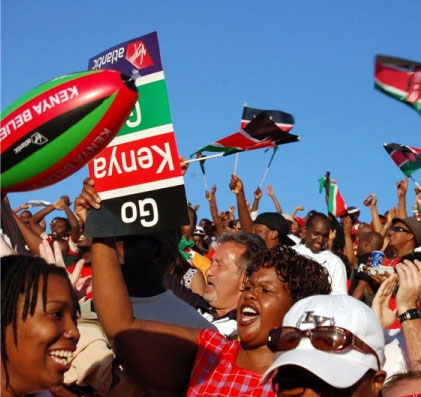

LAS VEGAS – Kenya advanced to the final four of this year’s USA Sevens but could not get to the final as they were stopped by a determined New Zealand after a 21-7 score. South Africa, the defending USA Sevens champions, could not repeat the feat this year, managing to only reach the quarter finals.
Kenya and South Africa were the only African teams participating. The USA Sevens was held last weekend in Las Vegas and is the largest rugby event in the United States. The tournament was the fourth stop of eh eight global tournaments that comprise the annual IRB Sevens World Series circuit. It brought sixteen of the world’s elite teams which played 44 matches in two days at the Sam Boyd stadium.
This was the first time Las Vegas hosted the seventh annual event. Previous tournaments have been held in Los Angeles and San Diego.
<object width=”425″ height=”344″><param name=”movie” value=”http://www.youtube-nocookie.com/v/HTBRojNpJJ0&hl=en_US&fs=1&rel=0″></param><param name=”allowFullScreen” value=”true”></param><param name=”allowscriptaccess” value=”always”></param><embed src=”http://www.youtube-nocookie.com/v/HTBRojNpJJ0&hl=en_US&fs=1&rel=0″ type=”application/x-shockwave-flash” allowscriptaccess=”always” allowfullscreen=”true” width=”425″ height=”344″></embed></object>
On Day 1 of the tournament, the South African team which was placed in Pool B, played against Canada, Fiji and the United States. The South African’s first game which was against Canada was impressively played, and especially more so, when Ryno Benjamin started things off right by scoring the first try which was closely followed by another try from Steven Hunt which culminated in a 31-0 win.
The Kenyan team was placed in Pool C against Samoa, Scotland and Chile. The first game got off to a rough start, but the “marked man” Collins Injera, who was easy to spot in his lime green cleats, set things right when he scored the first try in the first few minutes to the chanting frenzy of the Kenyan fans.
The game became a family affair when shortly thereafter, Humphrey Kayange scored another try after overcoming a challenging tussle with the Chileans. Kenya won that game 33-7.
The raucous travelling contingents of Kenyan fans lived up to expectations and were once again the loudest fans. They were easy to spot in their variations of Kenyan and Rugby jerseys.
The South African Coach, Paul Treu was cautious about his team’s performance against the Canadians, he stated that “the first game is always the most difficult, but I am pleased with the result.” His team’s strategy for playing the US team was focused, “on keeping the ball, learning from the previous game’s mistakes and working as a team especially since the pitch is of unusual width”. South Africa went on to beat the US 31-12, but failed to charm the Fiji team into giving up the game, and lost narrowly at 12-5.
The Kenyan games followed those of South Africa, which worked well for the latter as they were cheered on by the loud Kenyans.
Kenya outplayed Scotland beating them 17-0 but failed to go past the Samoans falling 19-7 to the tournament’s eventual winners.
On day 2 of the Tournament, the South Africans lost to New Zealand, by a score of 12-5 but came back strong against England with a 32-14 win and another brilliantly played game against Fiji in the Plate final for quarter final losers winning 12-7.
The Kenyan team’s fortunes seemed well on the right path in a thriller of a game against England that went to a sudden death extra time with Kenya winning 26-21 to advance to the semi-finals. With all their energies spent in the battle with England, the going got tough for the Kenyans in the semis and they fell to New Zealand team which won by a score of 21-7 to advance to the final against Samoa where they lost.
All teams fought hard for the Plate and Cup at all stages of the Tournament and gave the fans an amazing insight into the discipline and passion that it takes for the athletes to perform at such a high level on a traveling tournament such as this. Las Vegas was the fourth stop on the IRB Sevens World Series, and it is the largest annual Rugby event in North America.
Cheers to the best of the USA Sevens Rugby Cup winner, Samoa and to South Africa, the winner of the USA Sevens Rugby Plate.
ABC to Broadcast USA Sevens Special
ABC will on Saturday, February 20, air a one hour special of the USA Sevens rugby tournament at 5 PM (EST). Check your local listings.
“In addition to the dynamic tournament coverage of the most recent Olympic sport, we will also have the opportunity to introduce the USA team to America,” said Mark S. Reilly, of USA Sevens LLC and the executive producer. “Viewers, both rugby fans and those new to the game, will find their stories compelling.”


In the past eight years, U.S. trade with sub-Saharan Africa has more than doubled as Africans improve their lives and livelihoods while exporting an ever-expanding list of goods to the United States, says Deputy U.S. Trade Representative Demetrios Marantis.
“At the same time, American companies and workers have found new opportunities to do business in Africa — providing inputs and expertise to aspiring African entrepreneurs, participating in joint-venture partnerships, and increasing American exports and investments,” Marantis said in a February 16 speech at Makerere University in Kampala, Uganda. Makerere, Uganda’s largest and oldest university, was established in 1922 as a technical school and has gradually grown into a full university.
The United States has helped foster Africa’s expansive trading capacity through the 2000 African Growth and Opportunity Act (AGOA), Marantis added, noting that U.S. imports and exports from the 38 AGOA-eligible nations totaled $104.52 billion in 2008, a 28 percent increase from the previous year. Complete trade figures for 2009 are being compiled, but give an indication of another good year, according to the U.S. Commerce Department.
The trade growth is being driven by several key economic sectors, including machinery, automotive vehicles and parts, wheat, non-crude oil products, aircraft, and electrical machinery, which includes telecommunications equipment.
“Trade-capacity-building assistance is a critical element in the effort to help African countries turn trade opportunities like AGOA into exports,” Marantis said. “And the United States has worked hard to ensure that African nations have the resources they need to seize the benefits of trade.”
At the 2009 AGOA Forum in Nairobi, Secretary of State Hillary Rodham Clinton said that “as Africa’s largest trading partner, we are committed to trade policies that promote prosperity and stability,” and the United States wants to be Africa’s partner and not its patron. Africa accounts for 2 percent of global trade; an increase of 1 percentage point would generate substantial additional export revenues annually that would be greater than the annual amount of assistance that Africa receives.
Clinton added that AGOA implemented duty-free trade preferences for more than 6,000 African products.
AGOA, signed into law by then-President Bill Clinton in May 2000, is designed to expand U.S. trade and investment with sub-Saharan Africa, stimulate economic growth, promote trade and investment talks, encourage economic integration and help bring sub-Saharan Africa into the global economy. Currently 38 countries are participating in AGOA.
At the center of AGOA are substantial trade preferences that allow all marketable goods produced in AGOA countries to enter the U.S. market duty-free. The U.S. Congress requires the president to determine annually whether countries are eligible for AGOA benefits by meeting certain criteria, including progress toward the establishment of a market-based economy, rule of law, economic policies to reduce poverty, protection of internationally recognized worker rights and efforts to combat corruption.
Marantis said that in addition to improved trade and investment since the inception of AGOA, the United States has established four regional trade hubs in sub-Saharan Africa with the U.S. Agency for International Development (USAID).
“The nearest of these, in Nairobi, Kenya, serves all of East Africa, including Uganda,” Marantis said. “At that hub, Ugandans can receive AGOA-related training and technical assistance.”
“Trade support provided by the Nairobi hub is estimated this year to have produced well over $14 million in export sales for East African businesses,” he added.
But Marantis also added that despite the progress achieved in the eight years since AGOA was first enacted, Africa benefits too little from global trade. “Because Africa lacks capacity, global capital is still too timid about most countries in Africa, fearing instability and uncertainty,” he said.
Marantis said some progress in trade liberalization has been made by sub-Saharan African nations, but Africa’s overall trade policies remain the world’s most protectionist.
“Average African tariffs are nearly 20 percent. This is compared to just over 10 percent for the rest of the world, and 5 percent for industrialized countries,” Marantis said.
“Many African countries lack manufacturing capacity and face challenges such as high energy and transportation costs. This makes products less competitive in global markets,” he said.
To change this situation, Marantis said, African nations must continue to adopt broad economic and trade reforms to enhance their ability to attract foreign capital. “Success in this regard will address supply-side constraints, further integrate the region into the global economy, and pull millions out of poverty,” he said.
New challenges are rising as other nations, especially in Asia, are becoming more competitive in the global textile and apparel markets, he added, and with the expansion of bilateral free trade and economic partnership agreements. The situation calls for new trade policies, and Marantis said the United States is committed to that.
U.S.-AGOA TRADE
In 2008, U.S. imports from sub-Saharan Africa exceeded $86.05 billion, which was more than quadruple the amount in 2001. U.S. exports to sub-Saharan Africa more than doubled to $18.47 billion during this period.
In recent years, more than 98 percent of African exports to the United States entered duty-free.
The Commerce Department annual report also said that the top five African destinations for U.S. products were South Africa, Nigeria, Angola, Benin and Ghana. The leading nations for U.S. imports were Nigeria, Angola, the Republic of the Congo, Equatorial Guinea, Chad and Gabon.
Last week Arise magazine showcased three African designers at New York Fashion Week. The designers painted a confident and accomplished triptych of fashion from the continent.
In muted, powdery tones ranging from sand and putty to rose and aloe, Black Coffee’s autumn 2010 collection was inspired by the simple, structured lines of masks. The collection is a reinterpretation of African masks for a Cubist-like take on winter garments. The results are pleated and quilted, oversized silhouettes with strong, structured lines.
<object width=”460″ height=”295″><param name=”movie” value=”http://www.youtube-nocookie.com/v/VTeOnA1iqc8&hl=en_US&fs=1&rel=0″></param><param name=”allowFullScreen” value=”true”></param><param name=”allowscriptaccess” value=”always”></param><embed src=”http://www.youtube-nocookie.com/v/VTeOnA1iqc8&hl=en_US&fs=1&rel=0″ type=”application/x-shockwave-flash” allowscriptaccess=”always” allowfullscreen=”true” width=”460″ height=”295″></embed></object>
Loin Cloth & Ashes designer Anisa Mpungwe, from Tanzania, used a monochromatic palette of urban blacks and greys for garments that are youthful and easy to wear.
Nigerian Deola Sagoe was inspired by two seemingly incongruous sources, East African Maasai warriors and 18th-century European military uniforms.


A soaring talent is heading for New York Fashion Week, writes Andrea Nagel of South Africa’s Times Live
This year is big for Anisa Mpungwe, the creator of the clothing label Loin Cloth & Ashes, but then, she’s had a big year every year for the past three years.
In 2008, she won the Elle New Talent competition which attracts young design talent from around the country. Mapungwe’s fresh, unique and meticulously presented garments won her the coveted prize of “Young Designer of the Year”.
In April last year, she showed her second range at the Spring/Summer Sanlam SA Fashion Week.
The collection, titled “Metropolis”, depicted the challenges we face today as urbanites in a city imbued with many different cultures and traditions. The designs featured rigid, hard lines and stiff silhouettes, mixed with bright and warm hues.
In May last year, Mpungwe’s first range with Mr Price, part of the “Project” collection, was distributed in select stores nationwide and in August last year, she showed at Sweden Fashion Week.
The Loin Cloth & Ashes 2010 winter collection, titled “Midnight”, was launched in September last year at SA Sanlam Fashion Week and in December last year, Mapungwe was invited to show at Mozambique Fashion Week.
It was there that she worked with Jan Malan, who suggested to Nduka Obaigbena, the chairman and editor-in-chief of Arise Magazine, that the young up-and-coming designer be invited to show a collection at Mercedes Benz New York Fashion Week.
Mpungwe is one of three African designers, including Black Coffee and Nigerian designer Deola Sagoe, to be featured in the AriseMagazine Collective show that will take place this Saturday in the fashion capital.
Of showing her collection in New York, the young designer said: “I am completely blown away by this experience. My dream is about to come true and I feel that I must sit still and smile, because if I move one inch, the bubble just might burst.”
Mpungwe is showing a new collection on Saturday.
“I was so inspired to show my clothes in this amazing city that I completed the collection in one week.”
The theme of the collection is “Elsewhere” and the designer describes it as a wearable collection using a palette of earthy tones and metallic colours.
“I’ve used only fabric made in SA,” says Mpungwe, who was born in Tanzania, but moved to South Africa in 1994. “The silhouette of the collection is lean and symmetrical. I like form and order. I’m the kind of person that won’t stand on cracks in the sidewalk.”
Her designs for the New York show are mathematically draped and she says that much of her inspiration was taken from the Japanese art of origami.
“I’m so pleased with this collection,” she says. “I’ve done my own printing for the first time. I’ve designed origami birds with my logo on them that appear on the fabric.”
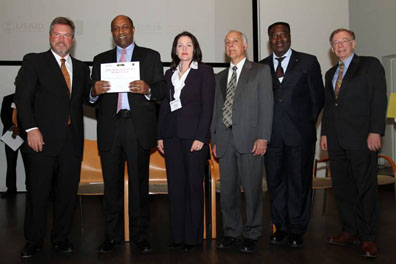

Receive $50,000 – $100,000 Matching Grants to Fund Business Plans
A commercial plant tissue culture business that uses biotechnology to increase yield and quality of produce for Ethiopian agriculture producers, to a franchise business model that will empower female nurse entrepreneurs to improve access to healthcare and reduce the burden on government hospitals in Ghana were recently awarded matching funds to fund their business plans by the African Diaspora Marketplace (ADM).
ADM is an initiative launched last year by Western Union and the United States Agency for International development (USAID).
The initiative, which included a research component, was designed to demonstrate the impact that entrepreneurs from the world’s Diaspora or migrant communities can have on development in their home countries.
The program which launched last summer involved African Diaspora members in the United States submitting comprehensive business plans that were evaluated based on “business idea and management framework, prospects for sustainability, capacity to leverage Diaspora resources, and results orientation”, according to Western Union.
733 business proposals were submitted with the panel whittling it down to 58 business plans.
The finalists pitched their business plans to the judges during a conference in Washington, DC to select the final fourteen that were awarded the matching grants. The winners were awarded grants ranging from $50,000 to $100,000.
Raymond Rugemalira of Crestline, California was one of the grant recipients. His winning business proposal was an SMS messaging system for buyers and sellers of crops and livestock in Kenya to increase their efficiency.
“I want to help improve the lives of small scale farmers by offering them markets via mobile phone technology so that they can concentrate on what they know best to do, which is to farm,” Rugemalira said at the ADM conference upon winning. “We will help get the buyer to come to them.”
The fourteen business plans that won the grants will be implemented in seven African countries including Ghana, Ethiopia, Kenya, Nigeria, Uganda, Liberia and Sierra Leone.
The competition rules required that the submitted proposals be on countries in Africa where USAID has both on-the-ground presence and potential technical assistance programs for entrepreneurs. Those countries are Angola, Burundi, Ethiopia, Ghana, Kenya, Liberia, Malawi, Mali, Mozambique, Namibia, Nigeria, Rwanda, Senegal, Sierra Leone, South Africa, Tanzania, Uganda, and Zambia.
Participants had to be members of the Sub-Saharan African Diaspora living in the United States as a US citizen or permanent resident and were required to have a local partner in the country of implementation.
Speaking at the ADM conference, Karen Turner, Director of USAID’s Office of Development Partners lauded the program as a demonstration of partnership and innovation bringing about ‘powerful solutions to development challenges”.
“ADM highlights not only the value of public-private partnership but also the contributions that U.S Diaspora communities can make. Today’s event also shows how widely the spirit of entrepreneurship and commitment to economic opportunity – central themes of the upcoming Presidential Summit on Entrepreneurship – are shared,” Turner said.
Western Union revealed that its participation in the program drew on its experience with the 4 + 1 public-private gift matching initiative in Mexico, which engages Mexican Hometown Associations in the U.S. to fund productive projects leading to sustainable job creation in Mexico.
“This is a rare public-private initiative that successfully harnessed the entrepreneurial spirit of U.S.-based African Diaspora members to address poverty through business innovation,” said Anne McCarthy, Executive Vice President of Corporate Affairs, Western Union.
The full list of awardees can be found here.
Part 2 of 2
Harassment Orders
“Harassment” means acts, words or gestures that the harasser uses that
get in the way of someone’s safety, security, or privacy. This can be
threatening to hurt the individual or their property, stalking or
following them, or repeatedly mailing or delivering objects to them.
A person who is being harassed can get a restraining order to prevent harassment in situations where they could not get an Order for Protection (OFP). For an OFP, the abuser must be family, a cohabitant or ex-cohabitant, a significant romantic partner or significant other. However, for a harassment order, the relationship between the harassed and the harasser does not matter. The harasser may be a stranger, a neighbor or a co-worker.
Getting a restraining order from harassment is like getting an OFP. The individual being harassed must first:
The hearing is like an OFP hearing. The Court order can:
There are several situations where victims of domestic violence or violence in general often refuse to report or help prosecute the perpetrators due to the fact that the victims do not have immigration status in the U.S. or have expired status. In such situations there are specific immigration laws designed to encourage victims of violence without status to come forward and report the crime.
U Visas
What is a U Visa?
The U visa is a special visa for victims of certain crimes, including crimes of domestic violence and sexual assault among others. The person must be the victim or “indirect victim” of the crime, cooperate with law enforcement in the investigation of the crime, and show that they have suffered on account of the crime. Some of the victim’s family members can be included in a U-visa application.
A U-visa application is not an application against the person who committed the crime. It is an application for the victim. There is strict confidentiality through the entire application for a U-visa. The application and documentation will not be revealed to the person who committed the crime, or to other individuals in the community. The person who committed the crime will not be interviewed about the applicant’s U visa case.
Victims of domestic violence who do not have legal status in the U.S. will be well advised to immediately contact an attorney with experience in family law and immigration law to determine if they qualify for U visa certification. As a general rule, immigration has not been deporting U visa applicants and there is a general waiver even for those victims who came in illegally or have an outstanding order of deportation. There are several issues to consider in such situations; again it is imperative to contact an attorney to talk with you in detail about this.
If a U-visa case is approved, immigration will grant U visa status to the victim applicant for four years. Approved applicants will have the right to apply for Lawful Permanent Residency (Green Card) three years from the date of the approval. Approved applicants need to be eligible for residency at that time. Contact an immigration lawyer for specific details about this.
The United States Citizenship and Immigration Services (USCIS) has published a list of crimes that qualify for U visa certification, they include but are not limited to:
Domestic Violence, Obstruction of Justice, Unlawful Criminal Restraint, Abusive Sexual Contact, Sexual Assault, Sexual Exploitation, Felonious Assault, False Imprisonment, FMG, Kidnapping, Perjury, Prostitution, Rape, Torture, Trafficking, Witness Tampering and Other related Crimes.
Call 911 if you have a domestic violence emergency. Consult an immigration/family lawyer or professional to determine if you are eligible for any of the reliefs listed in this article.
Nothing in this article should be taken as legal advice for an individual case or situation. The information is intended to be general and should not be relied upon for any specific situation. For legal advice, consult an attorney experienced in family/immigration law.