Home Blog Page 221

Thirty Hours That Destroyed Kenya

1

Kenyans for Peace with Truth and Justice have released the data, findings, analysis and verification of their legal working group, who have conducted an intensive investigation of electoral anomalies and malpractices that plunged Kenya into civil war.  The four documents comprise:

1) An analysis of the differences between the presidential and parliamentary vote in 2007, using the 2002 results as a benchmark.

2) An hour-by-hour log, compiled by Kenyan election observers, of the last phase of the presidential tallying. Their testimonies expose what can only be termed a resolve among electoral officials—including Commissioners and staff—to obtain a pre-determined outcome, whether supported by fact or not.

3) A table of these anomalies, malpractices and illegalities committed in at least 49 constituencies across the country.

4) A summary of the findings.

KPTJ is a civil society coalition of over 40 Kenyan legal, governance and human rights organizations, as well as concerned individual Kenyan citizens.

Read the full reports here.

Roll-out of Kenya Human Rights Violations

0

This Friday, in Nairobi, the Kenya National Commission for Human Rights will release its documentation to date of the human rights violations and breaches of international humanitarian law that have occurred in the post-election period.

When:          
Friday, 25th January, 2008 at 10.00 A.M

Where:       
KNCHR offices, 1st Floor, CVS Plaza, Lenana Rd, Nairobi.

Who:         
KNCHR Commissioners

KNCHR Secretary, Mburu Gitu           

Contacts:    
Linda Ochiel  
+254-722-583200
[email protected]

Victor Bwire
+254-722-318820
[email protected]   

www.knchr.org

Petition to pull Kenya back from the brink

0

Only dialogue and an independent election review will resolve the crisis. The world can play a crucial role: by reinforcing the efforts of mediators like Kofi Annan, and refusing to recognize any government not legitimately established. 50,000 of us have already sent this message to our foreign ministers, and almost all have listened so far. But inside Kenya, hardline leaders are sowing conflict and the country hangs in the balance.

President Kibaki and opposition leader Odinga need to hear that international legitimacy will only come after they engage honestly in mediation. To send this message, we are taking out a full page ad in The Daily Nation, an influential Kenyan newspaper. The ad will list the number of messages we have sent to our governments, the more the better — so  please, click here to see the ad and send your own message.

It’s not too late to help Kenya back from the brink!

Angelique Kidjo: An Amazing Entertainer

0

It’s a blistering cold Sunday evening in Minnesota, but within the lobby of the Ordway Centre for the Performing Arts in downtown St. Paul, there is a warmth flowing through the chatter and excitement amongst the hundreds waiting to get tickets to the Angelique Kidjo concert. I have never been to the Ordway before, though countless times I’ve dreamed of dressing up and joining the many who come for Operas and concerts. Now here I am, standing in this beautiful, red carpeted, high ceiling, brightly lit lobby, ticket in hand.

My friends and I walk up the spiral stairs to the mezzainine floor where we are ushered into the auditorium amidst loud applause for Angelique Kidjo. We get comfortable as she introduces her next song. Most of the songs will be from her new album ‘Djin Djin’, she says in a french-beninese accent. She signals and the drummer starts to play the drums. Angelique dances with vigor and life before she begins singing. Her beautiful voice resonates in the filled auditorium accompanied by the guitars and percussion instruments. Up on the balcony, there are fans dancing to the music and song, but none can match up to the rythmic movement of Angelique’s shoulders, torso, hips and legs as she dances from one end of the stage to the other. When the song comes to an end, there are screams, ululations as people applaud and cheer the perfromance. Song after song, Angelique is entertaining and captivating keeping with the momentum and high in energy. Between the perfrormances, she shares inspirational words on humanity, peace. love and she fondly speaks of Africa.     

Angelique Kidjo, began her music career at a very early age in Benin where she was born. Years later she relocated to Paris where her love and appreciation for music continued to grow and diverse. Through her music career, Angelique has released ten CD’s, she’s had numerous collaborations with various artists, has been nominated for four Grammys and won many International awards.

Angelique takes a break and leaves the stage to her band – the electric, acoustic, bass guitarists, percussionist and drummer – who individually perform to the excited auditorium. Back on stage, Angelique performs a couple more songs before she calls on her fans to join her in dance to her next song. Kids and grown-ups walk down the aisle to the stage and once the music begins, bodies are shaking, swaying, jumping and bumping happily together. The rest of us stand and dance by our seats as we clap along to the song. The whole auditorium is filled with so much cheer and joy, that once the concert comes to an end, everyone calls out for more. Angelique obliges her fans with one last song, then bows and exits the stage.

The concert comes to a complete end after she signs autographs and takes pictures in the lobby with her many fans. Angelique Kidjo was quite an entertaining performer, and for a first concert at the Ordway Centre for performing arts, there was no better way for me to do it.

Her new CD ‘Djin Djin’ which was released May last year, features artists like Josh Groban, Alicia Keys, Ziggy Marley, Amadou and Mariam amongst other artists.

Kenya: Kibaki, Odinga Defiant

3

Hopes raised by John Kufuor’s visit dwindle as the Ghanaian president and African Union boss leaves Kenya after a failed attempt to find a solution to the political gridlock.

MOMBASA, Kenya, Jan. 11 – “Nyeusi ya wananchi, Kijani ni ya ardhi, Nyekundu ni ya damu na Nyeupe ya amani. Ni hakika ya bendera, daima mimi mKenya….Mzalendo halisi…” (Black for the citizens, Green for our land, Red for the blood and White for peace. The purpose of our flag, Forever I am Kenyan….A patriotic citizen…)

These are the words of Eric Wainaina’s song “Kenya Only,” which reverberate across various homes, as Kenyans ethnic violence eats the country away.

Adopted as the unofficial song of mourning soon after the August 1998 terrorist bombing of the U.S. Embassy in Nairobi, Wainaina’s song, which many in Kenya now consider an alternative national anthem, is back on air. This time it’s calling for peace, after the ethnic clashes that erupted across the country in protest to President Mwai Kibaki’s supposed Dec. 27 vote rigging.

As I leave our house in the morning I encounter just outside our gate on a path that leads to Bangladesh, a sprawling slum in Kenya’s coastal city of Mombasa, lorries and truckloads of the dreaded paramilitary General Service Unit (GSU). They have in the past few days been restoring calm and imposing an unofficial curfew on paths leading from the informal settlement area into the middle class estates. Gunshots in the night have become the norm rather than the exception. In the evenings and nights the police have kept vigil and formed a man wall surrounding and ringing in the slum dwellers, who can’t leave their shanties to access medical care and emergency relief.

  Spent cartridges, wasted lives

As I stoop severally to pick up spent cartridges, I ask myself why Alfred Mutua, the government spokesman, has reiterated time and again that the police are not using live bullets. The reports released by the government showing that only ten people have died in Mombasa due to the skirmishes is amazingly low, given that every night for the past two weeks one or more persons has been shot dead in our neighborhood.

Mutua fiddles while Kenya burns terming what was happening as “isolated” cases of violence. Around the county, things are not different. There are aerial views being broadcasted of burnt homesteads from Mt. Elgon, Eldoret, Kericho, Kisumu, Nairobi and Mombasa. More than 500 people have died and an estimated 250,000 Kenyans displaced. Thousands more continue to flee as refugees into Uganda.

I fear for my daughter and other children who play outside and we can’t wait for them to go to school on Monday, already a week late.

My neighborhood Mikindani situated in Mombasa West is a shell of its former glory.

Supermarkets were looted, completely destroyed as marauding youths broke down concrete walls and iron burglar proof grills, stole electronics some of which were fixtures and selectively torched shops known to belong to Kikuyus and Merus, the two ethnic groups deemed to have voted enmasse for Kibaki.

We were virtually under House Arrest for all of two weeks – woe to people who had not stocked the refrigerators and pantries!

Many neighborhoods have been affected by the skirmishes and looting, which have left residents without food. Those who are able to make it to corner markets and supermarkets find prices up one 100 percent.  The tourism sector, which has been an integral part of Mombasa’s economy continues to decline, as tourists vacate beach hotels enmasse due to the negative travel advisories given out by their countries and consuls.

The calm that was slowly returning to the coastal area following reports that African Union Chairman and Ghanaian President John Kufuor had arrived in the country to mediate talks between Kibaki and opposition leader, Raila Amolo Odinga, appears to be in jeopardy after Kufuor’s efforts failed.

Several Mombasa residents I have talked to believe Kibaki acted in bad faith by naming half of his cabinet when President Kufuor had just arrived for mediation talks.

It is believed that the majority who voted for Odinga are the poor and low-income earners who are not feeling the effect of the more than 6 percent economic growth that the Kibaki government is flaunting.

The masses’ salaries have been near stagnant for the past five years and 50 percent if the county is still jobless.

Yet the prices of basic commodities have shot up. For example, between August and November 2007, the price of a dozen eggs shot up to 100 shillings (about $1.50), an increment 66 percent. There were also tremendous increases in the prices of wheat flour, bread and maize, Kenya’s staple.

Curses, black magic, poison

On lighter note, looting seems to have declined. Looters in Kisauni and Mwandoni in the northern coast of Mombasa returned property after one businessman engaged a Muslim elder to invoke an Islamic prayer called Al Badiri. The prayer is said to be invoked by people who were wronged in order to seek justice from God. It is one of the most feared curses here in Mombasa, for it is believed to bring calamities to those it is directed at. 

Fears of bewitchment have also helped reduce looting. Among Kenyan cities, Mombasa is often rumored to be a city of black magic. There has been gossip about business owners summoning the powers of magicians to help return their looted goods. The most intriguing tale was of a man who carried a large flat screen on his back, but couldn’t unload it because it got stuck to his body. Not even family members could take the TV off his back, the tale goes. The man roamed around with the TV for days like a mad person, sleeping at night while standing, and he eventually keeled over and died.

Local many residents believe that such prayers and curses, already resorted to by many others, actually do work. The fears of severe consequences, including in ability to pass urine and have bowel movements, have prompted many looters to return goods to original owners.

No end in sight

It doesn’t seem to help matters that as I file this article several dailies are reporting that Electoral Commission Chair Samuel Kivuitu disowned the elections results that declared Kibaki the winner.

As I write this, primetime news reports indicate that the opposition, Orange Democratic Movement, have promised a showdown in Parliament, come Tuesday, when the August House officially opens. Because they claim that ODM is the legal government, they have said they are going to sit on the right-hand side of the National Assembly Speaker, the area normally reserved for the government.

Odinga has also said that the opposition rally postponed last week will back on at Uhuru Wednesday.

In the run-up campaigns of the just concluded elections, the slogan and rallying call of Kibaki’s Party of National Unity was, “Kazi Iendelee” (Let the work continue), and ODM’s was, “Pamoja Tusonge Mbele” (Together, let us move forward). Clearly, their mottos have both come to naught, as Kenya has been set back economically, just like it happened during the 1992 Molo ethnic clashes, and the 1997 Likoni upheaval.

LUCKY’S CELEBRATION AT THE ZUHRAH SHRINE EVENT CENTER.

0

Doors opened at 8:00pm and people started streaming in. I was excited and quite surprised that I was not at all nervous about hosting the tribute concert to Lucky Dube. The auditorium was well lit, decorated to a calm perfection with a spacious dance floor and stage. On one corner was a huge projector with music videos by Lucky Dube as well as short clips of interviews he carried out during the early years of his career.
The event began with a prayer by Reverand G. Freeman, then an introduction of the event by me, the host of the evening. The night celebration began with the house band, Cross Atlantic Crew, an all Liberian Afro Centric/Reggae band, that perfrormed a series of upbeat songs from their collection to get the crowd livened up. Jarija Afro Reggae band was up next, but not before we gave away a couple of Lucky Dube t-shirts that were a part of an on-going raffle through the night.

Present at the dedication concert was OLM president Mr. Kerper Dwanyen, who gave a short speech before artist Isaac Randolph with a trio of his dancers, took to the floor and entertained the crowd with Rap music and dance. After a short intermission where the DJ, Joseph Seibure, played some Reggae music, Innocent, a Reggae artist originally from Tanzania took to the stage. His energy and popular Lucky Dube music got the crowd jumping up and down on the floor. There was singing, dance, laughter, food and plenty to drink as everyone celebrated the life and music of Lucky Dube. SUNplugg’d was the last band to perform at the end of the night before the house band took over to close out the celebrations.


Change or Perish, Anti-AIDS Activist Tells Africans

BROOKLYN PARK, Minn. – Africans must break their silence and stop treating sexual education as a forbidden subject, if they want to survive HIV/AIDS, an epidemic that is increasingly threatening to destroy the “beauty of Africa,” a renowned Zambian activist, Princess Kasune Zulu, said.

“My brothers and sisters, taboos are killing us,” Zulu said. “Enough is enough. Until we accept that HIV and AIDS exist among us, we are fighting a losing battle.”

Zulu, who has been living with HIV for 10 years, spoke at North View Junior High School in Brooklyn Park, where dozens of African immigrants, health providers and anti-HIV/AIDS advocates gathered on Dec. 15 to observe African World AIDS Day. Zulu expressed concerns that – 25 years after HIV/AIDS became known – many Africans still saw the disease as taboo, a factor she said has contributed to the rampant spread of the epidemic.

“We need to do a better job,” Zulu, 31, said. “We need to break the silence, the discrimination and the stigma, the shame that is attached to HIV-positive people.”

Although only 11 percent of the world population lives in sub-Saharan Africa, 68 percent of the 33.2 million people infected with HIV worldwide live in the region, according to the 2007 UNAIDS report. There were approximately 1.7 new infections in the region last year, bringing the total population of HIV-positive people to 22.5 million.

Last year, 76 percent of all AIDS-related deaths occurred in sub-Saharan Africa. Southern Africa was the worst-affected area, with national HIV prevalence rates exceeding 15 percent in eight countries. Unlike other regions, most of the people living with HIV in sub-Saharan Africa are women, who account for 61 percent of all cases.

Zulu said that although money was important in caring for those infected, behavioral change was the single most important factor that could prevent new infections and eventually bring the disease to a manageable level.

“It doesn’t take money all the time to do something,” she said. “It’s our behaviors. It’s us saying no to the things that are killing us. We are a people who are strong and we need to show, even in HIV/AIDS, that we have come this far. Ignorance was one thing, now we know too much to remain silent. Until we accept our responsibility, nothing is going to change – not even the funds we’re being given by [President] Bush.”

And Zulu had evidence to prove that indeed one can do a lot without a single cent: Her own story. She was just a 14-year-old girl when she became the head of the household after losing her parents to AIDS. At 18, she married a man 25 years her senior, who she thought was going to help her out of her suffering.

“I was put in a situation where I had to get married at the age of 18,” she said. “Of course a boy my age couldn’t give me everything I needed. But little did I know that I was putting myself in the dangers of the commonly infected.”

In 1997, Zulu was diagnosed with HIV and immediately wanted to speak publicly about her status, although her husband did not approve. Soon afterwards, she was invited to a radio show to tell her story. That was the beginning of what she called, “A calling from God.” Her appearance earned her “Positive Living,” her radio show devoted to HIV/AIDS education, which she still hosts. A few weeks later, the U.S. Embassy in Zambia honored her for excellence in HIV/AIDS broadcasting.

Zulu is also famous in Zambia for posing as a hitchhiker to educate motorists who pick her up about HIV/AIDS.

“As crazy as that sounds, I thought if I could speak just to one truck driver, his wife and children would be protected,” she said.

Zulu took more responsibilities when World Vision, a U.S.-based international Christian charitable organization, asked her to represent it in her home country. But Zulu said that although she is a Christian, she joined World Vision because of the need she saw in the fight against HIV/AIDS.

“HIV and AIDS have thrown us the reality of life, the reality of sex and the reality of death, and there is no religion that can claim that it has been left untouched,” she said.

Going international has helped Zulu’s campaign against the epidemic and her advocacy for the disease’s most vulnerable victims: women, children and the poor. She has met with several world leaders including President Bush and former British Prime Minister Tony Blair to seek their commitment to tackling the AIDS epidemic.

Her own suffering as a teenager caring for her ailing parents, and later orphaned siblings, is without doubt what inspired her into action. That is the role she would like to see other HIV-positive people take, which she said would prevent new infections. But having such people come forward requires a society that understands the disease, Zulu said.

“It takes a certain kind courage to be able to say, ‘Look, I have this disease that is attached to something we do but don’t want to talk about: Sex,’” she said.

Zulu urged Africans to realize that their existence was in danger and put aside debates of whether AIDS was the consequence of irresponsible sexual practices. Considering the scope of the problem, such debates were immaterial, she said.

“If there is a fire in the room, what do you do?” she asked. “You gather everything you have got to put it out, and then you try to find out later how it started. If a snake enters the house, you kill it. You don’t ask where it entered from first. That’s exactly what we need to do with AIDS.”

Zulu called on her audience to take advantage of the free HIV testing that various health care providers offered onsite. She also asked parents to discuss sex and AIDS with their children to make sure they have the knowledge they need to stay safe, and to act as good examples to their children, because just talking won’t be enough.

“How many men will say, ‘Enough is enough. A real African man is going to stick to his only wife?’” she asked, as the men in the audience raised their hands, and the women screamed and applauded them. “But we also need women who are going to say no to married men.”

Minnesota Women Advocates Important Nationally, Says Calif. Congresswoman

0
Minnesota Women Advocates Important Nationally, Says Calif. Congresswoman

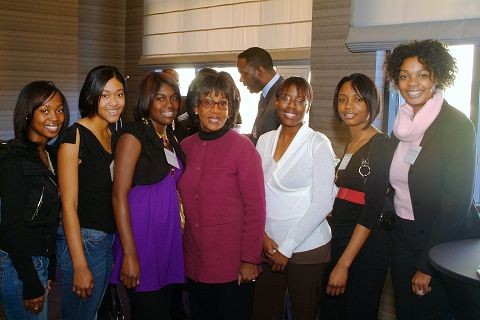
MINNEAPOLIS- Historically, Minnesota has been at the forefront of the women’s movement. With the endorsement of Sen. Hillary Clinton for the Office of the President of US, the Minnesota Women’s Political Caucus continues to support progressive women in office.

Although Maxine Waters represents a Californian district in Congress, she attributes her political success to women both in her district and in many other parts of the country including Minnesota.

“I was the underdog without the support of the political establishment and with no budget for a campaign,” she said. “I got support from women.”    

Congresswoman Waters was speaking at the 29th annual luncheon of the Minneapolis Women’s Political Caucus, where she gave the keynote address.

There is progress but …
With about 90 women in Congress, Waters asked women to continue running for public office.

“Women pay attention to not only women’s issues, but are involved in all areas of public policy,” she said.

She argued that having more women engaged in matters of public policy would improve not only the rights of women and children, but also general policies.

In response to a question from the audience about income disparities between genders, Waters advised women to get more involved and participate in board decision making, teach young women their worth and educate women on compensation and job numeration.

Studies show, that across the board, women still earn less than men, about 77 cents on every dollar.

“Do not support women who demonstrate that they do not care as they do not advance the women’s cause,” she said, in reference to actions and comments made by conservative public commentator Ann Coulter.

In a couple of interviews Coulter has said that because women, mostly single women, are liberal, their right to vote should be taken away to allow for only Republican administrations.

In an apparent continuation of her dissent in Congress against the war in Iraq, Waters said, “Not another nickel! Not another dime! Not another soldier! It is unpatriotic and un-American to allow a senseless war.”

Other speakers included the president of the National Women’s Political Caucus, Lulu Flores, who congratulated MWPC for being one of the most active women’s political caucus in the country.

“In endorsing Senator Hillary Clinton we are encouraged that she will overcome the final barrier for women in this country.”

Over the last year, MWPC has been working towards increasing the participation of women of color in public office. As part of this initiative, MWPC has launched its Diversity Outreach Project. See Mshale report here.

Who Said You Have to be African to Sing African?

0
Who Said You Have to be African to Sing African?

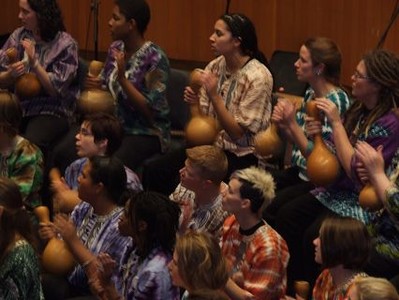
ST. PAUL, Minn. – With European names like Macpherson, McCurdy, Crockett, and Sollenberger, one might think resulting music would include an accordion or bagpipe. But the fall concert held at the Janet Wallace Fine Arts Center of Macalester College in St. Paul on Dec. 8, presented African sounds, lead by Sowah Mensah, ethnomusicologist, composer, and master drummer from Ghana. 

The 55-voiced combined African Music ensembles from Macalester College and the University of St. Thomas used a wide variety of authentic drums and gyil (xylophones) to entertain a crowd of over 200 people.  The 90-minute show performed traditional music from Africa, including Ghana and Zimbabwe.

The ensemble, dressed in the colorful garb of traditional African dress, often seemed to take their cue from either their director Mensah or his college-aged son and ensemble participant, Nii Adjetey Mensah. 

In fact, the ensemble resembled a highly skilled high school choir throughout much of their performance.  Maybe my expectations were too high, they aren’t the Soweto Gospel choir, after all.  But seeing a few members standing vacantly, their hands stuffed in their pockets as they sang, distracted me from the aural experience. 

Often, when the occasional solo voice sang out, I wanted to hear the raw power and muscle I associate with the African voice.  Sometimes I did, but not consistently.  I felt they needed to go deeper into the music and completely surrender to the rhythms and atonal harmonies of African sound. 

Beyond the vocal aspect, they also played instruments. This elevated the musical acumen as well as added to the visual enjoyment of the show. In addition to the common congo drums and gyil, they used the tamani, also known as a talking drum, squeezed under the arm pit, atenteben (flutes), bells, rattles, mbiras, marimbas, horns, and gourds. 

The percussive elements gave attending students enough rhythms to dance in the balconies and on the main floor.  The elder Mensah joked that the dancing students, who were also pupils in his class, would receive credit for their participation.

Sowah Mensah maintains his position as director not only at Macalester and St. Thomas, but also the University of Minnesota.  He directs Sankofa, a Ghanaian folklore and dance ensemble in the Twin Cities and makes up one-fourth of the group Speaking in Tongues, based in the Metro area that includes two percussionists, a bassist, and a Chinese pipa player.  Follow this link for more information.

Coming in mid-February, 2008 will be a small group from Ghana to perform with the African Music ensemble at Macalester College.

Minn. Department of Health to Fund HIV/AIDS Education

0
Minn. Department of Health to Fund HIV/AIDS Education

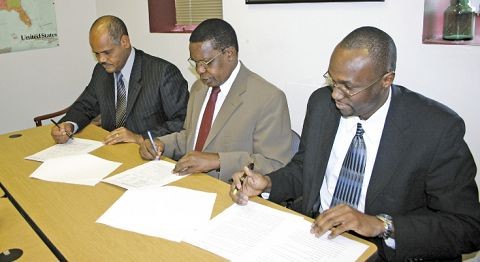
The Minnesota Department of Health will spend $250,000 over the next 21 months to fund public health nonprofit organizations dedicated to HIV/AIDS testing, care and education, an official said.

The Minnesota Department of Health will spend $250,000 over the next 21 months to fund public health nonprofit organizations dedicated to HIV/AIDS testing, care and education, an official said.

Japhet M. Nyakundi, a program specialist in the Infectious Disease Epidemiology, Prevention and Control Division, said three of the 13 that applied for grants will receive money.

“We want people to get tested to know their HIV status and get into care if they test positive,” Nyakundi said.

One of the organizations to be funded is Sub-Saharan African Youth & Family Services in Minnesota. Upon receiving the grant, SAYFSM Executive Director Ephraim Olani said part of the money would be spent on African community media like Mshale, The Warsun Times, Somali TV and Mestawet.

Olani said the grant would enable SAYFSM to continue offering free HIV tests to the community.

Minnesota Muslims Mark Eid-el-hajj With Prayers

0
Minnesota Muslims Mark Eid-el-hajj With Prayers

The Islamic holiday celebrates Prophet Abraham’s faith and his obeying of Allah’s command to sacrifice his only son.

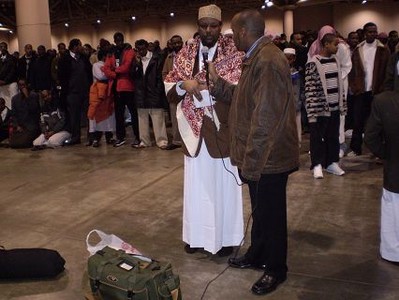
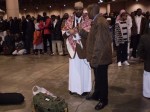
MINNEAPOLIS – Minnesota Muslims took part in early morning congregational prayers on Dec. 19 to celebrate Eid-el-hajj, which takes place in Islamic communities on the 10th day of Dhul-Hijjah, the last month of the Islamic calendar.

It is otherwise referred to as Eid-ul-Adha (celebration of sacrifice) as it has its origins on the act of Prophet Abraham obeying God’s command to sacrifice his son Ismail. When Abraham had shown all intentions of doing so, God in his infinite mercy provided a lamb as sacrifice thus saving Ismail’s life.

The Eid-el-hajj occasion this year saw over two million Muslims from all over the world making the journey to Mecca and Medina in Saudi Arabia to perform religious rituals pertaining to pilgrimage, and those who did not make it congregated in large assemblies to perform the Eid prayers. It is a celebration that involves the slaughter of an animal for every Muslim family to share the meat with neighbors, the needy and family members.

The largest single congregation of Muslims in Minnesota took place at the Minneapolis Convention Center, where Sheikh Abdulrahman Omar, Imam of the Abubakar Saddique Islamic Center, appealed to all Muslims to reflect the Hajj spirit of brotherhood, fraternity, love and service to humanity.

Hajj is the “climax of the individual’s spiritual life centered on the unity of the Muslim umma (world) as one body based on a brotherhood in the faith that transcends narrow considerations of race, nationality, color and ethnicity,” he said.

The Imam men to strive to be good husbands and fathers to their wives and children and women should strive to be good wives to their husbands and good mothers to their children through teaching them piety and worship of Allah. He called upon Muslims to support the efforts of the Abubakar Islamic Center in propagating the teachings of Islam and building capacity through payment of zakkat (Islamic tax) and charity to enable the Muslims to help those in need.

The Hajj (pilgrimage) is the Fifth Pillar of Islam that required all physically fit Muslims and blessed with finances to make the trip to Mecca and other Islamic holy shrines in Saudi Arabia at least once in a lifetime.

Muslims all over the world, clad in their most attractive attire, join those who have made it to Mecca in festivities and celebrations thanking Allah for all blessings received. They do so by visiting friends and family, the sick, praying for the departed loved-ones, and by offering meat portions to the needy along with other gifts.

When Muslims slaughter animals in the name of God during this “celebration of sacrifice”, the Qur’an warns against false beliefs that God is in need of the meat and blood of the slaughtered animals. In Chapter Hajj 22:37 God clarifies the purpose of sacrifice in the following words: “It is neither their meat nor their blood that reaches Allah, but it is piety (taqwaa) from you that reaches Him.”