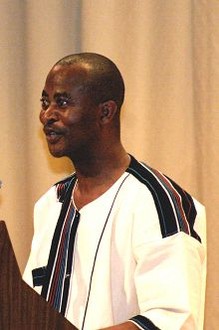
The Sunday before he died, Mzee Stanley Kamana invited me to his home in the Tandika district of Dar-es-Salaam. It was like old times. We sat on his back stoop and talked about the usual everything: Tanzanian elections, media gossip, Bongoland gangsters, Swahili poets, spiritual quests, what have you. The talk continued as we ate ugali, spinach, beans, and,
Stanley
’s favorite, kiti moto, Tanzanian Swahili slang for the taboo swine meat.
A veteran editor and journalist, Mzee Stanley had the gift of gab, both in the editorial pages and in person, and his stories and joking rarely ceased. Just before I left that night, he gave me a bit of advice I will never forget, thereafter walking me to the bus stop where we exchanged our farewells.
Five days later, I received word that
Stanley
had passed away. His time was finally up. For years, he had suffered from high blood pressure and heart problems. The news still came as a shock, though, as I had just seen him so full of life. I would have never learned the ropes of life in without
Stanley
. We met when I first step foot in Dar-es-Salaam four years ago as a scholar of the East African press, and we worked together at the media conglomerate, Habari Corporation.
No doubt,
Stanley
was a newspaperman of the old school. He had an exceptional command of the English language, a sharp intellect, and a cutting sense of humor. Even through his thick mustache and gruff voice, he could always put on the charm.
His start in the news business came in 1969, when he joined the government-owned daily, the Tanganyika Standard (now the Daily News), later working for several government publications alongside the likes Benjamin Mkapa and other future stalwarts. Over his 36-year-career, he moved through countless news outfits as an editor and writer, and he even started his own private newspaper when the private press in didn’t exist.
Like many such veterans, he was no stranger to the many jaded ways of the pressroom. He also fought his bouts with drinking, smoking, and gambling, finally defeating them all late in life although not before they had taken their toll. His inexplicable joy and humor, however, always pushed their way through his pain.
One of his dear friends and colleagues, James Shani Mpinga, stood by
Stanley
at his deathbed. In an obituary for the Dar-based daily, the Citizen, he wrote: “Minutes before [
Stanley
] died, he seemed to be communicating with his creator directly: ‘Jesus, my time has come…. Halleluya, Halleluya, Halleluya!’”
More than 300 people showed up to pay their respects at his funeral, from the expected next president, Jakaya Kikwete, to scores of journalists, relatives, and everyday people. There is nothing quite like a msiba (funeral), its gravity and spiritual magnitude, especially in
East Africa
with rituals, songs, and orations seemingly never ending. I would rather be late for my own wedding than miss a msiba for a dear friend.
For
Stanley
’s last rites, we didn’t reach the cemetery until late afternoon. It was there that, beside the sorrow of
Stanley
’s family and friends, a mystifying sense of peace came over me. Unlike some of his contemporaries, who went on to become major media owners and even presidents, Stanley lived in national housing until the day he died, making just enough in his string of media jobs to get by and to put his children through school. Bygones be bygones. In the end, he still beamed with that joy and faith that his rough old spirit would live on.
Hallelujah, Mzee. Hallelujah.
The writer is a Twin Cities resident currently visiting
East Africa
on a cultural exchange program. He will share his perspective and observations while there in this column which will appear in Mshale through early 2006 when he returns to the
. You can reach him at [email protected].
Tivo ToGo: Tivo Expands to Hottest Handheld Devices
TiVo Inc. is expanding its video recording service- the latest move targeted at putting TV in people’s hands for viewing anywhere. For those of you who love recording your favorite TV shows, TiVo ToGo is a service which allows you to load television recordings from your stand alone Tivo device to another portable device such as a PSP (Play Station Portable) or an iPod or a windows based handheld device such as a pocket PC. Even though the beta version is out, TiVo expects to officially launch this new idea to TiVo Series 2 subscribers next year.
Why iPods, PSPs or Pocket PCs?
With the addition of the MPEG-4 video format, TiVo hopes to maximize this new found technology on the popularity of iPods, PSPs and pocket PCs which are among the hottest handheld gadgets with video capabilities.
What are the Requirements?
– A networked TiVo
– TiVo ToGo 2.1 or better
– Windows 2000 or XP
– At least 10 GB of available hard disk space
– Portable video player such as Sony PSP or a video capable iPod
– Video encoded software to automatically transfer, convert and store programs
What does this entail?
Many consumers like yourselves are probably trying to conceive the possibility of syncing TiVo shows with your portable video devices, but you need not worry because TiVo will now do the video format conversions that people would rather not deal with in the background. Of course you have to be a TiVo ToGo subscriber, which is currently free for subscribers, to benefit from this hot technology. In addition, it will also require video encoded software provided by TiVo at a low cost and a DVR box (which you buy in order to record your TV programs with TiVo). This advanced TiVo ToGo will enable users for the first time to automatically extract new recordings of their favorite programs to portable gadgets via their PC.
Please do not expect instant results. The transfer process begins with the TiVo Series2 device to the PC which can then be synced to your portable device via the PC and this should not be more than 10 minutes.
Does this benefit people who travel to or people who live in Africa?
You will be able transfer all your favorite programs to from your PC to your handheld device for viewing later and anywhere in the world.TiVo ToGo subscription is definitely a must.
TiVo ToGo to handheld devices is a new technology that would be beneficial to everyone who needs to keep track of their favorite programs i.e. football games soaps etc regardless of geography. Can you imagine TV togo, who wouldn’t want that?
In anticipation of the holiday travel season, U.S. Citizenship and Immigration Services (USCIS) urges individuals with an application for adjustment of status to that of lawful permanent resident, or an asylum application to consult with an immigration attorney before making any foreign travel plans.
These foreign nationals must obtain advance parole before traveling abroad by filing Form I-131, Application for Travel Document, with USCIS. However, travel outside of the may have severe consequences for certain aliens who are in the process of adjusting their status.
Foreign nationals who depart the after being unlawfully present in the for certain periods may be barred from admission to lawful permanent resident status even if they have obtained advance parole. Those aliens who have been unlawfully present in the for more than 180 days but less than one year are inadmissible for three years; those who have been unlawfully present for a year or more are inadmissible for 10 years. Foreign nationals who are unlawfully present, who depart the , and who subsequently reenter under a grant of parole may nevertheless be ineligible to adjust their status.
Advance parole is permission for certain foreigners who do not have a valid immigrant visa to reenter the after traveling abroad. Such people must be approved for advance parole before traveling abroad; they may not be permitted to reenter if they have not obtained it before leaving the U.S. Foreign nationals who need advance parole before leaving the U.S. to enable them to return include aliens in the U.S. who have an application pending for adjustment of status, have been admitted as a refugee or have been granted asylum, have been granted temporary protected status, or have a pending asylum application.
In a similar announcement made earlier this year, USCIS pointed out that processing times vary from 60 to 150 days, necessitating advance planning for applicants who will be traveling abroad.
Number of Refugee Admissions
President Bush issued a determination on October 24, 2005, announcing the Fiscal Year (FY) 2006 refugee admissions numbers and authorizations of in-country refugee status. A total of 70,000 refugee admissions numbers will be allocated as follows: Africa: 20,000; East Asia: 15,000; Europe and Central Asia: 15,000; Latin America/Caribbean: 5,000; Near East/
South Asia : 5,000; and 10,000 unallocated numbers, which will be allocated to regional ceilings as needed. Additionally, the Secretary of State is authorized to transfer unused numbers originally allocated to a particular region to one or more other regions in the event that there is a greater need. President Bush also specified that, for FY 2006, persons in , , and the former Soviet Union may, if otherwise qualified, be considered refugees for the purpose of admission to the within their countries of nationality or habitual residence. Also included in this category in exceptional circumstances are certain persons identified by a embassy.
Sanctions Against Sudan
Continue
On November 1, 2005, President George W. Bush signed a notice continuing the national emergency with respect to , which was signed by President Clinton on November 3, 1997. The 1997 order imposes sanctions on in response to the policies and actions of the Sudanese government, including support of international terrorism and human rights violations, such as slavery. President Bush continued the national emergency and the measures adopted on November 3, 1997, to deal with that emergency for one more year through November 3, 2006. In doing so, President Bush stated that the actions and policies of the Sudanese government continue to pose an unusual and extraordinary threat to the national security and foreign policy of the
Please note that nothing on this page should be taken as legal advice for any individual case or situation. The information is intended to be general and should not be relied upon for any specific situation. For legal advice, consult an attorney experienced in immigration law.
Monica Pitta is the chairperson of the Minnesota 2005 African World’s AIDS Day (AWAD). This year’s event will take place at the
Sabathani
Community Center
in
Minneapolis
on 10 December (See calendar on Page 3 for time and address). To find out what will transpire on the said date, Mshale Senior Staff Writer, Swallehe Msuya, interviewed Monica who discusses a number of issues related to HIV-AIDS education and eradication.
Can you brief our readers what AWAD is and when it came into being?
The African Worlds AIDS Day (AWAD) is a commemorative day set apart for the observance of the World AIDS Day for African-born people living in
Minnesota
. This event unites African communities, Community Based Organizations and agencies serving African people in MN to fight HIV/AIDS. In 2004, Africa-born
Minnesota
residents representing several African nations were enjoined in a unified commemoration to call attention to the impact HIV and AIDS has had on Africans here and in their respective countries
According to the Minnesota Department of Health, HIV continues to be a problem among Africa-born persons in
Minnesota
, who made up 19 percent of new HIV diagnoses during 2004, but represented less than 1 percent of the general population. This group is particularly vulnerable because they have not been exposed to 20 years of HIV education and prevention messages that the general population has.
Briefly explain the objectives of AWAD.
The objectives of AWAD are to:
Increase knowledge on HIV services available in MN.
Reduce HIV related stigma and discrimination.
Provide HIV prevention education.
Encourage and provide HIV testing, counseling and referrals.
What is the date, time and venue of the 2005 AWAD?
The AWAD event for 2005 will take place at the
Sabathani
Community Center
on December 10, 2005 as from 11.00 a.m. to 4.00 p.m. The address is
310 East 38th Street, Minneapolis, MN
55409
For direction call 612-827-5981. Plan to arrive early, the event will start on time.
Who are the key participants in the 2005 AWAD?
This year the planning process has brought together 35 African and non-African Community Based Organizations serving diverse African communities, three governmental units, one academic institution, several faith-based institutions, and individual volunteers. In addition, the event is expected to bring together more than 500 African and non-African people to reflect on the current realities of HIV/AIDS.
The event is free and open to all Africans living in MN, and to the general public, we welcome all.
How will this year’s event differ from last year’s?
MP: The theme of this year’s event “STOP AIDS. KEEP THE PROMISE” was created to emphasize and build upon the key factors that were addressed in the previous year. This is mainly because of the disease prevalence among the African-born communities and the existing stigma that is associated with AIDS.
What is the theme of this year’s event?
The theme of this year’s event is “STOP AIDS. KEEP THE PROMISE”. The AWAD is a united effort to bring togetherAfrican people living in
Minnesota
, in the support andcompany of their providers and friends to reflect on the current realities of HIV/AIDS, increase knowledge on services, eliminate stigma and have a fun day together in the African style.
It’s aimed at encouraging African people in
Minnesota
to step out, dispel fear of talking about HIV and take responsibility for themselves and their community.
What achievements did we gain and what lessons did we learn from last year’s AWAD event?
Last year’s event was successful. It was the first event of it’s kind that brought together more than 400 African-born people for the purpose of increasing awareness on HIV/AIDS, reducing stigma and discrimination, providing prevention education, and connecting those already affected to existing care services. It was also marked by two African heroes living with HIV/ AIDS step out despite the stigma to tell their story. This was done in a culturally appropriate and relevant manner, and the participants appreciated the presentations and exhibits made available on site. Later effect were more African communities opening up to welcome HIV/AIDS education in their social gathering. Two more people living with HIV gained the courage to speak out.
What do you hope to achieve by hosting this AWAD event this year?
Unity is strength. The African proverb says “when spider web unite, it can tie up a lion”. We hope to unite all concerned about the increase of HIV in the African born community in MN in the fight against HIV.We hope that African people in Minnesota will begin to see HIV as any chronic disease which is among them, open up to speak about it, learn how to prevent getting the infection, not fear or blame those who are living with the disease, accept and support people living with HIV/AIDS. We also hope to increase the knowledge on HIV services available. We hope the audience will learn why it is good to know ones HIV status early and those who want to be tested or connected to services will have the opportunity on spot.
The sessions will be seek to encourage behavior change and modification, promote the need for HIV testing, in addition to highlighting the services available to those already infected.
Are members of the general public invited to attend? What should they expect to see or gain by attending?
It is open invitation to all members of the general public. It is a free event, free food, African entertainment like dance, drama, music, table display, HIV testing, latest HIV/AIDS information, information on type of services for HIV+ people etc.
Those who attend, other than the information they will gain, they will have afree fun day
Who are the organizers of AWAD and who are the sponsors this year?
The organizers (see the footnote of the attached invitation letter) are composed of members from 35 African and non-African Community Based Organizations serving diverse African communities, three governmental units, one academic institution, several faith-based institutions, and individual volunteers.-They include:
How widespread is HIV-AIDS among African immigrants in
Minnesota
? Is the situation getting better or worse over the years? Why?
Whereas the African community is less than 1% of the population of
Minnesota
, the Minnesota Department of Health (MDH ) has noted an increase in the proportion of new cases of HIV among African immigrants from 4% in 1996 to 59% in 2004. For the last 3 years, new HIV infections continue to be highest in the African born people. African community members are still being diagnosed with advance disease (AIDS) mainly because they seek treatment late due to socio-economic implications, language barriers, and fear of and isolation and discrimination.
HIV-positive people who are African immigrants in
Minnesota
have serious issues with stigma associated with AIDS within their communities, immigration with its complicated navigational route, housing needs, health insurance cover, and employment windows. How will AWAD address these problems?
The AWAD has a specific mandate that does not cover the issues this question raises. The AWAD planning committee has made invitations for presentations (oral and display) by various service providers in
Minnesota
for purposes of highlighting the range of services available to those seeking testing and those living with HIV/AIDS. Participants attending the event are guaranteed to have their questions answered by the service providers on-site.
Some of the so-called community-based non-profits serving HIV-AIDS people are actually family businesses designed to benefit the families that own them. Is there a possibility to have a shift in which HIV-AIDS patients can assume ownership and control of these mushrooming organizations as key stakeholders so that they can directly benefit from them?
AWAD’s prerogative is to bring together organizations whose aim is to serve African-born people in
Minnesota
in order to ensure a healthy and sustainable community. In this regard, the AWAD initiative is not mandated to sanction any existing organizations that are serving the African communities, but it is hoped that all organizations that join this collaborative do so for purposes of effectively serving their community. The event gives special focus and encouragement to people living with AIDS to make a break through by speaking out and hopefully participating in the fight against AIDS.
Basic assistance for HIV-AIDS people like bus cards, phone cards during public holidays to call home, educational assistance for career building and pocket money have been hard to come by. At best they have only trickled down stingily rather than being automatic rights for targeted people on whom institutions and members of the public donate so generously. Can you promise AIDS suffers some light at the end of the tunnel as far as these basic rights are concerned?
My two years experience in working in the field of HIV/AIDS has revealed the truth that funding is shrinking. There seem to never be enough services to go round. There is lack of culturally appropriate services. The need for more people to be involved especially people living with HIV is great. On the other hand Africans are not adequately accessing the services available due to lack of knowledge about what is out there. Every community needs to be involved. People living with HIV should join he fight and one day, we will win and kick out HIV.
Is it time for those with HIV-AIDS to get mobilized and form their own non-profit organizations to bypass those ripping them off?
Some of the present organizations were founded by HIV positive individuals and they are doing well to date. Every body should be encouraged to find what they can do to contribute in the fight against HIV/AIDS. There are many areas lacking, it might be working in the present agencies, in the advisory boards or in the MDH planning council which has influence on funding among others etc. I am sure each person as individual, community, faith institution etc has a place in the fight against AIDS.
National Geographic Society Honors Kenyan Marine Conservationist
Kenyan conservationist, Dr. Nyawira Muthiga, has been awarded the prestigious 2005 National Geographic Society/Buffett Award for Leadership in Conservation. Dr. Muthiga, who is the coordinator of the Wildlife Conservation Society’s Western Indian Ocean Marine Program, won the award for leadership in African conservation.
Dr. Muthiga received her $25,000 price from agriculturalist, businessman and widely published agricultural, humanitarian and wildlife photographer Howard Buffett at the National Geographic Society in Washington, D.C., on Wednesday, Oct. 19. Mr. Howard Buffett is the son of well known investor, Warren Buffett. The award was established through a gift from the Howard G. Buffett Foundation and acknowledges the winners’ outstanding work and lifetime contributions that further the understanding and practice of conservation in their countries.
Dr. Muthiga is a marine scientist whose visionary leadership has helped make a model for marine conservation in
East Africa
. As coordinator of the WCS’s Western Indian Ocean Marine Program, Muthiga oversees marine and coastal research and biodiversity conservation programs in , , , and , with a focus on reconciling the needs of local communities with the region’s conservation priorities for marine wildlife. Projects include research on coral reefs and mangrove and coastal forests, and studies on marine species of special concern, such as dugongs and sea turtles. Her impact on marine conservation in
includes the development of effective marine-protected-area management plans, community ecotourism initiatives and an extensive training program for marine-protected-area staff and community representatives.
Dr. Muthiga, who has a Ph.D. in zoology from the
University
of
Nairobi
, is also president of the Western Indian Ocean Marine Science Association. She oversees marine and coastal research and biodiversity conservation programs in , , and .
This program focuses on reconciling the needs of local communities with the region’s conservation priorities for marine wildlife.
National Geographic Society/Buffett Award recipients are chosen from nominations submitted to the National Geographic Society’s Conservation Trust, which screens the nominations through a peer-review process.
“This year’s awardees are being recognized for their outstanding leadership and the vital role they play in managing and protecting the natural resources in their regions. They are inspirational conservation advocates, who serve as role models and mentors in their communities,” said Thomas Lovejoy, chairman of the Conservation Trust. The Conservation Trust supports innovative solutions to issues of global concern, and encourages model projects that engage and inform their areas’ local populations, according to National Geographic.
In addition to serving as president of the Howard G. Buffett Foundation, which focuses on humanitarian, conservation and education issues, Buffett is president of Buffett Images and chairman of the Nature Conservation Trust. He is also a member of the Commission on Presidential Debates.
Nyawira’s husband, Timothy is also involved in marine work as is their son Robert.
Besides her Bachelor’s degree and Doctorate from the
University
of
Nairobi
, she is also an alumnus of
Florida
State
University
where she obtained a Masters Degree in Biological Oceanography.
Her accomplishments have caught the attention of the government. Last year the government established the Kenya Maritime Authority and appointed her as a director. The Authority regulates maritime affairs in and oversees the enforcement of maritime and shipping laws.
In an interview she gave to Nairobi’s East African Standard newspaper after winning the award, Dr. Muthiga said coral reefs form one of the most important eco-system in the Indian Ocean region and have received a great deal of attention, especially following the 1997/98 bleaching event that devastated 70 per cent of the reefs in the region. At the interview she gave to the Standard, she said as a young child, she got accustomed to the sea and would often spend entire afternoons at the beach. This was in the late 60s when her family was living in
Dar es Salaam,
’s commercial and port city.
She was later to attend ’s prestigious
Alliance
Girls
High School
. After high school, she enrolled at the
University
of
Nairobi
for a zoology degree. She described her mother, who was among the first Kenyan women to get a degree from the and later a top manager at one of the largest corporations in
East Africa
, as a great motivator.
Dr. Muthiga has written several international marine journals and also served as a member of the based
World
Fish
Center
whose stated mission is to reduce poverty and hunger by improving fisheries and aquaculture.
Somali Educator receives Virginia McKnight Binger Award
Said Salah Ahmed of
Minneapolis
was among eleven Minnesotans awarded the 2005 Virginia McKnight Binger Awards in Human Service. The McKnight Foundation presented the awards on Friday, November 18,at a private ceremony in
Minneapolis
and described Mr. Ahmed as a Somali community builder.
A committee of seven people working in human service fields across the state selected the finalists from almost 100 nominations.
"It’s difficult to fathom the true value of the combined hours these awardees have donated to
Minnesota
‘s communities," said Erika L. Binger, chair of The McKnight Foundation. "These people have found unique and important ways to make significant differences in the lives of others. We are proud to tell their stories, in recognition of all Minnesotans working to build communities and strengthen our state."
Since 1985, The McKnight Foundation has given the awards each year to recognize Minnesotans who demonstrate the difference one person can make in helping others. The awards are named for the Foundation’s former chair and president, Virginia McKnight Binger. Mrs. Binger served the Foundation for nearly 50 years as a board member, as president from 1974 through 1987, and then as honorary chair until her death in 2002. Although her parents, William and Maude McKnight, established the Foundation, it was Mrs. Binger’s personal compassion and generosity that set the standard for the Foundation’s work.
Candidates for the awards are nominated confidentially by someone familiar with their work. No one may apply for them directly. Counting this year’s recipients, 220 individuals, including eight pairs, have received the awards.
Said Salah Ahmed “uses his gift for words and theater to speak to the hearts of Somali people. A former refugee, Said is an educator and mentor, dedicated to mobilizing, educating, and reflecting on the rich tradition of Somalis around the world. As president of the Somali Action Alliance, he strives for peace, reconciliation, and an end to discrimination”, a McKnight description of him stated.
The $7,500 awards honor
Minnesota
residents who give their time to improve the lives of people in their communities.
Joseph Mbele, professor of English at St. Olaf College in Northfield featured in the first event of “Meet the Author” series organized by Mshale on Sunday, November 13 at Profile Café in
Southeast Minneapolis
. He introduced his latest book titled Africans and Americans – Embracing Cultural Differences – to an enthusiastic audience that attended the inaugural event.
His book has made a significant mark in media reviews and broadcasting networks is a handy companion for travelers crossing from to
Africa
and vice-versa to make educated decisions in coping with cultural differences.
In a lively exchange that ensured, Professor Mbele who has lived in for a considerable period of time and was raised in displayed his understanding of both cultures of Africans and Americans. He said he has accompanied American teams to African visits and his book answers many of the concerns that people raise once they step outside the comfort zone of their own culture.
Giving the example of some body language when Africans hold a conversation, he said culturally they do not maintain eye contact. Americans are the very opposite of that and when an African is being interviewed for a job by an American, not maintaining eye contact may make him lose some marks. Americans believe in maintaining eye contact as a sign of a truthful person.
He said he could relate to some African-American culture of shouting or calling out names across the street as a typical African habit. He explained that if a mother has not seen her child after going out to play for a long time, she simply screams out her name – “Maria, where are you? Come home it is getting dark.” This kind of noise in the village does not bother anyone in
Africa
.
In
, if you are parting in your house and there is some loud music, he pointed out, neighbors get furious and usually call in the police. In
Africa
, the louder the music, the greater the excitement for everyone.
Professor Mbele also spoke about the sense of time among Africans where an event announced to start at 2.00 pm usually starts an hour later. Asked if this was a good habit for Africans in the European and American world to carry forward, he admitted that when in
Rome
, we have to behave like Romans. He however cautioned that Europeans and Americans going to
Africa
must be prepared for delays in appointments and unscheduled visits and phone calls some of which may extend for hours.
The Book Reading experience was appreciated by those who showed up as a culturally fertilizing activity that will stimulate the habit of book reading as a way to broaden our horizons of knowledge and they pledged to bring in their friends on next event of its kind. Mshale newspaper promised to hold a “Meet the Author” event in intervals of every two months.
Professor Mbele signed copies of his book purchased by attendees who came to experience the mindset behind the author of a book that they so proudly enjoyed to posses. The next Book Reading event will be announced in the calendar of events section of Mshale newspaper and via email. Mshale Publisher, Tom Gitaa, said Profile Café will continue to be the venue for future Meet The Author series events. Proifle Café, with free parking and located within walking distance of the
The Itasca Project, a group of about 40 Twin Cities business leaders, academics and public officials in late October released a report called, "Mind the Gap," that it had commissioned. The report showed the seriousness top business leaders in the area attach to the influx of new immigrants that have come to the area. The report noted that Minnesota has the largest Hmong, Somali, and Liberian communities in the , a fact well known by recent census numbers. Immigrants from 160 countries came to
Minnesota
in 2002, the report noted.
Many of these immigrants have naturally found their way into the workplace, enriching the workplace but also presenting challenges and a much more nuanced way of doing things that many managers at Minnesota companies long used to dealing with people of similar backgrounds have not completely adjusted to.
On Wednesday, November 16, the
Multicultural
Development
Center
in conjunction with the City of
Bloomington Human Rights Commission
, organized a workshop titled Somali Contributions in the Workplace and Beyond. The workshop, using case studies and best practices submitted by leading Twin Cities employers aimed to provide an in-depth look into the contributions of this growing community in the workplace.
Over eighty middle and upper management employees from companies such as Andersen Corporation, Cub Foods, Emerson Processing Management, Health Partners and Medtronic among others listened and engaged a panel of three accomplished and distinguished Somali speakers – Farah Nur, Co-Director of Ubah Medical Academy, Amal Abdalla, Founder and Manager of Somali Success School and Hussein Samatar, Executive Director of the African Development Center (ADC) – in a lively discussion about the Somali way of life and culture, and the role religion plays in their lives. A majority of Somalis are Muslims.
The workshop was facilitated by Omar Yousuf, a procurement analyst at Piper Jaffray.
Corrine Shepherd, chair of the Bloomington Human Rights Commission in opening remarks said her commission deemed the workshop important and stated its purpose as seeking to increase the cultural competence of everyone.
Case studies for the workshop dwelt mostly on best practices that other companies have implemented in terms of making reasonable accommodations to achieve productivity goals from Somalis in the workplace. One case study for example was from a manufacturing company that has rotating and spinning fixtures in the assembly line and the challenge flowing hijabs and veils worn by Somali women pose in terms of safety. Ms. Abdalla told workshop participants that while the Koran requires both sexes to dress modestly and cover themselves appropriately, modifications are allowed as long as such modifying does not compromise the modesty requirement to which Mr. Nur concurred and added “religion does not require that you kill yourself”, referring to the danger of hijabs getting caught in the spinning assembly lines. Ms. Abdalla said employers can seek the services of trusted Islamic scholars who can talk to Somali employees on the need to make such modifications to enhance workplace safety. She said an Imam from a mosque Somalis frequent is a good example of a trusted scholar.
There was also a discussion on some of the interpersonal relationships that take place in the workplace. Participants were told that Somali men are not opposed to having female supervisors and any perceived unwillingness on the part of Somali men to take direction from female supervisors could be due to differences in communication styles. Mr. Nur encouraged managers who could be experiencing such challenges to try and learn from other managers who have had success in similar situations.
Participants also learnt that Somali society is an oral based one and is age oriented.Elders are given considerable respect and managers need to keep this in mind when dealing with elderly Somali employees. Mr. Nur gave an example of his former mathematics teacher in who now works under him as a member of the charter school Mr. Nur co directs. He said according his former teacher the respect he deserves does not in anyway compromise his ability to give direction and supervision, that the two are not mutually exclusive. Ms. Abdalla said one of the saddest things for her is to see the difficulty elderly Somalis have in adjusting to American life. Some of the elderly had prestigious positions in but have been reduced to doing menial work to survive. It is a bit easier for the young, giving herself as an example. When she came to the in 1998, she had a Masters of Arts in Business Administration and was fluent in five languages except English. She bagged groceries while she worked on her English proficiency. It was a humbling experience and said that elderly Somalis might not have the luxury of looking to a brighter future given their age.
Muslims are required to pray five times a day and many workplaces have made progress in allocating praying space for Muslims and giving them the flexibility to take time off to do so. However there is still some ground to cover. Mr. Nur for example said he had given up previous jobs because his employers would not give him time off on Friday afternoon for the congregational prayer that is required off all Muslims at least once a week. The congregational prayer happens on Friday normally during the lunch hour.
Mr. Yousuf said employers and managers need to be aware that Somalis are not a monolithic group and communication is key in obtaining productivity gains from Somali employees. He said his employer, Piper Jaffray, has also made accommodations for the Muslim employees in the downtown
Minneapolis
office he works at by giving them space to pray.
Mr. Hussein Samatar who heads the
African
Development
Center
in Minneapolis which serves African businesses from all parts of
Africa
said the spirit of entrepreneurship among the African immigrant community is very high and that this community has transformed the commercial corridors of the Twin Cities. He said Africans are not just employees but are now also employers. Mr. Hussein, a former banker with Wells Fargo before leaving to start ADC four years ago, enumerated some of the challenges facing African entrepreneurs which he named as, a Lack of planning, Market isolation, wasted wealth and financial literacy and management. His center works with African entrepreneurs to overcome these challenges and also acts as a micro lender.
The workshop concluded with testimonials from Bonnie Stanberry from Emerson Processing Management and Patience Ferguson, Minneapolis YWCA Human Resources director. Bonnie said the demographic changes that have occurred where her company is located means there are not enough workers to fill all the positions they have. She recalled a while back when there were openings for forty people and management was aware it was going to be a challenge to fill them when eight Somalis showed up and applied much to the delight of everyone but then came the challenge of how to accommodate them in terms of religion and culture. She said all accommodations and changes to the workplace that her company has implemented have been worth it.
Ms. Ferguson said companies should not implement changes such as what Emerson did for the sake of it but must have a business case for it. For her, the business case is that with a changing demographic and globalization, it is smart business to make these reasonable accommodations to new immigrants such as Somalis as the success story at Emerson shows.
The Bloomington, Minnesota based
MultiCultural
Development
Center
was founded in 1991 by Ghafar Lakanwal, a native of . The center’s stated goal is to promote multicultural understanding and inclusiveness in the workplace as well as in the community.
Minnesota Muslims on Thursday November 3 joined an estimated 1.2 billion Muslims across the globe in celebrations to mark the end of the month-long fast of Ramadhan. Muslim men and women clad in Islamic regalia were visible in many mosques and designated prayer centers celebrating EID-EL-FITR by prayers, feasting and religious sermons.
Minnesota Muslims numbering about 100,000 according to estimates of the Islamic Institute of Minnesota were seen in a happy festive mood exchanging goodwill greetings of “EID-MUBARAK.” Highlights of the celebrations included morning prayers, giving to charity (Zakkat fitr) to the less privileged in their communities, renewing their commitment to belief in one God and extending a hand of friendship to friends, neighbors, the sick and those in need by being philanthropic.
Traditionally, EID-EL-FIT being an annual event involves bigger congregations than those that are experienced on the weekly Friday prayers in mosques, thus special designated sites are selected to accommodate the big gatherings. The main prayer sites in
Minnesota
were
the
Minneapolis
Convention Center
in the city of Minneapolis where thousands of Muslims held their morning prayers; and at the Higher Ground Academy
1381 Marshal Avenue
in the city of
St. Paul
. Yet other prayers were held in assorted mosques across the state.
today has some 650 mosques in total. After the morning prayers, the Abubakar As-Saddique Islamic Center of Minneapolis organized religious feasts for men at The Abubakar
Islamic Center where people gathered and enjoyed halal (lawful) food and soft drinks. At Masjid Shafie, women assembled for the EID festivities while children programs were held at Brian Coyle with food, drinks and fanfare. In all these centers food and refreshments (non-alcoholic) were
served to Muslims and their invited guests. Other festivities went on in private homes.
The Imam who led prayers at the
Minneapolis
Convention Center
called on Muslims to maintain the good righteous deeds that fasting Muslims upheld during Ramadhan for the next eleven months without going astray before another term of fasting. He said while Muslims were fasting, they were very generous in giving charity to the poor, the disabled, orphans, visitors, travelers, widows and other neglected communities in our society.
The Imam said that good deeds should not end with Ramadhan. The discipline, self control and kindness that people felt for others during the fasting month should remain a permanent feature for believing Muslims in their daily lives. He said husbands should be nice to their wives, parents should show love to their children and people-to- people relations should be based on respect and unconditional love. He said people have been called by God to remain righteous so that they may save their souls from hell fire.
Ramadhan is the ninth month of the Muslim calendar and it is during this month that the Holy Quran was revealed to Prophet Muhamad – (SAW) – (May the Peace of Allah be upon him) through Arch-Angel Gabriel (Gibril). Fasting entails refraining from worldly desires such
as taking food, drink, sex, abstaining from using foul language, refraining from oppressing others and staying away from all hedonistic flesh desires from sunrise to sunset. After sunset, fasting Muslims take light meals for ending the day’s fast. At night, married couples are free to engage in
matrimonial relations but they are not allowed to do so during daytime.
According to the Islamic Society of North America, fasting started on October 4, and ended after sunset on November 2, this being a leap month of 30 days; there are periods when thelunar moon during Ramadhan comes out only after 29 days).
During Ramadhan, some Muslim owned businesses served the evening meals like at the Sun Ray Restaurant on East Lake Street in Minneapolis where the proprietor Ameen Ali served evening meals for breaking fast (Iftar). The assorted menu comprising delicious East African
dishes and Somali cuisine with such tasty additions as special tea with condiments, roast goat meat, birian (spiced rice), chapati (wheat fried combo) gyro, kebabs and mouthwatering samosa attracted hundreds of fasting Muslims during Ramadhan and beyond. The diners were also treated to salads, dressing and refreshing mango, orange and pineapple juices alongside ripe bananas.
At the Marina Grill and Deli in
Minneapolis
where Adel Hegazi and Saker Elsaied served Middle Eastern dishes, Muslims gathered to break their fast every evening. These business owners have the experience of 25 years in similar businesses in Cairo and . Their menu included grilled lamb, stuffed grape leaves, kofta kebabs, felafel and buffet cuisine.
Brother Elsaied said the business was good and not only did he help his customers by providing good service, he also made good money too. He intends to keep his buffet going even beyond Ramadhan as some people fast an extra six days within the lunar month of Shawal that follows the end of Ramadhan.
The Quran, the Islamic Holy book was revealed to Prophet Muhammad during this month and has given the religion five pillars as the articles of faith. The first pillar is the shahada,the affirmation that “There is no God but Allah” and that Prophet Muhamad is his Prophet and messenger. The second pillar is performing salat – prayers performed five times a day facing Mecca (Alkaaba – the niche of Islam). The third pillar is payment of zakat (tax charged at 2.5 % of annual income). The fourth pillar is Swaum– fasting during Ramadhan. The fifth pillar is pilgrimage to Mecca for those with the financial means and physical capability.
Muslims performing hajj (the pilgrimage) arrive in Mecca from virtually every race, class, ethnic
groups, – shedding their outer garments and settling for a plain white shroudlike dress – a symbol of equality and humility before God. They supplicate to Allah (God) who has promised paradise
for the practicing believers and hell fire for non-believers.
About two thirds of all Muslims in the United States are immigrants and their descendants. Muslim immigrants first landed in America in the 1880, the first groups coming from Syria,
Lebanon, Jordan, and Palestine. Muslim communities began to form in the industrial Midwest Toledo, Cedar Rapids, Detroit, Michigan City, and Chicago. The extended families of these
immigrants became the founders of the first mosques in North America.
The next big wave of Muslim immigrants was between 1947 and 1960 mainly from the Middle East as well as India, Pakistan, Eastern Europe, and the former Soviet Union. The last wave
of immigrants who came mainly as refugees or for economic reasons were from Yemen, Lebanon, Egypt, Jordan, Turkistan-Turkey, Kuwait, Saudi Arabia, Iraq, and Afghanistan. Most
recent arrivals are from Sudan, Uganda, Guyana, Bermuda, former Yugoslavia, Somalia and south East Asian countries.
One of the largest and most highly organized Islamic association in America is the Muslim Student Association (MSA) formed in 1963. Other service and professional organizations sprung from it such as American Muslim Social Scientists, Muslim Youth of North America, Islamic Medical Association and several others under the umbrella of the Islamic Society of North America (ISNA).
In America, Elijah Muhammad (at times being falsely referred to as prophet) tried to create a unique version of Islam and his activities were carried forward by his son Warith Deen Muhammad. But then their new outlook of Islam was disapproved by Malcolm X -one of the earlier activists -who after going for his pilgrimage to Mecca discovered the true universal
Islam. The general trend today in America is for Muslims to return to the universal religion of Islam as propounded by the Holy Quran and the traditions of Prophet Muhamad (SAW).
Scars of such militant symbols of civil liberty agitation such as Black Muslims or the Nation of Islam differed from mainstream Islam and today Louis Farrakhan is a powerful voice carrying
forward the fragmented remains of the controversial so-called Nation of Islam.
Most African slaves who were shipped to America from West Africa were from Muslim background, but after arriving in America under their white slave-masters were led to abandon
their faith, many of them were baptized and given new Christian (European) names. Today, some African-Americans tend to be going back to the religion of their forefathers of Islam.
There are more than 650 mosques in America today and there are credible projections that Islam (at the rate in which it is spreading) will be the second largest religion in the United States
following Christianity by the year 2015. EID-EL-FITR unites all Muslims globally in a common celebration that is devoid of alcohol, use of drugs, pork and all unlawful habits such as gamblingand hedonistic relations outside marriage.
Upcoming African immigrant professionals and entrepreneurs under the banner of Channel Afrique in Minnesota meet every last Friday of the month to network and co-ordinate their activities for greater shared gains.
On Friday October 28, they met at the Double Tree Hotel where Tom Gitaa, Editor and Publisher of Mshale – The African Community Newspaper, gave an invigorating talk on how he has worked his way in reaching out to the reading public and now his paper isregarded by many as a leader in the Minnesota African community media circles.
Comfort Ofori of Channel Afrique set the tone of the engaging business talk by emphasizing the need for African business men and women working together to share experiences and explore areas of mutual cooperation that will move the African business community to a new level of entering global competition.
She said every new good thing involves making sacrifices of individualtime and resources. She said in order to create a powerful umbrella organization that will steer the activities of African entrepreneurs to international standards of supplying quality goods and services that can penetrate the market place alongside those of our competitors, we must come together.
Tom Gitaa, the evening’s guest speaker, was asked in a Q & A that followed his presentation to forecast how he sees his newspaper five years down the road. He said he envisioned the paper growing to be a nationalpaper in the US and a leader in the field of serving the African community at home and in the Diaspora with excellence and quality responsible journalism.
Comfort Ofori told the assembled African entrepreneurs that she was working with financiers to establish a credit union where funds will be made available to entrepreneurs to borrow start-up capital for their businesses. She said final arrangements are in progress and in a few months the facility should be available for networking partners.
Other entrepreneurs who introduced their businesses to the group included Pampered Hair Haven of Brooklyn Park where the proprietor spoke about hair extension services and world class beauty treatment that will make her clients look like celebrities. Richard Ooga of ePix Mobile Studio of Burnsville was also present. Joshua Wanyama of Spectrum Interactive located in Coon Rapids; also introduced his business.
Other businesses who introduced themselves included Rosetta Wireless of Park Square Mall in Brooklyn Park, Robert Ngwu a Realtor and Financial Consultant in Eagan; Noble Fahnbulleh of Fahnbulleh Technology Solutions based in New Hope. Others entrepreneurs included Titi Olawuyi of Topset Corporation in Burnsville, and New World African Publisher, Ladu Gubek who promised to be out weekly in the streets of Minnesota. Many other African entrepreneurs were also available and they spent quality time to cut across the participants to seek common ground for cooperation.
Tom Gitaa spoke about the need for entrepreneurs to remain focused,committed and persevering if they are serious about doing sustainable business in America. He said we all have to begin somewhere, and usually we start very small, and through hard work and dedication, we can grow to whatever we wish to be over time. He hailed Channel Afrique for creating the forum that has brought a growing number of African professionals and businesses in Minnesota together. He underscored the need for working together in order to succeed as a team and avoid being sidelined as a community.
Former President Clinton uses Ghana experience to make case for alternate US foreign policy
Former President Bill Clinton told of an experience he had in to illustrate the strategies the can take to combat terrorism. He talked of a Ghanaian woman who ran after him to hand him a shirt as a present to thank the former president for his African Growth and Opportunity Act (AGOA) that provided economic opportunities for her. Mr. Clinton signed into law the AGOA Act in his final year of office.
The former president was speaking during an hour-long speech at the
University
of
Minnesota
’s
Northrop auditorium during the Humphrey Institute for Public Affairs’ Distinguished Carlson Lecture Series. The former president was the invited speaker during the series’25th anniversary celebration on Saturaday, November 5.
Mr. Clinton told the audience of about 5,000 that after he left office, he visited to work on economic development projects with the new president. When he was headed for
his plane, the woman ran after him shouting ‘President Clinton, don’t
go, don’t go!’ And she’s waving a package at me. So I turned around and went back and shook hands with her.
And she says, ‘Because of that
Africa
trade bill you signed, I am one of 400 women in our community that have jobs making shirts. We can support our children, and our children are in
school. It’s wonderful. So here’s your shirt.’ “And I thought, ‘what the heck, I’m not president anymore.’ I took the shirt.” the president said amid laughter.
Mr. Clinton who remains popular in Africa in retirement as he was while in office said he keeps the shirt he received from the woman in a place “near my closet where I look at it and I see someone who knows we are not her enemies”. The president added that the AGOA didn’t cost very much money and “It’s a lot cheaper than fighting a war.” he said.
Mr. Clinton said the AGOA act enabled the Ghanaian woman to live a much better life even though her standard of living may not reach those of Americans. “It is what we say may
used to be our version of living the American dream”. He said America cannot expect to rid the world of all its enemies and it is wise to have more friends than enemies. Creating economic opportunities such as what AGOA is doing is one of a variety of policies that the United States can pursue. He warned that the Israeli withdrawal from Gaza may in fact create a situation where a lack of economic opportunities may lead to disillusionment and eventual unrest.
To further illustrate how doing good will benefit America, he gave the example of the US humanitarian efforts during the Asian Tsunami. Mr. Clinton said Osama bin Laden’s
approval ratings prior to the tsunami was 58% and 36% for America but after the massive humanitarian assistance the Americans gave, “Ours (approval ratings) was 60% and 28%
for Osama”, the former president said. He said the reason the tsunami victims responded positively to Americans was because “we related to them as human beings” and not in geopolitical terms. He added that the response has been the same lately in Pakistan with the earthquake that hit that country.
The Clinton speech was free but tickets had to be obtained and the Dean of the Humphrey Institute, J. Brian Atwood, caused laughter prior to the president speaking when he said Mr. Clinton remains so popular that students slept in sleeping bags overnight to ensure they got tickets.
On the day of the event, doors opened one hour prior to the 5PM start time and already long lines had formed. Fifteen minutes past the 5PM start time and the audience got impatient and started applauding and whistling prompting Mr. Atwood to come out and say “I heard the applause and
thought I would come and say hi’, causing even more laughter, but in a serious note said with the extensive secret service protocol, things were running a bit behind but that the program will start in twenty minutes and apologized for the delay. Ten minutes later David Bruininks, the university president came to the podium to welcome everyone and kick off the program.
Mr. Atwood was the United States Agency for International Development (USAID) director
during the Clinton administration, a fact that Mr. Clinton acknowledged and praised him for.
President Clinton’s speech touched on a variety of global and domestic issues and the work of his Clinton foundation. He assailed President Bush without mentioning his name for fighting a war while cutting taxes, something that has never been done in the history of this country as everyone
is expected to sacrifice to support the war effort. He also said the United States is better off being part of international organizations than being on the outside. On other domestic policy issues, he said the United States should encourage minorities especially Black Americans and women to enter the sciences. He said these two groups are more than enough to satisfy the demand for future scientists.
Former vice-president Walter Mondale who introduced Mr. Clinton called him one of the most important public thinkers and communicators of our time and wondered why the constitution limits presidents to two terms as Clinton “is just what we need” drawing the loudest applause of the
entire evening.
The former president also urged all to get involved in their communities to improve them and not to get discouraged by short term outcomes of elections.
The Chairman and CEO of the Carlson companies, Marilyn Carlson Nelson, which sponsors the lecture series, also gave brief remarks at the end giving a brief history of how her late father gave birth to the idea of the distinguished lecture series when the climate back then was not conducive to its start.