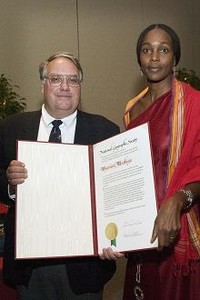
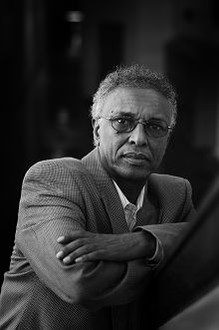
Twin Cities entrepreneur and community advocate, Martha Sinoe, staved off a stiff challenge from her former campaign manager, Henry Fahnbulleh, to emerge victorious as the new president of the Organization of Liberians in Minnesota (OLM). Elections were held on Sunday, November 20. The tone of the campaign left no doubt that it will be a close race but few predicted how tight the race was, as only twenty votes separated the contenders. Mr. Fahnbulleh was Martha Sinoe’s campaign manager in the last OLM elections.
After the manual process of counting the votes was done at the
United
Lutheran
Church
in
North Minneapolis
, electoral commission chairman, Benoni Grimes announced to both camps’ observers present that Martha Sinoe garnered 479 votes to Mr. Fahnbulleh’s 459. Martha Sinoe’s running mate was Jackson K. George while Henry Fahnbulleh had Mr. William D. Towah.
Voter participation this year saw a 33% drop from last year. The total of 938 votes cast for president is a significant drop from the January 2004 election where 1,403 ballots were
accepted in what was equally a charged environment. Martha Sinoe came in second to Wilfred Harris in the 2004 elections. In a sign that the new president has her work cut out for her
in terms of igniting more enthusiasm for OLM and its activities, the number of registered voters was about 10% less compared to 2004 at 1,289. Some voters obviously decided not to show
up even though they took time to register. 812 of those who cast ballots registered on election day ensuring an equally busy time at the registration desk.
The population of Liberians in
Minnesota
is estimated to be over 20,000 with a significant number
of them residing in the northwest suburbs of the Twin Cities. The polling took place at Northview Junior High School in Brooklyn Park. Among the first to vote were the two presidential candidates and for most of the morning there was light traffic as expected as most Liberians attend church on Sunday mornings. The two candidates and those vying for board positions then accosted prospective voters to solicit their votes. The pace picked up as church services concluded during the lunch hour and the venue was a beehive of activity until polls closed at 7PM. As in the previous OLM elections, the venue for counting the ballots had not been confirmed and
there was a last minute rush to secure a location before the United Lutheran Church pastor offered his church located in North Minneapolis.
Transporting OLM election ballot boxes is not for the faint hearted. The election team as in previous occasions had a hard time removing the boxes from the polling station to the counting venue without raising loud objections from supporters and campaign officials of the two camps.
A frustrated Mr. Grimes, the elections commission chair, was on the verge of calling law enforcement officials before being prevailed by others to “keep it in the house”.
Ballot counting started promptly at 9:30PM Sunday evening. The Sinoe and Fahnbulleh team each had four representatives to observe the counting. Also allowed in to observe was the former Union of Liberian Associations in the Americas (ULAA) President, Mrs. Roberta Rashid and
Mshale newspaper. Counting of the board ballots took close to three hours and concluded shortly after midnight, allowing counting of the much anticipated presidential ballots at 12:15am Monday morning. With only two candidates on the ballot, the exercise went relatively smoothly with voter intent easy to discern as voters appeared to be extra careful not to make mistakes when it came to presidential ballots. Being careful did not mean lacking a sense of humor. One voter instead of marking “X” or a check mark next to the box of their preferred candidate instead circled Martha Sinoe’s picture and wrote in big letters “God Yes, bless you, Yes” to indicate their choice. A commissioner ruled the voter’s intent was to vote for Ms. Sinoe and caused one of the light
moments during the long night. All quickly agreed with the ruling.
Unlike last year, a much more collegial atmosphere prevailed at this year’s counting exercise and there appeared to be a determined effort by both sides to ensure a speedy resolution to contested ballots. Arthur Zakama, Jr., the strategic planning chair for the Fahnbulleh team led the
observer team for his side while Kerper Dwanyen, Sinoe campaign chairman led his team in observing the counting.
The two who command considerable respect from their respective teams and their opponents ensured none of the bitter exchanges that characterized last year’s counting exercise happened.
In the 2004 elections, opposing teams threatened to walk out and stall the counting exercise when they did not agree with rulings by the election commission. Given the fact that there
were four presidential candidates and four observer teams to satisfy, amid the contention, the counting took more than twelve hours and concluded late morning the following day.
The most tedious exercise is that of counting the ballots for board membership where there nine
candidates for the five positions in the board. A voter picks five out of the nine for the board elections. Georgette Gray emerged with the most votes in the board elections. She got 652 votes followed by Mr. Abdullah Kiatamba who received 625. J. Sackie Kennedy, a losing presidential
aspirant in last year’s election before losing had the third highest number of votes followed by Marie Y. Hayes who got 532. Ms. Hayes is the outgoing vice-president under the Wilfred
Harris team. Harris T. Meh is the fifth board member and received 531 votes.
The four unsuccessful candidates were Christian Harris (421), Ousley Natt Early (313), Chris Wisner (263) and Toungon Vonleh (241).
The five new board members will choose from among themselves who will be board chairman. Mr. Kiatamba was widely expected to seek the chairmanship but he told Mshale after the results were announced that he had no desire to do so but may go for the post of Secretary to the
board. The top vote getter, Mrs. Gray confirmed via a telephone conversation with this reporter that she plans to run to be chair of the board. Her main challenger barring a change of heart by
Mr. Kiatamba is expected to be Ms. Marie Y. Hayes, the current outgoing OLM vice-president. Mrs. Gray is the outgoing secretary to the executive.
Although it is the most visible of the OLM organs and the one usually attracting voters to the polls, the executive, which comprises the OLM president and his team, is in reality answerable to the OLM board.
Mshale could not reach Mr. Fahnbulleh for comment after the elections before this edition went to
press but there were reports that he called Ms. Sinoe immediately after his team informed him of the outcome to congratulate her on the win.
In an interview with Mshale at her home minutes after the counting exercise as supporters started to stream in, Ms. Sinoe said people should not read too much into the close race. She said the outcome should unite the community and concluded that the reason for the close race was because the community was presented with two competitive candidates and went out of her way to stress the results did not symbolize a divided community. She planned to thank her supporters
before leaving for a two week vacation. Upon return she plans a round of unity meetings bringing together all Liberian counties present in Minnesota and a series of church meetings.
Her vice-president, Mr. Jackson George, told Mshale he is very interested in finding out why half the electorate voted for the other side. His hunch was that the opposing team went negative in the closing days of the campaign which may have taken away some votes from his team but that in the end the majority of the voters did not buy into the negative campaigning. He however did say that the results also indicated the Fahnbulleh team may have worked twice as hard as
the Sinoe team, negative campaigning notwithstanding. He was optimistic that the community will set aside the campaign spirit and move on.
One of his goals is to sell the idea of transforming OLM into a service oriented non-profit on behalf of the new Sinoe administration. With a goal to transform OLM to a service oriented organization, the new administration appears to be setting the stage for the envisioned
Liberian Cultural Center estimated to cost over a $1 million. The center will be partially funded by a $250,000 federal grant secured through the efforts of Minnesota US Senator Mark Dayton.
Elections Commission chairman, Benoni Tarr Grimes, called on the Liberian community to support the new administration and thanked his fellow commissioners for making the process credible and transparent. Mr. Grimes, a teacher with the Saint Paul Public schools and currently pursuing a Masters in Educational Administration at Saint Mary’s University is also the ULAA
Elections Commission chair. He said administering the OLM elections was not as tough as the ULAA ones even though there were a few frustrating moments. He said he expects to certify
the results within four weeks from the election date as stipulated in the OLM constitution.
The commissioners that did the counting were: Momolu Sirleaf, Jesse Fahngo, Edward Carter, Wisseh Geegabe, J. Clarence Yaskey II and Oblayon B. Nyemah, Jr. Ballot counting observers for the Fahnbulleh team led by Mr. Arthur Zakama were: Antoinette Beah-Towah, Edwin F. Kruah and Anthony A. Kanneh. Mr. Kerper Dwanyen led the observer team on behalf of the Sinoe
camp. The team included, George Saydee, Amara Kamara and Augustus Wrayee.
About Martha Sinoe
Martha Sinoe was born in Harbel, Margibi County, Liberia. She is an entrepreneur, a community advocate and a licensed professional nurse. She is the owner of a successful nursing business that employs Liberians and non-Liberians alike. Her Minnesota based business also serves parts of Wisconsin.
In 2004, she was elected Vice-President of the Northern Region of the Union of Liberian Associations in the Americas (ULAA). ULAA is the umbrella of all Liberian organizations
in the Americas. The Northern Region encompasses Minnesota, Wisconsin,Illinois, Ohio, and Michigan.
She received general business training at Essex County College, New Jersey (1982-1983), obtained a diploma in Secretarial Science at Essex School of Business (1985-87), and secured a
diploma in Nursing from Middlesex Vocational Institute (1990-92), in New Jersey.
She is the recipient of numerous managerial, professional and leadership certificates and trainings in the areas of non-profit management, community advocacy, business development,
para-medical services, among others according to her official biography provided to Mshale.
She has been married to Mr. Daniel Simbo for 22 years and is a mother of three children: Mars,
Tetee, and Danielle. Her eldest child Mars, holds an MBA in Financial Management from the New Jersey Institute of Technology (NJIT), and now works for the State of New Jersey. Tetee, her oldest daughter, presently works for a mortgage company as a loan-processing specialist. Her
youngest daughter, Danielle, is a freshman in high school.