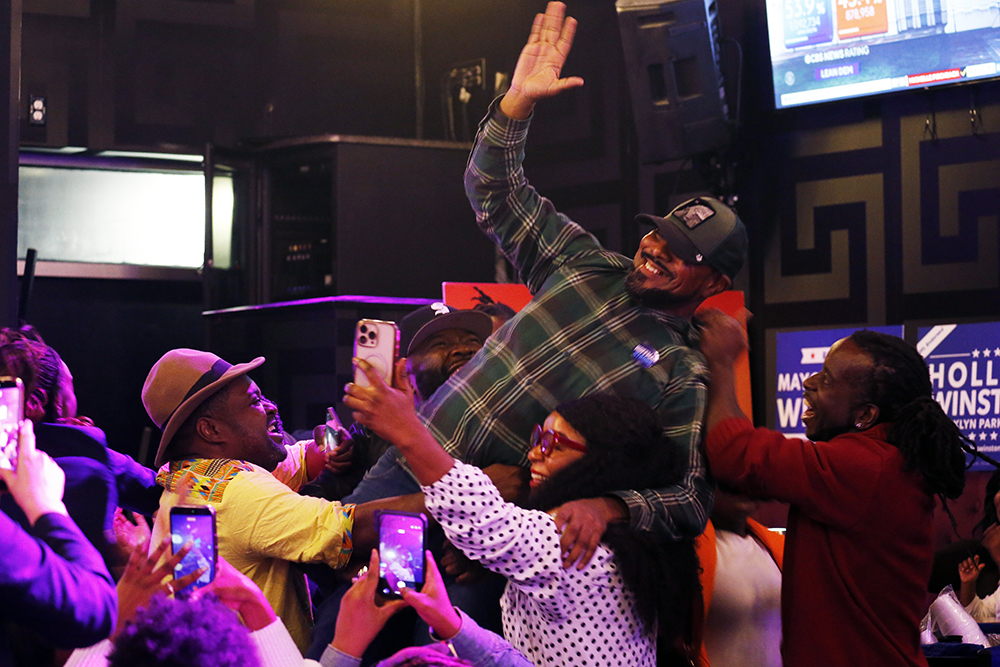

BROOKLYN PARK, Minn. — The crowd was chanting his title before he could deliver his victory speech.
“Mayor! Mayor! Mayor!”
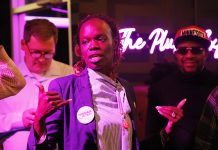
At Plush Restaurant and Lounge in Brooklyn Park on Tuesday night, supporters celebrated as Hollies Winston prepared to address them after winning a second term as mayor of Minnesota’s sixth-largest city.
But Winston, the city’s first Black mayor, had more on his mind than the election results.
In a speech that shifted between gratitude, defiance and reflections on political representation, Winston revisited what he described as months of personal attacks against himself and his family. His victory had settled the election, but his remarks made clear that the conflicts surrounding the campaign remained deeply personal.
Check out: Mshale Black Ballot – Election results for Black candidates around Minnesota.
“This has been a difficult, difficult election,” Winston told supporters. “People have attacked my wife. They’ve attacked my daughter.”
Winston defeated City Council member Shelle Page with 16,353 votes, or 55.26%, to Page’s 13,014 votes, or 43.97%, according to unofficial election results. The margin was 3,339 votes, or 11.29 percentage points.
The victory secured another term for the man who made history in 2022 when Brooklyn Park elected its first Black mayor.
Yet the tone of his remarks contrasted sharply with the celebration unfolding around him.
“When they attacked me, they weren’t just attacking me,” Winston said, arguing that the criticism represented something larger than opposition to an individual politician.
He portrayed the election as a contest over who could lead, who could succeed and whether Brooklyn Park’s increasingly diverse communities could shape the city’s future on their own terms.
For Winston, the voters had delivered their verdict. But he was not prepared to leave the campaign’s grievances unaddressed.
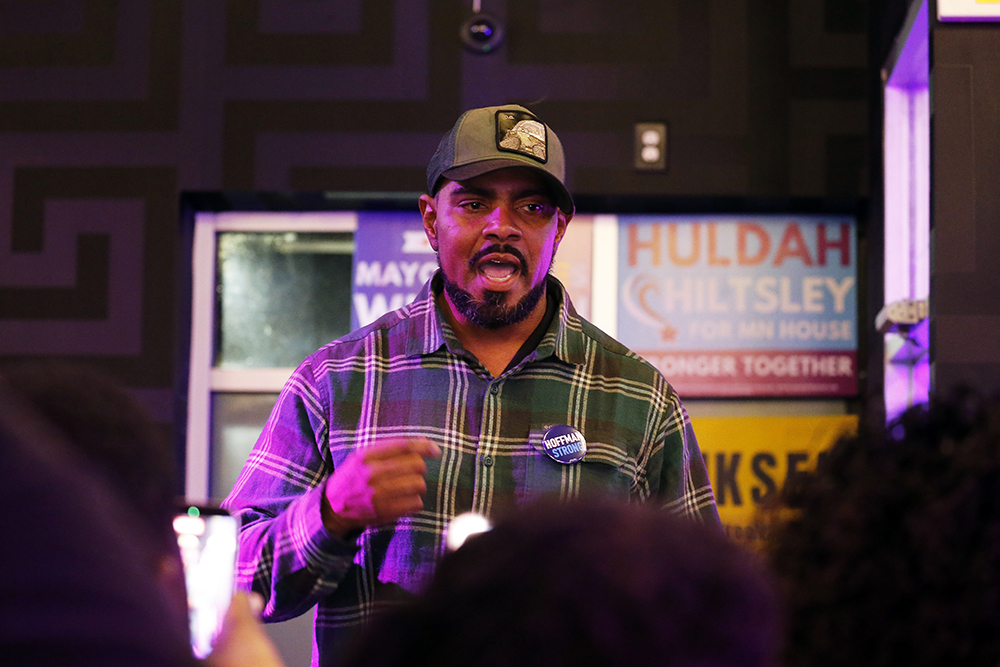
A victory speech shaped by a bruising campaign
Winston repeatedly described attacks that he said went beyond ordinary political disagreement.
He accused unnamed individuals of targeting his character and family, connecting those experiences to broader questions of race, identity and opportunity.
“You don’t get to come after my community,” he said. “You don’t get to come after my culture, my journey.”
Although Winston did not name Page in those passages, his remarks came at the conclusion of a contentious mayoral race marked by disagreements over leadership, development and the direction of City Hall.
Winston also invoked former President Barack Obama while discussing how a political leader should respond to personal attacks. He suggested that, unlike Obama’s more measured approach to political criticism, he was unwilling to let attacks on his family go unanswered.
“You do not get to come after my family,” Winston declared.
His comments reflected his account of the campaign. They did not establish who was responsible for the alleged attacks or whether Page had encouraged or participated in them.
Racial tensions also surfaced during the campaign after a screenshot from a video showing Page dressed as a ghost circulated on social media, prompting accusations of racism. Page rejected those accusations in a statement on her campaign’s Facebook page, saying the image was taken from a longer video involving a TikTok trend in which coworkers dressed as ghosts. She urged residents to consider the full context and engage in respectful conversations about race.
Winston did not specifically refer to the Halloween controversy in his Election Night remarks.
Instead, the mayor spoke broadly about the meaning he attached to his administration and its place in the city’s political evolution.
He argued that criticism directed at him also challenged the possibility of success for the communities he sought to represent.
“So as it goes in the city of Brooklyn Park, if any child can get up and dream and say, I can be successful,” Winston said, extending that vision beyond the city to the country and the world.
His remarks offered a window into how he interpreted the election: not simply as a contest between two candidates, but as a test of the leadership and opportunities available to residents of a diverse suburb.
The promise of ‘a Brooklyn Park for all’
The themes of inclusion and opportunity were not new for Winston.
When he was sworn in on Jan. 9, 2023, Mshale reported on the historic occasion under the headline, “A Brooklyn Park for all.”
Winston, the grandson of a Mississippi sharecropper, wore a blazer belonging to his late grandfather as he took the oath of office. His wife, Latrice, held the Bible while their children watched.
Before the ceremony, Winston outlined an agenda that included improving apartment living conditions, reducing crime and strengthening economic development.
“We just want to make sure that Brooklyn Park works for all and everyone,” he told Mshale at the time.
Nearly four years later, that vision of an inclusive city remained central to Winston’s message. But on Election Night, he delivered it against the backdrop of a campaign he said had tested him and his family.
During his first term, Winston emphasized public safety, economic development, housing and investment in young people. His administration pursued increased police staffing, alternative responses to some emergency calls and plans for a biotechnology district intended to attract higher-paying jobs.
The mayor defended those priorities during the campaign, arguing that Brooklyn Park needed greater commercial investment and more opportunities for residents to build wealth.
Page offered voters a different approach, emphasizing collaboration, listening to residents and greater independence in City Council decision-making.
The candidates appeared together at an August forum organized by the League of Women Voters of Brooklyn Park, Osseo and Maple Grove, where they debated city spending, public safety and economic development.
Their differences were also evident during an Oct. 15 mayoral forum organized by Black Votes Matter Minnesota at North Hennepin Community College, although Page did not participate.
Forum organizer Anika Robbins said Page had been invited several times and offered scheduling accommodations. Page disputed the invitation process, saying two sponsoring organizations had apologized to her. Neither side provided Mshale with a detailed timeline of their communications.
Reached by Mshale before the election, Page declined to elaborate, saying she wanted to focus on a positive campaign and building Brooklyn Park.
With no challenger onstage, Winston defended his development agenda and argued that the city should pursue a broader range of housing and higher-paying jobs.
“We want market rate. We want luxury. We want single family homes,” he said.
He also discussed plans for a biotechnology district, public safety and the proposed METRO Blue Line light rail extension.
Winston’s reelection gives him another term to pursue those priorities, although their implementation will depend on City Council decisions, funding and cooperation with other levels of government.
Page concedes but promises to remain a voice at City Hall
In a Wednesday post on her campaign’s Facebook page thanking supporters, Page acknowledged her defeat but appeared to play down the margin.
“Not a landslide 😉 like they thought,” she wrote.
Winston defeated Page by 11.29 percentage points, a margin of more than 3,300 votes. Page did not identify who she believed had predicted a landslide.
Page congratulated Winston but said she had attempted to contact him without receiving a response.
She also warned against political loyalties influencing City Council decisions.
“Our council members also have a responsibility to think independently, not simply vote as a pack,” Page wrote.
Page, who was elected to represent the Central District in 2024, will remain on the council despite losing the mayoral race.
She said the residents who supported her campaign deserved to have their concerns heard and pledged to continue pressing city leaders for answers.
“Accountability is not bitterness—it is part of caring about our city,” she wrote.
Her statement underscored the political disagreements that could continue at City Hall, where Winston will have to work with a council that includes his former challenger.
A changing City Council and a shared celebration
Winston’s reelection came on a night when several candidates associated with his political circle also celebrated victories.
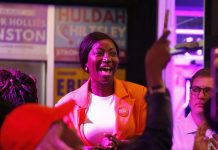
At the same Election Night gathering, state Rep. Huldah Momanyi-Hiltsley, a Kenyan-born Democrat representing House District 38A, celebrated winning a second term in the Minnesota House.
Bernice David-Cooper also won the West District seat on the Brooklyn Park City Council, becoming the first Liberian woman elected to the council.
Incumbent council members Christian Eriksen and Nichole Klonowski also won reelection.
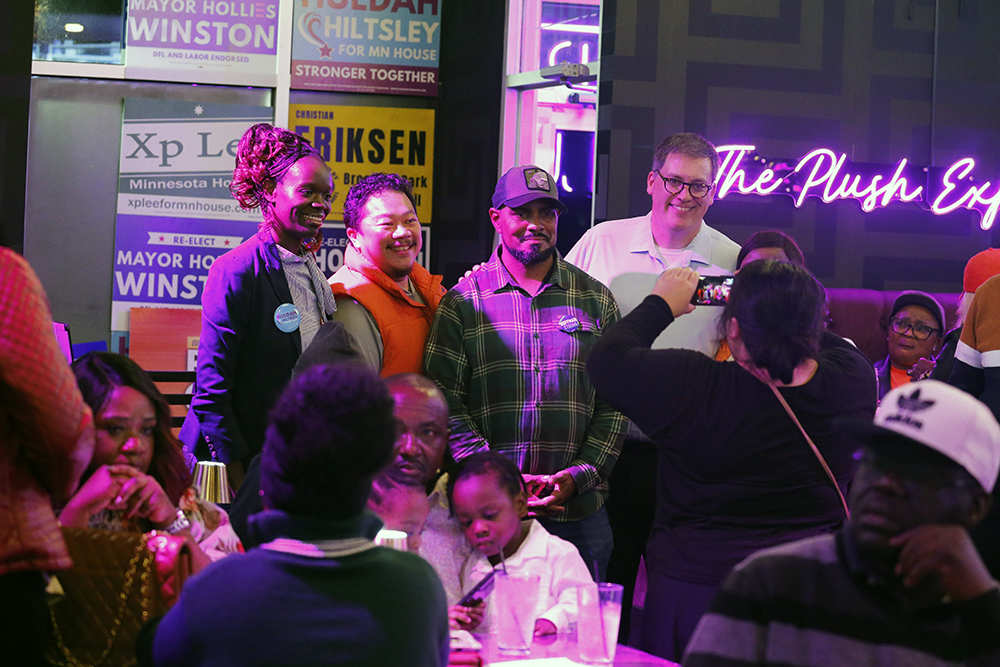
The results will help shape the political environment in which Winston begins his second term, although the council will continue to face competing priorities and disagreements.
For Winston, the celebration also offered a chance to recognize those who had stood beside him during a difficult campaign.
He thanked supporters, friends and family, singling out his wife and daughter for their contributions.
His remarks about his wife were among the evening’s most personal.
“When I had no political dreams, my wife was there, and now that I have political dreams, my wife is still there,” he said.
He also praised his daughter, a recent New York University graduate, for helping with the campaign while navigating criticism directed at the family.
The mayor returned repeatedly to the next generation, describing the opportunities he hoped young people would see in Brooklyn Park.
“It’s not about me,” Winston said. “It’s about the community. It’s about the next generation.”
Nearly four years after promising a Brooklyn Park that worked for everyone, Winston had secured another term to pursue that vision.
But on a night when supporters repeatedly chanted “Mayor,” his victory speech revealed that winning the election had not erased the personal and political divisions he believed the campaign had exposed.
Richard Ooga contributed to this report.
About Tom Gitaa, Editor-in-Chief
Born and raised in Kenya's coastal city of Mombasa, Tom is the Founder, Editor-in-Chief and Publisher of Mshale which has been reporting on the news and culture of African immigrants in the United States since 1995. He has a BA in Business from Metro State University and a Public Leadership Credential from Harvard’s Kennedy School of Government. He was the original host of Talking Drum, the signature current affairs show on the African Broadcasting Network (ABN-America), which was available nationwide in the United States via the Dish Network satellite service. On the show, he interviewed Nobel laureates such as 2004 Nobel Peace prize winner, Professor Wangari Maathai, the first woman from Africa to win the peace prize and heads of states. Tom has served and chaired various boards including Global Minnesota (formerly Minnesota International Center), the sixth largest World Affairs Council in the United States. He has previously served as the first Black President of the Board of Directors at Books for Africa. He also serves on the board of the Minnesota Multicultural Media Consortium. He has previously served two terms on the board of the United Nations Association. An avid runner, he retired from running full marathons after turning 50 and now only focuses on training for half marathons.
- Web |
- More Posts(522)
 (No Ratings Yet)
 Loading...