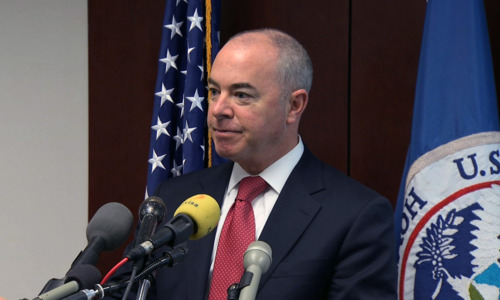
A rule change designed to decrease the time some undocumented immigrants spend away from their families could be implemented by the end of this calendar year, U.S. Citizenship and Immigration Services (USCIS) Director Alejandro Mayorkas said Thursday.
The policy would allow some undocumented immigrants with U.S. citizen family members to apply for a waiver from the so-called “three- and ten-year bars” from within the United States.
“We have committed to making it effective this year,” Mayorkas told reporters during a press conference to explain the agency’s strategic priorities for 2012. “I think we envision in the fourth quarter.”
The policy represents a change to existing immigration regulations that officials say prevent many people who are eligible for green cards through family ties from applying because doing so would subject them to a three- or ten-year ban from the United States.
Under current law, people who leave the country after being in the U.S. illegally for more than 180 days, are banned from coming back for three years. The ban is extended to 10 years if the person is present unlawfully for more than a year.
Existing regulations allow those individuals to circumvent the ban through a waiver if they have a U.S. citizen parent or spouse who would suffer “extreme hardship” upon their removal from the country. In order to apply for the waiver, however, they have to leave the country.
Without a guarantee that their waivers will be approved — and facing an average processing period of six months even if it is approved — many prefer to stay in the United States illegally, rather than take the risk of long-term family separation.
The proposed changes aim to encourage them to go through the process by giving them some indication of whether an approval is likely before they leave. A person applying for the waiver would still have to exit the country for a consular interview before the final adjudication, but the time he/she would have to spend away would be reduced to a matter of days.
The Obama administration first published a notice of intent to pursue a change in regulations in January. Mayorkas said Tuesday that USCIS will publish the actual proposal “imminently, in a matter of days or a week.” The public is then given 60 days to comment on the proposal, feedback that the agency will take into account in its final promulgation of the rule, expected to take effect by December.
Mayorkas also emphasized the agency’s efforts to strengthen initiatives to prevent fraudulent activity as a result of the new regulations.
“What we are seeing are cases of individuals who are misled by unscrupulous practitioners, or ‘notarios,’ who try to take advantage of the rule that is not yet effective and is only in proposed form, and not even yet in proposed form,” Mayorkas said. “We’re starting to see some victimization in the shadow of what is a tremendously important rule for the public.”
When the change was first announced in January, congressional Republicans, including Rep. Lamar Smith (R-Texas), accused the administration of putting the interests of undocumented immigrants ahead of those of legal residents. Smith also characterized the change as a “back-door amnesty” for millions of people.
Mayorkas said the changes fall within the law and are merely intended to minimize the hardship of people who would be eligible for the waiver anyway. He added that the agency does not have an estimate of how many U.S. citizens, or how many of their undocumented family members, would benefit from the change.
“What this proposed rule does, is accomplish the law’s purpose more effectively and more efficiently. Nothing more and nothing less,” he said. “The law provides that a United States citizen who would suffer extreme hardship by virtue of separation from his or her children or spouse, may obtain a waiver to alleviate that extreme hardship… and the law also provides that before that waiver is granted and the individual is admitted to the United States, the individual must depart the United States. Those basic tenets of the law, both its purpose and its requirement, are fully realized in the proposed rule that will be published shortly… And so I don’t believe that criticism is meritorious.”
53 year old Anglo-Nigerian singer, Sade, is among the top ten music money makers of 2011 according to Billboard’s just released 2012 Top 40 Money Makers List. Taylor Swift tops the list.
According Billboard, Sade grossed $16.4 million last year following the release of her album “The Ultimate Collection” that was followed by a worldwide tour which included the United States. Her North American tour was the first since 2001 and featured John Legend as the opening act in the 59 date tour.
The tour posted $45.7 million in revenue resulting in the group taking in $15.4 as their share. A DVD of the tour might be coming in the future according to Sophie Muller who was creative director of the tour.
The soft jazz veteran of more than 25 years was number six on the list behind only Taylor Swift, U2, Kenny Chesney, Lady Gaga and Lil Wayne. Her number six slotting also makes her the top British grossing musician of 2011. Her long musical career has seen her sell more than 50 million records worldwide making the shy Anglo-Nigerian the most succesful female British musician.
This is how the UK newspaper The Guardian quoted Brad Wavra, senior vice-president of touring at Live Nation, the world’s biggest show promoter, as saying of Sade “(she is a ) rare jewel. It feels like I’m working with Miles Davis, Elvis Presley and the Beatles all rolled into one.” Live Nation was the singer’s concert tour organizer.
Here is the Top 40 list according to Billboard:
1. Taylor Swift, $35,719,902
2. U2, $32,116,315
3. Kenny Chesney, $29,837,103
4. Lady Gaga, $25,353,039
5. Lil Wayne, $23,178,722
6. Sade, $16,382,809
7. Bon Jovi, $15,835,856
8. Celine Dion, $14,261,515
9. Jason Aldean, $13,409,011
10. Adele, $13,081,909
11.”Glee” Cast, $12,587,771
12. Journey, $12,313,822
13. elton John, $11,973,990
14. Katy Perry, $11,969,426
15. Toby Keith, $10,413,127
16. Britney Spear, $10,090,973
17. Bob Seger & The Silver Bullet Band, $10,017,031
Orders for Protection, Requesting a Hearing and What You Need to Know
Orders for Protection are generally orders to protect people who are victims of domestic abuse or are at risk of being further victimized. Domestic abuse is defined as any of the following conducts between family or household members: actual physical harm, bodily injury, assault, fear of imminent physical harm, bodily injury or assault, terroristic threats, criminal sexual conduct, or interference with an emergency call.
An Order for Protection (OFP) may be brought under Minn. Stat. § 518B.01, subd. 4(a) by:
A family or household member on their own behalf
A family or household member, a guardian, or a reputable adult age 25 or older on behalf of a minor; or
By a minor age 16 or older against a spouse, former spouse, or person with whom the minor child has a child, if allowed by the court.
When you are the subject of an Order for Protection or the ‘defendant’ or ‘respondent’ in an order for protection case, it is critical that you understand the restrictions against your ability to contact the victim or ‘petitioner’ and your right to request a hearing.
Typically, the OFP is issued as an Ex-Parte (for one party) Order. Ex parte means a legal proceeding brought by one person in the absence of and without representation or notification of other parties. The OFP order granted by the judge, ex parte, is typically a temporary order in Minnesota and the respondent is given five (5) days to request a hearing regarding the matter. Once a hearing is requested, the parties present themselves before a family court judge, referee or magistrate to have a ‘mini-trial’ on whether or not a permanent order for protection should be issued.
A permanent order for protection is typically in place for two years in Minnesota and can be renewed at the end of that period. An order for protection directs the offending party not to commit any acts of domestic abuse against the victim and excludes the offender from the victim’s home, workplace and other locations relevant to both victim and offender. Once an order for protection is entered against someone, it prohibits them from having any contact, direct or indirect with the victim. This includes any contact via telephone, text message, email, pager, and any other electronic means and via third parties, etc.
If you have an order for protection issued against you and you encounter the victim in a public location, you are required to leave the place, not the victim. Failure to leave any place where you encounter the victim may result in a violation of an OFP.
Consequences of Violating an OFP
Any violation of an OFP may be charged as a misdemeanor punishable by up to 90 days in jail, or $1,000 fine, or both. It can also be charged as a gross misdemeanor, punishable by up to one year in jail, or up to a $3,000 fine, or both. A violation could also result in a felony conviction, punishable by imprisonment of up to five (5) years in jail or a fine of $10,000, or both. Police officers have the power and authority to arrest you without a warrant and take you into custody if the officer believes you have violated an Order for protection.
Immigration Consequence
For people who are non-U.S. citizens, a violation of an order for protection carries the most severe of immigration penalties as it is a deportable offense. Non-U.S. citizens should be particularly wary of violating an OFP as it could result in their deportation, even if you have a permanent resident/green card.
Other Important Effects of an OFP or Pendency of an OFP case
Anyone who has an OFP currently in effect against or pending against them is prohibited from carrying, transporting, or receiving any firearm or ammunition. An OFP is enforceable by authorities in all fifty U.S. states, the District of Colombia, Tribal lands and the U.S. territories.
Relevance to Other Family Law Cases
The family court will consider an Order for Protection in a child custody, parenting time and child support case and weigh it negatively against the person who is the offender in the OFP.
What to do
If you find yourself the ‘Defendant’ or ‘Respondent’ in an Order for Protection case contact an experienced family lawyer immediately particularly if you are not a U.S. citizen. Attorney Obi Chukwu has successfully guided several clients through the Order for Protection process, either defending one or getting one issued. He has also helped clients make the best use of the process to produce positive results even in the most acrimonious situations. Attorney Chukwu has the experience and knowledge it takes to understand what an order for protection against you or in your favor means for you and how it can affect your immigration and other family law cases. Attorney Chukwu has effectively challenged false accusations on Orders for Protection and gotten them categorically dismissed.
If you have questions about an Order for Protection, its immigration consequences, what you can do to fight one or any other issues in this article, contact an experienced family law attorney. Consult a family lawyer to determine what process is relevant to your particular case or situation or for any of the issues raised in this article.
Nothing in this article should be taken as legal advice for an individual case or situation. The information is intended to be general and should not be relied upon for any specific situation. For legal advice, consult an attorney experienced in family law.
Forbes has released its list of the world’s billionaires and six black people appear on it. Five of the six are from Africa or have strong roots there. Only one is American and it is media magnate Oprah and she is the only black female on the list.
Mohamed Al-Amoudi at # 61 with $12.5 billion is the richest black person and is a Saudi national that was born and raised in Ethiopia before moving to Saudi Arabia at 19. He has replaced Nigerian Aliko Dangote (now at #76 with $11.2 billion) as the richest black person in the world.
Thus, two of the six are Nigerians, the other Nigerian being Mike Adenuga at # 248 with $4.3 billion.
South African Patrick Motsepe comes in as the 4th richest black person at # 442 on Forbes the Forbes list. Oprah is 5th but also at # 442 as she ties Motsepe at a worth of $2.7 billion each.
Mo Ibrahim rounds off the list at number 6 with a Forbes ranking of 1075. He is a British national born in Sudan. His worth is put at $1.1 billion.
SAN DIEGO, Calif.— Joseph Bukombe spent his entire life hiding his sexual orientation from friends and family in his native Kampala. Today he is fighting an American immigration system that doesn’t believe he’s gay.
In March 2011, the Board of Immigration Appeals—which decides appeals based on paper reviews of cases—denied Bukombe’s petition for asylum based on his sexual orientation, saying he failed to provide credible testimony attesting to the fact that he is gay. Bukombe is fighting his deportation order.
The 35-year-old chef-in-training in San Diego says he fears for his life if he’s deported because Uganda is not a safe place for gays. “If I’m sent to Uganda, I fear I will be tortured, imprisoned or killed,” Bukombe explained.
Such fears are grounded in personal experience and public scorn – at times violent — of homosexuality in his native country.
Earlier this month, Uganda’s Ethics and Integrity Minister Simon Lotodo called for the arrests of the organizers of a gay rights conference, saying gay people should go home “and suffer their illness from there,” according to news reports.
Bukombe’s saga illustrates the trouble of gay immigrants from the Middle East and Africa who flee persecution back home because of their sexual orientation. Upon arrival in the United States, many fall outside the stereotypical boundaries of gay life in this country and thus struggle to prove their homosexuality in court.
“They (immigration courts) may be asking, ‘Do you go to gay bars? Do you have relationships?’” said Shannon Price Minter, legal director of the National Center for Lesbian Rights. “[These are] things that gay people might do in the U.S. but not people in other countries, or they would be killed.”
Tortured
Bukombe married in 2005, two years after arriving in San Diego on a six-month tourist visa. He recalls hoping the marriage would “change” him. But it didn’t, and he eventually told his wife the truth, though he still could not bring himself to tell family back home, or for that matter, some of his African friends here.
“I did what most people do back home,” Bukombe said. “I lived a double life.”
It was only in the courtroom that he dared open up. A timid Bukombe told the judge that his relatives had tried to beat the gay out of him. In his testimony, he described how when he was 8 or 9 years old, his aunt and two neighbors tied him up and then beat him until he bled. His aunt thought she was doing him a favor.
“They were beating the homosexual demon out of me,” Bukombe explained. “They squeezed my penis and testicles so hard I had to have one of my testicles removed.”
They tried burning his genitals. His aunt grabbed a piece of burning wood from a cooking stove. When Bukombe wouldn’t stand still, she sizzled his leg. He couldn’t walk for days. His aunt told him he would die if he ever told anyone.
The young boy remained quiet; the fear that relatives would find out he was gay outweighed his fear of the beatings.
“I was afraid I would get into more trouble,” he said.
Punishable by Death
Bukombe came to the attention of immigration officials in January 2010, when he was arrested in the parking lot of a San Diego fast food restaurant on a DUI. In court, he began to recount for the judge the persecution gay people, including some of his friends, experienced back home.
“They look at you like if you have a disease and nobody wants to come near you,” Bukombe said of Uganda, where legislation was introduced in 2009 that would make gay sex punishable by death.
While the bill was tabled after international outrage, the climate in Uganda remains hostile. Currently, male-male relationships there are punishable with 10 years or more in prison, according to the International Lesbian, Gay, Bisexual, Trans and Intersex Association.
Worldwide, same-sex relationships are illegal in 75 countries, according to the San Francisco-based Organization for Refuge, Asylum and Migration, most of them clustered in the Middle East and Africa. In seven of those countries, being gay is punishable by death.
Despite these dangers, Bukombe’s petition for asylum was denied, a fact he attributes in part to his attorney’s inexperience. As a result, he’s now navigating the complicated web of immigration law without the assistance of legal representation.
“It’s a huge problem for LGBT people who are in the asylum process, finding attorneys who know what they’re doing; who are competent,” says Minter, noting that a number of his clients come seeking help after the attorney they initially hired missed a deadline or failed to show up for a court hearing.
Generally, non-citizens arrested for a crime have the right to government-appointed legal representation for criminal charges. But those facing deportation don’t have that right.
For Bukombe, this has meant struggling alone against a complicated, foreign legal system. He recently submitted a request for legal representation with the Ninth Circuit Court of Appeals, cognizant of the fact that without a lawyer his chances of winning on appeal are slim at best.
“It’s very difficult without an attorney. The government has all the resources to discredit you,” said Grace M. Gómez, an immigration attorney with the Law Offices of Gómez & Lackey in Florida who has successfully helped LGBT clients obtain asylum. “If you are not educated, not familiar with the language and the law, it can be very difficult.”
An End to the Nightmare
Bukombe still has nightmares from the 23 months he spent locked up in the Otay Mesa immigrant detention center outside San Diego. He says while there, agents regularly pressured him to sign deportation papers.
“We have your travel documents,” one agent told him after he was forcefully woken up and brought into an empty room to be interrogated.
“I was begging for my life,” Bukombe recalls. “I said, ‘No. I can’t do that. That would mean I’m signing my death warrant. I don’t want to die.’”
One agent later threatened Bukombe with jail time of four to nine years for refusing to sign the papers. “Being in prison here for nine years is better than going back and dying,” Bukombe replied.
He was released in December. Since then he’s been working as a chef at the Flavors of East Africa near San Diego State University.
On a recent Friday, he stood outside the restaurant and spoke about his hopes for the future.
“I’m praying every day that the situation gets better back home so that people like me can be free,” he said.
Until then, he adds, he will continue his fight to remain in this country, a fight that could mean the difference between life and death.
Community organizer and activist, Hindia Ali, was awarded this year’s CAIR-Minnesota’s (Council on American-Islamic Relations) Courage Award for her work in the community. CAIR-MN is the state’s only civil rights advocacy organization serving Muslims. It is affiliated with the national CAIR which is the country’s largest Islamic civil liberties group with 35 regional offices in the US and Canada.
The Courage Award is presented to a Minnesotan “who has demonstrated courage in promoting justice and civil rights”, according to Lori Saroya, CAIR-MN president.
At its annual gala which was keynoted by Imam Feisal Abdul Rauf and a surprise guest speaker- Ambassador Attallah Shabazz, eldest daughter of Malcolm X and Betty Shabazz, CAIR-MN in additon to Ms. Ali also honored Fedwa Wazwaz with the Justice Works Award. She is a community activist and blogger for the Star Tribune.
Ms. Ali who was born in Somalia is the Youth Leadership Coordinator at Somali Action Alliance and a resident with Community Organizing Residency (COR) in the Twin Cities Cohort.
She is the co-founder and former chair of Waxbaro (To Learn Something) Project, which celebrates the academic achievements and graduations of Somali college and high school students.
She assisted Congressman Keith Ellison’s re-election campaign to increase the participation of Somali voters in political campaigns. In presenting her with the award, CAIR-MN said Hindia has been a powerful voice in advocating for the rights and safety of Somali Muslims.
After a string of youth violence incidents in the Minnesota Somali community, she raised awareness and organized the community around the issue. She has also organized community rallies and regularly hosts Somali community meetings with elected officials and law enforcement.
Ms. Ali told Mshale in an email statement that “It was an honor to receive the courage award from CAIR-MN an organization that protects our American civil liberties everyday.”
Measles is a very serious and contagious disease caused by a virus. Because so many people are vaccinated, measles is no longer common in the United States. But it is still common in many other countries and may be brought into the U.S. by unvaccinated travelers, which is what happen in Minneapolis in the spring of 2011. Making sure everyone is vaccinated helps prevent measles outbreaks.
What are the symptoms of measles?
• Fever AND • Rash AND • Cough OR runny nose OR watery/mattering eyes
Symptoms appear about one to two weeks after a person is exposed to measles. The first symptom is usually fever. The rash usually appears two to three days after the fever begins and lasts five to six days. The rash begins at the hairline, and moves down the body.
How serious is measles?
Many people with measles have complications like diarrhea, ear infections, and pneumonia. Sometimes measles causes a brain infection that can lead to permanent brain damage. Complications are more common in children under 5 years of age and adults older than 20. It can be especially severe in persons whose immune systems are weak. Measles during pregnancy might cause a miscarriage or early labor which causes low birth weight babies. Measles can lead to hospitalization and even death.
How does measles spread?
Measles is spread through the air when people who have it breathe and cough. It is highly contagious. Fortunately, once you have had measles you cannot get it again.
How long is a person with measles contagious? A person with measles can pass it to others from four days before and four days after their rash appears.
Is there a treatment for measles?
No, there is no specific treatment for measles. People with measles need bed rest, fluids, and control of fever. They may also need treatment for complications such as diarrhea, ear infection, or pneumonia. If you or your child has symptoms of measles, what should you do? Be sure to stay at home and avoid having visitors until you have talked with your doctor or clinic. Your doctor or clinic will tell you if you should come in for a visit.
Is there a vaccine for measles?
Yes. The measles vaccination is combined with mumps and rubella called MMR. Children should receive two doses of MMR vaccine: the first at 12 to 15 months of age and the second at 4 to 6 years of age. (During a measles outbreak, children may receive the second dose as soon as four weeks after the first dose, even if they haven’t turned 4 years old.) All adults who have not had measles or a measles shot should receive MMR vaccine, particularly if they were born in 1957 or later. Certain adults (such as health care workers and travelers) should receive up to two doses of MMR vaccine to make sure they are protected. Children as young as 6 months old who are traveling overseas should also get an MMR. Talk to your healthcare provider before you travel.
If you or your child has been exposed to measles, what should you do?
Call your doctor or clinic right away. They will let you know if you need to come in for a visit.
If you have not been vaccinated, getting an MMR shot within three days of being exposed may prevent them from getting measles.
General Mills receives Global Citizenship Award from USAID
US Agency for International Development (USAID) administrator Dr. Rajiv Shah on February 24 awarded the Global Citizenship Award to General Mills for its work with food processors and small-holder farmers in Africa through its hunger fighting nonprofit, Partners in Food Solutions (PFS). He presented the award during a visit to the company’s headquarters in Minneapolis.
Shah also discussed how PFS supports USAID’s global hunger and food security initiative, Feed the Future. USAID has been a pivotal partner to General Mills as the agency helps shape and guide PFS through a public-private partnership formed in 2010.
Dr. Shah thanked employee volunteers for using their unique technical and business expertise to help African food processors produce high quality, nutritious and safe food at affordable prices, thereby increasing the demand for the crops of small-?holder farmers.General Mills is widely known for its iconic brands such as Cheerios, Häagen-Dazs, Nature Valley, Betty Crocker, Pillsbury, Green Giant and is a Fortune 500 company with revenues of $14.9 million last year.
Shah also discussed how PFS supports USAID’s global hunger and food security initiative, Feed the Future. USAID has been a pivotal partner to General Mills as the agency helps shape and guide PFS through a public-?private partnership formed in 2010.
General Mills’ chairman and CEO, Ken Powell, accepted USAID’s Global Citizenship recognition on behalf of the PFS employee volunteers.
“For General Mills, a key way for us to have an impact [on global poverty] is by sharing our food technology expertise,” said Powell. “I am honoured to accept the Global Citizenship Award on behalf of General Mills, and specifically, the more than 300 volunteers who have stepped up to make this effort a reality. Through their work, and the meaningful support of our partners, we are making a measurable difference.”
PFS is currently working with 30 food processors on 77 projects in Kenya, Zambia, Tanzania and Malawi.
When a foreign national arrives at a U.S. port of entry and applies for entry, a U.S. Customs and Border Protection (CBP) officer will determine whether he is admissible to the U.S. In some cases, the CBP officer may deny admission and issue an expedited removal order, forcing the person to leave the U.S. immediately or on the next available flight. An expedited removal order may be issued against a foreign national who lacks proper documentation or is found to have committed fraud or willful misrepresentation of facts to gain admission to the U.S. Between ports of entry, in some situations, an expedited removal order may be issued against those who illegally entered the U.S. and cannot prove continuous presence for more than two years.
To Whom Does Expedited Removal Apply?
From April 1997 to November 2002, expedited removal applied only to foreign nationals arriving at U.S. ports of entry. In November 2002, the Bush Administration expanded expedited removal to those arriving by sea and are not admitted or paroled. In August 2004, expedited removal was again expanded to those who are present without being admitted or paroled, are encountered by an immigration officer within 100 air miles of the U.S. international southwest land border, and cannot show that they have been present in the U.S. for more than two years.
How Does the Expedited Removal Process Work?
As the agency responsible for immigration inspections at U.S. borders and ports of entry, CBP has the power to issue expedited removal orders. Officers are instructed to only charge those grounds of inadmissibility that can be fully supported by the evidence and to consider, on a case-by-case basis, whether the person qualifies for any appropriate waivers, withdrawal of application for admission, or deferred inspection to resolve the ground of inadmissibility, rather than issue an expedited removal order.
The expedited removal process can only be used when CBP officers have determined that a person is inadmissible for one, or a combination of, the following reasons:
Fraud or misrepresentation of fact to gain admission to the U.S.
Falsely claiming U.S. citizenship.
Lack of a valid, unexpired immigrant visa or other suitable entry document, if the person is an intending immigrant.
Lack of a passport valid for a minimum of six (6) months from the date of the expiration of the initial period of stay, if the person is a nonimmigrant.
Lack of a valid nonimmigrant visa or border crossing card at the time of application for admission, if the person is a nonimmigrant.
When an expedited removal order is issued, there are no further hearings or review, unless the person states his intent to apply for asylum or indicates a fear of persecution in his home country. Those facing expedited removal have no right to counsel or to a hearing before an immigration judge. CBP officers have complete and exclusive authority to conduct the expedited removal process, which is usually done within a matter of hours.
Before ordering the person removed, CBP inspectors and other DHS immigration officers must create a detailed record of the facts of the case and statements made by the person. The person must be advised of the charges against him and receive the opportunity to respond to those charges in a sworn statement. The officer should question the person about his identity, alienage, and charges of inadmissibility, and record the person’s responses. These statements are noted in the Record of Sworn Statement, which can provide critical information when challenging an expedited removal order.
Officers must also ask series of “protection questions” to identify anyone who fears returning to his home country. Once a person expresses fear of return, he is supposed to be detained by U.S. Immigration & Customs Enforcement (ICE) and interviewed by an asylum officer from U.S. Citizenship & Immigration Services (USCIS). The asylum officer will then make a “credible fear” determination of the person’s claim. Those found to have a “credible fear” are referred to an immigration judge, who may review their defensive asylum application. Upon request, an immigration judge may also review the USCIS asylum officer’s determination that the person lacks a credible fear of persecution. The review must be completed “as expeditiously as possible, to the maximum extent practicable within 24 hours, but in no case later than 7 days” after the asylum officer’s finding of no credible fear.
Foreign nationals subject to expedited removal must leave immediately or be detained until they are removed from the United States. They are not eligible to be released on bond. They may only be released due to medical emergency or if needed for law enforcement purposes.
Those who claim a legal right to live in the United States based on citizenship, legal permanent residence, asylee or refugee status, are entitled to additional procedural protections. For example, they may receive deferred inspection or appear before an Immigration Judge to challenge the basis for removal or file an application for relief against removal.
What are the Consequences of an Expedited Removal Order?
An expedited removal order, in and of itself, carries a five (5) year bar to returning to the U.S. This means the person may not re-enter the U.S. for a minimum of five (5) years from the date of expedited removal unless they file a Form I-212 and is granted permission to reapply for admission to the U.S. Furthermore, those who were found to have committed fraud or misrepresentation are actually barred for a lifetime. These persons must file a Form I-212 and receive permission to reapply for admission, plus obtain the appropriate fraud waiver to enter the U.S. within five (5) years of the expedited removal order.
How Does One Challenge an Expedited Removal Order?
A court or judge may not review an expedited removal order. The person may, however, file a request for review to CBP directly with supporting documentary evidence showing that the expedited removal order is improper. In general, the challenge should be filed within 30 days of the decision. Based on the information and evidence provided, the CBP may exercise its discretion and overturn its prior expedited removal order.
The person may also file a complaint or apply for redress through the Department of Homeland Security Traveler Redress Inquiry Program (DHS TRIP). DHS TRIP routes the redress request to the appropriate office for review and adjudication. When the person applies for redress, he will be assigned a record identifier or Redress Control Number. Unfortunately, it can take many months to obtain a resolution through this process.
Because the expedited removal process offers limited due process rights in most cases, the foreign national might consider withdrawing his application for admission if the CBP officer offers this option. The person may then return to his home country to obtain the proper documentation for admission into the U.S. But when the expedited removal order is due to the CBP’s error or when the person can claim a right to reside in the United States or a fear of persecution in his home country, a challenge is in order.
Nothing in this article should be taken as legal advice for an individual case or situation. The information is intended to be general and should not be relied upon for any specific situation. For legal advice, consult an attorney experienced in immigration law.
Special US visa for human trafficking victims is underutilized
A special visa created 12 years ago to save thousands of victims of human trafficking and curb international human trafficking has been vastly underutilized.
Attorneys for rescued victims seeking residency protection say law enforcement agencies are often unwilling or slow to “certify” victims’ claims of having been brought to the U.S. to work by force, fraud or coercion.
Legal experts and social service providers in high-trafficking regions, including the San Francisco Bay Area, suggest that victims are placed in a dangerous dilemma: Promising to cooperate with an investigation could possibly help their visa cases, but it could also expose them and their families back home to retaliation.
One result is that victims only apply for a fraction of the visas available each year. Last year the government received one-fifth of its quota, and of the applications received nearly 23 percent were rejected.
Lawyers and service providers for trafficking victims said the lack of assistance from law enforcement slowed or derailed what they called deserving applications. In one case, a domestic servant who worked 16-hour days for no pay for years earned a T visa with the help of a crusading lawyer despite the lack of certification by federal law enforcement officials.
Created by the federal Trafficking Victims Protection Act of 2000, the T-1 Nonimmigrant Status visa provides trafficking victims from foreign countries temporary legal status, with an opportunity to apply for permanent residency and access to federal benefits if they cooperate with law enforcement in the investigations of their traffickers. Minors and those unable to participate in investigations because of physical or psychological trauma are excused, according to U.S. Citizenship and Immigration Services, the agency that adjudicates the visa applications.
Data supplied by the agency reveals that only a few hundred T visas have been issued each year since the program began, despite a yearly quota of 5,000 available. According to the agency, in the last fiscal year 557 T visa applications were approved and 223 were rejected.
The original federal trafficking law, authored by Rep. Christopher Smith, R-New Jersey, has been reauthorized three times, and revisions have included lowering the visa qualification standards and increasing services available to trafficking victims.
Scholars specializing in international human trafficking laws say the program is flawed because the help it offers victims is hinged on their willingness to assist in the investigations.
“It would be much better to have a system where your protections were not dependent on you giving evidence against the person who trafficked you, which is the case for children,” said Jacqueline Bhabha, director of research at Harvard University’s François-Xavier Bagnoud Center for Health and Human Rights.
Helping Law Enforcement
The T visa application encourages applicants to submit “primary evidence” of their cooperation, which consists of a law enforcement certification that they have agreed to support investigations of their traffickers.
Attorneys and social service providers who work with T visa applicants say obtaining the certification is often an impediment in the application process.
Zoraida Peña Canal was trafficked from Peru to be a domestic servant in Contra Costa County five years ago. Sacramento attorney Avantika Rao helped her obtain a T visa, even though she said she was unable to get certification from law enforcement.
Peña Canal entered the U.S. in July 2006 to live with and work for a Walnut Creek family. She was put to work from 6 a.m. to 10 p.m. each day for no pay caring for two children and doing chores, though her employer assured her that she would be paid.
Rao said Peña Canal escaped with the help of three neighbors. She learned about Peña Canal’s case when she was working at La Raza Centro Legal, a San Francisco-based organization that provides legal services to immigrants and low-income people.
Rao said in an email that law enforcement denied the certification though her client was doing everything possible to cooperate in the investigation.
“Ms. Peña Canal and I met with law enforcement agents and the U.S. Attorney’s Office on at least a dozen occasions during which Ms. Peña Canal provided physical evidence as well as testimony with regards to the crime,” Rao said.
After a series of requests to the U.S. Attorney’s Office to supply the certification, she was notified in September 2008 that the office would not provide the document.
“I was absolutely devastated by their decision, especially because they implied that they did not trust my client and did not view her case as important,” Rao said.
She submitted the T visa application anyway, without the certification. The lack of certification, she said, places “a much higher burden on the victim’s advocate to insert more details and documents in the T visa application, all of which are potentially discoverable by counsel for the trafficker in a legal proceeding.”
Despite these hurdles, Peña Canal’s T visa application was approved in January 2009.
Peña Canal relocated to San Francisco, where she now can be legally employed. She works as a janitor at a San Francisco company, cares for seniors in their homes and cleans houses on a referral basis.
Fear of Retaliation
Government agencies denying certification for T visa applicants is a common theme. Hilary Chester, associate director of anti-trafficking services at the United States Conference of Catholic Bishops in Washington, said law enforcement officials stalled on signing the certification for a client who was trafficked from El Salvador.
“I think what still bothers me personally is this notion that so much weight is given to the law enforcement piece, and that there is this requirement that a person be willing to cooperate in the prosecution,” Chester said. “I think it’s slippery.”
Her client did receive a T visa — more than two years later.
Legal service providers said that in addition to the hassle of getting law enforcement’s blessing, trafficked individuals also fear that applying for the visa may subject their families back home to threats.
“I think the biggest concerns are not so much fear in reporting the trafficking or talking to law enforcement about what’s happened, but it is very scary to be in a situation where they may potentially have to confront their traffickers in court — and the fears of retaliation for family back home,” said Lynette Parker, clinical supervising attorney for the immigration program of the Katharine and George Alexander Community Law Center, based at Santa Clara University.
“One of the biggest challenges for us is to identify NGOs on the ground in the home countries that can help give information and provide safety to the families,” she said, adding that many non-governmental organizations provide services to victims in coordination with U.S. groups.
Some clients are also apprehensive about going through with the investigations because of the stigma they and their families might face in their communities if U.S. investigators start asking questions abroad, as the FBI does occasionally.
Hediana Utarti, community projects coordinator at the Asian Women’s Shelter in San Francisco, said she had a case in which a family brought a young woman to the U.S. from Asia by promising her work as a cook and offering to send her to school. She said the woman did cook, but was also forced to participate in sex parties in the family’s home.
Utarti said that when the trafficking survivor applied for a T visa, law enforcement officials interviewed her, and they contacted her client’s siblings in her home country for the investigation.
“So it’s very scary for that person to have that situation where there are a lot of people talking about you,” Utarti said.
Steven Merrill, a supervisory special agent at the FBI’s San Francisco office, said agents sometimes travel to home countries of trafficked victims, but it is rare.
He said the hardest part for investigators in trafficking cases is that in many cases victims are unwilling to share their stories of victimization.
“There’s a variety of reasons why that may be, but that will always remain a difficulty from the FBI and any other law enforcement’s perspective in accomplishing our mission to put human traffickers — to convict them in court,” Merrill said.
Success Stories
In cases in which the T visa program works, it offers trafficking victims freedom to emerge from oppressive situations and live and work in the country.
A 63-year-old Bay Area woman who was trafficked from Peru to the U.S. by her brother-in-law said she was paid $80 every 15 days for working at his house in Los Angeles.
The woman, who requested anonymity for fear that her trafficker might track her down, said in an interview that she worked about 14 hours a day, seven days a week. She said he forbade her from contacting her family in Lima, Peru.
“They didn’t want me to answer the phone, they didn’t want me to call my children on the phone,” she said. “I would never receive a letter from my kids. Nothing. They didn’t want me to go to church either. I am Catholic, so I wanted to go every Sunday, but they didn’t want me to go to the street, leave the garden. They didn’t want me to go out at all.”
After fleeing the situation, she was helped by the attorneys at Santa Clara University to obtain a T visa, and she is now free to live and work in the U.S.
U.S. Citizenship and Immigration Services has sought to raise public awareness of the T visa program. Sharon Rummery, the agency’s spokeswoman in San Francisco, said her office has provided training nationwide to law enforcement, community-based organizations and the media, to explain the T visa and similar programs.
“We very much want people to know that the T is available, people to understand what it means to be trafficked,” she said. “Some people may not even know that they’ve been trafficked.”
Overcoming Isolation
Some human trafficking experts said that building a life in the U.S. after receiving a T visa is challenging for survivors because they feel isolated, and have trouble finding long-term housing and accessing victim services.
Denise Brennan, an associate professor and chair of the anthropology department at Georgetown University, said that in contrast to trafficking survivors, political and economic refugees tend to settle in communities where others from their communities are located.
“Generally speaking, refugees, they are not moving to a community completely alone,” Brennan said. “Formerly trafficked persons generally are resettled alone in communities that are not made up of formerly trafficked persons. In fact, no one would know that they were trafficked unless they told them.”
Some Bay Area advocates for trafficking survivors said that finding long-term housing after escaping is also problematic.
Mollie Ring, chief of programs at Standing Against Global Exploitation, a nonprofit group that provides services to trafficking victims, said it is tough for her clients to find affordable housing in San Francisco after they leave short-term, transitional housing.
Victims, she said, face a dilemma: “A client sometimes leaves the Bay Area in order to find a reasonable quality of life. But that means that they are disconnected from services. So it’s some of the Catch-22 there.”
Bono's African inspired prints at New York Fashion Week
NEW YORK — Fashionistas shivered visibly on Sunday in a makeshift event space along the blustery Hudson River, where the Edun fashion label, founded by U2’s Bono and wife Ali Hewson, was displaying its Fall 2012 collection. But the models wore bright, African prints that made one feel, at least momentarily, in a much warmer clime.
Among the most striking fashions: A graphic zebra print in a shoulder dress, draped prettily over one shoulder, or a silk safari print shirt dress, or a springbok (gazelle) silk twist dress, or an electric blue leopard-mix print dress.
Zebra, leopard, safari, springbok: The images don’t seem particularly suited for fall or winter on a cold city sidewalk. But Edun designer Sharon Wauchob explained that she was trying to marry the African roots of the collection with an edgy, urban, even punkish feel.
“I was trying to show the modernity of Africa, connected to an urban environment,” she said backstage. Or, as the program noted: “The Edun girl … has taken her punk rock roots on safari.”
One way to achieve her desired effect, Wauchob said, was to provide body-hugging shapes for her colorful prints. Another means of contrast was in Wauchob’s outerwear, which was often oversized and boxy — a big charcoal wool jacket, for example, over a silk zebra-print jumpsuit, or a very chunky two-tone turtleneck sweater, shown over a lacquer-printed kilt skirt.
Edun was founded by Bono and his wife in 2005 to “bring about positive change through its trading relationship with Africa,” according to the label. Of the 37 outfits displayed for the Fall/Winter 2012 women’s collection, 29 of them included garments that will be produced in Africa.
Hewson was in the front row on Sunday, along with Julian Lennon and iconic model Helena Christensen.
And though the shivering in the audience produced some concern for the coatless (mostly) models, they actually were the lucky ones: They dressed backstage in deliciously toasty heated tents.