A new Miss Universe was crowned Monday night: She’s Miss Angola, business student Leila Lopes, and she plans to work on HIV advocacy worldwide, in addition to helping her own country.
“As Miss Angola I’ve already done a lot to help my people,” Lopes, 25, said Tuesday morning after taking home the crown. “I’ve worked with various social causes. I work with poor kids, I work in the fight against HIV. I work to protect the elderly and I have to do everything that my country needs.
“I think now as Miss Universe I will be able to do much more.”
Those who weren’t watching the Denver Broncos notch a loss to the Oakland Raiders were treated to a parade of international hotties doing their pageant thing in Sao Paulo, Brazil — and that “pageant thing” of course includes a final round of questions for the Top 5.
This year’s questions included three that might’ve come directly from the Ministry of Gossip, plus a couple that clearly were not loaded with any political agenda whatsoever:
Nude beaches are common in some parts of the world. Is public nudity appropriate or inappropriate and why?
If you could change one of your physical characteristics, which one would it be and why?
If you could trade lives with anyone in history, who would it be and why?
Would you change your religious beliefs to marry the person you love? Why and why not?
What would you do to avoid fighting a war that you did not agree with it?
Miss Philippines stuck to her guns on the faith front, saying she wouldn’t marry a person if she had to convert to do so, and that a person who loved her would respect her enough to love her God too. Miss Angola stuck with her own physical characteristics, thanking God for doing right by her in the looks department and reminding people that we should all respect one another.
Miss China, broaching the nudity question, gave a short answer about all countries having their own rules and customs, which should all be respected. Miss Brazil said she’d handle the war problem by explaining that war is not based on respect but rather “always based on misunderstanding, it’s always based on a lack of education. So I would tell this person that we should respect each other as human beings.”
Miss Ukraine, meanwhile, said she would swap lives with Cleopatra — “a very powerful and strong woman who is very much worthy of respect.”
Here’s the order in which they finished: Miss China, Luo Zilin, fourth runner-up; Miss Philippines, Shamcey Supsup, third runner-up; Miss Brazil, Priscila Machado, second runner-up; and Miss Ukraine, Olesia Stefanko, first runner-up.
In two games that were played simultaneously in adjacent fields, Guinea beat Gambia 4-3 to advance to the finals while Liberia walloped Kenya 4-0.
Guinea and Liberia will now meet in the final on Saturday, September 17 at the Prairie Seeds Academy in Brooklyn Park.
The tournament is now in its fourth year and was founded by Guinea-born Kemo Camara as a way to bring Africans together through the game of soccer.
This year, the tournament is dedicated to Mshale Newspaper which is celebrating 15 years of providing news and culture for the African immigrant community.
Liberia, Gambia, Guinea and Kenya are the four teams qualified for this year’s Minnesota African Cup soccer semi-finals which will be held today at the Zane Sports complex in Brooklyn Park.
In the semi-finals, Kenya will play Liberia for a spot in the final on September 17. Guinea and Gambia will battle it out for the other spot.
This is the fourth edition of the tournament and this year, the organizers have dedicated it to Mshale which is celebrating 15 years of providing news and culture to the African community.
In recent years, the African fashion landscape has experienced a rapid change that shows no sign of stopping. With designers who have honed their skills, a savvy generation of African bloggers, fashion journalists, websites and magazines, at no other time in history has there been this level of focus on what designers from the continent can do.
The dominance of Paris, London, Milan and New York Fashion Weeks as the ultimate fashion capitals of the world is been challenged with over 7 fashion weeks on both sides of the Atlantic dedicated to African designers. From Dakar Fashion Week to Arise Fashion and Africa Fashion Weeks on the African Fashion calendar, the industry continues to grow and evolve in substance and strength.
Francis Ssennoga emerged victorious as the new president of the Uganda North America Association (UNAA), the premier organizations for Ugandans in North America.
Elections were held during the organization’s 23rd annual convention held in Denver during the Labor Day weekend. In a lopsided victory over JBM Ssentongo, Ssennoga garnered over 93% of the votes cast on the final day of the convention.
He is the first president elected under the new constitution UNAA adopted last year at its convention in Washington.
Ssennoga is the immediate vice-president of UNAA. His ascendancy has been a systematic one with his early service to the community starting with the Uganda Association in Minnesota before rising in the ranks in the ultra competitive UNAA.
It was one two punch for Minnesota which also saw another Minnesota resident, Brenda Kalema easily carry day to be vice president. Her victory was as lopsided as Ssennoga when she won 90% of the votes cast.
Others that will serve in the new Ssennoga administration were Bukenya Moses who also got a whopping 90% of the vote to become treasurer and Henrietta Nairuba Wamala who cruised to victory with 95% of the vote.
The 4th edition of the Minnesota Africa Soccer Cup tournament kicked off last weekend in Brooklyn Park with a dizzying eight matches in two days involving eight teams.
The pace continues this weekend with the elimination rounds games which culminate in the title game on September 17.
The semi-finals on Sunday will determine the two teams that will battle it out for the title on Saturday, September 17. The first semi-final game will kick-off at 3:00 P.M.
The tournament is the brainchild of Guinea born Kemo Camara who saw soccer as a way to build a stronger sense of community among Africans in Minnesota. The tournament is modeled after the Africa Cup of Nations back in Africa.
The organizing committee this year is dedicating the tournament to Mshale Newspaper which is celebrating its 15th anniversary this year and which Mr. Camara says is “an important community resource and has been a strong supporter of the Africa Cup”.
To mark the 15th anniversary of Mshale winning teams will receive trophies bearing the Mshale logo.
At last weekend’s games, the following were the results:
Day 1 (Saturday)
Sierra Leone 5 vs. Guinea 5
Kenya 4 vs. Somalia 1
Senegal 2 vs. Liberia 11
Gambia 1 vs. Cameroon 0
Day 2 (Sunday)
Liberia 11 vs. Cameroon 2
Gambia 3 vs. Senegal 0
Guinea 6 vs. Somalia 2
Kenya 2 vs. Sierra Leone 1
This weekend
Scheduled games for this weekend are as follows (all games are being held at Zane Sports Complex, 8717 Zane Ave., Brooklyn Park):
In the story of the lives of immigrants, the journey from the homeland is a significant component. Why did they leave home and how did they do it? For those who were lucky, it was a choice. But for most immigrants it wasn’t.
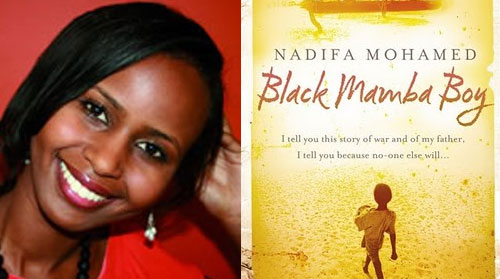
Author Nadifa Mohamed is herself an immigrant — to the United Kingdom — and her award-winning first novel, Black Mamba Boy, is about another immigrant, a young boy named Jama, a Somali orphan who travels from Yemen and ultimately ends up in the UK.
She spoke with “New America Now” host Shirin Sadeghi.
BROOKLYN CENTER, Minn. – The campaign for the presidency in Kenya has not officially started but the jockeying has begun.
Among those widely believed to be gunning for the top seat in Kenya is Peter Kenneth. He is an elected Member of Parliament for Gatanga constituency in central Kenya and an Assistant Minister for Planning, National Development and Vision 2030. Vision 2030 is the national strategic plan for Kenya by the Mwai Kibaki administration.
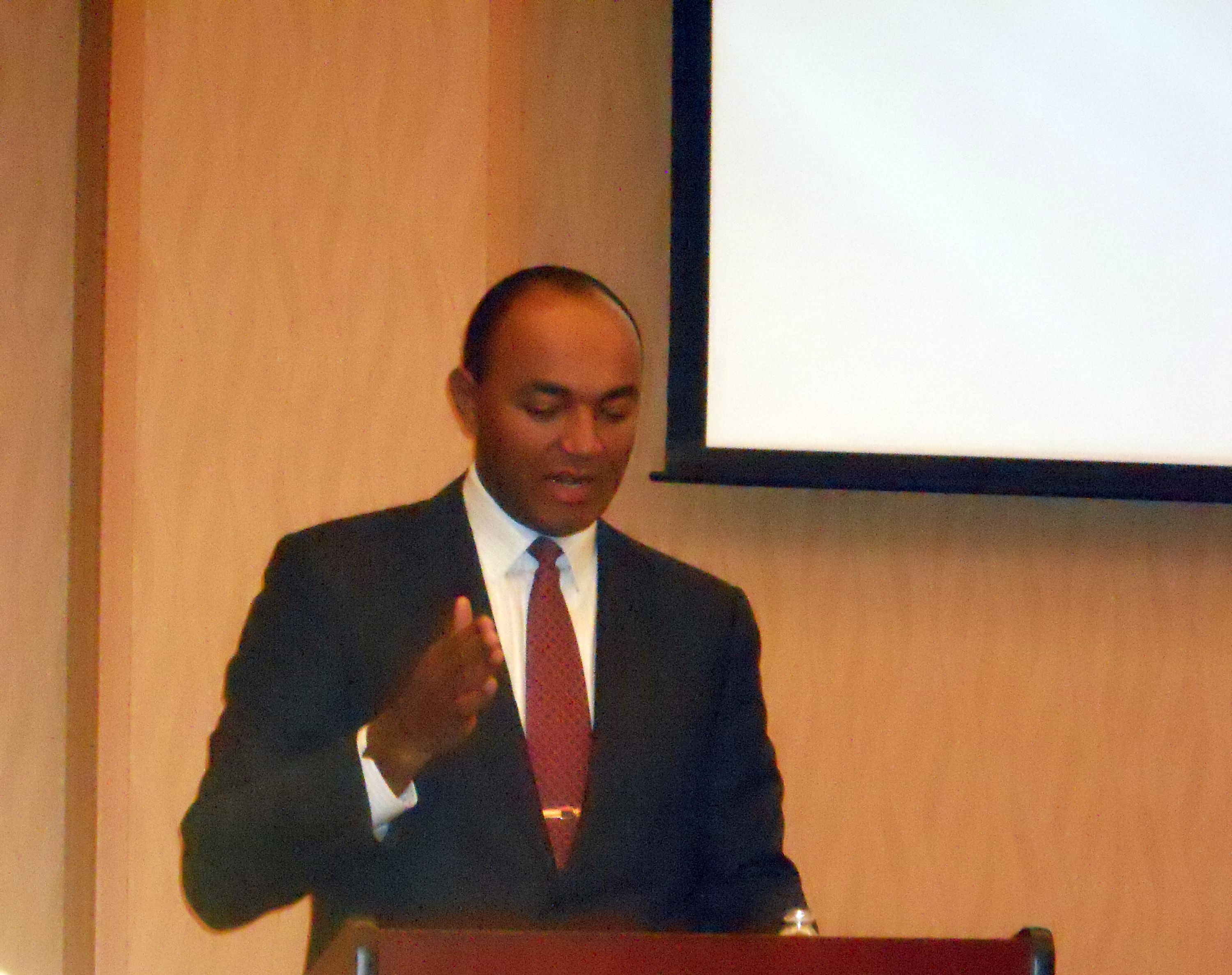
Mr. Kenneth has been on a US meet the Diaspora tour and made his last stop in Minnesota last Friday at a local hotel.
The youthful politician is the first among what is expected to be a trove of visiting aspirants for various public offices soliciting for support from the influential Kenyan Diaspora community. The visits typically start happening about a year before campaigns begin.
Along with Massachusetts, New Jersey and Texas, Minnesota is one of the big population centers for Kenyans in the United States and is considered a ‘must visit’ for any serious candidate for high office.
At a meeting attended by about 100 people, Mr. Kenneth addressed a wide range of issues particular to the portfolio he holds in government. Sounding very much like a candidate, he however refused to announce whether he is running for president deferring the decision “to an opportune time”. He however hastened to draw a clear distinction between himself and other young politicians also running for president. He said some of the young politicians that want to be president have in the past joined in the ‘fleecing of Kenyans’ and are no different from the old guard that Kenyans want to replace.
On issues of particular interest to the Diaspora, he confronted those head on. “There is no real estate bubble in Kenya”, he said in response to a question that real state is overpriced in the country. He said that in reality the Diaspora community with the remittances they send are contributing to the skyrocketing cost of real estate, as they are among the key top in the sector.
He also suggested a more “strategic” use of the remittances the Diaspora sends to the country. In a Q & A that took up most of the meeting, Mr. Kenneth gave a vision of Kenya with a modern infrastructure and adequate security. On infrastructure he said a lot of change has happened in the country for the better but that “more needs to be done”.
What did the audience think of the visit, one participant said “If only Kenyan politicians acted like Peter Kenneth was saying, we could have not been addressing these issues. He answered questions in the right way and hopefully his gatherings make a difference”.
Fifty years ago this summer, hundreds of young people organized, rode buses into the deep South and got arrested for challenging Jim Crow segregation in inter-state transit. They were beaten, firebombed and imprisoned. The Freedom Riders knew full well they would not convince segregationist Southern politicians like Alabama’s Sheriff Bull Connor or Governor John Patterson to embrace integration.
Instead, they were pushing President John F. Kennedy, a civil rights ally, to use his power to end segregation in public transit throughout the South. President Kennedy asked for patience, and said he could not unilaterally make the changes they wanted. More young people boarded buses for the South, and filled the jails of Mississippi. Kennedy realized the time to act had come.
In September of 1961, Attorney General Bobby Kennedy went to the Inter-State Commerce Commission, a federal agency, and got the rule changes necessary to end segregation on buses and trains. And the rest, as they say, is history.
President Obama faced a similar challenge and took a step towards justice as well as common sense law enforcement. He had the U.S. Department of Homeland Security make a change that could fundamentally alter how the United States treats undocumented immigrants facing deportation. The department announced it will now prioritize its deportation efforts on those undocumented immigrants who have committed crimes, have recently crossed the border, or have re-crossed the border after being previously deported.
What’s more, the department will immediately review the approximately 300,000 immigrants in deportation proceedings and “stay” (not immediately enforce) deportations for those immigrants who are not a priority. Going forward, all federal immigration enforcement agencies will work to keep non-priority undocumented immigrants out of deportation proceedings in the first place. It’s not yet clear exactly who all will benefit, but parents of young children, students of any age, relatives of military personnel, victims of domestic violence and people with strong community ties would appear to now be outside the immediate interest of immigration authorities.
Let’s give President Obama his due, but let’s also acknowledge that immigrant rights activists were the Freedom Riders on this issue. They saw President Obama as an ally, but one who was stymied by intransigent Republicans in Congress—just as President Kennedy was by Southern Democrats. And Obama, like Kennedy before him, said he was sympathetic but not able to help.
Immigrant rights activists come in many stripes. Some began to work behind the scenes laying out exactly why the Obama Administration did have the legal authority to provide “administrative relief,” or those things that the administration could do without congressional action. Others took to the streets, reminding the President of his commitment to justice for immigrants.
Just this past Wednesday, immigrants and their allies packed 500 people into a federal public hearing on immigration laws in Chicago. During the hearing a group of student age undocumented immigrants walked out to the street, sat down and got themselves arrested to draw attention to their cause – risking deportation because of their arrests. As in 1961, young people have been facing arrest in actions around the country. They are known as DREAMers both for the bill which would give them legal status and their willingness to stand strong for social justice.
These young activists were part of a much larger movement of organizations across the country pushing for change. Rep. Luis Gutierrez of Illinois, and a group of advocates from the Fair Immigration Reform Movement organized actions seeking administrative relief under the banner that “change takes courage.” Yesterday, Gutierrez, who has previously criticized the President for an increase in deportations, gave President Obama credit for his courage:
“This is the Barack Obama I have been waiting for and that Latino and immigrant voters helped put in office to fight for sensible immigration policies. Focusing scarce resources on deporting serious criminals, gang bangers, and drug dealers and setting aside non-criminals with deep roots in the United States until Congress fixes our laws is the right thing to do and I am proud of the President.”
Still, much remains to be done—just like 50 years ago. The real victory remains on the horizon as America needs new laws to provide a path to legal status for law-abiding undocumented immigrants, so good people can stop living in fear and contribute even more to our country. That being said, President Obama’s decision looks like a big step forward, but the devil will be in the details. And these details will be determined by how effective immigrant rights groups are at protecting this win. Three steps need to be taken by activists:
• They need to push the administration hard for the most just and fair interpretation of the new rules so that for instance those stopped for a broken taillight are not deported as criminals. • They need to call their President and Member of Congress to show support for this change. • They must use every tool in their toolbox to get congressional allies to kill any legislative effort by anti-immigrant nativists in Congress to overturn the president’s decision.
The bravery of the Freedom Riders eventually enabled a black man to run for the presidency of the United States and win. Somewhere in our nation today there is the American-born son or daughter of undocumented immigrants who may also look back on this day from the White House.
DREAM Act a win-win: Good for immigrant Women and the economy
“Educate a boy, and you educate an individual. Educate a girl, and you educate a community.”
Humanitarian Greg Mortenson invokes this African proverb to explain why his mission to eradicate poverty in rural areas of Afghanistan and Pakistan through education focuses on girls and young women. However, this proverb carries equal resonance in our own backyard.
As an attorney at Equal Rights Advocates (ERA), a national women’s rights advocacy organization based in San Francisco, I come across women everyday who work hard to support their families. They tend to have limited education, living below the poverty line, and many are undocumented.
Many are mothers who brought daughters to this country at a very young age, daughters who consider this country their own. While these mothers may have dim hopes about their own potential for advancement, this should not be the case for their daughters. And yet it will be without the passage of the DREAM Act (the Development, Relief and Education for Alien Minors Act).
The DREAM Act sustains the hope that children will break the cycle of poverty and fulfill the American Dream. It will also enrich our country’s economy with skilled and dedicated young people well worth the investment. This legislation will provide thousands of undocumented students a path to legal status through education or military service, and allow them to receive limited federal financial aid. To qualify, students must graduate from U.S. high schools, possess good moral character, have arrived in the U.S. as minors, and been here continuously for at least five years before the bill’s passage.
This month marks the tenth anniversary of when the Senate first proposed the DREAM Act, but it still has not gained sufficient traction to be signed into law. Because financial stability in this rough economic climate is our nation’s top priority, it is imperative now, more than ever, that Congress passes the DREAM Act. Research from the Migration Policy Institute shows that the median annual income of immigrant men is nearly $12,000 less than native-born male citizens. Immigrant women fare worse, making on average over $16,000 less. Lack of access to higher education is the chief culprit. As a result, many bright young women have minimal access to opportunities crucial to restarting the U.S. economy.
The DREAM Act will positively impact all immigrants, especially immigrant women. The Migration Policy Institute forecasts that if the DREAM Act becomes law, 57,000 immigrant women age 18 and older would become eligible to attain permanent legal residence. If the cut-off age remains 34, the act will provide conditional legal immigration status to an additional 268,000 young immigrant women between the ages of 18 and 34 who have a high school diploma or GED, allowing them to enter college or serve in the armed forces.
The DREAM Act is also good for families. To help support their families, undocumented women tend to work in informal labor sectors such as domestic services and agriculture. As callers to ERA’s toll-free counseling hotline confirm, these jobs often do not guarantee living wages, health care, or even protections for workers’ health and safety. Yet, history has shown that living conditions for entire families improve when girls are provided with educational opportunities. The risk of high school dropouts, teenage pregnancy and financial instability drops drastically.
Opponents of the DREAM Act will argue that the legislation rewards undocumented immigrants while taking away educational opportunities from citizens. However, the DREAM Act will provide educational opportunities to more people who deserve them. According to an Urban Institute study, each year approximately 65,000 undocumented immigrants who have lived in this country for at least five years, graduate from high schools. The DREAM Act will allow these students, including honor students, student leaders and gifted athletes, to fulfill their career aspirations, support their families and contribute to the economy.
Congress should follow California and Maryland, which have recently passed similar initiatives to provide educational opportunities to immigrant youth. If we let another ten years pass, the ranks of the underclass will swell further. The DREAM Act is the change that we need now at the national level.
For immigrant families and our country’s economic development, nothing short of this change will do.
If it is accepted that in Islam men and women are equal and enjoy the same rights, in theory at least, women should be able to perform the function of preaching. But it is only recently that the male monopoly on preaching in Islam has been challenged and the role of women in Islam is still very much in debate.
In Malaysia — a non-Arab Muslim country — auditions are currently underway for a reality television show to be aired in October 2011 that aims to select a winning Muslim woman preacher. The challenge is to find the woman who can best practice ‘dawah’ – the preaching of Islam.
In Morocco, according to a February 2007 BBC report, women preachers (known as murshidat) have been performing the function of Imams for several years now. Fifty females have graduated from a dawah course of study and have taken jobs in various provinces in the country. It is important to note that while they can preach, they cannot lead the prayers. That remains a man’s function.
A Tunisian newspaper (Alwasat) reported as far back as June 2006 that in Egypt crowds of women assembled in large numbers to listen to women preachers. Khadija Radwan, for example, is now renowned for the quality of her interpretations of Qur’anic verses.
Suspicion Lingers
Nonetheless, people still look upon Muslim women preachers with suspicion, and some have been reportedly reprimanded or banned for getting out of line or preaching beyond their repertoire, so to speak.
More recently, in the West Bank city of Hebron, the Ministry of Endowment and Religious Affairs warned women preachers not to touch on politics and issues such as “jihad” but to concentrate only on domestic affairs and the mundane concerns of daily life.
However, such warnings haven’t stopped Muslim women preachers from pursuing controversial topics or taking provocative stances on other issues.
In August 2008, the British television network, Channel 4, made secret recordings in London’s Regent Park Mosque which showed that hard line Muslim women preachers warned Muslim listeners not to talk to people from other religions because they are evil and filthy. They also called for gays and those who switch from Islam to other religions to be killed. The director of the mosque denied that women are allowed to preach in the mosque.
Writing in the Saudi newspaper Alwatan in February 2008, Amal Zahed wrote that at one session, women preachers used fiery scary language to intimidate and frighten worshippers. One preacher focused on fear and death and reminded the audience of the “hell and mayhem” that await them. She reminded her audience of torture in the grave as well as fire and brimstone in an attempt to brainwash her listeners into hating life and secular pleasures and instead focussing on death and the after-life.
Zahed wrote that this kind of preaching is contrary to Islamic teachings. Islam calls for initiative, work, education, exploration of the world, the achievement of material success and the enjoyment of life, he said.
Despite the criticism, some argue strongly in favor of the women preachers. Dr. Amina Nasir, a Professor of Islamic Doctrine at Al-Azhar University in Cairo said in a recent interview that there is a need for more women preachers. She reminded her interviewer that there are people out there who do not wish to open the way for Muslim women preachers.
To support her argument in favor of women preachers, she quoted verses from the Qur’an, demonstrating that the obligation to preach Islam is the same for men and women. Women preaching to other women is highly recommended, she said, because women can empathize and understand other women’s problems better than men can. Dr. Nasir insisted, however, that the preaching woman must have sufficient knowledge of the Prophet’s life and of the Qur’an in order to be an effective preacher.
Legalization of Sex-Slavery
At the other end of the spectrum of women’s roles in Islam, there is the Kuwaiti Muslim thinker Salwa al-Mutairi who, according to the UK’s Front Page Magazine (June 2011 issue), has called for the re-introduction of sex-slaves into Arab society. She says that men should be allowed to keep concubines to satisfy their urges. Her rationale is that legalizing sex-slavery helps prevent Muslim men from sinning with Muslim women.
In a further twist, she recently suggested that a new law should be enacted to enable Kuwaiti women to purchase good-looking men from Muslim countries. The men should have “slave qualities” and should be ready for marriage. These qualities include politeness and obedience.
Al-Mutairi’s rationale for this is that it will solve the problem of spinsters in Kuwait and reduce the divorce rates. Her statements were condemned widely by women’s organizations and even by some men. Many found her opinions shameful and degrading to women.
Islamophobes seized upon her comments to tarnish the Islamic religion and Muslims in general. This is, of course, not surprising. But it must be said that al-Mutairi’s distorted views are not representative of the wider Muslim attitude toward women.
Real Muslims don’t buy or sell women for sex. Women are not sex objects in Islam and Muslim men and women should stand together to renounce this nonsense. Fortunately, there are Muslim women preachers and this is exactly the kind of issue where they can play a significant role.