Home Blog Page 173

Marriage Fraud: Definition, Consequences & Solutions

Marriage transcends religion, language, culture and, in some cases, even gender. Although marital rights are recognized almost everywhere in the world, each country defines them differently. The reasons to marry include legal, social, emotional, economical, spiritual and religious factors, and vary across individuals as well as cultures. Some marriages are arranged while others are chosen by the parties themselves. Marriages are entered into for family obligations, the legal establishment of a nuclear family unit, the legal protection of children, and the declaration of the parties’ commitment to each other.


Regardless of the various reasons for marriage, all foreign nationals seeking to immigrate to the United States based on marriage to a U.S. citizen or lawful permanent resident (LPR) must prove one thing: they share a bonafide marriage that is based on mutual love and affection and was entered into with the intent of establishing a life together. If U.S. Citizenship & Immigration Services (USCIS) concludes that the parties married solely or primarily to obtain U.S. immigration benefits, it will issue a marriage fraud finding and deny the I-130 spousal petition. A sham marriage determination may also result in the refusal of issuance of an immigrant visa, denial of adjustment to lawful permanent resident status, the loss of resident status previously granted, and removal from the United States. A marriage fraud finding that is not overcome could forever bar the foreign national from gaining permanent resident status in the U.S.


Sham Marriage Determination


To reach an initial marriage fraud finding, USCIS must have sufficient evidence to reasonably infer that the marriage is a sham, which the parties may overcome with rebuttal evidence. To deny a second or subsequent petition based on a prior marriage fraud finding, USCIS must have “substantial and probative evidence” of a sham marriage. The key question is whether the husband and wife intended to establish a life together at the inception of their marriage. The parties’ conduct after they marry is one important factor for USCIS to consider.


Immigration Laws Aim to Curb Marriage Fraud

In 1986, Congress passed the Marriage Fraud Amendments to the Immigration & Nationality Act (INA) to address the growing concern about foreign nationals seeking permanent residence based on marriage to citizens or LPRs when the marriage was entered into for the sole purpose of obtaining permanent residence. The law includes a conditional residence requirement for foreign nationals who obtain permanent residence based on marriages that are less than 24 months old. In such cases, the LPR status is conditional and limited to two years. No earlier than 90 days before the two-year residence expires, the foreign national must then file a Form I-751 petition with USCIS to remove the conditions and keep the permanent residence status. A joint filing by both parties is preferred, but the foreign national may file alone when the parties are divorced and certain other conditions are met. USCIS normally reinvestigates the bona fide nature of the marriage, so that the approval of the initial I-130 petition does not automatically lead to an approval of the I-751 petition. If USCIS finds that the marriage was fraudulent after all, it will deny the I-751 petition but the foreign national may request review in removal proceedings before the Immigration Court.


Section 237 of the INA also allows for foreign nationals to be removed from the U.S. if they are found to have committed marriage fraud. Section 204(c) of the INA further bars the approval of a petition if the foreign national previously received or sought to receive immigration benefits based on a marriage that was found to be a sham. This means that USCIS may not only investigate the current marriage, but also inquire into past marriages. Even when there is overwhelming evidence to show that the current marriage is bona fide or that an employer has filed a meritorious employment-based petition, USCIS will not approve the petition if a prior marriage fraud finding exists. If the first petition was denied due to suspected sham marriage, the subsequent petition must include new evidence or compelling arguments to challenge the marriage fraud finding. USCIS, the Board of Immigration Appeals, and most (if not all) federal courts have authority to review I-130 petitions. Immigration Courts do not.


USCIS is generally more suspicious of marriages that occurred after the foreign national was placed in removal proceedings. Foreign nationals are barred from adjusting their status or seeking immigrant visas on the basis of a marriage entered into while they are in removal proceedings, unless they can show by “clear and convincing evidence” that the marriage was entered into in good faith.


In the age of terrorism, USCIS and Immigration & Customs Enforcement (ICE) view marriage fraud as a threat to national security. While such cases are not always prosecuted, they carry penalties up to five years’ imprisonment and a $250,000 fine for any person who knowingly enters into a sham marriage for immigration purposes.


Proving the Marriage is Bona Fide


A marriage certificate and proof of termination of all prior marriages are required to support a spousal petition. Documents to help show that a marriage is bona fide include proof of joint ownership of property; evidence of joint tenancy of a common residence; joint bank accounts and other proof of commingling of assets; shared debts and expenses; birth certificate(s) of child(ren) born to the parties; and affidavits by third parties having personal knowledge of the marriage.


Additionally, during the marriage interview before USCIS, the parties must be able to provide detailed and consistent answers about their relationship. The officer may choose to interview each party separately to draw out inconsistencies, which USCIS may use to support a marriage fraud finding. It is very helpful to have counsel present during the interview, especially when the parties are questioned separately.


Because the parties are sworn under oath, they are required to tell the truth. If the parties separated or keep separate residences due to marital problems or financial reasons, they must be upfront with USCIS and not lie about their situation. Wilful misrepresentation of a material fact to USCIS is one basis to deny the petition and bar the foreign national from obtaining permanent residence. Unannounced site visits to the couple’s claimed, shared residence are also common when USCIS suspects marriage fraud.


Greater scrutiny results when there is a lack of bona fide marriage documents, especially when the marriage is new. Other factors that may be causes for concern are vast age differences, language barriers, and cultural differences between the parties. Separations, separate residences, adultery, and other signs of a troubled marriage are also red flags, even though they do not necessarily mean the marriage is a sham. The husband and wife must be able to answer questions about each other’s personal history, families, employment, and other issues related to their marriage. Longer marriages in which the parties have children together usually make the strongest cases.


Because a marriage fraud finding leads to brutal immigration consequences, it is highly recommended that persons seeking to obtain permanent residence through marriage to a U.S. citizen or LPR consult with an experienced immigration attorney before filing the petition. Consulting with an experienced attorney is also critical if USCIS issues a notice of intent to deny the petition or denies the petition based on marriage fraud. Legal representation is especially needed when the couple is facing marital problems. With experienced counsel, the parties will be better able to prevent, address, and rebut marriage fraud allegations so that the foreign national may obtain or maintain permanent residence.


Nothing in this article should be taken as legal advice for an individual case or situation. The information is intended to be general and should not be relied upon for any specific situation. For legal advice, consult an attorney experienced in immigration law.

Rapping in solidarity with North Africa and Middle East

0
Rapping in solidarity with North Africa and Middle East

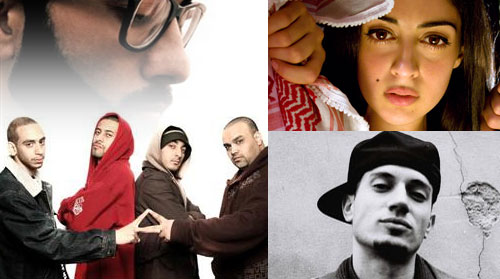
Many prominent Arab hip-hop artists inspired by uprisings in the Middle East and North Africa have released music in solidarity with protesters in the region. Though the messages of these new songs are not necessarily new to Arab hip-hop, the urgency and relevance of this new music has gained these artists increasing international attention.

While Arab hip-hop started to gain its recognition in the ‘90s, tracing back the history can be difficult in light of the fact that it stems from such a complex fusion of diasporic communities, people, art and culture. In North America, for instance, artists such as Fredwreck and The Narcicyst are cited as pioneers of Arab hip-hop, while groups such as DAM are credited with jump-starting the movement in Palestine.

In a conversation with Excentrik, an East Bay music producer, “actionist” (action activist and oud player), he explained, “Yeah, there’s an Arab hip-hop scene, but it’s a global scene, it’s not like a localized scene. Unfortunately, there’s not enough cats doing quality shit that have like a [single] place to go in any of these cities… It’s an esoteric scene, it’s random because it’s so big and so spread apart.” While there are certainly active indigenous Arab hip-hop scenes throughout much of North Africa and the Middle East, the majority of the most celebrated emcees in the global scene are based in North America and Europe, where hip-hop has had a longer history and faces less challenges in terms of censorship.

That said, artists still find opportunities to collaborate and work together across both national and international lines. “Most of us Arab rappers are very well connected,” said Rush of Cairo’s premier rap group, Arabian Knightz. Collaborations between rappers can be recorded from different studios and files can be shared with the click of a mouse. “The combination of hip-hop and the Internet, and the ability to record it and put it up online immediately and bypass all these typical media outlets and typical industry outlets is what makes it so powerful,” explained Syrian-American rapper Omar Offendum in a phone interview from Los Angeles.

In North America, Iraqi-Canadian rapper, The Narcicyst and Omar Offendum are two of the most highly acclaimed emcees in the global Arab hip-hop scene. Omar Offendum often evokes the work of Arab poets through his lyrics, emphasizing the links between poetry and hip-hop. The Narcicyst, who recently released a book entitled “Fear of an Arab Planet: The Diatribes of a Dying Tribe,” touches on themes ranging from Orientalism to homeland security in his music. One of his most popular songs, ‘P.H.A.T.W.A.’ released in 2009, is set in an airport. “We went from, supported to subordinate, can’t afford it, ordered / My motherland smothered and mortared, morbid, at borders / I’m sorted out from beardless cats that boarded the plane as I was boarding,” The Narcicyst raps.

The UK also boasts some of the world’s most recognized Arab rap artists such as Lowkey, who is of British and Iraqi heritage, and Palestinian rapper, Shadia Mansour, also known as “The First Lady of Arabic Hip-Hop.” Both are known for linking artistry and activism, rapping about topics such as Palestinian resistance, occupation and terrorism. “They calling me a terrorist / Like they don’t know who the terror is / When they put it on me, I tell them this / I’m all about peace and love / They calling me a terrorist / Like they don’t know who the terror is / Insulting my intelligence / Oh how these people judge,” raps Lowkey in the song “Terrorist.” Together, they have toured extensively and collaborated on titles such as “Long Live Palestine” which incorporates Mansour’s distinctive Arabic flow and emotive singing voice.

Rapping in the Middle East

In Tunisia, a young emcee by the name of El Général was among the first in the Arab hip-hop scene to gain international attention for his raps related to the most recent waves of political unrest in the North Africa. He released two songs “Rais Le Bled” (President Your People Are Dying) and “Tounes Bladna” (Tunisia, Our Country) which were both included on the Mish B3eed mixtape put out by ‘Enough,’ a Libyan movement voicing dissent against the Gadhafi regime.

According to The UK’s Observer newspaper, “Rais Le Bled,” released in November 2010 “lit up the bleak and fearful horizon like an incendiary bomb,” reaching audiences around the world through new media platforms such as YouTube. “My president, your country is dead / People eat garbage / Look at what is happening / Misery everywhere / Nowhere to sleep / I’m speaking for the people who suffer,” he raps in Arabic. The song was quickly banned in Tunisia, but Al Jazeera Television and Tunivision were still able to pick up on the El Général story followed by other notable media outlets such as TIME magazine. Shortly thereafter, the release of “Tounes Bladna” (Tunisia, Our Country) resulted in the 21-year-old rapper’s arrest from his family’s flat in the town of Sfax in Tunisia. El Général was released after three days of interrogation thanks to an outpouring of public protest in his favor.

The January 25 uprisings in Egypt sparked a second wave of protest music from the global Arab hip-hop scene, fueling an outpour from prominent artists such as The Narcicyst, Shadia Mansour, Lowkey and Omar Offendum. This time, the songs would be multinational collaborations, incorporating news clips from Al Jazeera and photos from demonstrations in the music videos.

On February 4, just weeks after the January 25 demonstrations, Egyptian rap group Arabian Knightz posted the song “Not Your Prisoner” featuring Shadia Mansour, and Palestinian-American producer, Fredwreck on YouTube. Lyrics alternate between English and Arabic, opening the dialogue to a larger international audience. “Destructive destruction, running my district / Antichrist running it, spittin’ evil wisdom!” raps Rush (one of three members in the group). The song became an instant YouTube success, accruing thousands of views within 24 hours of being posted.

When asked in a Skype interview about the role of their music in bringing about social change, Rush replied, “The people who started the revolution are teenagers. I doubt that the motive of the revolution, the music they were listening to while planning all these things, was ‘habibi’ music. I am sure it was hip-hop.” The ‘habibi’ music Rush refers to can be described as sentimental, easy-listening pop that is widespread in Arabic media channels. That music, according to many Arab hip-hop artists, fails to address the real concerns of youth on the front lines of protest throughout the Middle East and North Africa.

The North American Connection

A few days later, North American artists The Narcicyst, Omar Offendum, Freeway, Ayah, Amir Sulaiman and producer, Sami Matar contributed to the dialogue with a collaboration entitled “#Jan25.” The song, posted on YouTube, has drawn nearly 200,000 views, and even caught the attention of Al Jazeera, which interviewed Omar Offendum shortly after the song was released.

“I heard ‘em say / The revolution wont be televised / Al Jazeera proved ‘em wrong / Twitter has ‘em paralyzed / 80 million strong / And ain’t no longer gonna be terrorized / Organized – Mobilized – Vocalized / On the side of TRUTH,” raps Omar Offendum in the opening verse of the song. The use of graphic Al Jazeera news clips and gorilla photography throughout much of the music video is illustrates the grassroots nature of the Arab hip-hop scene, using a combination of audio and visual media to communicate their message to a growing audience of listeners.

In the meantime, mounting tensions in Libya inspired 26-year-old Chicago rapper M. Khaled to release a music video entitled “Can’t Take Our Freedom,” featuring UK rapper, Lowkey. The first lines of the chorus, “You can’t take our freedom, or take our soul / Take our freedom or take our soul / You are not the one that’s in control / You are not the one that’s in control,” sum up the overall message of the song speaking to the Gadhafi regime.

“It was never my intention to be a political rapper, or write political songs,” said M. Khaled in an interview with Arab Detroit News. Even so, this most recent release has become one of his most popular tracks to date. This song also seems to tie back to the legacy of his father, Mohamed Ahmed, who was reportedly held as a political prisoner in Libya for five years after leading student protests against the Gadhafi regime. “Like, could we be this close? Nah, couldn’t be / But if the people in Egypt and Tunis could do this, decide their fate…then why wouldn’t we?” raps M. Khaled.

Although the original music video for “Can’t Take Our Freedom” was removed from YouTube for reasons that are not entirely clear, several fans have reposted the song using their own personal online accounts. In addition to gaining popularity online, the song attracted the attention of media outlets such as ABC World News and CNN that profiled the story of the young rapper.

The Solidarity Rap

Each of these new protest songs in their own way illustrates a collective consciousness around growing political unrest in the Middle East and North Africa among artists in the Arab hip-hop scene. Solidarity with protesters is the central theme that runs throughout much of this new music. This solidarity is also reflected in the collaborative nature of many of these pieces featuring hip-hop artists who are spread across different cities and continents. Even on a local front, Bay Area hip-hop pioneer Davey D released a “Beats for Revolution Mixtape” that features “Not Your Prisoner” and “#Jan25,” alongside the sounds of Dead Prez, Public Enemy and Immortal Technique.

As political unrest continues to unfold throughout much of the Middle East and North Africa, many Arab hip-hop artists are optimistic, but cautious. “One thing governments cannot take away from the people is the will to live,” wrote Lebanese-Armenian Bay Area rap artist Tru Bloo in an e-mail. “I think we, in the U.S., have a lot to learn from these movements,” she added.

“There is a hopefulness and a sobering feeling,” said Oakland-based Lebanese American soul singer, Naima Shalhoub, of the ongoing events.

Still, artists involved in the Arab hip-hop scene remain inspired by the significance that music has in motivating and empowering youth. “The way kids listen to music is a really powerful thing,” said London-based rapper Logic after his concert at the University of California, Berkeley with Shadia Mansour and Lowkey last month.

Realizing the power that their music has to speak to youth in the face of adversity, Arab hip-hop artists do not take their work lightly. “Music plays a big role in influencing people,” said The Narcicyst, “and I almost think for our generation… music speaks to us louder than politics does.”

Kenyans sweep Boston marathon

0
Kenyans sweep Boston marathon

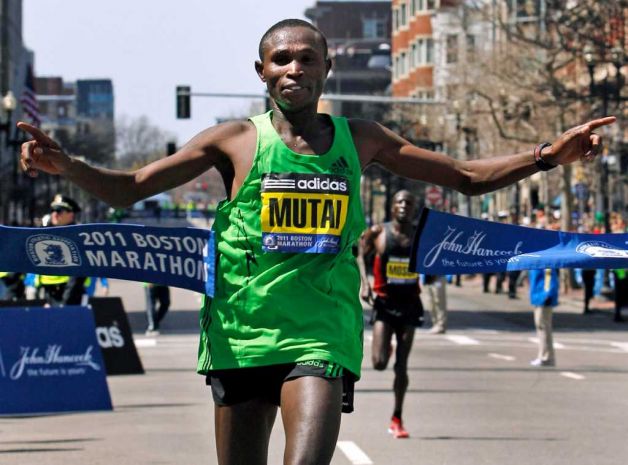
Geoffrey Mutai of Kenya ran the fastest marathon in history Monday when he ran the world’s oldest marathon, the Boston marathon, in a record 2 hours, 3 minutes, 2 seconds erasing Ethiopian’s Haile Gebrselassie, who ran the 2008 Berlin marathon in two hours, three minutes and 59 seconds.

However, the International Association of Athletic Federations (IAAF) immediately after the end of the race Monday determined that Mutai’s time wasn’t considered a world record because the Boston course is ineligible to set a record. IAAF requires that courses to start and finish near the same point in order to discourage downhill, wind-aided runs and the artificially fast times they can produce. Boston has a net decline of 459 feet, though the course is dominated by hills going up and down.

Still, Mutai will receive a $50,000 bonus for the world best and another $25,000 for the course record to go with the $150,000 he and women’s winner, fellow kenyan, Caroline Kilel earned for the win.

Another Kenyan, Moses Mosop, finished second to Mutai.

Mutai becomes the 19th Kenyan winner in the past 21 years. The last American, man or woman, to win the Boston marathon was Lisa Larsen-Weidenbach in 1985.

Sierra Leone uses fiftieth to trace connections to American history

0

The Sierra Leone Community in Minnesota will host its 50th Independence Day Celebration on April 23, featuring an exhibit about the reason the nation may be home to ‘the most important historical site in Africa for the United States.

For thousands of African American slaves Bunce Island , a small, sequestered landmass off the coast of Sierra Leone, was the last memory of Africa before crossing the Atlantic Ocean and entering North America.

“I truly think that Bunce Island is most important historical site in Africa for the United States,” historian Joseph Opala said. “An important part of American history is on that tiny, isolated island in Sierra Leaone.”

The Sierra Leone Community Association in Minnesota is taking the 50th anniversary of the small, African nation’s independence as an opportunity to highlight this historic connection between the two nations during a celebration at the East Side Neighborhood Services building on April 23rd beginning at 7 p.m.

The event will include the Minnesota debut of the Bunce Island Exhibit, consisting of 20 large display panels featuring the culmination of nearly three decades of Opala’s study of the island, which is home to a notorious British slave castle.

Funding for the purchase of the exhibit, which will make the Twin Cities one of about a dozen sites in the U.S. to host the display, was provided by a grant from the Minnesota Humanities Center , Jonathan Rose , president of the SLCM said.

“The exhibit goes well beyond the independence day celebration,” he said. “[Sierra Leone is] a small country, but this is an opportunity to learn that we have significance in the history of this country.”

In addition to the exhibit, the celebration, which is predicted to attract between 500-750 people, will feature Sierra Leonean food, music, dance and an address from keynote speaker, State Rep. Jeff Hayden .

To carry out the theme of the affair, “Continuing Education for a Better Future,” SLCM will award between six and 10 scholarships to high school seniors and college freshmen as part of the event for the first time, Rebecca Johnson , the SLCM secretary said.

“We want to let young people know there is life after high school,” she said. “That way, they can aspire to higher education and use knowledge to lift the community.”

Students of Sierra Leonean decent will write short essays about how they would help the nation progress and grow as young leaders as part of the application process for the scholarships, Rose said.

After the 50th celebration, the exhibit will spend a few weeks on the University of Minnesota campus before finding its permanent home somewhere in the Twin Cities. SLMC members plan to take the exhibit on several educational trips to community grade schools, according to Rose and Johnson.

Opala said the exhibit, which has two parts—Slave Castle and Links to North America—is significant because it was the only slave castles that almost exclusively exported to North America.

“Most Americans have this strange misconception that most of the slaves from Africa went to United States,” the Oklahoma native who lives in Sierra Leone, said. “The truth is, 96 percent went to Brazil or The West Indies, meaning only 4 percent went to North America.”

He said this is the reason many famous African Americans, including actor Isaiah Washington , who donated $25,000 to computer the computer animations for the exhibit, have traced their heritage back to Sierra Leone in recent years.

Sierra Leone’s 50th Independence Day Celebration will extend beyond the night of festivities with events including both Muslim and Christian prayer services in the days following the event, Rose said.

He also said he hopes both Sierra Leoneans and non-Sierra Leoneans are able to learn and understand connections between them as part of the celebration, particularly with the current turmoil in many African nations.

Opala, who is currently working on a $5 million project to preserve Bunce Island and build a museum there, agrees. According to him, the exhibit will highlight the shared history between all Sierra Leoneans and Americans.

“Wherever we’re from, we’re all part of the American story,” he said. “This is Sierra Leone’s part of the American story that they have to tell.”

Sierra Leone 50th Independence Anniversary Celebration

DATE: Saturday, April 23, 2011

TIME: 7:00 pm- 2:30 am

PLACE: East Side Neighborhood Services
1700 Second Street Northeast
Minneapolis, MN 55413

THEME: Continuing Education for a Better Future

Academic scholarships will be issued on Friday, April 22, 2011.

KEYNOTE SPEAKER: State Rep. Jeff Hayden

DONATIONS: $20.00 (IN ADVANCE) and $25.00 (AT THE GATE)

Exhibits from Bunce Island (A primary hub during the transatlantic slave trade) will be displayed at the event.

Contacts: Hassan @763-228-0650; Kehf @ 612-251-7134

Success is within us!

0

Too often, we give others the authority to define our identity and also to define what success is in our life. Approval from others or external sources is unnecessary because God validated us before we were born.

True success rests within us. God desires us to be ourselves; we were created to be an original. We are designed for uniqueness and we are meant to be one-of-a kind on earth. When we take action to use our own gifts and talents to make a difference in the lives of others, we will be on the right path

When we are pleased with ourselves, we never will need to seek approval for success through the opinions of others. All the ingredients needed to achieve fulfillment start with accepting the unique identity given to us by God.

Remember: If we don’t discover our true identity from God, we will never be able to live according to our true self. What lies deep within our heart gives the true picture of what we’re all about. Success is locked up in our God-given ability.

Toward African freedom in Libya and beyond

0
Toward African freedom in Libya and beyond

The fundamental stimulus of the attack on Libya is greed, not the protection of the Libyan people. In fact, the people of Libya have suffered more during this bombardment by Western powers and their allies than during the entire 41 years of the leadership of Muammar al-Gaddafi.

There are several rationales that have been advanced in the public for the reason for the assault on Libya. The attackers have said that Gaddafi has used force against his own people. They say that they are trying to prevent revenge attacks on the people who have risen against the leader of Libya. They also say that Gaddafi’s government has lost its legitimacy. None of these arguments make much sense in reality, and they conceal the attempt at exploitation, appropriation of Libyan petroleum and colonial incursion to demonstrate the will of the West in Africa.

We have yet to have a clear view of the attacks made upon the Libyan people by their government. If anything, the actions of the Libyan government in Tripoli appear restrained despite the agitation caused by a vocal minority. In the United States in 1965, when I was a young college student, I witnessed the actions of the National Guard on the streets of South Central Los Angeles. Nearly 40 people were killed in a confrontation with American government authorities.

Governments fight to maintain their legitimacy; this is the law of sustaining power. When President Bush reached the lowest point of his popularity among the American people, he was still considered the president. Gaddafi has not lost any legitimacy because groups of his people, influenced by social media, went to the streets to demonstrate against him. Popularity has rarely been the standard by which governments must be overthrown.

Furthermore, there were no African mercenaries fighting against the people of Libya as reported by the media; the Black people that the Western media experts saw were Libyans.

Although we can and should argue about the need for what Ron Daniels calls the “act of internal criticism” in African governments, there can be no argument about the necessity for Africans to solve their own problems. We must be clear that the attack on Libya is an attack on Africa.

One of the reasons that the French, the Americans and the British could not reach an agreement with the African Union to bomb Libya is because the political intelligence of African leaders has grown tremendously since the crises in Sudan, Côte d’Ivoire, Tunisia and Egypt. The African Union knows that Gaddafi’s leadership on questions of African unity is among the most prominent.

Few African leaders have been as active in assisting the continent economically and administratively as Gaddafi. He has used his country’s wealth to create a strong economy in Libya as well as to support civil servants in other African nations. We must not be beguiled by the Western media in its rush to remove one of the strongest African leaders from his post.

Gaddafi has minced no words about his support for and belief in the United States of Africa. Indeed, he knows that if Africa is divided between Northern and Southern states, or if Africa keeps existing as 54 independent states, the Western nations and the North American nations of Canada and United States will eat each part of Africa alive. They will not be able to swallow a continent that is united, firm in its convictions and dedicated to the liberty of its territory.

No one has shouted any louder than Gaddafi that Africa must be for the Africans. In this he reminds us of the clarion voice of Marcus Garvey.

With the fall of Tunisia, Libya and possibly Morocco and Algeria, France will have succeeded in its major plan to bring those states, especially oil-producing Libya, into a grand Mediterranean Basin clique. In such a scenario, the northern part of Africa will be declared the southern ridge of the European nation to the north. Gaddafi has been one of the major opponents of this neo-hegemony over African territory.

A United Africa would be a step toward overcoming disease, transportation problems, famine and land disputes. In our judgment we should not be so fast to criticize Gaddafi just because Western governments call for such an action. If they say that he is punishing his people, denying them free speech and keeping them from education, this must be proven.

Furthermore, why hasn’t the Western world rolled into Israel or the West Bank and saved the Palestinian people who suffer true slaughter and discrimination at the hands of Israel? What is Gaza, if not the pits of hell? When shall we hear high-sounding words from the leaders of the Western world in support of those Arabs? Africans must beware of the gifts of Europe.

Since Kwame Nkrumah, Africa has rarely had a visionary as broad in thinking and as dedicated in commitment as Gaddafi. Perhaps in his desire to strengthen the continent and to make Africa powerful he went too far with his donations to the governments of Senegal, Chad, Burkina Faso and Zimbabwe and did not do enough for the Libyan people.

No African nation was among those who came out to attack Libya on March 19. President Sarkozy of France has reported that some Arab nations supported the campaign against Libya, but even if that proves to be so, one must not read too much into this without some appreciation of the Arab distress with Gaddafi’s pro-African stance.

Transformations are produced by those who are focused on long-term goals, not by those who make convenient alliances with the enemies of their people. As Nkrumah was fond of saying, “We face neither East nor West; we face forward.”

It has been Gaddafi who has made Nkrumah’s mantra his own: “Africa must unite or perish.” Why would this language threaten the West? The Libyan leader has encountered, and continues to encounter, attempted setbacks and hurdles.

The work of the Brother Leader, as he is sometimes called, has been to raise African consciousness to the point that some of the nations on the continent of Africa begin to reject the loyalty they hold for their colonial masters. Some African leaders seem to fear other Africans.

Gaddafi has proposed that Africa do away with travel restrictions, create a common currency and ease trade tariffs and barriers. This African solidarity is not only a threat to the West – some who identify as Arabs have a difficult time accepting the Africanity promoted by Gaddafi.

With the proper safeguards and cooperation of the African world, the Libyan people can sort out their own internal squabbles. The great danger of the attacks on Libya is that they are being used by the U.S. to test the effectiveness of AFRICOM, the African Command, and this adventure will open the door to direct military intervention in Africa. We already know that the U.S. and the former colonial powers of France and England are re-inventing Cold War policies to enlarge and protect their economic interests on the continent.

The great danger of the attacks on Libya is that they are being used by the U.S. to test the effectiveness of AFRICOM, the African Command, and this adventure will open the door to direct military intervention in Africa.

The attack on Libya is also a challenge to Brazil, Venezuela, China, Iran and Russia for influence on the continent. However, beyond the economic argument is the moral argument for African people.

Why should a group of dissidents be able to challenge their state and cause international hegemonic forces to invade their land? Who is to blame for this political folly? We do not see the collapse of the Libyan government, and we support the masses of Libyan people against the tyranny of a minority.

When Africa needed Gaddafi, he was always present. Now that Libya needs Africa, let it be said that Africa will be present on the side of the legitimate government of the people of Libya.

Libyan Diaspora helps with the humanitarian disaster

0
Libyan Diaspora helps with the humanitarian disaster

Sarah Ibrahim, Press Officer for World Medical Camp Libya discusses the grassroots organizing that has raised hundreds of thousands of dollars in just weeks and delivers medical supplies to the most dangerous areas of the Libyan conflict.

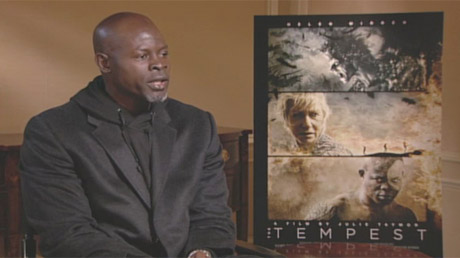
Interview: Djimon Honsou on The Tempest

0
Interview: Djimon Honsou on The Tempest

The Tempest brings Shakespeare’s final masterpiece to the big screen, I caught up with Djimon Hounsou where we talked about his Director Julie Taymor, and stars Helen Mirren and Russell Brand.

The Tempest stars Russell Brand, Helen Mirren, Alfred Molina, Alan Cumming, Chris Cooper, Djimon Hounsou and is directed by Julie Taymor.

Watch Interview.

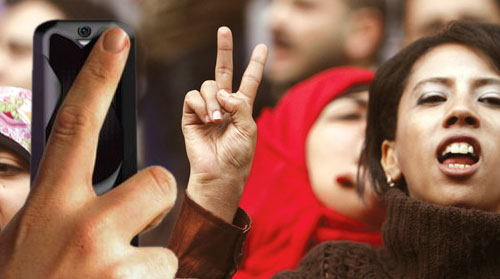
On the frontlines of revolution

0
On the frontlines of revolution

OTTAWA, Canada—It seems lazy to sit at a computer and offer freewheeling commentary via Facebook on the winter of discontent sweeping the Middle East. The sight of people standing up for their basic rights takes me back to a time when I was in Doha editing an English newspaper owned by Qatar’s foreign minister.

Some nights, I wake up dreading the prospect of running a newspaper in such tumultuous times. Other days, I miss being a part of history unfolding.

Until two weeks ago, the revolutionary zeal that was dethroning regimes in Tunisia and Egypt and rocking regimes in Yemen, Jordan and Algeria seemed like a faraway event that could be written about without too much restraint, albeit with a wary eye on what this might mean to the ruling family in Qatar. We might even have gotten away with saying that liberty and democracy are universal human values. However, with widespread rioting in next door Bahrain – a tiny island sandwiched between Saudi Arabia and Qatar – the dynamic in The Peninsula’s newsroom would have been palpably different. Editors would have become hawks, with Saturday’s call by a Bahraini opposition figure to overthrow the Al-Khalifa ruling family setting off panic attacks. Reading about demonstrations in Oman, I’d have broken into a cold sweat.

One misplaced word, a verb too strong or an empathetic headline that went too far, and the sword would fall. The laws would allow the paper to be shut down, publication suspended for a period of time or the editor facing charges of sedition, fomenting dissent or almost anything else. It’s a treacherous environment in the land that is also home to the so-called beacon of Arab freedom, Al Jazeera television.

As the Mideast faces its democratic moment, Al Jazeera has positioned itself in Canada and abroad as the most reliable news source in both Arabic and English. It reminds me of Peter Arnett reporting from Baghdad for CNN in 1991, with the same air of triumphalism. However, it is already evident that the Qatari channel’s breathless coverage of Tahrir Square in Egypt has given way to a more measured tone when it comes to the Pearl Square demonstrations in next door Bahrain and the riots in Kuwait.

Al Jazeera’s double standard may come home to roost and I can’t wait to see how the station’s much-ballyhooed journalism will cover an uprising in the streets of Doha. With the world’s second highest per capita income (after Liechtenstein), though, Qatar may be the last of the region’s emirates to come under the revolutionary spell that started with the ouster of Tunisia’s Zine El Abidine Ben Ali. Ironically, the Tunisian dictator is now a guest of Saudi Arabia, by far the most repressive of the sheikhdoms that have a throttle-hold on the world’s petroleum supplies and has a penchant for harbouring the world’s despots, beginning with the “Butcher of Uganda” Idi Amin.

For more than a half-century in this retrograde region, power has passed down to the eldest son or through palace coups staged with tacit support from Western powers, mainly the U.S. or Britain. In every other country of the world, citizens pay taxes in return for public services and infrastructure. The six “rentier” states of the Gulf – Saudi Arabia, Kuwait, Bahrain, Qatar, the U.A.E. and Oman – pay their citizens a fixed stipend from cradle to grave for the privilege of being notional owners of the oil and gas that their lands have been blessed with.

Of course, this stipend is paltry compared to what the state – read ruling family – reaps from this bounty, and dwindling oil reserves as in Bahrain and Oman mean there is not enough to go around. If Tunisians and Egyptians are now having trouble recouping the billions looted by their ousted rulers, the blurring of state revenues and private ruling family holdings in the Gulf makes the distinction purely academic. The inevitable tipping point will come when citizens realize they are being short-changed or when the tribal alliances that hold these states together break down.

The people, including majority expatriate populations in most of these states, are co-opted into this dubious “rentier” mentality through a tax-free environment that nurtures the myth that money is easy. Democracy and civil liberties are bartered for higher wages and huge perks that draw people from all over the world, including the world’s most industrialised nations. The days of cheap oil may be over in the West, but conversely, the price spike only hardens the lack of freedoms in these petro-economies.

However, as is already clear in Bahrain, Oman and Kuwait, these nations are not immune to global forces, especially when an authoritarian sentinel such as Hosni Mubarak falls. Although not a Sheikh (one privileged to be born into the ruling family), Mr. Mubarak behaved like one and came to be the Big Daddy in the Arab world. His country had a deeply unpopular peace treaty with Israel and yet he managed to cling to power for 30 years, balancing one interest against another, partially bankrolled by the U.S. Treasury.

Mr. Mubarak also saw the portent that was Al Jazeera, exclaiming during a visit to the TV station in 2003: “All that trouble from this little matchbox!” One of the first things he tried soon after his people took to the streets was to block Al Jazeera’s signal in Egypt. In the end, he was convinced that the station funded by Qatar’s rulers fuelled the uprising in his country and forced him out of office. He blamed his downfall on everybody except himself, including a seemingly democratic media institution funded by an equally unaccountable foreign Arab government.

The Peninsula and Al Jazeera were birthed in the same year (1996), but there the similarities end. The English newspaper has remained a shackled creation that has no editorial independence and primarily serves as a conveyor of news from the rest of the world. With a much bigger budget and ambition, Al Jazeera has taken the region by storm with its idiosyncratic take on the world’s hotspots and the demolishing of sacred cows along the way. It has fallen afoul of virtually every government in the region at one time or another, except, of course, its Qatari bankrollers.

As the genie of Tahrir Square rolls across a vast desert swathe, the Al-Saud, the Al-Sabah, the Al-Khalifa, the Al-Thani, the Bin Said and the Al-Nahyan ruling families are clearly circling their wagons. Just this week, the Al-Sauds announced a $36 billion – repeat $36 billion – in handout payments to its citizens as a way to ensure they remain politically stillborn while sucking off the state’s teat. It’s the world’s most elite club of wealthy rulers and accountability to their people has never crossed their minds.

Journalists at their supine media organizations may well, though, decide to be in the vanguard of a revolt, just as a key moment in the Tahrir revolution came when reporters at Egypt’s official Al-Ahram newspaper gave in to their bridled conscience and refused to make up stories for a regime on the defensive. At one point, the journalists there forced the management to issue an apology to its readers, confessing to what it called “unprofessional and unethical coverage” of the uprising. “We failed to hear the thundering message of change,” the apology read.

It doesn’t take a political scientist to see the writing on the wall. As Jill Crystal foretold in Oil and Politics in the Gulf (1990), crude oil is both blight and blessing. “Oil revenues, by precluding the coalition building that is crucial to stability, have left these regimes vulnerable. Oil and the tensions it produces carry the seeds of change…. In the future, these rulers may find themselves particularly ill-equipped to handle domestic conflict.” That hour of reckoning may be at hand at the gates of my former home in Doha.

Cameroon’s Henriette Ekwe Ebongo receives International Women of Courage Award

0
Cameroon's Henriette Ekwe Ebongo receives International Women of Courage Award

Although many women in Cameroon are economically empowered and active in civil society, they often lack the opportunity to enter politics and participate in their country’s male-dominated political sector.

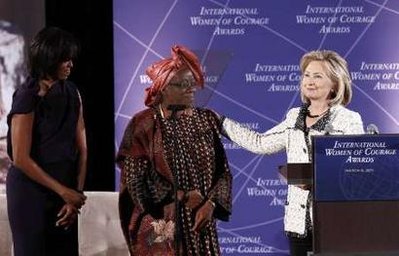
Henriette Ekwe Ebongo, a journalist and publisher of Bebela — a weekly independent newspaper — and a founding member of Transparency International in Cameroon, made that point March 7 at a roundtable discussion at the U.S. Department of State. Ekwe was in Washington to be honored at the 2011 International Women of Courage Awards.

Ekwe was selected for this award in recognition of her lifelong devotion to advancing press freedom, freedom of expression, the recognition of human rights, good governance and gender equality.

The Women of Courage Awards were established in 2007 by then–Secretary of State Condoleezza Rice to recognize and honor women around the globe who have shown exceptional courage and leadership in promoting women’s rights and advancement.

Ekwe said that in Cameroon, men dominate the political sphere. As a result, many Cameroonian women have concentrated their efforts in civil society and in creating their own nongovernmental organizations, or in working with organizations like the World Bank or the International Monetary Fund.

“Many of them [those women] have created organizations to defend women and to defend children,” she said. “They feel that they are respected much more in civil society organizations than they are in political parties.”

<object id=”flashObj” width=”486″ height=”412″ classid=”clsid:D27CDB6E-AE6D-11cf-96B8-444553540000″ codebase=”http://download.macromedia.com/pub/shockwave/cabs/flash/swflash.cab#version=9,0,47,0″><param name=”movie” value=”http://c.brightcove.com/services/viewer/federated_f9?isVid=1″ /><param name=”bgcolor” value=”#FFFFFF” /><param name=”flashVars” value=”videoId=818622026001&playerID=1857622883&playerKey=AQ~~,AAAAAGWqYgE~,KxHPzbPALrFGi6o0QhQY9IxyliWBJ3Vq&domain=embed&dynamicStreaming=true” /><param name=”base” value=”http://admin.brightcove.com” /><param name=”seamlesstabbing” value=”false” /><param name=”allowFullScreen” value=”true” /><param name=”swLiveConnect” value=”true” /><param name=”allowScriptAccess” value=”always” /><embed src=”http://c.brightcove.com/services/viewer/federated_f9?isVid=1″ bgcolor=”#FFFFFF” flashVars=”videoId=818622026001&playerID=1857622883&playerKey=AQ~~,AAAAAGWqYgE~,KxHPzbPALrFGi6o0QhQY9IxyliWBJ3Vq&domain=embed&dynamicStreaming=true” base=”http://admin.brightcove.com” name=”flashObj” width=”486″ height=”412″ seamlesstabbing=”false” type=”application/x-shockwave-flash” allowFullScreen=”true” swLiveConnect=”true” allowScriptAccess=”always” pluginspage=”http://www.macromedia.com/shockwave/download/index.cgi?P1_Prod_Version=ShockwaveFlash”></embed></object>

Ekwe lamented that the Cameroonian delegation that attended the Fourth World Conference on Women in 1995 in Beijing (along with more than 300 other women’s organizations), told no one in Cameroon upon their return of the platform that had been adopted in Beijing, which called for at least 30 percent of the any country’s decisionmakers to be women.

“We have many problems with getting women into politics,” she said. In Cameroon, there are only 21 women members of parliament (MPs) out of a total of 180, and 29 women mayors out of a nationwide total of 360, she said.

Ekwe said many women in Cameroon are educated, and many are business savvy as well, working in the markets and in many other businesses.

She explained that if a family has to choose between sending a son or a daughter to school, they don’t educate the daughter. The son is educated while the daughter is kept at home. She said many men don’t want their wives to become MPs because they don’t want to feel inferior to their wives.

Asked about the country’s electoral process and presidential elections scheduled for October 2011, she said, “If we have free, fair and credible elections, then I think we will be free to talk, we will be free to criticize.” The current president has ruled Cameroon since 1982.

Asked what she foresees for the future of her country, Ekwe said any progressive change in Cameroon will be brought about by young people who have been inspired by the role of young people in Tunisia and Egypt.

Here are the other 2011 International Women of Courage awardees:

• Kyrgyzstan President Roza Otunbayeva

• Maria Bashir, the prosecutor general in Herat province, Afghanistan

• Guo Jianmei, a director and lawyer at the Women’s Studies and Legal Aid Center in China

• Agnes Osztolykan, a member of parliament and the Politics Can Be Different Party in Hungary

• Eva Abu Halaweh, executive director of the Mizan Law Group for Human Rights in Jordan

• Ghulam Sughra, founder and chief executive officer of the Marvi Rural Development Organization in Pakistan

• Marisela Morales Ibañez, deputy attorney general for special investigations against organized crime in Mexico

• Yoani Sanchez, innovator, blogger and founder of “Generación Y” blog in Cuba

• Nasta Palazhanka, the deputy chairwoman of the Malady Front (Young Front) nongovernmental organization of Belarus

Acoustic Africa tour at the Cedar in Minneapolis on March 13

0

Three of the most brilliant stars in Africa’s musical firmament will shine in Minneapolis on Sunday evening, March 13th at 8:00 pm when the Acoustic Africa tour comes to the Cedar Cultural Center, 416 Cedar Avenue South.

Habib Koité, the Malian superstar whose exciting concerts have endeared him to audiences worldwide, has taken the traditional Mande griot praise singing of his homeland on a new course in much the same way Ray Charles diverted American gospel music down the path to rhythm & blues. Mr. Koité has previously played the Cedar with his group Bamada.

The gentle and unassuming Afel Bocoum, nephew of musical legend Ali Farka Toure, is also from Mali. Mr. Bocoum plays the guitar, sings, and composes mainly in Sonrai, his mother tongue, but also in Tamashek, the language of the Tuareg, and in Bambara.

Oliver “Tuku” Mtukudzi, Zimbabwe’s combination cultural hero and musical treasure, is also no stranger and has said the Cedar “felt like home”. “Tuku” was influenced early by the chimurenga stylings of Thomas Mapfumo. His unique musical blend of mbaqanga, JIT, and traditional kateke drumming is captivating, while his powerful lyrics blaze with the social and economic aspirations of Zimbabwe’s people.

Acoustic Africa featuring Habib Koité, Afel Bocoum and Oliver Mtukudzi

Time: Sunday, March 13, 2011 – 8:00pm

Doors Open: 7:00pm

Tickets for this seated show (ltd space for standing) are available now:

Advance: $30.00

Day of show: $35.00:

Phone: 612-338-2674 ext 2 ($1 fee per ticket)

In person: From a Cedar volunteer in the front lobby before and after shows (no fee), Depth of Field (no fee), or Electric Fetus (small fee)

Online: Ticketweb (fees apply)

All Cedar shows are all ages.

Students with ID may gain discounted admission for tickets purchased at the door.

Cedar website.