Home Blog Page 217

Talking to Your Traumatized Child

0

After her son’s suspension, Mary called the school social worker for help with his behavior and trouble sleeping. Although she was not comfortable calling the social worker, a community member encouraged Mary to ask for support in raising her son.

At the meeting, the social worker asked Mary about her life. Mary reluctantly told what happened during the war. Since her husband died, Mary has been unsure how to parent her son and discipline him in a new culture. She is considering sending her son back to Africa even though there is continuing conflict. And, she is worried her own immigration status may be affected if her son continues to get into trouble.

The social worker listened closely to Mary’s story before reassuring her that she would not be sent home for having trouble with her son. Schools do not share information with immigration officials. Then he explained that Mary’s son may be misbehaving because of his own reactions to the war and ongoing stress. He asked Mary if she talked with her son about his feelings. Mary said she felt uncomfortable talking about the past and hoped he would just forget what happened.

The social worker suggested that talking with adults about his feelings might help the boy. He recommended Mary find outside support to help her and her son talk with each other better. A trusted friend, faith leader or counseling professional could help them understand their struggle as normal responses to war trauma. Mary thought the social worker’s advice was reasonable and began thinking about talking with her son about his feelings.

Whether or not a child is having trouble at school, it is good for parents to talk with their children about feelings.

First, pick a time to talk with your child when you are both rested and calm. Listen to your child in a supportive manner. Acknowledge your child’s feelings and fears. Even if based on misinformation, your child’s feelings are real and need to be understood. Children talk about their emotions only when feeling safe.

Surviving war is upsetting and difficult for everyone. Tell your child it is normal for both adults and children to be troubled. Reassure your child it is okay to share feelings of worry, anger or sadness.

Talk about how you take care of your own anxious feelings. Your child will know that you are okay and learn new ways of managing feelings. 

Avoid letting your child hear bad news and upsetting phone calls. Hearing about bad events can increase feelings of worry. When your child does hear upsetting things, be prepared to talk about the situation.

Keep up a normal family routine as much as possible. Attend your local church or mosque. Find time to be together even if you are working long hours. Don’t avoid your child when you are stressed, but be sure to find a way to manage your feelings. Sometimes a phone call during the day may be helpful to you and your child.

Continue to take care of yourself. Parents who manage their feelings well can help their children learn to deal with school situations in better ways. It’s not just your words that comfort your children. Your movements and facial expressions also tell your child whether or not everything will be all right.

By talking together you and your child can work together with school staff to find better ways of dealing with problems in school. Don’t be afraid to seek professional counseling help if you and your child cannot solve these problems together. With time and hard work, you can help prepare your child for success in school and life.

This article was written by staff of the Center for Victims of Torture. CVT is a nonprofit organization whose mission is to heal the wounds of torture on individuals, their families and their communities and to stop torture worldwide. For information or referral, call 612-436-4800.
USCIS Announces 18-Month Extension of Temporary Protected Status

On March 10, the U.S. Citizenship and Immigration Services announced an 18-month extension of Temporary Protected Status (TPS) for nationals of Somalia through Sep. 17, 2009. Under this extension, those who have already been granted TPS are eligible to live and work in the United States for an additional 18 months and continue to maintain their status. Also, the USCIS automatically extended the validity of Employment Authorization Documents held by eligible Somalis for an additional six months (from March 17, 2008  – September 17, 2008). USCIS believes this will allow sufficient time for eligible TPS beneficiaries to receive their new work authorization documents without any lapse in employment.

TPS is a temporary immigration status granted to eligible nationals of certain countries designed by the Secretary of Homeland Security because those countries are experiencing temporary negative conditions, such as armed conflict or environmental disasters, that make it difficult for the nationals to return in safety or for the countries to accept their return. 

Nationals of Somalia who have been granted TPS must re-register for the 18-month extension during the 60-day re-registration period beginning March 12, 2008 and remaining in effect until May 12, 2008. 

To re-register, a TPS beneficiary must submit a Form I-821, Application for Temporary Protected Status, without the application fee, and a Form I-765, Application for Employment Authorization.  If the applicant is only seeking to re-register for TPS and not seeking an extension of employment authorization, the Form I-765 must still be submitted for data-gathering purposes. All applicants seeking an extension of employment authorization through Sep. 17, 2009 must submit the $340 filing fee along with the $80 biometrics fee.

Applicants may request a fee waiver for any of the application or biometric service fees. The necessary forms are available through the toll-free USCIS Forms Hotline (800) 870-3676 and on the USCIS website, www.uscis.gov.

USCIS Announces Biometric Changes For Re-entry Permits and Refugee Travel Documents


Effective March 5, 2008, all applicants filing a Form I-131, Application for Travel Document, are required to appear at an Application Support Center for biometrics (e.g. fingerprints and photographs). As with other applications, when the biometrics requirement becomes effective, USCIS will notify applicants of their appointment at the designated ASC after submission of the I-131 application.

The new Form I-131 instructions require that applicants for re-entry permits and refugee travel documents who are between the ages of 14 through 79 must provide biometrics before departing from the United States.   Applicants also are strongly encouraged to apply, whenever possible, well in advance of their anticipated travel dates to allow time to attend their ASC appointments and to receive their travel documents.   The necessary forms are available through the toll-free USCIS Forms Hotline (800) 870-3676 and on the USCIS website, www.uscis.gov. Shortly after filing a Form I-131, USCIS will mail the applicant a receipt and an ASC scheduling notice. 
In addition, if applicants require expedited processing, the instructions provide specific information for submitting pre-paid express mailers with the Form I-131 for USCIS to send the applicant his or her receipt and ASC appointment notice, as well as the completed Re-entry Permit or Refugee Travel Document, if approved.    A request for expedited processing should contain the applicant’s reasons for such processing.

In its announcement, USCIS stated that changes to the Form I-131 instructions concerning biometrics are vital to the security of the immigration process, as well as to help ensure that USCIS complies with congressional mandates for issuance of secure documents.  The added biometric requirements will provide the Department of Homeland Security with an opportunity to conduct more in-depth security background checks for applicants for immigration benefits or re-entry permits and refugee travel documents for entering the United States. These requirements also improve USCIS’ capability to verify identity and for applicants to obtain secure documents that are less subject to fraud and abuse.

U.S. Supreme Court Grants Certiorari to Consider Persecutor Bar to Asylum

On March 17, 2008, the U.S. Supreme Court granted certiorari to decide whether a person who was compelled, against his will, to assist or take part in persecution is barred from asylum under the persecutor bar at INA § 208(b)(2)(A)(i). The case involves an Eritrean citizen (“petitioner”) who worked as an armed prison guard. The petitioner objected to and occasionally disobeyed orders to inflict punishment on the prisoners. Nonetheless, the Board of Immigration Appeals found that the petitioner assisted in the persecution of others and therefore is statutorily ineligible for asylum and withholding of removal. The Fifth Circuit Court of Appeals (which hears cases from Texas, Louisiana and Mississippi) affirmed the decision of the Board of Immigration Appeals. In its order, the Fifth Circuit noted that whether the petitioner was compelled to assist authorities or whether he shares the authorities’ intentions is irrelevant. It is expected that the Supreme Court will hear this case in the term beginning Oct. 6, 2008.

Getting The Most From Auto Expenses

0

Deduct the actual business-related costs of gas, oil, lubrication, repairs, tires, supplies, parking, tolls, drivers’ salaries, and depreciation. Use the standard mileage deduction and simply multiply 50.5 cents (the rate for 2008, 2007’s rate equals 48.5 cents) by the number of business miles traveled during the year. Your actual parking fees and tolls are separately deductible under this method. Which method is better?
For some taxpayers, the standard mileage rate produces a larger deduction. Others fare better tax-wise by deducting actual expenses.

Tip: The actual method allows you to claim accelerated depreciation on your car, subject to limits and restrictions not discussed here.

The standard mileage amount includes an allowance for depreciation. Opting for the standard mileage method allows you to by-pass the limits and restrictions and is simpler, but often less advantageous in dollar terms.

Caution: The standard rate may understate your costs, especially if you use the car 100% for business, or close to that percentage.

Caution: Once you choose the standard mileage rate, you cannot later use accelerated depreciation if you opt for the actual cost method in a later year. You may then use only straight line.

Generally, the standard mileage method benefits taxpayers who have less expensive cars or who travel a large number of business miles.

How To Make the Most of Your Auto Deductions
Keep careful records of your travel expenses. We won’t be able to determine which of the two options is better for you if you don’t know the number of miles driven and the total amount you spent on the car.

Furthermore, the tax law requires that you keep travel expense records and that you give information on your return showing business versus personal use. If you use the actual cost method, you must keep receipts.

Tip: Consider using a separate credit card for business, to simplify your record-keeping.

Tip: You can also deduct the interest you pay to finance a business-use car, if you’re self-employed.

Note: Self-employees and employees who use their cars for business can deduct auto expenses if they either (1) don’t get reimbursed, or (2) are reimbursed under an employer’s "non-accountable" reimbursement plan. In the case of employees, expenses are deductible to the extent that auto expenses (together with other "miscellaneous itemized deductions") exceed 2% of adjusted gross income.

Minnesota Artists Hold mnSpin

0
Minnesota Artists Hold mnSpin

Spread out on the tables at Nomad World Pub on the West Bank of Minneapolis are candy cigarettes alongside tattoos for the Minnesota Historical Society, pens and a keychain.  Lying underneath these trinkets is literature for mnSpin, Summit Brewery, and mnartists.org, a project of the McKnight Foundation and the Walker Art Center. 

In a crazy connect-the-dots way, it all fits together.  Mnartists.org provides a cyber home for a medley of artists and arts organizations across Minnesota.  Now, in addition to offering a central gathering place on the Web, they’ve taken on the challenge of promoting Minnesota musicians through a contest they’ve named mnSpin. 

mnSpin runs with the sponsorship of both mnartists.org and Summit Brewery.  In keynote position is Rachel Joyce, assistant director of public relations at the Walker Art Center. 

“It is my hope that more established Minnesota musicians can reach new audiences through mnSpin, and that emerging talent gets the opportunity to connect with successful Minnesota artists, Minnesota music fans, and the music industry professionals who serve as judges,” Joyce says.

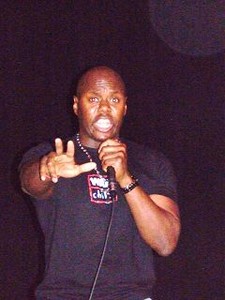
Saturday, at Nomad’s the public has its first taste of the sort of music mnSpin is attracting.  Z-Plus jumps on stage yelling, “You ready to have a good time tonight?” He then launches into War Child, a song he wrote recalling the war-stricken children world-wide.  Beneath his rapping vocals, Tracey Tarley sings backup.

Z-Plus performs several songs including a few with Kazeem, another rapper from Chicago.  It’s quite a leap to see Z-Plus dressed down from his day job at a Minneapolis bank.

The crowd of over a hundred people includes a mix of age, race, and probably interest.  The other artists scheduled to perform are Alison Rae, an acoustic guitar player who performs poignant solo songs and The Sexy Bang, a rocker band with a well-chosen name. 

With such diverse music sharing one stage consecutively, what appeals to one part of the audience might not entice another.  Z-Plus comments after the show, “I was a little nervous because of the mixed crowd but it all came together well and I was happy with my performance.” Z-Plus concludes of the experience, “It was awesome.”

Joyce reports that there were over 80 entries for the first quarter’s contest with an even greater amount pouring in for this current quarter.  Of the three judges for this second quarter’s event is M.anifest, a rapper from Ghana who released a critically acclaimed debut album, Manifestations in 2007. 

African immigrants have long found support from Joyce with her involvement in the African immigrant community, promoting events such as Afrifest and Diverse Emerging Music Organization (DEMO) and hosting the world music show “Shake and Bake” on KFAI radio.  With the advent of mnSpin, Joyce provides even more sustenance.

“I have made it a personal challenge for myself to make sure African and world music artists who are often over-looked in the music scene locally get access to the exposure that participation in mnSpin can offer,” Joyce says.

And what about those tattoos on the table?  Minnesota Historical Society, cooperating with Springboard for the Arts and the McNally Smith College of Music will present workshops for mnSpin participants in areas of professional development.  Summit Brewery provides a party with refreshments afterwards.

Kenyan Constitution like ‘Spoilt Milk,’ Says Kiai

0

BLOOMINGTON, Minn. – Maina Kiai, the chairman of Kenya National Commission on Human Rights, said Saturday that hoped President Mwai Kibaki and opposition leader Raila Odinga, who recently signed agreement to share power, would focus on replacing a constitution he said expired years ago.

Kiai was addressing Kenyan-born residents of Minnesota and their friends, who flocked the Sheraton Hotel in Bloomington to hear a first-hand account of the post-election violence that led to the death of over 1,000 Kenyans and the displacement of an estimated 300,000 others. While the violence shocked Kenyans abroad and the international community, Kiai said the signs had been there for many years.

 “It was bound to happen,” Kiai said.

Kiai attributed the violence to a constitution that allows a winner-take-all political system, which raised the stakes and made politicians more willing to incite Kenyans to kill each other.

“Kenya’s constitution was like milk with a sell-by date,” Kiai said. “That date was in 2002. For five years we have been drinking spoilt milk and in December it gave us diarrhea,” he added, as his audience applauded with laughs and cheers.

Kiai cautioned Kenyan against laying all their hopes in a political deal made by competing politicians, but instead pressure Kibaki and Odinga to put Kenyans first. He cited the response former UN Secretary General Kofi Annan gave when Kiai thanked him for brokering the peace deal because “when two elephants fight, it is the grass that hurts.”

“Anna told me, ‘At the same time, when these same elephants make love, the grass hurts too!’” Kiai said amid laughter. “We have to make sure they don’t make love too much.”

Kiai said he hoped that the “co-presidency” agreement would create a functioning Parliament that would shepherd reform. He advised the unity government to have not more than 25 ministries with a balanced portfolio where ministers and permanent secretaries alternated between parties.

Organized violence

Citing the burning of a church in Eldoret that left an estimated 50 people dead, and the later vengeful killings in Nakuru by members of the dreaded Mungiki sect, Kiai said it was clear that some leaders were behind it.

“I am not sure if it was pre-planned, but it was organized,” Kiai said.
 
Kiai said that on his visits to mortuaries in Kisumu, Kakamega and Migori, he saw that victims had gun shots wounds on their backs, indicating that they had been shot by police officers as they fled – a gross violation of human rights by the state.
Kiai said the political upheaval and violence that pitted Kenyans against people they had lived with side by side as neighbors also found the Good Samaritan in many Kenyans once the killings had stopped. Even members of Kenya’s middle class, who have come under fire in the past months for detaching themselves from the crisis by hiding in the safety of their suburban homes, came out in droves to donate resources to those affected by the violence.

Peace and reconciliation

Kiai called for a truth and reconciliation commission that would bring to justice the perpetrators of the violence in different parts of the country. He alluded to high ranking politicians in instigating violence and was confident that they would face their day in court. This same commission would be urged to facilitate peace talks between different Kenyan communities. Other things that the commission would include solving Kenya’s land issue, and a national discussion on creating new economic resources for the country’s poor who solely rely on depleting land resources, Kiai said.

In response to Kenyans who contend that such a commission would hurt the country by reviving old pain, Kiai said: “There is no healing without pain. When you have a decaying tooth, you have to go through a painful extraction to avoid an infection that could kill you.”

Several members of the audience expressed concern over the continued violation of human rights as internally displaced persons continue to live in fear for their lives. Some Kenyans continue to live in camps while others have sought refuge in neighboring Uganda and Tanzania. According to news reports at least 50 people have died since the deal was signed two weeks ago. The crisis has left a wound that will take Kenyans a while to heal.

“The crisis has exposed our differences,” Kiai said. “Members of different communities continue to distrust each other.”

OLM Inaugral Ball

0

The organization of Liberians in Minnesota (OLM) held a customary
inaugural dinner and ball this past Saturday at Cedar’s Hall in
Minneapolis. The ball which started with guests arriving at 5:30pm was
in honor of now OLM President Kerper A. Dwanyen. Dressed in beautiful
gowns, suits and traditional wear, OLM Board members, the Vice
President Andrew G. Tehmeh, Tribal Elders and President Kerper Dwanyen
walked the red carpet into the hall where those gathered applauded in
warm welcome.

The soft light hall had round tables surrounding a huge wood tiled dance floor. A long table at the head of the room held the members of the OLM and guest speaker Congressman, Minnesota 5th District, Keith Ellison. The evening begun with a word of prayer by Rev. Geraldine Freeman, before a dinner that consisted of salad, chicken with stir-fried rice and drinks. Traditional Liberian music playing in the background as people enjoyed dinner and small talk.

OLM was formed over thirty years ago by the Liberian community in Minnesota, with the intention of assisting families intergrrate into the American lifestyle, as well as build networks to maintain relations and livelihood amongst each other.

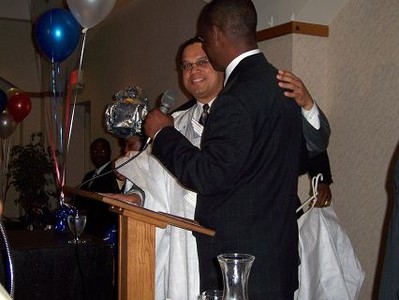
A vibrant voice suddenly burst through the speakers, as a young woman, Tarloh Quiwonkpa accompanied by Cross Atlantic Crew, took to the floor performing dances to Liberian songs. Tarloh danced with vigor and purpose as her soulful voice drew the audience into the music. Though not Liberian, I could easily sense the bond of togetherness among those gathered at Cedar Hall. Congressman Ellison who was the guest speaker of the evening, took to the podium after the exciting musical performance. Congressman Ellison has been very involved in the Liberian Community over the years and helped push for the extension of the temporary permanent status, when Liberians had been asked to go back to their home country.

His speech was received with great applause, especially when he joked that he was Liberian and commended the OLM President on his qualities as a good listener and communicator. He urged Liberians to ‘get on the bus’ and support  Dwanyen in his work to lead them to the future.

David Dwanyen and Renee Mompremier had the honor of introducing their father, OLM President, to present his speech. Kerper Dwanyen begun his speech by recognizing members of board, distinguished guests and his fiance’ Ms. Re Cooper. Humble and articulate in his speech, Dwanyen listed key changes that the OLM needs to undertake to better the committee and the Liberian community as a whole. This changes included structural reform to attain a unitary chain of command with board of directors, political involvement with the aid of Liberian Community Action (LCA) so as to represent political aspirations of the Liberian community and participation in the reconstruction of the education and health care centers in Liberia. He urged Liberians to invest in their home country to aid in the rebuilding and economic advancement of Liberia. Dwanyen concluded his speech quoting JFK Junior, with a little twist of his own saying, “Ask not what OLM can do for you, but what you can do for OLM.”

Right before the ball was about to commence, four young girls presented a beautiful poem, “Dare to Dream”. Each in her own character and absorbing personality, the girls individually presented a poem on wisdom, responsibility, good investment, love and sound judgment. The performance called on the youth and elderly to raise children with the above mentioned qualities to ensure a good purposeful future for both the young and the old. The audience proudly applauded the presentation while nodding their heads and murmuring their approval of the spoken words.

Thereafter, people gathered on the dance floor to the beat of Liberian music. It was a mesh of beautiful evening gowns and elaborate traditional wear that included big hats strategically placed on womens heads. From where I was seated, I could take it all in and deeply appreciate the beauty of it. The evening was definetely one that will be memorable for days to come.

Rep Ellison Urges Minnesota Liberians to Run for Office

0
Rep Ellison Urges Minnesota Liberians to Run for Office

MINNEAPOLIS – Rep. Keith Ellison, the first African American from Minnesota to be elected to the U.S. Congress, challenged Liberians in the state to run for political office.
 
Ellison was speaking Saturday at The Cedars Hall in Minneapolis, during the Inaugural Ball of Kerper Dwanyen as the 20th president of Organization of Liberians in Minnesota.

“I am looking forward to a day when a Liberian will get on the ballot and run for political office,” Ellison said.

Rep. Ellison, who served as guest speaker, lauded Liberians and said they are blessed with great gifts. He said Liberia and the United States have a special relationship which dates back to the 1800s.
 
He noted that the name “Liberia” means freedom. He asked Liberians to push for the passing of the “Liberian Permanent Act” to enable their fellow citizens living in the United States under temporary protected status to become permanent residents before expiration of the 18-month extension President George W. Bush granted them in September.

In his inaugural statement, Dwanyen said that OLM had established a political action committee – the Liberian Community Action (LCA) – “to elect Liberian Americans to city council seats” in Brooklyn Center and Brooklyn Park.

As Kenya Celebrates Power Deal, Real Test Begins

0

The post-election violence was fueled in part by outrage resulting from President Mwai Kibaki’s failure to honor a similar accord with opposition leader Raila Odinga that led to Kibaki’s election in 2002 as Kenya’s fourth head of state.

NAIROBI, Kenya – A few days before Kenyan President Mwai Kibaki and his main opponent Raila Odinga signed the Feb. 29 agreement to share power, it looked as if the country was closer to returning to the post-election ethnic violence that had claimed the lives of more than 1,000 people and left hundreds of thousands more wounded and displaced.

Earlier in the week, it appeared as though Kofi Annan, the former United Nations secretary general who was leading the talks, was going to fail a task he had embarked on more than a month earlier to bring together Kibaki’s Party of National Unity and Odinga’s Orange Democratic Movement after the Dec. 27 disputed elections.
 
Violence erupted in many parts of the country on Dec. 30 when the Kenya’s electoral commission declared that Kibaki had won a second term, despite evidence that the tallying of the votes had been seriously flawed.

When Annan, who had been in the country since Jan. 22, emerged from the meeting with both parties to announce that he was suspending the talks, panic spread a cross the country as Kenyans feared that ODM would call for fresh “mass action,” which could have certainly led to riots and more violence. But the former UN chief did not give up; he went to straight to the top by calling a meeting with Kibaki and Odinga. By the end of the week, he had managed to get the two leaders to sit next to each other at a desk outside the Office of the President to sign an agreement to share power.

“This process has reminded us that, as a nation, there are more issues that unite than divide us,” Kibaki said after signing the documents.

Odinga added, “With the signing of this agreement, we have opened a new chapter in our country’s history – from the era or phase of confrontation to the beginning of co-operation.”

A time of merry

After the two leaders signed the agreement, Annan said, "Today we have reached an important stage, but the journey is far from over. The real challenge now is for President Kibaki and honourable Raila Odinga to work together to heal and reconcile this nation, working jointly to implement the reform agenda on which they have agreed, and sustaining the effort until the job is done.”

Celebrations rocked opposition strongholds and other parts of the country as news spread that Odinga and Kibaki had signed a power-sharing deal that would bring an end to the post-election turmoil and political impasse that had engulfed the country for two months. Residents took to the streets of the lakeside city of Kisumu to as motorists hooted to celebrate the good news. In the coastal city of Mombasa, celebration was the same soon after the deal was signed. Revellers, singing and dancing, jammed entertainment joints. Tourism businesses, which were severely affected by the violence, were prompt to react.

Some citizens asked the Government to pick a work-free celebration day in the following week to compensate for the New Year’s Day, which Kenyans did not celebrate because the violence began on Dec. 30. Many also commended Odinga for agreeing to work with Kibaki.

In the North Rift, however, there were mixed reactions to the deal. Cheruiyot Ruto, a resident, said the deal was an affront to democracy. But many people called for reconciliation and healing, with others saying that the arrest and prosecution of people suspected to have engaged in violence should stop in order to achieve peace.

Residents praised Annan for his humility, saying that his team had done a commendable job despite opposition from hardliners on both sides.

There was excitement at camps for the displaced in the western district of Trans Nzoia when people received the news. They urged Kibaki and Raila to facilitate their return to their homes.

The agreement between Kibaki and Odinga will see the return of the Office of the Prime Minister, scrapped in 1964 by Jomo Kenyatta, Kenya’s founding president. The prime minister will supervise all Cabinet ministers and lead the government in Parliament. The arrangement will also provide for a sharing of Cabinet positions based on the strength of parties in the Parliament. The prime minister will be assisted by two deputies, positions that will be shared by PNU and ODM.

The power-sharing deal also stipulates that to fire the prime minister the president must seek consultation from the parties involved. Such a decision must also be put in writing and made in agreement with the prime minister’s party. But the prime minister may be removed by a motion of no confidence in Parliament by a majority vote.

A historical accident

Both parties agreed to work together to ensure that Parliament cements the agreement into the Constitution. When that is completed, the leader of the political party with the largest number of members in Parliament will almost automatically become the prime minister.

Foreign leaders, who had been involved in one way or another in brokering the truce expressed satisfaction with the agreement. Tanzanian President Jakaya Kikwete, who is also the chairman of the African Union, called the post-election violence a historical accident, adding that it was possible to make it a “thing of the past.” Kikwete, who flew to Nairobi to continue the mediation after hosting U.S. President George W. Bush for four days, said the toil and sweat of the mediation team had been handsomely rewarded.

“This agreement, if implemented fully, will help the people of Kenya,” Kikwete said.

British Prime Minister Gordon Brown told journalists that Kenya’s leaders had reached a power-sharing agreement that represented a triumph for peace and diplomacy, and a renunciation of the violence that had scarred a country of “such enormous potential.”

 “Common sense has prevailed, and the Kenyan people have the outcome for which they have hoped and prayed,” Brown said. “I applaud the courage that Kenya’s leaders have shown in taking the tough decisions necessary to put Kenya back on the path to the prosperity, democracy and stability which it is so richly deserves.”

Tom Casey, the U.S. State Department deputy spokesman, said the agreement was an important and very positive step forward for Kenya.

“We are very pleased to see that this agreement has been reached,” Casey said.  “We want to see this agreement implemented. We certainly would hope that everyone associated with their (Kibaki’s and Odinga’s) political parties and movements would work with them to support this deal and move it forward.”

Negotiations not over

Although the agreement was good news, it is unclear how President Kibaki and Odinga are going to make it work. There is still a strong rivalry between the two men stemming from the failure of a similar agreement popularly know in Kenya as the MoU or memorandum of understanding. If fact, what led to the bitterness between the two men was their subsequent differences on the agreement signed before the 2002 elections to rally Odinga’s followers behind Kibaki against KANU, the incumbent party.

But there is hope that the involvement of the international community in the brokering and signing of the new accord will force Kibaki and Odinga to put aside their differences for the good of Kenya. If they succeed, the memorable covenant could usher in a new era of reforms that successive regimes had procrastinated over, leading to the post-polls meltdown.

Although Annan left Kenya on March 2, the team of mediators, headed by Nigerian diplomat, Ambassador Oluyemi Adeniji continues with the talks to define the specifics of how it will be implemented to address, land access, injustice, poverty and corruption in government – the main problems that led to the violence.

African Businessman Learns that Diversity Pays

African Businessman Learns that Diversity Pays

As small businesses struggle with tough economic times, Graham Kigo’s fortunes have taken a 180-degree turn and he is ‘finally making money’ because he has reached out to his neighbors.

HAYWARD, Calif. – Just over a year ago, Graham Waweru Kigo was contemplating quitting his bar and entertainment business after five years of barely staying afloat. Kigo had entered the business with – not experience or training – but a lot of emotion and flawed math.

“I had left my job after a long time and I didn’t want to work for anyone anymore,” Kigo says. “I figured I’d just become my own boss.”

Based on a few simple calculations, Kigo decided a bar would be the most profitable.

“I did my math and found that even if I bought beer at the supermarket price, I could make as much as four times more, and with entertainment on the weekends, I couldn’t go wrong,” Kigo says, smiling sheepishly as if to mock himself for having been so naïve.

So in early 2002, Kigo, who is from Kenya, bought Foxes Cocktail Lounge in Hayward, a city on the eastside of the San Francisco Bay Area. Soon, word went around that an African had bought a club in Hayward and fellow Africans started to flock there. Kigo replaced the entertainment schedule of this once country-western bar with one full of African dance parties. For a while, it seemed like he had made a great decision to go into the business.

Then, perhaps because the novelty of Foxes had diminished, the number of Africans going to Foxes on weekends began to dwindle. 
“I couldn’t tell why they stopped coming,” he says. “I was the only one around here playing African music and selling Tusker (a Kenyan beer).” 

Desperate to bring them back, Kigo started to book African entertainers like Shimita El Diego, a renowned Congolese musician who had relocated to California with his Affro-Muzika band. The first night brought a full house, but when only a dozen or so people showed up a few months later to the concert of a man who had played with the great Lokassa Ya Mbogo and veteran guitarist Dally Kimoko in Soukous Stars, Kigo knew he was in trouble.

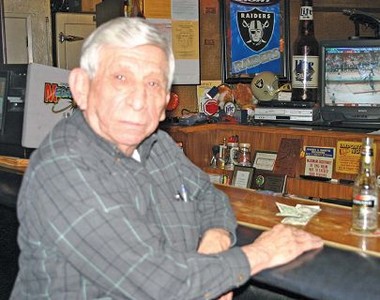
Soon Kigo realized that in addition to loosing his fellow African customers, non-African patrons like 70-year-old Al Alvarez, who had been coming to the lounge since 1972 had reduced their trips to Foxes or stopped coming all together. Most of them were people who went to Foxes because of its proximity to their homes, Alvarez says.

“A lot of bars in Hayward have closed down,” Alvarez says.  “This one is very convenient for me because it’s only a mile from my house.”

Other non-Africans who used to come to Foxes and stay until closing began to leave early because the entertainment schedule had become exclusive. That is when Kigo realized that he had broken a promise of inclusion he had made to himself when he bought the bar.

In 1987, while Kigo was a student at nearby California State University, he and a friend walked into The Brandin’ Iron, as Foxes was known back then, to have a drink. Although it was not a busy hour at the country-western bar, the bartender kept telling them they would be served, but continued to chat with his friends.

“It took us a while, but we finally realized that we were not welcome at The Brandin’ Iron,” Kigo recalls.

Kigo and his friend walked out 15 minutes later after realizing that they were not going to be at¬tended. The bartender, who clearly saw them leave, made no at¬tempt to call them back.

Nearly 15 years later, when Kigo was looking to become his own boss, he went to a real estate broker in nearby Walnut Creek and contracted him to search for a bar. After visiting the Foxes in No¬vember 2001, Kigo decided the location was was ideal and went into the bar to learn more about its history.

“Then I said to myself, ‘Wait a minute: This is the same place we were denied service,’” Kigo remembers.

The only things that had changed since the night the bartender wouldn’t serve him, says Kigo, were the name and ownership of the club. Bruce Fox, the man he bought it from, had purchased it in 1997 and renamed it Foxes, ending The Brandin’ Iron’s life, which began in the early 1960s. However, Fox had kept its country-western theme.

Kigo decided to buy the bar and promised himself to redesign it to welcome everyone. First on his list was the removal of some of the country-western memorabilia, such as steer horns and rifles.

“The most memorable thing I have in the storage is a seven-foot branding iron,” Kigo says.

Before Kigo realized a year ago that he had forgotten his vow to make Foxes a place where everyone feels welcome, he thinking about giving up. He was barely breaking even. He came to work early and left late everyday because he couldn’t get bartenders to stay. In just five years, he estimates that 45 bartenders had worked at Foxes. Many of them had quit because they were not making enough money, but the majority of them he had fired because they had stolen from him, after he trusted them – another evidence of how little he knew when he started the business.

But what kept Kigo from selling the bar was the thought of returning to the corporate world he had left behind. Although he had been a manager, he couldn’t imagine returning to a similar job after such a long time away. So he decided to try a different approach to revive his business. He had learned that he couldn’t depend on African immigrants alone because their population was not as large those of, for example, Latinos and Asians, who had communities that had established themselves and built loyal customer bases.

Today, Foxes’s weekend entertainment schedule caters for a diverse group of customers. There is hip-hop, African, and Latino music. Non-African customers like Guillermo Mendoza and his friend Manolo Beltran, who come to Foxes every Friday to drink and play to pool while listening to Latino music from the jukebox, are slowly returning.
Like Alvarez, they come to Foxes because it’s close to their home.

 “And he is a good guy,” Mendoza says pointing toward the bar at Kigo.

Kigo has realized that a good relationship with area residents like Alvarez, Mendoza and Beltran is important. At five o’clock one Friday evening, barely an hour after opening, there are already a dozen customers from the neighborhood. That is a big change from a year ago, Kigo says.

“I’m finally making some money.”

Closing Thoughts On Way Forward for Kenya

0

Yesterday, Kenya’s 10th Parliament convened formally, to implement the Harambee House Accord. Kenya’s urban middle classes bask in the justified relief of our country being pulled back from the very brink of civil war. But the 600,000 Kenyans living in appalling destitution in IDP camps have nothing to celebrate.

The lavish motorcades to Parliament, the assurances of speedy economic recovery, the pretense that everything is "back to business as usual", are the clearest signs we could have of the criminal blindness and self-interest of the political class.  This is the blindness and greed that dragged Kenya into this crisis in the first place. Never again can Kenyans allow the power and resources of the country to be concentrated in the hands of a tiny, powerful elite.

So what must we do?

Firstly, stay involved in civil society initiatives set up in the past two months. Rescue Kenya offers a comprehensive list of the groups and organizations set up, across all sectors, from civilian humanitarian relief to political action. Among the forces that brought Kenya back from the abyss, the strength and speed with which Kenyan civil society mobilized, domestically and internationally, cannot be discounted.

Secondly, participate in the political process. Tom Maliti, AP Kenya correspondent, offers this blueprint:

"As citizens, it is our national duty to remind our parliamentary leaders that this is not just about them. It is about all of us.
 
"How do we do that? Many of us went to the same school with a current member of parliament or have worked with them or just attended a half day seminar with them before they became politicians. Or it was their relative we were in school with or the person we know is an aide or key ally.

"We are connected. This is one time we need to make those connections work. Individually, for example writing to them, or collectively through the neighbourhood association.

"If the member of parliament is not easy to reach, try your local councillor. Many councillors live in the ward they represent and are easy to find. Many also act as grassroots mobilisers or coordinators for members of parliament and can easily get in touch with the area member of parliament.

"Under the arrangement elaborated in the accords, there is not going to be a significant opposition in parliament. So who will act as a check on the government? Ensure that what the politicians have agreed to is implemented? As citizens we will be required to be more vigilant than before.

"In the months to voting day, lots of questions were raised about the type of political parties we have. The chaotic nominations of parliamentary and civic candidates prompted many of those questions. The general sense was, "Well, that is politics for you". It doesn’t have to be that way. And there’s a possible answer: the Political Parties Bill.

"It was passed by parliament in November and is waiting for the assent of President Mwai Kibaki. The importance of this bill is it proposes to steer our political parties to become mature organizations that are responsive to their members and have a national agenda.

The Political Parties Bill requires political parties to report each year to the Registrar of Political Parties on their membership countrywide, financing and other issues. If passed, a lot of briefcase parties will disappear simply for failing the membership criteria. The bill also provides for the Treasury to give some funding to parties with a certain level of representation at the council or National Assembly level. This could, I emphasise could, help political parties ease the grip people with deep pockets have on them. The catch is this: it does not have clear criteria on limits of funding by an individual or company, nor does it make it mandatory for parties to disclose who is funding them and how.

"The Political Parties Bill offers an opportunity towards a different politics. Talk to your MP to talk to the president to sign the bill into law.

"But matters do not end there. Assuming your preferred political party is able to recruit a substantial and committed national membership, is able to fundraise for its needs, will willingly and publicly account for the monies, and has a clear agenda that is tied to principles and not individuals, where are the people to make all this happen?

"A big challenge for any political party today is staff. From the simplest job to the most complex. Many people volunteer their time, services and money during election time. Once the election is over, however, they go back to their routines. And yet we still expect political parties to work and satisfy our ideals of what politics should be. Why?

"If you recognise Kenya is at a historical moment and want to make a contribution, opportunity is knocking at your door. Answer, give time to your preferred political party, even if it is just one Saturday a month.

"If you don’t, who will?"

This will be my final Kenya Crisis blog on Mshale. In addition to the demands of my other life, as a working and touring artist, I will be devoting my time to working on the ground in Nairobi with Kenyans for Peace with Truth and Justice.

My thanks to all of you who have read this blog in the last 2 months, shared and acted on the information in it. May we all continue to work for a Kenya where every life is of equal value.

Minnesota Artists Ready for another Wild mnSpin

0
Minnesota Artists Ready for another Wild mnSpin

Liberian rapper, Z-PLUS, is among the musicians who will compete and showcase their talents.

Reaching into the masses and pulling out winners is what mnSpin, the annual competition and showcase of Minnesota artists, hopes to do this year.  Well on their way, each week since Jan.14, they’ve posted on-line a trio of songs from a raft of submissions for this first quarterly music contest. 

mnSpin, created by mnartists.org, which in turn was established by the McKnight Foundation partnered with the Walker Art Center’s New Media Initiatives group, seeks to skim off the best of Minnesota’s local musical artists who submit their work for competition and feature their work on the Internet in key locations.

Rachel Joyce, Assistant Director of public relations for the Walker Art Center coordinates mnSpin.  For this first round of entries, she was joined in judging by Chris Roberts, arts reporter for Minnesota Public Radio news and host of “The Local Show,” Kate Galloway, artist and repertoire coordinator for Compass Productions, and Dessa, a Minneapolis writer and rapper.

From each quarterly winning line-up, several artists will have their music played at listening parties at area venues. The party will feature guest DJs playing the music of contest winners and live entertainment.   The first listening party, sponsored by Summit Beer, will be held on Saturday, March 22 at the Nomad World Pub, 501 Cedar Avenue, on the West Bank in Minneapolis. 

Of particular interest to Mshale readers at this upcoming listening party will be the inclusion of Liberian rapper, Z-PLUS, who was featured in this paper a year ago.  Also music of Alison Rae and the band The Sexy Bang will also be featured at this first listening party. 

In addition to the exposure on the Web and possible inclusion at a listening party, musicians are invited to a series of mnSpin professional development workshops at Summit brewery with a complementary party following the clinic.  The first workshop will be held on Saturday, March 29. 

mnSpin accepts any and all genres of music.  For submission details, go to http://www.mnartists.org or call 612.375.7611.  The next deadline is March 15.