

Home Blog Page 230

Hurricane Katrina Anniversary

0
Hurricane Katrina Anniversary

Two years after the costliest and one of the strongest hurricanes to hit the United States, New Orleans’ pain is still fresh.


NEW ORLEANS – Nearly two hundred New Orleans residents and their supporters assembled on a Saturday morning along the Monticello Canal to do something their government had refused to do: build a levee.


The Association of Community Organizations for Reform Now (ACORN), a community-based coalition fighting for the rights of low and moderate income families, organized the demonstration forming a “Human Levee for Human Rights” demanding residents’ right to equitable flood protection.


A reinforced levee and floodwall protects Jefferson Parish, a wealthier neighbor of Orleans Parish, from the Monticello Canal. Despite defenses reaching twelve feet above the ground on one side, the predominantly African-American working class neighborhood of Carrollton-Hollygrove bordering the Orleans Parish side, the canal stands unprotected. This disparity provides a shocking view into environmental injustices faced by numerous African American neighborhoods in New Orleans.


“This neighborhood has always flooded during heavy rains,” Joe Sherman, a longtime resident and ACORN neighborhood chair, told protesters as rain clouds loomed ominously over head. “Our community is left vulnerable while the state, the Army Corps of Engineers and the Water and Sewerage Board keep pointing fingers.”


Two years after Hurricane Katrina wreaked havoc in New Orleans, the city’s most-affected resident feel that whatever rebuilding progress they have made is in danger because the government has done very little to protect them. Residents fear that should another disaster of Katrina’s magnitude happen, it would be more damaging. Katrina left at least 1,836 dead across the Gulf Coast, with 75 percent of those deaths occurring in New Orleans. A third of the city’s population, nearly 150,000 people, still hasn’t returned to the city.


Sherman, who worked for twenty years in the engineering department of the Sewerage and Water Board of New Orleans, explained how he and his neighbors have been fighting for years – even before Hurricane Katrina – for flood protection, but had been told their community was not a priority. During the New Orleans recovery planning process, residents set flood protection as a top priority, but planners determined it would not be addressed for five years or more in Carrollton-Hollygrove.


Since the Army Corps of Engineers took over New Orleans’ flood control system in 1965, residents said Carrollton-Hollygrove flooded eight different times. Floodwaters reached eight feet high in some homes after Hurricane Katrina. Making matters even worse, the current city drainage system pumps more water into the Monticello Canal than is pumped out, frequently forcing floodwaters over into this neighborhood during most major rain events.


“The risks increase for these residents because there is protection on one side, and no protection on the other,” said Stephen Bradberry, Louisiana ACORN head organizer and 2005 Robert F. Kennedy Human Rights Award winner.  “How can you say the community not at risk when you have protected one half of the community and not the other?”

Leftovers from the age of slavery”

Dr. Robert Bea, lead investigator on the National Science Foundation’s inquiry into New Orleans’ flood protection system, confirmed that placing a levee and floodwall on one side along the Monticello Canal but not the other had no grounding in science.


“It is perfect example of the disconnected incomplete nature of this flood protection system,” said Bea in a recent interview. “Much of what happened [there] during Katrina represents the leftovers from the age of slavery in the South.”


The Chicago Tribune in a revealed recent report that the $1.6 billion worth of work done by the Corps of Engineers since Hurricane Katrina has overwhelmingly benefited New Orleans’ wealthier white neighborhoods, continuing to leave African-American areas vulnerable.


Forming a human levee
To expose the inequity and garner attention to the dangers of inadequate protection that lower income residents face, demonstrators formed a human levee stretching over a third of a mile.


Participants included local residents, ACORN members from across the city, United Teachers of New Orleans and AFL-CIO members, as well as supporters from the Washington, DC-based RFK Memorial Center for Human Rights. 


As protesters lined the Monticello Canal, Kerry Kennedy, daughter of Sen. Robert F. Kennedy, told the crowd how African slaves 200 years ago in New Orleans were stacked one on top of another, forming a “human levee”, to protect white property from oncoming floodwaters.


Kennedy equated this to the current discriminatory flood protection system where predominantly black neighborhoods remain vulnerable while white communities receive increased protection. Such inequality makes it harder for African American families to return home, in violation of international human rights law, she said.


While some residents have not been able to return, many homes are showing signs of coming back. Lifetime Hollygrove resident Nyra Humphries is almost finished repairing her home. Looking at the Monticello Canal everyday, she could not help but worry that her months of hard work would be in vain.


"It’s hard to put so much time and money into my home when there’s no work done to prevent more flooding," Humphries said. 


Also in attendance was a church group from Milwaukee that had been repairing homes in the Ninth Ward with ACORN but took a break to support to the protest. 


"We thought it was important to work on the problem from a different angle," Freesia McKee, a volunteer, told journalists. 


After the rally Stephen Bradberry told the church group volunteers about the struggle faced by residents who have returned to the city and the hurdles placed by various levels of government.  


"The people of New Orleans need you to go home and tell your friends, tell you federal representatives about what you’ve seen and heard," said Bradberry.  "Our federal government needs to undergo a fundamental shift towards helping all its displaced citizens to realize their rights to return and rebuild their lives and communities."


While many of New Orleans’ displaced residents want to return, they fear the risks of inadequate flood protection in Carrollton-Hollygrove and other areas across the city. Kennedy note that continued government inaction to provide equitable flood protection violates international human rights laws on internal displacement. 


During the rally, residents demanded a temporary floodwall be built immediately. New Orleans City councilwoman Shelley Midura, who represents the neighborhood, promised residents that a study to determine the cause of the flooding would begin soon and lead to action by the Sewerage and Water Board to build a flood wall. She remained hopeful that the Army Corps of Engineers could eventually be convinced to build a more permanent flood protection, she said. 
 

Obama Urges More U.S. Involvement in Africa

Obama Urges More U.S. Involvement in Africa

Presidential hopeful promises change of policy toward Africa if elected

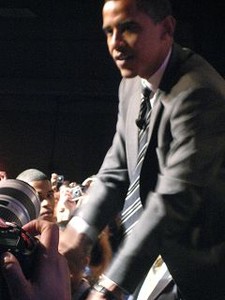
LAS VEGAS – Democratic presidential candidate, Sen. Barack Obama, told a convention of black journalists in Las Vegas that the genocide in Darfur has continued for the worse because the United States has failed to intervene.

“That is a consequence of us not being consistently engaged in Africa,” Obama told a crowd of more that 3,000 black journalists, who had gathered there for the 32nd annual convention of the National Association of Black Journalists.

Obama asked the U.S. government to take advantage of the unanimous vote to send 26,000 peacekeeping troops to Darfur, cast in July by the 15 members of the United Nations Security Council, to ensure the ongoing genocide comes to an end. One step the U.S. could take, Obama said, was enforce a no-fly zone, which he said should be “the bare minimum.”

Since 2003, when the conflict in Darfur began, the United Nations estimates that the Janjaweed, an Arab militia backed by the Sudanese government, has killed at least 450,000 black Africans. Members of the militia continue to set homes ablaze and have driven more that 2 million people out of the region. Most black Africans have sought refuge in neighboring Chad.

Obama said to avert future crises in Africa, the United States should be more involved in the continent during times of peace.

“We can’t wait until all hell breaks loose,” he said. “We can’t wait until genocide takes place.”

He suggested the United States participate in education and improving African people’s standard of living to avoid future violence in the continent. Continued neglect of Africa would make the continent a recruitment target for terrorist organizations, he warned.

Obama gave special recognition to ethnic media, which he said covered issues that the mainstream press gave very little attention. He challenged other black journalists to follow suit and tell stories that show how poor black Americans are suffering.

“Tell the stories that will lift up African Americans,” Obama said. “Show their difficulties and struggles.”

Rain or Shine, Minnesota’s Afrifest Carries On

0

Africans in the Twin Cities defied unexpected dull weather to launch the first-ever festival of the Diaspora in the state and Mshale followed closely for the entire four-day celebration.

Rain is considered a blessing in most of Africa, but when it pours down on the weekend of a highly anticipated, first-ever outdoor cultural summer festival like Afrifest, one is left scratching their head in search of the good fortune. 

At the culmination of the festival during the Lucky Dube concert at First Avenue on the night of Monday, Aug. 20, Afrifest organizer Nathan S.White was relieved that the event he had taken months to plan was finally coming to an end.

“I really need a vacation, but I don’t think that will be possible because already there are so many inquiries about being included in next years plans,” White said.

With regards to the weather he said he would consider an indoor event next year. Nonetheless, the four-day festival was a showcase of great talent and was received well by those who attended. 

“They did a good job putting it together for the first time,” Gorper Kweekeh, who moved to the Twin Cities from Detroit, said about Sunday’s event at Currie Park. “I am encouraged that since I can’t be at the Africa World Festival in Detroit I can attend this one.” 

Kweekeh’s 3-year-old son, Elijah Moore, enthusiastically swayed to the music of Tanzanian musician Innocent and excitedly dashed towards the stage to reward the musician with a dollar bill.
 
African “beauty and vitality” at its best
The weekend got off to an energetic start on Friday night at the Grand Opening event with a New York-style runway fashion show at Klub Afrika in Brooklyn Park. Africans, who are notorious for arriving at clubs after midnight, streamed through Klub Afrika’s doors early and by 10:45p.m a decent line had formed at the door, because the fashion show had generated quite a buzz. 

Camera lights flashed from a hollering audience as models – clad in a cross of contemporary American fashion and African designs – strutted across the passageway. Dance group Diaspora showed off a couple of hip-hop moves in their choreographed dance.

“This is a taste of what’s in store for you for the rest of the weekend,” said the deejay who then proceeded to keep the revelers on their toes for the rest of the night with a sweet mix of African and American hip-hop tunes. 

On Sunday the fashion show, which was saved for last, delivered as promised and was a favorite for many. 

“This was my favorite part of the day,” said Nyakuan Daniel. “I thought it was perfect!” 

Without the glitz and glamour of afore planned outdoor stage and lights, fashion show organizer, Victor Abalo, had to be creative about the setup, which was moved indoors due to the heavy rains. Perhaps the bright lights of the gymnasium were not a bad thing after all, for they enabled the crowd to get a better view of the elaborate designs of the clothes. Showcasing about 30 outfits – some made just for Afrifest – 19-year-old Sudanese designer, Nyamal Both, stunned the audience with her versatile collection. A dozen or so African models exhibited a range of magnificently-tailored Western gowns and contemporary African wear, and at times a creative blend of the two.

The casual segment was just as diverse in its range from swim suits, to camouflage combinations, to kikoi summer outfits. The expressions on the faces in the crowd said it all. There were claps, cheers, “ooohhhhs” and “aaaahhs.” One gentleman repeatedly said, “Oh my God” and, upon hearing of the designer’s age, loudly exclaimed “Walahi!” evoking laughter from those standing by him. 

“Nyamal brought out beauty and vitality. She brought a smile to people’s faces despite the weather,” said Wade Bove of the designer. 

At the conclusion of the display, a shy and humble Both came forward and thanked her sponsors and the crowd for their attendance. 

“My fashion represents all of Africa,” she said, holding the microphone tightly close to her chest with both hands. “I hope you keep supporting me. I have more coming in the future.”

 After the show there were many requests for Nyamal’s business cards. Someone even wanted her to showcase her craft for a wedding, but many were shocked to find out that she did not have a business card or store, but works from her apartment. Nyamal has never been to a tailoring class either. She has been sewing by hand since childhood and only recently did she teach herself how to use a sewing machine. She is taking some classes at Minneapolis Community Technical College and hopes to get into one of the larger fashion and design schools like New York’s Parsons School of Design.

The Afro-Latin connection
More, rain, rain, rain, on Saturday may have deterred many from going to the Gala event at the Cedar Cultural Center, but the energy from the performers was far from dull. Minneapolis-based Liberian songbird, Munnah Myers, wowed the audience with her powerful, passionate and soulful vocals in a way comparable to R&B artists like Mary J. Blige and Keisha Cole.

“I am blessed to be doing what I love most,” she proclaimed, as the audience applauded.

Some nodded their heads and other tapped their feet to the R&B beat of her music. But it was her song “West Africa” that brought the audience to its feet. 

“Back home people don’t get to see musicians up close and personal,” Munnah said, as she introduced the song. “We only see them on the television. It is my goal to get musicians to go back home and have a big concert.” 

Maria Isa, who is from Puerto Rico, also gave a riveting performance while reviving a sometimes forgotten Afro-Latino music connection. 

“I hope you weren’t expecting a reggeaton show,” she said. “You are coming to a show of how rhythms come together through the element of the Bomba drum.” 

Backed by the Bakers Band, Isa performed a mixture of song and spoken word, while at the same time beckoning the crowd to come forward and dance to the beat of the Bomba drum. Her efforts were rewarded as the crowd, which could no longer resist the drumbeat, made its way to the front during her performance of “Yo lo quiero” (I want it).

An African History lesson
Sunday, which had been predicted to be the better day of the weekend, saw a heavy downpour that seriously crippled the day’s schedule. Even though Mother Nature did not permit for the performances to be held outside, some people patiently waited as volunteers set up the music equipment in the Brian Coyle Center’s gymnasium.

In the lobby of the building Joseph Mbele, a professor at St. Olaf College, who hosted Afrifest’s education segment, was kept busy by many people who streamed by his table to inquire about his Pan-African historical material displayed on the walls. 

Outside the hall, people – mostly children – took the opportunity to make a few brush strokes on the Afrifest community mural that was later to be displayed at the Brian Coyle Center. Children singing, “Rain, rain, go away,” kept themselves entertained with blow-up balls given to them by MoneyGram. Once set up, brothers DJs Hustla and Xpektt from Mezesha Entertainment spiced up the rainy day by playing popular contemporary African hits.

The chatter died down as Incognito, an African pop singer, took to the stage performing some of her songs from the previous night. Innocent, the local Tanzanian-born artist, thanked the crowd for staying despite the bad weather, noting that even some performers had left early. Due to time constraints, his performance was cut short, but was not lacking in variety. He played guitar and was accompanied by three percussionists playing drums and a xylophone. His cover of reggae legend Bob Marley’s “No Woman no Cry” and the popular Kiswahili love ballad “Malaika,” kept the festive mood alive.

All in all, the efforts of the organizers were recognized and appreciated and many said they were already looking forward to next year’s event. 

“If you look on the bright side, next year can’t get any worse than this,” said George Ndege of Kilimanjaro Entertainment. 

“I thought it was a good foundation to work on,” added Bove. “The rain provided a challenge which we can work upon and the event thus far has provided a glimpse of African talent.”

Wanted: Intercultural Competence, Advocacy

Africans love Minnesota! Many of them make the state their home willingly; others resettle here because trouble in their home countries has forced them to flee. But all find hospitality and citizens willing to help them in times of need. All should be able to access that help with ease.

Minnesota has in place many local social service agencies catering to its new residents from Africa and other parts of the world. There are also numerous non-governmental organizations involved in efforts to make sure that the state’s new inhabitants go through a smooth transition as they struggle to navigate a system so strange to even people from other states.

This year, the Corporation for National & Community Service placed the Twin Cities at number one in volunteerism. The organization reported that between 2004 and 2006, nearly a million people donated time to help others.

As the generosity of Minnesotans continues to attract more immigrants to the state, there is dire need for several apparatus to make sure the manpower available to help immigrants is put to use effectively. Nowhere is such need urgent and necessary than in breaking the language barrier to make sure immigrants from non-English-speaking countries understand their rights and take advantage of the services that exist.

According to 2000 U.S Census, nearly 13 percent of Minnesota’s foreign-born population – 33,860 people – were people who were born in Africa. African immigrants in Minnesota contend that that estimate was too low. But no one disputes the fact that Minnesota’s African population continues to grow tremendously.

As Minnesota’s African immigrant numbers soar, local governments need to accord special attention to the community. Those who come from countries where English is not a primary or common language deserve priority. But it is the responsibility of those in the African immigrant community who are well informed and capable of organizing to push authorities to recognize the importance of such an undertaking.

Recently, an African woman of about 55 years old, who does not speak English, went to the rental office of her Section 42 low income housing apartment. With her, she had a notice sent by the management, asking her to vacate the apartment by October because she had failed to prove by an August deadline that her income remained below what the law requires to qualify for Section 42 housing.

It was obvious that she had difficulties understanding the notice, since she brought a 12-year-old boy to help facilitate communication between her and the property management staff. It was also evident that the boy was not doing his job well. How could he? He was only a child and translation is no easy task even to adults.

“You failed to bring the necessary paperwork by the deadline. You must move out by October,” the staffer repeatedly told the tenant.

The woman said something in her native language in protest, but the boy did not translate, at all. Without acknowledging the breakdown in communication, the staffer continued to yell at the woman and even threatened to call the police if she did not leave.

The boy gently pushed the woman out of the building.

Such incidents are not uncommon among immigrants. Local government authorities should do everything to make sure that messages intended for people who don’t speak English are delivered effectively. We are not asking for Somali, Amharic or Swahili to be added to every automated telephone greeting, but minor steps that may make African immigrants feel more welcome.

One such step might be to require companies that benefit from government contracts to have intercultural competence, in addition to diversity. For example, the property managers of a Section 42 apartment complex (they get tax credits) should be required to have translators – on site or on call – if a significant number of their tenants do not speak English. Another remedy would be to ensure that employees of such organizations take diversity and intercultural awareness training.

Such steps are simple to implement, but will not come to fruition unless African immigrants and community organizers advocate for changes.

Lucky Dube’s Concert in Minnesota

1

The originality of Lucky Dube’s shows and his energetic performance have earned him a lot of praise.  Lucky Dube, well known around the world for his music and lyrics in the reggae genre’, hails from South Africa. A week ago, I finally got the opportunity to attend one of his concerts at First Avenue, in downtown Minneapolis. The show, which was an extension of the Afrifest Celebrations, started early Monday night with doors opening at 7pm.

I was prompt though there really wasn’t anyone on line, contrary to what I expected. Inside the venue, people were scattered everywhere. I hooked up with a few of my friends who were there already and chatted a bit as we listened to reggae music playing from the speakers.


Shortly, Larry B., one of the organisers of Afrifest, appeared on stage with a band. They performed a handful of reggae songs, as people continued to stream in. After a brief intermission, a different band, The Elementals, took to the stage and sang some Roots music. By this time, the venue was filled with people anxious for the main event to begin, me included.


Another brief intermission and finally, the introduction of Lucky Dube. On stage were the guitarist, the drummer and the sound engineer. From one end of the stage came three beautiful women, Lucky Dube’s back-up singers and dancers, dressed in black and white. Around their waists, over their costumes, were vibrant colored skirts made out of beads.


Suddenly with a burst of energy, Lucky Dube appeared. There were screams, cheers and ululations from the huge crowd of fans. Having never seen Lucky in person or in concert, I was star struck and amazed. The minute he started singing, we all jumped up and down in unison to the beat and sang along to the music. The place was alive with energy and excitement.


Lucky Dube who has been singing for over two decades and won numerous awards, performed song after song, that kept the audience on toes and engrossed. Included in his performance were some of his popular songs like Prisoner, Feel Irie, Slave, Remember me and Together as one. He also performed songs – Shut up, Respect, One – from his new album, Respect, which he recently released. His band, which was absolutely amazing, entertained the crowd with an energy that matched that of the artist.


By the end of the concert, exhausted but still in high energy, we left First Avenue amped on Lucky’s musical lyrics and feeling content.          

Africa Opposed to U.S. Command Base

0
Africa Opposed to U.S. Command Base

CAPE TOWN – There is broad consensus among African countries that foreign forces – specifically in the form of the United States’ new African Command – would not be welcomed to establish themselves on the continent.

Defence Minister Mosiuoa Lekota expressed this sentiment Wednesday, during a briefing on the implementation of government’s programme of action by Cabinet’s International Relations, Peace and Security cluster.

The minister indicated a hesitance on the part of African countries to host the US’s new dedicated command for the continent.

"The Africom [the US Africa Command] initiative has raised a lot of interest and attracted a lot of attention because … Africa has to avoid the presence of foreign forces on her soil," Mr Lekota told reporters on Wednesday.

"If there was to be an influx of armed forces into one or other of the African countries, that might effect the relations between the sister countries and [would] not encourage an atmosphere and a sense of security," he added.

As a start, the 14-country Southern African Development Community had taken a decision that none of its members would be willing to host US forces, he said.

Mr Lekota said that the SADC had adopted the position that it would be better for the US not "to come and make a presence and create uncertainty here", the Defence Minister added.

"At the interstate defence and security committee meeting held in Dar es Salaam, the SADC defence and security ministers took the position and recommended that sister countries of the region should not agree to host Africom – in particular, to host [US] armed forces," he said.

That recommendation went to the heads of state of the region, who met recently at a summit held in the Zambia capital, Lusaka.

"And that’s the position of SADC," he said, adding that the question may arise that a country in another region may differ.

"But as far as we aware the majority of the regions of our continent have taken that position," Mr Lekota added.

In reply to a question as to whether this decision had been communicated to the United States, he indicated that a decision made by the continental body, the African Union (AU), would likely be communicated by the Addis Ababa administration through the relevant channels.

The defence minister added, however, that "it is not unnatural" that one or two countries on the continent may differ from this position, but indicated that a decision not host US armed forces would likely be upheld by the AU’s 53 members in the interest of unity.

"The interests of unity of African nations supersedes any individual view [of a constituent member]," he added.

Should a particular country choose to break ranks with this decision, he said: "I would imagine that any country that wants to go against the decision of the Africa Union would consider what the implications might be – where other sister countries may refuse to cooperate with it in other areas other than that particular area."

Whether or not South Africa itself takes a different view, he said, is irrelevant in that it would abide by the position of the continent as a whole because this would be in South Africa’s "medium- to long-term interest".

Meanwhile, Mr Lekota said that the recent SADC summit progressed towards launching the SADC armed brigade, which he described as "an important step towards constituting a regional force that will complement the strengthening of the African Union peace force".

Shaun Benton of BuaNews South Africa contributed to this report.

Sudanese Ambassador Blames Darfur People for Their Plight

Ukec questions “morality” of sanctions against Sudan.

ST. PAUL, Minn. – Sudan’s ambassador to the United States, Gen. John Ukec Leuth Ukec, blamed the people of Darfur for killing each other and said that there was little the government in Khartoum could do to stop the violence.

Ukec denied that there was a genocide going on in Darfur and said that both Janjaweed – the militia blamed for killing an estimated 450,000 people and driving more than two million people from their homes – were a Darfuri rebel group fighting other rebels for control of resources.

“Janjaweed are Darfuris. It’s Darfuris killing Darfuris,” Ukec, said, raising his voice, as people in the audience stared at him in awe.

The ambassador was addressing an audience of about 100 people, who gathered on August 24 at Metropolitan State University for a conference to discuss how best to address problems facing Africa and African immigrants.

Ukec, who had been calm, mostly holding on to the lectern as he spoke about immigration as a global issue, became animated and loud when he began to talk about Darfur.

Ukec has in the past vehemently denied that what is going on in Darfur is genocide, but his contention that the people of Darfur are responsible for the violence seems to be a new strategy.

“If you ask four different Darfuris why they are fighting, you’ll get four different answers,” Ukec said. “They have refused to stop fighting.”

He lashed at the media for publishing what he called inaccurate information and exaggerations about the conflict.

“The press skews the facts because they don’t know anything about Sudan,” Ukec said. “The media is stuck in what happened before the Government of National Unity was formed.”

The envoy denied that the government in Khartoum was launching attacks on the people of Darfur or funding and supplying weapons to Janjaweed. He said there was a possibility that some soldiers in Sudan’s national army were participating in the massacres because they sympathized with Janjaweed, but they were not following orders from Khartoum. The Darfuris were fighting over “grazing land,” Ukec said.

When Mshale sought to know why the government of President Omar al-Bashir failed to intervene, Ukec said it was not an easy task.

“The situation has become more complex,” he said. “It’s hard (for the government) to know who is Janjaweed and who is not.”

The ambassador further blamed the United Nations and the United States for imposing sanctions against his country, saying they made it harder to convince Darfur’s warring parties to stop fighting.

“When the sanctions were put on the government, the people of southern Sudan, who have been fighting that government for 50 years, were punished,” Ukec said.

The money that the international community pledged to develop southern Sudan if rebels stopped fighting has been held back because of the sanctions, Ukec explained.

“What is the morality of refusing to help the people of southern Sudan because of Darfur?” he asked. “Do they control what’s happening in Darfur? That makes it hard for the rebels in Darfur to stop fighting because they don’t see any incentive.”

Ukec, a member of the Sudanese People’s Liberation Movement, fought against the government in Khartoum before joining it in 2005, when SPLM signed the Comprehensive Peace Agreement to form a Government of National Unity, which brought an end to decades of civil war with Sudan’s South.

In response to Ukec’s speech, Bula Atomssa, an Ethiopian citizen, who had earlier asked him if the Sudanese government was arresting and extraditing Oromo refugees to Ethiopia for trial, said he did not think that the ambassador was sincere on the Darfur issue.

“It is the government’s responsibility to bring peace and it should do everything within its power,” Atomssa said. “The ambassador himself spent years fighting and lived in refugee camps. That should make him sympathetic to refugees.”

Educating the Ethiopian Girl Child: Organization Taps Africans

1

A Twin Cities charitable organization involved in the education of girls in Ethiopia hosted a fundraising dinner in Minneapolis that was also an attempt to get the African community involved.


Dubbed “Food for Thought,” the Aug. 14 dinner was held at Kilimanjaro Café by Fill a Mind & Heart, a Minneapolis based nonprofit organization that supports four schools in rural Ethiopia. While many of the guests had attended most of the organization’s fundraisers in the past, they said that that evening was special because it was the first time they were partnering with the African community.


Tim Carroll, the organization’s president, said that money raised from such events had helped change the lives of Ethiopian girls.


“I don’t mean to sound cliché, but donations from events like this are about how a little bit can go a long way if put it in the right hands,” Carroll told an estimated 100 people who attended the dinner.


One of Fill a Mind & Heart’s founders, Greta Sebald, said the dinner was an effort to meet Ethiopians and other Africans and learn how better her organization can help Ethiopian children.


“We hope to share our experience and learn more about the culture,” said Sebald.


Sebald’s first trip to Ethiopia was in 1999 as a volunteer for a Don Bosco school in Zway, 60 miles south of Addis Ababa. Accompanying her was co-founder, Christine Carroll. They were struck by the condition of the school.


 “There was no curriculum and the children had no pencils,” said Sebald. “What a great need there was among the children.”


According to statistics released by UNESCO in June, youth literacy in Ethiopia stands at 50 percent, with men being 20 percent more literate than women. That was the reason why the Salesian sisters, who run the Don Bosco institutions, set up in the most poverty stricken areas of Ethiopia schools to educate girls.


Moved by the experience and determined to make a change, Sebald said she came back home to Minneapolis and founded Fill a Mind & Heart to support the Don Bosco schools. Sebald was quick to explain that Fill a Mind & Heart is not affiliated with any religion. She chose to work with the Salesian sisters because of a shared vision.


Sebald’s group now works with four Don Bosco schools in Zway, Addis Ababa, Adwa and Dilla to provide over one thousand children with education, food and basic medical care.


“In 1999 we found bare classroom walls, but now those walls have colorful wall hangings and the shelves are stocked with books,” Christine Carroll said happily.


In addition, five of Sebald’s first students have graduated from college, she said. Two are nurses, one of whom works at Addis Ababa’s Fistula Hospital, which received much attention after it was highlighted on the Oprah Winfrey Show. Another student graduated with a degree in microbiology and is pursuing medicine. One graduate of the program who attained a degree in Computer Science is now teaching at one of the Don Bosco schools. The only male student in the program was in training to become a priest.


The organization attributed the success of the program to the donations of well wishers, 100 percent of which go towards the programs. Sebald said there were no plans to expand beyond the borders of Ethiopia because the need is still great.


It was through Ethiopian board members – a couple, Amelech and Girma Wolde-Micheal – that the group was able to use Kilimanjaro Café for the benefit dinner. Before dinner Girma Wolde-Michael gave the guests a crash course on how to eat injera, Ethiopian staple flat bread usually eaten by hand, “like an Ethiopian.”


 “You pinch off a bit of the bread and scoop up the meat, or chicken stew, or vegetables, or lentils with the spongy side,” he further demonstrated.


While some guests dared to eat with their hands, the vast majority opted to use forks. In addition to the delicious food, guests listened to local artist Teshome deliver sweet Ethiopian tunes and 80s hits from musicians like U2 and Lionel Ritchie. Others were lucky to win gifts from the array of Ethiopian baskets, scarves, coffee, trivets and hand carved crosses dished out during multiple drawings held throughout the evening.

Africa 4th in Broadband Penetration – Study Shows

0
Africa 4th in Broadband Penetration - Study Shows

Africa has been rated fourth in broadband penetration among six continents that were sampled by the Economist Intelligence in the year 2007.
 
The study conducted by the Economist Intelligence Unit (EIU) rated Africa as  fourth in its uptake of broadband services within the Middle East and Africa (MEA) region scoring 7.4 behind North America 10, Western Europe 9.9, Central and Eastern Europe 7.6. After MEA came Latin America with 7.3 and Asia Pacific 7.1 within the six regions under review.

"Scores are on scale of 1-10, with 10 representing the highest level of  affordability," EIU stated.

Africa’s positive but slow response to broadband is attributed to Africa’s  gradual liberalisation of the telecommunications market.
 
EIU precisely cited South Africa as an example of where broadband deployment  progress has made broadband access much more affordable in recent years if  online retails sales are anything to go by, said the report.
 
"South African e-commerce consultancy World Wide Worx reports that online sales  of consumer goods grew by 25 per cent in 2006 to the tune of R688 million (about
$94 million), and expects it to expand by another 35 per cent in 2007," EIU added.
 
South African enterprises, the study indicated have in turn leveraged online  services to manage growth more efficiently, particularly in newly competitive
industries: low-cost airlines have burgeoned in South Africa in the post-apartheid era, in large part owing to online bookings.
 
EIU explained this phenomenon by citing four primary airlines who sell online  tickets and have made a fortune of R1.8 billion in 2005, with Kulul.com accounting for 60 per cent of that trade, thus becoming the country’s largest online commerce site.

The study further noted that as broadband goes increasingly wireless, consumer familiarity with mobile devices such as phones and handheld computers would help
individuals make the most out of the Internet.

The survey also showed that the ability to tap into broadband while on the move is increasingly becoming a contributor to improved employee productivity in many
countries.

The EIU also said that this influence is not in the area of penetration only but equally its affordability to households in developing economies most of which
are in Africa matters.

"Broadband is increasingly affordable in the developing world," the white paper made available to Highway Africa News Agency (HANA) stated.

In addition, EIU pointed out that the goalpost has shifted in terms of connectivity based on broadband accessibility.
The study also shows that certain types of connectivity are proving better than others in enabling e-readiness and broadband has been found to be enjoying more effect in the Information and Communication Technology (ICT) industry worldwide.

The study was written in co-operation with the International Business Machines (IBM) Institute for Business Value.

Umunne and Umunna, the Igbo Children

Umunne and Umunna, the Igbo Children

Centuries away from undiluted Igbo customs, and thousands of miles away from the land of their ancestors, Minnesota Igbos strive to keep their traditions alive.

ST. PAUL, Minn. – Young women wiggled their bellies and shook their torsos to the tune of the music. Gentlemen – with bundles of one-dollar bills in their hands – lined up to tip their favorite dancers. Women dispensed generous amounts of dollars, too. It was one big party, but not the kind you are thinking about. It was the fourteenth-annual IgboFest.
   
Members of Umunne Cultural Association, an organization of Igbo-speaking Nigerians in Minnesota, gathered Saturday at the University of St. Thomas in St. Paul to celebrate their culture. Women, men and children braved the showers that descended on the Twin Cities all day to form long lines at he food kiosks.
 
Inside the O’Shaughnessy Education Center auditorium, two young women stood on stage, ready to sing. The first one sang the Star-Spangled Banner. Two people – perhaps American friends of Umunne – sang along. But when the other young woman took the microphone and began to sing, “Arise, O compatriots, Nigeria’s call obey, …,” the auditorium joined and applauded loudly when she finished.

Throughout the day, the theme of the festival seemed to be “Dance, dance, dance,” and people came from far places to join their countrymen in performing traditional Igbo dances and rituals.

“There is a brother-sister relationship between us and Umunne,” said Uba Nwaerondu, as sweat dripped down his face.

A minute earlier, Nwaerondu, who traveled from, Manitoba, Canada, was on stage, clad in a golden-brown T-shirt and a multi-colored cloth wrapped around his waist, shaking his abdomen and stamping his bare feet. Jingles from small bells attached to a waist belt filled the room, as men and women cheered and showered him with dollar-bills for “Ubamara,” a special dance he said he had invented and named by combining the first two letters of his name and Amara, his wife’s name. Nwaerondu belongs to Umunna Cultural Association, (not to be confused with Umunne) based in Winnipeg, Manitoba.

“Umunna means ‘children of the same father,’ and Umunne means ‘children of the same mother,’ he explained. “We are all descendants of the same parents.”

So special is the relationship between the two organizations that each group makes efforts to send representatives to the other’s festival. Umunne dancers traveled to the Twin Cities to Winnipeg in July to attend Ummuna’s IgboFest. The trip prompted Nwaerondu and other dancers to come to St. Paul – not only to return a favor, but also to showcase their new dance moves.

“It is a well-natured competition between us,” said Ifeoma Okwor, a University of Manitoba graduate student of immunology, whose Umunna troupe danced as drummers and percussionists played traditional Igbo beats.

The highlight of the evening was Ummune’s Bende war dancers. Imagine four clean-shaven topless black men wearing red, white and blue-stripped Santa hats and kilts similar in color, but not as neatly tailored as Scottish ones. In fact, they were not tailored at all. Then add eight similarly dressed little helpers aged between 10 and 12 with – like the Santas – dry blood-like emulsion on their bare chests. Now imagine them dancing to West African drums, bells and flutes.

“This is who is going to carry the mantle and make sure the tradition continues,” Austin Wamuo, the group’s leader, said of the boys. “We want them to master the traditional Igbo culture and pass it on to future generations.”   

Wamuo has been commander of the warriors since the first IfboFest. He retired on Saturday.

The dance is unique to the Bende region of Igbo and is a celebration of victory in  war against a non-Igbo tribe, said Marcus Kalu, who went around the hall dipping a white fly whisk in a bowl of water and spraying “villagers” to cleanse them of “evil spirits.” His ancestors used palm wine.

As the younger warriors danced around the stage, one of the older men paraded three skulls supposedly decapitated from to the enemies they had “killed.” Ironically, all the warriors still carried between their teeth eight-inch pieces of golden-yellow paper, like pigeons delivering messages of peace. The rolled-up and twisted papers were supposed to be dry palm leaves traditional warriors placed in their mouths to ensure they “concentrated on the task of fighting and killing the enemy.” The warriors are forbidden to talk until the cleansing ritual is finished.

“We try our best to accurately simulate the way it was done in the past,” Kalu said.

The festival is not only about past traditions, however. Young people are allowed to show that the past and the present can come together harmoniously. That is why four girls, whose group was so new they hadn’t even thought of a name for it – received cheers and applause for a routine that was not even remotely Igbo: They danced to the late South African diva Brenda Fassie’s hit song, “Vulindlela.” 

It is this kind of flexibility that has made the festival popular across generations, said Diane Uchechi Okwulehie of St. Paul, who has attended IgboFest every year since it’s founding in 1993.
   
“The festival has quite grown,” Okwulehie said. “Every year more people from outside (the Twin Cities metro area) come to celebrate with us.”

Money raised from the festival goes toward promoting Igbo cultural education and awareness, according to Umunne’s Web site. The organization hopes to raise enough money to acquire a building to serve as a permanent Igbo cultural center.

UNICEF appoints South African fashion icon Gavin Rajah Goodwill Ambassador

0
UNICEF appoints South African fashion icon Gavin Rajah Goodwill Ambassador

Designer to champion protection of children from violence and abuse

Cape Town, South Africa, 11 August… UNICEF last night announced the appointment of top South African couturier and humanitarian activist Gavin Rajah as a UNICEF Goodwill Ambassador.  The announcement by the world’s premier children’s organization came at the close of the designer’s Cape Town Fashion Week show in the city South Africans affectionately call the “mother city”.

Welcoming Mr. Rajah to the global fraternity of UNICEF Goodwill Ambassadors, Macharia Kamau, UNICEF South Africa Country Representative, said the appointment recognized Rajah’s transformative contributions to the lives of South African children and their families.  Through his generous philanthropy and advocacy and his impressive creative achievements as a fashion designer and entrepreneur, Gavin Rajah promotes the rights of women and children to protection from violence, abuse and exploitation, and actively supports the development of critical life skills for young people.” 

 “I am deeply honored by this appointment, Mr. Rajah said, as he accepted the UNICEF appointment.  I have always been a great admirer of UNICEF’s work to protect the children of the world and I am proud to have been given the opportunity to help UNICEF protect, care for and stamp out the most abhorrent crime of violence against children, particularly those in my own country.  We must all work harder to create safer conditions for children to grow up in.  There is no future without children.” 

In his work with UNICEF, Rajah will champion child protection, focusing on the care and protection of orphans and other vulnerable children like those in child-headed households, and for their right to grow up in healthy, safe environments, free from the scourge of violence.

According WHO global estimates, twenty-five per cent of girls and eight percent of boys have been subjected to some form of sexual abuse.  The United Nations Study on violence against children showed that from forty to sixty percent of sexual abuse in families involves girls under the age of 15, and that boys and girls with physical disabilities are particularly vulnerable to sexual abuse.

Equally startling data on violence against children in South Africa show that the country may have a long way to go to achieve Rajah’s dream of a violence free environment for all children.  According to the South African Police Service (SAPS), in 2005, 360,000 women and children were murdered, raped, assaulted and sexually molested in South Africa and 31,607 children were victims of common assault.  Eighty-eight percent of first offenders are known to the abused, and homicide and violence is the no. 15 cause of death for children under 5 years old in South Africa.
 
South Africa is fighting back, however, with significant pieces of protection legislation currently before Parliament such as the Children’s Amendment Bill, the Sexual Offences Bill the Child Justice Bill and Child Trafficking legislation.  Child protection units and specialized courts have been established to deal with sexual offences and aim to help reduce the time between reporting and finalizing a case and increase conviction rates.  South Africa has a 7% conviction rate for all rapes reported to police, whether child or an adult. UNICEF provides technical support to these initiatives and to the 12 integrated centers (Thuthuzelas) that provide treatment, care and support to child survivors of sexual violence.

About Gavin Rajah

Gavin Rajah, who recently introduced  the work of  four young South African designers at his 4 July Paris Fashion Week show, is a founder of Cape Town Fashion Week and the only South African designer invited by France’s prestigious Federation Française de la Couture to showcase his collections at fashion’s leading event, Paris Fashion Week. 

His relentless advocacy has helped give the fashion industry a human face and has earned him international admiration as a speaker on development issues at high level events like the World Economic Forum, where he recently spoke out about child labour practices in the fashion industry and others.  He is in demand as fundraiser and remains an influential celebrity advocate for the rights of South African children and women.

Inspired by South Africa’s rich, cultural heritage and traditional crafts, Gavin Rajah believes they should be nurtured and protected. “These unique traditions can, through advanced skills training, provide HIV affected young people and their families with sustainable livelihoods,” he says.  Mr. Rajah has announced plans to work with UNICEF and other partners to establish a sustainable development community-based project that supports families and young people who wish to learn garment manufacturing skills, a backbone industry in the Western Cape, where he operates his design studio and where his world famous garments are made. 

With his new appointment, Gavin Rajah joins global celebrities such as tennis great Roger Federer, singers Ricky Martin and Shakira and South African football and music stars Quinton Fortune, Zola and Yvonne Chaka Chaka, who use their celebrity power to advocate for improvements in the wellbeing of all children.