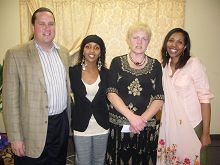
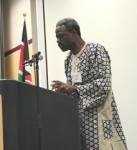
Nimco Ahmed was recently appointed as the policy aide for Robert Lillgren, the city councilor of the 6th Ward in Minneapolis.
As Lillgren’s aide, Ahmed will work on issues around Community Development, Election, Health, Energy and Environment, Taxes, transportation and Public Works. Ahmed will also work on the City Labor Management Committee, Empowerment Zone, Meet Minneapolis, Minneapolis Community Development Agency (MCDA) Operating Committee, Neighborhood Revitalization Program Policy Board, Non-Motorized Transportation Pilot Program, Southwest Corridor Policy Advisory Committee, and Transportation Advisory Board.
Ahmed joins the Sixth Ward with tremendous experience as a community organizer. She has been instrumental in working together with the Somali Community and mainstream politicians.
A political activist since high school, Ahmed has worked on political campaigns with the following: John Corzine (current New Jersey Governor), the late Paul Wellstone, Senator Amy Klobuchar and Congressman Keith Ellison. With her appointment, Ahmed would like to bring more resources to the community, and to represent those she says “do not have representation.”
“Today is the beginning of the rest of your life.”
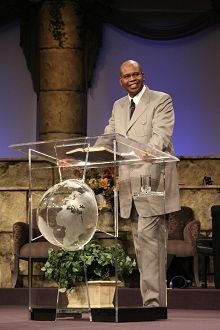
“Today is the beginning of the rest of your life.” These are Pastor Randy Morrison’s opening words during a Sunday morning service at Speak the Word Church International in Golden Valley, MN.
One part motivational and one part spiritual, Pastor Randy, as his church members and friends call him, conveys his message to an excited and receptive crowd – a crowd whose diversity is perhaps only matched by that of the United Nations. Individuals and families of various cultural, socio-economic, and denominational backgrounds gather beneath an array of hanging international flags and within the meticulously decorated church walls, all in the name of praise and worship.
“Today is the beginning of the rest of your life!” Pastor Randy repeats himself, this time with a little more fervor, making sure that each and every person beneath these flags and within these walls and beyond hears him; for his message aims to reach an estimated 2000 members a week and a potential 1 billion television viewers worldwide.
Nearly thirty years ago Speak the Word Church International began with just six people. Today its membership has grown so large that it must expand beyond its Golden Valley walls.
Pastor Randy speaks with enthusiasm and anticipation about his church’s plan to build the Dominion Center, the next stage in what he calls “leaving a legacy.” He explains, “Dominion is more than a church, it’s a community center…it’s a theater for performing arts that happens to have a church in it.”
This legacy, however, reaches beyond the future walls of the eagle-shaped Dominion Center. In fact, it has always stretched beyond its church walls. Pastor Randy is focusing on what he believes is his church’s mission – to hone-in on the last part of his church’s name: international.
“Jesus said go out to the entire world didn’t he? We must go to them if they can’t come to us!” Pastor Randy eagerly proclaims this as if any other way is nonsensical.
“International means reaching the countries. We don’t want to change people’s culture – we want to work within culture to help each person in each country to discover the purpose for their being.”
Under the leadership of Pastor Randy, Speak the Word Church International has made this their global mission: to spread The Word, aid in disclosing individual value, and empower those individuals to use their gifts to help their communities. And he has found that the places that need this the most are developing countries; for in developing countries, as he puts it, “we allow ourselves to be stigmatized. And colonialism didn’t help. It can be passed onto kids. And cultures can be imprisoned. I get in trouble for saying that, but it’s the truth. I like to break molds. Break molds by changing mindsets.”
Profound is the idea that the progress or lack thereof in developing countries may be a result of colonized, stigmatized societies. Profound is the notion that these historical and generational stigmas may be shattered.
And profound is the fact that Pastor Randy used the possessive word “we” in describing developing countries. He has lived in the United States for thirty-six years, yet at times perhaps subconsciously, still speaks as though he is a young boy growing up in the West Indies island of Trinidad. And this is what he believes has allowed him to step onto international soil and convey his message – his relatability. Recently he has used this relatability to speak to and empower the people of Ghana, Kenya, Tanzania, Uganda and Zimbabwe.
“You don’t need money, you need a dream!” Pastor Randy lives by this motto.
He is not a fan of giving developing countries material items alone. He believes this must be supplemented with skills and encouraging words. Pastor Randy has been visiting Ghana for the past ten years and working with Dr. Mensa Otabil of the International Central Gospel Church based in Accra. In Accra, he and Dr. Otabil search for ways to spread the Word of God while simultaneously empower individuals to find their life purpose and business savior.
“Why are you here, what are you doing?” – a couple questions they may ask to push an individual to “dream bigger” and “make a contribution to humanity.”
Pastor Randy is convinced that “what makes the United States great is that it is built upon the brains of other countries because their own country wouldn’t allow them to use their gifts and talents.”
His goal is to help foster these gifts and talents right at home so people may help to build-up their own communities.
“Poverty is a state of mind, it is not a lack of resources.” Pastor Randy and Speak The Word Church International are currently involved in Zimbabwe’s City Light Foundation, an organization that assists widows and children who are affected by AIDS. Through this program he hopes to change the state of mind of the participants by offering them a valuable resource – industrial sewing machines. Pastor Randy refers to this as “empowering vs. enabling.” Giving them clothing to sell is enabling while providing them with the resources to make and sell their own clothing as they choose is empowering. He likens this situation to the book and ensuing movie “The Pursuit of Happiness” and exclaims, “This man didn’t sit and wait for someone to help him. In Africa you never see a “Will Work for Food” sign…People do,” as in they do for themselves to the best of their ability. There is a minimal sense of entitlement, which he views as commendable.
In June Pastor Randy plans to visit Kenya & Tanzania to meet with businesspeople and deliver the same message he gives to the people of Ghana and Zimbabwe: “The condition you were born in, you don’t have to die in.”
Simply put, empower by understanding your value and take responsibility. He exclaims, “Understanding your value will keep you from living your life carelessly.”
And when asked what he understands his value to be, he readily and insightfully explains, “My value is giving of myself – what I’ve learned and received. I am a container of something good…now I can take it and become a coach.”
And he is hopeful that the people of Ghana, Kenya, Tanzania, Uganda, Zimbabwe and other developing countries will do the same. After talking about the countries in Africa in which he is involved, he sits back and calmly says, “If I can help Africa to compete with the rest of the world, I’ve done my job.” And then he smiles and reflectively adds, “I love Africa…I really do.”
“Today is the beginning of the rest of your life.” In light of his international efforts, these opening words seem to render more than just inspiration. When asked why he incessantly shares these words, he speaks of our numbered days on this Earth and further replies, “Proverbs says that we are not guaranteed tomorrow and yesterday is gone. How would you live your life if today were your last day? So now, you are living your life with purpose.”
And perhaps this is the perfect foundation for self-empowerment, value and responsibility no matter where you are or what you believe in: living life with purpose.
Speak The Word Church International is located in Golden Valley on 515 Jersey Avenue South. Pastor Randy Morrison & Dr. Mensa Otabil will speak about “Taking Responsibility” at the Annual Empowerment Conference at Speak The Word Church International, May 7-11, 2007.
It was a night to remember. Saturday the 10th of March 2007 Bayelsa State (also known as the Glory of Lands), Nigeria hosted the main players in the film industry from the continent.
The 3rd edition of the African Movie Academy Awards (AMAA) took place at the Gloryland Center, Yenagoa Bayelsa State. Yenagoa, a city in the oil rich Niger Delta region of the country has gradually projected itself as a tourist destination with the caliber of national and international guests AMAA hosts each year. Last year, some of Hollywood’s finest like Vivica Fox and Lou Gossett Jr. came to join Africans in celebrating the brilliance of the Nigerian Movie Industry. This year it’s gotten bigger and better, at the moment the Nigerian Movie Industry a.k.a Nollywood is the 3rd largest in world after Hollywood and India’s Bollywood.
Nigerian movies have been a source of home entertainment not only for the local market, but also for Africans on the continent and in the Diaspora. One of the largest cable operators in Africa some years ago created a TV channel specifically to satisfy the demand by subscribers for Nigerian and African produced movies.
AMAA 2007 was keenly sponsored by corporate bodies and the organizers this year decided to expand the scope and vision of the awards by unveiling more categories to cover all of Africa as well as rewarding winners with cash gifts of up to $50,000. Nominees for the awards this year included a winner from a Nigerian TV reality show, the son of one of Nigeria’s best movie directors and quite a number of upcoming actors and actresses.
These are the Nominees and Winners of AMAA 2007
CATEGORY A- Best Nigerian Film (irrespective of language)
Apesin
Amazing Grace
Sitanda- Winner
Abeni
CATEGORY B- Best Cinematography
Abeni
Mokili (from Burkina Faso)
Amazing Grace –Winner
Sitanda
CATEGORY C-Best Indigenous Film
Apesin
Irapada-Winner
Abeni
Iwalewa
CATEGORY D- Achievement in Costume
Azima
Apesin-Winner
Amazing Grace
Bunny Chow (from South Africa)
CATEGORY E-Best Documentary Feature
Convenant Church
Conversations On a Sunday Afternoon (from South Africa)-Winner
Bitter Water Mara (from South Africa)
CATEGORY F-Best Visual Effect
Snake Girl-Winner
Explosion
Apesin
CATEGORY G-Best Performance by Child
Teco Benson Jr. (Explosion)
Samuel Olaseinde (Abeni)-Winner
Samadina Adinma (Speak the Word)
CATEGORY H- Best Edit
Abeni
Mokili (from Burkina Faso)-Winner
Amazing Grace
Sitanda
CATEGORY I-Best Original Soundtrack
Iwalewa-Winner
Sitanda
Bunny Chow (from South Africa)
CATEGORY J-Best Sound
Abeni-Winner
Amazing Grace
Sitanda
CATEGORY K-Original Screen Play
Sitanda-Winner
Maroko
Dancing Heart
Azima
CATEGORY L- Achievement in Make up
Maroko
Azima-Winner
Convenant Church
Amazing Grace
CATEGORY M-Best Upcoming Artiste
Amzat Abdel Hakim (Abeni)
2. Mbong Odungide (Amazing Grace)
3. Ali Nuhu (Sitanda)-Winner
4. Moumouni Sanou (Mokili from Burkina Faso)
CATEGORY N-Best Actress in Supporting Role
Noelie Funmi Agbendegba (Abeni) Republic of Benin
Jackie Agyemani (The President’s Daughter)(Beyonce)-Ghana-Winner
Ireti Doyle (Sitanda)
CATEGORY O-Best Actress in Lead Role
Chioma Chukwuka (Sins of the Flesh)-Winner
Khabirat Kafidipe (Iwalewa)
Nadia Buhari (The President’s Daughter)(Beyonce)Ghana
CATEGORY P-Best Actor In Supporting Role
Bruno Iwuoha (Sins of the Flesh)-Winner
Obi Okoli (Explosion)
Yinka Quadri (Apesin)
Fred Amata (Amazing Grace)
CATEGORY Q-Best Actor in Lead Role
Olu Jacobs (Dancing Heart)-Winner
Ganiu Nofiu (Apesin)
Kunle Abogunloko Convenant Church)
Ayo Lijadu (Maroko)
CATEGORY R-Best Director
Izu Ojukwu (Sitanda)-Winner
Muyiwa Ademola (Apesin)
Jeta Amata (Amazing Grace)
Tunde Kelani (Abeni)
CATEGORY S- Best Picture
Amazing Grace
Sitanda-Winner
Apesin
Abeni
This year the awards’ night was compeered by one of Nigeria’s leading actors, Richard Mofe Damijo & Tammy, a South African Actress. It unfolded to be a night of style, glamour, fashion and excitement for all who attended. Some of the biggest thrills were guest appearances by Oscar Winner Cuba Gooding Jr. and Monique from the sitcom the Parkers and the movie Phat Girlz.
Nollywood’s favorite duo Chinedu Ikedieze and Osita Iheme (popularly known as Aki & PawPaw) were honored with Lifetime Achievement Awards in recognition of their dedication to the movie industry and a posthumous award was given to Joe Layode for his immense contribution to arts.
AMAA 2007 was capped with a colorful music and comedy festival at the Bayelsa Stadium featuring the MTV Award Winner Tuface Idibia, VIP from Ghana and other artistes.
No doubt, Nollywood is here to stay and can only get better from now on.
Thousands of Ghanaians and well-wishers stood in silence at the capital of Accra on that faithful hot day of March 6th, 1957, as the thunderous speakers of the independence square blurted out the famous words of Dr. Kwame Nkrumah, “Ghana, your beloved country is free forever,” he shouted. The jubilant crowd roared in response. Nkrumah, the founding president of what is now the republic of Ghana, was the hero of the day. Many listened and hung on to his words as if their lives depended on it, as though they had been waiting for that moment all their lives, and in so many ways they had.
Ghanaians in the Diaspora joined in the celebrations to mark their country’s golden jubilee. On March 10th, 2007, the Chairman of The Council of Ghanaian Associations of The Washington Metro Area (COGA) Mary Damaoh, conveyed to a crowd of over seven hundred at Howard University, the importance of Nkrumah’s speech. “We became politically free forever,” she shouted.
“We preferred self-government with danger to servitude in tranquility, quite a bold and courageous resolve, but we did it,” she said, as the crowd nodded and cheered in agreement, she then went on to thank special guests.
COGA hosted the dinner and dance with the Ghanaian Ambassador to the United States Dr. Kwame Bawuah-Edusei a special guest. The celebrations were aimed at allowing Ghanaians in the Tri-State area (Maryland, Virginia and D.C) the opportunity to celebrate their country’s independence in high-style. High-style, was perhaps an understatement for there was excitement in the air and attention to detail in attire was indication that many had planned months, or perhaps even years ahead for this moment. The dominant attire of choice was Kente, a traditional woven cloth of Ghana which is easily identified by its dazzling, multicolored patterns of bright colors, geometric shapes and bold designs. The second favorite of the night was a special 50th anniversary cloth specially designed in Ghana, while some just simply came in western formal wear. Undoubtedly, the amalgamation of traditional and non-traditional attire allowed for a wonderful display of style and color.
As guests seated themselves at round carefully decorated dinner tables, a parade of local Ghanaian royalty was ushered in adorned with gold jewelry displayed from top to bottom, accompanied by talking drums and huge gold rimmed umbrellas, several non-Ghanaian watched in amazement as they paraded in and took their assigned seats.
Later, the United States Army was invited in and marched across to the front of the hall where the crowd respectfully stood as first, the U.S, and then, the Ghanaian anthem filled the loud speakers of the hall. Almost as if by chance everybody in the crowd blurted out the last words of the Ghanaian anthem “and help us to resist oppressors rule with all our strength and might forevermore”, followed by a huge roar in the crowd, the party then began.
“We are here to celebrate 50 years of independence, and we are going to do so by having fun,” a guest shouted, as the DJ instinctively selected crowd pleasers from the famous high-life era such as ‘Adwoa Yanki’ and ‘Sika Nye Moja’. What sets high-life apart is its unique ability to grab a crowd’s attention with one note, a momentum that lasts through a whole song. High life music has an incredible fusion of African roots and western beats allowing for an exclusive sound. On this night, Ghanaian revelers were proud to dance to the glory of a genre of music they helped make successful. It is not just the music that sets high-life apart, but also the rhythmical dance that accompanies it, a wonderful mixture of medium paced bodily movement, using the hands as a guide to the movement of the rest of the body, a routine many on this night had mastered years ahead.
As the servers started rolling in with the three-course dinner, the DJ toned down to an African jazz mix, allowing the ambassador, Dr. Bawuah-Edusei to take to the podium to address guests. The ambassador, a former physician at nearby Greenbelt Medical Center in Maryland, reiterated the importance of sustaining the independence dream.
“The euphoria of Ghana’s independence had a ripple effect across Africa,” he said concluding that Ghanaians should be proud of such legacy, but also urged all in the Diaspora especially those in the U.S to ensure that the vision of Ghana’s founding fathers is sustained and rationality kept at the fore-front of all endeavors.
The ambassador’s address was a continuation of theme of President John Kufuor’s speech four days earlier at Independence Square in Accra as he led Ghanaians and heads of states and governments from around the world in celebrating the golden jubilee. In his address, president Kufuor said: “as we celebrate fifty years of independence and sovereignty, it is worthwhile to remind ourselves that freedom is a living flame to be constantly fuelled and not a monument to be saluted and revered occasionally. Ghana’s freedom, indeed, Africa’s freedom must be an eternal flame to be continually fuelled by all our governments and peoples, because it defines our humanity.”
The evening in Washington continued with the DJ mixing high-life for the older crowd and hip-life for the younger crowd.
Mr. and Mrs. Affortue residents of Virginia where pleased to have come to the event and spent the night dancing to the sound of high-life, “This is what I call music,” said Mrs. Affortue, “this event is a rare treat.”
In Minneapolis, clad in traditional regalia, the chair of the Ghanaian Association in Minnesota, Kwami Ahlelegbe, was enthusiastic about the progress that Ghana has made in the last fifty years. While he credited founding fathers for their role in developing and shaping their country’s destiny, Ahlelegbe cautioned Ghanaians at being complacent in advocating for further development.
“It is our duty as a new generation of Africans to set our destiny. Our past leaders have played their role, it is our turn. “
The guest speaker, Benjamin Kodjo Taylor, a renowned entrepreneur, echoed Ahlelegbe’s sentiments. He encouraged Ghanaians in the Diaspora to consider taking the risk of investing in Ghana as market risk is similar in all parts of the world. Taylor challenged the current Ghanaian administration to take on development projects such infrastructure development, health and nutrition and economic growth among other things.
“What role will you play in the future of Ghana?” he posed to his audience.
There is a popular belief that when non-citizens and undocumented workers are detained for violating immigration laws, they remain in jail until an immigration judge allows them to stay or orders their removal from the U.S. But there are alternatives to detention, which can make life better – or worse – for individuals whom the U.S. government seeks to remove from the country.
For the most part, the Office of Detention and Removal (DRO) detains those who are a threat to the public or national security, and those who must be detained under immigration laws (for example, individuals who were convicted of certain firearms offenses). But ever since the DRO stepped up its enforcement strategies, it has started to run out of bed space in detention centers. The Department of Homeland Security (DHS) states that it arrests over 1.6 million non-citizens and undocumented workers every year.
Because of their tight budget and limited bed space, the DRO often relies on alternatives to detention, such as:
Release on an Order of Recognizance (ROR): The individual is released from detention under certain restrictions, including regular reporting to DRO officers and appearing at all immigration court proceedings. ROR is mostly for individuals who do not have the financial resources to post a bond, but do not pose a threat to the public or national security. If the individual fails to appear for a hearing, he or she will be ordered deported and will be subject to mandatory detention when arrested.
Appearance bond: This is more restrictive than ROR. The individual posts a bond of not less than $1,500 dollars, which is forfeited if he or she fails to appear in court as required or upon any other demand by the U.S. Immigration and Customs Enforcement (ICE).
Electronic Monitoring Devices (EMD): This requires the individual to wear a monitoring ankle bracelet or report by telephone to a case manager. EMD is designed to improve court appearance rates and prevent individuals who are ordered removed from absconding. This started out as a pilot program, but is now available nationwide.
Intensive Supervision Appearance Program (ISAP): This pilot program is available to individuals who are not subject to mandatory detention; who are in immigration court proceedings or awaiting removal from the United States; who are residing within the managed area; and are unlikely to pose a threat to the public or national security. Participants are assigned to a case specialist who is responsible for monitoring them through an electronic monitoring device, home visits, work visits and telephone reports.
ISAP – Benefits and Controversies
ISAP is now available in nine cities: Baltimore, MD; Delray Beach, FL; Denver, CO; Kansas City, MO; Miami, FL; Philadelphia, PA; San Francisco, CA; Portland, OR; and St. Paul/Bloomington, MN.
A private contractor, Behavioral Interventions (BI), operates ISAP. In Minnesota, the BI/ISAP office is located in the same building as the Immigration Court in Bloomington.
The DRO states that the primary goal of ISAP is to improve rates of appearance at hearings and compliance with immigration judges’ final orders. Yet the target groups for ISAP are quite broad. They include any adult over age 18, asylum seekers, individuals who are at low risk for violence or absconding, and individuals on order of supervision.
ISAP has three phases:
Phase one (“intensive phase”): This lasts for thirty days. The participant wears an electronic monitoring device (EMD) on their ankle, is subject to nightly curfews, and must report to the BI office three times a week. BI also visits participants’ home at unscheduled times and calls at certain times of the day to ensure they have not fled the area. If the participant complies with phase one, the EMD is taken off and he or she is moved to phase two.
Phase two (“intermediate” phase): There is no curfew, but the participant must report to BI one day a week. BI also conducts one home visit each month in a sixty- day period.
Phase three (“regular phase”): The participant reports to the BI office twice a month and remains on this phase until the court issues a decision or the DRO orders the participant’s release from ISAP.
For those who would otherwise be detained in jail, ISAP is a great alternative. The restrictions get fewer and fewer as time passes and as they comply with the requirements. Sometimes, however, the DRO applies ISAP to individuals who would normally be released without electronic monitoring or other restrictions, if ISAP did not exist. Also, some participants have problems complying with the requirements because they have work, school and family obligations, do not live close to the BI office, or have no reliable transportation to get to the BI office.
In one recent case, attorney Herbert Igbanugo challenged the DRO’s decision to place one of his clients into ISAP. Because the client has four children (two of whom have special needs), has no convictions, and has ties to the community, she offered to post bond instead of being placed into ISAP. When ICE refused the offer and placed the client into ISAP, Mr. Igbanugo requested a bond/custody re-determination hearing before an immigration judge. He also filed a habeas corpus petition and an emergency motion for a temporary restraining order with the federal district court, asking the federal judge to order ICE to release the client from ISAP.
Eventually, the immigration judge ordered ICE to release the client from ISAP once she posted bond. When ICE reluctantly agreed to comply with the immigration judge’s order, Mr. Igbanugo agreed to drop the habeas corpus petition. Still, ICE plans to appeal the immigration judge’s order to the Board of Immigration Appeals in an attempt to prevent nationwide repercussions that may result if others begin to challenge ISAP throughout the nine cities where DRO operates the program. ICE, in theory, could place the client back on ISAP if it wins on appeal. The client, however, may file another habeas corpus petition if that happens.
Mary Gitagno was visiting Minnesota after giving a lecture at Harvard University on her work as an activist of her community in celebrating Women’s History Month in March when Mshale caught up with her. One is instantly struck by her homeliness and humility. Her mission is simple: to empower both men and women in her community so that they can have a choice in their destiny.
Born into a large family, it was not until her tenth birthday that Gitagno saw the inside of a classroom. She remembers begging her father to invest in her education. He was worried that she would fail. Her response, “But father, I will not fail.”
And she has never looked back. Gitagno went on to graduate from high school and enroll into a teachers college beginning what has become her lifelong career—a teacher to her community. Her challenges are enormous to say the least, but Gitagno has continued to work tirelessly to not only allow for economic independence for people, but she also continues in developing social and gender equity.
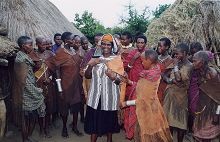
The Barabaig Community in Tanzania The Barabaig have traditionally been pastoralists. Even in the recent past, the Barabaig have not been completely disenfranchised. Until recently, they were one of the largest suppliers of beef to the rest of Tanzania. Coupled with their remote location, and prolonged seasons of drought, the Barabaig have had to look for alternative economic lifestyles. Like many pastoral communities in Africa, the Barabaig have suffered in the hands of their government and foreign developers who have seen their land as a resource for development.
Hanaag Women Counseling and Development Association (HAWODA) Gitagno found that her efforts with the Barabaig community were not isolated. In 1998, she joined HAWACODA, a women’s group whose mission is to sensitize both men and women on problems faced by women through personal interaction with the community in seminars, workshops, public rallies and skits through radio and television.
“Education is key. For instance, we made a list of all chores in the community and found that women were overworked. We made the men realize that there are only two things that neither of the genders cannot cross-perform, child-birth and breast-feeding, “she chuckled.
HAWOCODA works closely with lawyers from the Legal Human Rights Center. One of the greatest inroads that have been made is a reduction in female circumcision. According to Gitagno, thanks to education on the hazards of FGM, members of the community report FGM activities as it is illegal.
Economic Empowerment for Women The Barabaig Traditional Heritage is a community organization whose goal is to empower women to use local resources for economic sustainability thus reducing poverty and some issues of inequality. The project has been a great success, as the women who have made economic gains have risen to leadership positions in a community that is male-dominated.
With a smile on her face, Gitagno says of the project, “It is wonderful to see women educating their children. I am delighted to see that these women have choices to make thanks to the newfound respect in the community.”
The Amias Project is an American-based organization that was founded, by Nichole Smaglick, on the premise of economically empowering the Barabaig community. Amias (which means beautiful in Barabaig) purchases arts and crafts made by the community and sells them to an American market.
Gitagno’s Drive “When I see someone suffer, their rights being violated, it pains my heart. But it also softens me making me work even harder to make sure that they never have to live like that.”
Swahili Language Teaching Is Back at the University of Minnesota
The event which is likely to attract large crowds of people from the Swahili culture and those intent on learning Swahili as an emerging African international language spoken by over 100 million people will be held at the Sabathani Community Center on 310 E, 38th Street, Minneapolis.
During an interview with this reporter, Professor Earl P. Scott of the Department of African American & African Studies, said the Swahili Open Day is an occasion “to celebrate the return of Swahili instruction at the University of Minnesota with community activities, basic Swahili instruction and a talk by Dr Karenga (founder of Kwanzaa) about language as a way of mediating differences and celebrating culture.” Dr Scott was accompanied by Angaluki Muaka, the new Kiswahili Teaching Specialist hailing from Kenya and a holder of a BA in Swahili and Arabic from the University of Nairobi and MA in Arabic from the University of Khartoum.
Before joining the faculty of University of Minnesota, Mr. Muaka taught Swahili as a foreign language at Indiana University and Stanford University until last year when he moved to Minnesota.
“I am trained in various aspects of foreign language pedagogy, especially under the auspices of the National African Language Resource Center at the University of Wisconsin, Madison, and the American Council on the Teaching of Foreign Languages (ACTFL).”
Mr. Muaka has published a Swahili novel, “Ushuhuda wa Mwanachuo,” and several scholarly articles. He proudly asserts: “Swahili is one of the most widely spoken, taught and broadcast African languages in the world and the most widely used in Eastern, Central and Southern Africa. It is a language of administration, business, and scholarship.”
Swahili is one of the official working languages of the African Union because of its widespread use in countries like Tanzania, Kenya, Uganda, Rwanda, Burundi, the Democratic Republic of Congo, Mozambique, Zambia, Malawi and other neighboring countries. African Americans have “adopted it as the language of their heritage, making it arguably the most popular African language in the US”, endorses Mr. Muaka.
Mr. Muaka’s research interest is in comparative studies between Swahili and Arabic, and the use of literature and technology in the instruction of advanced levels of Swahili and Arabic.
Professor Scott told this reporter that his Department “is one of only a few departments in the United States that allow students to examine African American, African and African Diasporic studies; to have access to (4) major languages; and to prepare for a number of learning abroad opportunities in Africa, the Middle East, the Caribbean and Latin America.”
The Department fully integrates African American and African studies and Middle Eastern languages into its curriculum and learning abroad opportunities. It prepares students intellectually to examine and participate in an ethno-national culture and for world citizenship. Languages taught include Arabic, Swahili, and Hausa.
Since his arrival here, Mr. Muaka said he has seen Swahili begin to blossom. “We offered two sections of beginning Swahili for fall semester, and they filled quickly without our needing to advertise them,” he said. Swahili students come from a wide variety of backgrounds, both culturally and academically. They include white and African Americans and “heritage learners,” students whose parents are native Swahili speakers. Many of them are planning to do field work in east Africa in nursing or public health, or are majoring in global studies or history. Muaka explains, “We expect enrollment to continue to grow, and hope to offer intermediate classes next year, and advanced Swahili the year after that.”
Swahili is being re-introduced at the University of Minnesota after it remained shelved when a former instructor retired and funding became unavailable. This time around, all indications are that the teaching of Swahili will be energized.
Swahili Open Day is a way for the University to connect with the community, and vice versa. “We’re having this event in the community because it’s important to have an exchange and dialogue outside of campus,” said Scott. “We want people in the community to come visit with us, to learn about our mission, our language classes, and opportunities for our students to study abroad.”
At a Glance What: Swahili Open Day Where: Sabathani Community Center, 310 E 38th St., Minneapolis When: Saturday, April 21, 3:00 – 6:00 p.m. Who: Dr. Maulana Karenga, creator of Kwanzaa, plus students from the University of Minnesota Swahili program How: Free and open to the public
Kenya Ideal for Investment, Kimunya Tells Diaspora
Minister Tickles Funny Bones in Atlanta, Booed in Minneapolis
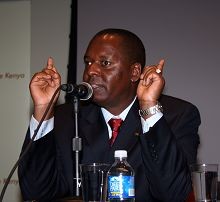
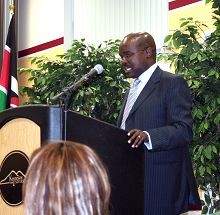
ATLANTA – In an apparent attempt by the government to woo the Diaspora to invest in Kenya, Finance Minister Amos Kimunya told his fellow citizens abroad to put their money to work in their motherland, which he said had undergone tremendous economic growth.
The minister was speaking at a convention at Kennesaw State University in the Atlanta metro area where Kenyan leaders, business owners and citizens in the Diaspora met on March 23 for a two-day conference to discuss how they can improve their country’s economy.
“A great chance exists for Kenyans to own the companies that do business in their country,” Kimunya said.
The minister said Kenya had changed a great deal since 2002 when a coalition of parties led by President Mwai Kibaki defeated the KANU government that had been in power for nearly 40 years.
“We need you to start saving from wherever you are and translate those savings into investments,” Kimunya told the crowd.
As he would through most of his speech, Kimunya caused prolonged laughter when he asked Kenyans not to build huge houses in rural areas, which they only use on the rare occasions they visit home.
“Some people are pressured to build mansions in coffee plantation just so relatives can say, “Mtoto alienda ng’ambo (we have a son overseas),” he said, as the room exploded with cheers and applause. “Why not build the house in the city and rent it out to make money instead of paying one person to circle the house every day cutting grass?” Kimunya asked, followed by more laughter.
Kimunya suggested that members of the Diaspora ask their relatives to start small businesses instead of spending all the remittances.
The Kenyan government’s efforts to court the Diaspora came upon realization that Kenyans abroad sent home more than $1 billion in 2006. Remittances have been a key factor in boosting the country’s growth since 2003. In 2006, Kenya’s economy grew by 5.6 percent, up from averages less than 1 percent in the years preceding 2003. Last year the government was able to fund the budget with 93 percent of locally generated revenues. Ten percent of that was money generated by sales taxes and dues from small businesses started by capital from remittances.
The idea of money sent from abroad fueling a country’s economy is not new, but has been brought to light in Kenya since Kibaki took power. His government’s vigilant record keeping and establishment of an aggressive tax collection system is credited with the discovery.
Investment in the country’s stock market has also risen due to what Kimunya called “the feel-good factor” that drove Kenyans to invest upon KANU’s fall. The number of shares traded in the Nairobi Stock Exchange rose sharply from 381 million in 2002 to 1.4 billon in 2006, according to Chairman Jimnah Mbaru.
Kimunya called on Kenyans to be optimistic and focus less on the past and more on where the country is headed.
“It’s like driving a car,” he said. “There is a windshield in front of you, and a rear view mirror. While the rear view mirror is important, you can’t spend most of your driving time looking at it.”
Increase in freedoms of speech and the press was another factor that should drive Kenyans home, Kimunya said.
“People can now stand on the streets and call the president names” without getting in trouble, he said.
The number of media outlets in the country has been upward since 2002. For example, Dr. Bitange Ndemo, the permanent secretary in the Ministry of Information and Communication said the number of radio stations rose from five in 2002, to 70 in 2007.
On the issue of corruption, which has been the main culprit of Kenyan economic drawback, Kimunya said the government was doing all it could to reduce the vice. He didn’t give details, but said arresting and prosecuting offenders was not the best solution.
“You can round people up and hang them, and some countries have done that, but corruption will still be endemic,” he said. “What we are doing is closing the gates” to prevent future corruption.
That, the minister said, doesn’t mean Kibaki’s administration is extending amnesty to those who stole or continue to steal from the government.
Kimunya stayed away from addressing the issue of security, a major concern of Kenyans. In recent months, Kenya’s major dailies have given stories of crime major play. No one brought the matter up in the question and answer session that followed Kimunnya’s speech.
Kenyans in attendance had mixed reactions to Kimunya’s presentation. Kelvin Ngige said that while Kimunya did a great job outlining the number of investment opportunities, he wasn’t pleased with the way the minister said the government was handling corruption.
“He should have explained in depth what mechanisms the government has in place to stop things from falling through the cracks,” Ngige said.
Celestin Ogwel agreed. “I think the minister is in denial about corruption,” Ogwel said.
Edward Njoroge, who left Kenya before Kibaki’s government took over and hasn’t been back since, said the minister assured him that his money would be safe if invested in the country. When asked whether he believed Kimunya, Njoroge said though he had to be skeptical of all politicians, he was willing to give Kimunya a chance.
“I don’t know a lot about the minister,” Njoroge said. “But I will trust him until he gives me a reason not to.”
Representatives of the private sector in Kimunya’s delegation included real estate and property management companies, Housing Finance Corporation, Capital Partners, Old Mutual and NW Realite Ltd. Equity Bank and Barclays, whose employees constantly engaged in signing up new customers, represented the banking sector.
Also present in the conference were several scholars, among them Dr. Paul Tiyambe Zeleza (University of Illinois, Chicago), Dr. Olubayi Olubayi (Rutgers University, NJ), Dr. Kefa Otiso (Bowling Green University, Ohio) and Dr. Eric Aseka (Kenyatta University and Fulbright Scholar at Kennesaw State). The professors presented papers recommending several remedies to Kenya and Africa as a whole.
The conference was the brainchild of the Institute of Global Initiative at Kennesaw State University, led by Dr. Akanmu Adebayo. Every year the Institute chooses a country for interested students to study. For the 2006-2007 academic year, Kenya was the country of focus.
From Atlanta, Kimunya and his entourage took the same message to the Edge Christian Worship Center in Minneapolis, Minn., where hundreds gathered to listen to him. Like their countrymen in Atlanta, the Kenyans in Minneapolis received the minister’s message well. However, during the question and answer period, many disapproved Kimunya’s denial that the state of security in Kenya was getting out of hand. They uncontrollably jeered and booed him for more than a minute.
The difference in feedback between Atlanta and Minneapolis was perhaps because the latter has more Kenyans opposed to Kibaki’s regime. Raila Odinga, an Opposition presidential aspirant, received a hero’s welcome when he visited Minneapolis earlier this year.
Robert Nyagudi was dismayed by what he said was the minister’s insincerity.
“It’s important that the members of the government dialogue with us in honesty,” Nyagudi said.
Others like Anne Kemunto were embarrassed by the lack of respect and regard the hecklers showed the minister.
“Even if the minister was not honest, this was an investment meeting,” Kemunto said.
“I am afraid many individuals in the audience politicized it.”
You Can Rescue Your Motherland, Africans Abroad Told
Diaspora’s Financial Power Key
ATLANTA – African immigrants around the world should not expect foreigners to tackle the problems of their continent, a Malawi-born distinguished historian and advocate of African-centered solutions to the continent’s challenges said here today.
Dr. Paul Tiyambe Zeleza, a professor of history and Chair of the Department of African American Studies at the University of Illinois at Chicago told a group of Kenyan leaders and professionals that people from other continents were busy addressing their own concerns. Zeleza was speaking at “The Role of the Kenyan Diaspora in Kenya’s Development” convention at Kennesaw State University.
“We can sit down and watch while Africa is molested by ruthless and racist policies of exploitation,” Zeleza said. “Or we can gang up against poverty that threatens our continent.”
Citing the fight against Apartheid in South Africa as an example, Zeleza said the African Diaspora has proved in the past that it is capable of uniting for a common cause.
“The Diaspora must defend Africa,” he said. “It constitutes Africa’s eyes and ears and it should serve as the continent’s mediator to the rest of the world.
Zeleza urged Africans abroad to use their financial power to influence the governing of their countries.
By sending money home Africans are already making an impact in the continent’s economy. Last year in Kenya, for instance, the government was able to fund the budget with 93 percent of locally generated revenues. Ten percent of that was money generated by sales taxes or dues from small businesses started by capital from remittances.
The idea of money from abroad fueling an economy is not new, but has been brought to light in Kenya since 2002 when President Mwai Kibaki took power. His government’s vigilant record keeping and establishment of a more effective taxation system was instrumental.
Although the Diaspora’s impact on the Africa’s development has been positive, there was great room for improvement, Zeleza said. Sub-Saharan Africa accounts for only 8 percent of remittances by immigrants worldwide, he said, while Asia leads with 32 percent.
African governments should also do their part in motivating the Diaspora to aid the economy by addressing political concerns of their citizens living abroad, Zeleza said.
“It would be unfair for governments to court the Diaspora financially while shunning it politically,” he said.
Zeleza was referring to Kenya’s unwillingness to honor dual citizenship. Currently, a Kenyan immigrants taking the citizenship of a foreign country legally ceases to be Kenyan.
The standing ovation at the end of Zeleza’s speech was testimony that most in the hall agreed with him. Joy Kaimuri, a Kenyan graphic designer and resident of Atlanta said Zeleza made “very interesting points.”
“We have to take ourselves very seriously,” she said. “If we don’t stand up for ourselves, who will?”
John Mwangi of Auburn, Ala., agreed.
“Our problem is that we segregate ourselves,” Mwangi said. “We have to come together and form a strong alliance for a strong voice.”
ATLANTA – Dr. Bitange Ndemo, the Permanent Secretary for Information and Communication, today reiterated the Kenya government’s commitment to transforming the economy through information and communication technologies (ICTs). Dr. Ndemo made the remarks when he and the Permanent Secretary in the Ministry of Planning and National Development, Dr. Edward Sambili were given a private tour of the Ryla Teleservices facilities by that company’s President and CEO, Mr. Mark Wilson.
The facility is located about three miles south of Kennesaw State University where an international conference and investment forum on Kenya is being held. The two are part of the delegation that is accompanying Finance Minister, Amos Kimunya to the conference which started yesterday.
Ryla Teleservices, a privately held corporation is a provider of outsourced call center services for corporations. It has already established a call center in Nairobi employing about 300 people with the number set to double in the near future. Some of Ryla’s clients include IBM, Dun & Bradstreet (Mr. Wilson’s former employer) and the T.D. Jakes Ministry. Mr. Ndemo thanked the company for their investment and challenged a few of the Kenyan-American entrepreneurs that accompanied him on the visit to emulate Ryla “if each of you employs 100 Kenyans each back home, you will make a big difference, him (Mr. Wilson) he has done it alone, that is what we want”, he said.
During the visit, the two permanent secretaries, were shown some of the latest technology that the company uses as well as its command center, including a tour of the call center floor. The company employs about 800 people according to Mr. Wilson. Nyambura Kamau, the Consul General at the Kenyan Consulate in Los Angeles was also present.
ATLANTA – Unless Kenyans shun the politics of tribe, they will continue to experience severe social and economic problems that still exist more than 40 years after independence, a Fulbright Scholar at Kennesaw State University said.
Dr. Eric Masinde Aseka asked leaders to cultivate and embrace a culture of integrity based on good character. Only then will they be able to earn the trust of Kenyans, he said.
“You can not have integrity unless there is a moral obligation, and with integrity, you get moral authority,” Aseka said, amid applause from an audience of nearly 200 Kenyan professionals and leaders.
Since 1963 when Kenya gained independence, Kenyans have been involved in a political system based on ethnicity. It is not unusual for those in power to fill employment positions with members of their tribes. The practice has caused anger and resentment from tribes that have not held top government offices and led to multiple ethnic-based political parties.
In a bold speech directed at both the government and Diaspora, Aseka told Kenyans that the culture of dividing themselves into ethnic groups placed Kenya at a disadvantage in its attempts to com Kenyan pete internationally. Aseka said that Kenyans should use their neighbor, Tanzania, as a model of a country that has risen beyond tribalism.
“If you compare our sense of nationhood in Africa, Tanzania scores a first,” said Aseka. “Tanzania succeeded because there was a level of ideological production and leadership engagement of the citizenry on a frequent basis to the extent that a Tanzanian’s perception of humanness and the essence of humanity was raised to a higher pedestal.”
Aseka was giving a keynote address on the first full day of “The Role of the Kenyan Diaspora in Kenya’s Development” convention, which began yesterday at Kennesaw State University. The conference is geared towards encouraging Kenyans abroad to take a greater role in deciding the fate of their country.
Aseka asked Kenyan dignitaries like Amos Kimunya, Kenya’s finance minister who was present, to call for laws making it criminal for politicians to make statements that incite tribes against others.
“It’s these social conflicts that are a recipe for political instability, one of Africa’s greatest problems,” Aseka said.
Politicians were not the only ones with the obligation to end tribalism, Aseka said. Although Kenyans abroad have been condemning ethnic-based politics in their homeland, the Diaspora itself was divided along tribal lines, he said.
In response to Aseka, Peter Ogego, Kenya’s ambassador to the United States said that good governance can not be achieved if educated people shy away from politics.
“Professionals must be involved,” Ogego said. “Otherwise touts and goons will go to Parliament.”