University of Nairobi trained medical doctor, Dr. Edwin Bogonko was installed as the new president of the Twin Cities Medical Society at its annual dinner on Tuesday, January 15, 2013.
University of Nairobi trained medical doctor, Dr. Edwin Bogonko was installed as the new president of the Twin Cities Medical Society at its annual dinner on Tuesday, January 15, 2013.
Dr. Edwin Bogonko, a former Kenya Medical Association secretary was last night installed as president of the 5,000 member Twin Cities Medical Society, the largest component society of the Minnesota Medical Association which represents most Minnesota physicians. The 10,000 member statewide MMA has 31 such component societies around the state with TCMS, which represents most metro area doctors, being the largest with its 5,000 members.
Dr. Bogonko is a clinical director of medicine and lead physician at St. Francis Regional Medical Center in the Twin Cities suburb of Shakopee, Minnesota. He received his medical degree from the University of Nairobi and worked as an ICU physician before moving to the United States in 1999. He completed a residency in internal medicine at Hennepin County Medical Center in Minneapolis.
Minnesota Commissioner of Human Services, Lucinda Jesson was the keynote speaker at the Twin Cities Medical Society’s annual dinner on January 15 2013 which also installed Kenya born Dr. Edwin Bogonko as its president. Photo: Tom Gitaa/Mshale
The Twin Cities Medical Society came into being in 2010 following the merger of the East Metro Medical Society and the West Metro Medical Society resulted. The society works in engaging its members who consist of doctors, medical students, medical residents and fellows in improving clinical practice, policy development and public health initiatives.
Bogonko was installed at the society’s annual dinner in Saint Paul which was keynoted by the state’s Commissioner of Human Services, Lucinda Jesson. The commissioner’s address centered on the upcoming Obama administration health care reforms and the progress Minnesota has made in preparing for the law and its impact.
Speaking at the annual dinner, Bogonko said he was greatly humbled to accept the responsibility of serving as president for 2013. He told a rapt audience that since becoming active with the society “it has been a ride full of valuable lessons yet very fulfilling in seeing that our beloved society has achieved so much,” he said. Some of the milestones he highlighted included the society’s work with counties to create a “smoke-free” Minnesota and the society’s work with communities, businesses and schools as part of the Twin Cities Obesity Prevention Coalition.
Outgoing Twin Cities Medical Society president, Dr. Peter J. Dehnel (right) accepts a gift from incoming president Dr. Edwin N. Bogonko at the society’s annual dinner on January 15, 2013 in St. Paul, Minnesota.
In addition to his high level work with Minnesota’s medical community, Bogonko has been active in helping immigrant physicians, especially African ones, in obtaining board certification in Minnesota to continue their medical careers here. He told Mshale it is a passion of his that he plans to continue with “as it brings me a great deal of satisfaction,” he said.
Joining Dr. Bogonko on the board in 2013 is Dr. Lisa Mattson as president-elect, Dr. Peter Dehnel who is the outgoing president, Dr. Ken Kephart as treasurer, Dr. Carolyn McClain as secretary, Doctors Matthew Hunt and Nicholas Meyer as At-Large members.
With his ascension to the presidency of the Twin Cities Medical Society, Bogonko joins the very small elite group of minority professionals that lead mainstream professional and trade associations in the state of Minnesota.
Leo Sarkisian shows off his musical collection. Sarkisian recently retired after decades of hosting Music Time in Africa. Photo: Richard Harris.
Leo Sarkisian shows off his musical collection. Sarkisian recently retired after decades of hosting Music Time in Africa. Photo: Richard Harris.Leo Sarkisian shows off his musical collection. Sarkisian recently retired after decades of hosting Music Time in Africa. Photo: Richard Harris.
Leo Sarkisian was going to be an artist. Then his life took a major turn when he headed overseas, to remote corners of the world, to record previously unknown tribal music. He turned that into a decades-long run of hosting an African music show on Voice of America.
The man who founded Voice of America’s “Music Time in Africa” program retired this past fall at the age of 91 after 47 years on air.
And while Leo Sarkisian may not be well-known in the United States, but in Africa, he is kind of a household name.
Sarkisian exudes the energy and enthusiasm of a man a fraction of his age. He sums up his improbable life by quoting an African proverb: “When door opens, go in.”
And he did, again and again.
Growing up in an Armenian family in the immigrant city of Lawrence, Mass., where he was constantly drawing and taking art classes, Sarkisian got a scholarship to the prestigious Vesper George School of Art. During his childhood, he was surrounded by Middle Eastern music, playing the lute and bamboo flute with other Armenian musicians.
In the midst of divisive political debates over gun control and tax-and-spending policies, the White House promised to keep a close eye on immigration reform. Just a week after being re-elected, President Barack Obama said he expects a bill to be introduced and acted upon in Congress soon after his inauguration on January 21. Then during a December 30 interview on Meet the Press, Obama noted, “Fixing our broken immigration system is a top priority. I will introduce legislation in the first year to get that done.”
By pledging to offer an immigration bill, Obama has taken a step beyond where he stood in his first term, when he encouraged Congress to strike a deal but did not write his own legislation. Obama now considers immigration reform to be the second-term equivalent of his first-term push for health care reform. The current political climate supports this post fiscal-cliff agenda, but the White House and Congress must act fast before the momentum loses steam.
Political Clout of Latinos and Other Voters Who Support Immigration Reform
To reach out to the growing Latino population and avoid a repeat of the 2012 vote, more and more Republicans are beginning to soften their opposition to immigration reform. Many Democrats deem the 2012 election results as a mandate for broad immigration reform.
In the November election, Obama won 71% of Hispanic votes nationwide as well as the Latino-heavy battleground states of Colorado, Florida, Nevada, and New Mexico, which helped secure his second term.
Early in his campaign, Obama faced staunch criticism from the Hispanic media and immigrant advocates for failing to prioritize immigration reform in his first term and for increasing deportations to record levels.
Obama’s introduction of Deferred Action for Childhood Arrivals (DACA) in June 2012, however, led to renewed support from Latino voters. Meanwhile, Mitt Romney’s call for mandatory EVerify, “self-deportation,” and ending the DREAMer deferred action program hurt the Republican challenger’s popularity among Latino voters.
Immigration is a crucial and personal issue for Latino voters, of which 60% report that they “know somebody who is an undocumented immigrant.” Latinos generally support a comprehensive bill that offers a pathway for undocumented immigrants to become citizens or permanent residents of the U.S.
An overwhelming number of Asian Americans and younger Americans, who comprise a growing portion of the electorate, also support immigration reform with a path to citizenship. A huge percentage of these voters chose Obama in the 2012 election.
The share of the American electorate that opposes immigration reform mostly includes older, rural conservatives and other voting groups who are losing their political clout.
Shift from Piecemeal Reform to Comprehensive Reform
Back in September, at a Univision News forum, Obama described the lack of immigration reform as his “biggest failure.” Since the start of the Obama administration in 2008, Congress has not debated a broad immigration bill that would improve the nation’s broken immigration system or provide a path to citizenship or residency to the millions of undocumented immigrants in the U.S.
Instead, Congress has focused on piecemeal types of reform that target certain segments of the immigrant population. One example includes the DREAM Act, which provides undocumented immigrants, who were brought into the U.S. when they were children, a pathway to citizenship by earning a college degree or serving in the military. Although various versions of the DREAM Act have been introduced and debated in Congress, none were enacted into law.
Following the November election, the Republican-led House passed the STEM Jobs Act, which would increase visas for foreign nationals who earn advanced degrees in the U.S. for science, technology, engineering and mathematics, but eliminate the diversity lottery that grants 55,000 permanent resident visas to individuals from countries with low rates of immigration to the U.S.
The Democrat-controlled Senate is expected to ignore the bill. The Obama administration officially opposed the bill, noting that it detracts from broader reform. In its statement of administration policy, the White House declared, “…the Administration does not support narrowly tailored proposals that do not meet the President’s long-term objectives with respect to comprehensive immigration reform.”
Furthermore, anti-immigrant local laws have proven to be costly for states and their citizens. Arizona’s S.B. 1070, for instance, resulted in lost revenue, boycotts, and heavier financial burdens for the state. After the U.S. Supreme Court struck down much of S.B. 1070, while upholding the “papers please” provision, a Latino Decisions/Center for American Progress Action Fund/America’s Voice poll showed that 79% of Latinos nationwide believed that Latinos who are legal immigrants or U.S.citizens “will get stopped or questioned by police.” Most Latinos fear that laws like S.B. 1070 target even those born and raised in the U.S.
Due to the limitations and costs associated with anti-immigrant state laws, proponents of immigration reform argue that the only reasonable option is a comprehensive bill at the federal level.
Advocates of comprehensive immigration reform note that piecemeal measures fail to address fundamental flaws in the existing immigration system. The fate of 11 million undocumented immigrants now living in the U.S. continues to hang in the balance. The number of visas made available each year for both high-skilled and less-skilled workers has not increased to meet the growing demands of the U.S.economy. Families are separated for years or for indefinite periods due to harsh immigration laws and the massive backlog in immigrant visa processing.
The White House is calling for “a 21st-century immigration system that meets the Nation’s economic and security needs through common-sense, comprehensive immigration reform.” Obama seeks a broad bill that would attract and retain highly skilled immigrants, reunite families more quickly, create a pathway for undocumented immigrants to earn citizenship, as well as bolster border security and penalize employers for hiring undocumented workers.
Congressional Support for Immigration Reform
The 113th Congress seems poised to take on comprehensive immigration reform. In early December, a bipartisan group of six senators met at the Capitol to discuss how to push a comprehensive bill through Congress. The Republicans included the newly elected junior senator from Arizona, Jeff Flake, and longtime immigration reform advocates Lindsey Graham of South Carolina and John McCain of Arizona. The Democrats were Charles E. Schumer of New York, Robert Menendez of New Jersey and Richard J. Durbin of Illinois. This was considered the first of many upcoming bipartisan talks on comprehensive immigration reform.
Latino leaders, in particular, plan to push for a broad bill that creates a pathway to legal status for unauthorized immigrants in the U.S. Rep. Luis V. Gutierrez (D-IL), a champion of immigration reform, recently announced he will join Rep. Zoe Lofgren (D-Cal.) on the House Judiciary Committee to help lead the charge for a comprehensive bill.
Rep. Gutierrez stated, “passing comprehensive immigration reform is my passion and my commitment to my constituents and immigrants all across our country…I felt I must be on the Judiciary Committee during this Congress to help the others on the Committee get immigration reform to the finish line.”
House Speaker John Boehner (R-Ohio) expressed optimism that Congress and the White House could reach an agreement on comprehensive immigration reform. “This issue has been around far too long,” Boehner said in a November interview with Diane Sawyer on ABC World News, “and while I believe it’s important for us to secure our borders and to enforce our laws, I think a comprehensive approach is long overdue, and I’m confident that the president, myself, others can find the common ground to take care of this issue once and for all.”
The Road Ahead for Immigration Reform
According to White House aides, it will likely take about two months to create a bipartisan bill and then another few months for chambers to vote on it. Therefore, concrete actions are not expected to occur until early or mid-summer 2013. Plus, many Republicans like Senator Marco Rubio (R-Fla.) still favor piecemeal approaches to tackling immigration issues.
In addition, humanitarian appeals are hardly enough to secure immigration reform. In the last comprehensive immigration reform that occurred in 1986, Republican congressional leaders gained their party and the president’s support by stressing that economic growth was essentially tied to immigration. Advocates will need to show how more immigration, not less, is key to the nation’s economic prosperity, including job creation and higher incomes.
While immigration reform involves an arduous process, the White House’s pledge to make it a top second-term priority, overwhelming support from the electorate, and bipartisan efforts make it a strong possibility during Obama’s second term. Fulfilling his first term campaign mandate of health care reform, Obama now looks to take on comprehensive immigration reform to add to his legacy.
Until Abdiasis (Abdi) Hirsi was hired as community outreach coordinator for SPOKES Bike Walk Connect last August, he had never ridden a bicycle. These days Hirsi’s work involves teaching other East African residents of Minneapolis’s Seward, Cedar-Riverside, and Phillips neighborhoods that biking is a healthy, safe, and enjoyable alternative mode of transportation. This is important because the Twin Cities metro area is home to the largest population of East African refugees and immigrants in the United States. Born in Mogadishu, Hirsi and his family fled Somalia during its civil war in 1991. They arrived in the United States (and Minneapolis) from Nairobi, Kenya in 2005. Before accepting the position at SPOKES, Hirsi had served on the board of directors at Seward Towers, where he has been a resident since 2007. Hirsi says he is “blessed with a very peaceful and quiet place to live,” and enjoys giving back to the community. He also works as an associate educator for Minneapolis Adult Education.
Is it true that bicycling is something new to you?
I had tried to ride a bike when I was in grade school, back in Somalia, but without much success. When I was hired by SPOKES I took an adult learn-to-ride class from Cycles for Change. After three or four sessions I was able to ride. I’m not a winter biker yet though.
If you weren’t a bicyclist, what drew you to this job?
I graduated from the University of Minnesota with a BA in English last May. English is not the most practical degree, so I was looking for a job. One day I was speaking with Nasra Noor (community organizer at Seward Towers) who told me that Sheldon Mains (SPOKES director) was looking for someone to fill a community outreach position. Sheldon emailed me the job description. I applied, was invited for an interview, and then was hired.
What do you do as community outreach coordinator?
A lot of my work is with East African adults, who want to learn to ride a bike. Younger East Africans are already biking, so I’m doing outreach to their parents. That’s the target group. I educate them about the value of biking for their health, and teach them that bicycling is a legitimate alternative form of transportation.
Is the idea and experience of getting around by bike new to most people you work with?
Yes, back home, most of us walked everywhere. Either that, or we took the bus. Owning a car was too expensive for most people. Once they arrive here, everyone is driving, and they want bigger cars or mini-vans that will accommodate large families. We need to show them that it’s safe to bike, and not just in the summer, but winter, too. We also want to help them realize that bicycling is a form of transportation, not just something that people do occasionally for recreation.
Why was biking not an option in Somalia?
It was an option for people living in farming communities. For them it was often the best way to get from their farm into town. But there was no infrastructure for bicycling in the cities.
Why is SPOKES’ work important?
I like seeing people wake up to the fact that they can’t remain healthy if they’re not getting exercise. SPOKES provides them with opportunities to explore walking and biking as healthier and safe transportation options. We’ve started dialogues with East African residents and provided a number of activities for community members to participate in. Now that winter is here we’ll be offering winter safe walking classes.
What are some other programs and classes SPOKES offers?
We have bicycle maintenance classes, four-week classes that cover different topics. I’m participating as a student. In September we had community rides, where we would bike as a group to a different destination each week. Andrew Magill (lead trainer/mechanic), was along in case people ran into problems with their bikes. The adult learn-to-ride classes are very popular. We also have open shops days for people who need to fix their bike but don’t know how, or don’t have the tools. Other new programs will start this winter and in the spring.
What would you say is your biggest challenge at SPOKES?
Continually identifying ways to promote bicycling. Can we convince people that a bicycle can be a transportation tool comparable to a car? That’s still a challenge. We want to emphasize the recreational aspect first and then convince people to use their bike for transportation. All of this begins with people like me practicing what we preach.
How do you get the word out to members of the community you want to reach?
A lot of it’s through word of mouth, but I also put up flyers, and use social media to reach younger people. Informally I talk with friends and neighbors at the Towers outside of my working hours.
Are some people harder to convince about bicycling than others?
East African women are not very comfortable with the idea of biking. More than five have asked if we could find an enclosed place where they can learn how to ride. Others are fine with learning in an open space like Matthews Park.
What do you find most satisfying about your work?
I really like it when an East African community member comes to SPOKES and gets involved in the adult learn-to-ride classes and eventually gets his or her own bike. It’s satisfying to know that I’ve introduced one more person to biking. When a parent comes with their child and learns to fix their bike, that’s also a thrill. It helps fuel my passion.
ICE agents escort man after an arrest in Detroit. Photo: Courtesy of ICE
ICE agents escort man after an arrest in Detroit. Photo: Courtesy of ICEICE agents escort man after an arrest in Detroit. Photo: Courtesy of ICE
The federal government conducted more than 200,000 deportations of parents who said their children are U.S. citizens in a timespan of just over two years, according to new data obtained by Colorlines. The figures represent the longest view to date of the scale of parental deportation.
Between July 1, 2010, and Sept. 31, 2012, nearly 23 percent of all deportations—or, 204,810 deportations—were issued for parents with citizen children, according to federal data unearthed through a Freedom of Information Act request.
Because some people may have been deported more than once in the time period, the data represents total deportations conducted, not the number of individuals removed from the country. However, experts say that the total number of deportations of parents may be higher because some mothers and fathers fear telling authorities that they have kids. An additional group of parents whose kids are not U.S. citizens are not reflected in the numbers.
As Congress and the White House promise immigration reform legislation in the new year, the numbers raise questions about the impact of the government’s immigration policies on families and about what happens to the children whose mothers and fathers are deported from the United States.
“We are in a crisis situation in which we need to start taking action immediately to prevent these needless and often-times permanent separations of American children from their families,” California Rep. Lucille Roybal-Allard said in an interview with Colorlines.com. Roybal-Allard, a member of the Congressional Hispanic Caucus, introduced legislation last year that would protect detained and deported immigrant parents from losing their children.
“We have to make sure that all children are protected,” Roybal-Allard said. “We’re talking about U.S. citizens; their pleas and cries for help are pretty much being ignored at this point.”
Congress in 2009 ordered Immigration and Customs Enforcement to compile data on parental deportation beginning on July 1, 2010, and to release it every six months. Since then, however, the federal government has released the figures just once, and only for the first six months of 2011.
The new data includes all deported mothers and fathers who reported having U.S.-citizen kids since July 1, 2010, including those in the previously reported six-month period. Rates of parental deportation have remained more or less level since the government began collecting the data, and annually, more than 90,000 parents with U.S.-citizen kids are removed from the United States.
Families Torn Apart
Questions remain about what happens to the children of deportees.
“We don’t know how many [children] stay here and how many go with their parents,” said Luis H. Zayas, the dean of the University of Texas School of Social Work who is at work on a federally funded study on the mental health impacts on children when mothers and fathers are deported
“We know there are traumatic effects on the kids,” Zayas added. “We are talking about separating families from children. That’s not something our government should be doing.”
Zayas said that when children follow their parents to Mexico, the country where most deportees are from, they often struggle with stigma and deep poverty. “Many of their parents fled poverty, fled government oppression and when they return, they return to these origins. That puts kids at risk.”
It’s clear, however, that a disturbing number of children are separated from their families for significant stretches of time, and some permanently. A Colorlines.com investigation released in November 2011 estimated that there were at least 5,100 children in foster care who faced significant barriers to reunifying with their detained and deported parents. We projected that if deportation and child welfare policies remained unchanged, another 15,000 kids could face a similar fate over the three years between 2012 and 2014.
Among them were the children of Felipe Montes, an undocumented Mexican immigrant who was deported from his home in North Carolina in December 2010 because he had racked up a series of driving violations. He left behind three young U.S.-citizen children and a wife, Marie Montes. The kids initially remained with their mother, but Felipe Montes had been the primary caretaker and wage earner in the family and without the support of her husband the county child welfare department soon determined that Marie Montes, who had long struggled with mental illness and drug abuse, could not care for them. The three young boys were shuttled into foster care with couples who hoped to adopt them and the child welfare department refused to reunite the kids with their father in Mexico.
Last month, after a long court battle that drew national attention, a state judge in North Carolina granted Montes custody of his three kids. The 32-year-old father expects to take them with him to Mexico after the child welfare case is closed as planned in February.
The Administration’s ‘Discretion’
The new figures show that rates of parental deportation have remained largely level since Congress ordered ICE to begin collecting the data, quashing hopes from some advocates that the agency’s 2011 “prosecutorial discretion” guidelines would lead to a decline in these removals.
The guidelines, released on June 17, 2011, in a memo from ICE director John Morton, instructed ICE agents to focus deportation efforts on people with serious criminal convictions, those picked up crossing the border into the U.S., and those who had previously been deported from the country.
The memo also ordered agents making deportation decisions to weigh “the person’s ties and contributions to the community, including family relationships,” and “whether the person has a U.S. citizen or permanent resident spouse, child, or parent.”
In answer to questions about the parental deportation data, ICE officials told Colorlines.com the continued pace of deportations does not reflect a failure to implement prosecutorial discretion, because most deported parents have other factors weighing against them.
“Evaluation of this data in the past has repeatedly shown that the overwhelming majority of these individuals have significant criminal and/or immigration histories placing them within ICE’s enforcement priorities,” wrote agency spokesperson Gillian Christensen in an emailed statement, “therefore making them ineligible for an exercise of prosecutorial discretion.”
In April, the Arizona Republic reported over 74 percent of deported parents had been convicted of crimes, according to ICE figures. Another 13 percent had been deported previously.
But the devil is in the details. And the question for parental deportation is the same as for other groups the federal government have said are criminals: what’s considered “significant” criminal background? Figures on deportations though the Secure Communities, an ICE program that picks up immigrants in local jails, reveals that nearly 40 percent of deportees with convictions were charged with the lowest level crimes, including driving offenses.
Advocates note that regardless of whether a deported mother or father falls into one of the government’s priority groups, the impact on their kids the same. “Any deportation of a parent is a horrible thing for the child,” said Emily Butera, senior program officer at the Women’s Refugee Commission who advocates in Washington for greater protections for these families. “The reason for the deportation is immaterial for the kid.”
Officials say they’ve made strides to protect parents who fall outside of their target populations and are the primary caretakers for children.
“ICE works with individuals in removal proceedings to ensure they have ample opportunity to make important decisions regarding the care and custody of their children,” Christensen noted. “ICE is sensitive to the fact that encountering those who violate our immigration laws may impact families.”
As a sign of this, agency officials point to Felipe Montes, to whom the agency granted a rare “humanitarian parole” to reenter the country in August so that he could attend court hearings on his parental rights.
But immigration attorneys say the Montes case is a rare exception and that few, if any other deported parents have the opportunity to come back. Meanwhile, attorneys say that immigrants held in immigration detention centers continue to struggle to maintain contact with their children.
The data does show a slight decline in the number of parental deportations in the most recently reported three month period. From July until September of this year, ICE deported 20,878 parents, about 10 percent less than average. The overall deportation numbers for August to September of this year have yet to be released however, so it’s impossible to know whether this also marks a decline in the larger rate of deportation.
One reason for the small decline could be that in recent months, ICE appears to have had less luck getting judges to order the deportation of parents. Before January of this year, ICE was able to obtain deportation orders from immigration judges in 50 to 58 percent of cases. Since April, courts have handed down deportation orders in fewer than 43 percent of cases.
Concern over what happens to the children of deportees is now squarely at the center of recent advocacy and congressional promises about an immigration reform bill likely to be introduced next year. Last week, dozens of children, some whose own parents have been deported, arrived on Capitol Hill to deliver boxes of letters from other kids asking Congress to stop deporting parents. The “We Belong Together” campaign, as the effort convened by several advocacy groups is called, aims to call attention to the impact of deportations on kids.
White House officials and members of Congress have promised to push an immigration reform bill early next year, after deliberations over the “fiscal cliff” settle. Rep. Roybal-Allard, who joined a briefing with the group of children last week, told Colorlines.com that she and other members of the Congressional Hispanic Caucus are demanding that any comprehensive immigration reform bill focus on family unity. She wants the bill she introduced last year, the Help Separated Families Act, to be folded into the comprehensive immigration legislation passed by Congress. The bill would provide protections for deported parents and for undocumented family members who care for their young relatives
“There needs to be a path to citizenship for those here, and there needs to be provision to keep families together,” she said. “I’m not sure that my colleagues in general are aware of the information that you are now bringing to light.”
South African singer Lira is excited to perform at an inauguration ball for American president Barack Obama in January, she said on Wednesday.
“I’m very excited. I got the invite about three weeks ago,” she said in Pretoria.
“The president will be present during my performance and I hope I get to meet him.”
During the inauguration taking place in Washington on January 21, Lira will perform two sets for about 200 people at the African-themed ball -one of the 10 official balls.
She said December had been a busy month and she had not had the time to think of which songs to sing.
“I kind of have to exist one week at a time… I have some ideas, but I have not really planned it, I wouldn’t want to lie.”
Lira and her band are expected to leave on January 19.
The songbird was chosen from a shortlist of African musicians nominated to perform at the ball.
What you need to know about Whooping Cough (Pertussis)
Another fitful night. A mom is awake, listening to her baby cough and trying to comfort him. She will be too worried to sleep tonight. For the past four days, her baby has had trouble eating, drinking, and sleeping because of this awful cough. Tomorrow, she will miss another day of work to care for him. She wonders when it will end. She is exhausted
and her baby is miserable. Unfortunately, the end will not come soon because this cough is whooping cough, also called the “100-day cough” because of its long duration.
Whooping cough – or pertussis – is a serious and very contagious respiratory disease that can cause long, violent coughing fits and the characteristic “whooping” sound that follows when a person gasps for air. It takes a toll on anyone, but for infants it can be deadly. This year alone, more than 3,500 people in Minnesota have been diagnosed with whooping cough.
Fortunately, there are vaccines that can prevent whooping cough. The Minnesota Department of Health (MDH) recommends that infants and children get the childhood vaccine that includes protection against whooping cough, diphtheria, and tetanus (DTaP) at 2 months, 4 months, 6 months, and 15 through 18 months of age. A booster of DTaP is
given at 4 through 6 years of age.
Because protection from DTaP fades over time, MDH recommends another dose of whooping cough vaccine, known as Tdap, for adolescents (ideally at 10-12 years) and adults. Adults who did not receive Tdap as pre-teens should get a dose now. By protecting themselves, older children and adults can form a circle of protection around the babies in their lives that may be too young to be fully protected by DTaP.
Whooping cough vaccines are very effective, but like all vaccines, not 100% effective. You can still get the disease even if you’ve been vaccinated. Also, whooping cough often goes undiagnosed since it usually starts with cold-like symptoms, but can become a series of coughing fits that continues for weeks or months. Unfortunately, someone may not even know they have whooping cough and unknowingly spread the disease to others, including babies.
If a doctor suspects whooping cough, a test can be done to confirm the diagnosis. If the diagnosis is made early, antibiotics can be given to decrease the severity of symptoms and prevent transmission. If you think your or your child’s persistent cough is whooping cough, it’s important to tell the doctor if you will be around an infant. If you think your infant has whooping cough, see a doctor immediately. Sometimes an infant won’t have the hallmark cough or whooping sound, so be alert to any difficulty breathing.
To learn more, visit MDH’s pertussis website at www.health.state.mn.us/pertussis. You can also get information from the U.S. Centers for Disease Control and Prevention (CDC) at www.cdc.gov/pertussis or 1-800-CDC-INFO.
Third-party custody is when a third person is given custody of the child/children. Third-party custody typically occurs when the biological parents do not want custody of the child/children or the biological parents are incapable of caring for the child/children.
In some instances, parents agree to allow an adult other than themselves to raise their child or children. These situations where custody is awarded via an agreement between the parties can also be part of the basis for establishing third-party custody. Voluntary agreements for third-party custody often leave the court with jurisdiction over the matter so either parent can petition the Court to restore custody to them in the future.
Third-party custody by order of a Court
Custody may be awarded by a family Court to a third party (who is neither of the biological parents) to raise the child or children. This generally happens when the Courts finds that the parents are unfit to raise the child or children. The basis for finding parents unfit and giving custody to a third party include: in cases of child abuse or neglect, substance abuse by the parent/s, abandonment of the child/children, inability to provide for or care for the child, or inability to adequately raise or protect the child.
A parent or parents will be found unfit if the Court deems that it is contrary to the best interests of the child or children to be allowed to remain in the custody of the parent/s due to any one of the above factors or factors similar or adding up to the above.
If a parent or parents are found to be unfit and a suitable third-party petitions for custody of the child or children, the court will consider the petition by using the best interests of the child standard established under Minnesota statue 518.17 subd.1. The Court retains authority over the case and may later consider a petition by the parents to regain custody if circumstances significantly change.
Special Immigrant Juvenile Status (SIJS)
A Special Immigrant Juvenile is an unmarried person under the age of twenty-one who is in the United States; and who has been declared dependent on a juvenile court located in the United States or whom a juvenile court has legally committed to, or placed in the custody of, an agency or department of a State or of an individual or entity appointed by a State or juvenile court; and whose reunification with one or both parents is not viable due to abuse, neglect, abandonment or a similar basis found in state law. 8 U.S.C. § 1101(a)(27)(J).
With respect to the special juvenile status and family courts, an important provision of the statute is the reference to the placement of the child in the custody of “an individual” as provided the above federal statute. While this statute helps place juveniles in the custody of an agency, entity or individual (third-party) approved by the family court, it is most significant for special juveniles who happen to be unauthorized immigrants. The third-party custodian who petitions to be awarded custody of the child/children, who are in the US illegally, must make sure that the Court makes certain factual findings that allow the custodian the ability to continue to care for the child/children without negative immigration consequences, like the deportation of the child. To avoid such consequence, the petitioning custodian must be a US citizen and petition for special immigrant juvenile status for the child once third-party custody is granted.
Eligibility and Requirements
The requisite findings that make it possible for the third-party custodian to petition the immigration service for Special Immigrant Juvenile Status (SIJS), legal status, for the child or children, are detailed in the SIJS regulations. For a child without legal status who has been given over to a third-party custodian to be eligible to apply for SIJS, the Juvenile Court or State Court must first make several findings of fact. Under the law, the Juvenile or State Court does not make any immigration decisions, but rather, makes factual findings concerning the child. The Juvenile or State Court –not immigration– makes these findings because these are the courts with both knowledge and skill in juvenile matters. The required findings include:
That the child is dependent upon the juvenile court or has been legally placed under the custody of an individual (third-party);
That the child’s reunification with one or both parents is not viable due to abuse, neglect, abandonment or similar basis under state law; and
It is not in the “best interest” of the child to be returned to his parents’ previous country of nationality or country of last habitual residence.
A prudent third-party custodian should argue to the family Court that the lack of security for the child/children, neglect, or desertion of the child that leads to the child’s or children’s illegal crossing or entry alone into the United States is akin to abandonment under the law. While the above findings by the family court will not entitle the child to be awarded residency in the U.S. by the immigration service, they are a prerequisite for applying to the immigration service for any legal status. Without an order from the Family Court with the above findings, the child cannot petition the immigration service for legal status.
What to Do
If you find yourself involved in a third-party custody case or a third-party custody case with SIJS implications, contact an experienced family lawyer immediately, especially if the child is not a U.S. citizen and you are a U.S. citizen. A third-party custody award may provide immigration options for the child.
If you have questions about a third-party custody case, its immigration consequences, or any other issues in this article, contact an experienced family law attorney. Consult a family lawyer to determine what process is relevant to your particular case or situation or for any of the issues raised in this article.
Nothing in this article should be taken as legal advice for an individual case or situation. The information is intended to be general and should not be relied upon for any specific situation. For legal advice, consult an attorney experienced in family law.
Third-Party Custody and Special Immigrant Juvenile Status: Eligibility Criteria and Legal Requirements
Third-party custody is when a third person is given custody of the child/children. Third-party custody typically occurs when the biological parents do not want custody of the child/children or the biological parents are incapable of caring for the child/children.
In some instances, parents agree to allow an adult other than themselves to raise their child or children. These situations where custody is awarded via an agreement between the parties can also be part of the basis for establishing third-party custody. Voluntary agreements for third-party custody often leave the court with jurisdiction over the matter so either parent can petition the Court to restore custody to them in the future.
Third-party custody by order of a Court
Custody may be awarded by a family Court to a third party (who is neither of the biological parents) to raise the child or children. This generally happens when the Courts finds that the parents are unfit to raise the child or children. The basis for finding parents unfit and giving custody to a third party include: in cases of child abuse or neglect, substance abuse by the parent/s, abandonment of the child/children, inability to provide for or care for the child, or inability to adequately raise or protect the child.
A parent or parents will be found unfit if the Court deems that it is contrary to the best interests of the child or children to be allowed to remain in the custody of the parent/s due to any one of the above factors or factors similar or adding up to the above.
If a parent or parents are found to be unfit and a suitable third-party petitions for custody of the child or children, the court will consider the petition by using the best interests of the child standard established under Minnesota statue 518.17 subd.1. The Court retains authority over the case and may later consider a petition by the parents to regain custody if circumstances significantly change.
Special Immigrant Juvenile Status (SIJS)
A Special Immigrant Juvenile is an unmarried person under the age of twenty-one who is in the United States; and who has been declared dependent on a juvenile court located in the United States or whom a juvenile court has legally committed to, or placed in the custody of, an agency or department of a State or of an individual or entity appointed by a State or juvenile court; and whose reunification with one or both parents is not viable due to abuse, neglect, abandonment or a similar basis found in state law. 8 U.S.C. § 1101(a)(27)(J).
With respect to the special juvenile status and family courts, an important provision of the statute is the reference to the placement of the child in the custody of “an individual” as provided the above federal statute. While this statute helps place juveniles in the custody of an agency, entity or individual (third-party) approved by the family court, it is most significant for special juveniles who happen to be unauthorized immigrants. The third-party custodian who petitions to be awarded custody of the child/children, who are in the US illegally, must make sure that the Court makes certain factual findings that allow the custodian the ability to continue to care for the child/children without negative immigration consequences, like the deportation of the child. To avoid such consequence, the petitioning custodian must be a US citizen and petition for special immigrant juvenile status for the child once third-party custody is granted.
Eligibility and Requirements
The requisite findings that make it possible for the third-party custodian to petition the immigration service for Special Immigrant Juvenile Status (SIJS), legal status, for the child or children, are detailed in the SIJS regulations. For a child without legal status who has been given over to a third-party custodian to be eligible to apply for SIJS, the Juvenile Court or State Court must first make several findings of fact. Under the law, the Juvenile or State Court does not make any immigration decisions, but rather, makes factual findings concerning the child. The Juvenile or State Court –not immigration– makes these findings because these are the courts with both knowledge and skill in juvenile matters. The required findings include:
That the child is dependent upon the juvenile court or has been legally placed under the custody of an individual (third-party);
That the child’s reunification with one or both parents is not viable due to abuse, neglect, abandonment or similar basis under state law; and
It is not in the “best interest” of the child to be returned to his parents’ previous country of nationality or country of last habitual residence.
A prudent third-party custodian should argue to the family Court that the lack of security for the child/children, neglect, or desertion of the child that leads to the child’s or children’s illegal crossing or entry alone into the United States is akin to abandonment under the law. While the above findings by the family court will not entitle the child to be awarded residency in the U.S. by the immigration service, they are a prerequisite for applying to the immigration service for any legal status. Without an order from the Family Court with the above findings, the child cannot petition the immigration service for legal status.
What to Do
If you find yourself involved in a third-party custody case or a third-party custody case with SIJS implications, contact an experienced family lawyer immediately, especially if the child is not a U.S. citizen and you are a U.S. citizen. A third-party custody award may provide immigration options for the child.
If you have questions about a third-party custody case, its immigration consequences, or any other issues in this article, contact an experienced family law attorney. Consult a family lawyer to determine what process is relevant to your particular case or situation or for any of the issues raised in this article.
Nothing in this article should be taken as legal advice for an individual case or situation. The information is intended to be general and should not be relied upon for any specific situation. For legal advice, consult an attorney experienced in family law.
My initial reaction to Kenya’s Justice Minister and Sabatia Member of Parliament Eugene Wamalwa’s proclamation that the diaspora vote will be excluded from the ballot was muted disappointment then reluctant acceptance of this edict. The Justice minister Eugene Wamalwa last week told Parliament that Cabinet had passed a decree that it was “not practical” for Diaspora voting because of the logistical, financial and time constraints on the Independent Elections and Boundary Commission (IEBC). All this despite the fact that Parliament has already passed guidelines for the registration of voters in the diaspora and 47 Biometric Voter Registration (BVR) kits have already been dispatched to embassies in preparation for the general elections.
Granted the Kenyan government can always play the poverty and unpreparedness card to excuse their laxity on any issue of public concern and that the constitution is also framed vaguely on this issue stating that the right to vote will be progressively achieved. In other words it is at the discretion of the powers that may be not a concluded right that they will grant despite the logistical odds.
Then a few days later the Chairman of the IEBC Ahmed Isaack Hassan categorically challenged this claim asserting that the Minister was stating the obvious challenges that facilitating the Diaspora voting would pose to IEBC. According to Mr. Hassan, the Justice Ministers proclamation was apparently a matter of opinion not policy. Mr. Hassan also avowed the independence of the IEBC in making decisions related to the electoral process. He later conceded agreeing with the Cabinet’s decision which sealed the fate of millions of diaspora voters.
Democratic election is a game of numbers and as it stands, the citizens in the diaspora would have been the proverbial swing voters if they voted in the March 4 election. The recently released polls by Infotrak show that two other Presidential candidates Honorable Peter Kenneth and the Prime Minister Raila Odinga have a stronger following in the diaspora which complicates the electoral map for any would be aspirant. And with potentially over 3 million votes up for grabs, that could spell doom to Eugene and his cronies in the so called G7 alliance who believe they have a strangle hold on their various ethnic blocs. The obvious solution against this threat to their dominance in numbers locally is to suppress the diaspora vote. It’s the oldest trick in the book.
Honorable Eugene Wamalwa was strategically placed in the justice docket to protect the interests of his cronies. He has single handedly mutilated the reforms that Kenyans voted in place in the new constitution by watering down the Integrity Bill proposed by the Commission for the Implementation of the Constitution (CIC) , silenced the voice of the common mwanainchi by eliminating constitutionally guaranteed public participation during public appointments and excluding the requirement for wealth declaration measures that have paved the way for persons of questionable integrity holding public office (read as the Hague suspects).
This voter suppression effort is another successful ploy to scuttle the democratic voice of the Kenyan people. While it is now clear that the diaspora will not participate in the 2013 election, this latest assault further reveals to Kenya who the true enemies of reform are. On March 4th, 2013 if given the opportunity, let your vote be your stamp of disapproval against this new tide of voter suppression tactics.
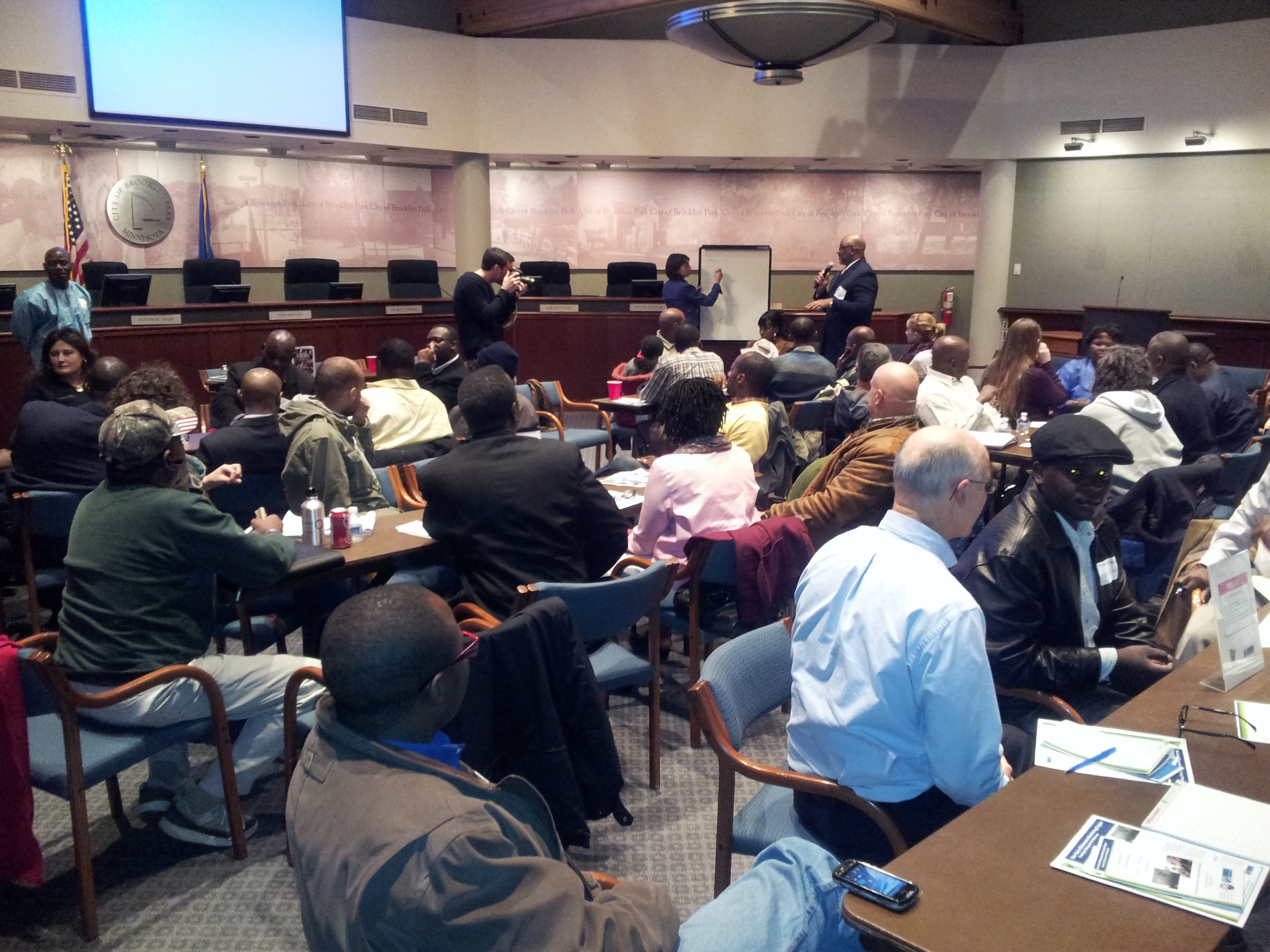
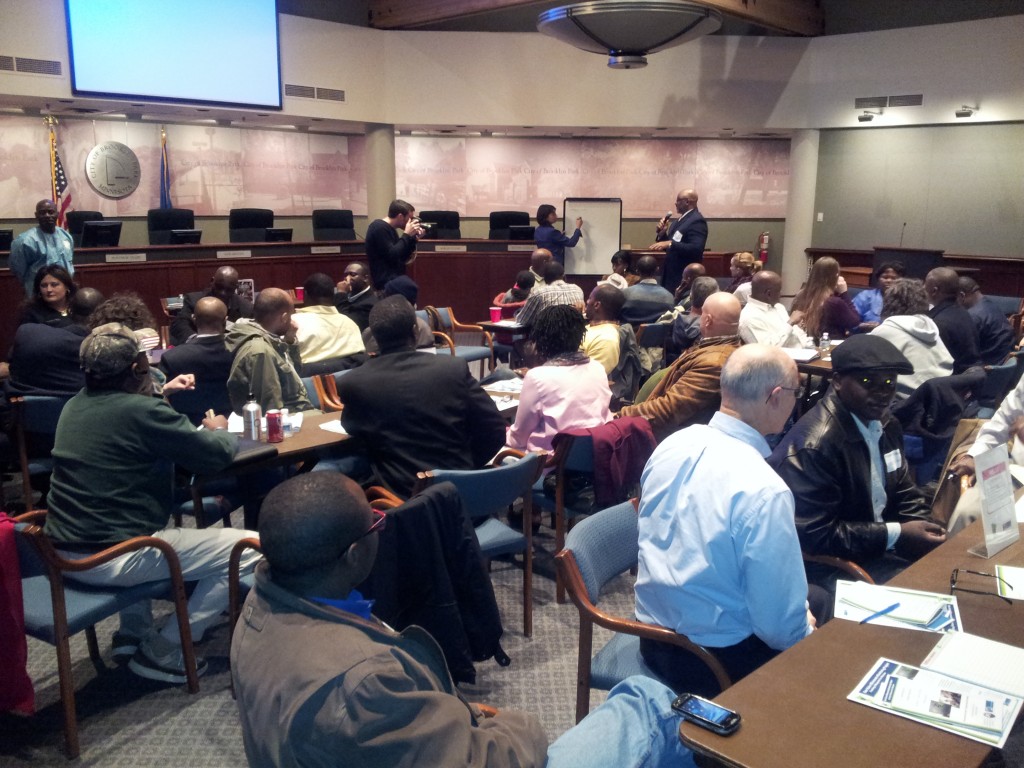
Participants at a November 15, 2012 event organized by African Immigrant Services (AIS) and The Advocates for Human Rights for the Voice Minnesota Monitoring Project at the Brooklyn Park City Council chambers. Photo: Tom Gitaa/Mshale
Participants at a November 15, 2012 event organized by African Immigrant Services (AIS) and The Advocates for Human Rights for the Voice Minnesota Monitoring Project at the Brooklyn Park City Council chambers. Photo: Tom Gitaa/MshaleParticipants at a November 15, 2012 event organized by African Immigrant Services (AIS) and The Advocates for Human Rights for the OneVoice Minnesota Monitoring Project at the Brooklyn Park City Council chambers. Photo: Tom Gitaa/Mshale
BROOKLYN PARK, Minn. – About 100 people packed the Brooklyn Park City Council chambers November 15 for One Voice Minnesota Monitoring Project: Creating a Blueprint for Welcome, an initiative of the Minnesota based The Advocates for Human Rights. The project which kicked off early this year is a fact-finding documentation project to combat anti-immigrant sentiment with a goal of creating long term policy changes that address root causes of inequity that immigrants and refugees face.
The project also aims to determine how immigrant experiences in Minnesota compare to international human rights standards.
The Wednesday event was organized by African Immigrant Services in collaboration with the project sponsors, The Advocates. This being a data collection exercise, the mostly African immigrant crowd shared their experiences on “how welcome they felt’ in Minnesota. AIS executive director, Abdullah Kiatamba, said the exercise was an important one as the project would tell stories that “would otherwise go untold” and gave that as one of the reasons AIS chose to “intentionally engage” with The Advocates on the project.
After city employee, Elizabeth Tolzmann, assured participants that they can speak candidly despite being inside a government facility, participants went about the exercise with gusto after local Kenyan-American hip-hop artist Mobisa did an acapella titled “Give them a chance African children”.
Experiences shared varied from racial insults hurled at some of them to those of gratitude to the embrace extended to new immigrants. Raymond Gwenigale, a twin Cities lawyer of Liberian descent was first to thank Minnesotans for the
Temi Adedoyin presents her group's discussion points during one of the breakout sessions at the One Voice Minnesota Monitoring Project organized by African Immigrant Services (AIS) and The Advocates for Human Rights at the City of Brooklyn Park Council chambers on November 15, 2012. Photo: Tom Gitaa/Mshale
welcome extended to “our people”, getting a second from Hassanen Mohamed, a Somali immigrant. Mr. Mohamed presented himself as exhibit A of the success that is possible in America, stating with passion that “I am the typical American dream” as he described his success in business and community involvement. He serves in a number of citizen led commissions in the City of Brooklyn Park.
Benard Muko, a candidate for a seat in the Brooklyn Park city council in the just concluded elections and himself an immigrant from Kenya, urged the African community to embrace life in America wholly in order to be successful. “We can’t be here physically and our heart and mind elsewhere”, he voiced incredulously.
But there are those who said that their desire to fully integrate to society is what gets them in trouble in the first place and exposes the racism that exists in Minnesota, sometimes from African Americans. Thro Nyumah, a US military veteran from Liberia shared during a group discussion his frustration with African Americans who would tell him to go back to Africa as he drove his ice cream truck through neighborhoods.
Despite the challenges, one Kenyan-American and a fixture in the community organizing community in Brooklyn Park, Irene Njoroge, said she is undeterred and encouraged the African community to get involved in local issues.
Mohammed Dukuly, an Imam at the Masjid An-Nur said his concern is with the parent-child relationship in the United States. Respect for parental authority is a challenge, he said as is the ability for African immigrants to adequately play their parental roles. This, he said needs to be addressed.
The One Voice Minnesota Monitoring Project report is scheduled to be released in early 2014 according to The Advocates for Human Rights.