Home Blog Page 194

US Business to Africa: Stop the Blame Game

0
51f9fe74 fd17 3f84 9aebd357e5b5a724
US Business to Africa: Stop the Blame Game

Stephen Hayes, president of the Corporate Council on Africa (CCA) in this interview with Mshale Correspondent Williams Ekanem in Washington D.C says African leaders should reflect on why things are working out in other continents but not in Africa. He is of the opinion that there is nothing outsiders can do about the high level corruption on the continent.

The Corporate Council on Africa (CCA) had a very successful outing in September during the 7th U.S. Africa business summit, although early, but what would say are the gains of the summit?

The gains definitely depends on our goals which is basically to strengthen relationship and investing in  Africa in terms of business and credibility with various governments  including our own government, certainly that was achieved.  The secretary of state gave a very important speech which was underlined the relationship with the key countries, Nigeria been one of them, South Africa, to some extent Kenya and Ethiopia as well as Ghana.

I think in that case, it was just a huge success. In a way, I can say that it was the most successful summit, in terms of having identified specific goals and having met some of those goals.

Now the other aspect is, does it increase US-Africa business relationship?  That is going to be in the long term, we have to wait and see on that.

Can you point at any example where your objective of strengthening   commercial relationship with African businesses has paid off?

I can give a lot of different examples and they are business to business. A lot of members of CCA like General Electric have put up a lot of contracts and we set up some of the meetings. Westinghouse is another example. One can cite a lot of more examples but that is less important to me. What is more important is that we are establishing business relationships.

There are a number of examples and there are also probably, a number of those that we don’t know about. Our organization basically deals with relationships and those relationships are hard to track, but most of our members continue to do new businesses because of the relationship we have created.

With the myriad of economic problems in most African countries, how does CCA market them for meaningful business engagement with U.S. companies?

Well those are the major challenges on the African side, on the U.S. side there are also challenges including people having to understand that Africa is a diverse continent with different countries and different places to invest and quite some good and also difficult places to invest. So I think the greatest challenge is trying   to get more U.S. companies in Africa. It is still a learning process, no matter how long I have been here, but in any case, I think where we are going with the bilateral relationships we are going to be far more successful in U.S.-Africa business formations.

It is designed to move the relationship forward by bringing businesses together looking at where we can partner in all parts of Africa a. Yes lack of infrastructure is a problem that is why some African countries and China are working on improving infrastructure that is not only going to be used by the Chinese but by everybody else. I like to see more U.S. companies involved in infrastructural development.

The Council recently signed a Memorandum of Understanding with the Nigerian Economic Summit Group NESG; can you lead us into more details?

Nigeria is one of the most important markets in Africa. . Nigeria to me is of paramount importance. Its stability is key to the stability in the entire continent. The fact is that a lot of people have just started investing in Nigeria. If we have a way to track the investments, I think a lot of the Diaspora community is investing more in the country than any other Diaspora community. 

It is one of the most important nations on the continent of Africa. So the NESG is the place where we intend to have one or two meetings in a year and we will get to meet large Nigerian companies through this partnership.

With the intractable problem of wanton corruption in most African countries, turning wealth into a curse, the continent sure needs help. Is there anything the CCA can do?

We are not all things to all people, where we can help is areas we can do build business relationships, make the environment more stable. We are working with our companies to do that, but again we can’t do that unless you have local partners, so it can take some time realistically. In the long run, we make small difference here and there in terms of building partnership but its better dealt with locally.

What is the Infrastructure summit in April 2010 all about?

It’s   about   building relationships with various other countries and companies as well as finding partnerships. We have a considerable South African contingent coming; we are pushing very strongly to have a large Nigerian contingent also because that is where they can access infrastructural relationships.  That is the basis of the forthcoming U.S. Africa infrastructure conference in Washington D.C. It is very difficult to name any other of such gathering and ours is such a very high quality and visibility.

What we are also going to do is to work very closely with the World Bank on this because we are going to make it come immediately after the World Bank spring meeting so that we can have the finance ministers there. We are looking at a tie-in between infrastructure and financing because financing is the biggest obstacle to investment. Our work is long term, its relationship building for greater investment.

As successful as the CCA may be in facilitating commercial relationships between the U.S. and Africa, critics are of the view that the Council has not really impacted the continent. What is your response to this?

I understand the perception; there is a general negativism and cynicism often to many things in life. I can understand where that might have come from. But has U.S. investments in Africa increased? Yes it has. Has it increased significantly? No, perhaps no less significant than in any other area with exception to China and India who are becoming more significant investors in the continent of Africa. So have we added to the visibility of Africa in the United States? I don’t think any other group has done more work.

I don’t know of anybody who has done more in the past ten years in making Africa visible as an economic destination.  AGOA hasn’t worked very well, not because it is a bad legislation, but because the capacity to use AGOA is not there, the infrastructure is not there. Why is it not there? Africans have to stop blaming others but ask what can be done to make the situation better and to me that comes back to functional leadership.

We are strongly resolved to making a change in Africa. These are areas we got to address and on our part we work to get people see that Africa is a very diverse and a very good destination that is not been used.

A greater relationship with Africa can help the U.S. economy considerably. I think we need Africa in more ways than Africa needs us. But at the same time, have these guys asked themselves why things are happening elsewhere and not in Africa? It is very easy to blame the outsider because then you don’t have to address the issues, especially at the leadership level.

Based on all you have said so far, what message do you have for Africans?

Don’t give up hope. I think it’s going to be a stronger U.S. Africa relationship   but it’s going to take a lot of work.

Editor’s note: Read Williams Ekanem report on the 7th U.S. Africa business summit held in Washington, DC.


Changes in Tax Brackets and Benefits for 2010

0

For 2010, personal exemptions and standard deductions will change only slightly to reflect inflation adjustments. Many levels will remain consistent with 2009.

By law, the dollar amounts for a variety of tax provisions must be revised each year to keep pace with inflation. As a result of little inflation, there will be no significant changes for 2010. The following is a brief review of some of the key levels effecting 2010 returns, filed by most taxpayers in early 2011, include the following:

  • The value of each personal and dependency exemption, available to most taxpayers, will remain at the same level of $3,650, no change from 2009.
  • The new standard deduction is $11,400 for married couples filing a joint return in 2010 (no change from 2009), and $5,700 for singles and married individuals filing separately (again, no change from 2009. The Head of Household standard deduction increased slightly to $8,400 for heads of household (up from $8,350 in 2009). Nearly two out of three taxpayers take the standard deduction, rather than itemizing deductions, such as mortgage interest, charitable contributions and state and local taxes.
  • Tax-bracket thresholds increase slightly for each filing status. For a married couple filing a joint return, for example, the taxable-income threshold separating the 15-percent bracket from the 25-percent bracket is $68,000, up from $67,900 in 2009.
  • The maximum earned income tax credit for low and moderate income workers and working families with two or more children is $5,028, up from $4,824. The income limit for the credit for joint return filers with two or more children is $43,415, up from $41,646.
  • The annual gift exclusion will remain at $13,000, same as 2009.

Nigerian Americans Do Double Take on Terrorism Suspect

2dd041b9 d165 f375 a6530309e1e4877e
Nigerian Americans Do Double Take on Terrorism Suspect

When Herbert Igbanugo heard that a Nigerian man had been arrested for allegedly attempting to blow up a plane on Christmas Day, he didn’t think the suspect was born in the West African nation.

“Talk about surprise,” said Igbanugo, a Nigerian-born immigration attorney and founding partner of Minneapolis-based Igbanugo Partners International Law Firm.

Igbanugo said his initial inclination was that Umar Farouk Abdulmutallab, the suspect, must have originated in another country and fraudulently obtained a Nigerian passport for the trip to Detroit.

“When it actually turned out he was a Nigerian, I was shocked,” Igbanugo said.

Whenever there is breaking news related to the U.S. war on terror, immigrants from the suspect’s country of origin often fear that attention from law enforcement agencies may spark backlash from the American public.

For example, when news broke in early 2009 that the FBI was investigating Abubakar As-Saddique Islamic Center, a Minnesota mosque attended by young men believed to have gone to fight in Somalia’s civil war, members of the Somali community in the state feared that resentment of them would increase.

Abdulmutallab is said to have spent some time in Houston in 2008, and the FBI has sent agents there to investigate his stay. But the Nigerian community there wasn’t too concerned about backlash, said Chido Nwangwu, whose company, USAfricaonline, has been publishing newspapers, magazines and books for African immigrants since 1993.

Nwangwu said that Houston’s Nigerian community received the news of Abdulmutallab’s arrest with “deep concern, resignation and denial.”

“But above everything else,” he said, “they are insistent that he does not represent the values of Nigerians and Africans in America.”

He said some are concerned that Nigerians and other Africans would be cast in a bad light, but no one has expressed fear of overt acts of retaliation.

“It is natural for some people who have been introduced to Nigeria for the first time by this event to look at Nigerians with a critical eye,” Nwangwu said. “But it is important to know that there are too many champions of excellence in the African community  – too many persons who have achieved so much and built so much in America –  to be pigeonholed by potential acts of bigotry or violence from anyone.”

One aspect that makes Nigerians less worried is that, although Abdulmutallab reportedly acknowledged ties to Al Qaeda, he did not originate from a training camp in Nigeria. In fact, after Abdulmutallab severed ties with his family, his father, a prominent Nigerian banker and former government minister, alerted the U.S. Embassy in Nigeria that his son was developing extremist religious views. That act would help the image of his father and of Nigerians, said Igbanugo, the Minneapolis lawyer.

“I think that goes a long way toward showing good faith and showing that this is not something that should be blamed on a certain person or a group of people,” said Igbanugo.

Another aspect that sets Nigeria apart from Somalia is that, although there has been tension between Nigerian Muslims and Christians, the violence has never been directed at the United States or any foreign power.

Segun Kerry, the founder of Nigerian Community Help Center, a New York City-based organization that helps new immigrants, said he had received several calls from Nigerians wanting to talk about the implications Abdulmutallab’s arrest would have on their community.

“I believe what I’m hearing,” said Kerry. “The feeling presently is that people are not taking it so seriously that it is going to affect a lot of Nigerians.”

Kerry said the callers to his office seemed to stress that Abdulmutallab’s alleged act was an isolated incident, and hoped that his training and indoctrination in Yemen – rather than Nigeria – would emphasize that fact.

“We Nigerians are not the kind of people that will tell you that, ‘Hey, I’m gonna kill you and then kill myself,” Kerry said. “We don’t  do that. Granted we are humans, and there are some radicals (in Nigeria). However, no matter how radical the individual is, I’m not sure he would kill himself. He will go out there and do something, provided it will not involve taking his own life.”

Igbanugo agreed with Kerry that it was not in the nature of Nigerians to engage in terrorist acts that involved suicide.

“Quite honestly, this is uncharacteristic of Nigerians,” Igbanugo said. “The Nigerian type of Islamic fanaticism has never included suicide bombing. To me, this is a guy that was not just indoctrinated, but also has mental illness.”

Igbanugo said his colleagues, friends and those he has talked to since the news broke don’t seem to anticipate a backlash, or believe that another Nigerian will be involved in a similar incident.

“I don’t think you are going to see another one like this,” Igbanugo said.

Stark Reality for Africans in Minnesota: Reported HIV/AIDS Cases Continue to Climb

0
2497d17e ac58 d700 e613c76fb303e3b2
Stark Reality for Africans in Minnesota: Reported HIV/AIDS Cases Continue to Climb

African-born immigrants make up less than 1% of Minnesota’s population, however in 2008, they constituted 11% of all HIV infections diagnosed, according to the Minnesota Department of Health (MDH).

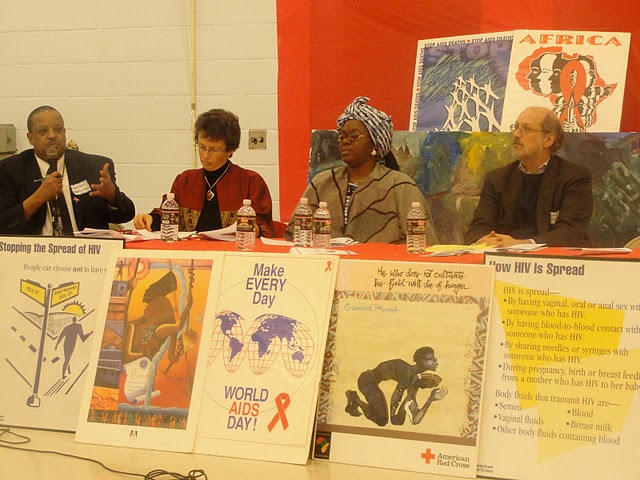
The stark statistcs were shared during the sixth annual African World AIDS Day (AWAD) held in Minneapolis at the Brian Coyle community center in the cedar-Riverside neighborhood in December. According to the department, a noticeable trend of increasing numbers of new HIV cases was reported among the African-born population. In 2008, the department says there was a reported 37 new infected HIV cases among Africans.

The occasion consisted of presentations on HIV from health care and African agencies, food, entertainment and a panel discussion on HIV/AIDS. During breakout sessions, attendees listened to African drums, songs and words of wisdom from elders.

AWAD made this year’s theme, “United in the fight against AIDS.” 

AWAD focused on emphasizing the difference between HIV and AIDS, the advancement of HIV in the body and its effects, and the ways in which the virus can be transmitted from one individual to another. It also featured testimonies from people who are currently living with HIV.

Many African youth, students, elders said they attended the informational event to learn more about what HIV/AIDS were exactly.  

Sharmake Farah, 16, who attends Roosevelt High School in South Minneapolis, said he came to educate himself about HIV and ways to protect himself.

“Some people in the African community don’t know about AIDS and they don’t talk about it,” Farah said. “These kinds of events make them more aware of what’s going on and warns people to be more cautious.”

Testaments to living with HIV

Three years ago when Sheila Mills learned she was HIV positive, the results did not sink in quickly. Instead, it took her close to five months to come to terms with the HIV pandemic. She said she came to talk to people to enlighten and empower them to learn more about HIV/AIDS.  

Mills, an advocate of HIV awareness and a counselor to African and African American communities, said individuals living with the virus should not be treated differently.

“I want people to know that a person who is living with HIV should not be treated differently than a person who is living with diabetes or cancer,” she said. “Everyone should be treated with dignity and respect.”

Taboo about HIV

Stigma is associated with HIV/AIDS and this shame is prevalent among the African community. Mills said individuals living with HIV need a support system and should not be cast aside.

“It is sad the way that we are treated because of the stigma attached having HIV,” Mills said. “I am applaud and angry about the way our children and families are thrown away because they are living with HIV.”

This stigma associated with HIV/AIDS has been increasingly widespread and cultural barriers as well as taboos about HIV/AIDS have made it difficult to open about the dialogue about the real issues at hand.

Margaret Korto, the keynote speaker and a Capacity Building Specialist at the Office of Minority Health Resource Center in Maryland, stressed the need for the African community to have an open and healthy discussion about HIV/AIDS.

“As Africans, it is hard for us to talk about sex,” Korto said. “We do not have sex, we have babies.”

Korto advised people to talk to their children and take the initiative to turn the discussion “into a joke” so that there is a level of understanding between parents and children.

“If your child wants to come and talk to you about HIV, how will they come and talk to you, if you have stigmatized that whole word,” Korto asked.  “We have to get to a point where we are comfortable with talking about HIV.”

Korto said because of this prevalent stigmatization of HIV/AIDS, many HIV/AIDS educational organizations have been looking at ways to create culturally sensitive ways to start the discussion.

Abdullahi Sheikh works for Minneapolis Urban League as the Program Service Specialist and coordinates the African Wellness Program, which works to prevent and reduce HIV/AIDS and substance abuse among the African-born population.  He said AWAD has made it possible for the event to have an all-around African theme.

“We realize we need to create something that is African that people can identify with,” he said. “We’ve got guest speakers and experts who are African, the music is African, and the food is African.”

As a result of this, they have been bringing Kenyan chorus groups, West African drummers and African food to make it easier to talk about these sensitive issues.

Sheikh, who is also the Chair for AWAD Planning Committee, said one of the things AWAD has done is start the HIV/AIDS conversation at a time when no one was talking about it.

“Over time, we’ve increased the critical awareness that was necessary,” Sheikh said.  “It is a difficult conversation to have and we are at a level where we are able to talk about sex now.”

While there is no cure for HIV, there are some treatments to allow HIV patients to live a longer, enjoyable life. However, the speakers gave a lot of information on ways to prevent HIV spreading.

“We can’t tell people to stop what you are doing Change of behavior takes a long time, people have to make a decision about that change,” Sheikh said. “So, we’ve been able to give them some information about the most critical issues in relation to making those changes.”

Sacdiyo Gelle, a Somali mother, said she attended the event because she wanted to learn more about what HIV and AIDS were.

“Thanks to this event, I no longer think of HIV as an immediate death sentence,” Gelle said.  “I want to learn more about this disease and teach it to my children and grandchildren.”

Google Directions Debuts in Nairobi

0
32db5f72 d5cd d69a f1061e1bef1b933f
Google Directions Debuts in Nairobi

A  first for Africa

Editor’s note: The author first wrote this for his blog Whiteafrican.com. Republished here by permission.

Gone are
the days where you had to have lived in Nairobi for a couple of years before you
understood all the back roads and neighborhoods in order to get from one place
to another. Kenya has an advantage in the fact that the only non-sales office
in all of Africa for Google is here. When they create new tools, or customize a
feature from the developing world, for Africa they do it here in their own
backyard first.

24519def f794 d8e9 22d7ca798f996e4f

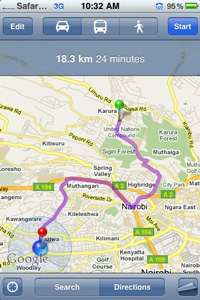
In December, Google turned on mapping directions for Kenya. Like me, most of the people who know Nairobi were shocked and didn’t believe it. Could this really work? It does, and it works well.

I’ve been testing it out for the last week to see what type of results I get, and I’ve been impressed with the results. Fortunately I have my iPhone with me, and it allows me to do things like challenge Google/Apple to find my current location and then give directions from that location to somewhere in Nairobi that I happen know every back road, alley and footpath between.

Shortcomings

As omnipotent as Google seems to be, what they’re unable to do is track the vagaries of Nairobi traffic. So, as logical as the directions you get from Google might seem, they are not the best way to go much of the time. While they give accurate directions for new people to Nairobi to follow, they are also the “obvious” route and will cost you hours of sitting in gridlock while you watch the matatu’s (public minibuses) clog the road even further.

[NPI Float=”none”]/Media/0/png/2010/1/24535e78-cc9b-9c81-d8843f6d0142407a.png[/NPI]

Lack of detail on the maps

Some areas, even large towns like Ongata Rongai aren’t even shown on the map. Below is the failure screen for getting directions from Rongai to Eastleigh. I had to go with Langata instead, as that was the next closest “town” in Google Maps. This pattern holds true for dirt roads and paths that are usable by vehicles, but which don’t show up on the map.

[NPI Float=”none”]/Media/5/jpg/2010/1/243c0b85-947a-a9d2-33a95216769ae0a3.jpg[/NPI]

I’ve also seen this in regards to offices and buildings, where they are put on the wrong part of the road, sometimes off by a good half kilometer, as was my father’s office in Upper Hill shown below.

[NPI Float=”none”]/Media/36/jpg/2010/1/244c94eb-ff58-c750-0a23d0de12452a19.jpg[/NPI]

Final Thoughts

Anyone living or working in Kenya should buy a drink for every intern and Google employee who has done the manual work to get Kenya mapped to the level that it is. It’s an iterative process that only gets better as time goes by and more people work on it.
As Google states:

“This essential tool is by no means Google’s effort alone – we’re enormously grateful to Kenya’s active online cartographers who have helped us build these maps from ground up with the use of Google Map Maker, a tool that allows people to help create a map by adding or editing features such as roads, businesses, parks, schools and more.”

The directions provided by Google in Nairobi (I haven’t tested up-country) are adequate. They’ll get you to and from the locations in Nairobi that you need to go. You’re better off now than you were before, and as someone new to the city you’ll have a lot better luck with Google’s maps and directions than you’ll have with asking someone on the side of the road.

The Thing Around Your Neck: Audio Interview with Nigerian Author Chimamanda Adichie

0
2dc2586d c8ee 14b0 e4b376d18fc6d855
The Thing Around Your Neck: Audio Interview with Nigerian Author Chimamanda Adichie

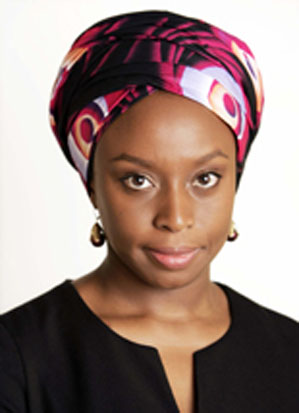
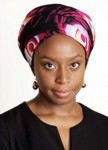
Chimamanda Ngozi is an award winning author whose novels have catapulted her to international fame. Her new book, The Thing Around Your Neck, is a collection of twelve short stories about the Nigerian experience both in Nigeria and in the United States.

The Center for Disease Control and Prevention (CDC) Removes HIV Ban and Issues New Vaccination Criteria for U.S. Immigration

CDC Says HIV Infection is No Longer a Communicable Disease


Foreign nationals who are determined to have a “communicable disease of public health significance” are inadmissible to the United States, according to U.S. federal regulation. Those applying for adjustment to lawful permanent resident status or for an immigrant visa abroad must receive a medical examination to demonstrate they are not inadmissible on public health grounds. The Center for Disease Control and Prevention (CDC) defines the list of communicable diseases of public health significance, which can change when a new disease emerges or when more is known about a disease that is already on the list. Such communicable diseases are those that can be spread easily between persons.


On January 4, 2010, HIV infection was removed from the CDC’s list of communicable diseases. Prior to this final rule, non-U.S. citizens with HIV were inadmissible to the United States. Immigrants, refugees, asylees and parolees were denied entry to the United States based on their HIV status, unless they obtained an HIV waiver. Now that the new rule is in effect, HIV testing is no longer a part of the immigration-related medical exam.


According to the CDC, non-U.S. citizens who have a disease that falls into any of the three following categories are inadmissible:


1. Listed diseases: active tuberculosis, infectious syphilis, gonorrhea, infectious leprosy, chancroid, lymphogranuloma venereum, and granuloma inguinale. (HIV infection was removed on January 4, 2010.)


2. Quarantinable diseases designated by any Presidential Executive Order. The current list of diseases includes cholera, diptheria, infectious tuberculosis, plague, smallpox, yellow fever, viral hemorrahagic fevers, severe acute respiratory syndrome (SARS), and influenza caused by novel or re-emergent influenza (pandemic flu).


3. Diseases reportable as public health emergency of international concern to the World Health Organization under the International Health Regulations of 2005.


HIV infection was added to the list of communicable diseases of public health significance in 1987 when little was known about it. At the time, it was not known whether a handshake or a hug would spread the disease. However, after years of research, it is now widely known and accepted that HIV is mainly spread through unprotected sexual interaction with an infected party or through sharing needles with an infected person. The CDC issued the final rule because it determined that HIV is not spread to the U.S. population through casual contact and therefore does not belong on the list. This means non-U.S. citizens with HIV infection no longer require a waiver to enter the United States or adjust to lawful permanent resident status.


CDC Issues New Vaccination Criteria for U.S. Immigration


As of December 14, 2009, the CDC’s new vaccination criteria for U.S. immigration became effective. The CDC will use these criteria at regular periods (as needed) to decide which vaccines must be part of the immigration-related medical exam. Those applying for lawful permanent resident status or for immigrant visas to enter the United States will be affected by these changes.


The new vaccination criteria are:


1. The vaccine must be age-appropriate for the immigrant applicant.
2. The vaccine must protect against a disease that has the potential to cause an outbreak.
3. The vaccine must protect against a disease that has been eliminated or is in the process of being eliminated in the United States.


Currently, applicants for U.S. immigration must be vaccinated against the following illnesses:


1. Mumps
2. Measles
3. Rubella
4. Polio
5. Tetanus and diptheria
6. Pertussis
7. Haemophilus Influenza type B (HiB)
8. Hepatitis A
9. Hepatitis B
10.Rotavirus
11.Meningococcal disease
12.Varicella
13.Pneumococcal disease
14.Seasonal influenza


With the new criteria, vaccinations for Human Papillomavirus and Zoster are no longer required. All applications that were pending before December 14, 2009, however, are subject to the old vaccination requirements. While these changes may seem minor, would-be immigrants must comply with all vaccination requirements.


Nothing in this article should be taken as legal advice for an individual case or situation. The information is intended to be general and should not be relied upon for any specific situation. For legal advice, consult an attorney experienced in immigration law.

Inner Peace

0

When we accept Christ into our lives we don’t have to be worry.  All anxieties and worry should be rolled over to the Lord.  We have the ability to make a choice to focus on worry or inner peace.   

Allowing worry to infiltrate thoughts paralyzes movement toward our God-given purpose in life.  Time spent in worry is useless time.  There is no benefit gained from all the energy expended in worry and fear.  

It is my prayer that each person gets to the place God has prepared for them. This is the place where everlasting peace will dominate thoughts, decisions and actions.  When we put our faith in God, we can be assured the Lord will get us to our destination.  

When we firmly trust the inner peace within us, we won’t need to spend worrying about roads taken in life.  God is the way-maker.  God knows the answer to every problem faced.  We will have inner peace when we “buckle-up” with the word of God and partner with Him in all that we do.   As believers, we can have peace while the world around us is in turmoil.

Remember:  Inner peace comes from our relationship with the Lord; it causes us to triumph over problems.  Inner peace is dependent on the sufficiency and strength of Christ.  Inner peace passes understanding; it is deep, stable, selfless, genuine and real. Inner peace is independent of circumstances since it comes from within and can’t be lost.

Relief For Victims Of Domestic Violence And Abuse – Part 1 of 2

0

Part 1 of 2

There has been a significant increase in the amount of domestic violence and domestic related incidents of harassment.  Victims of violence are best advised to call the police right away or, in the alternative, seek help from several of the domestic abuse hotlines or county support agencies.  

If an individual is worried about a child or an adult in someone else’s family or household, it is best to report the abuse first to Child Protection or Adult Protection Services.

For victims who want redress through the courts, the following are three ways to get relief.

Orders for Protection (OFP)

An Order For Protection (OFP) is a court order to stop family violence.  An OFP is not a criminal case.  Instead, it takes place in family court.  The court can order the abuser to stay away from the victim or order them to get counseling or treatment.  The court can also order child support or custody. 

An OFP is one of the key ways for a victim of family violence, physical abuse, or immediate harm threats, to not only stop such violence but to prevent it from reoccurring.  Victims of family violence need to understand the full breath of what encompasses domestic violence. 

Domestic/family violence includes incidents involving sexual violence and terroristic threats; other examples include: the abuser throwing things at the victim; pushing the victim saying things like “I’ll kill you”; waving a weapon at the victim; killing  the victim’s pets or forcing the victim to have sex; and/or preventing the victim from calling 911.

An individual can get an OFP if they are a victim of any of the above examples, behaviors or actions that are similar to those listed from a spouse, ex-spouse, anyone whom they have had a significant romantic or sexual relationship with, any blood relative, anyone they have lived with now, or used to live with, their parent, or their child if they are over 18 years old.  

The victim does not need to start a divorce to get an OFP and they can apply for a child within their household or family.  There are no residency requirements and there is no court fee for applying for an OFP.

While the victim does not need an order for protection to stop abuse, one of the most important things to keep in mind is that it is illegal for anyone to hurt, threaten, or stop someone from calling 911 for help.  An OFP makes it easier for individuals to protect themselves; it tells the abuser that any more threats or abuse will lead to arrest, criminal charges and maybe jail or a fine. 

Orders for Protection make it easier for the police to arrest the abuser.

There are two kinds of Orders for Protection, an “Ex-parte” order, which means an order without telling the person on the other side of the case, and a regular OFP.  An ex-parte order is in effect the day it is signed by a judge, before the abuser is served, and it protects victims until there is a hearing, which normally occurs within 7 days.  A hearing normally occurs within 14 days for a non ex-part order.

Someone who is suffering from family/domestic violence does not need a lawyer to get a temporary order for protection; however, since there are all kinds of relief, they could ask for an OFP and there might be custodial repercussions, it is advisable to contact an attorney for proper advice regarding the best way to proceed with the OFP. 

A key thing to keep in mind when preparing a petition for an OFP is to document within the petition the series of abuse or violence that has occurred from the abuser, the dates of their occurrence, and a description of each incident.  Judges are often reluctant to issue an OFP based upon only one incident, unless it is extreme.

Forms of Relief

In a petition for an order for protection, the applicant can ask for various forms of relief from the court such as: ordering the abuser not to harm or threaten the victim; his or her children or anyone in the home; ordering the abuser to leave the home; to stay away from the applicant’s work; home or school; ordering counseling for the abuser; and ordering the abuser to pay temporary child support and alimony.

It is illegal for a person who has an OFP against them to posses a firearm.  The applicant can ask the court to order the abuser to turn over their guns to the police.  The applicant can also ask in their petition for the court to keep their address and other contact information confidential.

Once an OFP is issued, it is can be for up to 2 years in most cases.  An order for protection also affects custody issues and rights against whom it is issued as the court must take the OFP into account when making a decision in custody hearings.  Once an OFP is issued, the victim should always keep a copy of the order with him or her at all times.

An applicant is well advised to consult a lawyer regarding how to best prepare for the OFP hearing as it is a full evidentiary hearing where the parties are required to show evidence of their allegations and if necessary offer testimony of witnesses.

Nothing in this article should be taken as legal advice for an individual case or situation.  The information is intended to be general and should not be relied upon for any specific situation.  For legal advice, consult an attorney experienced in family/immigration law.

Note: Go to Part 2.

Sweet Success for ‘Non-traditional’ Somali Students

0
0c8e7164 ea1b a278 a7248f2917f14c91
Sweet Success for ‘Non-traditional’ Somali Students

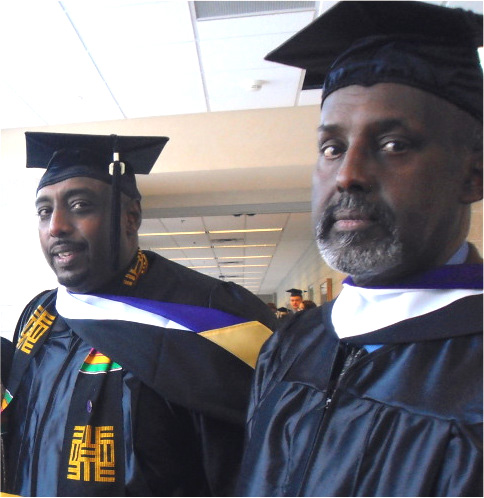
Amid the daily struggles of life in a new country and revelations of Somali youth leaving Minnesota to fight alongside a designated terrorist group, Somali-Minnesotans continue to show a tremendous strive to adjust life in Minnesota. Among the many graduating students of this year from Minnesota State University were Mohamed-Rashid Mumin and Hussein Wehelie.

Neither of these men is ordinary nor a traditional student.

Somali students in Minnesota campus hallways are a common sight but not that of 53-year-olds also attempting to complete a degree. Mr. Wehelie and Mr. Mumin’s achievements are exceptional by Somali standards. Most 53-year-old Somalis work in odd jobs and strange shifts, and are preoccupied with how to raise their kids and help relatives in the native-land, Somalia, or consumed with Somali politics.

However, while working full-time and raising big families, both Mr. Mumin and Mr. Wehelie managed to earn their degrees from a respected American University.

Mr. Wehelie and Mr. Mumin’s past success may have contributed to their continued drive to better their lives. Mr. Mumin’s late father, Abdirahman Sh. Mumin, was a prominent Somali politician and three-time minister of Somalia. He last led the ministry of defense in the late President Aden Abdulle Osman’s administration. Mr. Mumin himself was known for his role in the Somali’s professional sports. “I was a professional soccer, basketball, volleyball player … I even played at the national level with more than one of these sports.” Mr. Mumin said.

Likewise, Mr. Wehelie was a renowned and respected figure in the journalism field. Before the civil war, he was a producer and a writer for both Radio Mogadishu and Xidigta October newspaper. “I used to write for number of programs at Radio Mogadishu and was the first person to write about the “Titanic” tragedy in Somalia.” Wehelie stated.

Obviously, no success is achieved with ease or without a remarkable price. “I went through a lot trying to provide and make time for my family while going to school.” Mr. Mumin explained.  Mr. Wehelie faced similar challenges, “I used to work 3 days for 12 hours and go to school for the other four days … all of these time, and I was also helping my relatives back home.”

Even though Wehelie was a student at the Somali National University in Mogadishu when the civil broke-out, his coursework and credentials were not recognized in Minnesota and had to start over. “First, I enrolled into an ESL (English as a Second Language) program then GED (General Education Development) to prepare for the high school diploma before going on to college” Wehelie explained.

This may be a prime example of one’s resolve but could also be an indication to a possible trend.

Mr. Wehelie and Mr. Mumin received their degrees in Political Science & Public Administration and Urban Planning & Geographic Information System respectively.

Women of Zimbabwe Honored for Human Rights Work

0
0c5e5785 f1f9 075d 0d55372cdbf8ae4f
Women of Zimbabwe Honored for Human Rights Work

Women of Zimbabwe (WOZA), a grassroots movement working to empower women from all walks of life to mobilize and take non-violent action against injustice has mobilized hundreds of demonstrations of thousands of women across Zimbabwe, motivating mothers to take a stand against the brutal repression and neglect committed by President Robert Mugabe’s government.

WOZA’s protests have been met with repression and violence. The act of speaking up about the injustices has led their government to label the women as “unrepentant criminals.” 

Ms. Mahlangu has been arrested over 30 times in the course of her work as a human rights defender. Along with WOZA co-founder Jenni Williams, she has led campaigns with WOZA supporters to address many of the most crucial human rights issues facing Zimbabwean women, including domestic violence and rape, the right to food and education for children, the rights to participation and the right to association.

It was against this backdrop of bravery and courage that led the Robert F. Kennedy Center for Justice & HUman Rights to award this year’s Robert F. Kennedy Human Rights Award to Magodonga Mahlangu and her organization, Women of Zimbabwe Arise.

The Robert F. Kennedy Human Rights Award was established in 1984 to honor courageous and innovative human rights defenders throughout the world who stand up against injustice, often at great personal risk.

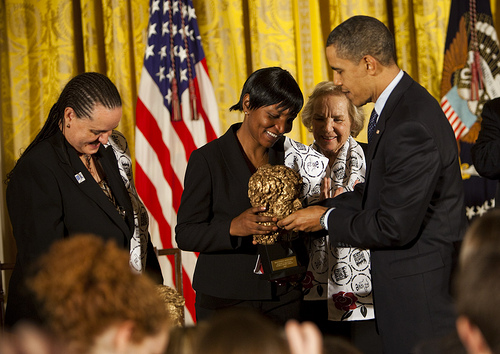
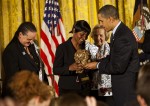
The award ceremony took place at the White House and was presented to Magodonga Mahlangu on behalf of WOZA by President Barack Obama.

“By her example, Magodonga has shown the women of WOZA and the people of Zimbabwe that they can undermine their oppressors’ power with their own power – that they can sap a dictator’s strength with their own.  Her courage has inspired others to summon theirs.  And the organization’s name, WOZA – which means “come forward” – has become its impact – its impact has been even more as people know of the violence that they face, and more people have come forward to join them,” said President Obama.

First lady Michelle Obama was also in attendance.

<object width=”480″ height=”300″><param name=”movie” value=”http://www.whitehouse.gov/sites/all/modules/swftools/shared/flash_media_player/player.swf”></param><param name=”allowFullScreen” value=”true”></param><param name=”bgcolor” value=”282828″></param><param name=”allowscriptaccess” value=”always”></param><param name=”flashvars” value=”path_to_player=http://www.whitehouse.gov/sites/all/modules/swftools/shared/flash_media_player&path_to_plugins=http://www.whitehouse.gov//sites/default/modules/wh_multimedia/wh_jwplayer&path_to_captions=&file=http://www.whitehouse.gov/videos/2009/November/112309_EastRoom.m4v&image=http://www.whitehouse.gov/sites/default/files/audio-video/video_thumbnail/awards.jpg&controlbar=bottom&frontcolor=AAAAAA&plugins=http://www.whitehouse.gov//sites/default/modules/wh_multimedia/wh_jwplayer/captions,http://www.whitehouse.gov//sites/default/modules/wh_multimedia/wh_jwplayer/hat&captions.file=&stretching=fill&menu=false”></param><embed src=”http://www.whitehouse.gov/sites/all/modules/swftools/shared/flash_media_player/player.swf” type=”application/x-shockwave-flash” allowscriptaccess=”always” allowfullscreen=”true” width=”480″ height=”300″ flashvars=”path_to_player=http://www.whitehouse.gov/sites/all/modules/swftools/shared/flash_media_player&path_to_plugins=http://www.whitehouse.gov//sites/default/modules/wh_multimedia/wh_jwplayer&path_to_captions=&file=http://www.whitehouse.gov/videos/2009/November/112309_EastRoom.m4v&image=http://www.whitehouse.gov/sites/default/files/audio-video/video_thumbnail/awards.jpg&controlbar=bottom&frontcolor=AAAAAA&plugins=http://www.whitehouse.gov//sites/default/modules/wh_multimedia/wh_jwplayer/captions,http://www.whitehouse.gov//sites/default/modules/wh_multimedia/wh_jwplayer/hat&captions.file=&stretching=fill&menu=false”></embed></object>

The White House ceremony to honor Mahlangu sponsored by   the RFK Center for Justice and Human Rights (RFK Center), also included remarks by Kerry Kennedy and a tribute to Senator Edward Kennedy, an RFK Center founding board member from 1968-2009.

RFK Board Chair and former Chair of the Massachusetts Democratic Party Phil Johnston, introduced the President saying, “Those of us who loved and admired Robert Kennedy celebrate the fact that President Obama carries on RFK’s ideals in this White House on a daily basis.  On behalf of Ethel Kennedy, her children and grandchildren , the extended Kennedy family, and the Board of the Robert F. Kennedy Center for Justice and Human Rights, we are  honored that you invited us to the White House and we are determined to do all we can to support your work during the coming exciting and productive years.”

Magodonga upon accepting the award told an audience of two hundred, including top Administration officials, Members of Congress, and the Diplomatic community, about parents forced to choose between putting food on the table and sending a child to school. She spoke about the rise of child-headed households as HIV/AIDS, malnutrition, stress and a collapsed healthcare system continue to send mothers to an early grave. And she pointed to the alarmingly low life expectancy for a Zimbabwean woman -34 years.

Magodonga said, “While (Zimbabwean President Robert) Mugabe boasts of having degrees in violence, I and 75,000 WOZA members who stand beside me, have degrees in non-violence.”

“I feel both great excitement for the recognition of my work with WOZA and sadness because although my work has gained recognition internationally, in my own country I have been labeled an enemy of the state,” said Ms. Mahlangu. “Now I know I am not alone, the world is watching and one day (Zimbabwe) shall be a normal society – with the determination of the members of WOZA, anything is possible.”

“We are not fighting a revolution in Zimbabwe, we are leading an evolution.  And civic education is our tool to evolve the hearts and minds of Zimbabweans to build a strong, new, African democracy where respect, tolerance and accountability are key”, said Jenni Williams, co-founder of WOZA with Ms. Mahlangu.

Ms. Williams, referring to president Obama’s community organizing roots said: “Mr. President you know how invaluable community mobilizing can be. We have learnt that knocking on doors, talking with and listening to people is the way we can rebuild our nation. We call on you, to support community mobilizers who are organized to empower Zimbabweans to deliver change from the ground up.”

According to the RFK center, the award includes a cash prize of $30,000 and on-going legal, advocacy and technical support through a partnership with the RFK Center.

Winners were selected by an independent panel of human rights experts. The 2009 panel included Claudio Grossman; Gay McDougall; Kenya-born Makau Mutua, Dean of University at Buffalo Law School, The State University of New York; Sushma Raman, President of Southern California Grantmakers; Dr. William F. Schultz, Senior Fellow at Center for American Progress.