

Home Blog Page 199

Femi Kuti Brings the Zoo Down

0
3cab588e 3048 99b7 520667cc720250c1
Femi Kuti Brings the Zoo Down

Wilson Coker left his Nigerian homeland 17 years ago.  He now supervises a group home for Ramsey
County, Minnesota.  Tuesday evening,
although still dressed in business attire, he moves his hips in true Nigerian
dance style.  He might have lost a bit of
his accent, but he hasn’t lost the beat of traditional dance.

He came to the Minnesota Zoo on June 30th to hear
a favorite musician, King Sunny Adé who opened the evening of Nigerian music to
a near-capacity crowd of over 1300 people. 
He stayed to experience superstar Femi Kuti close the house.

Under overcast skies, dark with foreboding rainclouds, Coker
finds himself pleasantly surprised with the music venue.  “I expected something else, you know, at the
zoo, but this is great!” Coker said.

Adé has been entertaining audiences since the mid 60s.  After forty years of performance, Adé has
perfected his signature juju music, a dance-inducing mingle of western pop and
traditional African, rooted in Nigerian guitar music. 

His band of a dozen musicians warms up slowly on this chilly
evening with temperatures below 70 degrees. 
They play with perfect synchronicity and South African sounding
harmonies.  Adé may be the front man of
the band, but he doesn’t take the stage, rather blending in with the rest of
the band mates. 

He does, however, elicit a strong, enthusiastic response
from those in the audience who speak his language.  Adé calls out in Yoruba and the crowd
responds in kind with laughter and whistles. 
The opening act lasts 75 minutes with a short intermission before Kuti
lands on stage. During this musical hiatus, Coker assures me that the dance
traditions of his homeland are indeed handed down through the musicianship of
people like Adé and through parties at home where, “we teach our children how
to move. We’re handing it down,” says Coker.

Johnny D, who hosts KFAI’s reggae-infused show on Friday
afternoons, fills in during the break between musicians as he pulls names from
a box and hands out prizes such as T-shirts and tickets to upcoming events.  An emcee from the Zoo stalls for time telling
us that the entire stage is built and torn down each night.  The stage sits only steps away from the
audience, giving customers a true chance at standing in very close proximity to
their desired stars. 

In no time, Femi Kuti’s band, complete with trumpets,
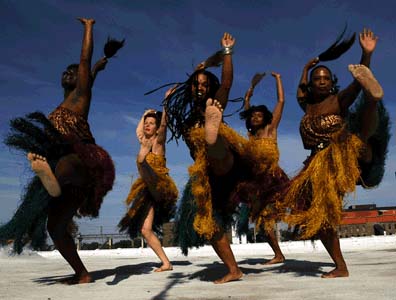
trombone, saxophones and dancers wearing not much more than ropes of beads with
hot pants, climbs on stage.  Adé had,
admittedly, pulled the crowd to our feet, but Kuti’s electrified music makes us
dance as if stepping on hot stones.  In
his opening song Kuti calls out, “We all have to dance right down to the
ground,” before completing a dance move that has him touching the stage floor
with his hands.

Like his show last year, Kuti acts the chameleon, singing,
playing a triad of instruments, dancing, and directing with precision.  With the cooler temps, his shirt stays on,
but his music sizzles in some places and mesmerizes in others. 

His second number commands his listeners to Stop-stop-stop AIDS and Fight-fight-fight AIDS without any
details on how to follow his directive. 
The volume increases to the point where I am blessing my earplugs,
begged off one of the security guards. 
Wilson Coker looks as if he’s at least equally pleased with Kuti as he
was with Adé.

For me, there’s no comparison.  Kuti eclipses the opening act.  He engages the audience vocally as well as
physically—walking out to the lip of the stage and schmoozing with the dancers
among the concert goers.  He maintains
tremendous eye contact with his band members, coaxing them on with his hands
and facial expressions. 

Midway through his 75-minute show the band sings a song off
their latest album, which is reggae-sounding in spirit though not in tone.  “Day by day by night by night we work and
pray for peace today…”  Kuti calls out,
“Harmonies and melodies will bring peace!” 
He then yells, “As far as I’m concerned, everything is politics.”  He continues to pontificate until I am
tempted to raise my arms up as if in a revival tent meeting shouting Praise Be!

In the final fifteen minutes, Kuti hands us a hot
potato.  “Sex and music walk hand in
hand,” he says.  “It is important for a
father to teach his son about sex and for a mother to teach her daughter,” he
says between intoning “Don’t come too fast.” 
The double entendre is not lost on the wild and spirited audience.  He then promises that those who learn the
intimacies of sex will some day, when they are sixty years old, start in with
romance at 9 or 10 o’clock in the evening and keep going until 4 in the
morning…”don’t come too fast…”  The crowd
roars approval.
Abubakar Islamic Center Receives Record Support at Convention despite Controversy

0
3c5af594 3048 99b7 52c34ecaa412e10f
Abubakar Islamic Center Receives Record Support at Convention despite Controversy

Despite fears of distractions from  the missing Somali youth saga that has engulfed the Somali community in Minnesota, the Abubakar As-Saddique Islamic Center held its 9th Annual Convention at the Minneapolis Convention Center over the  weekend where thirty speakers addressed 10,000 people over three days. Participants said it was encouraging to see the number of attendees, the breadth of topics, and the scope of talent.

Despite a tumultuous year, the mosque saw increased attendance at this year’s convention and a spike in monetary support. Since last fall, the mosque has come under fire for the “missing youth” debacle, a connection that the mosque administrators and its supporters continue to deny. People close to the mosque did not believe the annual event would occur this year, they feared that the need to address the allegations would distract the administration and volunteers from organizing the convention. But after successfully meeting fundraising goals and having a record attendance with the help of 200 volunteers, the Abubakar community believes it maintains the trust and love of the Somali community. “This crowd and their energy is a testimony to their commitment to the mosque and its respected leaders,” attendee Ali Abdi said.

People travelled from Columbus, Nashville, Toronto, Kansas City, and across the United States and Canada to listen, learn, and meet. Hundreds of others logged-in to a live broadcast through several websites that serve the Somali community. Twenty-year-old Anab Ibrahim travelled from Seattle to attend the convention. “We came because my aunt was impressed with the line-up. When we arrived, we were amazed with the number of people we saw standing and sitting around in the lobby… we were even more shocked to see the packed auditorium,” she said. At the peak of the event on Saturday, an estimated 7,000 thousand people filled the two auditoriums. Anab said she especially enjoyed the English lectures. “Other conferences are only about the politics of Somalia, and often make us feel hopeless. This was applicable to our lives here and our faith. It showed me what we could do for our community and ourselves.”

Speakers addressed a wide range of topics, including the future of Somalis in the diaspora, the prevalence of autism, the importance of knowing your rights, the danger of gangs and extremism, the notion of Islam as mercy among others.

The only wrinkle on the conference was keynote speaker, Sheikh Mustafa Harun, being denied entry to the United States upon landing at Newark airport. He ultimately addressed the audience via webcam the following day. Participants expressed outrage over their revered scholar being denied entry. Harun said he checked in with the U.S. Embassy in Norway weeks prior to his scheduled flight and was told he should not encounter any issues. Norway has a visa waiver program with the United States. Despite his attempt at planning ahead, he did not make it to the convention. After a 9-hour flight, he was questioned for 3 hours and was told that although his identity was cleared, he must leave the country. He was allowed to make a call before boarding another 9-hour flight back to Norway.

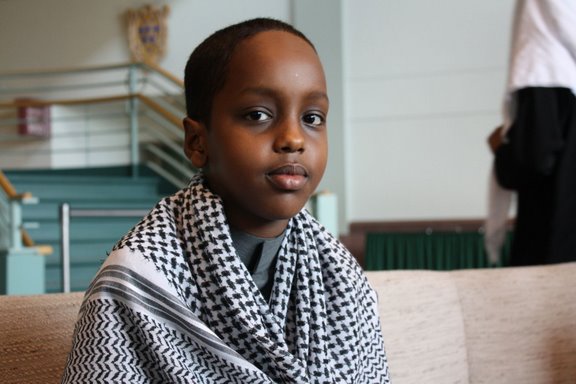
Other speakers included imams from around the U.S. including Minnesota, among them Sheikh Abdirahman Sheikh Omar, Sheikh Abdirizak Hashi, Sheikh Jamel Bin Ameur, and others. Audience members were astounded by the knowledge and wit of 12-year-old Mohamud Ahmed Mohamud, who was introduced as “Sheikh Mohamud.” He related the story of Salman Al-Farisi, a historic figure in Islamic history, and spoke on the importance of seeking knowledge and asking questions. He shared the Somali proverb of regret where a person says, “when I had youth, I did not want to learn, and when I had age, I wished I had learned during my youth.” Mohamud says he wanted to send a strong message to the youth, and encourage them to take advantage of their time. “I want young people to step up to the plate because I see so much good in them and it’s time for the youth to rise,” he said. Mohamud spent the past three years helping in the bookstore of the mosque, reading and writing as he could.

Gubernatorial candidate Steve Kelley, and Constituent Advocate to Sen. Amy Klobuchar, Siad Ali spoke on the health, education, and anti-immigration sentiment. Klobuchar addressed the audience by video where she touched on the cultural and intellectual wealth Somalis bring to Minnesota. Minneapolis welcomed Abukar Arman, the President of the CAIR chapter in Columbus who did a “know your rights” presentation in Somali, while members of the local chapter of CAIR did a program in English. “It’s important for people to understand their legal rights and the implications of their actions – intentional or not. Wanting a lawyer is not an omission of guilt. We want people to cooperate with law enforcement and we want them to know their rights,” he said. Arman also addressed the allegations against certain mosques in the city, saying that, “we’re finding that people are being judged by public opinion, which is ridiculous because this is a nation of law and order, and rumors should not absolve or condemn people or institutions of allegations. Rather, this should be determined by an established legal process.”

Poets Sara Mohamed and Maryam Warsame made their début at the convention. Warsame is one of three organizers for the mosque’s “Youth to Youth” group, a mentorship program for young women. Sara is a student in the program, and the two began writing together this winter. They rhymed about the situation of women in their homeland, and shared the stories of those who did not find relief. “We don’t want to be famous, we just want to get message out and not forget about those who are suffering,” Warsame said. She added that the convention was a good opportunity for students to share their work.

In addition to the poetry and lectures, the convention also included a fundraising component. In a little over an hour, participants pledged $150,000 to help cover expenses incurred over the construction of the second floor of the mosque, as well as to jump-start the next phase of development. The administration hopes to complete the parking lot and make the exterior of the building more visually pleasing.

It is difficult to imagine that this is the same institution that operated from a garage in the Cedar-Riverside neighborhood – the epicenter of the city’s newest wave of immigrants. Founding member Abdulaziz Sugule says this vision for a mosque comprehensively serving the community started over a decade ago and the organization began operations in 2000. Then called the Imam Shafi’i Mosque, the name was changed to the Abubakar As-Saddique Islamic Center and the organization moved to an abandoned warehouse in South Minneapolis. “Today, that vision is a five million dollar project,” Sugule said. “The mosque plays a major role in advancing the community; it consists of all kinds of social services including providing family counseling, settling community disputes, celebrating Islamic holidays, working with local and national government leaders, mentoring youth, and providing a place of Islamic worship and education,” he said.

Looking up with a smile, he added, “Contrary to what some people are saying, they (the mosque administration) are trying to build a healthy community with good people… they’re starting a movement for positive change and people love the place and its people.”

View from the Top

0

God wants us to see life from His point of view.  This is truly the “view from the top”.  This is an expansive, sweeping view of the future landscape for our lives. 

This view is rich with seeds for growth which can produce bountiful opportunity for advancement.  Taking the step to view life from the “top” requires effort on our part to put thoughts and actions that deter us from God’s view into a state of “solitary confinement.”
This requires our receptivity to understand and continually follow God’s instructions and wisdom. 

Focusing our mindset, time and activities on God’s view opens up countless opportunities. This view is priceless – it is a view that will cause freedom in thinking and action so that we can capture and act on the endless possibilities the Lord has planned for our lives. 
 
Remember:  God’s view is the level our thinking should advance toward.  We won’t rise any higher than the limits we place on our mind. Our mindset is what activates and releases whatever happens in our life

After Minneapolis, FBI Eyes Atlanta’s Somalis

0
youngSomaligirlspray

CLARKSON, GA. -– In this small town on the edge of Atlanta, the FBI and local law enforcement are looking out for an alarming kind of crime: radical Islamist terrorists potentially trying to recruit the town’s young Somali-Americans to fight a war in Africa.

There is terrorist recruitment taking place already in Minnesota, said Clarkston police chief Tony J. Scipio. That’s why his department and the FBI are looking for anything similar in the Somali-American community here in Clarkston.

In Minneapolis, as many as 20 young men have been reported missing from their homes since last fall. They are thought to have been lured into the ranks of al-Shabaab in Somalia. That group got a terrorist designation from the U.S. State Department, which ties it to al-Qaeda, bombings, assassinations and attacks on peacekeepers. A powerful faction fighting Somalia’s transitional government, al-Shabaab’s agenda is extremely strict Sharia law.

To fight potential recruiters, the Atlanta FBI has spent the last several months in what the agent-in-charge called an “outreach” program to Clarkston Somali-Americans, including mosque visits and community meetings.

Supervisory special agent Andrew Young said radical violent Islamist recruiters use the same strategy as a street gang recruiter, or even a little league coach.

“From what we know about recruiters, whether they’re Islamic, drug gangs or the coach, they’re looking for those kids who are looking for something deeper inside. To one it could be geopolitics. To one it could be a friendship. They’re all looking for something,” he explained.

And terror recruiters are quickly becoming adept at online tactics, noted Young.

“That’s what we see as a trend hitting home,” he said. “We see a lot more Internet recruiting being targeted to our youth.”

If young people go to Somalia, the FBI’s biggest worry is that they may return with dangerous souvenirs, like bomb-making or demolition skills and a radical anti-U.S. agenda.

Atlanta’s Somali-American community mushroomed after 1991 with arrivals of war refugees. Between 2000 and 2007 alone, the U.S. Office of Refugee Resettlement sent some 3,000 Somalis to Atlanta.

Because so many suffered in the war, they’re unlikely to see much appeal in returning to war, say Somali-American leaders in Clarkston.

But the alleged Minneapolis recruits spent little or no time in war-ravaged Somalia or in refugee camps. That may make young people vulnerable to a dramatic, nationalistic appeal, according to one Georgia leader.

“If al-Shabaab says, ‘We’re fighting Ethiopians,’ then they’ll have sympathy,” declared Omar Shekhey, president of the Somali-American Community Center, a statewide umbrella group.

Somalia’s transitional government is supported in part by the army of Somalia’s number one enemy, Ethiopia. The two countries have fought two formal wars in 40 years.

Al-Shabaab has no sympathizers in Clarkston, Shekhey insisted, but suggested that the other side -– the transitional government –- is frustrating, ineffective and unpopular. He jumped to criticize the transitional government’s power-sharing formula that he says reduces some Somalis to half-citizens, or non-citizens because it fixes quotas for parliamentary seats by clan.

U.S. support for that interim government rouses ire in some, Shekhey said, especially young people who reject the costs of that U.S. strategy.

“They can be angry,” he said. “‘Why is the U.S. doing this?’ they ask.”

Sharmarke Yonis, of the Georgia Somali Community, a non-profit headquartered in Clarkston, says that anger doesn’t always translate into a violent act.

“We might have some people who have sympathy, but not anyone who will commit a hate crime,” he said.

There’s sympathy because every religion spawns radicals who commit hate crimes, such as a person who would bomb an abortion clinic in the name of Christianity, he suggested, but emphasized that he sees no danger in Atlanta.

“In Georgia, we don’t have many, just a few listening,” Yonis said. He believes the threat is bigger in Columbus, Ohio, or Minneapolis, where the Somali-American populations measure in the tens of thousands.

No Somali-Americans are reported missing in the Clarkston area. A four-month police and FBI joint operation of surveillance and confidential informants turned up nothing, according to the police chief.

But “the word ‘FBI’ scares people,” said Hussien Mohammed, the director of Sagal Radio, a Clarkston-based station that broadcasts in English plus four languages spoken in east Africa: Somali, Afaan-Oromo, Amharic and Swahili.

“They’re coming from a country that has no law. They’ve been beaten, abused, harassed by security forces in their country … Some have been taken away in the middle of the night. People fear the same here.”

Mohammed seemed conflicted about the level of FBI involvement.

“Too many visits from the FBI have been seen in our community,” he said, but later added, “It’s their job. It’s why we’re safe.”

He’s very adamant on one point, which is backed up by other Somali-Americans and law enforcement: “These people are very peaceful like any other community. They’ve been terrorized at home enough. They want to be Somali-Americans, not just Somalis.”

Time for immigration Reform is Now

0


Editor’s Note: This editorial was produced in association with New
America Media (www.newamericamedia.org),
a national association of ethnic media, and was published by ethnic media
across the country this week to bring attention to
the urgency of immigration reform.

 The White House
and members of Congress must move quickly on enacting a just and humane
immigration reform package that will reunite families, reinvigorate the
economy, and remove the term “illegal or undocumented immigrants” from the
dialogue in this country. Ethnic media, which reaches over 60 million adults in
the United States, calls on Congress to move decisively on immigration reform
because there are few issues as important to the nation’s well-being as an
overhaul of the inefficient, inhumane and economically debilitating immigration
system. More importantly, we are also urging our readers and viewers to contact
their Senators and Congressmen and let them know that immigration reform must
be a national priority.

The immigration
system is broken not just for 12 million undocumented immigrants, but also for
specialized workers blocked from joining the American economy because of narrow
quotas, and mothers and fathers and brothers and sisters of U.S. citizens who
must wait for years before being reunited with their families.

Our nation needs
comprehensive immigration policies that will replace a broken system of raids
and roundups with one that protects all workers from exploitation, improves
America’s security and builds strong communities. It’s time to end the division
between workers, which has allowed big business to exploit both sides. Clearly,
working-class citizens and immigrant workers have much in common – dreams of
better homes, education for their families and quality healthcare.  There is more that brings us together, than
separates us.  United we can be a strong
force for change, changes that that bring more workforce safety and humane
conditions.  

Immigration is
often portrayed as an explosive, divisive issue. In reality it’s not. Since the
repeal of the national origins quota system in 1965, which discriminated
against certain immigrants, a consensus has been building towards an
immigration system that respects the country’s core values. These include
economic opportunity, equality under the law regardless of ethnic background,
and an embrace of the world’s most innovative, energetic and ambitious workers.
Now, with the country facing serious competition from workers abroad, it’s more
important than ever to create a world-class immigration system. It’s for the
good for families, good for communities and good for America.  

Women Immigrants Key to Family Unity

0
immigrantwomen

ATLANTA, Ga. – Women immigrants must overcome formidable barriers when
they first come to the United States, but their determination to hold
their families together helps them overcome many of those obstacles.

Those are among the findings of a recent New America
Media-commissioned national survey that pollster Sergio Bendixen shared
with a tightly packed gathering here at the Hyatt Regency Hotel on June
5 at a forum, “Women in Ethnic Media Breakfast: Women Changing the Face
of Immigration and Journalism.”

NAM chief of staff Odette Keeley, who immigrated from the Philippines
nine years ago, said women are redefining themselves both in the home
and the workplace.

Meredith Greene Megaw, communications director at the Committee to
Protect Journalists, a press freedom advocacy group, talked about her
organization’s efforts to shine the spotlight on the two North Korean
journalists and the Iranian American journalist, Roxanna Saberi, all of
whom were arrested while in pursuit of stories.

The threats to women journalists are not much different than those
faced by their male counterparts, Megaw noted, except that women
journalists also face cultural taboos, as well as the danger of being
sexually assaulted and threatened.

Those risks have forced many of them to switch to other forms of
media like the radio and the Internet, where they can maintain some
amount of anonymity while still practicing their trade, Megaw said.

Bendixen said that one of the greatest challenges new immigrant
women initially face is language. It is even more challenging if they
come from a certain socio-economic status. Many have little or no
access to health care. And to top it all, most of them face gender
discrimination.

“But within 10 to 15 years after they come to United States, women shed
their submissiveness,” become more assertive and take on a new role:
family stewardship, Bendixen said. “Keeping their families together is
their number one goal,” and they will do whatever it takes to ensure
that.

One of the first things they do in their new role in their family is to urge their spouses to seek citizenship.

“What could be more American than that?” Bendixen said.

Women who were forced to leave their children behind in their homeland
when they migrated to the United States generally succeed in bringing
their children over within five years, the poll shows. Those who face
deportation, take their children back with them.

Of the 90 percent of the women immigrants interviewed, 30 percent were
undocumented. Nearly all the women interviewed said that their families
were intact, their husbands live with them and their children were
either born here, or live with them in the United States.

Minneapolis Looks Within, Celebrates its Diversity

0
hayorbibimmaafricandancecompany
Minneapolis Looks Within, Celebrates its Diversity

The Minneapolis MOSAIC is launching its seventh annual celebration of the city’s diversity this weekend in downtown Minneapolis. The Twin Cities is home to immigrants and refugees from all over the world. Minnesota has a rich history of immigration, and new arrivals in the past several decades have introduced a blend of new cultures, perspectives, and people to the state. The Minneapolis MOSIAC hopes to capitalize on this diversity, and encourages the city to explore difference through artistic means.

The Minneapolis MOSAIC will feature talented local and international artists, and reflect the vibrant diversity in the city. Minneapolis Mayor R.T. Rybak said, “Our rich cultural scene is one of the things that we love about living here—and we love to share it.” The festival hopes to highlight the state’s increasingly diverse demographics, which create an opportunity for artistic exchange and appreciation.
 
The annual celebration will open this Saturday with an event entitled, “Many Worlds. One Night.” Brian Turner from Cities 97 will emcee one of the stages, and various artists and acts are scheduled to perform during the opening ceremony. The Chamber Ballet of Morelos, a dance company based in Mexico will perform “The Passion,” for its first show in Minnesota. The ballet is fusion of genres and includes elements of jazz, classical, and contemporary styles. Food, items, and displays will be available from Midtown Global Market and Mill City Farmer’s Market food vendors, as well as other independent vendors.

The kick-off event is one of many planned events throughout various locations. The seventh annual celebration will include over a hundred music, dance, theater, visual art, film, and spoken word events that will continue throughout the summer. The festival will be an opportunity for a diverse group of Minnesotans to share their talents, history, experiences, and culture, as well as an opportunity to experience the culture of many other people.
 
The schedule of activities can be found at the Minneapolis MOSAIC website.

Federal Court Litigation In the Aftermath of the Real ID Act


Federal district courts continue to play a significant role in reviewing immigration cases, despite the passing of the REAL ID Act of 2005, which makes it more difficult to obtain judicial review of discretionary decisions by U.S. Citizenship & Immigration Services (USCIS) and other government agencies.


The Administrative Procedure Act (APA) generally permits an individual to sue the United States in federal district court when he suffers a legal wrong caused by agency action or inaction. For example, individuals may ask a federal court judge to review USCIS’ denial of certain applications when the decision is arbitrary, capricious and unlawful. This is called a complaint for declaratory relief.


In addition, when a person applies for an immigration benefit, such as naturalization (Form N-400) or adjustment to lawful permanent resident status (Form I-485), and does not receive a decision within a reasonable amount of time, he may petition a federal court judge to order USCIS to process the application and issue a decision in a timely manner. This is called a complaint for mandamus relief.


Federal court litigation, however, remains a costly legal process that requires the expertise of skilled counsel. Moreover, as a threshold matter, plaintiffs must establish that the court has jurisdiction (the authority to apply or interpret the law) in their case. Otherwise, the court may dismiss their complaint for lack of jurisdiction without even considering the merits of their claims. With the passing of the REAL ID Act, establishing jurisdiction has become a tougher hurdle for plaintiffs to overcome.


Section 242(a)(2)(B) of the Immigration & Nationality Act (INA), entitled “Denials of Discretionary Relief,” restricts federal court review of certain discretionary decisions by the government in immigration cases. The REAL ID Act expanded the scope of this statute so that it now applies to discretionary decisions made not only in removal (deportation) proceedings, but also in non-removal cases. Nevertheless, this change did not strip jurisdiction over all federal district court lawsuits, so it is still possible to obtain declaratory relief and mandamus action in some cases.


Declaratory Relief


The complexity of immigration laws and the legal ambiguities over whether an agency decision is discretionary or non-discretionary have resulted in inconsistent outcomes on the extent of federal courts’ jurisdictional powers. Even when jurisdiction is found, the limits in scope of review and deference to agency decisions often affect the results on the merits of the case.


One of the primary legal questions now being debated is whether a federal district court has jurisdiction to review the agency’s denial of a Form I-130 petition, particularly when the denial is based on a sham marriage determination. Typically, an I-130 approval is needed to help a foreign national spouse immigrate to the United States or adjust to lawful permanent resident status.


In the U.S. District Court for the District of Minnesota, two judges have ruled differently in similar but separate cases, with Judge Ann Montgomery finding jurisdiction and Judge James Rosenbaum finding lack of jurisdiction over the agency’s denial of an I-130 petition based on marriage fraud. Igbanugo Partners represented the plaintiffs in both cases.


While the Eighth Circuit Court of Appeals (the appellate court for Minnesota cases) has yet to settle this issue, the Fifth, Second and Seventh Circuits all held recently that they have jurisdiction to review an I-130 petition. In Ayanbadejo v. Chertoff, the Fifth Circuit held that the decision of whether a U.S. citizen entered into sham marriage with a Nigerian citizen, for purposes of their I-130 marriage petition, is non-discretionary and so is not barred from judicial review under the REAL ID Act.


The court reversed the federal district court’s judgment to the extent that it dismissed the I-130 petition for lack of jurisdiction and remanded the case to the district court for further proceedings. Likewise, in Ruiz v. Mukasey, the Second Circuit found that the REAL ID Act did not bar judicial review of UCSIS’ denial of an I-130 petition based on a sham marriage finding. 


The court denied the government’s motion to dismiss the petition for review based on lack of jurisdiction and transferred it to the district court for consideration.  Finally, in Ogbolumani v. Napolitano, the Seventh Circuit found that it had jurisdiction to review USCIS’ denial of a U.S. citizen’s I-130 petition for her Nigerian spouse. Nevertheless, on the merits, it upheld the denial of the I-130 because it agreed with the district court that the foreign national had previously entered a sham marriage.


Mandamus Relief


Several district courts, including the U.S. District Court for the District of Minnesota, have found they have jurisdiction to compel USCIS to adjudicate applications in a reasonable time. In one case, Igbanugo Partners filed suit petitioning the court to compel USCIS to adjudicate the plaintiffs’ asylum-based adjustment of status applications, which had been pending for six years.  Pointing to the APA, which states, “within a reasonable time, each agency shall proceed to conclude a matter presented to it,” plaintiffs argued that the agency failed to perform a duty owed to them.


The court agreed and remanded the case to USCIS to adjudicate the I-485s within 30 days. Plaintiffs were granted lawful permanent resident status in less than 30 days. 


In another case, a foreign national retained Igbanugo Partners to challenge the government’s motion to dismiss his pro se complaint seeking mandamus action in his naturalization case. The plaintiff argued that USCIS had a duty to adjudicate his naturalization application within 120 days after his naturalization examination under section 335 of the INA, but USCIS failed to do so. The government asked the court to dismiss the complaint for lack of jurisdiction because the FBI background check was still pending and the case was not ripe for review. 


In the alternative, the government asked the court to remand the case to USCIS for adjudication with no time limit or deadline. Finding jurisdiction to review the complaint, the court remanded the case to USCIS and ordered it to fulfill its non-discretionary duty to adjudicate the naturalization application within six months. Two months later, the applicant became a naturalized citizen.


Nothing in this article should be taken as legal advice for an individual case or situation.  The information is intended to be general and should not be relied upon for any specific situation.  For legal advice, consult an attorney experienced in immigration law.


Kenya Coalition Government is Stable, Says Mwakwere

0
mwakwereandambogengo
Kenya Coalition Government is Stable, Says Mwakwere

Transport Minister Chirau Ali Mwakwere said over the weekend
that the coalition government in Kenya was stable despite what was portrayed in
the press.”Sasa tuko katika hali ya
kusikizana ki sawa sawa
(we are in the process of being in agreement)”. The
Minister was speaking to Kenyans in Minnesota gathered to celebrate Madaraka
day at a local park. He is in the country to be part of the inaugural flight to
Nairobi
by Atlanta based Delta Airlines on June 2.

Minnesota was his first stop in the county at the request of
Kenya’s ambassador to the U.S. Peter Ogego. Ambassador Ogego three years ago
declared that official Madaraka day celebrations will be held in Minnesota, a tradition
he has stuck to.

Speaking mostly in Swahili, minister Mwakwere said he was
optimistic that a new constitution will be in place by 2011 in readiness for
the 2012 general elections. Sticking to the script of all Kenyan politicians
whenever they speak to Kenyans in the diaspora, he declared that dual
citizenship was being given serious consideration. “Ni a tunayo (the will is there)”. Without elaborating, he said
calls for dual citizenship will be included in the new constitution as it “is
what the people want’.

Hundreds of Kenyan-Americans listened as the minister
reiterated the importance of Madaraka day saying that even in the current
political climate in Kenya, occasions such as the one being observed have come
to be occasions to come together as one despite political differences.

Other than briefly briefing those present on the political situation
back in Kenya, most of the minister’s remarks centered on recent developments
at his ministry. Among the initiatives he mentioned included the construction of
a new port in Lamu to serve landlocked Ethiopia saying the funds for the
project are already available. The new port will supplement Kenya’s biggest port.
Mombasa. 

As he spoke of the developments
on the new port initiative, a Kenyan, Gichiri Ndua, a Kenya Ports Authority
(KPA) corporate Services manager was just last week picked as president of the International
Association of Ports and Harbors
(IAPH) becoming the first African to get that position.
He takes over from Mrs Datin Paduka Phang of Malaysia.

The minister also spoke at length on the ambitious Nairobi
metropolitan plan that aspires to transform Nairobi into a modern metropolis.  Although that major initiative is not managed
by his ministry but the Ministry of Nairobi Metropolitan Development, his
ministry has to work closely with that relatively new ministry as transport is
a major component of the plan. Last December when President Mwai Kibaki unveiled
the Nairobi Metro 2030 plan, the cost to implement it was pegged at US$ 423
billion. Nairobi Metro 2030 is part of the bigger Vision 2030 that plans to
develop metropolitan regions across the country. Minister Mwakwere during his
remarks in Minnesota said the plan once implemented will solidify Nairobi’s
position as the economic hub of the region and radically transform Nairobi into
a major economic force.

Ambassador Ogego in commending the local organizing
committee for Madaraka day celebrations said his embassy is willing and ready
to engage the Kenya diaspora on substantive issues “and not petty ones”. He
also handed out certificates of appreciation from the embassy to local Kenyans
in Minnesota that he said have exhibited exemplary community service. As in
previous Madaraka day visits, the ambassador was accompanied by embassy staff
who renewed passports onsite.

Also making brief remarks at the celebration was a
representative from the office of US Senator Amy Klobuchar of Minnesota.

The hundreds of Kenyan-Americans who turned out were later
treated to a soccer match between Kenyans and Ugandans in which Kenya lost 2-1,
after good natured ribbing between both teams’ fans about the disputed Migingo
island
.

Courage

0

Courage is the fuel that powers our ability to believe that all things are possible in our life. Courage fuels action and advancement; fear fuels passivity and mediocrity.

Problems can’t be solved at the level they were created; courage fortifies our capacity to stand firmly on the level of problem-solving needed for long-term impact. It takes personal courage to make tough decisions.

Courage is needed, as well, to adjust to the rapid pace of change going on in our world today. Truly understanding that God’s principles for life are all we need to guide our decision-making frees the power of courage within us.By doing this, we are able to face situations on a day-to-day basis with boldnesss and wisdom from the Lord. Courage is power – it reinforces the full use of our mind and spirit.

When our mind and spirit is aligned we operate on all cylinders.

Remember:  Without courage, the greatness within us may not come to reality. When we live our life with courage we won’t be pulled off track by changing circumstances.

Books for Africa Expands Operations into Atlanta

0
bfa atl ribboncutting
Books for Africa Expands Operations into Atlanta

ATLANTA – Books for Africa, the world’s largest shipper of donated books to the African Continent has opened a 20,000 square-foot warehouse in Atlanta.  The new facility, located just outside city of Atlanta in Smyrna, will serve as the organization’s primary shipping, receiving and sorting center.

Speaking during the grand opening ceremony James Kiiru, the Commercial attaché to the Kenyan Embassy in Washington DC praised the organization for its work when he delivered a message from Kenya’s Ambassador to the US, Peter Ogego who was to serve as the chief guest but had to be with the Kenyan prime minister who was making an official visit to the country. Mr. Kiiru said the Embassy greatly appreciates the organization’s work as it complements the efforts being made by most African countries which are striving to offer formal education to their children.

Mr. Kiiru said “Africa will forever be grateful to Books for Africa as its efforts continue to positively impact education development on the continent”. He added the continent is faced with a lot of challenges, most of which directly affect the children. “It is good to know that someone cares. The Kenyan Embassy will do everything in its powers support you as it believes in your dream,” he said amid applause. He then performed the ribbon cutting to officially open the new warehouse and sent off the first container of books from the new warehouse destined for the city of Eldoret in Kenya.

Speaking earlier, Books for Africa’s board of directors President-elect, Tom Gitaa, said that the organization greatly appreciates the cooperation and support given by African embassies in Washington. “We recognize the fact that we cannot do much without their invaluable support”, he said. Gitaa, who is also the president and publisher of Mshale, thanked all donors and sponsors for making it possible to ship the books to Africa. He said the organization was truly grateful to talk-show host Oprah Winfrey and Organization of the Petroleum Exporting Countries (OPEC), for their recent donation of $95,000 and $100,000 respectively.  He told those present that the Atlanta hub will be a busy one. “We are hitting the ground running. We intend to be shipping at least a hundred containers annually”, said Gitaa.

Books for Africa founder, Tom Warth, told a riveted audience the story of how the organization came to be. Upon selling his business in 1988, he went on a tour of Africa. While in Jinja, Uganda, he came upon a library with empty shelves. “When I looked at those children’s faces, I knew that they yearned for knowledge but they had no way of getting it”, said Warth. The urge to touch their lives and others like them led him to create a system for collecting discarded books from American schools, colleges, Libraries, and publishers. What began as a one man’s concern 21 years ago has grown to unimaginable proportions. “But we are not there yet. The 21 million books we have sent to 45 countries are not enough. We need more books, money, and volunteers”, he said.

 “We are very excited today,” said Patrick Plonski, Books For Africa’s executive director.  “The people here are very kind. They have come to see what we are doing and they are very impressed. Many of them have promised to help as volunteers in our new office and warehouse”. Plonski added that he is very hopeful that the expansion will be a success story. “The greater Atlanta area offers us exceptional opportunities to interact with diverse corporations and businesses, schools, universities, community leaders and organizations,” he said.

Delta Airlines, which is commencing direct flights to Kenya on June 2 also offered to deliver the first air shipment of books from the organization to Kenya free of charge through a partnership initiated by Books for Africa partner, Atlanta based Our Reading Spaces. The first air shipment of books will be aboard the inaugural flight to Nairobi and among its passengers will be Kenya’s ambassador to the United States, Peter Ogego. 

Delta Airlines, through a company representative at the grand opening promised to continue partnering with development-oriented agencies to offer relief to the needy. “It is a symbolic gesture that aboard our inaugural flight to Nairobi on June 2nd will be aid to Africa in form of books”, said Frank Wrenn, the External Affairs and Community Relations Manager.

But it was perhaps the founder and Executive Director of Our Reading Spaces, Irene Mbari-Kirika, who summed it up for everyone when she said: “Education is a fundamental human right. We all have an obligation to make sure that all children, regardless of where they are, get it”.

With a mission to end the book famine in Africa, Books for Africa collects, sorts, ships and distributes high-quality books to needy children in Africa.  Books donated by publishers, schools, libraries, individuals and organizations are sorted and packed by volunteers who carefully choose the ones which are age and subject appropriate.  Each 40-foot container, which holds approximately 22,000 books, benefits approximately 250,000 students over the life of the books.  Each container costs approximately $9,500 to ship, which is less than 50 cents per book.   

Books for Africa will continue to keep its organization’s headquarters and operate a warehouse facility in St. Paul, Minn.
Present during the ceremony were Elisa Voelkel of H.J. Russell & Company, David Murphy of Better World Books, and Beth McClurg of Cushman & Wakefield.  Others included Kenyan businessman Peter Mwaniki and Kenyan businesswoman Elizabeth Mungai, who donated hundreds of books.