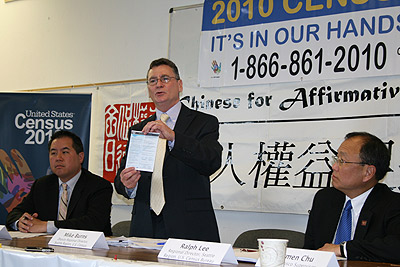
SAN FRANCISCO – On April 1, 2010, less than a year from now, a snapshot of the whole population of the country will be taken. Whether you are a citizen, an immigrant, legal, illegal, homeless or an international student, if you are in the United States at that time, you will be counted.
How important is it to be in the snapshot? How do we get everybody in it? These questions were answered at a May 5 roundtable discussion at New America Media, where ethnic media met with government officials to discuss how to get the message out to those who are most likely to dodge the “snapshot” — immigrants and minorities.
One reason that immigrants, especially the undocumented, may not want to be a part of the census is that they are afraid that their information will be used by government agencies against them.
“Immigrants tend to have fear and suspicion toward government agencies because of issues like race and profiling that the government used to sanction,” said Susan Hsieh, representative for Chinese for Affirmative Action (CAA). “A lot of distrust and fear are the response to what has been happening in history. The big job for the Census Bureau is to work together to inform people that they don’t need to be afraid, there is no way that the Census Bureau will use that information to put them in jail or deport them.”
In fact, of the 10 questions on the census form, which is printed in five different languages including Chinese, Vietnamese, Spanish, Korean and Russian, not one question asks about immigration status. So even if someone attempts to use that information — which is illegal — it is impossible to find out someone’s residential status from the census data, said Carlos Rodriguez, a partnership specialist with the U.S. Census Bureau.
A group of Latino evangelical pastors recently has called for a census boycott among undocumented immigrants. Rodriguez, who is doing outreach to the Hispanic community, said that “the effort of the proposed boycott is misguided.” Being part of the census can actually increase a community’s political influence. “These people do not understand the impact,” he said. “It is ironic because they’ve been fighting for equal rights, equal access to health care, education and all that for the last 50 to 100 years.”
Rodriguez said that the Census Bureau will not respond directly to the boycott, but instead they will reach out to the community in a more positive way, explaining why it is important and how easy it is. This is where the ethnic media come into play.
Being the first avenue that immigrants go for news, ethnic media play a significant role in helping the census improve the count because their readers are the ones who historically have been undercounted, said Phil Ting, assessor-recorder of San Francisco. Ting said San Francisco has an undercounted population of 100,000 which, if it had been figured into the population, would have gotten the city an extra $29 million per year in funding. And ethnic newspapers, TV and radio programs are the media that enter the living rooms of many in this undercounted population.
It all comes down to money, and every single person matters. Key local, state, and federal decisions are based on census data. Population figures not only affect political representation; they also help determine how the $300 billion in annual federal funding is allocated, said Ralph Lee, regional director of the U.S. Census Bureau’s Seattle region.
This goes back to the fundamental of democracy — one vote, one voice, said supervisor Carmen Chu. The census data will be used for reapportioning seats in the House of Representatives, and drawing the district lines.
Mike Burns, deputy regional director of the U.S. Census Bureau’s Seattle region, suggested that immigrants take a look at what effect the census data has at the local level. “Look around the neighborhood,” he said. The schools, community centers, immigrant transition English classes are all affected by the census, which counts the population, and decides how much government funding it is getting.
“Because San Francisco is a sanctuary city, basic city services are provided to people without status,” said Hsieh. “To be counted is a way to make sure their neighborhood gets the money to run these services, so that everbody benefits.”
Jane Xiao, a reporter for Sing Tao Daily, thinks that the Chinese community will actively participate in the census because many of them are from Hong Kong, Taiwan, and China, where large-scale censuses are conducted regularly. “The methods may be different,” she said. “But people get the idea.”
The story of Somali youth who vanished from the Twin Cities, possibly to fight alongside jihadists in their home country, is transforming the normally passionate and sometimes pugilistic debates at Minneapolis coffee shops into quieter introspection.
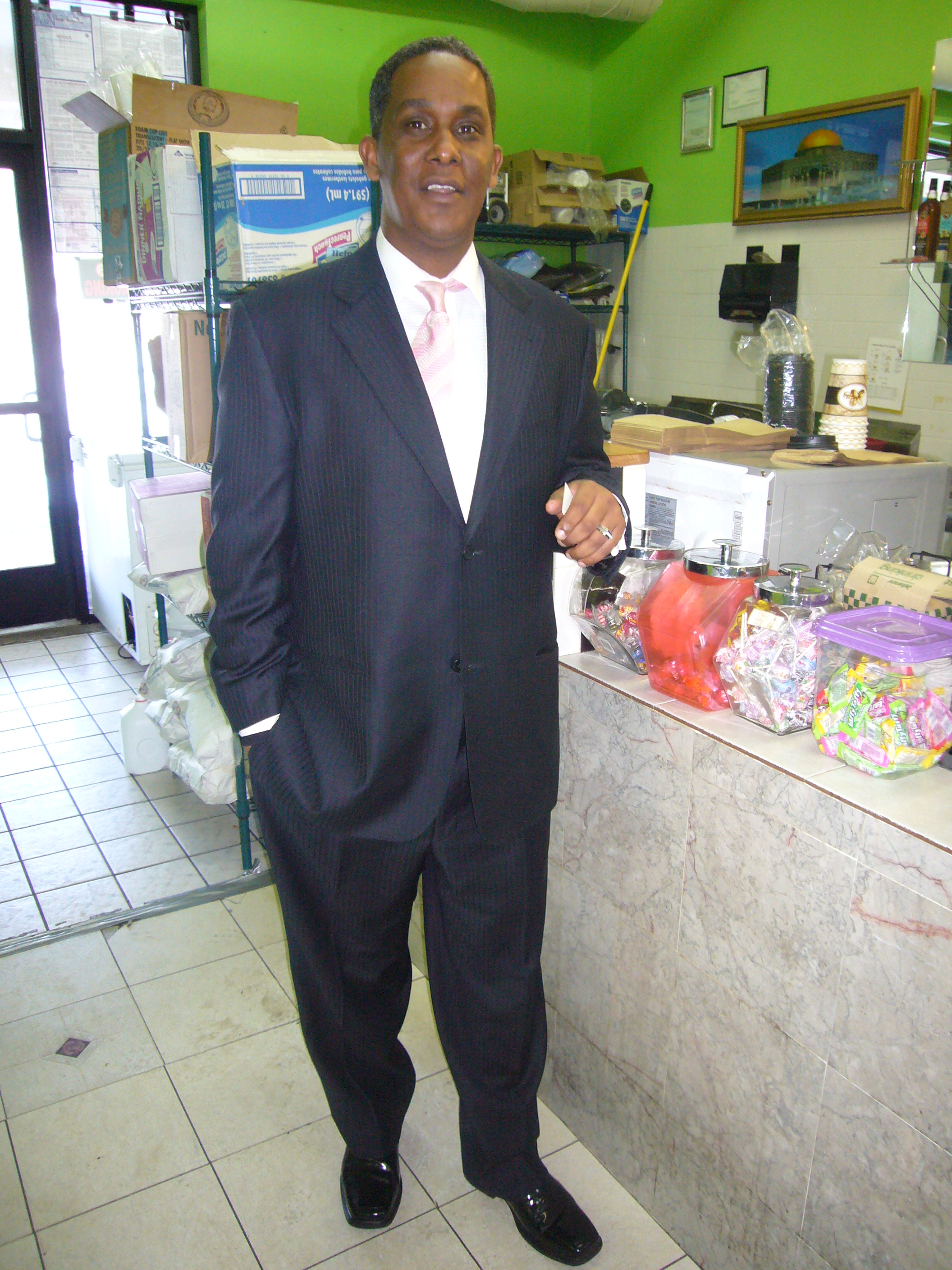
Now a recurring topic of conversation among Somalis is “reconstructing the community’s tainted image,” said Dahir Awaleh, a 47-year-old small-business owner who frequents the popular Starbucks on Minneapolis’ Riverside Avenue.
“In Minnesota, Somalis are increasingly associated with terrorists,” he lamented, sipping his coffee. “Businesses are raided. Friends and family members are being interrogated by law enforcement agencies. Mosques are under surveillance.”
On a recent Saturday afternoon – a day when the shop’s customers are almost entirely Somali – Awaleh’s remarks drew quick nods from the half dozen Somali men he sat with. They said the unknown number of Somali youth who left the Twin Cities, among other places, to fight in Somalia, are casting the community in a negative light, thanks to alarmist individuals and sensational news media.
“Individuals anointed by the news media as leaders are capitalizing on this tragedy,” said Mukhtar Osman, an engineering student at the University of Minnesota, who was recently held at the airport for hours when he returned from a family visit in Sweden. “My detention is a direct impact of reckless remarks made by so-called community leaders who claim that Somali youth may strike U.S. targets if they return. There’s no shred of evidence for this.”
Osman’s assertion is backed up by law enforcement. Andrew Liepman, deputy director of intelligence at the National Counterterrorism Center, recently told a Senate panel that his agency does “not have a credible body of reporting right now that leads us to believe that these American recruits are being trained and instructed to come back to the U.S. for terrorist acts.”
Self-radicalized?
Though much of the blame for the missing Somali youth has been directed at local mosques, there are signs that the youth, galvanized by the 2006 Ethiopian invasion of Somalia, may have radicalized themselves. Ethiopia’s invasion, widely believed to be supported by the Bush administration, “has attracted the rapt attention of Somali Diaspora communities and heightened their nationalistic sentiments,” Liepman testified before the Senate Homeland Security and Governmental Affairs Committee in March.
Extremist elements like al-Shabaab, a Somali group designated a terrorist organization by the U.S., have exploited the bitter reaction to the Ethiopian invasion and compelled young, despondent Somali men to join their ranks.
As a result, some of the men may have sold assets or worked overtime to pay the airfare to Somalia. A source close to one of the missing young men, Abdisalam, also known as “Bullet-head,” said that he sold his car just a few weeks before he left last year. At least a handful of the vanished youth have had decent paying jobs.
Earlier this month, a young man who uses the pseudonym “Abu Muslim” and claims to be a 23-year-old from Minneapolis, told a local radio station in Somalia that no one had recruited him to fight.
“I chose to join the cause of jihad in my country,” he said in broken Somali, a clear sign that he grew up in the Diaspora.
Also this month, al-Shabaab released a sophisticated 31-minute propaganda video designed to appeal to Diaspora Somalis. The star of the video is a Caucasian man who calls himself “Abu Mansoor,” the American. He commands an English-speaking unit of about two-dozen men, thought to be Somalis bred in the West. A Somali member of the unit, whose face is obscured, says in an American accent that he never thought he’d be leaving the comfort of home to carry an AK-47 in defense of his country.
‘Under Siege’
Whether the missing youth radicalized and financed themselves, or whether certain individuals within the community have actively recruited them, the negative impact of the story can hardly be overstated.
Two weeks ago, FBI agents raided the Minneapolis offices of money transfer business — a key lifeline for millions of Somalis who depend on monthly remittances from loved ones in the Diaspora. Although the offices were not closed, the episode was another blow to a community shaken by fear, confusion and uncertainty.
Special agent E.K. Wilson of the Minneapolis FBI said the raids were part of an ongoing investigation, though he wouldn’t confirm or deny if they were related to the vanished youth.
That uncertainty surrounding the subject of the investigation is bedeviling the community. Returning to Somalia for any reason – marriage, traditional medical treatments or a just to visit family – is cause for intense scrutiny.
“Even people who tried to take vacation from their jobs were asked by their superiors if they were going to Somalia for jihad,” said Abdi Sheikh-Osman, an adjunct professor of law at the University of Minnesota. “Somalis fled a country where the government was the principal enemy. Now they face a similar situation. The community is effectively under siege.”
Back at the Starbucks, many in the crowd said they know countless friends and family members who have been interviewed by the FBI. They also said the news of a grand jury being convened to investigate the matter, while a welcome step, has increased anxiety among them.
Al-Shabaab in trouble?
Ethiopia’s withdrawal from Somalia late last year, a crucial recruiting tool for al-Shabaab, has probably hurt its bottom line, experts said. Left with a popular Islamist as the president of the nascent Government of National Unity and an unfriendly clannish society, al-Shabaab will inevitably see its membership dwindle, experts believe.
“The Shabaab is already in trouble, thanks to the Ethiopian withdrawal,” wrote Ken Menkhause, a Somalia scholar at Davidson College in North Carolina. “It also runs the risk of having its most powerful ideological card – Somali nationalist, anti-foreigner sentiments – turned against it, as domestic adversaries accuse it of being a puppet of foreign jihadists bringing more trouble to the country.”
If such scenario bears fruit, the story of the vanished Somali youth may have reached its climax.
This story first appeared in the Minnesota Independent
“Conviction” is Defined More Broadly Under Immigration Law
Non-citizens, including lawful permanent residents, may face severe immigration consequences if they are convicted of certain crimes, including offenses that are deemed relatively minor and carry minimal penalties. Moreover, the term “conviction” is defined more broadly under immigration law than under criminal law. For example, did you know that if you plead guilty to a charge and the judge orders a form of punishment, you are considered “convicted” for immigration purposes, even if adjudication was stayed and the case is later dismissed? Did you know that even if your criminal case is expunged, you must disclose the offense on immigration applications, which the adjudications officer might consider in deciding your case? Did you know that a dismissed case could still be a “conviction” under immigration law unless the case was dismissed on the merits or the government failed to prosecute the case? And did you know that certain convictions make you inadmissible, removable, or ineligible for some immigration benefits, including naturalization?
Under immigration law, a “conviction” exists:
1. When a court enters a formal judgment of guilt; or 2. If adjudication of guilt is withheld, when a judge or jury finds the person guilty or the person enters a guilty plea or nolo contendere, or admits sufficient facts to warrant a finding of guilt, and the judge orders some form of punishment, penalty, or restraint on liberty (e.g. fine, probation, community service or alcohol awareness classes).
As a result, the mere fact that you have no convictions under criminal law does not necessarily mean you have no convictions under immigration law. In the criminal sense, a person is not convicted if he pleads guilty, pays a fine, completes probation, and then has the charge dismissed after he meets the conditions. But in the immigration context, a conviction would still exist in this same scenario. The foreign national’s guilty plea, no-contest plea or admission of certain facts is considered a conviction even if he satisfies the conditions imposed and the charges are ultimately dismissed.
Immigration Consequences of Convictions
Criminal convictions often have devastating consequences on a foreign national’s status in the United States and eligibility to become a naturalized U.S. citizen. Non-citizens could be found removable if they were convicted of aggravated felony, domestic violence, firearm or destructive device offense, controlled substance offense (except for a single offense of simple possession of 30 grams or less of marijuana), two crimes of moral turpitude, or one crime of moral turpitude within the last five years of being admitted to the U.S. and for which a sentence of one year or more may be imposed. They could also be deemed inadmissible when applying for entry into the U.S. if they were convicted of a controlled substance offense (except for a single offense of simple possession of 30 grams or less of marijuana), crime of moral turpitude, prostitution and commercialized vice, or two or more offenses of any type for which an aggregate sentence of five years or more may be imposed.
In addition, foreign nationals often discover that their criminal history makes it harder or impossible for them to prove good moral character, which is necessary to become a citizen. A person cannot be found to have good moral character if, during the statutory period (three or five years prior to filing for naturalization), he was convicted of one or more crimes of moral turpitude, convicted of any controlled substance law, or convicted of two or more gambling offenses, for example. Not all convictions in the immigration sense, however, bar foreign nationals from becoming citizens. While grave offenses like murder are automatic bars to obtaining citizenship, less severe offenses like traffic violations do not usually have the same effect.
What to Do Following An Arrest or Charge
Plea bargaining is a necessary part of the criminal justice system, especially because resources are limited and it allows for quicker disposition of criminal cases. Through plea bargaining, the defendant agrees to meet certain conditions like pay a fine or engage in community service, in exchange for a dismissal of the charges or a withholding of adjudication. Although this approach usually allows the defendant to erase his conviction under criminal law if he meets the terms of probation and other requirements, it could lead to devastating immigration consequences if he is not a citizen. Convictions often come back to haunt foreign nationals long after they have met conditions and their case has been dismissed.
Some criminal defense attorneys do not realize that plea agreements for even fairly minor crimes could cause the foreign national to be removed from the U.S. or be denied admission to the U.S. While entering guilty pleas or other plea agreements are often beneficial for citizens, they might not be for non-citizens. As such, criminal defense attorneys should consider the immigration ramifications or consult with immigration counsel when advising non-citizen defendants.
Not all convictions carry immigration consequences, but many do. Because of the complexity of immigration law, the best-case scenario is to have no criminal history at all. Short of that, foreign nationals should make sure they know the immigration consequences of a conviction before entering a potentially life-altering plea agreement or admitting certain facts. Following an arrest or charge, they should work with a criminal defense attorney who understands the immigration consequences, consult with knowledgeable immigration counsel, and/or request that their criminal attorney and immigration attorney coordinate with each other. These steps will enable foreign nationals to obtain the next best scenario to having no criminal history at all.
Nothing in this article should be taken as legal advice for an individual case or situation. The information is intended to be general and should not be relied upon for any specific situation. For legal advice, consult an attorney experienced in immigration law.
Good news! There is a special spiritual stimulus package all signed, sealed and ready for delivery to us. This package includes God’s love, blood, forgiveness and acceptance.
The entire contents of this package are guaranteed for eternity. His love is so immense that he gave His only son for us. His love endures all things so that we can be put back together again. His blood is the covenant made with us.
We can’t blame others; rather, He wants us to acknowledge our errors. His blood cleanses what we confess. His forgiveness breaks the link between our failures and us as individuals.When God forgives us, he breaks the link with our past.
His acceptance is all the validation we will ever need. He accepts us regardless of performance. All we need to do is believe in Him. The best news is that God’s original stimulus package of salvation is always available -it is signed, sealed and ready for delivery if we are ready to accept it!
Remember: Forgiveness is not a memory lapse; it is releasing painful memories of the past. He never consults your past to predict your future.
Martin Mohamed walks in and out of several stores at Karmel Mall, an eight year old mall in South Minneapolis that hosts about 300 Somali stores.
Mohamed is the chairman of the African Chamber of Commerce (ACC). He
knows most of the shop owners and calls everyone he meets by name. A
quick tour around the mall shows the growing number of
small-businesses. Mohamed senses the financial struggles some of them
are going through.
“There is a need for the African businesses to grow,” Mohamed says.
“One is to do business with each other, enter the main stream American
business, and to become a certified minority business provider.”
Many African entrepreneurs in Minnesota see the need for their
businesses to be part of main stream American businesses. Penetrating
the local business market is hard for immigrants, and the country’s
financial business does not make it any easier.
The Midwest Minority Supplier Development Council (MMSDC) is an
organization armed with the task of equipping small minority businesses
with tools to overcome some of these barriers. Through their programs,
minority businesses receive a certification which allows them to engage
in business with major corporations likeCargill, Target and others.
Mohamed finds a flaw in one of the MMSDC’s
criteria which requires business owners to have US citizenship so that
they can be certified Minority Business Providers. This certification
authenticates minority business allowing large corporations to engage
directly with them. Mohamed argues that when corporations rely solely on MMSDC’s
certification they indirectly decline to deal with minority businesses
whose owners are US residents, but are not citizens. “I don’t think
that strategy is fair.”
When large corporations seek companies through MMSDC
they do so to seek diversity. Mohamed contends that diversity should go
beyond color. While Africans and Africans Americans are both black, the
similarity ends there, he argues. Africans, Mohamed said face
immigration, family reunification, sponsorship, and student visa
issues: different adversities from those experienced by African
Americans.
“I think corporations need to understand the difference between diversity and multi-culture,” says Mohamed. The ACC’s
mission is to “accelerate the development of African immigrant
businesses, entrepreneurs, and families so that they may thrive within
American economic and social systems.”
According to Mohamed the ACC has met with MMSDC
in attempt to have the organization more inclusive: to include African
immigrants in its diversity. “They took us nowhere,”he says.
Though the MMSDC
is not a funding organization; corporations, according to Mohamed,
allocate funds for diversity, work force programs, and certification
for minority business providers. There are also quotas. In order for
minority businesses to gain access to such quotas, they have to be
certified. Mohamed claims that these resources do not reach the African
immigrant business community.“So far, they have very little
outreach with the African community. Our community is not really going
through the certification. This means they cannot be certified minority
[business] providers.”
Growing population and business“
“Our
businesses
are not growing as they are supposed to. We are not part of
the networking,” laments Mohamed. On the other hand, the population of
African immigrants in Minnesota is growing at an incredible rate.
In
2000, Minnesota ranked tenth in numbers of African immigrants in the
United States. According to the U.S. Census Bureau, Minnesota’s African
population is growing five times faster than the nation’s black
population.
Ryan Allen, an immigration expert and professor of
community and economic development at the Humphrey Institute, agrees
that many Africans immigrate to Minnesota for many of the same reasons
that Hmongs immigrated to here in the 1970s and 1980s.
For
African immigrants, Minnesota is attractive, “because the quality of
life is high,”Allan he says. “There are opportunities… like affordable
housing.” Minnesota, he added is not the only place experiencing the
economic fallout and foreclosure. “Minnesota has a lot to offer
immigrants.”
According to the Minnesota State Demographic
Center,“The black or African American alone population in Minnesota is
projected to rise 64 percent between 2000 and 2015, and to reach
386,600 by 2030.”
The report “Minnesota Population Projections by Race
and Hispanic Origin 2000-2030”, stated that, “Blacks will remain
Minnesota’s largest nonwhite racial group.”
In Hennepin County
alone, the Black and African America population has increased from
104,725 in 2000 to an estimated 137,300 in 2010 and projected to be
150,500 in 2015.In terms of business, these figures highlight
the need for a more inclusive partnership with Africans or
multi-cultural business as the African buying power is almost $1
billion (annually) as estimated by the Minnesota Bankers
Association.
Not
all is well for African entrepreneurs who are still struggling to
sustain their businesses, build wealth or participate in community
activities. Though it has been described as Minnesota’s fastest growing
market, many Africans find it difficult to operate in the American
finance system.
For many immigrants the challenges rise from learning a
financial system different from the one in their home country. With
little or no credit it is almost impossible for these new business
owners to get business loan assistance from financial institutions. For
some of these individuals aborting their dreams and working in
different industries seems to be an easier solution. However, there are
others whose resilience has allowed them to fight language and cultural
barriers and to learn how to navigate the business industry.
In 2002,
there were approximately 22,000 minority firms in Minnesota generating
over $3.2 billion in total revenue according to the U.S. Department of
Commerce’s Minority Business Development Agency (MBDA). Some of these
were African businesses.
The Retailers
Around Lake Street in Minneapolis
are about 300 Somali businesses, most of these businesses reside within
Karmell Mall, and a second Somali mall known as “24” (its on Elliot
Avenue and 24th St). While all these businesses are registered with the
Secretary of State’s office none is certified by the MMSDC.
Sharon
Garth, President of the Minnesota Minority Suppliers Development
Council (MMSDC) explains why, “The African community is at this time
concentrated on the retail side of business.”
“When
you look at the businesses that are cropping up around Lake Street and
other areas, those are primarily business-to-costumer businesses,”
Garth said. “They are retail in nature and they have individual
customers who they are marketing and selling to. They are not marketing
to sell to large corporations like Target or 3M.”
The MMSDC, an
affiliate of the National Minority Suppliers Council is one of 39
councils around the country. Garth said the MMSDC’s mission is to
facilitate business opportunities between minority business enterprises
and corporations. She describes the MMSDC as a business-to-business
organization.
Garth said businesses like those at the Lake Street are
not part of MMSDC’s
focus or charter at this time. However, she agrees that some of her
organization’s policies need to be changed. She hopes to discuss some
of the problems among minority-business owners at theMMSDC’s April
meeting in Washington.
Many African business owners interviewed are
concerned about MMSDC’s membership limitation that requires only US
citizens. For the ACC, this limits financial resources and business
influence in minority communities.“We
are very clear that there are still companies that we are not able to
reach at this point in time,” Garth agreed. “Because of citizenship.”
Nevertheless,
the role that many cherish more than any other is being part of an
organization that considers their contribution to business developments
in Minnesota.
Resource Allocation
In dealing with minorities
businesses, ACC argued there should a distinction between diversity and
multi-cultural businesses. Mohamed and others believe that the MMSDC
focuses more on diversity than they do on multi-cultural businesses in
the Somali, Liberian or Latino communities. Linking multicultural
businesses to corporations is what the African Chamber of Commerce
wants the MMSDC look into.
The Somali Mall is home to markets
where dozens of shops are open every day. It booms with activities as
customers look around for goods and services that they can’t find from
other retailers in Minnesota. Tagging African businesses as
“minority-business” works in some government sectors, but hasn’t worked
well when dealing with big corporations. The problem, according to
experts is the size of African businesses.
“The sizes of any
business will obviously affect their growth,” said D Craig Taylor,
Director of Business and Community Development at the University of
Minnesota. “Depending on their capacity; it can affect their ability to
deal with a large or a smaller contracts, and more consistent with
their capacity to perform.”The lack of capacity to prove
financial stability, management skills and demonstrated track record in
handling projects for big companies, makes African and minority
business owners to become subcontractors.
The MMSDC also suggest this to its small-business members. “Corporations
are going to use businesses that have the ability to meet the
requirements or the scope of what is been requested,” Taylor said.
“If
the business is too small, in most cases, they would be passed over.” However, ACC
wants small-business owners to get past the supplier-diversity managers
and sit at the table with those in charge of specific projects geared
towards the multicultural communities. As minority groups
continue to increase, so is the need for their businesses to tap into
new sources for capital. But, without help or certification, many find
it difficult to continue, let alone expand.
The Twin Cities collaborate on certain projects with the MMSDC.
When multicultural businesses are not certified, Mohamed said, they
miss many opportunities such as funding from the government.“You
can do all you want, but you’re not reaching out the multicultural
community who are bilingual,” Mohamed said. These multicultural
businesses have many challenges, especially in trying to survive the
country’s economic meltdown.
For years, many believe they could
get help from the City to expand or gain access to the corporate
market. Now, nothing is certain because dealing with corporations needs
certification from the MMSDC . Like the African businesses, much of the
Latino businesses also look forward to expand, but no one could offer
any lucid explanation to them beyond the requirements set by MMSDC for business certification. With millions of dollars pouring to other businesses, doubt has descended among the multicultural business communities. Contracts and contractorsIn
2006, the City of St. Paul’s housing and redevelopment services awarded
$220 million in contracts, according to an audit report, but less than
seven percent went to minority groups.
Last year, Mayor Chris
Coleman said while the audit report showed no ill intent “there was a
lack of coordination impeding our ability to do everything we needed to
do.” According to MPR , Coleman also added that, “there were clear lines
of accountability, there was no one person that could be held
accountable or to the council or to the community.”There are
many minority-owned businesses that are not considered in the process.
Many suggest that a plan should be in place to track general
contractors to ensure that they’re complying with minority hiring
goals.
Clifton Boyd Jr. serves in the committee charged with studying
the contracts dealing with women and minority firms.“Still
there is a little struggle up till today,” Boyd said. “We still have a
problem getting contracts with the larger contractors at the City of
St. Paul.”
Boyd and other members continue to meet with
officials to solve the problems. The contracts to minority groups are
far less as compared to their population.
Boyd emphasized, “It is not a
reflection on the total population.”Five years ago, social
justice groups and African American community leaders demanded the City
of St. Paul to examine lapses in its goals in giving contracts to
minority vendors. However, many of the city’s critics viewed it as a
bureaucratic response to solving problems far entrenched in the city’s
power corridor.
The work at the City is not yet over, it still has it
host of skeptics.
In 2004, only two percent of the city’s total
contract spending went to minority vendors. It was less than the
previous years. St. Paul’s minority population is 39 percent.
Angela Burkhalter,
who co-manages the Minority Businesses Retention Program for the City
of St. Paul, said while at the Planning and Economic Development (PED),
they opened up opportunities for entrepreneurs, startup businesses and
offered technical assistance.A
t the news Department of Human Rights and Equal Economic Opportunity, Burkhalter
who comes from a corporate background said the department will
coordinate various contracting services to include minority and
multicultural groups.When
she joined the City of St. Paul, her
first job was to know the minority businesses.
“You can’t sell them
anything if you don’t know who they are. It was my habit to go and find
out about their businesses,”Burkhalter said. “So it is the same here to
find out about businesses, and I also have to learn about the
government ordinances.”
The City’s Vendor Outreach Program (VEM) sets
goals for small minority owned businesses.
“We don’t buy fashion,” Burkhalter said, referring to the African
retail businesses at the Somali Mall. “
That is not where we spend tax
payers’ money.”
NOTE: In the next edition, the challenges and obstacles for minority businesses – views for the MMSDC and the City of St. Paul.
We often go through our daily routines only thinking about ourselves or our own problems. We sometimes get so consumed by our own issues that we never think about what others are going through.
Now is the time to change this “me-only” mindset to think more about others, including what we can do to help. We are here on earth to make a difference in the lives of others.
True happiness, satisfaction and fulfillment will come when we use the gifts and talents given to us by God for unsolicited acts of kindness and service to others. We weren’t designed to hold our gifts and talents for a “rainy day.”
Everyday is the day to help somebody.
One of the best ways to serve is to get involved by being a “silent server”. This is a person who approaches things with a humble heart, without need for position, title, recognition or authority. Think about someone you know who has a specific need. Now, reflect on what strengths or talents are within you that you could share to help this person overcome or meet their need. Make a commitment to quietly help this person without acknowledgement or fanfare.
Reflect on how you feel after you complete this random act of service. The more we take action to serve, the more service will become a natural part of our routine. Always remember that we are part of God’s Kingdom to serve not to be served.
The first step to leadership is servanthood (John Maxwell).
The U.S. Supreme Court, the highest court in our country, has ruled that an Eritrean prison guard who was forced to persecute inmates can still be considered for asylum in the United States. The high court reversed a lower court decision on the fate of former Eritrean prison guard Daniel Girmai Negusie by overturning a broad interpretation of the statute barring persecutors from eligibility for asylum even if their participation was under threat of death. The Court held that both the Board of Immigration Appeals (BIA) and the U.S. Court of Appeals for the Fifth Circuit erred in relying on the Court’s 1981 decision in Fedorenko v. United States, in applying what is known as the “persecutor bar” to asylum.
The Supreme Court held that the BIA and the Fifth Circuit misapplied Fedorenko as mandating that whether an alien is compelled to assist in persecution is immaterial for prosecutor-bar purposes, and held that the BIA must interpret the statute, free from this mistaken legal premise, in the first instance.
Daniel Girmai Negusie, petitioner in the case, was forced to serve as a guard in the prison camp in which he himself had been imprisoned and tortured for his refusal to serve in the Eritrean military. He later sought asylum in the United States. Negusie eventually escaped to the United States and applied for asylum.
The U.S. Court of Appeals for the Fifth Circuit upheld the denial of asylum, holding that because the “objective effect” of Mr. Negusie’s conduct – even though involuntary – assisted persecution of others in the camp, he was barred from protection. The unpublished opinion of the Fifth Circuit is reprinted in 231 Fed. App’x 325.
Eighth Circuit Finds Reliance on State Department Investigation Violates Due Process
In Banat v. Holder, the Eighth Circuit recently held that “[r]eliance on reports of investigations that do not provide sufficient information about how the investigation was conducted are fundamentally unfair because, without that information, it is nearly impossible for the immigration court to assess the report’s probative value and the asylum applicant is not allowed a meaningful opportunity to rebut the investigation’s allegations.”
The Court went on to say that the report in this case was glaringly deficient in providing the most basic indicia of its circumstantial probability of reliability.
Bassel Banat is a Palestinian refugee who was born and lived most of his life in Beirut, Lebanon. While at the airport, he was told to go with the men to answer some questions, and he was blindfolded, handcuffed, and driven away in a car. Lebanese officials at the airport witnessed his abduction but did nothing to stop it. According to Banat’s story, he was held for several days at a Palestinian refugee camp, questioned, and beaten. His captors spoke with Syrian accents, but he thought some were also Lebanese. The outside of the building indicated it belonged to the Popular Front for the Liberation of Palestine (PFLP). After arriving in the United States, Banat’s father sent him a handwritten letter purporting to be from the PFLP that had been sent to Banat’s Lebanon address prior to his return to the United States. The letter commanded Banat to return for questioning on January 26, 2002, and threatened death if he did not comply. Banat’s parents allegedly received numerous threatening inquiries from the PFLP about his whereabouts. When his father died, Banat did not attend the funeral, and allegedly there were armed PFLP men at the funeral looking for Banat.
The Department of Homeland Security had not verified the authenticity of the letter, and the Immigration Judge inquired with the State Department about its authenticity. The State Department responded with a letter dated March 22, 2006, and acknowledged that the U.S. Embassy in Beirut had not had any previous experience with that type of document, but that its investigation suggested that the letter had been fabricated.
The Court ruled that the Immigration Judge’s reliance on a State Department letter in making adverse credibility finding violated the Banat’s due process right to a fundamentally fair hearing, and that Banat was prejudiced by the due process violation.
Nothing in this article should be taken as legal advice for an individual case or situation. The information is intended to be general and should not be relied upon for any specific situation. For legal advice, consult an attorney experienced in immigration law.
President Barack Obama has given a 12-month extension extension to
thousands of Liberian immigrants who are on a temporary immigration
status in the US.
Confirming the extension the Communications Director of U.S. Rep. Keith Ellison, Rick Jauert, said, “We welcome this extension, but we will continue to work for a vehicle for a road to citizenship.”
Thousands of Liberians fled to the US following a decades-long civil war that left their country in shambles. While many of them sought refugee and asylum status, thousands others were offered a temporary stay in the US. This temporary immigration status known as TPS (temporary protective status) is usually offered by the American government to citizens of other countries who are already in the US, but are temporarily unable to safely return to their home country because of ongoing armed conflict, an environmental disaster, or other extraordinary and temporary conditions.
A Deferred Enforced Departure (DED), on the other hand, is an extension of the TPS. In 2007, President Bush authorized an 18-month stay which was set to expire on March 31st, 2009.
Liberia is no longer at war. However, the country under the leadership of its president Ellen Johnson Sirleaf is slowly making an economic recovery. As it continues rebuilding its infrastructure following the end of the war in 2005 critics have argued that Liberia does not have the capacity to accommodate thousands of returnees should the US deport them.
Legislators hope that these Liberians will eventually get residency status since they are legally in the US and have made homes here.
US Senators Amy Klobuchar and Harry Reed yesterday introduced the Liberian Refugee Immigration Fairness Act of 2009 (S. 656). This bill would allow Liberians who were brought to the United States legally under temporary protection status classification to apply for citizenship. A similar bill co-authored by congressmen Ellison and Patrick Kennedy has been introduced in the House.
In a telephone interview with Mshale, Congressman Ellison contends that the hard work for legislatures has just began, “it takes a long time to get a majority of the Senate and the House on board.”
“I am grateful that President Obama has granted our Liberian neighbors extended DED status,” Representative Ellison said. “This was the right thing to do to keep families together and it embraces the fundamental foundation of an immigrant nation.”
In a press statement following the extension, Senator Klobuchar said, “It was the right decision to grant Liberians extended DED status. The Liberian Community has become an important part of the social fabric of Minnesota – they are our neighbors and our co-workers. While Liberia continues to be unstable, it is important that Liberians who are here legally are able to continue to call Minnesota home. This extension will allow us to continue our pursuit of a more permanent solution.”
The Advocates, a human rights organization that works with the Liberian community, estimates that there are between 4,000 and 10,000 Liberians under temporary protected Status in the United States. An estimated 25,000 Liberians live in Minnesota.
Read here an article on “Liberian-Americans in Minnesota Want Option to Stay.”
A momentous election and a huge stimulus check for school improvement must mean that things are looking pretty good for high school students of color these days.
With Pres. Barack Obama in place as role-model-in-chief, African-American parents now have another shining example to which they can point when they tell their children about the possibilities this nation has to offer. And Congress has made billions available for states to address the distribution of effective teachers, educational data systems, and other sorely needed reforms.
It is tempting to take these promising signs to mean that solving the problem of educational inequities is a fait accompli. Yet regardless of Pres. Obama’s achievements and the investment of stimulus funds, the fact remains that, like their peers across the nation, nearly half of African-American students in the state the president represented in Congress will not graduate from high school. On average, African-American 17-year-olds read at the same level as white 13-year-olds. And African-American students are more likely than whites to attend dropout factories–high schools where no more than 60 percent of the entering first year class makes it to their senior year.
For these young people, educational disparities present an often insurmountable barrier to success. An economic recovery package that ignores their needs is a colossal mistake with serious long-term implications. The American high school is the front on which we must continue the struggle for civil rights and equality for all. And it is on this same front that we must act if the nation is to achieve long-term economic viability.
Developing a strong workforce for tomorrow requires fostering future business and civic leadership through high-quality high school education today. The payoff for our community in employability and economic growth will ensure a role for America in the global marketplace. For example, had the more than 1.2 million dropouts from the high school class of 2008 earned their diplomas, the nation’s economy would have seen an additional $319 billion in income over the course of those students’ lifetimes.
Today we are far from this ideal. Of all incoming ninth graders, two-thirds—comprising an overrepresentation of students of color and youth from low-income neighborhoods—will fail to graduate with the skills they need for college and work.
The African-American community cannot ignore the devastating impact of ineffective education policies that allow too many of our high schools to fail the young people who should be receiving the preparation necessary to take over as America’s social, political and business leaders. By continuing to offer inadequate solutions to America’s education crisis, we are willingly confining too many of our children to segregated and sub-standard education and we are forfeiting their futures.
The stimulus package offers a beginning toward reform. To make the change significant and sustainable, our policymakers must focus on preparing all students for college and work, holding high schools accountable for student achievement and graduation, and providing adequate resources. It is also important to collect and report data that identify which schools and students are most in need of help to improve performance. School districts must receive the support to implement effective high school models that support different learning styles and meet student needs. And, the nation must find a way to place highly effective school leaders and teachers in high-need high schools.
On the campaign trail, Pres. Obama asked the nation to hold him to the promises laid out in his “Plan for Lifelong Success through Education.” This call for accountability sets a standard that must be applied to our nation’s high schools. As his administration makes good on promises to prioritize reform, Congress must examine opportunities within existing legislation to improve student access to a high-quality education. We are making progress toward closing the achievement gap between students of color and white students, but federal leadership and the strong, ceaseless voice of the African-American community is necessary to truly eliminate inequity in American public education. This way, we can make graduation for African American students and every student the rule, not the exception.
Michael Wotorson is executive director of the Campaign for High School Equity, a Washington, D.C.-based policy group.
Immigrant workers struggle to support families back home
Semenyo Ahli gathers stray carts in the Wal-Mart parking lot on University Avenue in St. Paul. He came to the United States four years ago for economic opportunity and to attend college to become a registered nurse. Despite being qualified to work as a nursing assistant, Ahli has been unsuccessful in finding a second job in addition to Wal-Mart. However, no matter how tight the money gets, Ahli still sends money back home to Togo every month. “I have brothers and sister back home,” he said. “And my dad is not working, so they use the money for food.”
“I got a job here because of my friends,” he said. “They helped me to get a job here. I did apply to Target when I first started looking for a job, but I didn’t get it.” The $8.20 an hour he earns from pushing carts has to cover not only his living and education expenses, but also to support his family back in Togo. His family largely depends on remittances to survive, but sending $300 monthly is becoming a financial burden. Recently, his hours at Wal-Mart were cut from thirty-six to twenty hours a week. Like Semenyo Ahli, several of his fellow employees have reported with frustration that their hours also have been cut recently.
Store managers at Wal-Mart on University Avenue declined to answer any questions.
Greg Rossiter, a spokesman for the corporation, said he was unaware of any decrease in employee hours in any part of the country. Wal-Mart officials claimed that their recent economically driven decision to lay off eight-hundred corporate employees in the Twin Cities would not negatively affect their store associates or their hours, according to Rossiter.
In response to questions about reductions for Wal-Mart employees in St. Paul, he replied, “Wal-Mart reduces hours of our associates depending on customer demand.” However, customer demand is on the rise across the country. According to a corporate financial fact sheet, sales at Wal-Mart were up 6.2% in 2008, and the Wal-Mart on University Avenue is one of their busiest locations in the Twin Cities. Rossiter said, “It is typical to cut employee hours right after the holidays.” However, several employees reported their hours being cut only within the past three weeks.
The majority of the associates at Wal-Mart on University Avenue are immigrants from East Africa, most of whom support families back home. According to one employee, Burhan Mohamed, approximately forty of these employees are on the floor at any given time, working less and less hours a week while trying to support themselves and their families. Though he was hired as full-time three years ago, Mohamed reported that he has recently been demoted to just above twenty hours a week.
The decrease in full-time work has made it increasingly difficult for employees to survive and attain benefits. If an employee cannot work full time, which is more than thirty-five hours a week, then full-time pay of $10.25 is unattainable. In addition, the standard six-month pay increase appears to becoming a rare privilege, with employees reporting not receiving a raise in as long as a year and a half. Employees like Burhan Mohamed and Semenyo Ahli do not blame Wal-Mart for this stretch of reductions in hours, but instead the ailing economy.
Since the recent store-wide cut in hours, Semenyo Ahli now takes home less than $700 a month while working twenty hours a week, meaning the $300 that he sends back to his family in Africa takes up 44 percent of his paycheck.
Though it is a financial strain, Ahli remains loyal to providing his family with food and means for going to school. “They use the money for my sister and brothers, ‘cause they all go to school,” he said.
Ahli’s situation is common among Wal-Mart employees who came to America in pursuit of a better life for themselves and their families, and are now struggling to work an adequate number of hours to survive financially. For the employees who place the blame on hard economic times, this stretch of reduction in hours has led to fear of losing their jobs altogether. Burhan Mohamed summed up the general feeling of these employees. When asked if he’s worried about losing his job he said, “I’m scared, it could happen tomorrow to me. You don’t know.”