ATLANTA – The highly anticipated convention of Diaspora Kenyans to discuss what they can do to help their country’s economy began yesterday at Kennesaw State University in the Atlanta metro area.
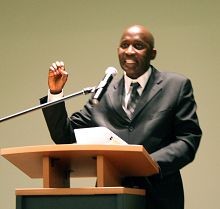
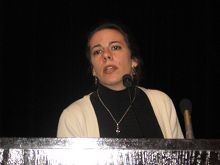
There conference opened with a presentation by Dr. Olubayi Olubayi, a professor of microbiology at Rutgers University who presented his paper, “The Emerging Culture of National Unity in Kenya.” Olubayi argued that unlike the generation before them, younger Kenyans do not identify themselves based on ethnic origin. Instead, they look at commonalities, a trend that is reducing tribalism, he said.
“People don’t support leaders just because they are from the same ethnic groups,” Olubayi said. “The leader of the Opposition, a Kikuyu, criticizes the president, who is also a Kikuyu.”
Many in attendance, however, disagreed with him, saying that tribalism was still very prevalent in Kenya.
“Political parties are still very tribal,” said Eric Masinde Aseka, a Fulbright scholar at the university.
Dubbed “The Role of the Kenyan Diaspora in Kenya’s Development,” the two-day convention is seen by many as an attempt by Kenyan government officials and businessmen to woo Kenyan’s abroad to invest home. Among the speakers are Amos Kimunya, Kenya’s Finance Minister, and Jimnah Mbaru, the Chairman of Nairobi Stock Exchange.
Earlier this month, Kenya’s Vice President Moody Awori said Kenyans in the Diaspora sent home remittances totaling more than $1 billion. The money accounted for 10 percent of the country’s national budget.
The Institute of Global Initiative at KSU sponsored the conference, said Hana Njau-Okolo, the event’s press officer. Every academic year the university chooses a country for interested students to study. The 2006-2007 was Kenya’s year.
Ghanaians in Minnesota Celebrate their Golden Jubilee
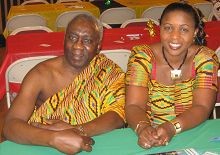
Hundreds of Ghanaians living in Minnesota gathered in Columbia Heights to celebrate this historic occasion. Guests were treated to speeches calling for a positive direction in political and economic progress of not only Ghana, but also Africa. Music and dance culminated the celebrations.
Clad in traditional regalia, the chair of the Ghanaian Association in Minnesota, Kwami Ahlelegbe, was enthusiastic about the progress that Ghana has made in the last fifty years. While he credited founding fathers for their role in developing and shaping their country’s destiny, Ahlelegbe cautioned Ghanaians at being complacent in advocating for further development.
“It is our duty as a new generation of Africans to set our destiny. Our past leaders have played their role, it is our turn. “
The guest speaker, Benjamin Kodjo Taylor, a renowned entrepreneur, echoed Ahlelegbe’s sentiments. He encouraged Ghanaians in the Diaspora to consider taking the risk of investing in Ghana as market risk is similar in all parts of the world. Taylor challenged the current Ghanaian administration to take on development projects such infrastructure development, health and nutrition and economic growth among other things.
“What role will you play in the future of Ghana?” he posed to his audience.
Beatrice Kombé (1971-2007) died February 22, 2007, a result of kidney failure. Ms. Kombé founded the all-women dance company Compagnie TchéTché in 1997 in Abidjan, Côte d’Ivoire. The company’s repertoire includes the award winning Dimi (1999), which played at the Walker Art Institute last November.
In addition to their Minneapolis performance, the show was performed throughout the United States. TchéTché has performed extensively at international festivals and art houses in Africa and Europe. Ms. Kombé’s company was awarded the UNESCO prize at the MASA festival in Côte d’Ivoire for Dimi.
New Money Transfer Service for Kenyans Abroad as PostaPay Launches in US
BALTIMORE, Maryland – The Postal Corporation of Kenya yesterday officially launched PostaPay, its money transfer service, for Kenyans overseas at a ceremony officiated by the Kenyan ambassador to the United States, Mr. Peter Nicholas Rateng’ Oginga Ogego, at a local hotel. The service is being offered through a partnership with Afripayments LLC, a US based company that is also part owner of Nairobi based Afripayments Kenya Ltd. The Kenyan entity is a joint venture between Afripayments LLC and a group of Kenyan investors, according to Ms. Caroline Kurgat, Afripayments Manager for International Business Development when she spoke with Mshale moments after the launch.
With the launch, the scene is set for a PostaPay head to head competition with the two leading MTOs (Money transfer Operators) that dominate the money transfer business into Kenya. Kenyans overseas sent an estimated 50 Billion Kenya Shillings (about $US 1 billion) last year. The PostaPay service is the successor to the former Post Bank that was for long the main agent for Western Union until last year. The partnership with the former Post Bank gave Western Union access to the most expansive network of agent outlets in Kenya. The country is one of the top recipients in Africa of inflows from its nationals abroad.
Postal Delegation
A high powered delegation from PostaPay headquarters in Nairobi led by the Postal Corporation of Kenya chairman, Major general (Rtd.) Peter Kariuki and the CEO and Postmaster general Mr. Fred Odhiambo were on hand for the launch. Mr. Kariuki admitted to his corporation’s surprise at the enthusiasm that has greeted the arrival of PostaPay during brief remarks at the launch. Mr. Odhiambo on his part thanked Afripayments for seeing value in a partnership with PostaPay. “The country is hungry for new investments,” Mr. Odhiambo said. With over 200 outlets throughout Kenya, he told launch attendees that the number of outlets will soon double. In the meantime, he said the focus is on automation, ramping up customer service and associated training as well as branding. During a brief interview after the launch he revealed his short term goal is to grab 10% share of the remittances coming into Kenya from the Diaspora.
The Afripayments US President and CEO, Dwayne Johnson, in brief remarks welcoming launch attendees said his corporation was fully committed to the partnership with the Postal Corporation of Kenya.
Killer Attribute
Ms. Kurgat during a PowerPoint presentation that was one of the highlights of launch activities to introduce the service said unlike its competitors, Afripayments supports what she called individual and institutional funds transfer whereby Diaspora Kenyans can send funds directly to places such as schools when paying tuition for relatives or those they are supporting. “We consider this a killer attribute”, she said as she meticulously walked the audience through her presentation. She said the company has formed strategic partnerships with corporations such as PayQuick and RIA that are active around the globe in the money transfer business. PayQuick provides the technology that many in the money transfer business utilize.
She said customers have the option of sending money either through the PostaPay website or by placing a toll free call to the call center that is located in Kenya. An enthusiastic Dr. Nyanchama described that as reason enough to use the service “since it (Afripayments) has provided employment opportunities”. He described the coming of Afripayments as a wake-up call for him. “Someone has been eating our lunch,” he exclaimed from the podium in reference to the millions that non-Kenyan money transfer companies have made over the years.
Invited guests read like the who is who of Kenyans in North America. Among those present included Ms. Jean Adero of the Association of Kenyan Professionals in Atlanta (AKPA), Ms. Mkawasi Mcharo, president of the Kenyan Community Abroad (KCA) and the KCA founding president Dr. Matunda Nyanchama of Toronto. Dr. Nyanchama served as the master of ceremonies for the launch celebration. The Kenyan American business community was also represented at the launch with some described as potential PostaPay agents by Afripayments’ VP for Sales and Marketing, Mr. Edwin Nyambeche.
One of the Kenyan American business people attending was prominent Minneapolis realtor, Ms. Eunice Chege, who told Mshale she always has an eye open for new business opportunities which is why I am here”, she said. She however challenged the Afripayments team to take it “to the next level” by introducing debit cards or even venturing beyond Kenya.
Mr. Joshua Mochache, an aerospace engineer from Dallas, said the service appeals to his patriotism. ‘Even if the other competitors drop their rates as they have been doing, I still feel Afripayments is the way to go – its like GM (General Motors) says in that Chevy truck ad of theirs my country my truck,” he said. Mr. Mochache said he was in Kenya when the service first launched and believes the venture is grounded in “sound business principles”.
Ms. Mcharo said Kenyans abroad expect “good things” with the coming of the PostaPay service as she is a believer in competition as it “makes everyone better”.
The guest of honor, Ambassador Ogego before declaring the service officially launched told the audience that the embassy is an ally to the Kenyan community in the US and was available to provide assistance to Kenyans here that want to invest back home. The ambassador who headed straight to the launch from the airport from a visit to Kenya said Kenyans and other potential investors will find a receptive partner at the embassy.
The Postal Corporation of Kenya delegation included the chairman, Major General (Rtd.) Peter Kariuki, Mr. Fed Odhiambo (Postmaster General and CEO), Mr. Tom Ogutu (General Manager, ICT), Mr. Harun Nyamboki (Director), Mr. Enoch Kinara (Manager, Financial Services), Ms. Sally Wainaina (General Manager, Financial Services) and Mr. Dick Rayori, Manager, Corporate Communications.
A Delaware comedy group provided laughs for the otherwise serious group of community leaders and business guests sketching the life of a Kenyan coming to America.
Marketing
Meanwhile, PostaPay and Mshale newspaper are this year’s national tour sponsors of the popular Kenyan comedy group, Redykyulass, during their annual US tour starting in July. Minneapolis based Kilimanjaro Entertainment will once again be hosting and organizing the popular group during their tour. Kilimanjaro’s CEO, Mr. George Ndege expressed his pleasure during the launch at having PostaPay be first time sponsors. He said the group will be visiting ten US cities.
Once again, the U.S. Citizenship & Immigration Services (USCIS) is looking to raise filing fees for immigration and naturalization applications and petitions. The USCIS published a Notice of Proposed Rule Making in the Federal Register on February 1, 2007, which lists the proposed fee increases and the reasons behind them. The USCIS says the increased fees will help pay for the rising cost of processing applications and petitions, which the USCIS attributes partly to stricter security measures and new immigration requirements.
The proposal affects employment-based, nonimmigrant categories, including H-1B and L-1 visas; family- and employment-based immigration petitions; and naturalization cases.
The sixty-day comment period for the proposal ends on April 2, 2007. Fees will stay the same at least until that date. The USCIS will need to review and consider the comments before sending the proposed fee increases to the Office of Management and Budget (OMB) for review. Because fees may increase after the sixty-day comment period ends, petitioners and applicants should try to file their forms before April 2, 2007.
Anyone may post their comments on the fee increases through the Federal eRulemaking Portal (http://www.regulations.gov/fdmspublic/component/main) or via mail or hand-delivery in hardcopy, disk, or CD-ROM form, addressed to: Director, Management Division, U.S. Citizenship and Immigration Services, Department of Homeland Security, 111 Massachusetts Avenue, NW, 3rd Floor, Washington D.C. 20529.
Comments will be available to the public here. Do not include any personal information unless you are willing to share it. Comments must be received by April 2, 2007 and must reference the agency name (U.S. Citizenship and Immigration Services) and the docket number (USCIS-2006-0044).
Operation Return to Sender Puts Undocumented Immigrants on Edge
There are an estimated 12 million undocumented immigrants in the United States. Many of them are here simply because their home countries do not have jobs for them or do not have jobs that pay them enough to feed their families. Between 2000 and 2005, for example, Mexico lost 900,000 rural jobs and 700,000 industry jobs. Although Congress has been debating immigration reform, there is still no temporary worker program for aliens unlawfully present in the United States. In the meantime, the U.S. government is mostly focused on catching and deporting illegal immigrants.
On May 26, 2006, the U.S. Immigration & Customs Enforcement (ICE) began an enforcement campaign that supposedly targets the “worst of the worst”: 590,000 illegal immigrants who have been classified as “fugitive aliens” (foreign nationals who either failed to appear for an Immigration Court hearing or ignored an Immigration Judge’s orders to depart the United States). ICE estimates that 50,000 to 75,000 fugitive aliens are also "criminal aliens" who were convicted of local, state or federal offenses. ICE notes that its main targets include criminal aliens convicted of a controlled substance offense, firearms offense, offense against a minor, disorderly conduct, and driving under the influence with prior convictions.
Since its inception, the enforcement campaign – known as Operation Return to Sender – has resulted in the indiscriminate arrests of nearly 14,000 undocumented workers throughout the United States. Although some are fugitive aliens or criminal aliens, many of them have no problems with the law or immigration authorities. Therefore, while the primary goal is to catch the “worst of the worst”, ICE does not give passes to those who do not have lawful status or who have never been convicted of a criminal offense. In a recent federal raid at six Swift & Co meat-processing plants, 1,282 people were arrested for immigration violations. Only 65 were also charged with identify theft or other criminal charges.
Operation Return to Sender subjects every undocumented person to arrest, detention and removal from the United States. Because no temporary worker program exists, the enforcement campaign has put undocumented workers on the edge. The increased risk of living in the United States without lawful status makes it even more important to seek advice from an experienced immigration attorney on your immigration options.
Legalizing Status – A Catch-22 Situation
This year, immigration advocates hope for comprehensive immigration reform that would allow more undocumented immigrants to obtain lawful status in the United States. The present immigration laws, however, make it difficult for foreign nationals who entered the United States illegally to become permanent residents.
Even if they share a bona fide marriage with a U.S. citizen and have children with the citizen, foreign nationals who entered the United States illegally may not adjust to lawful permanent resident status (unless they qualify for an exception, such as having a Form I-130 petition pending on their behalf before April 30, 2001). Instead, in most cases, they must leave the country to obtain an immigrant visa at a consulate abroad.
The problem is that when they leave the United States, they could trigger a three-year, ten-year or permanent bar to re-entering the country because of their prior illegal entry and unlawful presence. So, departing the U.S. to consular process for permanent residence is a catch-22 situation for many undocumented immigrants. To obtain an immigrant visa, they must prove that their petitioning spouse or parent would suffer extreme hardship if they were not allowed to return to the United States. This is otherwise known as the “hardship waiver,” which we will discuss in a future article.
Liberians leave U.S. to build businesses back home
MONROVIA, Liberia – Ciata Victor gave up a high-paying tech job, a spacious condo and a first-world life in Maryland to return home to an African capital that barely has electricity or running water.
After 26 years of watching from afar as her native Liberia was ravaged by coups and war, Victor says she’s home to stay. And she’s started a business — running a seven-computer Internet cafe using a generator and a borrowed satellite hookup.
‘There’s some now who say they will not come to Liberia until Liberia gets running water and electricity. I just wanted peace,’ Victor said.
As this West African country works to rebuild, moneyed Liberians who spent decades abroad are starting to come home. It’s a trickle that the year-old government hopes will swell, supplying investment and a much-needed educated class in a nation where few went to school during 14 years of fighting and instability.
Now 45, Victor was 19 when she moved to the United States to attend college in 1980, the year Liberia’s government was overthrown in a coup. Nine years later, Charles Taylor launched a rebellion that threw the region into a conflict from which it only emerged with his ouster in 2003. Taylor has been charged with war crimes by neighboring Sierra Leone and is awaiting trial.
Sirleaf’s Victory
In 2005, a Harvard-educated former U.N. and World Bank official became the first female elected president in Africa. Many Liberians said the installation of Ellen Johnson Sirleaf heralded a new era for the country’s 3 million citizens — including those who hadn’t been back in years.
Victor said Sirleaf’s speech to the U.S. Congress in March prompted a trial visit.
‘I visited in May, and I felt pretty safe. So I went back [to the U.S.], gave my job 30-days notice, sold my condo, packed a container — and on July 31, I came home,’ she said.
Most Liberians with means fled during the war. Liberia’s historically close ties to the United States — it was created in 1847 to resettle freed slaves — meant many ended up in U.S. cities.
Sirleaf started calling on Liberian expatriates to come home during her election campaign and many returned to take posts in the government. But Liberia’s biggest sign of hope may be entrepreneurs like Victor who start businesses with their own money.
Foreign Interest
There is already foreign investment in Liberia — Firestone operates a rubber plantation, Mittal Steel is redeveloping iron ore mines and foreign governments have promised aid. And the U.N. has brought in 15,000 peacekeepers and other expatriate workers.
Henrique Caine, who is trying to start a construction equipment rental company in Monrovia, said the foreign presence was part of what spurred him to return.
‘I look on the news and I see a lot of white folks from Europe and America in Liberia and I say `Well, it can’t be that bad. So it’s time for us to start going home,’ ‘ he said.
Caine keeps a house in the Baltimore area where his wife and children live, but he travels to Liberia every few months. On this trip, he was trying to get a container of jackhammers, concrete mixers and other supplies past customs.
He says it’s gotten easier to do business, but he still has had to pay some bribes at Monrovia’s port. And he’s had difficulty getting U.S. investors for a company in a country so recently known for child soldiers and no-go zones.
Victor says her Internet cafe has yet to turn a profit after six months. Running the generator eats up most of what she makes from e-mail surfers and people who use their laptops in her wireless lounge. She’s funding the enterprise with savings and ad sales from a website that she runs for the Liberian diaspora. Her relatives in the United States call her crazy for moving back so soon.
Victor describes the Monrovia she once knew as a place where children were more familiar with books than guns. She said it was hard to come back and find buildings gone and people missing. Most former classmates are still overseas.
But the pioneers share a heady optimism that may be just what a devastated Liberia needs.
Noble Goals
Barkue Tubman, who did marketing for singers like Missy Elliott and Norah Jones in New York before she moved back, says her ultimate goal is to bring a performing arts center to Monrovia and to get cultural life going again.
Caine says he’s risking everything on his venture — he even cashed out his 401(k) retirement plan.
Many of those who stayed, or couldn’t leave, are more cautious. Just outside Monrovia, aid workers in the village of Quenyodee say they’ve had to cajole residents to rebuild houses. Men who had rebels tear down their homes again and again have been reluctant to trust the peace.
T-Max Jlateh, a Monrovia radio talk show host, said some of those who stayed resent the ease with which those who left can return, but he added that Liberia is thankful for whatever help it can get.
‘Some of them have quite a lot of expertise that this country really needs now coming back from war,’ Jlateh said.
A typical newcomer, he said, is easily distinguishable by his American accent, hip-hop clothing — and his walk.
‘He walks as if he was walking on ice,’ said Jlateh, “Floating up and down. . . . But it’s just an act. After five or six months, it wears off and you’re just a Liberian just like anybody else.’
Empowering Adolescent Girls: Important Aspect in Bridging Gender Gap
This was Maria Jose Alcala’s argument as she addressed a couple of hundred Minnesotans this past weekend. Alcala who is the senior Technical Advisor for Gender Equality and Empowerment, at the United Nations Population Fund (UNFPA) was speaking at the University of Minnesota where the Minnesota Advocates for Human Rights hosted its12th annual International Women’s Day.
Although women, have in recent history, made great strides in political and social development across the globe, there is still a lot to be done. This was Maria Jose Alcala’s argument as she addressed a couple of hundred Minnesotans this past weekend. Alcala who is the senior Technical Advisor for Gender Equality and Empowerment, at the United Nations Population Fund (UNFPA) was speaking at the University of Minnesota where the Minnesota Advocates for Human Rights hosted its12th annual International Women’s Day.
The gathering brought together men and women from different organizations, all geared towards the betterment of women both locally and internationally.
Alcala’s speech was entitled ‘Bridging the Gender Divide: Unfinished Agenda of the 21st Century’. Alcala addressed every aspect of women’s development, from childhood to adulthood including all aspects of her life from education, political and economic development.
In highlighting the plight of the adolescent girl, Alcala pointed out that young women are a priority group when dealing with gender equality since this was the stage that empowerment and opportunities could be given to them before the full weight of gender discrimination had a chance to derail their aspirations and dreams.
The adolescent girl the world over faces discrimination when it comes to education, 55 million girls are out of primary school and there are more girls out of school than boys. They face early marriage, 80 million girls will be married as children over the next decade. As if this is not bad enough, 15 million girls between the ages of 15 to 19 give birth every year. One half of adolescent girls are mothers before they turn eighteen.
Alcala went on to say that studies have shown that keeping girls in school through high school was one of the leading solutions to resolving many of the world’s problems.
“Basic human rights of women have to be met, “asserted Alcala. “Although attention has been brought in closing inequality in the work force, attention still needs to be paid to the woman’s reproductive role and how this affects her work life.”
Alcala argued that even though more women are entering the workforce, there has been little change in homes since working mothers, in most parts of the world, still single-handedly raise children and maintain their homes. She noted that steps have been taken in several countries and organizations to allow for a paternity leave.
Alcala noted that the UN has established the Convention on the Elimination of All Forms of Discrimination Against Women (CEDAW) in addressing gender inequality. CEDAW is one of the UN’s seven international core conventions and the only one that is exclusively devoted to women.
Alcala stressed that it was up to the women’s movement and all related organizations to bridge the gap between the policies and their implementation. Failure to do this would mean that many women and girls would live without hope of equality or educational opportunities.
“Today, more than any other time in history, we have several women leading nations all over the world, including Liberia’s election to Africa’s first female president, Ellen Johnson-Sirleaf, “she said on the great strides made by female leaders in the 21st century.
She spoke on the plight of the migrant worker, human trafficking of women and illegal immigration among domestic workers. An on going vice in many women’s lives is the issue of domestic violence which occurs in every country in the world and can happen to any woman regardless of social or economic status.
Alcala was pleased to announce that the world would see a major intensification of efforts against gender based violence from the UN system over the coming years. Alcala applauded the various organizations whose tireless efforts had provided models and support for legislative reforms in both locally and abroad.
In concluding her remarks, Alcala encouraged the Minnesotan community to continue embracing its immigrant community as Minnesotan organizations work towards equality for women within the system.
Nnamdi Ajah Okoronkwo was recently appointed to the Minneapolis City Attorney’s office as an Assistant City Attorney. He joins a team of 56 other assistants and is a graduate of Augsburg College. He began his appointment on December 4th 2006.
The job includes eight weeks of training to learn the operations of the City Attorney’s office. The Office is divided into two divisions, Civil and Criminal. Nnamdi has been assigned to the criminal division. His job entails prosecuting “livability” crimes in the city. Livability crimes range from petty misdemeanors to gross misdemeanors, punishable with up to 365 days in jail. He is alarmed at the high rate of driving while intoxicated (DWI) cases and believes that more could be done to educate the public.
Prior to this appointment, Nnamdi worked as a Civil Litigation attorney at Best Buy, the nation’s number one electronics retailer headquartered in Minneapolis. During that time, he worked through the Volunteer Lawyers Network (VLN) to help various individuals under the Best Buy Pro Bono Committee. That initiative was launched in November 2003 and Best Buy was honored for its model pro bono policy the following year at the annual Minnesota State Bar Association convention.
Networking
Nnamdi’s Nigerian father, Daniel, moved to Minnesota in the sixties where he met and married Nnamdi’s mother, Mari, at college. He was born on November 6th 1964 and was raised by his mother to work hard and value education as the key to achieving one’s dreams. Nnamdi advises immigrants coming in today, with the intent of getting established in the work force to get a degree right away. Getting a job these days and achieving career success is dependent on one’s network of friends, according to Mr. Okoronkwo. In this light, Nnamdi stays active in the community and attends IgboFest every year. Igbofest is an annual celebration of the culture of the Igbo people of Nigeria that Umunne Cultural Association puts together each August in Minnesota. Similar festivals are held around the US and Canada at about the same time. He also networks with his fellow Africans. He is aware that people with foreign degrees face obstacles when looking for work and has seen many start their own businesses as a result.
Nnamdi finds his job exciting and unpredictable. He sees quite a few immigrants in court which is concerning to him and he emphasized the need to educate people about the importance of adhering to the laws here since ignorance is not a defense.
He suggested that various cultural organizations should take it upon themselves to educate their nationals on the law and said he would be willing to come into the community to share information. He encouraged everyone to familiarize themselves with the driving manuals and make them readily available to the community. Driving information is available at License Bureaus, but he believes that this information should be brought to the community by placing the brochures in ethnic stores.
Crimes and Misdemeanors
Nnamdi stresses that many people do not realize that misdemeanors, repeated over time, have an adverse effect on one’s employment prospects, ability to obtain federal student loans as well as any federal aid needed to start a business or buy a house.
Nnamdi advises people to get an attorney whenever they get trouble, to ensure the best representation possible. He urged everyone to keep their drivers’ licenses and insurance current to avoid unnecessary charges.
When asked what he hoped to achieve in his new position as Assistant City Attorney in Minnesota’s largest city, Nnamdi stated that he would be in a position to become a well rounded attorney and hoped to do more for the community with the experience he would gain. He has spoken in the past on behalf of a group called Mad Dads, which is a national organization committed to providing a better way of living in minority communities.
Family and Education
Nnamdi is married with two children. His mother believed that he would be exposed to greater opportunities in private school so she sacrificed and paid for his school. He had to take three different buses to get there everyday. At the time, he believed it was way too much trouble, however, in retrospect, he now understands what his mother was trying to do. The sacrifice has obviously paid off and he urges parents to ensure that their children get a good education to increase the options that are out there. Nnamdi is also open to giving advice to anyone thinking about or already in law school.
Mr. Okoronkwo can be reached at the Minneapolis City Attorney’s office 612-673-2010.
A simple GPS receiver, a memory stick and a couple of clickable buttons all embedded in the heel of a shoe. You can be running, walking, flying, jumping, but as long as you are wearing this new high-tech shoe, its GPS location is being recorded on a regular basis.
Yes GPS has extended to footwear now and one of the coolest gadgets to be released at the beginning of 2007 is a new GPS tracking system in shoes. This trendy footwear enables the wearer to broadcast their location in case of an emergency.
These smart shoes can be equipped with other systems to determine heart rate, body temperature and so forth. According to Isaac Daniels, an engineer who designed this high-tech sneaker, the GPS chip is located on the bottom of the shoe and is designed to reveal the location of the wearer with the press of a button.
Features
ON button: This button is pressed in case of an emergency.
OFF button: This is to turn off the GPS chip activation.
Mini USB: This is to enable battery charging and for data transfer from footwear to computer or other monitoring device.
Module Cavity: This contains the modem and GSM and GMA antennas for sending and receiving and for wireless communication.
Other features include the GPS and GMA antennae
How much does it cost?
The price of the GPS embedded shoe ranges between $325 and $350 and they will hit the shelves in March of 2007.
How does it Work?
The GPS is activated by a press of a button on the shoe, and then a wireless alert is sent to a 24 hour monitoring service, revealing the location. Hopefully this new technology will not be used for non-essential matters such as finding out if your husband or wife is really on a business trip.
If something terrible has happened to the shoe wearer and they are not in a position to press the button, the GPS can be activated remotely and notify the authorities.
In addition, GTX Corporation, a California based company is designing a separate brand of GPS footwear using the Cingular networks to broadcast location data. This particular brand enables Duo GeoFencing, which allows caretakers to determine safe or unsafe zones by sending them cell phone alerts if the wearer is found in a predetermined unsafe zone.
If you have an elderly person or kids living at home and you are concerned about their whereabouts and safety from time to time, investing in this state-of-the-art footwear technology might not be such a bad idea after all.
SAN DIEGO, Calif., Feb. 11 – In an apparent trade of fortunes between Kenya and South Africa at this year’s U.S.A. Sevens Rugby tournament in San Diego’s PETCO Park, South Africa took home the competition’s second highest trophy – the Plate – after a 28-19 win over Scotland.
Last year in Los Angeles, Kenya won the Shield after defeating the United States. South Africa returned home empty handed.
The South Africans started the final day of the contest with a 26-21 loss to Fiji. Although this was a bad start, it should have been a warning to South Africa’s potential opponents. Fiji was the top performer at the competition; therefore, a five-point loss to them was not bad, said Paul Treu, South Africa’s coach.
“I’m pleased by the fight we put up,” Treu said. “We really gave our best out there.”
Earlier in the tournament Treu had expressed his respect for island teams, saying he always expected a “physical battle” every time South Africa faced one. Fiji went on to win the Cup, the competition’s top trophy.
In the second match, the Plate semifinal, the South Africans dominated the team that ended their quest for a trophy last year, England, to win 21-14 and qualify for the final. Mzwandile Stick and Gcobani Bobo scored all South Africa’s points, 11 and 10, respectively.
In the final game against Scotland, the South Africans played knowing all African eyes were on them, after Argentina eliminated any hope of the Kenyans winning any trophy by whopping them 22-5.
The match against Scotland was so physical that South Africa’s Marius Schoeman left the field bleeding profusely from the face after a collision with a Scottish player.
South African and Kenyan fans, who stayed on their feet for the entire match, urged their continent’s team on, shouting repeatedly, “We want another one, just like the other one” after every try.
With only a two-point lead and the clock ticking, the South Africans knew they needed to put more points on the board. The opportunity came when a Scottish player fumbled the ball in a tackle deep in his team’s territory. Johathan Mokuena wasted no time. He picked the ball up and dashed to the end zone, sealing Scotland’s fate.
The Africans chanted, danced, stamped their feet, blew horns and waved their flags. South Africa had just won the second highest award of the tournament!
This was the fourth consecutive year the tournament has been held in southern California. Fans traveled from all over the country to Los Angeles to show support for their teams. Last year, however, organizers decided to move the two-day, 16-team, tournament to PETCO Park – the official home of the San Diego Padres – with hopes that the popularity of the stadium and its downtown location, accessible by public transportation, would boost attendance.
This year USA Sevens, the organization that owns the competition had an international festival in the main parking lot outside the stadium, featuring food, beer and wine, and a children’s play area. Ticket holders were allowed to reenter the stadium from the festival area – a privilege that kept all matches well attended.
South Africa and Kenya are the only African teams that participate in the tournament every year.