Rain or Shine, Uhuru Launches 2006 Open Golf Tournament Season
SAN LEANDRO, Calif. March 25— It’s shortly after 11 o ’clock on a sunny Saturday morning. The cold wind blows gently east from the nearby
San FranciscoBay
. It’s not the perfect
California spring weather, but compared to the day before, it’s a beautiful day.
More than 30 golfers are gathered at Monarch Bay Golf Course, located in the marina off the east side of the bay. Suddenly, the winds become stronger and with them come showers of rain. It gets colder.
A quick survey of the golf course by a worker reveals that the fairways in the first two holes are flooded, a result of a storm that descended on the Bay Area on Friday evening and most of the night.
Any group of friends gathered for a game of golf would probably postpone it if the course was flooded and every attempt to drive the ball to the right direction was frustrated by rain and strong winds. But the men and women of Uhuru Open Golf Tour are not ordinary friends. Most of them are from California, but there are a few who have come from as far away as Illinois and Kansas . They are not going to let bad weather stand in the way of carrying on their mission. The friends are brought together by a desire to eradicate poverty through education. They are here to raise funds to award scholarships to poor African children.
With many African governments unable to provide academic financial aid to the children of their poorest citizens, many Africans abroad are taking matters into their own hands. Africans are increasingly forming non-profit organizations to pay for the education of high-achieving students whose parents are poor. “Governments have lots of things to do,” says James Gachu, Uhuru Open’s tournament director. “If we wait for the government, we’ll never get things done.”
Africa has some of the poorest countries in the world. Of the 18 countries whose $40 billion debt the world’s richest countries forgave last year at the G8 Summit, 14 are from
Africa
.
Founded six years ago, Uhuru Open provides financial assistance to children from the slums of Nairobi , according to Kaburi Kariuki, the organization’s executive director. Every year Uhuru holds a series of golf tournaments across the . Each player pays $70 to reserve a spot in the tournament. At the end of each tournament the group raises money through a raffle and auctioning wines, Kenyan beer and Uhuru Open golf wear.
Currently, 54 Kenyan students benefit from Uhuru scholarships and the organization is planning to expand to other African countries due to the tournament’s increasing international aspect, Kariuki says.
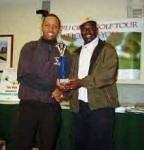
“What you are doing is commendable,” Kenyan Consul General M. Nyambura Kamau tells the golfers and volunteers after a group photo. “If each one of us takes a child or two, we’ll do a lot.”
Kariuki, the executive director, informs the golfers that the tournament will adhere to USGA (United States Golf Association) golf rules. Off to the course they go.
The golfers start in groups of four. It has stopped raining but it’s still windy. Tony Gathungu of
Dublin, Calif.
is the first one to tee off. Dressed in blue jeans, a blue golf shirt with thin white horizontal stripes, a navy blue Nike cap and white shoes, Gathungu steps to the ball, swings and drives it straight to the middle of the fairway, defying the gusty wind. He seems happy with the shot.
One by one, the groups of golfers navigate through mud and bad weather as a small red pump connected to a green hose sucks floodwater from the driveways of the golf course. Halfway through the tournament, their perseverance pays. The weather lets up and they are able to finish the tournament, with Thomas Kanyingi of
Lenexa, Kan.
as the tournament champion.
Gachu, the tournament director, can’t immediately provide the amount of money the group raised today, but he says they sold everything that they intended to.
“It was a success.”
Visit the Picture Gallery for images from the tournament.
Just seven months ago, Ikran Hagi Daud Warsame was a full-time housewife and a bread-winner for her 18-member household in Borame, a remote town in the mountainous border between and . Little did she know that her next move would take her all the way to the White House for a full-fledged dinner with President Bush and First Lady Laura Bush – something no Somali president has done in decades.
Warsame, the mother of nine, made history last year when she became the first democratically elected woman to the 82-member, male-dominated
Somaliland
parliament. The only other female member in the parliament is appointed.
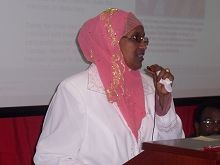
She explained her rapid and unlikely political ascent and described the current state of Somaliland during a March 19 meeting in
Minneapolis
with some of those who financed her campaign.
“We’re in peace and prosperity, and we hope the same thing for [],” she said, standing before a giant
Somaliland
flag “We need the Diaspora communities to return and invest in our country.”
Yusuf Budle, chairman of Kulmiye Committee in
Minnesota
, a group of supporters from Ms. Warsame’s political party and co-organizer of the event, says that they are proud of her. “We supported her campaign with money and moral.” He says.
Recognizing
Somaliland
Somaliland, a breakaway enclave of , declared unilateral independence from the rest of the now-ruined republic in 1991, and maintained relative stability, good governance, and free elections. No government has recognized
Somaliland
as a nation, but the State Department has touted its model more than once.
In fact, the State Department has done more than touting by issuing Warsame’s visa to the U.S on a Somaliland-issued travel document.
“That is a positive gesture,” says Warsame “But I’m more concerned with introducing Somaliland to our neighbors first, then to .”
That’s because when she met with a Kenyan counterpart in Washington, D.C., during a Women’s Democracy Network conference early this month and introduced herself as a Somaliland MP, she received a blank stare and a painful question “Where is
Somaliland
?” And when she explained, the Kenyan MP replied “I only heard of Somali MPs staying at 680 hotel in
Nairobi
and not paying their bill!” (She’s referring to the prolonged stay of Somali parliamentarians in almost two years ago.)
Warsame, out of dismay, extended an official invitation to all five delegates from Africa at the conference to
Somaliland
.
She was among 30 “accomplished women leaders” from around the world who gathered for the three-day conference sponsored by International Republican Institute (IRI) to “foster relationships” and “share experiences.”
IRI, a congressionally funded nonprofit, nonpartisan organization dedicated to advancing aspiring democracies has done a “comprehensive political assessment in
Somaliland
” in 2002. Among other programs, the organization helped the parliamentary elections in which Warsame was elected.
‘Kingdom of men’
To get on the ballot, Warsame had to penetrate multiple layers of social and cultural hurdles. First, she had to coax her own family to help her talk to the powerful tribal elders.
“My husband was supportive,” she said “and he’s the most important person.”
After securing the green light from most of her family, she had to cajole tribal elders, an exclusive-men’s club, to “allow” her to seek party nomination.
She got lucky.
But then, her party, Kulmiye, the main opposition party, had to assess the risk involved, provided that they desperately wanted to control the parliament and couldn’t afford to lose her seat.
She got lucky, again. Or so, she thought.
Just after she was cleared to put her name on the ballot, conservative clerics intervened, citing a revelation banning women from assuming high public office. But moderate clerics came into her defense, though they reiterated that women can’t run for president.
Finally, she had to convince the largest and the most skeptical group of people: the voters who never experienced something quite like this. Warsame, a former teacher and a caretaker of two orphans and five disabled children, said that she turned to the people she built a rapport with: women and youth.
“I focused on the youth and told them to vote for me since only 35 years and older person could run,” recalls Warsame, “and I think they did vote for me.”
On election day, the unexpected happened; Warsame survived what she characterizes as the “kingdom of men” and became the first elected woman in Somaliland and, perhaps, some say, in the entire history of greater .
“She is a trailblazer.” says Osman Sahardeed, chairman of Somali American Democratic Association.
Even after becoming a busy legislator in Hargeisa, the capital of
Somaliland
, Warsame allocates time to mother her relatively young children. On Wednesday evenings, the start of a weekend in that part of the world, she commutes three hours back to Borame over extremely rough roads.
Political ambitions
Warsame, who serves on the rules and regulations committee of the parliament, says her biggest political ambition is conducive to restoring women’s rights and family justice.
“I’d like to end the guilt-assumption of women at court of justice and in the society at large.” she says. “Quite honestly, I’m fascinated with the betterment of women.”
So fascinated with women that she is a reminiscent of Arraweelo, a feminist medieval queen who took over reigns of power from unscrupulous men and reduced them to render household services while establishing a women-dominated monarchy in what is today.
Before returning to
Somaliland
later this month, Warsame has speaking engagements lined up for her in Chicago and Columbus on an itinerary that included Washington and Dallas.
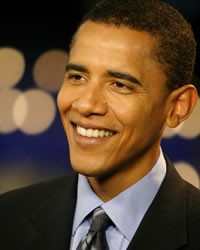
Illinois US Senator, Barack Obama will deliver the keynote address at the 29th Annual Hubert H. Humphrey Day Dinner that will be held at the Minneapolis Hilton on Saturday April 8 at 7PM. Tickets are $125. The dinner is organized by the Democratic Farmer Labor (DFL) party.
Elected to the US Senate in 2004, Obama is a rising star in Democratic circles and widely believed to be a future presidential contender. He is also a prolific fundraiser. He collected $6.5 million last year for his political action committee (PAC) called Hopefund.When he formed the PAC, he said it had the goal of “promoting the candidacies of leaders who are committed to changing the course of our nation to ensure the promise of
for future generations”.
The Humphrey Day dinner is one of the high profile speaking engagements that Senator Obama has accepted in an effort to bolster the Democratic Party’s coffers. The added exposure to Democrats across the country has added to the speculation that he is destined for higher office.
Born in Hawaii to a Kenyan father and American mother on August 4, 1961, Obama graduated from
Harvard
Law
School
and was the first African-American editor of the Harvard Law Review. He is married to Michelle and they have two daughters, Malia and Sasha who are 7 and 4 respectively.
Tickets for the Humphrey day Dinner can be purchased online at www.dfl.org or by calling 651-251-6380.
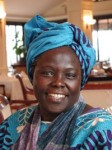
For Dr. Wangari Maathai, the 2004 Nobel Peace prize winner and the first woman from Africa to win it, a life of environmental curiosity and later activism began during the East Coast fever epidemic in Kenya. It is a fatal disease that afflicts cattle caused by ticks and characterized by intense fever, labored breathing, a generalized weakness and emaciation of the affected cattle.
She was working at the University of Nairobi in the veterinary department, part of the team that was working to solve the problem. While observing the tick that was the vector in transmitting the disease, she came up close with the environmental degradation that was taking place. As a scientist she became aware, on a personal level, of the cost of damaging existing eco-systems and the consequences thereof.
In the early seventies having earned a Masters at the time in Biological Sciences Maathai was the only woman teaching in the sciences at the University of Nairobi. Beside Dr. Maathai, there were only two other females in the faculty. Kenyan Association of University Women (KAUW) started campaigning for equal pay and rights of the women teachers and this led Maathai to represent them at the 1975 Mexico UN Women’s Conference. While at the conference Wangari Maathai met with other Kenyan women from all levels of society. She was made aware of the four main concerns of women at the grassroots level namely, firewood, water, poverty, and vulnerability.
The scientist in Wangari Maathai paid more attention to what were the root causes of these problems and she deduced that change of land use and land use management were the culprits. The land was cleared for cash crop cultivation such as coffee and tea which led to loss of sources of firewood; because of agro-chemicals and bad farming methods water sources were either contaminated or no longer available; cash crop farming involved payments going directly to husbands’ bank accounts.
This arrangement led to poverty and vulnerability on the part of the women. This inspired Maathai to start teaching the women to plant trees so the earth could repair itself and thereafter offer sources of food, shelter and security.
This was the message Dr. Maathai brought to the upper Midwest in March. She was one of the keynote speakers at the 18th Annual Nobel Peace Prize Forum – which is the Norwegian Nobel Institute’s only such program or academic affiliation outside Norway. The forum was held at Luther College in Decorah, Iowa on March 10-11. This year’s Forum theme was Striving for Peace: Sustaining the planet. The focus of this year’s forum was to honor the work of Dr. Wangari Maathai and her message the threat to peace that is posed by scientific, political, and economic aspects of environmental degradation. Also present at the Forum was the Executive Director of the Norwegian Noble Institute, Dr. Geir Lundestad and the Ambassador of Norway to the United States, the Honorable Knut Vollebaek.
During conversations about governance and the role of governments in taking responsible environmental action Prof. Maathai cautioned that individuals should not feel helpless or hopeless when they feel their government’s policies are not environment friendly. Signing a treaty is not enough. Some countries are quick to sign and ratify agreements but take little or no action to put into effect or enforce them. “Every country can take action, and so can every individual.” Every individual can do their part in the 3Rs (Reduce, Reuse and Recycle). The United States and Australia did not sign the Kyoto Protocol in Japan, but this does not prevent millions of their citizens from subscribing to environmental efforts and doing the 3Rs. It is the action of individual citizens that is important. “The world belongs to all not just to Presidents and Ministers.”
Maathai gave an example of Japan a consumer culture that is incorporating an age old Buddhist belief of Mot Tai Nai in its environmental policies. Japan is a mega consumer only using and consuming from other countries what she doesn’t have or produce. Mot Tai Nai is the concept of the 3Rs but has another aspect that is difficult to translate but roughly means being grateful for what you have, receiving it with respect. This concept is still embedded in the older Japanese generation but is not the case among the younger generation that has grown up in a period of prosperity. The individual philosophy of Mot Tai Nai is helping reduce their negative impact on environment. Japan has even taking further steps in recycling plastic to create computer parts, synthetic silk items like the traditional furoshiki cloth, which is made from recycled plastic and even modern materials for men’s suits.
What keeps her going? The Green Belt Movement founder shared a story that she heard that helps her sustain her energy and helps her not feel overwhelmed. One day a big forest fire had all the animals, birds and reptiles running away. All except one – the hummingbird. The little hummingbird kept going back to the fire, she would fly to the stream pick a drop of water in her beak and take it back to douse the fire. From a safe distance the other animals stood and watched, soon they started laughing at her, those who were kinder tried to discourage her “what can you do with your one drop of water?” The humming bird didn’t answer and just continued her task back and forth. Finally she answered her discouragers (some of whom, like the pelican, could have carried a lot more water than the little hummingbird), “I am doing the best I can.”
Pan African Green Belt Network
She was the first woman in East and Central Africa to earn a doctoral degree. In 2004 she also became the first African from the vast area between South Africa and Egypt to be awarded the Nobel Peace Prize as well as being the first woman from Africa to receive such an honor. Her efforts founded the Green Belt Movement that has mobilized women to plant more than 30 million trees on a grassroots level around Kenya. Maathai’s efforts have been adopted by other countries through a Pan African Green Belt Network.
Currently Maathai duties also include being Ambassador of Goodwill for the Congo Forest Region, and mobilizing the civil society of Africa by helping the African Union form the African Civil Society Parliament. This parliament will consist of two representatives from the 53 countries.
Partisanship and the Environment
A second plenary address was given by Christine Todd Whitman, former governor of New Jersey (1994-2001)and Environmental Protection Agency (EPA) Secretary (2001-2003) in the Bush administration. Her speech was titled “The Capability of Politics in the United States Today to Address Hard Environmental Problems”. In her speech Whitman called attention to the partisan climate currently prevailing in Washington that has made it difficult to legislate substantive environmental laws.
However she was optimistic that even in the absence of mandated action businesses are complying with EPA standards and making positive changes environmentally. “Economic development and environmental progress can and must exist together”. She stressed that consistent legal regulations were needed but these changes will only occur when the people make their concerns clear to the politicians and decision makers in Washington D.C. Politicians act on the issues that concern the electorate and polls have shown that the environment polls very low as a priority among the public which said needs to change.
In responding to a question from the audience on the role media could play in promoting environmental issues, Whitman stated that “individuals have to make the change because the papers give what the public wants.” The central theme throughout the two day forum was exploring the importance of grassroots development and the difference individual citizens can make in creating a more just and sustainable planet.
Passing the Torch
The final plenary address from Luther alumnus, Dr Michael Osterholm, director of the Center for Infectious Disease Research and Policy at the University of Minnesota was titled “The Role of the Scientist in the Making of Policy”. Dr Osterholm reiterated the important role individuals play in impacting the world. Osterholm is an internationally recognized expert in epidemiology and public policy, bioterrorism and public health preparedness. Recently he was a featured guest on the television show Oprah, discussing the bird-flu threat. Osterholm urged the audience at the end of his speech to “Be involved. We need an informed public.” He stated that his personal measures of success are his students, “The single most important thing is passing the torch.”
The Forum ended in the same way it had opened, with a ceremony featuring a theatre/dance performance ,Shall We Gather. The opening performance portrayed people coming together and their actions although seemingly productive (i.e. fetching firewood, clearing the land for planting crops, using lumber for building/furniture) were destroying the earth. It showed one person mourning the destruction and trying to fix it, she was later joined by two others. Taja Will a music major sophomore wrote the music and arranged the choreography. Mshale spoke to her and another student performer Justin Zeigler, a junior majoring in theatre dance about the closing performance and what they were trying to express. The ending performance showed people coming together to heal the earth, and others watching and learning and then each leaving after replacing a “tree” and according to Taja it meant to show that “even as we [forum participants] leave we shall still gather in other places and share the knowledge.”
Peace Jam
Leaving Iowa, Dr. Maathai traveled to the Twin Cities where she led a PeaceJam Youth Conference comprised of Upper Midwest youth on Sunday, March 12 at the University of St. Thomas in Saint Paul. PeaceJam is an international education program built around leading Nobel Peace Laureates who work personally with youth to pass on the spirit, skills, and wisdom they embody. This event was only open to the youth.
A sold out public event that PeaceJam also hosted was addressed by Dr. Maathai. She stressed the importance of starting small to effect the change that is needed. She told the audience that the world must rethink the concept of peace. By consciously managing our resources better and following democratic principles, the world is more likely to live at peace with each other.
Dr. Maathai also stressed the importance of ensuring the equitable distribution of resources “not equal distribution, as I know that is not possible but EQUITABLE”, she said.
Special Meeting
Dr. Maathai used her lunch break from the PeaceJam conference in Saint Paul to dash to the Cowles Auditorium at the Hubert Humphrey Institute of Public Affairs to meet with Kenyans and their friends in Minnesota. The event was hosted jointly by the Kenya Welfare Association of Minnesota and Mshale Newspaper.
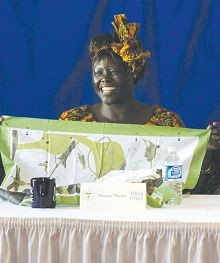
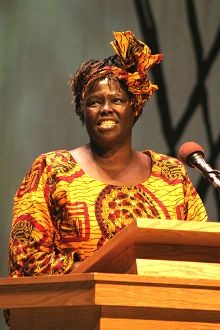
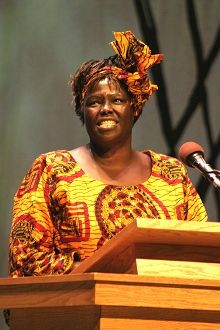
Her entrance into the University of Minnesota’s Cowles Auditorium was greeted with ululation from some Kenyan women and cheers from the rest of the audience. Smiling and saying thank-you, Prof. Maathai worked her way down to the podium. The admiration and awe on the faces of the regrettably small audience was obvious.
Dr. Njoki Kamau was equally jubilant in her introduction of Prof. Maathai, “I remember Prof. Maathai coming to our school in the 70s and telling us to water our trees and our education!” she remarked. Dr. Kamau is Assistant Professor at the University of Minnesota’s Department of Women’s Studies at the Duluth campus.
For many Kenyans, Prof. Maathai is mostly remembered for her relentless struggles against the regime of Kenya’s former president, Daniel Toroitich Arap Moi. In 1989 she challenged Moi’s decision to build a 60-storey structure in Nairobi’s Uhuru Park; as a result the building was never constructed. In 1990 at Freedom Corner in the same Uhuru Park Prof. Maathai accompanied other women in demanding the release of their sons who had been unfairly taken as political prisoners. When the police (who were as young as their sons) confronted them and started beating them, they stripped naked which in African terms is tantamount to a curse.
Ironically, today she finds herself becoming increasingly dissatisfied with the government of Mwai Kibaki. Late last year she turned down an appointment as Environment Assistant Minister following a cabinet reshuffle after current president Mwai Kibaki’s team, lost the referendum vote on the constitution to the Orange Democratic Movement (ODM). This leaves her in an awkward position being that she occupied the post before the reshuffle and no one has replaced her to date; she explains that she is essentially a minister who has not taken her oath and this has never happened before so no one really knows how to go about the situation. Her reasons for declining the offer were not as superficial as the politics of the constitutional review and the dismissal of ODM ministers. “I like to deal with the ‘root’ causes – that’s why I plant trees,” she joked.
On a serious note, she stated that the president’s failure to honor the Memorandum of Understanding (MOU) which advocated for equal sharing of power for all the parties in the opposition alliance, NARC, should they come into power in 2002 was the root cause of Kenya’s political instability and eventually exploded at the referendum. “It is important that we stay on track so that we do not frustrate the confidence and hope Kenyans invested in the 2002 elections, she said.” In response to a question as to whether she would be ready to run for president of Kenya, she replied that she has been ready since ten years ago when she unsuccessfully tried to run against then president Moi. She also encouraged women to join politics so that they don’t complain from the outside, but go in and effect change. For now however, she hasn’t set a date to take the oath as the Environment because she wants to be a constant reminder that the Kenyan government is on the wrong path.
Nonetheless it is unfair not to recognize the positive strides of the government she added. Since the government allocated 3% of revenue to the constituencies, citizens have more say in development in their areas. She also reminded everyone that the fact that Kenyans can hound ministers on corruption as they are doing today, is because of the democratic space allowed by the new government.
Though many of the questions from the audience revolved around Professor Maathai’s political life and insights, she is above all, a passionate environmentalist. She admits that Kenya has a good environmental policy on paper, but implementation is wanting and lack of funding means that extension services to farmers are not available. “With all conflicts there is an underlying problem of resources and the world needs to rethink security and peace,” she said. She added that Africa cannot have peace without equity and ardently advocated for a stronger civil society to check excesses of governments. She pointed out the irony of people going to war over small pieces of land when desertification is taking inches of our soil every day and no one lifts a brow. “We have eyes, but we do not see!” she lamented.
In spite of the numerous responsibilities she currently holds, Professor Maathai did not pass up the invitations to be Goodwill Ambassador to the Congo Forest and the first chair the African Union’s Economic, Social and Cultural Council (ECOSOC). Much needs to be done soon in Africa, which has an abundance of natural resources that are at risk of disappearing and through these positions she believes will be better situated to work with Africans to create a sustainable and secure environment.
Peace Prize Festival Rescheduled
A snow storm in the Twin Cities on March 13 led to the cancellation of the 11th Annual Nobel peace Prize Festival that was to be held at Augsburg College in Minneapolis. The event which is geared words elementary school children was to be graced by the presence of Dr. Maathai. Most schools in the metro cancelled classes prompting festival organizers to call it off. This was to be Dr. Maathai’s last engagement in the Twin Cities.
Festival organizers told Mshale the event will be rescheduled. Rescheduled date and details will be posted at www.augsburg.edu/peaceprizefestival . Mshale publisher, Tom Gitaa, said readers who have signed up for Mshale’s mailing list at mshale.com will also be notified once the new date is set.
Interview on ABN-America
While in the Twin Cities, Dr. Maathai did a special interview on ABN-America’s Talking Drum show which is hosted by Tom Gitaa of Mshale. The show will air on April 20 at 8:00 P.M. CST with a rebroadcast on Sunday, April 23 at the same time according to ABN’s Vice-president of Programming, Mr. Lamin Dibba.
ABN-America is headquartered in Saint Paul, Minnesota and is available nationwide via satellite on the Dish Network Channel 749.
After leaving the Twin Cities, Dr. Maathai had speaking engagements in various US cities such as Seattle and Atlanta before flying back to Kenya.
“Liberia WILL be better than it was before!” pledged young children in a skit where each child took on the role of a professional in uniform. Statements by each child were met with cheers of encouragement from the audience. It was clear that pride, optimism and festivity ruled the night of the Inaugural Ball of the Organization of Liberians in Minnesota (OLM).
The speakers at the podium all delivered the same message albeit in different words. They congratulated Liberians for progress achieved thus far and further urged them to transcend their achievements and move to the next level. For Liberians back at home and here in Minnesota that is not a light request.
After a quarter of a century of violence, newly elected president of Liberia Ellen Johnson-Sirleaf has the arduous task of leading the reconstruction of the country .
Meanwhile, here in Minnesota , newly elected president of OLM, Martha Sinoe, finds herself leading the revamping of the organization. One of her main aims is to transfer OLM from a political and social organization into a non-profit organization. This is the first time that a woman is OLM president adding to the pressure to be successful but at the same time garnering a lot of support and attention.
Guest speaker, senate candidate Dan Williams opened his speech by reading a letter of congratulations to Mrs. Sinoe from Governor Tim Pawlenty and stood by the governor’s pledge to support the organizations goals. “OLM is not the same as it was 2 years ago or even 5 years ago,” he stated. As OLM goes through structural changes, Williams advised its leadership and audience alike to realize the importance of effective engagement during rapid change. “Your results must be pre-determined,” he stated. “Always be prepared for change, recognize when change is occurring and know what has been changed, what is has changed from and what it is changing too,” he articulated.
Williams also noted the rapid changes taking place in American politics and remarked’ “What you see today may very well be obsolete tomorrow. Some people in office are like that.” Mr. Williams is running for Minnesota State Senate – District 54. He is the founding pastor of Grace Resurrection Ministries and has extensive experience as a politician and businessman.
After a brief introduction by her son, OLM president Martha Sinoe took to the podium amidst loud cheers. “Unity, services and accountability shall be the guiding principles for our administration,” she declared. In the transition to a non-profit organization, her administration has set up a leadership team of committees to achieve the goals of the organization which have changed since its inception as a student organization in 1973. She expressed her pride in being part of an organization that has provided Liberians with a means to get together and re-live their culture in a foreign land. However she admitted that Liberians in Minnesota face many challenges, which have grown and become more complex in recent years.
Among these challenges are Liberian youth without education suddenly thrown in an education system that does not understand their needs. The problem is compounded by the fact that their parents are working two to three jobs and not able to have time to raise their children. Another pressing concern is the Temporary Immigration Status of many Liberians. Through the immigration committee, Mrs. Sinoe hopes that OLM will be able to influence policy issues on immigration. Mrs. Sinoe said that in its new structure, OLM will be better equipped to improve capacity and provide services for the community.
Apart from a redefined structure, she hopes that OLM will have a Community Cultural Center in two years. She is working with other African groups that have community centers to see that she meets this goal. The organization through the efforts of US Senator, Mark Dayton, received federal funding totaling $250,000 in the FY2005 Omnibus Appropriations Bill to go towards the center. Above all, she asked for increased support for the Liberian community because as president she can not do much without the support of the people. “Only together we can make a difference,” she said.
Also present to congratulate Mrs. Sinoe on her election as OLM president was the mayor of Brooklyn Center, Myrna Kragness, who also happens to be the first female mayor of the city and a large delegation of various members and officials from the Union of Liberian Association in the Americas (ULAA), which is the umbrella group of the various Liberian organization in the Americas.
ULAA’s President Mr. Arthur Watson remarked that this was the largest delegation of ULAA officials he had seen at any chapter’s inauguration ball and noted its implication on the optimism and increasing support for gender inclusiveness in decision-making.
He noted that challenges faced by Liberians in Minnesota were the same for Liberians all over the U.S and stressed the importance of presenting a united front when lobbying congress. “It is challenging when Liberians attack immigration from different fronts, everyone needs to join one battle,” he concluded.
By midnight the audience having eaten well and listened to the words of their leaders, were ready to get their groove on. Mr. and Mrs. Sinoe led the Grand Ball March and the crowd danced to African tunes until the wee hours of the morning.
Visit the Picture Gallery for pictures from the inaugural dinner and ball.
Nobel Laureate Faults Kenyan President for Political Stalemate
Her entrance into the University of Minnesota’s Cowles Auditorium was greeted with ululation from some Kenyan women and cheers from the rest of the audience. Smiling and saying thank-you, Prof. Maathai worked her way down to the podium. The admiration and awe on the faces of the regrettably small audience was obvious.
Dr. Njoki Kamau was equally jubilant in her introduction of Prof. Maathai, “I remember Prof. Maathai coming to our school in the 70s and telling us to water our trees and our education!” she remarked. Dr. Kamau is Assistant Professor at the University of Minnesota’s Department of Women’s Studies at the Duluth campus.
For many Kenyans, Prof. Maathai is mostly remembered for her relentless struggles against the regime of Kenya’s former president, Daniel Toroitich Arap Moi. In 1989 she challenged Moi’s decision to build a 60-storey structure in Nairobi’s Uhuru Park; as a result the building was never constructed. In 1990 at Freedom Corner in the same Uhuru Park Prof. Maathai accompanied other women in demanding the release of their sons who had been unfairly taken as political prisoners. When the police (who were as young as their sons) confronted them and started beating them, they stripped naked which in African terms is tantamount to a curse.
Ironically, today she finds herself becoming increasingly dissatisfied with the government of Mwai Kibaki. Late last year she turned down an appointment as Environment Assistant Minister following a cabinet reshuffle after current president Mwai Kibaki’s team, lost the referendum vote on the constitution to the Orange Democratic Movement (ODM). This leaves her in an awkward position being that she occupied the post before the reshuffle and no one has replaced her to date; she explains that she is essentially a minister who has not taken her oath and this has never happened before so no one really knows how to go about the situation. Her reasons for declining the offer were not as superficial as the politics of the constitutional review and the dismissal of ODM ministers. “I like to deal with the ‘root’ causes – that’s why I plant trees,” she joked.
On a serious note, she stated that the president’s failure to honor the Memorandum of Understanding (MOU) which advocated for equal sharing of power for all the parties in the opposition alliance, NARC, should they come into power in 2002 was the root cause of Kenya’s political instability and eventually exploded at the referendum. “It is important that we stay on track so that we do not frustrate the confidence and hope Kenyans invested in the 2002 elections, she said.” In response to a question as to whether she would be ready to run for president of Kenya, she replied that she has been ready since ten years ago when she unsuccessfully tried to run against then president Moi. She also encouraged women to join politics so that they don’t complain from the outside, but go in and effect change. For now however, she hasn’t set a date to take the oath as the Environment because she wants to be a constant reminder that the Kenyan government is on the wrong path.
Nonetheless it is unfair not to recognize the positive strides of the government she added. Since the government allocated 3% of revenue to the constituencies citizens have more say in development in their areas. She also reminded everyone that the fact that Kenyans could hound ministers on corruption as they are doing today, is because of the democratic space allowed by the new government.
Though many of the questions from the audience revolved around Professor Maathai’s political life and insights, she is above all, a passionate environmentalist. She admits that Kenya has a good environmental policy on paper, but implementation is wanting and lack of funding means that extension services to farmers are not available. “With all conflicts there is an underlying problem of resources and the world needs to rethink security and peace,” she said. She added that Africa cannot have peace without equity and ardently advocated for a stronger civil society to check excesses of governments. She pointed out the irony of people going to war over small pieces of land when desertification is taking inches of our soil every day and no one lifts a brow. “We have eyes, but we do not see!” she lamented.
In spite of the numerous responsibilities she currently holds, Professor Maathai did not pass up the invitations to be Goodwill Ambassador to the Congo Forest and the first chair the African Union’s Economic, Social and Cultural Council (ECOSOC). Much needs to be done soon in Africa, which has an abundance of natural resources that are at risk of disappearing and through these positions she believes will be better situated to work with Africans to create a sustainable and secure environment.
The afternoon event featuring Dr. Maathai was presented jointly by the Kenya Welfare Association of Minnesota and Mshale Newspaper.
Ghanaians Honor Their Best at Independence Day Celebration
SHOREVIEW, MN Mar. 11 2006 – Nearly 200 Ghanaians gathered today at the
Shoreview
Community Center
to celebrate ’s 49th anniversary. The Ghanaian Association of Minnesota (GHANAM) hosted the event themed ‘Living the American Dream and Making a Difference Back Home’.
The event also honored leading Surgeon Dr. Oheneba Boachie Adjei and marked the beginning of a new era for GHANAM as a new board was ushered in.
“To know where we are going we should know where we come from,” said Kwame Frempong, President of the Ghanaian Association of Minnesota during a speech in which he urged all Ghanaians to use skills and knowledge gained in the U.S to make a difference back home.The Message was further emphasized when Guest speaker and former GHANAM president, Dr. Oheneba Boachie Adjei, shared his experiences and achievements in an effort to inspire fellow Ghanaians to follow in his footsteps.
In his powerful power-point presentation Dr. Boachie-Adjei highlighted ’s improvements since its independence. , according to Dr. Boachie-Adjei has come a long way since its independence in 1957. He listed many developments, such as the increase in minimum wage to $2 and the annual growth in gross domestic product (GDP). He also urged Ghanaians to take advantage of a dual citizenship law, which enables Ghanaians to have both U.S and Ghanaian citizenship he said that “this would make it easier to make a difference back home, especially at a time when Ghanaians in the diaspora have the opportunity to cast absentee ballots. He also mentioned that in a recent research led by London School of Economics professors, ranked 10th happiest place on earth and he attributed this to the Ghanaian spirit.
“We still have a long way to go,” said Dr. Boachie as he listed the areas in which can improve and stressed the need for more improvements in the field of health care. “I cannot say much about the other areas,” said Dr. Boachie, “but I can say a lot about the health care system in , we need help… There are less than a dozen orthopedic surgeons in , this is very serious.”
As a leading orthopedic surgeon in the U.S, Dr. Adjei has engaged in advanced orthopedic and spine complex research. He used his expertise to form the Foundation of Orthopedics and Complex Spine (FOCOS) in 1998. FOCOS delivers advanced treatment and control of injuries and disorders of the musculoskeletal and spine systems in third world countries. FOCOS makes strides in bringing free and affordable, state of the art care to both the young and old of who are afflicted with deformities and disorders of the spine.
During his presentation he offered what he called his strategic plan in fighting inequalities, telling the audience not to just care but also to “turn their compassion into action…this is the most precious gift you can ever give.”
The Ghanaian Association of Minnesota awarded Dr. Boachie Adjei, a lifetime achievement award. Many were moved by Dr. Boachie-Adjei’s story. “I wanted to find a success story among the Ghanaians in the , and I could think of no other story better than Dr. Boachie’s,” said Frempong. “Many audience members came because of him, he is an incredible individual and his speech fell right in line with the goal of GHANAM this year” he said.
Frempong believes that it is important for the Ghanaian community in the U.S to realize their responsibilities back home, “through our new programs we can better facilitate this process,” he said.
Audience members were later treated to a Ghanaian style dance. They also had the opportunity to network and discuss the event. Gilbert Odonkor, Alumni of the
University
of
Minnesota
and Twin Cities resident said, “the speaker was great. I really appreciated what he had to offer. We sometimes get wrapped up in our own worlds that we forget where we come from, it is important to hear such messages once in a while to bring us back to reality.” Odonkor also expressed his interest in becoming a full member of GHANAM and related his decision to the satisfaction he got from the event.
According to Frempong one of GHANAM’s goal is to increase its membership, “this event pulled a huge crowd,” he said “we were very surprised; this is a great start to what is going to be a great year.”
Nobel Peace Prize Laureate Urges Individual Action
DECORAH, Iowa – Nobel peace prize laureate Dr. Wangari Maathai today said citizens of the world should hold those in power accountable for their actions towards the environment, if we are to preserve the environment for future generations. She gave the example of Americans who despite their government’s refusal to sign the Kyoto treaty have with individual actions have embraced the spirit of the treaty.
Maathai, winner of the 2004 peace prize said good governance is critical to the sustaining of the environment. She told attendees at the conference numbering about 1,500 that it is the little things that they do that make a difference and they do not have to wait for the government to do it for them.
“If left alone, politicians can do almost anything if they can get away with it”, she said. She was one of the keynote speakers along with former Environmental protection Agency (EPA) Secretary Christine Todd Whitman at the 18th annual peace prize forum that began here today.
Dr. Maathai who gave an eloquent speech for about an hour without notes was well received at Luther College where the conference is being held receiving a prolonged standing ovation at the conclusion of her address.
The Green Belt Movement, of which Maathai is the founder is credited with planting more than 30 million trees since its founding three decades ago.
DECORAH, Iowa – The 18th Annual 2006 Nobel Peace Forum got underway today at Luther College in Decorah, Iowa. 2004 Nobel Peace prize winner, Wangari Maathai of Kenya is the honored guest. This year’s conference is honoring her work sustaining the environment.
The two day conference also features former Environmental Protection Agency (EPA) Secretary in the Bush administration and former governor of New Jersey, Christine Todd Whitman.
Updates from the Mshale team which is at the forum will be forthcoming later today.
With the discovery of the H5N1 (Asian, or “bird” Flu) virus in three northern provinces of Nigeria in February, Africans may face one of the most serious continent-wide threats in recent history. If it spreads beyond Nigeria, the virus – which is expected to destroy food crops (mainly poultry) and reduce productivity – can, coupled with impact of HIV/Aids and rampant Tuberculosis in Africa, destroy families and communities in a way that has not been witnessed in Africa in decades.
Already concerned with the HIV/Aids epidemic and Tuberculosis in Africa, the World Health Organisation (WHO) has warned that the spread of the deadly H5N1 strain of bird flu had the potential to spread across the continent within days of being discovered. In early February instances of the H5N1 virus were discovered in poultry in Nigeria’s Kaduna, Kano and Plateau states, with unconfirmed cases reported in Yobe, Nassarawa, Jigawa and in the Federal Capital Territory.
The immediate impact of the H5N1 virus on Nigerian society is expected to be devastating. In February the Nigerian newspaper, Business Day, published figures which suggested that the country may lose at least 112billion Naira (about US$9bn) if the country’s entire poultry population is wiped out.
Professor Babafunso Sonaiya of the Obafemi Awolowo University told Business Day that Nigeria had an estimated 140 million birds, at least half of which were free-ranging and, therefore, exposed to droppings of migratory birds who may carry the virus. Based on estimates by the Central Bank of Nigeria, the loss of the poultry population could significantly reduce the 2.95% contribution livestock makes to the Nigeria’s Gross Domestic Product (GDP). This immediate impact may be relatively small compared to what it may cost to prevent the spread of the pathogen to the rest of the country if it migrated to humans – given, especially, the impact of HIV/Aids and Tuberculosus on the continent.
The Impact on Africa
Beyond Nigeria the impact of the H5N1 virus, if spread to humans, could cripple or completely destroy local and regional political economies on the continent, and exacerbate the crisis in public health that the HIV/Aids epidemic that continues to spread across Sub-Saharan Africa. While Africa is home to 10% of the world’s population it is, also, where 60% of all HIV cases have been identified. In South Africa, which probably has the highest developed and most sophisticated public health program in Africa, HIV infections grew by 25% between 1990 – 2000 with almost 30 percent of all women who attended antenatal clinics in the country during 2004 testing positive for the disease.
A third element in the public health nightmare is the fact that of the estimated 40 million people living with HIV/AIDS, at least 30% are also suffer from Tuberculosis (TB). In Sub-Saharan Africa the proportion is even higher. The WHO explains that people infected with HIV are five to 10 times more likely to develop TB in a given year than those who are not. According to Dr Bernard Fourie, a scientist with South Africa’s Medical Research Council and former head of its TB research programme, there has been no decline in TB rates in Africa since the late 1980s, a factor which he links to the presence of HIV. The Director of the Stop TB Department of the WHO, Dr Mario Ravaglione explains that “TB … is not only the major killer of HIV-infected people, but a disease that is out of control on the African continent”. Both comments were made to the WHO and were published on the organization’s website.
Possibility of a Pandemic
The impact of an H5N1 Influenza pandemic, which the WHO considers to be virtual certainty, can be lessened with early warning systems in place. In the past influenza pandemics took societies by surprise. Health services had little time to prepare for sudden increases in detections and deaths. While vaccines were available for the 1957 “Asian Influenza” and “Hong Kong influenza” of 1968, both large-scale transnational pandemics, they arrived too late to alter the impact of the virus, resulting in devastating social and economic disruption and large-scale lose of life.
According to the WHO, the H5N1 virus has significant pandemic potential. The H5N1 strain has been monitored by health experts for almost eight years. The strain first infected humans in Hong Kong in 1997 – 18 cases, resulting in six deaths. Since mid-2003, the virus has caused the largest and most severe outbreaks in poultry on record. In December 2003, infections in people exposed to sick birds were identified. Since then, over 100 human cases have been laboratory confirmed in four Asian countries, Cambodia, Indonesia, Thailand, and Viet Nam, and more than half of these people have died. Most cases occurred in previously healthy children and young adults. The virus does not jump easily from birds to humans, nor is it believed to spread readily and sustainably among humans. Should the H5N1 evolve into a form as contagious as normal influenza, a pandemic could begin.
According to the WHO, the world may well be “on the brink of another pandemic”. Given the speed and volume of air travel the virus, once detected in humans in one part of the world, can travel around the world within weeks. Given, also, that most people will have no immunity to the pandemic virus, infection and illness rates are expected to be higher than during seasonal epidemics of normal influenza.
The WHO believe, moreover, that very few countries have the staff, facilities, equipment, and hospital beds needed to cope with large numbers of people. Supplies of vaccines and antiviral drugs, the two most important medical interventions for reducing illness and deaths during a pandemic, are expected to be inadequate in all countries at the start of a pandemic and for many months thereafter. Inadequate supplies of vaccines are of particular concern, as vaccines are considered the first line of defence for protecting populations. On present trends, according to the WHO, many developing countries will have no access to vaccines throughout the duration of a pandemic.
Those most vulnerable to the disease are the poor and the weak; in Africa, poverty and the prevalence of HIV/Aids and Tuberculosis could inflate the WHO’s estimation of as many as seven million deaths world-wide. For now, it seems, most poor countries, especially those in Africa, can only wait and hope for the best.
Ismail Lagardien is an independent writer and scholar. He is currently teaching a course on the Social and Historical Causes of Conflict in Africa at the University of South Carolina.
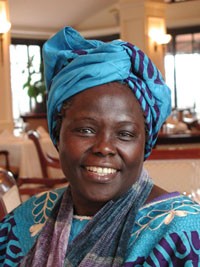
2004 Nobel Peace Prize Laureate, Dr. Wangari Maathai, in Minneapolis March 13 for Peace Festival
The 11th annual Nobel Peace Prize Festival will be held at Augsburg College in Minneapolis on Monday, March 13 from 11:00 a.m.-1:30 p.m. and will honor 2004 Nobel Peace Prize Laureate Wangari Maathai. The Norwegian Nobel Institute selected Professor Maathai from Kenya for her contribution to sustainable development, democracy, and peace. She is also founder of the Greenbelt Movement. This organization is responsible for planting 30 million trees in Kenya over the past 30 years.
The Festival is designed to connect students in grades 1-12 who first study the work of a Nobel Peace Prize recipient; and then create a related interactive exhibit, work of art, or performance to showcase their learning about the life and accomplishments of their adopted Laureate. The one-day Festival gives students the opportunity to share their projects and presentations with Wangari Maathai and representatives of the Greenbelt Movement, as well as other invited dignitaries and members of the community.
Wangari Maathai is the first African woman to receive the Nobel Peace Prize. In her acceptance speech in Oslo, Norway she stated: “I would like to call on young people to commit themselves to activities that contribute toward achieving their long-term dreams. They have the energy and creativity to shape a sustainable future. To the young people I say: you are a gift to your communities and, indeed, the world. You are our hope and our future.”
Some of the highlights of the Festival include: African drumming, a traditional Kenyan welcoming ceremony, original songs and dramatic performances, including unicycles.
During the Festival closing ceremony, Wangari Maathai will be presented with a Peace pole. The message on the Peace pole reads in several languages: “May Peace Prevail on Earth.”
Dr. Maathai will also be the featured speaker during the 18th annual Nobel Peace Prize Forum that will be held March 10-11 at Luther College, Decorah, Iowa. The 2006 forum, "Striving for Peace: Sustaining the Planet," will focus on threats to peace posed by environmental degradation and on the importance of grassroots development and individual efforts.
Maathai is to address the forum’s opening plenary session.
Christine Todd Whitman, former governor of New Jersey, will also address a plenary session of the forum. Whitman, president of The Whitman Strategy Group, Gladstone, N.J., served as administrator of the Environmental Protection Agency, 2001-2003.
Dr. Michael Osterholm, director of the Center for Infectious Disease Research and Policy and professor in the School of Public Health, University of Minnesota, Minneapolis, will address the forum’s closing plenary session. He served as a special advisor to the U.S. Department of Health and Human Services on issues related to bioterrorism and public health preparedness, 2001-2005.
The Nobel Peace Prize Forum is held in cooperation with the Norwegian Nobel Institute and five colleges of the Evangelical Lutheran Church in America (ELCA): Augsburg College, Minneapolis; Augustana College, Sioux Falls, S.D.; Concordia College, Moorhead, Minn.; Luther College; and St. Olaf College, Northfield, Minn. It is the Norwegian Nobel Institute’s only such program or academic affiliation outside of Norway.
The five colleges were founded by Norwegian immigrants. They have sponsored the forum on their campuses since 1989 to recognize Norway’s international peace efforts and to offer the general public opportunities to hear Nobel Peace Prize laureates, diplomats and scholars involved in peacemaking, including, in previous years, Jimmy Carter, Rigoberta Menchu, Oscar Arias Sanchez and Elie Wiesel.
The Rev. Susan R. Briehl, project associate on Education and Formation of People in Faith, Valparaiso University, will preach during a Saturday morning worship service. Briehl is currently Distinguished Professor of the Art of Ministry, Wartburg Theological Seminary, Dubuque, Iowa, one of eight ELCA seminaries.
Other speakers include Robert Jacobel, chair of the Physics Department, St. Olaf College, Northfield, Minn.; Frederick Kirschenmann, distinguished fellow at the Leopold Center for Sustainable Agriculture at Iowa State University, Ames; Andrea Olsen, professor of dance and faculty member in the Environmental Studies Program at Middlebury College, Middlebury, Vt.; Chad Pregracke, founder and president of Living Lands & Waters, East Moline, Ill.; and Frances Seymour, founding director of the Institutions and Governance Program at World Resources Institute, Washington, D.C.
On Friday four concurrent sessions will focus on water, climate, food security and embodiment — "the personal landscape."
Thirty-one seminars will be offered twice on Saturday. Topics include: "Global Climate Change: The Scientific Basis and Policy Discussion," "The World Bank: Ally or Enemy in the Struggle for Sustainability?" and "Caring for Creation: Doing Agriculture as Conquerors or Citizens."
A peace fair will showcase organizations involved in peacemaking efforts around the world. An ethnic arts festival will celebrate the global community through music, dance, food and displays.