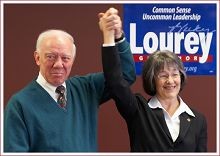
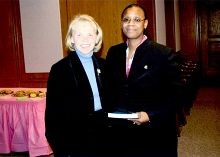
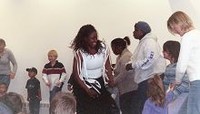
It is official, Becky Lourey is running for Governor of Minnesota. She made this announcement to Green Party friends and well-wishers at a House Party held at the residence of former Minneapolis mayoral candidate Farheen Hakeem on Friday, February 10. She said she had done the mathematics and is confident to win this race as she has alternative policies that will “put power in the hands of the people.”
Introducing her campaign team of Liz, Barbara and Farheen; Becky proudly announced that she is “surrounded by people who care for the things that she cares for.” Outlining her winning strategy, she said she stands for a “Universal Health Care Program” describing it as “the most durable” the blueprint of which should be out shortly. Determined “to deliver” and driven by the passion to fix things in Minnesota, she said what we see around us falls short of the people’s expectations, and the people are thirsting for alternative choices.
On her proposed health care plan she said “we have worked so hard on it that we encourage people to read it when it is published.” As a long-time legislator, she boasts of her track record in such programs as early childhood care, pesticide legislation, environmental issues, transportation concerns, and safe neighborhoods.
She was disappointed by the present Governor’s plan to build more jail houses as a way to fight crime instead of investing on quality education that will keep our youth off the streets and place them on a sound footing to work on building successful careers.
She said our current democracy is based on “constitutional liberalism” in which a few rich people have hijacked the power from the people and do not care for social justice. Believing in their materialistic wellbeing, she asserted that the situation on the ground is reduced to that of the rich man’s game “where survival is for the fittest.”
Becky has raised 12 children, four of them are her biological children and the others are adopted and these include African-Americans and Koreans. “I have struggled to put food on the table for 12 children. At one time four of my children were on surgery, my husband was out of work and we had no health insurance. I know what being without health insurance means first hand.”
She has seen racial injustice take place when her black children “got arrested when they should not,” and when she sympathized with them they told her point-blank: “Mum we are being arrested because we are black.”
She maintains that now is the time for change and she brushed aside skeptics by declaring “if you approach elections with a defeatist attitude, you will lose.” She lashed out at the current administration for going “to war just for the oil” and passing down unprecedented huge budget deficits “to our grandchildren.”
She laments that over the years, she has witnessed the legislature “being compromised” and it is time for new leadership that will work in the interest of the people and introduce a “fair taxation system.” She is sure of winning this race because she has the winning strategy hinged on issues that the people of Minnesota want addressed now.
We began the final trek up Mount Kilimanjaro at midnight. Up the last 6000-plus feet to the rooftop of Africa. Up the sheer slope along a zigzagging path of scree and volcanic rock to Uhuru Peak.
“Pole pole,” our guide reminded the four of us as we lugged one foot in front of the other, gasping for breath in the thin mountain air. Pole pole means “slowly slowly” in Swahili, a motto wisely adopted by many climbing teams. Hearing it again boosted our morale, but by that point, slowly was the only way we could take it.
Under a nearly full moon, we faced a dark mass of mountain to which we could see no end. For every three steps in that loose rock, we seemed to slide back one. Fierce wind gusts regularly shook our balance, and temperatures dropped to a deep freeze.
Looking back down at what little progress we had made, we spotted two different clusters of lights: a long train of fellow climbers’ headlamps winding its way up, and, much farther past them, appearing almost as far away as the stars appear above, the lights of downtown Moshi.
But let’s cut to the climax. We all made it. We all stood at Uhuru Peak with freezing toes and faces, some suffering from altitude sickness and exhaustion, others, we would later find out, from pneumonia. We all had our photos taken. We all went down.
I could go on about sunrises over a sea of clouds or gazes into African glaciers. But it has all been written, photographed, and filmed countless times before. Instead, I want to write about what, or rather whom, was missing at the top of our (and every) final ascent.
Our team consisted of two Tanzanian mountaineers, four American travelers, and eight Tanzanian porters. The porters, who stay back at camp during that last climb, inspired awe and reflection in all of us. It’s one thing to see a young man bearing 45 pounds, much of it on his head, for six days up and down a rugged mountain trail. It’s a whole other 19,341-foot-like perspective once you know he is carrying your own bag, with all your gadgets and gear, extra clothing, sleeping bags and air mattresses, or your tents, water, camping equipment, and food for a week. And you only have a daypack with your camera and trail mix.
By the first day when we were still in the forested foothills, all of us realized how helpless we would be without each other and the Tanzanians beside us. A regular Westerner climber taking on Kilimanjaro without porters and guides is like Lance Armstrong winning the Tour de France without a bike.
It’s difficult not to ponder post-colonial legacies in seeing their underpaid day-in-day-out struggle often for the sake of Western tourists’ false sense of accomplishment.
After all, the German explorer, Hans Meyer, has long been credited as the first person to reach Africa’s highest point in 1889, later having both a peak and cave named after him. Few the guidebooks to this day mention Johannes Kinyala Lauwo, a teenage African army scout who happened to climb to the top of Kilimanjaro before Meyer and who even helped Meyer and company up their first trek in which many porters perished.
The guide for our climb, Joseph, came from the same village as Lauwo and has himself made more than sixty climbs. I made him a promise on the way down the mountain that he and his crew would see their names in newspaper print for a change. It’s a pebble-sized token, but the boys will get a kick out of it. Here they are: Joseph, Asantiel, Gaspa, “Little” Joseph, Kornel, Richard, Gaudence, Ndugu, Living, and Deo. Asante marafiki. Thank you, friends. The view was nice, the journey divine.
Jakaya Kikwete is Tanzania's President of the People
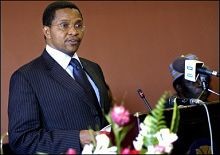
Tanzania’s Fourth President, Jakaya Mrisho Kikwete who took office after last November’s landslide election victory is a man of the people who combines the wisdom and vision of Nyerere and the liberalization stances of the economy of Mwinyi and Mkapa. He has inherited a stable, peaceful and unified country where patriotism and nationhood come first before other considerations like tribe, religion and sex.
His take-off is enhanced by the good groundwork of setting macro-economic fundamentals right of his predecessor Benjamin Mkapa and the positive gains of good governance and fiscal discipline that will be the legacy of Ben Mkapa. Kikwete has inherited a country that is free from debt as the World Bank and International Monetary Fund have approved Tanzania as qualifying for total debt cancellation. This is a strength he can build on.
Nyerere’s greatest achievement was to build a strong foundation of unity, peace and pride in the nation that had evolved during his tenure to be the forefront of the liberation struggle in Southern Africa. Like Nkrumah of Ghana, Nyerere had maintained that the independence of Tanzania was incomplete until the total liberation of Africa was attained.
Under President Nyerere, Tanzania provided sanctuary to freedom movements from South Africa, Namibia, Zimbabwe, Mozambique, Angola and had thousands of refugees from the troubled neighborhoods. The image of Tanzania then was the distinct voice of Africa and international for a sought Tanzania’s position on global issues before taking a stand.. Nyerere was also one of the founding father of the Organization of African Unity (OAU).
Jakaya Kikwete has had the advantage of working within the ruling party (CCM) and government machinery of his predecessors and thus he is well acquinted with what good governance is all about. His main challenges will be how he will proceed to fight corruption, armed robbery and avert a famine that has hit the country as a result of a long drought.
Jakaya Kikwete has outlined a ten-point Action Program that characterizes his leadership:
• Ensure peace, stability and unity
• Protect and promote the achievements of past administrations
• Carry forward the war on poverty, illiteracy, and disease with new VIGOUR, new ZEAL, and new SPEED,
• Focus on good governance and and accountability, rule of law and respect of human rights’
• Maintain law and order and protect people’s lives and property’
• Secure national borders’
• Maintain good relations with all countries, neighbors, regional and international organizations
• Pay special attention to the needs of disadvantaged groups, including women, youth, children, the disabled and orphans
• Introduce new initiative on environmental conservation’
• Promote sports, cultural activities and other forms of entertainment.
President Kikwete (affectionately referred to as JK) has praised the 41 year old union between Tanganyika and Zanzibar as a shining example of practical positive steps towards African unity. Acknowledging that a few cracks on the union exist especially in Pemba politics, JK promised to develop mechanisms to speedily and seriously deal with problems related to the union. He has relieved the Vice President of the portfolio of poverty reduction to give him more time to focus on Union matters.
He sees the need to look into the union structure to ensure that it supports socio-economic development in Zanzibar without infringing on the autonomy of the Zanzibar Revolutionary Government on non-union matters.
On the steps taken by the Third Phase administration to strengthen the Judiciary, JK notes that Mkapa did a commendable job in “establishing specialized divisions of the High Court, such as the Commercial Court, and the Land Court. He said he will strengthen the existing infrastructure through employing more judicial officers, staff training, rehabilitation of court premises and building new ones.
Acknowledging that agriculture continues to be the country’s mainstay of the economy, he promised subsidies and tax exemptions for fertilizers and agricultural machinery and inputs. He has also promised to better fund the Irrigation Master Plan and give it good staff to quickly increase acreage under irrigation.
On Information and Communication Technology (ICT) he observed that it was a pillar of a modern economyand that he would create a conducive environment for the introduction and use of ICT in all developmental endeavors.
In a country where export earnings only pay for one third of imports, it is imperative for JK to devise a strategy that will allow the country achieve favorable balance of trade. He sees a breakthrough in strengthening Small and Medium Enterprises (SMEs) and promoting the idea of Export Processing Zones (EPZs). Such effort coupled with improved infrastructure to allow tourism be a major source of income to the country and dig deeper into the pockets of investors who do mining in the country, the Forth Phase government of Tanzania may take us miles forward in our thirst for economic development.
JK’s promise to create 5 million jobs during his term in office is achievable only if he stays focused on all-round improvement in education, agriculture and agro-processing as well as support peasant farmers, small fishermen, cattle keepers and artisanal miners.
While addressing economic issues, the JK administration will be faced with an uphill task on matters related to health; providing clean water tor all, and the tough fight against malaria, tuberculosis and HIV-AIDS. Industrial development will be bogged down by drying hydro-electric power supply sources causing a further strain on the already unbearably high costs of energy unless diversification into gas and coal as alternative sources of power is undertaken vigorously. We have on the table the Mchuchuma coal project and the Rusumo River and Stigler’s Gorge hydro-electric Power Projects. These should be brought on board to supplement current power shortages that have led to rationing. The Mnazi Bay natural gas project will offer another window if concerted efforts are taken to tape this valuable resource.
More importantly, the JK legacy should be built on widespread empowerment of the people to jump into the bandwagon of economic activities through buying shares in on-going viable projects with high returns on investment and providing credit facilities for business-start-ups as well as enhance co-operative groupings for collective fund-generation to be placed in investment ventures. The gap between the “haves and poor” is growing rapidly, and Members of Parliament who are supposed to speak for the down-trodden seem to be fighting for their stomachs first. K should steer the National Assembly to a people-friendly champion of the plight of the poor rather than selfish self-centered legislators who will only work for filling up their own economic baskets.
The team of House Speaker Hon. Samuel Sitta, and the Prime Minister Hon Edward Lowassa should be supporting hands for JK’s endeavors as the people of Tanzania have abundantly identified JK to be their man of the moment who can deliver!
Minneapolis – On a cold February afternoon, more than 650 visitors paraded through the hallways and offices of the new Center for Families to check out the newest innovation in North Minneapolis created to help struggling families succeed.
The 19,000-square-foot facility — built by the Greater Minneapolis Council of Churches — will serve all families, with a special focused outreach to West African immigrants. It will house services such as language classes, job training, health screenings and referrals, mental health services, adult basic education, and many others designed to help families plant strong roots in the community.
The center is located on the campus of Fellowship Missionary Baptist Church in North Minneapolis, and the grand opening celebration brought together West Africans, religious leaders, community leaders, social service advocates, and government officials. Rev. Albert Gallmon, Jr., pastor of Fellowship Missionary Baptist Church, gave the afternoon’s address and left the crowd standing on its feet.
“The fact that we all have united Blacks/Whites, the children of Cameroon, Sierra Leone, Nigeria, Liberia, Ghana, Togo, rich, poor, middle class to construct and operate a Center for Families is something to shout about. We have come today even though some said this day would never happen. We have come today not because we believe that the city and others join us in our sense of moral outrage but because we want preachers, black and white, Protestant and Catholic, Jewish and Muslim to join hands and hearts together to bring about a moral revolution in our land.”
The grand opening also featured the premiere performance of “We, Too, Rise,” an original choral anthem commissioned by GMCC to celebrate its 100th Anniversary of uniting people of faith to serve people in need. It was composed by Emmy-Award-winning composer, Steve Heitzeg and performed by the Fellowship Missionary Baptist Church choir, under the direction of Sanford Moore. The anthem is taken from the Reverend Dr. Martin Luther King, Jr.’s “Letter From a Birmingham Jail,” in which King responds to eight Alabama clergyman who had labeled his demonstrations as “unwise and untimely.” King responds: “…the time is always ripe to do right.”
Planning for the $3.5 million Center for Families began nearly four years ago with an advisory committee made up of government professionals, social service advocates, and community leaders. But most important was the representation from the West African community whose wisdom guided the center’s development from its infancy.
During the past 10 years, Minneapolis and St. Paul have seen a significant jump in the number of African immigrant families. The Twin Cities has the fourth largest African immigrant population in the country and the highest growth rate in African immigrants (628 percent since 1990). Unlike more well-established groups from East African countries such as Somalia, Ethiopia, and Kenya, those from West African countries such as Liberia, Nigeria, Ghana, and Cameroon have few services available to them.
The Center for Families is the result of a unique collaboration of public- and private sector partners from a variety of fields. Partner agencies supporting this venture include:West African immigrant groups, the Greater Minneapolis Council of Churches, Fellowship Missionary Baptist Church, the city of Minneapolis, Hennepin County, Minneapolis Public Schools, City View Community School, NorthPoint Health & Wellness Center, the Council on Crime and Justice, the Neighborhood Involvement Program, Episcopal Community Services, Goodwill Easter Seals, the McKinley Community, Minnesota Advocates for Human Rights, Northside Food Project, and Urban Leadership Academy.
Photojournalist: Richard Ooga/Mshale
View pictures from the event in the photo gallery.
LOS ANGELES, Feb. 12—Kenya defeated the United States, 26-12, to win the 2006 USA Sevens rugby tournament Shield at the Home Depot Center.
It was the second face-off between the two nations, after a 5-5 tie on the first day of the two-day competition.
Like they did on the Saturday, the Kenyans got on the board first. Dennis Mwanja scored in the second minute followed by a conversion by Lavin Asego to give Kenya a 7-0 lead. Three minutes later, the United States responded with a try by Jason Pye and a successful conversion by Mose Timoteo to tie score.
That, however, would be the last time the United States matched Kenya’s scores. During the rest of the match Kenya—amid chants of “USA sucks” from Kenyan fans— scored 19 points, including two tries by the team captain, Victor Sudi Simiyu, and as many conversions by Asego. The United States only managed to put five more point on the board.
“We had to cut down on our mistakes and make good use of the ball,” Sudi said, referring to several missed tackles that marred the team in its first match against the United States.
The Americans were not surprised by Kenya’s performance in the final.
“They are hard to beat,” said the Eagles’ Todd Clever.
Clever said Kenyan fans may have played a great role in the Kenyan team’s performance. Exhibiting the Kenyan colors of white, red, green and black on their clothing, and waving Kenya flags, Kenyan fans were, by far, the loudest in the tournament.
The annual tournament, which first came to the United States in 2004, features 16 national teams of seven players a side. South Africa and Kenya are the only African countries that have participated. More than 21, 800 rugby fans attended this year’s tournament.
The last day’s performances by both African teams were almost shocking to many. South Africa, which is ranked second in the world by the International Rugby Board, started the first day better than number 38, Kenya. Although they lost their opening match 17-12 to Canada, they came back to whop Mexico 78-0—the biggest shutout of the competition.
“We woke up,” said Phillip Burger, who scored 29 points against the Mexicans.
South Africa went on to defeat Samoa, 28-12, that day.
In contrast, Kenya started the first day with two losses, 26-5 to England and 38-12 to France. The best Kenya could do that day was the tie the United States.
On Sunday, South Africa continued its winning streak by defeating Australia, 26-5. That, though, would be the end of the South Africans’ rally as England handed them a 38-0 blow that prevented them from advancing to the finals. England would proceed to win the tournament’s Cup Finals against Fiji.
The Kenyans started their second day with a loss 21-7 loss to Scotland. But the Kenyan team got its first win of the tournament when it defeated the West Indies, 38-5—a win that propelled Kenya to the Shield finals against the United States.
Check out more pictures from the tournament at our gallery.
If you’re a small business owner here’s one more reason to have a professional handle your business return.
The American Jobs Creation Act of 2004 added the domestic production activities deduction, a tax benefit for certain domestic production activities. This deduction provides a tax savings against income attributable to domestic production activities.
The Act created new Internal Revenue Code section 199 and is available to corporations, individuals, and pass-thru entities such as S Corporations, partnerships, estates and trusts.
The draft version of the applicable form has only 19 lines, and looks deceptively easy.
It’s not.
It’s going to make tax preparers lose sleep and confuse business owners all over the .
Let’s take a look at how this deduction works.
For 2005 and 2006, the deduction equals 3% of the lesser of: (a) qualified production activities income; or (b) taxable income for the taxable year. However, the deduction for a taxable year is limited to 50 percent of the W-2 wages paid by the taxpayer during the calendar year that ends in such taxable year. Thus, self-employed manufacturers do not get this deduction.
The deduction is phased-in; for 2007 through 2009 the percentage increases to 6% and for 2010 and after the percentage will be 9%.
Qualified production income must have occurred in whole or in significant part within the . For foreign production income to qualify direct labor and related factory burden must be at least 20% of the total cost of goods sold.
An allocation must then be made between the manufacturing and service aspects of your business. And then an allocation must be made between the products manufactured domestically and those manufactured internationally. Finally, an allocation must be made between the domestic salaries by services and manufacturing.
Now, to make this more confusing special rules apply to certain industries, such as architectural and engineering services. Newspaper production is a qualifying service. Software development qualifies but software support doesn’t. Restaurants don’t qualify but food preparation done for wholesale does qualify. The production of certain films and sound recordings are also qualifying activities.
Doesn’t that sound easy? Not even the most seasoned tax professional can do this quickly. It takes a considerable amount of time to master and it can often be frustrating. But an extra 3% deduction can be a significant deduction and should not be missed. So please give us a call and we’ll help you take advantage of this valuable deduction.
Chuck Chuckuemeka is partner at Chuckuemeka & Associates in Bloomington,
Minnesota Companies Cite Growing Need for International Business Skills
As Minnesota companies become increasingly involved in the global economy, demand is growing for employees trained in areas of international business. A survey released in February by the Minnesota Department of Employment and Economic Development sheds new light on the knowledge, skills and abilities sought by companies most involved in international global markets through exporting, importing or foreign direct investment.
DEED collaborated with Metropolitan State University on the survey, which focused on companies with at least one professional employee involved in international business activities. About 82 percent of these respondents were manufacturers and 45 percent were small businesses.
Respondents had a greater willingness to provide training for international business areas as needed by employees, rather than requiring such skills a a condition for employment. The five most frequently mentioned skills considered essential for hire were general in nature – such as writing, teamwork, and computer skills – followed by five international business skills areas: direct sales, exporting and importing, global sales contracting, transportation logistics and strategic planning. Respondents most frequently required or desired their employees to have language skills in Spanish, Chinese or French.
Companies noted they were willing to cover the cost of training their employees in many international business skills, but those eligible were more likely to be current employees. Almost 60 percent fully paid for job-specific training, and more than 40 percent covered the costs of continuing education or professional qualification. Over the next five years, the majority of respondents expect to increase their training budgets or maintain them at the current levels.
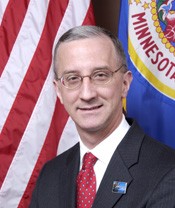
“This survey provides much-needed insight into the type of skills Minnesota companies need to compete in the global economy,” said DEED Commissioner Matt Kramer. “Organizations involved in training may find the results useful in developing or fine-tuning curricula for continuing education, job-specific training or professional qualification programs.”
There are generally four ways to obtain permanent residence in the .One way is to have a relative who is a United States Citizen or permanent resident file a petition on behalf of the foreign national.The second is to have an employer make a job offer to the foreign national for permanent employment for a job where there are not enough workers available to fill the positions.The third is to obtain status in the as a refugee or an asylee (someone who has been granted political asylum).Finally, a person may obtain permanent residence through a special program such as the diversity lottery or NACARA.
This article will focus on how an individual can obtain permanent residence through a family member.
The main goal of family-based immigration is to reunited families.Based on this goal the has established a system whereby close family members of citizens and permanent residents can come to the legally to rejoin their family members.
Family members are admitted to the as either an immediate relative of citizen or under the family-based preference system.Immediate relatives are the spouses of citizens, the minor, unmarried children of citizens and the parents of citizens.Under the preference system, adult children of citizens (both married and unmarried) as well as the spouses and the unmarried minor and adult children of a permanent resident can obtain permanent residence.
The preference categories have been established because Congress has set an annual limit on the number of foreign nationals that came be admitted to the as permanent residents based on both family-based or employment based immigration.The limitation for family-based immigration is 480,000.Because of this limitation, the government has set up a system in which each person who applies for permanent residence must have an immigrant number available for them before they can get a green card.There is no numerical cap on the number of immediate relatives who are admitted as permanent residents.However, the number of immediate relatives admitted each year is subtracted from the 480,000 cap on family-based immigration to determine the number of other family-based immigrants that will be admitted the following year.In addition Congress has set a floor of 226,000 immigrant numbers for the family-based immigration.
In addition to these limits, Congress has established pre-country limits on the number of immigrant numbers that are available. Because there are so many people in the world applying for permanent residence in the , the number of people seeking permanent residence is greater than the number of immigrant numbers that have been allotted for that particular year.Therefore, backlogs have arisen.
FAMILY-SPONSORED PREFERENCES
The family-based preferences are broken down as follows.
First Preference: Unmarried Sons and Daughters of Citizens;
Second Preference: Spouses and Children, and Unmarried Sons and Daughters of Permanent Residents (The second preference is and is broken down further into two subcategories:
A. Spouses and Children (minor) and,
B. Unmarried Sons and Daughters (21 years of age or older);
Third Preference: Married Sons and Daughters of Citizens: and,
Fourth Preference: Brothers and Sisters of Adult Citizens.
Based on these categories, the United States Government through the State Department publishes the Visa Bulletin each month.The Visa Bulletin sets out the backlog by listing priority dates for each category as well as the Countries that have reached their numerical limit of immigrant numbers.The priority date is the date on which their family-based petition was filed and the State Department lists priority dates to advise people that an immigrant number is available for cases filed on or before the date listed in a given month.
Below is an example of the visa bulletin priority dates for cases that will be processed in March 2006.
All Chargeability Areas Except Those Listed
CHINA-mainland born
PHILIP-PINES
Family
1st
22APR01
22APR01
22APR01
08AUG94
22AUG91
2A*
22FEB02
22FEB02
22FEB02
15MAY99
22FEB02
2B
08JUL96
08JUL96
08JUL96
15FEB92
08JUL96
3rd
22JUL98
22JUL98
22JUL98
01JAN95
08FEB91
4th
01OCT94
01OCT94
22MAR94
22MAY93
01OCT83
As you can see from this chart, , , and the are backed up further because these Countries have also reached the per country limits.This chart indicates that petitions filed on or before the date listed can in the moth of March 2006 can apply for permanent residence.For example, take the All Chargeability category for the 1st preference.This category lists a priority date of April 22, 2001.This means that petitions that where filed on or before April 22, 2001 can in the moth of March 2006 file for permanent residence.
A copy of the monthly visa bulletin can be obtained from the U.S. State Department website at http://www.travel.state.gov/visa/frvi/bulletin/bulletin_1360.htmlt.
A family member initiates the process for a qualifying relative by filing an I-130 Alien Relative Petition.If the relative is an immediate relative, they can process their application for permanent residence by either appling for an immigrant visa outside the once the I-130 is approved or by filing an I-485 application for adjustment of status if they are in the and last entered the with a visa or parole.If on the other hand the immediate relative last entered the without being inspected by an immigration officer and is illegally in the that relative will also have to apply for an immigrant visa outside the .This is a very complicated situation because depending on how long someone has been in the illegally, they may be barred from returning to the once they leave to process an immigrant visa.Immigrants in this situation must consult an immigration attorney before they make any decision to leave the Country to process a visa.
With regard to family preference petitions, the immigrant will have to wait until their priority date is reached before they can apply for either an immigrant visa or adjustment of status.Also the general rule is that if the immigrant is in the United States when their priority date is reached they will also have to be in a valid immigration status (such as a student or visitor) in order to file for adjustment of status in the United States.Again these situations can get very complicated and anyone who is processing an immigrant petition based on a family preference petition must seek the advice of an immigration attorney before making any decisions to either process their case in the or leave the Country to process an immigrant visa.
Nothing on this page should be taken as legal advice for any individual case or situation. The information is intended to be general and should not be relied upon for any specific situation. For legal advice, consult an attorney experienced in immigration law.
Secretary of State Mary Kiffmeyer Addresses Alpha Kappa Alpha Day at the Capitol
SAINT PAUL – Minnesota Secretary of State Mary Kiffmeyer addressed the Alpha Kappa Alpha Sorority, Inc.’s “Day at the Capitol” gathering on February 9th in Saint Paul. Kiffmeyer was introduced by Alpha Kappa Alpha member Cassandra Ward Brown, a prominent Minneapolis attorney.
Kiffmeyer talked about elections and about efforts to encourage people of color to vote.
“Minnesota has had the highest voter turnout in the nation for the past three elections. It’s because of civic-minded citizens like the members of Alpha Kappa Alpha that we’ve been able to do that,” said Kiffmeyer. “It was a real honor to address the group.”
Twin Cities Muslims Peacefully Rally against Controversial Cartoons
Minneapolis, MN – Overseas, protests over cartoons were hardly non-violent. But the one organized by Twin Cities Muslims was deliberately different: Peaceful.
So peaceful that furor against Muslim violence seconded the furor over the cartoons- the subject of the rally in
Minneapolis
.
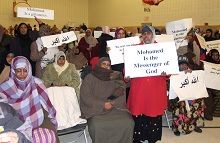
An estimated 1,000 Muslims crammed into the Brian Coyle center on Feb. 20 to denounce controversial caricatures originally published on a small Danish newspaper that lampooned prophet Mohamed in an unflattering manner.
“The best way to defend our prophet is peace, his core message to us,” said Mona Ahmed, 24, a student at the
University
of
Minnesota
“Violence doesn’t help at all.”
In Islam, the depiction of Mohamed, positive or negative, is considered blasphemous.
The protest was the first relating to the cartoons held in
Minnesota
.
The publication of the 12 controversial cartoons in September had a domino effect around the world. Several European newspapers reprinted the caricatures in solidarity with the Danish paper and to uphold freedom of expression, further exasperating Muslims.
So far, about 45 deaths, mostly in , and , are blamed on the cartoons.
Minneapolis protestors said that they are in solidarity with global Muslims in condemnation of the cartoons, but do not condone the violence and lawlessness that followed.
To do just that, protestors were decidedly calmer, labeling violence as an “Unislamic.”
“Islam basically means peace,” said Ahmed Abdikarim, a member of the rally organizing panel. “Despite strong reactions, we’re very discontented with the acts of violence and distraction around the Muslim world.”
Sentiments of distress with the violence seem to be equally picking up around the Muslim world. A consortium of renowned religious leaders and scholars recently issued a statement flatly denouncing violence and warning that Muslims may become “pariahs”. The statement, though, was unapologetically critical of the cartoons but cautioned that violence may overshadow the very protest aimed against the problem.
In some ways, the discontent with violence overshadowed the cartoon protest at the
Minneapolis
rally. Almost all speakers voiced concerns about a negative perception of Muslims if violence is not quelled immediately.
Many protesters were holding signs that read “Mohamed is a gift of mercy” and “Mohamed is the messenger of God” among others.
Another highlight of the protest was the fact that most major American newspapers have not published the cartoons, earning a rare praise from Muslims.
“American media has shown responsibility.” said Hassan Mohamoud, imam of Al-Taqwa Mosque in
St. Paul
.
A call for prayer was announced halfway through the rally. Most men stood in lines, facing northeast, the direction of Ka’aba, Islam’s holiest site in Mecca and, quietly pronounced “Allahu Akbar” (God is great). Women prayed in a nearby room.
Organizers say that they are considering holding similar protests in other Minnesota cities where there is a significant Muslim community, such as
Rochester
.
African Dance Awakens Local Libraries During Black History Month
Eden Prairie, MINN – It’s common knowledge that hip-hop dancing is a veiled attempt to sexualize the movements of African dance. Isn’t it? According to G. Craige Lewis who preaches nationally as well as at his website, “The roots of Hip Hop are demonic. Oppression, anguish, poverty, violence, and other negative influences created this culture.” However Edna Stevens Talton takes a very different view of hip-hop dancing. And she should know.
Stevens Talton, a native of Liberia, immigrated to the United States when she was seven years old. Fresh from winning the Bright Functional School’s annual Liberian Pageant, Stevens Talton continued, even as an adult, in her pursuit of dance knowledge and skill. She now seeks to suggest another point of view than the one held by G. Craige Lewis and others like him.
“I did a workshop last week at the Ordway for a group of educators and one of the educators commented, ‘hip-hop– I’ve always seen it as a provocative style of dance.’ and I said, ‘no, it’s not. It’s actually how one presents it… when I give an explanation of why it’s done the way it is, such as ‘hey, this is a celebration dance in Africa, this is why we do it, we’re happy’ then it’s viewed differently.”
During the month of February, Stevens Talton’s dance troop, Universal Dance Destiny, performed at three Hennepin County libraries. I had the good fortune to watch and participate at the Eden Prairie County Library show on February 18.
Saturday morning Moses Brown and Gbassay Zinnah begin pounding on their d’jembe drums while a crowd of 75 people, many of them under ten years old, look on. Initially, the motionless crowd holds their hands and their children in their laps. As the drumming continues, folks slowly start to warm up. Shoulders twitch, heads bop, and tots squirm free to move on the carpeted floor. The program, sponsored by Young Audiences of Minnesota, hits their target audience this morning.
Zinnah plays his steady heartbeat d’jembe while Brown uses a more punctuated rhythm, like popcorn. Both of these percussionists were once part of the Liberian Culture Troop, a musical start-up band based in Liberia. Soon Stevens Talton along with Shanice Craig (14), Joshua Raul Stevens (14) and Lyric Hughes (10) walk to the front of the room.
African dance relies mainly on rhythm. “You have no dance if you have no African drum,” declares Stevens Talton. With feet barely touching the floor, the four dancers bounce around the audience, exposing many, possibly for the first time, to authentic West African dance movement. Ten minutes later, Stevens Talton begins teaching us about the similarities between African dance and hip hop dance.
“Being that I live both worlds, the African and the corporate worlds, that’s why I named my company Universal Dance Destiny. You’ve got to find an avenue in how to bring people together. And if one (world) is not understanding then you help them understand.”
We are then served a vigorous helping of Liberian SouSous, sometimes known as the Chicken Head dance, the Wabbee, also called the Pancake or African Walking dance, as well as break, popping, locking, klowning, and krumping, all features of hip hop dance.
The sensual visuals of hip-hop are put in a new light. Stevens Talton explains, “Shanice is so slim, I don’t care if she does that (hip movement), but I have another dancer and myself, we’re very curvy, so usually when she does her part I always ask her to play down the hips because she can be seen differently than someone who doesn’t have all of those curves. So it is a lot of the hip movement. Many people don’t understand how our African dance emanates from the hips, but that’s what we know culturally. ”
Volunteers are solicited and given the opportunity to try their hand and foot at the heel-step-toe movement and other basic hip hop steps. Popping, which looks robotic and difficult, is demystified as the dancers show us how a series of tightening a muscle, such as one’s bicep, and releasing it produces the intriguing effect.
Having defined muscles to begin with certainly helps. Stevens Talton doubtless has the muscle tone necessary for demonstrating before the crowd. She teaches dance at the Capri Theater in Minneapolis, along with hip-hop, salsa, cha-cha, funk, and hustle swing, to name only a few of the many dance forms taught at Universal Dance Destiny.